23rd Annual Bud Pryor Memorial Match, June 10-11, 2017 Match Report by Josh Shrum
For 23 years now, Benchrest Score shooters have flocked to the Thurmont Conservation & Sportsman’s Club outside of Frederick, Maryland for “The Bud”. This year, competitors from as far south as Georgia and as far north as Vermont came to try their hand against the always-challenging conditions of “The Bud”. Traditionally held in mid-June’s tricky conditions, the Bud Pryor Memorial is an event to challenge even the most skilled Benchrest competitor.
Day One started with the 100-Yard Aggregate, which pretty much set the tone for what was to come all weekend long. Of the 33 shooters competing in the Varmint For Score (VFS) class, thirteen shooters dropped at least one point at 100 yards. “The Bud” had begun.
100-Yard Winner Wayne France
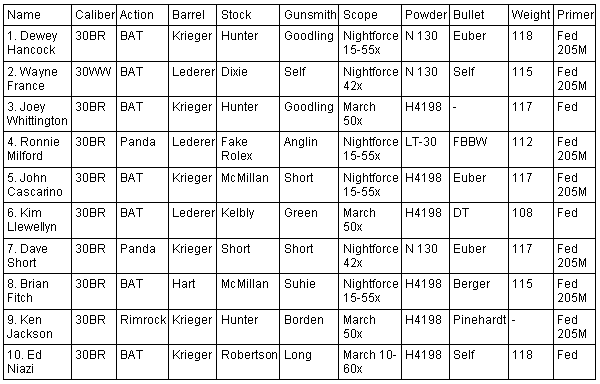
By the end of the 100-Yard Agg, five competitors finished with top scores of 250-21X, with Wayne France taking the win under Creedmoor tie-breaker rules. Wayne would continue to shoot well for the entire weekend, finishing in the Top 10 at 200 and taking second (by Creedmoor) at 300, shooting his Lederer-barreled BAT in a Dixie stock. Wayne does his own gunsmithing, makes his own bullets, and shoots his own cartridge design. He is truly a “Do-It-Yourselfer”.
200-Yard winner Ronnie Milford checking conditions…
Ronnie Rocks at 200, with an Impressive X-Count
Georgia shooter Ronnie Milford won the 200-Yard Agg with an impressive 250-13X. Ronnie was one of only six shooters to finish “clean” at 200, as traditional Bud weather was punishing even the smallest errors in judgment by shooters. Built by gunsmith Doyle Anglin, Ronnie’s Lederer-barreled Panda beat the field at 200 yards by three Xs, a significant margin. The next three shooters (places 2-4 at 200 yards) all shot 250-10X. Interestingly, Ronnie was shooting Accurate LT-30 powder, not the more widely used Hodgdon H4198 or Vihtavuori N130.
Of special note, Mrs. Carol Grosbier came on Saturday to visit during the match. Nearly every single shooter there stopped by to visit and offer their condolences on the passing of her husband Dick Grosbier, former IBS Vice President and Webmaster. It was great to see Carol and everyone’s actions showed just how great of a community of shooters the sport of Benchrest has.
The longest challenge, the 300-Yard Agg, was shot on Day Two. While conditions were not quite as “tough” as the previous day, they were anything but forgiving. High heat and gusting winds kept shooters on their toes as they strove for victory at 300 yards. A mere seven shooters would manage to stay clean through the first match, and only Maryland shooter Dewey Hancock managed to stay clean through Match Two. Dewey would go on to win the 300-Yard Agg shooting a 248-3X, beating 100-Yard winner Wayne France by Creedmoor and edging out Joey Whittington’s score of 248-2X. Dewey’s Goodling-built rifle uses a BAT action, Krieger barrel, and sits in a beautiful Roy Hunter stock.
Dewey Hancock Wins with Strong Performances at 100, 200, and 300
Dewey Hancock’s excellent performance at 300, coupled with his second-place finish at 200 and his Top Ten finish at 100 put him on the throne. Hancock won the Grand Aggregate for the 23rd Annual Bud Pryor with a score of 748-31X. Just one point behind, Wayne France took second with a score of 747-31X. Joey Whittington took third with 746-35X.
Hunter Class was contested by both K.L Miller and Brian Fitch (Brian competed in both VFS and Hunter) with K.L Miller taking the Grand Aggregate in Hunter with a 723-11X while Brian posted a 717-11X. Mark Ukishima shot the events only Factory Class gun. It was great to have so many different classes contested at this year’s Bud Pryor.
TOP 10 EQUIPMENT LIST:
About the Bud Pryor Memorial Match Bud Pryor was a fine gentleman who started shooting IBS matches in 1983. He was a machinest turned gunsmith who made friends and got many people started in shooting IBS registered matches over the next few years. Bud and Dick Grosbier ran the first IBS match at the Thurmont range in April 1983. CLICK HERE to see vintage photos of the 1983 match.
After Bud’s untimely passing a few years later, the club decided to put on a big match and dedicate it to him. As Thurmont is one of the few ranges around with 100/200/300 yard capabilities, we decided to put on a 3-yardage Grand Aggregate match. This was not as simple as it seems, since the three-yardage 100/200/300 was not an IBS-recognized Aggregate. After an agenda item was approved at an IBS winter meeting, 100/200/300 records were set at Thurmont. Over the years, most records have stayed at this scenic range. There are a total of four IBS ranges now holding 100/200/300 yard matches.
When it comes to shooting targets, “Variety is the spice of life”. Shooting the same old target over and over again can get boring. We like to shoot a variety of targets. And we have to admit, the arrival of a new set of colorful targets in the mailbox has been known to motivate us to grab our guns and gear and head to the range.
Midsouth Shooters Supply has slashed prices on Birchwood Casey and Champion targets, both the splatter variety and conventional types. Here are some of our favorite fun-shooting targets. They are all inexpensive to buy. You can even get free shipping if you combine a target purchase with a larger order. Midsouth just announced $9.00 flat-rate shipping with orders of $99.00 or more.
And here are a couple of FREE fun targets, courtesy the NRA Blog:
IBS 31st Annual Memorial Match at Union County Sportsmen’s Club, Weikert, PA Reported by Jeff Stover, IBS President
The “Boop Shoot” is traditionally held on Mother’s Day in May, but this year it was moved to June due to a club conflict. No matter, as 63 shooters showed up on June 10th and 11th, 2017 to compete at one of the best benchrest ranges in the country. “Weikert” is nestled in a narrow valley in pastoral central Pennsylvania and has a wide following since the IBS Nationals have been held there a number of times.
The 2-Gun Aggregate represents “all the marbles” — the overall win for a weekend of Short Range Group shooting. Accuracy gunsmith Dave Bruno won the 2-Gun with a .2606 Agg shooting his 6PPC built on a Borden action in a Roy Hunter stock. On Dave’s heels was Al Auman, shooting a Goodling-built 6PPC BAT. In third place was Paul Mitchell with his BAT 3-Lug in a Scarborough stock built by Dwight Scott. The 2-Gun Aggregate is the combined average group size for 20 targets total, 10 each for both the Light Varmint (10.5-lb) and Heavy Varmint (13.5-lb) classes, with shooting at both 100 and 200 yards. Despite the class distinctions based solely on rifle weight, a vast majority of shooters opt for a 10.5-lb rifle for the entire course of fire. You get a lot of shooting at an IBS Registered Group match.
Two-Gun Overall Winner Dave Bruno (center) flanked by second place Al Auman (right) and third place Paul Mitchell (left).
The Tailwind from Hell
The real story of this match was the shooting conditions. For the entire weekend, there was a tail wind. When the wind blows hard, a pure tailwind is favored by many veteran shooters as velocity changes are less apparent on the target compared to a pure crosswind where pickups and letups can be mapped on the record target of a less-than-observant trigger puller. At this match, it was a tailwind from hell. The over-the-shoulder wind veered from red (right to left) to green (left to right) as quickly as it took you to read this sentence. The point of impact in the extremes could cause groups of 1.5 inches at 200 yards. It was one of those shoots where posting a .824” 200-yard group could move you up in the standings. Normally shooting an “eight” would assure a “bottom of the pile” finish.
Sunday morning saw that nefarious tailwind doing its dirty work once again, but it was not quite as bad as the afternoon would turn out to be. The tailwind’s impact, however, could be seen in the fact that the Heavy Varmint 200-yard winner was upstate NY shooter, Jim Miller with a .2817 (200-yard Aggregates are recorded in MOA, so Jim’s average group at 200 yards was .563”). He was the only competitor in the “twos”. Bob White shot well but his .3012 was not enough.
Scott Miller ready to pull the trigger on the firing line…
Dave Bruno Dominates Light Varmint 200
Light Varmint 200 was shot after lunch on Sunday. The winds had picked up while the shooters were enjoying burgers and hot dogs from the range house. This last Aggregate was the climax of the entire weekend. Two-gun winner Dave Bruno set the stage for his overall win by shooting as if he were from another planet. He was on fire with a .2388 Aggregate. Next was Bob Brushingham with a .3024. That is a difference of .0636” in average group size, or about 1/16th of an inch. A sixteenth is not much in most things, but in short range benchrest it is a chasm that Evel Knievel would not dare to test. Most Aggregates in benchrest are won and lost by a few thousands, or even ten-thousands of an inch. Dave blew out the field with his singular performance. When asked what condition he shot, Dave said “the tailwind” — go figure.
Yes, 100-yard was also contested. Back in the day, a “Teen Agg” (an aggregate of targets under .200”) was usually shot in perfect, or mild, readable conditions. The level of shooting in recent years, however, has seen Teen Aggs shot in tough conditions. The aforementioned tailwind prevailed on Saturday too, but was just a bit less nasty.
Loading at the range remains important in the Benchrest for Group discipline. In a Special Report below, IBS President Jeff Stover explains how loading methods (and hardware) have evolved over the years.
Pat Hurley checking his aim (notice bolt is out).
Two Gun Overall
1. Dave Bruno: .2604
2. Al Auman: .2727
3. Paul Mitchell: .2776
4. Bob Brushingham: .2851
5. Kent Harshman: .2969
Heavy Varmint Grand
1. Jim Miller: .2582
2. Bob White: .2622
3. Allen Arnette: .2706
Light Varmint Grand
1. Dave Bruno: .2375
2. Al Auman: .2717
3. Paul Mitchell: .2770
Light Varmint 100 was won by veteran Howie Levy (he started shooting in 1968!) with a .1794. He was not alone below .2, as Dale Boop was close at .1848. He was shooting Norma 201 to boot. This powder was the ticket to small 6PPC groups in the 1980s, but has been little seen for many years.
More Teen Aggs were shot in the Heavy Varmint relays. Benchrest Hall of Fame shooter Allen Arnette recorded a tiny .1686. On the podium with Allen were Howie Levy with a .1808 and Willie Bauer who shot a .1980.
Light Varmint Trophy Winners (L to R): Hensley, Boop, Auman, Brushingham, Francis, and Bruno.
Memorial Shoot Is a Family Affair
The 2017 Annual Boop Memorial Shoot ran like clockwork, as usual, and once again the success of this annual shoot can be attributed to the Trutt and Boop families. Mark Trutt serves as range officer extraordinaire. Dale Boop is match director while his mother, Linda, handles the administrative and scoring chores. Target crew honcho Steve Dodge, once again, ensured a rapid and accurate changing of the target.
NOTE: It has yet to be determined whether 2018 Memorial Match will be on Mother’s Day or in June.
Loading at the Range — Then and Now
In benchrest shooting for group, loading at the range has been de rigueur for decades. In the Score discipline, preloading is usually the custom. The main reason is that, in Score competition, only one Aggregate (warm-up match and five record targets) per day is usually shot. That would be less than 50 shots, assuming a few sighter shots. Also, the 30BR, the dominant Score cartridge, is amenable to pre-loading.
By contrast, the Group discipline includes 21 targets (two warm-ups and twenty record targets) over a weekend, usually shot with 6PPC-chambered rifles. Many times, the 6PPC shooters may tweak their loads through the day given changing atmospheric conditions or simply trying to find the correct tune to “dot up”. This term, “Dot up”, means the shots are essentially going through the same hole, or closely so.
Loading at the range was a bit different when benchrest competition was in its infancy. The 1951 book, Modern Accuracy by Bob Wallack, is the best of the early benchrest books. Copies can be found, from time to time, on eBay or Alibris. It is a fascinating survey of benchrest as it existed more than six decades ago. There’s even coverage of a controversial target that was argued over at the time. In it, there is a photo of Wallack using the rear bumper of a car at the bench to clamp his reloading tools. Things have come a long way compared to the range loading set-ups of modern shooters. Here you can see Bob Wallack way back in 1950:
Modern loading bench set-ups shown in this Boop Memorial Match Report belong to top shooters Howie Levy, Bob Hamister, and Kent Harshman.
June is National Safety Month. In summer, when children are home from school and more likely to be unattended, it’s especially important to store firearms securely. The No. 1 way to help prevent accidents is to securely store your firearms when they’re not in use. The NSSF says: “Whether you own a gun or not, firearm safety is your responsibility. Take a moment to watch the videos below on how to safely handle and store firearms.” Along with these videos, the NSSF’s Project ChildSafe program offers a host of gun safety materials on its resources webpage.
Firearm Safety: First, Last, Always
There are “10 Commandments” to firearm safety and the first four are the big ones. Remember, while at the shooting range or anywhere you handle a firearm, safety always comes first.
This is a Good Video that Covers the Key Principles of Gun Safety. Worth Watching:
Storing a Gun Safely and Securely
For those who do have a gun in the home, now is also good time to review some gun storage options that fit your lifestyle. For more information on storing your firearms safely and securely, visit ProjectChildSafe.org.
Project ChildSafe’s 3rd Annual Friends and Family Campaign
Share Project ChildSafe resources, messages and gun safety tips for your chance to win prizes from NSSF partners. Enter HERE!
Three Shots Standing at 400 Yards in 4.37 Seconds Could you hit a silhouette target at 400 yards, shooting offhand? Probably, with a little practice. Now try doing that three times in just 4.37 seconds, including picking up/mounting the rifle! Not possible? Watch the legendary Jerry Miculek do that in this impressive demonstration of rapid-fire rifle shooting.
Jerry Miculek — that name is synonymous with revolvers. But Jerry is also one heck of a rifleman, as he demonstrates in this video. Grabbing his rifle from the top of an oil drum, Miculek proceeds to put shots on three different steel targets at 400 yards — all in under 4.4 seconds. Most of us would be lucky to make one successful shot in that time limit. Miculek hits all 3 targets (and makes it look easy).
In this video, Jerry hits not one but THREE c-zone targets at 400 yards. And — get this — he does this in under 4.4 seconds starting with his rifle laying on a support (plywood on top of a barrel). It took Jerry two tries (on his first run he hit 2 out of 3 in 4.65 seconds). On the second attempt (see video starting at 2:19), it takes Jerry just 4.37 seconds to shoulder his rifle, aim, and fire three shots, each hitting a separate steel target. Wow. That’s truly remarkable. Most of us would need ten seconds (or more) just to get the scope on the first target.
Trust us folks, this ain’t easy. It takes remarkable marksmanship skills to shoot with this kind of precision at this kind of pace. As Jerry would say himself, “Not bad for an old guy who needs glasses”.
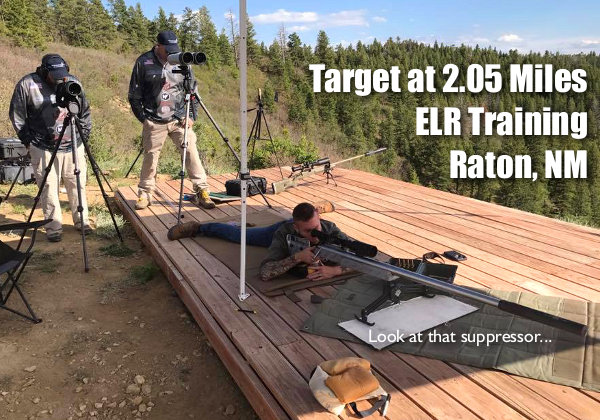
Shooter behind the .375 Lethal Magnum. Check out the size of that suppressor!
Two-Mile ELR Training The Applied Ballistics ELR Team spent the weekend at the NRA Whittington Center in New Mexico training for the upcoming King of 2 Miles event. Former USAMU coach Emil Praslick III was on hand to help with wind calls. The results were impressive — all team members had confirmed hits at 2.05 miles on a 36″x36″ steel target. Bryan Litz even had a 3-shot group that measured 17.5″ x 22″. That’s under 0.6 MOA!
Most guys would be happy with 0.6 MOA at 300 yards. Bryan did it at 3611 yards, shooting Paul Phillips’s .375 Lethal Magnum. When you consider all the variables involved (bullet BC variance, shot velocity variance, wind changes during flight, Coriolis effect etc.), that’s phenomenal.
Report by Paul Phillips
Just got done shooting two days in New Mexico with Recoil Magazine and the Applied Ballistics ELR team. We learned a lot and had great success. Every team member made impacts on target at 2 miles. The best 3-shot group at 3611 yards (2.05 miles) was shot by Bryan Litz with my 375 Lethal Mag. The group measured 17.5 inches tall by 22 inches wide with Cutting Edge bullets. We also had Recoil’s David Merrill shoot at two miles and was laying them in there like a true pro. We had three team members make impacts on the 36-inch plate at two miles within just three attempts in a mock competition. I also increased my personal longest shot by hitting only 15 inches right of center at 3611 yards. 2.05 miles. I did it with a GSL Technology Copperhead Silencer.
Report by Emil Praslick
I participated in the Extreme Long Range training with the Applied Ballistics team at the Whittington Center in Raton, NM. All team members had confirmed hits at 2.1 miles. Components and hardware suppliers included: Berger Bullets, Cutting Edge Bullets, Nightforce Optics, Kestrel, FLIR Systems.
Q: At that distance (2.1 miles), how much do spin drift and the Coriolis effect impact bullet trajectories?
Praslick: At 3613 yards we had to adjust about 1.5 MOA/56″ of Coriolis (up), and 5 MOA/~190″ of right spin drift adjustment. You’d have to come down if facing East. The planet rotates counter-clockwise (from above), so your target would be falling away from you.
Here is a 3-round group at 1898 yards (1.08 Miles) shot with factory ABM Ammo .338 Lapua Magnum loaded with 300 grain Berger Bullets Hybrids. That’s sub-MOA elevation. (The guy calling wind didn’t do too bad, either.)
Report by Bryan Litz
Learning is my favorite part of new ventures and we learned a LOT this weekend shooting extreme range in New Mexico. I connected on a second round hit on a 3-foot square target at 2 miles in simulated match conditions under coaches Emil Praslick and Paul Phillips. In fact all five of our team shooters got on at 2 miles. The Applied Ballistics Extreme Long Range team is in good shape for the King of 2 Miles match later this month, and there is still so much to LEARN!
You need serious equipment for shooting beyond two miles. Who can identify this high-tech hardware?
In response to many requests from Forum members who shoot F-Class, we are republishing this informative interview, which first appeared last summer. You’ll find many “solid good” tips that can help any long-range rifle competitor.
Dan Pohlabel is a member of the all-conquering Team Sinclair F-TR squad. This talented group of shooters hasn’t lost a team match in years. What’s the secret of Team Sinclair’s success? Well there is not one single factor. These guys have very accurate rifles, they work hard on load development, and they practice in all conditions. In this interview, Dan Pohlabel talks about F-TR competition, reviewing the hardware (and skill set) it takes to win. He offers some great tips on developing loads. You’ll find a longer version of this interview on the Sinclair Int’l website. CLICK HERE to Read Full Interview.
Q: What do you find most challenging in F-TR Shooting?
It has to be keeping up with the competition, our sport has grown so quickly with new talented shooters. Staying at the top requires having a laser of a rifle, perfect loads, near perfect wind reading, and, of course, breaking good shots.
Q: How can novice shooters improve their game?
Seek out the local F-TR shooters and go to matches with them, listen and learn. Attend team matches and offer to score for one of the teams. As a scorer, you will sit close enough to hear the coach make wind calls and see the results on the target. Through the spotting scope you will see changes in mirage and it’s the quickest way to learn the basics of wind reading. Choosing and buying equipment is relatively easy, learning to read the wind is a journey.
Q: What’s in your range bag for match days?
Rear bag, towel, shooting glasses, canned air, ear protection, data book, pen, rifle rain cover, hat, rifle tools, timer, ammo, and bug spray.
Q: What specialized gear can you not live without?
1. A good set of elbow pads. It’s hard to keep concentrating on shooting when your elbows are rubbed raw from days of competing on them.
2. Good bug spray. We shoot from the ground but our shooting mats aren’t that big. It’s hard to concentrate with bugs crawling or chewing on you.
Q: Load Development — How do you work up a load?
First, I call Derek Rodgers and get his load data, he is the best load development shooter I know! Otherwise, here is the procedure I recommend. Measure throat length with bullet of your choice, to determine how much room is left in the case. The above measurement determines what powders you can use. We use only Hodgdon Extreme powders. Shoot a ladder test, five rounds each in 0.2 grain increments, to find the accuracy node for that bullet/powder combination. Take the best two loads and do a jump test with five rounds each, test at .005″, .025″, .060″ jump. One of these groups will be significantly better than the rest, now you can tweak that measurement +/- .002” or .005” to get the best accuracy.
Test at least three different primers to determine which offers a little better ignition for your load, a 5-shot test will usually tell you which is the best. Go back and test the two best combinations in a 10-shot test at least twice, pick a cool overcast day and also a hot sunny day and compare results. Take your final “best load” back and do a “simulated match”, 20 shots, waiting at least 20 seconds between shots. If you like those results it’s probably a reliable and accurate load.
Q: What rear bag do you use?
I use a two-bag system, large bag on bottom with a smaller bag on top. I had the bags made of marine canvas, zippered and filled with plastic beads. I can adjust the amount of fill to make them a perfect height for my shooting position. Teammate Jeff Rorer uses a similar system and mine is nearly a copy of his rear bags.
Q: How often do you practice and how many rounds do you shoot per year?
In good weather I practice a couple times a week at the local range, a couple more dry-firing practices/week at home. I typically shoot between 2,000-2,500 rounds per year.
Q: How do you prepare mentally before a match?
[I do] lots of visualization — run the video in my head of what I expect to see and of my performance. I think about the correct strategy for the conditions, staying disciplined to the strategy.
Q: What do you avoid before a shoot?
No late nights or excessive alcohol. Very little caffeine in the morning. Leave your cell turned off. Avoid emotional people.
Q: What’s your procedure on a Match day?
I arrive early, get squadding card, move gear, watch wind speed/direction, check over rifle and gear, sit and relax, visualize and focus on the most important goal of the day. Most days we shoot three relays of 20 shots. It’s important to eat and hydrate continually all day. My focus and concentration are better when I snack all day with fruit and energy bars, and lots of water. While taking my turn in the pits, I try to relax and only focus on what is ahead of me and [not] what’s already happened.
Q: What is your favorite reloading product?
My favorite reloading product is the Sinclair Premium Neck Turning Tool with Handle, I also use the expander mandrels provided by Sinclair for sizing the brass in preparation for the turning process. Correct and repeatable neck tension begins with turning necks to a uniform thickness. Sinclair also has mandrels to size the necks after neck turning that accurately size the necks for a specific neck tension.
Q: What is your preferred scope?
The scope I find the most useful is the Nightforce Competition Scope. This scope is very light-weight, has 15-55X magnification, world-class quality glass, 10 MOA per revolution on the turrets, 1/8 moa adjustments. It’s perfect for F-Class competition.
Q: What advice do you have for someone wanting to get into the sport?
Find a local club with some F-TR shooters and ask for their help. Most shooters will be happy to take you with them to a match, listen and learn while you’re there. You may find out it’s not what you thought, or you may be hooked. If you decide to jump in, start with an inexpensive rifle. This sport is expensive and you don’t need a $5000 rifle to learn good wind-reading skills. Start with a used Savage F-TR rifle and learn the basics, shoot for a year at least before making a larger investment. The money you saved buying a used Savage rifle will help pay for your divorce lawyer, LOL.
Q: What training drills do you use?
Dry-firing the rifle at home is a good way to practice when you can’t get to the range and shoot. It allows me to practice set-up, rifle handling, and position. When I can practice at a local range, I also dry-fire between shots to increase the amount of repetitions and increase the time spent in position.
Q: Who has been your biggest influence in shooting?
Eric Bair, 2006 F-Open National Champion helped me get started and gave me great advice. Most of the shooters on Team USA and Team Sinclair help each other, nobody knows all the answers but we share what we have learned. Danny Biggs, 2008 and 2009 F-TR National Champion also helped me when I was struggling to learn some of the ranges. I learned a lot from Danny.
Getting started in long-range shooting? Need some pointers on gun set-up and hardware options? Bryan Litz of Applied Ballistics has created a helpful series of videos for the NSSF covering long range shooting. Bryan, a past F-TR Long-Range National Champion and Chief Ballistician for Berger Bullets, knows his stuff. His Applied Ballistics squad was the winning team at the 2016 King of 2 Miles event. Here are four (4) videos, each covering a topic of interest for long-range shooters. Running 3-4 minutes each, these videos can help you get started, and invest wisely when acquiring your next long-range rifle, scope, and accessories.
Long Range Precision — The Keys to Success
TIP for Plotting Long Range Trajectories: You want to know the true, actual ballistic coefficients of your loads. The BCs listed by manufacturers for their projectiles may be somewhat unreliable — the real BC could be higher or lower (and BC can change with velocity). That can result in problems at longer distances. Using sophisticated equipment, Applied Ballistics has measured true BCs for hundreds of projectiles. Plugging these verified numbers into your Ballistics App can improve your hit percentage at long range.
Tools of Choice — Purpose-Built Long Range Rifles
TIP for Choosing a Rifle: When you’re selecting a rifle for long range shooting, it’s important to understand your application and objectives. The applications for long-range shooting can be very refined. You have to select all the details of your application to select the correct rifle. Here are two examples — a semi-auto AR-platform rifle with scope and a bolt-action Fullbore (Palma) rifle with aperture sights. There are many other long range disciplines — F-TR for example. The F-TR rig uses a bipod and rear bag and a scope. To be competitive, a modern F-TR rig should shoot well under half-MOA.
Equipment Advice — Upgrading Your Hardware
TIP for Upgrading Your Rifle: At some point factory rifle owners will recognize weak links in the equipment chain. You can run that factory rifle for quite some time, but the barrel is eventually what’s going to hold you back. The twist-rate may not be high enough to stabilize the high-BC bullets. So the first thing you’re going to want to upgrade is the barrel. You want to get a fast twist-rate barrel with a chamber that is optimized for the bullet you’ll be shooting. A good-quality, custom barrel will be easier to clean, and it will improve the overall accuracy and precision of your shooting.
Big Boomers — Large-Caliber Rifles for Long Range
TIP for Shooting Hard-Recoiling Rifles: Bryan Litz defines “Large Caliber” as .338 caliber and bigger. These rifles can shoot heavy bullets with high BCs. However there are some trade-offs. It can be hard to maintain good fundamentals of marksmanship (trigger control, sight alignment) when you’re fighting heavy recoil and burning 100+ grains of powder. You’re dealing with the challenges that high energy brings. You want a muzzle brake with any cartridge .338 or above. Also, when considering lathe-turned solid bullets, remember that these typically have less sectional density compared to lead-cored bullets with similar profiles. This affects ballistics as well as recoil energy.
Did you know that American women are the fastest-growing segment of gun owners? Whether it’s for self-protection, hunting, or target shooting, women are showing more interest than ever in owning firearms. Moreover, women are taking steps to train and educate themselves, and to get involved in hunting, recreational shooting, and firearms competition. This is now a significant trend — women are becoming an important and vital part of the shooting community. Nearly one-quarter (23%) of American women now own at least one firearm.
The numbers of women participating in the shooting sports has grown dramatically in recent years. in fact, in the decade from 2001 to 2010, the number of female target shooters has risen 43.5%:
Thinking of getting started in the Practical/Tactical shooting game? Looking for ways to be more stable when shooting from unconventional positions? Then you may want to read Marcus Blanchard’s Practical Shooter’s Guide (A How-To Approach for Unconventional Firing Positions and Training). Unlike almost every “how to shoot” book on the market, Blanchard’s work focuses on the shooting skills and positions you need to succeed in PRS matches and similar tactical competitions. Blanchard provides clear advice on shooting from barricades, from roof-tops, from steep angles. Blanchard says you need to train for these types of challenges: “I believe the largest factor in the improvement of the average shooter isn’t necessarily the gear; it’s the way the shooter approaches obstacles and how they properly train for them.”
Blanchard also offers good tips on shooting fundamentals. Here’s an example:
Blanchard on Trigger Control
“There will always be some amount of wobble when shooting in positions other than prone, and timing the shot to go off when the reticle is within the target is difficult to accomplish when poor trigger techniques are employed. The most common [mistake] I have seen is ‘slapping’ the trigger. The finger is usually hovering off the trigger, and when the shooter determines that NOW is the time to fire, they quickly pull their finger to the rear and ‘slap’ the trigger. The finger never pulls the trigger in the same place and often provokes a sympathetic contraction of the rest of the muscles in the hand, which results in unwanted movement before the bullet exits the muzzle.”
Author Marcus Blanchard has the credentials. A Marine Corps veteran, Blanchard is a regular Top 10 finisher in Precision Rifle Series events. In 2015 Blanchard was ranked 8th overall (nationwide) in the PRS series at year’s end. In 2016 Blanchard won the New Mexico Precision Rifleman’s Championship.
Check out the Table of Contents to see the Topics Covered:
Click image above to view larger Table of Contents.
6.5 Guys Recommend Practical Shooter’s Guide
The 6.5 Guys have reviewed Blanchard’s book and they recommend it highly: “What’s a good book for the beginning shooter who wants to get into long range precision rifle or the intermediate shooter who wants to improve his scores? [The Practical Shooter’s Guide] is particularly useful because it explores firing from various positions and props that are encountered in long range precision rifle [events]. This knowledge is completely missing from more traditional books where the shooter is usually slung up and shooting at a paper target. Marcus… goes into considerable detail about shooting from rooftops, reverse rooftops, side slopes, tank traps, barricades etc. This is the type of information that is very difficult to find. We consider ourselves reasonably knowledgeable shooters and this book provided us with new and useful information.” CLICK HERE for 6.5 Guys REVIEW.
6.5 Guys Review Marcus Blanchard’s Practical Shooter’s Guide




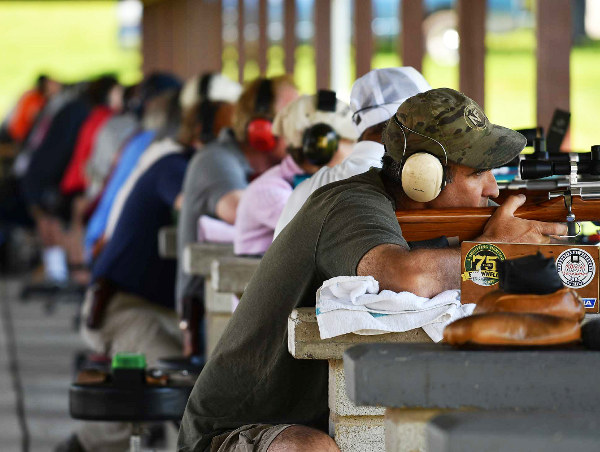
 Bud Pryor was a fine gentleman who started shooting IBS matches in 1983. He was a machinest turned gunsmith who made friends and got many people started in shooting IBS registered matches over the next few years. Bud and Dick Grosbier ran the first IBS match at the Thurmont range in April 1983. CLICK HERE to see vintage photos of the 1983 match.




 The Applied Ballistics ELR Team spent the weekend at the NRA Whittington Center in New Mexico training for the upcoming King of 2 Miles event. Former USAMU coach Emil Praslick III was on hand to help with wind calls. The results were impressive — all team members had confirmed hits at 2.05 miles on a 36″x36″ steel target. Bryan Litz even had a 3-shot group that measured 17.5″ x 22″. That’s under 0.6 MOA!


