The movie “The Patriot” gave us the phrase “Aim small, miss small”. While that’s a good mantra, aiming strategies for long-range competition are a bit more complicated, as this article explains…
The The F-Class World Championships (FCWC) in Canada are just one week away. This August 11-17, the world’s top F-Class shooters will gather at the Connaught Ranges outside Ottawa, Ontario. Here are some tips that can help F-TR and F-Open shooters aim more precisely, and achieve higher scores. F-Class ace Monte Milanuk reviews reticle choices and strategies for holding off.
In our Shooters Forum, one newcomer wanted some advice on selecting a reticle for F-Class optics. He wondered about the advantage of Front (first) Focal Plane (FFP) vs. Second Focal Plane scopes and also wondered if one type of reticle was better for “holding off” than others.
In responding to this question, Forum regular Monte Milanuk provided an excellent summary of aiming methods used in F-Class. For anyone shooting score targets, Monte’s post is worth reading:
Aiming Methods for F-Class (and Long-Range) Shooting — by Monte Milanuk
F-Class is a known-distance event, with targets of known dimensions that have markings (rings) of known sizes. Any ‘holding off’ can be done using the target face itself. Most ‘benefits’ of Front (first) focal plain (FFP) optics are null and void here — they work great on two-way ranges where ‘minute of man’ is the defining criteria — but how many FFP scopes do you know of in the 30-40X magnification range? Very, very few, because what people who buy high-magnification scopes want is something that allows them to hold finer on the target, and see more detail of the target, not something where the reticle covers the same amount of real estate and appears ‘coarser’ in view against the target, while getting almost too fine to see at lower powers.
Whether a person clicks or holds off is largely personal preference. Some people might decline to adjust their scope as long as they can hold off somewhere on the target. Some of that may stem from the unfortunate effect of scopes being mechanical objects which sometimes don’t work entirely as advertised (i.e. one or two clicks being more or less than anticipated). Me personally, if I get outside 1-1.5 MOA from center, I usually correct accordingly. I also shoot on a range where wind corrections are often in revolutions, not clicks or minutes, between shots.
Some shooters do a modified form of ‘chase the spotter’ — i.e. Take a swag at the wind, dial it on, aim center and shoot. Spotter comes up mid-ring 10 at 4 o’clock… so for the next shot aim mid-ring 10 at 10 o’clock and shoot. This should come up a center X (in theory). Adjust process as necessary to take into account for varying wind speeds and direction.
Others use a plot sheet that is a scaled representation of the target face, complete with a grid overlaid on it that matches the increments of their optics — usually in MOA. Take your Swag at the wind, dial it on, hold center and shoot. Shot comes up a 10 o’clock ‘8’… plot the shot on the sheet, look at the grid and take your corrections from that and dial the scope accordingly. This process should put you in the center (or pretty close), assuming that you didn’t completely ignore the wind in the mean time. Once in the center, hold off and shoot and plot, and if you see a ‘group’ forming (say low right in the 10 ring) either continue to hold high and left or apply the needed corrections to bring your group into the x-ring.
Just holding is generally faster, and allows the shooter to shoot fast and (hopefully) stay ahead of the wind. Plotting is more methodical and may save your bacon if the wind completely changes on you… plotting provides a good reference for dialing back the other way while staying in the middle of the target. — YMMV, Monte
2017 USA Smallbore Silhouette Champion | 2017 USA High Power Silhouette Champion
2017 Canada Smallbore Silhouette Champion
We don’t know if there is an official “Lady Rifle Shooter of the Year”, but we would nominate Silhouette shooter Cathy Winstead-Severin, based on her amazing shooting so far this summer. Cathy has delivered some truly dominant performances recently. In mid-July, competing at the Ridgway Rifle Club in PA, Team Lapua’s Cathy Winstead-Severin won the 2017 Hunter Rifle NRA Smallbore Silhouette Championship. Cathy scored 110/120 to win her 20th NRA National Silhouette title. Then Cathy went on to win both the Standard and Hunter High Power Rifle Silhouette National Championships.
With those victories, Cathy completed a clean sweep of Smallbore (Rimfire) AND High Power (Centerfire) awards — a stunning achievement. Cathy was using Lapua cases, VihtaVuori powder, and a combination of Lapua and Berger bullets to win her 21st and 22nd National Silhouette Titles.
More Glory Across the Border — Cathy Wins in Canada Too!
Less than three weeks after her wins at the USA National Silhouette Championships, Team Lapua’s Cathy Winstead-Severin ventured north and won the Canadian NFA National Smallbore Silhouette Championship. After the match she also hosted a very informative clinic for other shooters. Congratulations Cathy Winstead-Severin. You have our vote for Lady Shooter of the Year. We also thank Team Lapua for providing support for major Silhouette Championship events.
An estimated 50 million Americans participate in target shooting sports, and millions more have expressed interest in learning about rifle, shotgun, and handgun shooting, according to NSSF research.
With a theme of (hashtag) #LetsGoShooting, this coast-to-coast celebration spotlights the fun and enjoyment of target shooting. Newcomers can take their first shots, and experienced shooters can invite someone new to the range or help an erstwhile shooter rediscover the fun of target shooting.
What Shooters Can Do to Promote National Shooting Sports Month:
The NSSF says: “As shooters, you serve a critical role in the continued growth of gun ownership and shooting sports participation. We urge you to join us this August for National Shooting Sports Month.” There are a variety of ways you can help this August:
— Introduce a family member, friend, or group of friends to the shooting sports by taking them to a local range that’s hosting an event.
— Spread the word to family/friends and encourage them to get out to the range in August.
— Encourage the ranges and retailers near you to host an event this August and add them to the official events calendar at www.ShootingSportsMonth.org.
“With so much going on in people’s lives today, the shooting sports offer an opportunity to tune out distractions, learn a new skill, socialize and share their experiences,” said NSSF President and CEO Steve Sanetti. “It’s important to remember to pass on our traditions and to reflect on our unique freedoms that make participating in them possible.”
Find Shooting Sports Events Near You
The NSSF’s ShootingSportsMonth.org website offers a comprehensive, searchable database. This lets you search by state, to find ranges, events, and sales promotions near you. Search for activities, and learn more at www.ShootingSportsMonth.org.
In an impressive performance, the U.S. Army Marksmanship Unit’s Service Rifle Team won the National Trophy Infantry Team (NTIT) Match on July 20th at Camp Perry, Ohio. In this match, also known as the “Rattle Battle”, six-member teams shoot at 200, 300, 500 and 600 yards with time limits — 384 rounds total. To win this match, the six shooters must work like a finely-tuned machine. This is a popular match with spectators as there is plenty of action in a short time span.
This year, the USAMU-Barnhart Team won the title with a score of 1439. The record for this match is 1466, set by the USAMU-Remily Team in 1996. 2017 Team Barnhart members included: SFC Shane Barnhart (coach), SFC Evan Hess (captain), SFC Brandon Green, SFC William Pace, SSG Cody Shields, SGT Joseph Peterson, SPC Lane Ichord, and PVT Forrest Greenwood. The second place USMC team scored a 1406. (U.S. Army photos by Michelle Lunato/released).
The National Trophy Infantry Team Match (NTIT) was first fired in 1922 and is part of the the CMP’s annual National Rifle Matches at Camp Perry. The NTIT is sometimes called the “Rattle Battle” because it emphasizes extremely fast, accurate fire.
Our friend Grant U., who runs the Precision Shooting Journal on Facebook, says the NTIT is a special match, a real “crowd-pleaser: “The National Trophy Infantry Team Match (Rattle Battle)… was always one of my favorite team events. It takes a hell of a lot more planning, practice, and precision than one might expect. You get one shot at it and the entire team had better be running on all cylinders because there are no alibis. Each team of six shooters is allocated 384 rounds and when the teams fire at 600 and 500 yards, it sounds like a war.”
PHOTOS courtesy U.S. Army Marksmanship Unit. See more on USAMU Facebook Page.
This upcoming Monday, July 24th, the CMP hosts the Vintage Sniper Rifle Match at Camp Perry. One of the most popular vintage rifle matches held each summer at Perry, this is a two-man team competition using scoped rifles of WWI and WWII Vintage. Many competitors use some version of the M1903 Springfield, but you’ll also see scoped M1 Garands, K31s, Mausers, and even a Lee-Enfield or two.
Two-person teams will fire 10 rounds in 20-second intervals from scoped vintage military rifles set on sand bags. One team marksman shoots from the prone position at 300 and 600 yards, while the other serves as a spotter to relay shot position. Marksman and spotter switch positions on the firing lines, allowing each teammate to play both roles. Scores are then combined for an Aggregate team total.
Two M1 Garands, fitted with scopes and lace-on cheekpads.
Who can identify this rifle, with its unusual scope mount?
Our friends at Criterion Barrels have written an interesting article about last year’s Vintage Sniper Rifle Match. It you want an “insider’s perspective” on the 2014 Match, plus Vintage Sniper gunsmithing tips, read this article. Here are some highlights:
About the Match and the Rifles
The Vintage Sniper Match was the brainchild of Hornady’s Dave Emary. The competition was inspired by his father, a World War II scout sniper, who carried a rifle similar to the 1903A4 rifle builds that can be found today on the Camp Perry firing line. Bob Schanen worked alongside Dave and the CMP staff in establishing the various competition rules prior to the first official Vintage Sniper Match in 2011. The match developers made a point to offer some level of flexibility in rifle configuration, allowing specific types of non-issue optics and rifle rebuilds. This helped make the match more inclusive.
Hornady’s Dave Emary and “Gunny” R. Lee Ermey (right):
Bob Shanen has two vintage sniper competition rifles. Both builds are based off of the USMC Model 1941 sniper rifle, a design similar to the M1903A1 National Match rifle. Bob’s rifles both carry 8x Lyman Junior Target Spotter scopes with a thin crosshair reticle. Bob attributes a large part of his rifle’s accuracy to the Criterion M1903 match-grade barrels installed on each rifle by Rick Humphreys, a Milwaukee area gunsmith. These tack-driving barrels are capable of half-MOA accuracy.
Camp Perry — The Venue
The hallowed grounds of Camp Perry have hosted some of the nation’s finest shooters each summer for more than a century. Some of the world’s greatest marksmen have accomplished remarkable feats on the ranges of this lakeside military outpost. Located on the coast of Lake Erie, Camp Perry is positioned just outside of the scenic town of Port Clinton, Ohio. It is our firm belief that every shooter should make the pilgrimage to the Camp Perry at least once in their lifetime. If not participating in an event, visitors should at least make an attempt to meet the competitors, witness the wide selection of firearms used by participants, and pay a visit to the various vendors on base.
The NRA National Smallbore Championships (Conventional and Metric) took place July 8-17 at the Wa-Ke’-De Range in Bristol, Indiana. The NRA’s Shooting Sports USA website has extensive coverage of the event written by correspondent Hap Rocketto.
In team competition, the USAMU shooters dominated: “The [conventional] paper team match was an AMU runaway — they carded a 4766-338X to have a 30-point pad on the second place Coast to Coast Team’s 4736-267X effort. The Illinois State Association finished third with a 4679-210X.”
USAMU shooters on the firing line at the Wa-Ke’-De outdoor range in Bristol, IN. Photo courtesy USAMU.
There were some great individual performances. In early prone competition, three shooters didn’t drop a point: “The U.S. Army Marksmanship Unit’s (AMU) Patrick Sunderman… opened the tournament with a 400-38X. Mike McPhail, perhaps one of the best prone shooters in world, followed up with a score of 400-37X and … civilian Daniel Martz closed out the top three with his 400-36X.” Later, in kneeling position, McPhail shot his second perfect score of the day, 400-30X, to win the kneeling match.
Iron Man Competition
There was a special “Iron Man” title for the best performance over the entire 8-day cycle. Rocketto writes: “The final prone match, 40 shots on the metric target with any sights, was the deciding factor in the Iron Man competition when McPhail beat George Norton by four points. Over eight days, McPhail shot a 9504-711X, Norton 9501-655X, and last year’s Iron Man Sunderman scored 9478-640X.” Overall the Army swept the top three places.
The Iron Man podium: SFC Mike McPhail (Center), SSG George Norton, & SPC Patrick Sunderman.
The last shot of the any sight metric position championship marked the end of the 2017 NRA National Smallbore Championships. The target frames have been stacked away until next year — when smallbore rifle shooters will again converge upon the Wa-Ke’-De Range in Bristol, Indiana.
Men and women now compete on equal terms at the National Smallbore Championship, gunning for the same honors in “gender-neutral” classifications. Photo courtesy Shooting Sports USA.
The Key to 3P — Beginner’s Guide to Smallbore Position Shooting
Would you like to try smallbore position shooting? Here are some tips from one of the best 3P shooters on the planet, Olympian Matt Emmons. Matt Emmons competed in the Three-Position Event at the Rio Olympics his fourth Olympic appearance. Matt has competed on the U.S. National Team since 1997, medaling in three Olympic games: Gold in 2004 in Men’s 50m Prone; Silver in 2008 in Men’s 50m Prone; and Bronze in 2012 in Men’s 50m 3X40. Although his specialty is Men’s 3-Position rifle, Emmons’ World Championship and Olympic Gold are in Men’s 50m Prone. He usually shoots an Anschütz or Bleiker .22LR rifle, with Eley Tenex ammo.
Here are shooting tips from Matt, courtesy Anschütz. Click image below to launch a large, full-screen PDF file.
The U.S. Army Marksmanship Unit (USAMU), in cooperation with Shooting USA TV, has created a series of instructional Pro Tip pages covering a wide range of shooting disciplines. All totaled, there are more than 50 USAMU Pro Tips. Most relate to rifle marksmanship but there are also numerous tips for shotgunners and pistol shooters. Each Pro Tip entry includes multiple photos and 6-15 paragraphs, in an easy-to-follow format. Many Pro Tips also include an instructional video produced by Shooting USA. Here are three Pro Tip videos, and links to seven more Pro Tip web pages.
USAMU TOP TEN PRO TIPS
1. Reading the Wind with SGT Sherri Gallagher.
Apart from gravity, wind has the most pull on the bullet as it travels down range. Being able to accurately read the wind and mirage will greatly enhance your performance on the rifle range. National Champion, SGT Gallagher gives you some of her tips.
2. Angle Shooting with SFC (Ret.) Emil Praslick.
SFC Praslick shows you how to determine the angle to your target, and then how to include that to change your data necessary to hit your target on the first shot.
3. Rifle Grip, Stance and Body Position for 3-Gun with SFC Daniel Horner.
Professional 3-gun marksman SFC Daniel Horner, U.S. Army Marksmanship Unit (USAMU), give tips on how to properly handle a semi-automatic rifle, including grip, stance and body position.
Story based on Report by Ashley Brugnone, CMP Writer
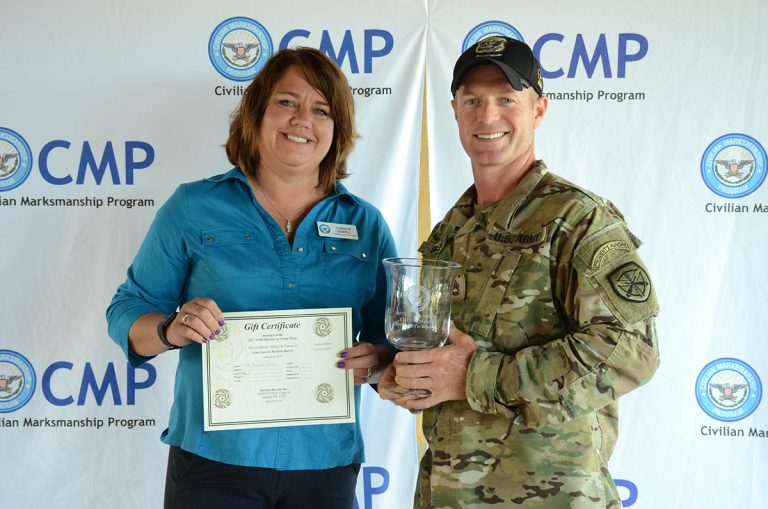
SFC Brandon Green, 32, of the U.S. Army Marksmanship Unit, fired a score of 2368-97X to earn the championship title in the 2400 Aggregate Rifle event held during the inaugural Civilian Marksmanship Program (CMP) Cup Matches. The 2400 Aggregate award goes to the top shooter in the three combined 800 Aggregates. The 2015 National High Power Champion, SFC Green is a gifted competitor who has excelled in multiple rifle disciplines. In addition to Service Rifle and High Power events, Green has competed in PRS and tactical matches.
Even before joining the USAMU Green was an ace marksman. As a junior, he earned Distinguished Air Rifle Badge #1. “I’ve been very fortunate to get support from friends, family and the ROTC programs in high school, and of course from the CMP and NRA as well, which kind of catered to someone like myself, coming in as a junior and shooting all the way up through the High Power sports,” said Green. “I’ve also been lucky enough to gain so many opportunities from being a part of the Army and the USAMU. It’s been a long learning journey, but it’s been a good one.”
The CMP Cup Matches, which kicked off the 2017 National Matches at Camp Perry, were introduced as an extra series of elite match and service rifle competitions. The schedule included a 4-Man Team Match, three consecutive days of 800 Aggregate matches, and an EIC Service Rifle Match.
4-Man Team Match kicked off a week of events fired entirely on the CMP’s electronic High Power targets.
The CMP Cup Series week marked a new era at Camp Perry, with the first successful competitions fired on the base’s ranges using CMP’s mobile electronic targets. Over 36,000 rounds were sent downrange, with less than 50 questioned by competitors throughout the week. For many, the Cup Matches provided an initial look at the CMP’s target system.
Also making marks in the 2400 Aggregate match during CMP Cup Week was SSG Amanda Elsenboss, 28, of the Army Marksmanship Unit, who earned the High Woman Award, as well as Serena Juchnowski, 18, of Richfield, OH, who snagged the High Junior credit. Paul Terrence, 65, of Cleveland, OH, was named the High Senior of the event.
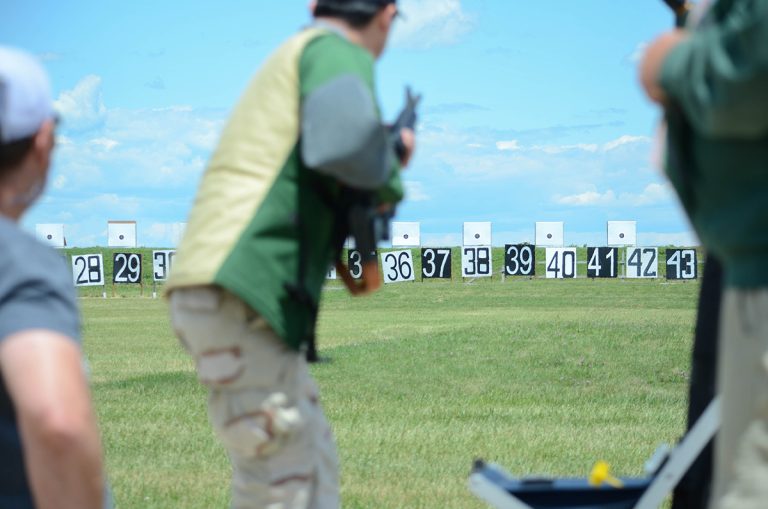
In the archives of On The Mark magazine, DCM Emeritus Gary Anderson, an Olympic Gold medal-winning shooter in his younger years, offers sage advice for competitive shooters.
In his article Ten Lessons I Wished I Had Learned as a Young Shooter, Anderson provides ten important guidelines for everyone involved in competitive shooting. Here are the Ten Lessons, but you should read the full article. Anderson provides detailed explanations of each topic with examples from his shooting career.
LESSON 1 – NATURAL ABILITY WILL NOT MAKE YOU A SHOOTING CHAMPION.
(You also need hard work, training effort and perseverance.)
LESSON 2 – ANGER IS THE ENEMY OF GOOD SHOOTING.
(The key to recovering from a bad shot is to stay cool, no matter what happens.)
LESSON 3 – BAD SHOTS CAN TEACH YOU MORE THAN GOOD SHOTS.
(Today, error analysis is one of the most powerful tools for improving scores.)
LESSON 4 – NEVER GO WITHOUT A SHOT PLAN.
(A shot plan is a detailed breakdown of each of the steps involved in firing a shot.)
LESSON 5 – PRACTICE IN BAD CONDITIONS AS WELL AS GOOD CONDITIONS.
(Most competitions are fired in windy conditions or where there are plenty of distractions.)
LESSON 6 – CHAMPIONS ARE POSITIVE, OPTIMISTIC PEOPLE.
(Negative shooters expect bad results; positive shooters expect to train hard to change bad results.)
LESSON 7 – IT’S NOT ABOUT WHETHER YOU WIN OR LOSE.
(It’s about how hard you try to win.)
LESSON 8 – YOUR DOG WON’T BITE YOU AFTER SHOOTING A BAD SCORE.
(Hopefully your coach, parents and friends won’t bite you either.)
LESSON 9 – YOUR PRESS CLIPPINGS CAN HURT YOU OR HELP YOU.
(Winning can go to our heads. We start thinking we are so good we don’t have to work hard any more.)
LESSON 10 — YOU NEVER SHOT YOUR BEST SCORE.
(Great champions are always looking for ways to improve.)
About Gary Anderson Gary Anderson served as the Director of the Civilian Marksmanship Program (CMP) from 1999-2009, and is now DCM Emeritus. As a Nebraska farmboy, Gary grew up hunting and shooting. Dreams of winning an Olympic Gold Medal in shooting led Gary to the U.S. Army. In 1959, he joined the elite U.S. Army Marksmanship Unit. Just two years later, he won his first national championship.
At the 1962 World Shooting Championships in Egypt, Anderson stunned the shooting world by winning four individual titles and setting three new world records. At the 1964 Tokyo Olympics, Gary won the 300m free-rifle Gold Medal, setting a new world record in the process. At the 1966 World Shooting Championships in Germany, Anderson won three additional world titles. At the 1968 Olympics, Gary won a second gold medal in the 300m free-rifle event.
Gary retired from active international competition after the 1969 World Championships in Spain, where he set a 50m, three-position world record. After his “retirement” from international competition, Gary competed in the National High Power Championships, winning the President’s National Trophy in 1973, 1975 and 1976. Over his competitive career, Anderson won two Olympic Gold Medals, seven World Championships, and sixteen National Championships. No American has ever won more major shooting titles.
Gary’s influence on shooting sports extends beyond the United States. Gary has attended eleven Summer Olympic Games, three as a competitor and eight as technical delegate or a jury member. Gary is the first American ever elected as Vice President of the International Shooting Sport Federation (ISSF), and still serves in that capacity. In 2012, Gary received the International Olympic Committee’s highest honor, the Olympic Order.
In this video, Bryan Litz of Applied Ballistics focuses on training. Bryan says that training is key for success in Long Range shooting: “Training in the sense that you want to want to refine your fundamentals of marksmanship — your sight alignment, your trigger control. You should practice those things enough that they become second nature and you don’t have to think about them. Keep in mind, it’s not just good enough to train, you have to learn how to train. You need to learn how to practice effectively, to get the most out of everything you do.”
Bryan says that success in Long Range shooting is not just about the hardware. It’s what’s between your ears that really counts: “The most important element in Long Range shooting is your knowledge — your understanding and practice of fundamentals of marksmanship, as well as your understanding of ballistics. You have to be able to fire the rifle, execute good shots that will put your rounds on target, but you also need to make intelligent sight corrections that will accurately account for the effects of gravity drop, and wind deflection, to center your group on those targets”.
Litz Competition Shooting Tips
Competition TIP ONE. Improving your scores in long range competition is a constant process of self-assessment. After each match, carefully analyze how you lost points and make a plan to improve. Beginning shooters will lose a lot of points to fundamental things like sight alignment and trigger control. Veteran shooters will lose far fewer points to a smaller list of mistakes. At every step along the way, always ask yourself why you’re losing points and address the issues. Sometimes the weak links that you need to work on aren’t your favorite thing to do, and success will take work in these areas as well.
Competition TIP TWO. Select your wind shooting strategy carefully. For beginners and veterans, most points are typically lost to wind. Successful shooters put a lot of thought into their approach to wind shooting. Sometimes it’s best to shoot fast and minimize the changes you’ll have to navigate. Other times it’s best to wait out a condition which may take several minutes. Develop a comfortable rest position so you have an easier time waiting when you should be waiting.
Competition TIP THREE. Actively avoid major train wrecks. Sounds obvious but it happens a lot. Select equipment that is reliable, get comfortable with it and have back-ups for important things. Don’t load on the verge of max pressure, don’t go to an important match with a barrel that’s near shot out, physically check tightness of all important screws prior to shooting each string. Observe what train wrecks you and others experience, and put measures in place to avoid them.


F-Class is a known-distance event, with targets of known dimensions that have markings (rings) of known sizes. Any ‘holding off’ can be done using the target face itself. Most ‘benefits’ of Front (first) focal plain (FFP) optics are null and void here — they work great on two-way ranges where ‘minute of man’ is the defining criteria — but how many FFP scopes do you know of in the 30-40X magnification range? Very, very few, because what people who buy high-magnification scopes want is something that allows them to hold finer on the target, and see more detail of the target, not something where the reticle covers the same amount of real estate and appears ‘coarser’ in view against the target, while getting almost too fine to see at lower powers.
Others use a plot sheet that is a scaled representation of the target face, complete with a grid overlaid on it that matches the increments of their optics — usually in MOA. Take your Swag at the wind, dial it on, hold center and shoot. Shot comes up a 10 o’clock ‘8’… plot the shot on the sheet, look at the grid and take your corrections from that and dial the scope accordingly. This process should put you in the center (or pretty close), assuming that you didn’t completely ignore the wind in the mean time. Once in the center, hold off and shoot and plot, and if you see a ‘group’ forming (say low right in the 10 ring) either continue to hold high and left or apply the needed corrections to bring your group into the x-ring.


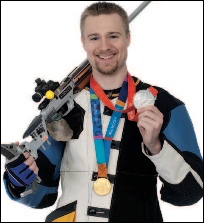 Matt Emmons competed in the Three-Position Event at the Rio Olympics his fourth Olympic appearance. Matt has competed on the U.S. National Team since 1997, medaling in three Olympic games: Gold in 2004 in Men’s 50m Prone; Silver in 2008 in Men’s 50m Prone; and Bronze in 2012 in Men’s 50m 3X40. Although his specialty is Men’s 3-Position rifle, Emmons’ World Championship and Olympic Gold are in Men’s 50m Prone. He usually shoots an Anschütz or Bleiker .22LR rifle, with Eley Tenex ammo.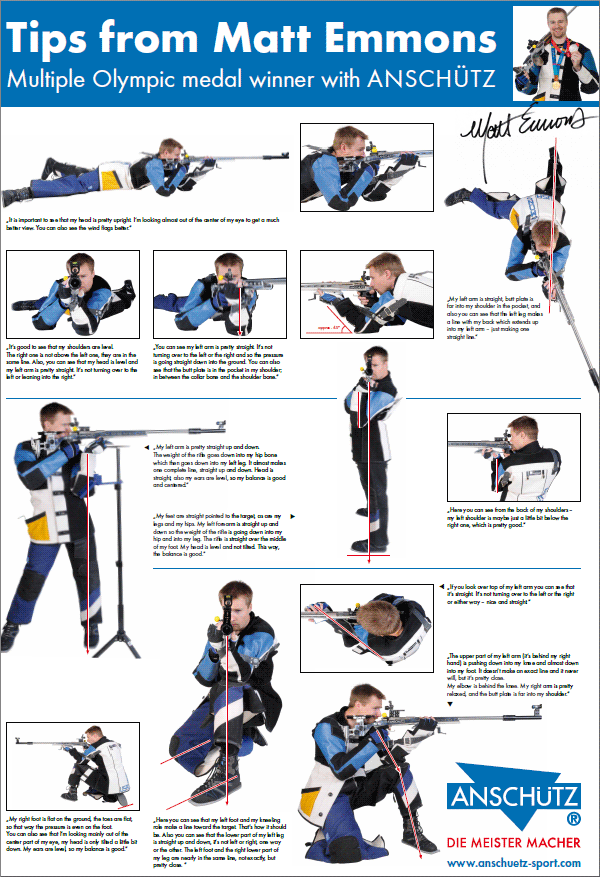




 In the archives of
 Gary Anderson served as the Director of the Civilian Marksmanship Program (CMP) from 1999-2009, and is now DCM Emeritus. As a Nebraska farmboy, Gary grew up hunting and shooting. Dreams of winning an Olympic Gold Medal in shooting led Gary to the U.S. Army. In 1959, he joined the elite U.S. Army Marksmanship Unit. Just two years later, he won his first national championship.
 Gary retired from active international competition after the 1969 World Championships in Spain, where he set a 50m, three-position world record. After his “retirement” from international competition, Gary competed in the National High Power Championships, winning the President’s National Trophy in 1973, 1975 and 1976. Over his competitive career, Anderson won two Olympic Gold Medals, seven World Championships, and sixteen National Championships. No American has ever won more major shooting titles.


