|
|
December 16th, 2016

Today, December 16th, 2016, Creedmoor Sports is offering FREE SHIPPING on ALL orders within the Continental USA. Orders must be placed by 11:59 PM EST, on Friday, December 16. And now through January 2, 2017, Creedmoor is offering holiday sale prices on a host of products, including match ammo, shooting coats, gun cases, gloves, spotting scopes, shooting mats, eyewear, and much more.
In its Holiday Shopping Catalog, Creedmoor has also cut prices on its best-selling instructional DVDs. You can save up to $9.50 per disc, with typical savings of 20% or more. Serious High Power rifle competitors can definitely benefit from these informative DVDs which combine instruction with photos, video, and interviews. Here are three highly recommended DVDs, the first from Triple-Distinguished Marksman Jim Hill and the other two from 11-Time National High Power Champion David Tubb. You can ORDER these DVDs Online.

December 10th, 2016

Top Shot Champion Dustin Ellermann is not just a great shooter. He also directs a Christian-oriented youth program in Texas. In the spring of 2017, Dustin’s Camp His Way team will be offering weekend marksmanship camps for youngsters and teens. Dustin tells us that there are still a few spots available for the Kids’ Camps on February 25-26 and March 25-26, as well as the Teen Camp on March 11-12, 2017. These two-day Camps make a great holiday gift for youngsters. The programs are conducted at Camp His Way outside of Zavalla, Texas. For more information, visit Marksmancamp.com.

These weekend Marksmanship Camps are specially designed for kids aged 9-13 and teens 14-18. The Christian-oriented two-day camps focus on safety, marksmanship skills, and team building. Campers enjoy a host of fun skill-oriented activities: Airgun Shooting, Archery, Blowguns, Knife Throwing, Paintball Games, Slingshots, Tomahawk Throwing, and of course Rimfire Rifle Marksmanship with a variety of rifles. The Rimfire Rifle Marksmanship program features Volquartsen Custom Rifles, S&W M&P 15-22s, Ruger 10/22s, Savage bBolt Actions, and Henry Lever Actions.

The Kids’ (ages 9-13) Marksmanship Weekends cost $270. Teen (ages 14-18) Camps are $300.00. These fees include all ammo, equipment, meals, lodging, team t-shirt, and one adult guest spectator. Parents are welcome to attend and spectate, but participation in marksmanship activities is limited to the kids at this time. CLICK HERE to reserve a spot — a few openings are still available.

Notice the young campers always wear ear and eye protection when shooting firearms. That’s as it should be. We wish adult shooters, including benchrest, smallbore, High Power, and F-Class competitors, followed this important safety practice.
December 8th, 2016

Top shooters like 11-time National Champion David Tubb have mastered marksmanship by being continually aware of their physical state while shooting. This article by Glen Zediker talks about respiration and how to modulate your breathing to maximize on-target accuracy and consistency. This article originally appeared in the MidSouth Shot Report Blog.
by Glen Zediker
Elsewhere I’ve talked about what I call the “true fundamentals” of shooting. Put the sight on the target and pull the trigger without moving the sight. And we’ve talked about some of the mechanics, like natural point of aim, sight picture, and the trigger itself, that combine to assist this goal.
Holding still sometimes takes more thought, and effort, than we might realize. Shooting well is a truly multi-faceted task that shooters like 11-time National Champion David Tubb have attended to through miniscule details, like being aware of the physical state continually while performing.
Another crucial and largely unknown element is controlling breathing. Right. That thing we do to stay awake and alive. Breathing can be a calculated technique among competitive shooters, and that is because the state of the body in the framework of making a shot is a defining element in the effectiveness of the shooting platform. That platform, by they way, is you!
I’ll break it down, and then offer a few suggestions on how to incorporate a better understanding of the dynamics of maintaining human oxygen supply.
When we are breathing when doing nothing in particular but living, we’re not taking the deepest breaths we can when we inhale, and we’re not expelling all the air we had when we exhale. We’re also not breathing in and out, in and out, in and out in constant successions. We breathe in to a comfortable level. Hold that a bit. We breathe out to a comfortable level. And then we hold that state for a bit. Then we very naturally breathe in again. These cycles are on a balanced rhythm, and a relatively shallow cycle. It’s a lot different than when we’re doing something strenuous, like running.
So, to fire a gun from our most stable state, make the trigger break in what shooting coaches call “the natural respiratory pause”. That’s the state between exhaling and inhaling. From a “human machine” standpoint, that’s when the body is most calm and stable.

Breathing Cycles for Best Shooting
Learn to use the natural pattern of your breathing to experience the most effective (steadiest) hold. When we breathe normally we don’t inhale as much air as we can hold and then blow it all out, and we also don’t breathe continually in and out, in and out. Rather, we simply inhale and exhale to levels that are comfortable to us. Take aim and fire the shot when you have reached what some call the “natural respiratory pause,” or the natural resting point prior to inhalation where we are “using” the oxygen we have retained.
It’s a narrow window. That window of opportunity varies widely depending on a lot of factors, but some experience dry-firing will show you where you stand.

December 6th, 2016

Christmas is coming soon. Books have always been popular holiday gifts. If you haven’t completed your holiday shopping, here are some recommended titles that should please the serious shooters and firearms enthusiasts on your shopping list. For shooting clubs, books also make great end-of-season member awards. Most of us would rather have a useful book than one more piece of wood to toss in a box in the closet.
Here Are TEN BOOKS Recommended for Serious Shooters:
 |
Top-Grade Ammo
by Glen Zediker, $34.95 (Softcover)
Glen Zediker’s brand new book, Top-Grade Ammo, is hot off the press. Many folks believe this is Glen’s best book ever. This 314-page resource covers every aspect of the reloading process — component sorting, priming, sizing, bullet seating and more. With 430 photos, Top-Grade Ammo is a richly-illustrated, step-by-step guide to producing high-quality handloads. Unlike many reloading books, Top-Grade Ammo is truly current and up-to-date, so it covers modern practices and the latest precision reloading tools. While Zediker focuses on producing match-grade ammo for competition, this book will also help novice reloaders on a budget. It’s written for all hand-loaders — beginners through advanced. This book features a special “lay-flat” binding so it’s easy to use as a benchtop reference. To view Chapter List and sample pages visit ZedikerPublishing.com.
|
 |
Modern Advancements in LR Shooting
by Bryan Litz, $27.99 (Kindle), $43.95 (Hardcover)
If you’re a serious long-range shooter, consider adding this book to your library. Relying on extensive ballistics testing, Modern Advancements contains some fascinating research results, including the effects of twist rate on muzzle velocity, BC, and precision. Other sections detail the evolution of modern rifle, bullet, and optics designs. And there is an important comparison test of chronographs. Laser rangefinders and wind measurement devices are explained in detail by contributing author Nick Vitalbo. This book is a valuable resource for anyone who wants to understand the current “state of the art” in today’s shooting world. There is a ton of “hard science” in this book — not just opinions. |
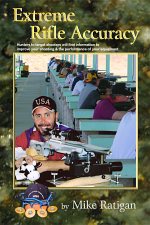 |
Extreme Rifle Accuracy
by Mike Ratigan, $35.65 (Softcover)
This book should be on the shelf of every short-range benchrest shooter. (Shooters in other disciplines will find the book helpful as well.) Butch Lambert says Mike’s book is “far and away the best Benchrest book written. Very comprehensive, it touches on every aspect of our game.” Mike’s 368-page book is dedicated to getting the most from modern rifle accuracy equipment with an emphasis on shooting 100-200-300 yard group benchrest tournaments. This book covers the most popular hardware plus new equipment offerings are covered, including external mount scopes, actions, triggers, stocks, wind flags, and more. Also covered are rifle handling techniques, note taking, tuning, bullet selection, goals, and match strategies. Mike provides many tips that will help active competitors update their own competitive program. |
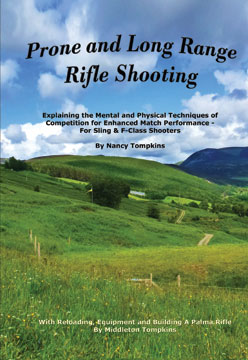 |
Prone and Long-Range Rifle Shooting
by Nancy Tompkins, $45.00, (Hardcover, 2d Edition).
Nancy Tompkins is one of the greatest long-range shooters in American history. She has won five National Long-range Championships. Tompkins’ treatise is a must-read for serious Palma, F-Class, and High Power shooters. The revised Second edition includes F-Class equipment and techniques, and newly updated information. Color pictures. Topics include Mental & Physical training, Reading Wind & Mirage Shooting Fundamentals, International Competition, and Loading for Long Range. Nancy Tompkins is a 4-time winner of the National Long Range Championships, and has won countless other major events. Nancy has been on six Palma Teams (as both a shooter and a coach). |
 |
Long Range Shooting Handbook
by Ryan Cleckner, $24.95 (list); $10.67 (Softcover, Amazon Price), $9.99 (Kindle)
Ryan Cleckner is noted for his ability to explain complex topics in an easy-to-comprehend manner. Now Cleckner has authored a book, the Long Range Shooting Handbook, which expands on the topics covered in Cleckner’s popular NSSF video series. The Long Range Shooting Handbook is divided into three main categories: What It Is/How It Works, Fundamentals, and How to Use It. “What It Is/How It Works” covers equipment, terminology, and basic principles. “Fundamentals” covers the theory of long range shooting. “How to Use It” gives practical advice on implementing what you’ve learned, so you can progress as a skilled, long range shooter. You can view Sample Chapters from Ryan’s Book on Amazon.com. |
 |
The Book of Rifle Accuracy
by Tony Boyer, $34.50 (Softcover); $42.50 (Hardcover).
Tony Boyer, the most successful shooter in the history of short-range benchrest competition, shares many of his match-winning tips in this 323-page book. The book covers all aspect of the benchrest discipline: loading, windflags, rest set-up, addressing the rifle, and match strategies. This is a high-quality publication, filled with valuable insights. Every serious benchrest shooter should read Tony’s book. Boyer has dominated registered benchrest in a fashion that will never be duplicated, having amassed 142 U.S. Benchrest Hall of Fame points. The next closest shooter, Allie Euber, has 47 Hall of Fame points. This handsome, full-color book is 323 pages long, with color photos or color illustrations on nearly every page. |
 |
The Rifle Shooter
by G. David Tubb, $34.95 (Softcover)
This book by 11-time National High Power Champion David Tubb focuses on position shooting and High Power disciplines. Section One covers fundamentals: position points, natural point of aim, breathing, triggering mechanics and follow-through, sling selection and use, getting started, getting better, avoiding obstacles. Section Two covers mechanics of offhand, sitting, and prone positions. Section Three covers shooting skills, including wind reading and mental preparation. Section Four covers the technical side of shooting, with extensive disuctions of rifle design, load development, reloading barrel maintenance, and rifle fitting. We consider this book a “must-read” for any sling shooter, and there is plenty of good advice for F-Class shooters too. |
 |
Bullseye Mind
(Mental Toughness for Sport Shooting)
by Dr. Raymond Prior, $17.95 (Softcover).
Having a Bullseye Mind means thinking in ways that create confidence and consistency, even under pressure. A “must-read” for competitive shooters, Bullseye Mind is a mental training book written specifically for the shooting sports. The book is well-organized, with handy highlighted lists and key “talking points”. Each chapter concludes with examples from a world-class shooters such as: Matt Emmons, 2004 Olympic Gold Medalist; Vincent Hancock, 2-time Olympic Gold Medalist; Jamie Corkish, 2012 Olympic Gold Medalist; Petra Zublasing, 2014 World Champion/ISSF Shooter of the Year; and Nicco Campriani, 2012 Olympic Gold Medalist, 2010 World Champion. This book has earned rave reviews from competitive shooters who found it really helped their “Mental Game”. One recent purchaser states: “This book is as though you had a coach in your back pocket…” |
 |
The Wind Book for Rifle Shooters
by Linda Miller and Keith Cunningham, $20.53 (Softcover).
Many of our Forum members have recommended The Wind Book for Rifle Shooters by Linda Miller and Keith Cunningham. This 146-page book, published in 2007, is a very informative resource. But you don’t have to take our word for it. If you click this link, you can read book excerpts on Amazon.com. This lets you preview the first few chapters, and see some illustrations. Other books cover wind reading in a broader discussion of ballistics or long-range shooting. But the Miller & Cunningham book is ALL about wind reading from cover to cover, and that is its strength. The book focuses on real world skills that can help you accurately gauge wind angle, wind velocity, and wind cycles. |
 |
Rifleman’s Guide to Rimfire Ammunition
by Steven Boelter, $29.95 (Softcover)
Steven Boelter’s 352-page book is a comprehensive study of all types of rimfire ammunition (including 17s and 22 mags), with over 600 photos. In a remarkable undertaking, Steven Boelter fired every brand and sample of rimfire ammo he could acquire (including .22 LR, 17 Mach 2, 17 HMR and .22 WMR), and recorded all the results. In all, Steven tested 11 brands and 137 different rimfire rounds, firing over 32,000 test rounds. |
December 4th, 2016

Photo courtesy USA Shooting.
 Competitive shooting is one of the few sports where people with physical disabilities and handicaps can compete side-by-side with their able-bodied counterparts. The NRA’s Disabled Shooting Services Program helps disabled shooters participate in NRA rifle and pistol competitions. The NRA’s Special Authorization Card allows disabled competitors to shoot from a modified position or wheelchair based on the type of disability or handicap. Competitive shooting is one of the few sports where people with physical disabilities and handicaps can compete side-by-side with their able-bodied counterparts. The NRA’s Disabled Shooting Services Program helps disabled shooters participate in NRA rifle and pistol competitions. The NRA’s Special Authorization Card allows disabled competitors to shoot from a modified position or wheelchair based on the type of disability or handicap.
 Jessi McClain, NRA Disabled Shooting Services Coordinator explains how allowances are made: “Physical limitations may prevent a shooter from getting into a certain position to compete. For example, a paraplegic person can’t shoot from the standing position, so [he] would use an adaptive shooting position to compete”. Jessi McClain, NRA Disabled Shooting Services Coordinator explains how allowances are made: “Physical limitations may prevent a shooter from getting into a certain position to compete. For example, a paraplegic person can’t shoot from the standing position, so [he] would use an adaptive shooting position to compete”.
To obtain a Special Authorization Card, competitors can download two forms online. The first is to be completed by the shooter, and the second by his/her doctor. Forms can then be sent to NRA Headquarters along with pictures of the modified shooting position and/or adaptive device being used to compete. The Manager of the specific shooting discipline (rifle, pistol, air gun, etc.) then reviews the request. If approved, a temporary card good for one year is issued. For juniors, Special Authorization Cards are issued for several years at a time so that re-evaluations can be completed as children’s bodies change.
The medical waiver application is fairly simple and consists of two documents. The first form, the Competitor Application, should be filled out by the shooter. The second document is a Medical Form that must be completed by the competitor’s physician.
Once received, the applications are reviewed by the NRA. After approving the application, the competitor will receive a card authorizing him/her to use the adapted position or equipment. The Authorization Card must be shown to the Match Director prior to the start of any competition.
November 20th, 2016

Thanksgiving is just four days away. What better way to celebrate the occasion than to blast away at some bearded gobblers (of the paper variety). Here’s our custom Turkey Day target, ready for some family fun. This special Turkey Bullseye Target was created by our friend and Forum member Pascal (aka “DesertFrog”). CLICK HERE for FREE Turkey Target.
Get a Full Set of Animal Targets
For your convenience, we’ve packaged the Turkey Target along with five (5) other varmint/animal-themed targets. These are all offered in .pdf (Adobe Acrobat) format for easy printing.
CLICK HERE to download all SIX targets in .Zip archive.

November 15th, 2016
In this video, Anette Wachter (the 30CalGal) offers tips for shooting from bipod.
 Our friend Anette Wachter, aka “30CalGal”, stars in a smart video from NRAWomen.TV. In this episode of Tips & Tactics, Anette talks about the “mental game” in competition. Specifically she explains how to “visualize success”: Our friend Anette Wachter, aka “30CalGal”, stars in a smart video from NRAWomen.TV. In this episode of Tips & Tactics, Anette talks about the “mental game” in competition. Specifically she explains how to “visualize success”:
I have found that a lot of my success in competition has come through what I call a ‘mental rehearsal’. I actually visualize every stage of the match and I visualize the success of the match and winning the match.
I actually visualize that round going downrange into the target, and the target coming up with a dead-center ‘X’. I visualize this over and over. If you visualize success you will achieve success.
|
Visualization is a process of mental preparation that is done before you get to the range. Many of the greatest shooting champions have used this technique to get ready for big matches, and to optimize their performance during record fire. If you want to enhance your “mental game” through pre-match visualization, we strongly recommend Lanny Bassham’s book, With Winning in Mind.
As a competitive smallbore 3P shooter, Bassham developed a mental management system. Using this system, Lanny Bassham won 22 world individual and team titles, set four world records, and captured an Olympic Gold Medal in Montreal in 1976. His techniques have been embraced by professional and Olympic athletes in many sports. With Winning in Mind covers a complete system of “mental management” techniques used by Olympians and elite champions. |
|
About 30CalGal
Life is short. Go Shoot! — Anette Wachter
Along with being a talented competitive shooter, Anette has her own Gun Blog, 30CalGal.com, and she writes for several gun publications including GunUp Magazine, Shooting Sports USA, Sure Shots Magazine, and Wide Open Spaces. She also designs and crafts custom jewelry items, sold through her AW Collections webstore.
November 14th, 2016

 The Civilian Marksmanship Program (CMP) invites young men and women shooters to apply for CMP scholarships for the 2017-2018 school year. The CMP offers $1,000 one-year scholarships to current high school seniors. Since 2005, CMP has awarded over $1 million in scholarship grants. Last year, the CMP received a record-setting number of applications and awarded over $150,000 in scholarship money. Winning scholarship recipients came from JROTC programs, 4-H groups and other shooting clubs. The Civilian Marksmanship Program (CMP) invites young men and women shooters to apply for CMP scholarships for the 2017-2018 school year. The CMP offers $1,000 one-year scholarships to current high school seniors. Since 2005, CMP has awarded over $1 million in scholarship grants. Last year, the CMP received a record-setting number of applications and awarded over $150,000 in scholarship money. Winning scholarship recipients came from JROTC programs, 4-H groups and other shooting clubs.
CMP Scholarships are based on merit. Selected individuals are high school seniors who are currently enrolled in a team or club that is participating in rifle or pistol marksmanship competitions. Applicants must provide rifle or pistol competition history, list of awards, and future goals in the shooting sports. Applicants must also provide academic GPA and an official high school transcript (3.0 Minimum GPA Required).
Applications are Being Accepted Now for 2017-2018
The CMP is now taking scholarship applications for the 2017-2018 freshman college year. Scholarships are one-year awards that may be used to fund any accredited, post-secondary education or vocational program. (Note: Students planning to enroll in a military academy are not eligible).
CMP Scholarship Regulations | 2017-2018 Scholarship Application Form.
The deadline for CMP Scholarship Application is March 20, 2017. Learn more about the program at the CMP Website Scholarship Page. If you have any questions, please contact Kathy Williams at 419-635-2141, ext. 709, or email kwilliams [@] thecmp.org.
October 18th, 2016
Here’s an example of world-class benchrest shooting. Charles Huckeba of Texas was the top individual shooter at the 2013 World Benchrest Championships (WBC) held near Sydney Australia in October 2013. In this video, 2013 WBC Two-Gun Overall winner Charles shoots a 1/8th MOA group at 200 yards — “a little bitty dot” as a fellow Team USA shooter observes. That’s impressive. If you can describe Huckeba’s style in a nutshell it would be “smooth, consistent, and rapid but not hurried”.
Charles also employed some unusual hardware. In the video, take a close look at the joystick on the Farley Coaxial front rest. There’s no knob at the end. In its place is a small, wood ammo caddy. Charles removed the standard knob from the handle of his Farley rest and replaced it with a home-made wood block that holds cartridges for the record target. The 10.5-lb Light Varmint rifle is chambered in 6PPC with a BAT Machine Action and a composite wood and carbon-fiber stock.
Watch Charles Huckeba Shoot 1/8 MOA, 200-yard group at World Benchrest Championships
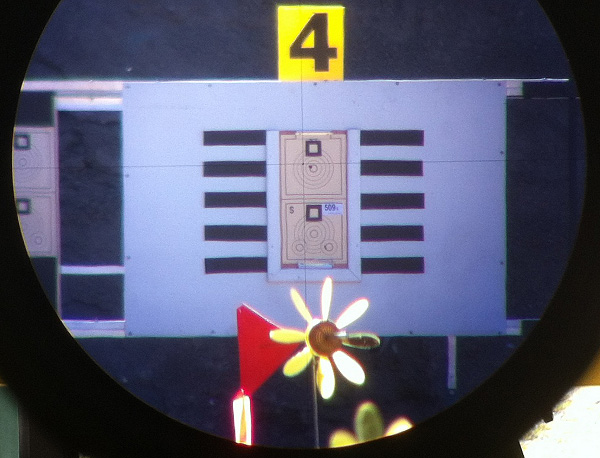
Here is the actual 200-yard, 5-shot group Charles shot in the video. Photo (by Stuart Elliot) taken through the lens of Huckeba’s 50X March scope (reticle has 1/16th MOA Dot).

Analyzing the Fine Points — What Makes Huckeba So Good
Short-range benchrest shooter Boyd Allen saw some interesting things in Huckeba’s WBC performance, as captured on video. Boyd noticed Huckeba’s smooth gun-handling and efficient loading. But Boyd also spied some interesting equipment, including an innovative joystick “handle-caddy”.
1. Low Friction Bags — When Huckeba slid his rifle, there was very little apparent friction. The front bag features the new 3M material (ScotchLite) on the sliding surfaces. The rear Protektor bag has ears of the same low-friction material.
2. Pause Before Chambering — While he was watching the flags and deciding when to start firing, Charles kept his first round in the action, but out of the barrel’s chamber, probably so as not to heat the cartridge and change the round’s point of impact.
 3. Ammo Caddy on Joystick Arm – Charles shoots a Right Bolt/Left Port action, so he pulls his rounds with his left hand. Note that Huckeba’s record rounds rest in a small, wood ammo caddy attached to the end of the joystick shaft. Look carefully, you’ll see the wood ammo block in place of the normal black ball at the end of the joystick. That allows Charles to pull shots with the absolute minimum of hand movement. Ingenious! Huckeba is very fast, with a great economy of motion. I believe that because his ammo was literally at hand, Charles was better able to keep his focus on aiming and the flags. 3. Ammo Caddy on Joystick Arm – Charles shoots a Right Bolt/Left Port action, so he pulls his rounds with his left hand. Note that Huckeba’s record rounds rest in a small, wood ammo caddy attached to the end of the joystick shaft. Look carefully, you’ll see the wood ammo block in place of the normal black ball at the end of the joystick. That allows Charles to pull shots with the absolute minimum of hand movement. Ingenious! Huckeba is very fast, with a great economy of motion. I believe that because his ammo was literally at hand, Charles was better able to keep his focus on aiming and the flags.
4. Smooth-Cycling BAT Action — Note how smoothly Huckeba’s action operates. When Charles lifts the bolt handle (to extract a round and cock the firing pin), this does not disturb the rifle. Likewise, as he closes the bolt, the gun doesn’t wobble. The smooth action allows Charles to hold point of aim even when shooting relatively quickly. Huckeba’s BAT action is chrome-moly steel. Some shooters believe this metal makes for a smoother action than stainless steel or aluminum.
5. Long-Wheelbase Stock — The wood and carbon fiber stock is light, long, and stiff. Yet, importantly, the stock is also well-damped. The longer-than-average stock length (with extended forearm) seems to help the gun track well without jumping or rocking. The longer forearm allows a longer “wheelbase”, effectively shifting the weight distribution rearward (less weight on the front, more weight on the rear). This places a greater share of the gun’s weight on the rear bag, as compared to a more conventional benchrest stock. Huckeba’s stock, built by Bob Scoville, is at the cutting edge of short-range benchrest design. Its light-weight balsa wood and carbon fiber construction provides a combination of stiffness and vibration damping that allows its relatively long fore-end to be fully utilized to increase the weight on the rear bag (always an issue with 10.5-pound rifles).
To learn more about this benchrest stock design, read the comments by stock-builder Bob Scoville in our PPC with Pedigree story in our Gun of the Week Archives. Bob observed:
“There is a lot more to the structure of the stocks than meets the eye. The carbon fiber skin with which I cover the stocks creates a light, tough exterior surface. However, this contributes very little to the overall performance of the stocks. The real strength and stiffness is the result of an internal beam utilizing balsa core/carbon fiber technology.
This type construction can be found in aircraft, race cars, powerboats, and sailboats. It is interesting to note, balsa has the highest strength to weight ratio of all woods and carbon fiber is one of the lowest stretch (modulus of elasticity) relative to weight of all materials. The marriage of these two materials is common in the high-performance world. Additionally, balsa is used commercially for vibration dampening and sound reduction.”
Video find by Boyd Allen. Video by Stuart Elliot of BRT Shooters Supply, Brisbane, Australia.
October 18th, 2016

Be prepared to have your mind blown by Max Michel. This guy is FAST. In this video he puts 18 shots on three targets with two (2) reloads, in a total of 4.79 seconds. That’s right, drawing from holster, he sends 18 rounds in under five seconds, with two mag changes in the process. That works out to a rate of fire of 225 rounds per minute. Consider this — Max shoots faster than a 19th-century Gatling Gun (which had a rate of fire of roughly 200 rounds per minute). And Max is accurate as well as speedy — 16 of Max’s 18 shots were in the targets’ A-Zones, with the other two just barely outside.
At age 30, Max Michel is a legend within the world of competitive shooting. A four-time World Speed Shooting Champion, six-time USPSA National Champion, and three-time US National Steel Champion, Max is a dominant force in pistol shooting sports. Born and raised in New Orleans, Louisiana, Max began shooting when he was just 5 years old. In 1999 Max joined the USAMU’s Action Pistol Team and served in the U.S. Army for 10 years as an Army shooter and trainer. Today, Max is recognized worldwide as a top-tier athlete and instructor.
Follow Max Michel, Jr., on Facebook at http://www.facebook.com/maxmichel.us.
To see Max Michel and other top shooters, watch HotShots on the Sportsman Channel.
|


