PrecisionRifleBlog.com recently reviewed several video-based rifle training DVD sets. While instructional DVDs will never replace live “hands-on” training, they can be cost-effective ways to sharpen your skills. Watched periodically, these training DVDs can help reinforce the fundamentals.
PRB’s Editor Cal Zant has purchased several rifle training DVDs over the years. His recent Precision Rifle Blog DVD review looks at four different options:
Long Range Made Easy, Two-Volume Set, from Accuracy 1st The Art Of The Precision Rifle, with Todd Hodnett (Magpul Dynamics) Putting Rounds On Target, with Bryan Litz (Applied Ballistics) Rifles Only — Precision Rifle Instructional DVDs, with Jacob Bynum
Cal reports that each of these four titles offers a slightly different approach, with each instructor displaying his own focus, based on his background and expertise.
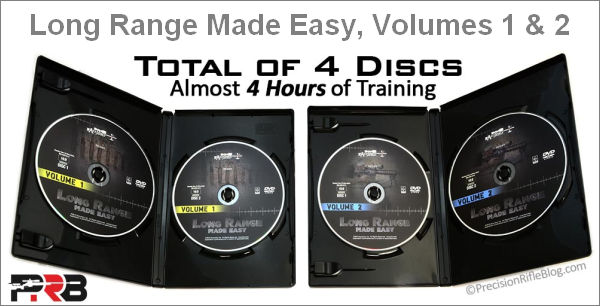
Accuracy 1st’s Long Range Made Easy Two-Volume Set seemed to win PRB’s Editor’s Choice Award. The tagline on the DVD is: “Go from basic to advanced with the guy that has trained our best military snipers for the past 10 years.” That’s a pretty good description. Todd Hodnett is the primary instructor, and Bryan Litz joins him in several segments.
It’s the best of both worlds. Todd Hodnett’s pragmatic “the-bullet-cannot-lie” approach (field-proven by hundreds of the world’s best snipers), is combined with Bryan Litz’s engineering approach and vast knowledge of external ballistics verified with carefully recorded live-fire experiments. The two styles complement each other well, and provide an extremely well-rounded and comprehensive overview.
The DVD set is split into two volumes, each of which includes two discs. All together there are almost four hours of instruction from the most respected guys in the industry. And they cover a lot of ground — you’d never be able to cover this much in a one- or two-day live class. Plus with the DVD you can easily repeat an important point, and watch the whole program more than once.
Cal paid $76.95 out-of-pocket for the Long Range Made Easy, Vol. 1 & 2 Bundle, so his review wasn’t a paid advertisement. He thought this set provides a ton of value, and could help a lot of shooters. Here are key topics covered in Long Range Made Easy:
■ Advice for Gear Purchases
■ Optimal Gun Setup
■ Technique for Position
■ Simple & Quick Wind Formula
■ Using the Applied Ballistics Kestrel
■ Truing Ballistic Algorithms, Drag Scale Factoring, and Custom Drag Models
■ WEZ Analysis
■ Wind Course
If you’re new to the long range game, or you’ve been doing it for a few years and want to learn directly from some of the most sought-after instructors in the world, then check out Cal’s write-up over at PrecisionRifleBlog.com. CLICK HERE for PRB Review of Training DVDs.
The first-ever New England CMP Games were held at the Camp Ethan Allen Training Site (CEATS) in Vermont, on September 14-18, 2016. This proved to be a great event at a stunningly scenic facility — a paradise for marksmen. Over 150 rifle and pistol competitors ventured to Vermont to enjoy the CMP’s inaugural New England Games, the latest in the CMP’s popular series of major, regional matches.
Here’s the view from the berm, looking back to the firing line…
The 2016 New England CMP Games included a Small Arms Firing School with expert instruction. Both novice shooters and experienced competitors benefitted from the training sessions.
Also featured at the New England Games was a preview of CMP’s electronic outdoor targets that are able to be transported and assembled across the country. For many shooters, this was the first time they were able to try electronic targets.
Competitors were mightily impressed by the breathtaking natural surroundings at the New England Games. “I was blown away by the facilities at Camp Ethan Allen,” said Steve Cooper, CMP North general manger. “The grounds were neatly manicured, our offices for registration and sales were very convenient and the classrooms were perfect for our clinics.”
He went on to say, “As beautiful as the surroundings were, the people were even better. They truly wanted us there and they enjoyed the matches, clinics, and other activities. It will be a pleasure to return next year for an even bigger and better event.”
Many awards were earned at the 2016 New England Games…
Of course, it wouldn’t be a true CMP Games event without a Rimfire Sporter Match.
The CEATS Pistol Range hosted both centerfire and rimfire matches in a lovely, tree-lined setting.
CLICK HERE for a complete list of New England CMP Games match results. Photos from the event are posted on the CMP’s Zenfolio website. Mark your calendars! Next year’s New England CMP Games are scheduled for September 20-24, 2017.
Most bolt-action rifle shooters work the bolt with their trigger-pulling hand. This is because most rifles sold to right-handed shooters come with right-side bolts, while “lefty” rifles come with left-side bolts. This “standard” configuration requires the shooter to take his dominant, trigger-pulling hand off the stock to cycle the bolt, then re-position his hand on the stock, and “re-claim” the trigger. Often the shooter must lift or move his head to work the bolt, and that also requires him to re-establish his cheek weld after each and every shot. Not good.
This really doesn’t make much sense for precision shooting with fore-end support*. There is a better way. If you leave your trigger hand in position and work the bolt (and feed rounds) with the opposite hand, then you don’t need to shift grip and head position with each shot. All this requires is a weakside-placed bolt, i.e. a left bolt for a right-handed shooter or a right bolt for a left-handed shooter. The video below shows a “Lefty” working a right bolt. Note how efficient this is:
As our friend Boyd Allen explains: “If you think about it, if you are going to work with a factory action where your options are left bolt and left port or right bolt and right port, and you are building a rifle that will only be shot from a rest, using the left/left for a RH shooter or using a right/right for a LH shooter works better than the conventional configuration”.
Shoot Like a Champ and Work the Bolt with Your Weakside Hand
Derek Rodgers, the only person to have won BOTH F-Open and F-TR National Championships, runs this kind of “opposite” bolt set-up, shooting right-handed with a left bolt. Though Derek is a right-hander, he shoots with a Left Bolt/Left Port (LBLP) action. He shoots with his right hand on grip, while manipulating the bolt (and feeding rounds) with his non-trigger-pulling hand. He pulls the trigger with his right index finger, while working the left-side bolt with his left (weakside) hand. This allows him to stay in position, and maintain his cheekweld.
2013 National Championship-Winning Derek Rodgers Left Bolt/Left Port Rifle.
*For true standing, off-hand shooting (whether in competition or on a hunt), a conventional strongside bolt placement makes sense, since the non-dominant arm must support the front of the rifle all the time. When shooting from bipod or rest, it’s a different story.
Today is practice day for the Mid-Range F-Class Nationals, which commence bright and early tomorrow morning in Lodi, Wisconsin. In any shooting competition, you must try to avoid major screw-ups that can ruin your day (or your match). In this article, reigning F-TR National Mid-Range and Long Range Champion Bryan Litz talks about “Train Wrecks”, i.e. those big disasters (such as equipment failures) that can ruin a whole match. Bryan illustrates the types of “train wrecks” that commonly befall competitors, and he explains how to avoid these “unmitigated disasters”.
Urban Dictionary “Train Wreck” Definition: “A total @#$&! disaster … the kind that makes you want to shake your head.”
Success in long range competition depends on many things. Those who aspire to be competitive are usually detail-oriented, and focused on all the small things that might give them an edge. Unfortunately it’s common for shooters lose sight of the big picture — missing the forest for the trees, so to speak.
Consistency is one of the universal principles of successful shooting. The tournament champion is the shooter with the highest average performance over several days, often times not winning a single match. While you can win tournaments without an isolated stellar performance, you cannot win tournaments if you have a single train wreck performance. And this is why it’s important for the detail-oriented shooter to keep an eye out for potential “big picture” problems that can derail the train of success!
Train wrecks can be defined differently by shooters of various skill levels and categories. Anything from problems causing a miss, to problems causing a 3/4-MOA shift in wind zero can manifest as a train wreck, depending on the kind of shooting you’re doing.
Below is a list of common Shooting Match Train Wrecks, and suggestions for avoiding them.
1. Cross-Firing. The fastest and most common way to destroy your score (and any hopes of winning a tournament) is to cross-fire. The cure is obviously basic awareness of your target number on each shot, but you can stack the odds in your favor if you’re smart. For sling shooters, establish your Natural Point of Aim (NPA) and monitor that it doesn’t shift during your course of fire. If you’re doing this right, you’ll always come back on your target naturally, without deliberately checking each time. You should be doing this anyway, but avoiding cross-fires is another incentive for monitoring this important fundamental. In F-Class shooting, pay attention to how the rifle recoils, and where the crosshairs settle. If the crosshairs always settle to the right, either make an adjustment to your bipod, hold, or simply make sure to move back each shot. Also consider your scope. Running super high magnification can leave the number board out of the scope’s field view. That can really increase the risk of cross-firing.
2. Equipment Failure. There are a wide variety of equipment failures you may encounter at a match, from loose sight fasteners, to broken bipods, to high-round-count barrels that that suddenly “go south” (just to mention a few possibilities). Mechanical components can and do fail. The best policy is to put some thought into what the critical failure points are, monitor wear of these parts, and have spares ready. This is where an ounce of prevention can prevent a ton of train wreck. On this note, if you like running hot loads, consider whether that extra 20 fps is worth blowing up a bullet (10 points), sticking a bolt (DNF), or worse yet, causing injury to yourself or someone nearby.
[Editor’s Note: The 2016 F-Class Nationals will employ electronic targets so conventional pit duties won’t be required. However, the following advice does apply for matches with conventional targets.]
3. Scoring/Pit Malfunction. Although not related to your shooting technique, doing things to insure you get at least fair treatment from your scorer and pit puller is a good idea. Try to meet the others on your target so they can associate a face with the shooter for whom they’re pulling. If you learn your scorer is a Democrat, it’s probably best not to tell Obama jokes before you go for record. If your pit puller is elderly, it may be unwise to shoot very rapidly and risk a shot being missed (by the pit worker), or having to call for a mark. Slowing down a second or two between shots might prevent a 5-minute delay and possibly an undeserved miss.
4. Wind Issues. Tricky winds derail many trains. A lot can be written about wind strategies, but here’s a simple tip about how to take the edge off a worse case scenario. You don’t have to start blazing away on the command of “Commence fire”. If the wind is blowing like a bastard when your time starts, just wait! You’re allotted 30 minutes to fire your string in long range slow fire. With average pit service, it might take you 10 minutes if you hustle, less in F-Class. Point being, you have about three times longer than you need. So let everyone else shoot through the storm and look for a window (or windows) of time which are not so adverse. Of course this is a risk, conditions might get worse if you wait. This is where judgment comes in. Just know you have options for managing time and keep an eye on the clock. Saving rounds in a slow fire match is a costly and embarrassing train wreck.
5. Mind Your Physical Health. While traveling for shooting matches, most shooters break their normal patterns of diet, sleep, alcohol consumption, etc. These disruptions to the norm can have detrimental effects on your body and your ability to shoot and even think clearly. If you’re used to an indoor job and eating salads in air-conditioned break rooms and you travel to a week-long rifle match which keeps you on your feet all day in 90-degree heat and high humidity, while eating greasy restaurant food, drinking beer and getting little sleep, then you might as well plan on daily train wrecks. If the match is four hours away, rather than leaving at 3:00 am and drinking five cups of coffee on the morning drive, arrive the night before and get a good night’s sleep.”
Keep focused on the important stuff. You never want to lose sight of the big picture. Keep the important, common sense things in mind as well as the minutia of meplat trimming, weighing powder to the kernel, and cleaning your barrel ’til it’s squeaky clean. Remember, all the little enhancements can’t make up for one big train wreck!
The movie “The Patriot” gave us the phrase “Aim small, miss small”. While that’s a good mantra, aiming strategies for long-range competition are a bit more complicated, as this article explains…
The U.S. Mid-Range and Long Range Nationals kick off tomorrow, September 23rd, in Lodi, Wisconsin. Here are some tips that can help F-TR and F-Open shooters aim more precisely, and achieve higher scores. F-Class ace Monte Milanuk reviews reticle choices and strategies for holding off.
In our Shooters Forum, one newcomer wanted some advice on selecting a reticle for F-Class optics. He wondered about the advantage of Front (first) Focal Plane (FFP) vs. Second Focal Plane scopes and also wondered if one type of reticle was better for “holding off” than others.
In responding to this question, Forum regular Monte Milanuk provided an excellent summary of aiming methods used in F-Class. For anyone shooting score targets, Monte’s post is worth reading:
Aiming Methods for F-Class (and Long-Range) Shooting — by Monte Milanuk
F-Class is a known-distance event, with targets of known dimensions that have markings (rings) of known sizes. Any ‘holding off’ can be done using the target face itself. Most ‘benefits’ of Front (first) focal plain (FFP) optics are null and void here — they work great on two-way ranges where ‘minute of man’ is the defining criteria — but how many FFP scopes do you know of in the 30-40X magnification range? Very, very few, because what people who buy high-magnification scopes want is something that allows them to hold finer on the target, and see more detail of the target, not something where the reticle covers the same amount of real estate and appears ‘coarser’ in view against the target, while getting almost too fine to see at lower powers.
Whether a person clicks or holds off is largely personal preference. Some people might decline to adjust their scope as long as they can hold off somewhere on the target. Some of that may stem from the unfortunate effect of scopes being mechanical objects which sometimes don’t work entirely as advertised (i.e. one or two clicks being more or less than anticipated). Me personally, if I get outside 1-1.5 MOA from center, I usually correct accordingly. I also shoot on a range where wind corrections are often in revolutions, not clicks or minutes, between shots.
Some shooters do a modified form of ‘chase the spotter’ — i.e. Take a swag at the wind, dial it on, aim center and shoot. Spotter comes up mid-ring 10 at 4 o’clock… so for the next shot aim mid-ring 10 at 10 o’clock and shoot. This should come up a center X (in theory). Adjust process as necessary to take into account for varying wind speeds and direction.
Others use a plot sheet that is a scaled representation of the target face, complete with a grid overlaid on it that matches the increments of their optics — usually in MOA. Take your Swag at the wind, dial it on, hold center and shoot. Shot comes up a 10 o’clock ‘8’… plot the shot on the sheet, look at the grid and take your corrections from that and dial the scope accordingly. This process should put you in the center (or pretty close), assuming that you didn’t completely ignore the wind in the mean time. Once in the center, hold off and shoot and plot, and if you see a ‘group’ forming (say low right in the 10 ring) either continue to hold high and left or apply the needed corrections to bring your group into the x-ring.
Just holding is generally faster, and allows the shooter to shoot fast and (hopefully) stay ahead of the wind. Plotting is more methodical and may save your bacon if the wind completely changes on you… plotting provides a good reference for dialing back the other way while staying in the middle of the target. — YMMV, Monte
Readers often ask us: “Is there a decent, easy-to-comprehend book that can help my wind-reading?” Many of our Forum members have recommended The Wind Book for Rifle Shooters by Linda Miller and Keith Cunningham. This 146-page book, published in 2007, is a very informative resource. But you don’t have to take our word for it. If you click this link, you can read book excerpts and decide for yourself. When the Amazon page opens, click the book cover (labeled “Look Inside”) and another screen will appear. This lets you preview the first few chapters, and see some illustrations.
Other books cover wind reading in a broader discussion of ballistics or long-range shooting, such as Applied Ballistics for Long-Range Shooting by Bryan Litz. But the Miller & Cunningham book is ALL about wind reading from cover to cover, and that is its strength. The book focuses on real world skills that can help you accurately gauge wind angle, wind velocity, and wind cycles.
All other factors being equal, it is your ability to read the wind that will make the most difference in your shooting accuracy. The better you understand the behavior of the wind, the better you will understand the behavior of your bullet. — Wind Book for Rifle Shooters
The Wind Book for Rifle Shooters covers techniques and tactics used by expert wind-readers. There are numerous charts and illustrations. The authors show you how to put together a simple wind-reading “toolbox” for calculating wind speed, direction, deflection and drift. Then they explain how to use these tools to read flags and mirage, record and interpret your observations, and time your shots to compensate for wind. Here’s are two reviews from actual book buyers:
I believe this is a must-have book if you are a long-range sport shooter. I compete in F-Class Open and when I first purchased this book and read it from cover to cover, it helped me understand wind reading and making accurate scope corrections. Buy this book, read it, put into practice what it tells you, you will not be disappointed. — P. Janzso
If you have one book for wind reading, this should be it. Whether you’re a novice or experienced wind shooter this book has something for you. It covers how to get wind speed and direction from flags, mirage, and natural phenomenon. In my opinion this is the best book for learning to read wind speed and direction. — Muddler
Do you know which one of your eyes is dominant? It’s easy to determine eye dominance with a simple exercise. Pick an object about 6-10 feet away (a light switch or door knob works well). Make an “OK” sign with your right hand (see photo) and hold that about 18″ from your face. Now, with both eyes open, look through the circle formed by your thumb and index finger. Center the circle on the object, so you can see the object in the middle.
Now, here’s the important part — while still holding your hand up, centered on the object, first close your right eye. If you don’t see the object anymore, then your right eye is dominant. If you still see the object, then repeat the procedure with the left eye shut and right eye open. If you don’t see the object when your left eye (only) is closed, then you are left-eye dominant.
The digital archives of Shooting Sports USA contain many interesting articles. A while back, Shooting Sports USA featured a “must-read” expert Symposium on Eye Dominance, as it affects both rifle and pistol shooting. No matter whether you have normal dominance (i.e. your dominant eye is on the same side as your dominant hand), or if you have cross-dominance, you’ll benefit by reading this excellent article. The physiology and science of eye dominance is explained by Dr. Norman Wong, a noted optometrist. In addition, expert advice is provided by champion shooters such as David Tubb, Lones Wigger, Dennis DeMille, Julie Golob, Jessie Harrison, and Phil Hemphill.
Top Rifle Champions Talk About Eye Dominance:
David Tubb — 11-Time National High Power Champion
I keep both eyes open, always. Some use an opaque blinder in rifle or shotgun shooting. If you close your non-dominant eye, you will not get as good a sight picture. If your aiming eye is not your dominant eye, you have even more of a problem to overcome.
Lones Wigger — World, National and Olympic Champion Rifleman
Shooters should try to use the dominant eye unless the vision is impaired and the non-dominant eye has better vision. You should always shoot with both eyes open since this will allow the shooting eye to function properly.
Dennis DeMille — National Service Rifle Champion
I close my non-shooting eye initially. Once I pick up my sight picture, it’s not something I focus on. For those that use a patch, I recommend that they use something white to block their view, rather than cover the eye.
Bruce Piatt — 2015 World Shooting Championship Winner
Some shooters, especially those with nearly equal or cross-dominance, will naturally find themselves squinting one eye. When anyone does this, you are also closing your dominant eye to some extent and adding stress to your face.
“[Elite] shooters have this specific thing that happens in their brain when they are shooting well. Maybe you’d call it a ‘quiet time’. One interpretation is that it is a lack of self-instruction or analysis. Once you are an expert you really shouldn’t be [thinking] ‘don’t do this, don’t do that’.”
In this video from USA Shooting, a scientist uses brain wave (EEG) and muscle activity monitors to study the biomechanics and cognitive functions involved in competitive shooting. The study explores how elite shooters control their muscles and mind before executing a perfect shot.
In the video, USOC Sports Psychologist Lindsay Thornton works with pistol shooter Teresa Chambers to evaluate (and optimize) Teresa muscle and brain wave activity during shooting. One purpose of the study is to see how a shooter’s muscles function before, during and after a firing sequence. The goal is to use the muscles in the most efficient manner. This reduces fatigue and improves shot-to-shot consistency. Thorton says: “We are trying to define [muscle activity] efficiency with numbers so we can replicate that.”
Thorton is also exploring how a top shooter’s brain functions when he or she is “dialed in” and shooting most accurately. Thornton explains: “We are looking at EEG activity, which is brain wave activity. Research studies show that shooters have this specific thing that happens in their brain when they are shooting well. Maybe you’d call it a ‘quiet time’. One interpretation is that it is a lack of self-instruction or analysis. Once you are an expert you really shouldn’t be [thinking] ‘don’t do this, don’t do that’ — everything should be pretty automatic.” Interestingly, the test showed a specific pattern of Alpha band brain waves right before a trained shooter breaks the shot.
The 2016 NRA World Shooting Championship (WSC) takes place September 15th through 17th, 2016 at the Peacemaker National Training Center in Glengary, West Virginia. The richest multi-gun event in North America, boasting $250,000 in cash and prizes, the WSC attracts the world’s best multi-gun shooters. This unique 3-day multi-gun match tests competitors’ skills across twelve stages sampling nearly every major shooting discipline (rifle, shotgun, and pistol). To be honest, the WSC is mostly a “run and gun” speed game, but competitors still must engage small targets at long range, so genuine marksmanship skills are required.
This year there will be three divisions: Open Professional, Stock Professional, and Amateur. Stock Professionals and Amateurs will use provided guns and ammo. But a 2016 WSC Rule change allows Open Pro competitors to bring their own firearms and ammunition for the match. Allowing the top Pros to shoot their own, optimized match guns should produce faster times and higher scores (plus fewer complaints about off-the-shelf guns that aren’t zeroed or don’t run right).
How to Win the World Shooting Championship
As first published in the NRA Blog, here are competition tips from reigning overall NRA World Shooting Champion Bruce Piatt, and Dianna Muller, the top female competitor at the 2015 WSC:
“The format at the NRA World Shooting Championship is unique in that you don’t know what you have to shoot until you show up, so training for the event is a little difficult. My advice is to pack some good eye and ear protection, bring an open mind, be prepared to listen to the stage descriptions, figure out the best way you can take the guns they provide, and post the best score you can. When the match supplies all the guns and ammo, all you have to do is deal with ‘the performance’. This is the most level playing field in the shooting sports — anyone from around the world can come and play.” — Bruce Piatt
“The NRA World Shooting Championship match is such a different breed — it’s really a difficult match for which to prepare! Over the past two years, I’ve learned to relax. I focus on relaxing in my own sport, because when you focus on the expectations over the procedure, it usually never works out in the shooter’s favor. The same goes for this match. You are tackling disciplines outside your expertise and using guns you aren’t familiar with, and that can really rattle your nerves if you don’t prepare for that mental challenge. But you can use this match design to your advantage. Remove all expectations, because, who is great at ALL the disciplines (besides Jerry Miculek)?! Give yourself some room to be ‘not so great’, focus on the fundamentals and try to enjoy the match. It is kind of liberating throwing everything to the wind and seeing how you stack up against all kinds of shooters! Coming from such a gear intensive sport as 3-Gun, I really enjoy walking up to 12 different stages and shooting guns and ammo that are provided. Although there may be issues with that format, it’s a great way to level the playing field, get down to brass tacks and see who is the most well rounded world champion shooter!” — Dianna Muller
The National Shooting Sports Foundation and Cavern Cove Rimfire welcomes everyone to join us October 14 – 16, 2016 for the 2016 NSSF Rimfire Challenge World Championship! The event will be hosted at the Cavern Cove Rimfire facility in Woodville, Alabama.
Competitors will be challenged with both rimfire pistol and rifle stages. As with all NSSF Rimfire Challenge events, both novice and experienced shooters are encouraged to participate. This event is designed to be fun and enjoyable for all skill levels. For many shooters, a Rimfire Challenge represents their first competitive shooting experience.
Rimfire Challenge events are intended to be entertaining for the entire family. Whether you’re coming as a spectator or a competitor, side shooting activities are in the works so that everyone in attendance will have the opportunity to enjoy some trigger time. Come one come all to what will be a very exciting and fun weekend!




 Train Wrecks (and How to Avoid Them)
 4. Wind Issues. Tricky winds derail many trains. A lot can be written about wind strategies, but here’s a simple tip about how to take the edge off a worse case scenario. You don’t have to start blazing away on the command of “Commence fire”. If the wind is blowing like a bastard when your time starts, just wait! You’re allotted 30 minutes to fire your string in long range slow fire. With average pit service, it might take you 10 minutes if you hustle, less in F-Class. Point being, you have about three times longer than you need. So let everyone else shoot through the storm and look for a window (or windows) of time which are not so adverse. Of course this is a risk, conditions might get worse if you wait. This is where judgment comes in. Just know you have options for managing time and keep an eye on the clock. Saving rounds in a slow fire match is a costly and embarrassing train wreck.
 F-Class is a known-distance event, with targets of known dimensions that have markings (rings) of known sizes. Any ‘holding off’ can be done using the target face itself. Most ‘benefits’ of Front (first) focal plain (FFP) optics are null and void here — they work great on two-way ranges where ‘minute of man’ is the defining criteria — but how many FFP scopes do you know of in the 30-40X magnification range? Very, very few, because what people who buy high-magnification scopes want is something that allows them to hold finer on the target, and see more detail of the target, not something where the reticle covers the same amount of real estate and appears ‘coarser’ in view against the target, while getting almost too fine to see at lower powers.
 Others use a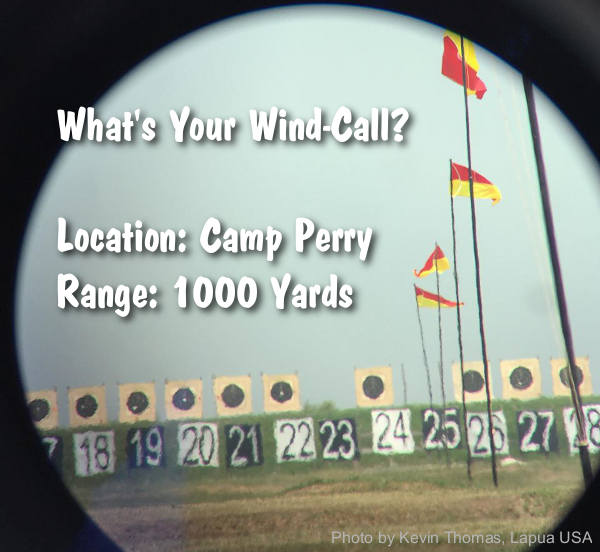


 Do you know which one of your eyes is dominant? It’s easy to determine eye dominance with a simple exercise. Pick an object about 6-10 feet away (a light switch or door knob works well). Make an “OK” sign with your right hand (see photo) and hold that about 18″ from your face. Now, with both eyes open, look through the circle formed by your thumb and index finger. Center the circle on the object, so you can see the object in the middle.


 “The NRA World Shooting Championship match is such a different breed — it’s really a difficult match for which to prepare! Over the past two years, I’ve learned to relax. I focus on relaxing in my own sport, because when you focus on the expectations over the procedure, it usually never works out in the shooter’s favor. The same goes for this match. You are tackling disciplines outside your expertise and using guns you aren’t familiar with, and that can really rattle your nerves if you don’t prepare for that mental challenge. But you can use this match design to your advantage. Remove all expectations, because, who is great at ALL the disciplines (besides Jerry Miculek)?! Give yourself some room to be ‘not so great’, focus on the fundamentals and try to enjoy the match. It is kind of liberating throwing everything to the wind and seeing how you stack up against all kinds of shooters! Coming from such a gear intensive sport as 3-Gun, I really enjoy walking up to 12 different stages and shooting guns and ammo that are provided. Although there may be issues with that format, it’s a great way to level the playing field, get down to brass tacks and see who is the most well rounded world champion shooter!” — Dianna Muller


