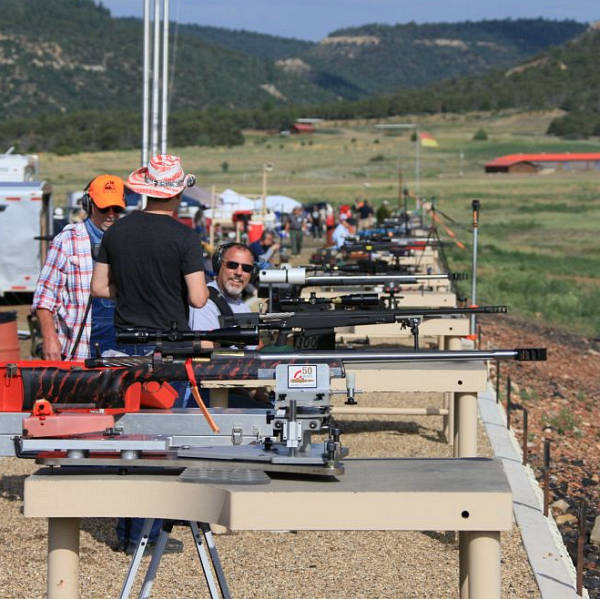
Are you a died-in-the-wool .50 BMG fan? Got a hankerin’ for heavy artillery? Then visit the FCSA Photo Gallery page. There you’ll find hundreds of photos from Fifty Caliber Shooting Association (FCSA) matches and 50 Cal fun shoots in eleven states plus Australia, Switzerland, and the United Kingdom. To access the photos from the Gallery Page, start by selecting a state/country and then click on the colored buttons for the event date (e.g. 2015-04).
Photo sets go all the way back to 2002, so you can see the evolution of the hardware over the years. Sample multiple archives to see the differences in terrain from one range to another — from Raton’s alpine setting to the hot, dry Nevada desert. This Gallery is really a treasure-trove of .50-Cal history. Here are a few sample images.
Story Tip from EdLongrange. We welcome reader submissions.
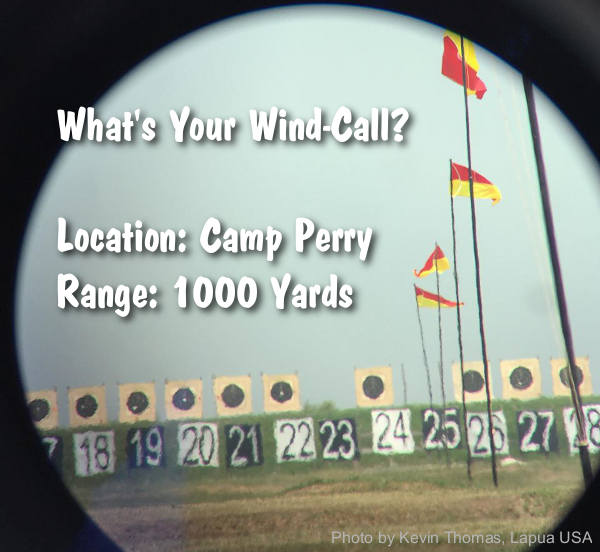
The ability to read the wind is what separates good shooters from great shooters. If you want to learn wind-doping from one of the best, watch this video with 2010 National High Power Champion (and U.S. Army 2010 Soldier of the Year) Sherri Gallagher. Part of the USAMU’s Pro Tips Video Series, this video covers the basics of wind reading including: Determining wind direction and speed, Bracketing Wind, Reading Mirage, and Adjusting to cross-winds using both sight/scope adjustments and hold-off methods. Correctly determining wind angle is vital, Sheri explains, because a wind at a 90-degree angle has much more of an effect on bullet lateral movement than a headwind or tailwind. Wind speed, of course, is just as important as wind angle. To calculate wind speed, Sherri recommends “Wind Bracketing”: [This] is where you take the estimate of the highest possible condition and the lowest possible condition and [then] take the average of the two.”
It is also important to understand mirage. Sheri explains that “Mirage is the reflection of light through layers of air, based off the temperature of the ground. These layers … are blown by the wind, and can be monitored through a spotting scope to detect direction and speed. You can see what appears to be waves running across the range — this is mirage.” To best evaluate mirage, you need to set your spotting scope correctly. First get the target in sharp focus, then (on most scopes), Sheri advises that you turn your adjustment knob “a quarter-turn counter-clockwise. That will make the mirage your primary focus.”
The National Shooting Sports Foundation is pleased to announce that registration is now open for its 2016 Fall Shooting Sports Fantasy Camps in Tulsa, Oklahoma. There will be two (2) sessions this October, each with 33 spots available.
Watch Highlights from the First-Ever Shooting Sports Fantasy Camp in Las Vegas:
The NSSF 2016 Fall Shooting Sports Fantasy Camp will take place at the world class United States Shooting Academy in Tulsa, Oklahoma. Two date options will be offered:
NSSF has lined up seven of our country’s top professional shooters for this premier event, including the first family of shooting, Jerry and Kay Miculek and Lena Miculek-Afentul, world class professional shooter, Bruce Piatt, 3-Gun pro couple Dianna and Ryan Muller, and Top Shot Season 4 winner Chris Cheng.
In addition to learning from today’s best shots, you’ll also be provided all meals, hotel accommodations, a swag bag full of premium shooting gear and more! You will need to provide your own travel arrangements and the camp registration fee of $3,495.
Camp Placements Will Sell Out Soon
If you are interestested, we recommend that you register soon — don’t delay. NSSF’s first Fantasy Camp (held this past spring in Las Vegas) sold out immediately. There are only 33 slots available for each date choice. For more information visit www.shootingsportsfantasycamp.com.
Ruger has created a series of videos showcasing competitive shooting competitions including: Rimfire Challenge, Metallic Silhouette, Biathlon, IDPA, SCSA (Steel Challenge), USPSA, and Cowboy Action shooting events. Log on to Ruger’s Beginner’s Guide to Shooting Competitions webpage to see informative videos for these sports. Rimfire Competition is affordable and fun, Silhouette is a great family sport, and the Steel Challenge is the ultimate pistol speed-shooting event.
INTRO to RUGER RIMFIRE CHALLENGE Matches
INTRO to STEEL CHALLENGE Pistol Competition
Ruger also offers many other cool videos, both on its Video Webpage and on Ruger’s YouTube Channel. On YouTube, you’ll find a great four-part Tactical Carbine video series, hosted by Dave Spaulding, winner of the 2010 Trainer of the Year award by Law Officer Magazine. There are also a number of videos featuring the Ruger Precision Rifle (RPR) a popular (and affordable) rig for Tactical/Practical shooting competitions. The video below explains the RPR’s adjustments:
Could your gun club or youth shooting group use money to upgrade range facilities or run training programs? Well here’s a chance to get some cold, hard cash to help with operations. Every year, the NRA Foundation Grant Program provides hundreds of grants to deserving organizations. The 2017 Grant Application is now available. CLICK HERE to Apply for a Grant.
Since its inception, the NRA Foundation has funded over 41,000 grants totaling over $300 million. Grants went to qualified local, state and national shooting sports programs, hunting and conservation programs, Second Amendment education and for the preservation of historical firearms.
Grant money comes from generous donors and volunteer fund-raising efforts. Through its Grant Program the NRA Foundation seeks to: 1) Promote shooting sports and hunting safety; 2) Help educate individuals in proper firearms use and marksmanship; and 3) Enhance shooting range facilities and support active shooting sports organizations.
Range Improvement Grants
Helping clubs improve shooting range facilities is one of the main missions of the NRA Grant Program. Such programs might include: Berm improvements (example below), Clubhouse improvements, Covered firing lines, Road improvements, Trap Machines, and other permanent improvements to club properties and/or facilities.
Our friend Kirsten Joy Weiss is a modern-day Annie Oakley. A very successful competitive shooter in the collegiate ranks, Kirsten now produces a popular YouTube Channel focusing on the “Joy of Shooting”. In her videos, Kirsten offers shooting tips and performs a variety of trick shots — such as splitting cards with a .22 LR rimfire. This young lady can shoot, that’s for sure.
In this video, Kirsten shoots at some tiny reactive targets — “Pop-Its”. These pea-sized targets “pop” audibly when hit. They make a very challenging target, even when bunched together. Kirsten secured three (3) Pop-Its with a clothespin, and then placed the clothespin in the ground.
It took a couple tries, but Kirsten did manage to light off a Pop-It or two. Kirsten reports: “Basically a small exploding target, Pop-Its, also known as ‘Bang Snaps’, snaps, snappers, party snaps, etc., are a fun firework trick noisemaker — but will they make a good target? Let’s put it to the test to see if these poppers are gun range-worthy targets. These little Pop-Its make for some challenging shots with reactive targets.” Enjoy the video:
Equipment Report: For this video, Kirsten shot Lapua .22 LR ammo in a Volquartsen Ultra-lite semi-auto .22 LR rimfire rifle, fitted with a C-More Red-Dot sight. She was using Oakley eye protection.
John Whidden of Whidden Gunworks won his fourth Long Range National Championship at Camp Perry this month. In this article, the first of a three-part series on Long Range competition, John shares his thoughts on wind strategies and keeping one’s composure in pressure situations. John tells us Camp Perry was very challenging this year: “The 2016 Long Range Championship will go down in my memory as one with quick wind changes that made it very easy to shoot a 9.”
How to Win at Long Range Shooting
(Or at least what worked at the 2016 National Championships)
by John Whidden, 2016 National Long Range Champion
The NRA Long Range National Championships at Camp Perry Ohio are now in the history books and the competitors are home and reflecting on what they could have done to improve their score. I think anyone who has ever competed always knows they could have done even better if they had changed this detail or that aspect. This is the case regardless of where a shooter places in the standings, even for the winners.
This year the winds were reasonably tough. We mostly have either headwinds or winds from the 2-3 O’clock positions with speeds often in the 9-11 mph range. The changes came quickly and we had to be on our toes. Fortunately the course of fire allows the shooters some options. For the 1000-yard matches, we typically have 33 minutes for preparation, an unlimited number of sighter shots, and then 20 shots for record. Many shooters will shoot about 3-5 sighters and complete the task in about 15 minutes.
The 2016 Long Range Championship was definitely a match where you had to fight for every point during the whole event.
In preparation for shooting by watching the wind, I realized that the quick changes were going to add to the difficulty. Given the conditions, I chose a strategy of choosing only one condition to shoot in and waiting during any changes away from my desired condition. This plan meant that I would have to be very patient and plan to use all of my 33 minutes allotted time if needed.
The sun was shining for most of the matches so we had mirage to look at. There are plenty of flags at Camp Perry and I was glad for them!
As the wind speeds get higher I think a shooter should study the appearance of the flags. Some people look at the flag, and some really LOOK at the flags. The difference is observing things like how many ripples are in the flag, how far the flag stands off the pole, the angle of the flag in a headwind or tailwind, and how high the tip of the flag is relative to where the flag is attached to the pole. These details make all of the difference.
Time Management and Patience
Patience in wind reading can be a virtue. Choosing a condition and being patient has probably yielded more success in my long range wind reading than any other method. It’s not the only way to go, but on a day when you have time available and patience on your side it can yield a win! It should be obvious now that keeping a timer and managing the available time along with the number of shots remaining is an important part of this.
Do you have a friend or family member who is just getting started in handgunning? The NSSF has created five Handgun 101 videos that cover the basics of handgun shooting, starting with key principles of firearms safety. Hosted by Top Shot Season 4 Champion Chris Cheng, these videos explain the important fundamentals of pistol shooting. If you will be taking a youngster (or novice adult) to the range for the first time, it would be a good idea to have him or her watch one or both of these videos. CLICK HERE to view all Handgun 101 videos.
Handgun 101: Rules for Safe Firearm Handling
Handgun 101: Single Action vs. Double Action Explained
Here are cool new reactive metal targets that spin rapidly when hit (watch video above). Birchwood Casey’s new Diamond Spinning Targets are fun to shoot. And, after each hit, the diamond automatically resets to face the shooter. That’s handy. There are three versions — all feature a durable metal frame that’s easy to place in the ground
Choose the Jack, King, or Ace of Diamonds depending on your intended use (and type of guns):
The Ace of Diamonds™ is constructed of ½” AR500 steel. That’s tough enough for centerfire handguns and rifles. The King of Diamonds™ is designed for .22 rimfire pistols and rifles. The least expensive variant, the Jack of Diamonds™, is rated for airguns up to 1000 fps. These Diamond Spinning Targets are made in the USA. For more info, visit www.birchwoodcasey.com or call 800-746-6862.
Yes, there are ten (10) shots. In the lower left (7 o’clock) of the group, two shots overlap!
Stunning 1000-Yard 10-Shot Group You’re looking at a stunning feat of rifle accuracy. That’s a sub-3″, ten-shot group shot at 1000 yards, all 10s or Xs. Measured at 2.856 inches, this group by shooter Mike Gaizauskas works out to 0.2727 MOA. Nearly quarter-MOA for ten shots at 1K! And the vertical for 7 of 10 shots is under an inch. Now that’s impressive. This was done with an IBS Heavy Class Benchrest gun, chambered for the 6.5×47 Lapua, a mid-sized cartridge originally designed for 300m competition.
Gun Specs: 6.5×47 Lapua chambering, Krieger 30″, 1:8″-twist barrel, Lapua 139 grain Scenars, Hodgdon H4350, CCI BR4 primers, Nightforce NSX scope. Smithed by Mark King, stock by Mike Gaizaukaus.
This amazing group, which establishes new IBS world records, was shot at the Harry Jones Memorial 1000-Yard Gun Club range in Fairview, West Virginia. Set in wooded, rolling hills, this range is shielded on all sides by thick stands of trees. It’s a beautiful facility, and you can see why, when conditions are right, the Harry Jones range can be about as close to shooting in a “tunnel” as you’ll ever get at 1000 yards. The Harry Jones Club in WV hosted the 2014 IBS Long-Range Nationals.
Mike’s remarkable 10-shot performance may be a Score Record as well as a group record, because all ten shots were in the 10-Ring and, under IBS rules, group size is the tie-breaker, rather than X-Count. Mike’s target was scored 100-3X, with two of the three Xs just clipping the outside of the X-Ring. Match directors reported: “On 7/24/2016, two new pending IBS 1000-yard world records were shot by Mike Gaizauskas with a 6.5X47 Lapua: 1) Heavy Gun Group (2.856″) and 2) Heavy Gun Score (100-3X). Congratulations Mike!” Here are the listed IBS records that will be broken, when this target is certified:
► Current IBS 1000-Yard Heavy Gun 10-Shot Single Group Record: 3.044″, Joel Pendergraft, 4/18/2009.
► Current IBS 1000-Yard Heavy Gun 10-Shot Single Group Score Record: 100 points, with 3.353″ group size tie-breaker, Gary Nicholson, 7/27/13.
Best 1000-Yard 10-Shot Groups Ever
This jaw-dropping 2.856″ group by Mike Gaizauskas also handily breaks the current NBRSA 1000-Yard, ten-shot Heavy Gun Record, which was 3.9912″ set by Bill Johnston on November 17, 2015. FYI: IBS and NBRSA Light Guns only shoot five-shot groups, so there is no equivalent IBS or NBRSA Light Gun 1K ten-shot record.
Only one other 10-shot, 100-score 1000-yard group was better than this in the history of rifle competition on this planet. Back in 2010, at a Williamsport match, Matt Kline shot a 2.815″ 100-4X. Depending on how Mike’s 2016 2.856″ group is finally measured, it could end up smaller than Matt’s. The difference (before final IBS verification) is only 0.041″, a mere four hundredths of an inch.
In 2014, Jim Richards fired a 10-shot Light Gun group at 1000 yards initially measured at 2.6872″. Shot under Williamsport Rules at the Deep Creek Range in Montana, that 10-shot group may be the smallest ever at 1K. However, the whole group was out in the 8 Ring, for a score of 80, not 100.
About the 6.5×57 Lapua Cartridge
To learn more about the record-setting 6.5×47 Lapua cartridge, including bullet and powder options and reloading tips, visit our comprehensive 6.5×47 Lapua Cartridge Guide.
The 6.5x47mm Lapua was developed in 2005 as a precision cartridge for 300m CISM rifle matches. Lapua (of Finland) and Swiss rifle-maker Grünig & Elmiger created this new cartridge to match the “pure accuracy” of the 6mmBR, but with even better ballistics. Following its debut as a 300m match cartridge, the 6.5×47 has proven to be a popular “jack of all trades”. Shooters have adopted this efficient, mid-sized cartridge because it offers excellent accuracy, mild recoil, good ballistics, and ample barrel life (plus it feeds well from a magazine). The 6.5×47 Lapua has won two NBRSA 600-yard Nationals. Now that this modern, mid-sized cartridge has set an all-time record for grouping precision at 1000 yards, we expect more shooters to experiment with this cartridge in the mid- and long-range benchrest disciplines.
Story Tip by Boyd Allen. We welcome reader submissions



 The ability to read the wind is what separates good shooters from great shooters. If you want to learn wind-doping from one of the best, watch this video with 2010 National High Power Champion (and U.S. Army 2010 Soldier of the Year) Sherri Gallagher. Part of the USAMU’s Pro Tips Video Series, this video covers the basics of wind reading including: Determining wind direction and speed, Bracketing Wind, Reading Mirage, and Adjusting to cross-winds using both sight/scope adjustments and hold-off methods. Correctly determining wind angle is vital, Sheri explains, because a wind at a 90-degree angle has much more of an effect on bullet lateral movement than a headwind or tailwind. Wind speed, of course, is just as important as wind angle. To calculate wind speed, Sherri recommends “Wind Bracketing”: [This] is where you take the estimate of the highest possible condition and the lowest possible condition and [then] take the average of the two.”




 Do you have a friend or family member who is just getting started in handgunning? The NSSF has created five Handgun 101 videos that cover the basics of handgun shooting, starting with key principles of firearms safety. Hosted by Top Shot Season 4 Champion Chris Cheng, these videos explain the important fundamentals of pistol shooting. If you will be taking a youngster (or novice adult) to the range for the first time, it would be a good idea to have him or her watch one or both of these videos.
 You’re looking at a stunning feat of rifle accuracy. That’s a sub-3″, ten-shot group shot at 1000 yards, all 10s or Xs. Measured at 2.856 inches, this group by shooter Mike Gaizauskas works out to 0.2727 MOA. Nearly quarter-MOA for ten shots at 1K! And the vertical for 7 of 10 shots is under an inch. Now that’s impressive. This was done with an IBS Heavy Class Benchrest gun, chambered for the 6.5×47 Lapua, a mid-sized cartridge originally designed for 300m competition.


