by Tony Chow
In recent years, the use of electronic trainer systems has revolutionized training in all disciplines of position shooting. By capturing (and illustrating) key performance variables like the steadiness of a shooter’s hold, accuracy of aiming, and the timeliness of trigger release, these devices can offer tremendous insights into the strengths and weakness of a shooter’s position and technique, making high-level marksmanship training less voodoo and more of a science.
Until now, electronic trainers all suffered from one critical limitation: the inability to be used outdoors in live fire training. Now, however, SCATT has introduced the next-generation MX-02 electronic trainer, a product that can finally support outdoor live firing in broad daylight, as well as dry firing indoors. In addition, the MX-02 is the first electronic trainer to support centerfire rifles. It goes without saying that, when we at AccurateShooter.com were offered an MX-02 test unit to review, we jumped at the opportunity.
How the SCATT MX-02 Works
The SCATT sensor mounted on the end of the barrel has a digital camera that “sees” the black bullseye in the target, even in broad daylight outdoors. Using the bullseye as a reference, the SCATT software tracks the movement of the muzzle relative to the center of the target. The unit can plot these movements as a continuous trace, which appears on a monitor as a squiggly, colored line. Data points from the trace are also available in a tabular spreadsheet format. This allows the shooter to “crunch the numbers”, revealing strengths and weaknesses in his gun-handling and aiming technique.
In our testing, we confirmed that, like SCATT’s earlier indoor-only WS-01, the MX-02 offers excellent support for indoor dry-fire training, which will continue to be the primary means through which position shooters sharpen their fundamental skills. Since the new SCATT uses the same familiar Windows software for data capture and analysis as its predecessors, shooters and coaches upgrading to MX-02 will have no learning curve to overcome, and newcomers to the SCATT platform can tap into the wealth of institutional knowledge accumulated over the years by the shooting community on how to interpret shot data.
It’s in the support for outdoor live firing, however, that SCATT MX-02 distinguishes itself from its predecessors and the competition. Shot trace data captured by MX-02 during live firing turned out to be every bit as valuable (and revealing) as we had hoped. The ability to correlate SCATT tracing with real shots on target gave us a better understanding of the shooting process, and helped the reviewer, already a high-level smallbore prone shooter, uncover a significant problem in his shooting. SCATT MX-02’s outdoor capability is therefore an invaluable feature, particularly for experienced shooters aspiring to world-class performance.
In summary, SCATT MX-02 is an outstanding product that delivers on its promises. We heartily recommend it, both for first-time users of electronic training aids, and also for those shooters who may wish to upgrade their current electronic training system. The MSRP for SCATT MX-02 is $1,799, $500 more than its predecessor, the SCATT WS-01, which is still available. In my view, the $500 premium for the MX-02 is justified by the MX-02’s enhanced capabilities, making it a better long-term investment.
Our complete, 3600-word MX-02 review of the SCATT MX-02 can be accessed through the link below. This full review contains many more photos plus detailed field test results. For the time being, the review only covers our experience with the product in smallbore shooting. An upcoming addendum to the review will include test results from centerfire shooting. Those attending SHOT Show in Las Vegas next week can examine SCATT MX-02 in person. SCATT will have the MX-02 on display at Booth 111.
To succeed in long-range shooting matches, given the high level of competition these days, you’ll need solid wind-reading abilities. We’ve found an article by SFC Emil Praslick III, retired USAMU Service Rifle coach and U.S. Palma Team Coach, that can help you make better wind calls in competition.
Emil Praslick, now retired from the U.S. Army, is considered one of the best wind gurus in the United States, if not the world. During his service with the USAMU he authored an excellent two-part article on wind reading that is available on the CMP (Civilian Marksmanship Program) website. Both articles contain helpful illustrations, and are “must-read” resources for any long-range shooter–not just Service Rifle and Highpower competitors.
Part One covers basic principles, tactics, and strategies, with a focus on the 200-yard stages. Emil writes: “There are as many dimensions to ‘wind reading’ as there are stages to High Power competition. Your tactical mindset, or philosophy, must be different for the 200 and 300 yard rapid-fire stages than it would be for the 600 yard slow-fire. In the slow-fire stages you have the ability to adjust windage from shot to shot, utilizing the location of the previous shot as an indicator. Additionally, a change to the existing conditions can be identified and adjusted for prior to shooting the next shot.”
In Part Two, Praslick provides more detailed explanations of the key principles of wind zeros, wind reading, and the “Clock System” for determining wind values: “The Value of the wind is as important as its speed when deciding the proper windage to place on the rifle. A 10 MPH wind from ’12 o-clock’ has No Value, hence it will not effect the flight of the bullet. A 10 MPH wind from ‘3 o’clock’, however, would be classified as Full Value. Failure to correct for a Full Value wind will surely result in a less than desirable result.”
Praslick also explains how to identify and evaluate mirage:
Determine the accuracy of the mirage. Mirage is the reflection of light through layers of air that have different temperatures than the ground. These layers are blown by the wind and can be monitored to detect wind direction and speed.
Focus your scope midway between yourself and the target, this will make mirage appear more prominent. I must emphasize the importance of experience when using mirage as a wind-reading tool. The best way to become proficient in the use of mirage is to correlate its appearance to a known condition. Using this as a baseline, changes in mirage can be equated to changes in the value of the wind. Above all, you must practice this skill!
Click HERE for more excellent instructional articles by Emil Praslick and other USAMU Coaches and shooters.
Do you shoot with a SEB joystick-equipped bipod, or are you considering acquiring a “Joy-Pod” for your F-TR rifle? Then you should read this article. Here Sebastian (“Seb”) Lambang, the inventor and builder of the SEB joystick bipod, offers tips on shooting with this impressive piece of engineering. Seb explains some techniques that can help with tracking and getting back on target. You can ask SEB questions about his Joy-Pod in this Shooter’s Forum Thread.
Joy-Pod Shooting Tipsby Seb Lambang
1. Be sure that the rear bag is settled before starting to shoot. Tap your stock into the bag. Then move your rifle back and forth, while checking your reticle. If it tracks straight, vertically perfect, and comes back to the original point of aim, it’s fine. If not, re-adjust.
2. If you use the Pod-Pad, be sure it is fully settled before starting to shoot. Tap the top where the feet rides on using your palm — you wan to create a flat top. To be sure the Pod-Pad does not move or slide, remove any gravel or pebbles under the pad — these can act as roller bearings.
3. Be sure your shooting mat is NOT springy or spongy. This is very important. Use a proper mat, or cut it if possible so your rear bag rests directly on the ground. Use a heavy rear bag. You can use a sand-filled doughnut (not a rigid spacer) to stabilize the bag on uneven ground. These doughnuts are relatively inexpensive and really work.
4. Be sure your whole body position is correct, so your shoulder is square. “Follow” the recoil with your shoulder, don’t push “against” it. Don’t move too much. Don’t make unimportant movements during your shooting string. Always be as consistent as you can in all things — how you hold the rifle, even how you breathe before taking the shot.
This young lady shooter is using a first generation Joy-Pod. The newer versions have flat, ski-like feet.
5. Be sure your rifle and rear bag are aligned. You want the slot between the ears of the bag perfectly aligned with your barrel. (You can use a yardstick or a piece of string to help with the alignment).
6. Use a heavy rear bag. The heavier and the more stable, the better.
7. It does not matter (from my own experience) whether you light-hold the joystick or leave the joystick in the air when you shoot (see Darrell Buell video — he shoots “hands off”). I believe the bullet already exits the muzzle before the joystick moves in your fingers. I lightly hold the joystick myself, just as I would hold a billiard stick.
Watch Darrell Buell shooting his .375 CheyTac equipped with a counter-balanced Joy-Pod. Note how the gun comes straight back, and how Darrell can release the joystick before breaking the shot.
SUMMARY — When It All Comes Together
If everything is set up right, and done correctly, your rifle will track beautifully straight and your reticle will come back or very close to the original point of aim, every time. If you have to change the Joy-Pod, rear bag, or your body position after a shot, there could still be something wrong with your set-up, alignment, or body position. When everything is right, you can also see your own score in the scope after every shot you make (after initial recoil). You also should not have to change the bipod’s setting, the height, the cant etc., at all. You only need to adjust for the current condition with the joystick, the joystick will do it all. That’s why we call our bipod the JOY-Pod.
SEB JOY-POD Joystick Bipod, and POD-PAD
Weighing in at just 18 ounces (510 grams), the Gen 2 Joy-Pod is unlike any other bipod on the market. Designed specifically for weight-restricted shooting classes, the Joy-Pod offers smooth and precise joystick-controlled aiming. The Gen 2 model offers up to 14 degrees of cant and an improved design that functions with up to 50 pounds of rifle weight. Each Joy-Pod comes with a Weaver rail adapter. The optional Pod-Pad accessory is designed expressly for the Joy-Pod. It works filled or unfilled with the Joy-Pod’s sleds to bring you back to your shooting position easily. CLICK HERE for more information, or visit SebRests.com.
.308 Win Tactical Rifle fitted with Joy-Pod on Pod-Pad. CLICK HERE for Video.
Nielsen-Kellerman (NK), makers of Kestrel® Weather Meters, has launched a new website, www.KestrelBallistics.com. The new mobile-friendly site features a Schoolhouse section with a wide range of information for long-range shooters of all skill levels. There you’ll find “How-To” guides and technical articles by respected ballistics and firearms experts. Along with the Schoolhouse, and a resource section offering free downloads of technical manuals, NK’s new Ballistics website will feature a webstore where customers can purchase long-range shooting accessories such as scopes, range finders, weather vanes, and Kestrel weather/ballistics meters. Along with Kestrel products, the eStore will offer Bushnell optics, MagnetoSpeed chronographs, and Accuracy 1st Ballistic Solvers.
The Schoolhouse resource offers articles from Kestrel’s own experts as well as Kestrel’s industry partners Applied Ballistics and Accuracy 1st. The purpose of the Schoolhouse section is to provide up-to-date information about industry advances and new techniques, as well as to provide comprehensive, detailed “how-to” guides for owners of Kestrel Weather Meters and Ballistics Calculators. Shown below is the Schoolhouse section that explains how to set up a Kestrel.
“As Kestrel has progressed in the long-range shooting space, we have seen that there is a real thirst for knowledge among long-range shooters. Just as we never ship a product without ensuring that it will provide accurate, reliable information, we will ensure that KestrelBallistics.com only contains articles, advice and products that customers can rely on. We are truly enjoying expanding our customer offering in this area.” stated Nielsen-Kellerman CEO, Alix James. NK’s new Ballistics site provides information and resources that can benefit all long-range shooters, whether they are primarily interested in hunting, competitive, or tactical shooting.
Baseball and car racing have their fantasy camps, and now the shooting sports has its own successful version following the inaugural NSSF Shooting Sports Fantasy Camp last week in Las Vegas. Sold out just days after being announced, the Shooting Sports Fantasy Camp attracted 30 shooters from across the country. The big draw was the opportunity to work with top shooting champions Jessie Duff, K.C. Eusebio, Julie Golob, Jerry and Kay Miculek, and Dianna and Ryan Muller. The NSSF made sure that “fantasy” wasn’t just a catchphrase. Not only were Camp guests provided personalized instruction by top shooting pros, but the Fantasy Camp included a three-night stay at the luxurious Las Vegas’ Aliante Hotel + Casino + Spa, all meals from arrival to departure, as much ammo as Campers could send downrange for the weekend, a bevy of new guns to try, evening cocktail receptions, plus a swag bag full of shooting gear.
“It was awesome,” said camper Georgiann Pharis. “[This] far exceeded any expectations I ever had.” And she added, “When [the pros] ride to the range on the bus with you, that says a lot to me. They’re not above you. They’re here on our level showing us how to get to their level. That’s a big plus.”
Jessie Duff Was One of the Fantasy Camp Instructors
Industry Sponsorship Support
“We knew when this event sold out immediately that we were onto something big,” said Chris Dolnack, NSSF Senior VP and Chief Marketing Officer. “We are always looking for ways to connect the industry with our customers, to show the public that shooting sports are on par with other major league sports[.]”
This first-ever fantasy camp was made possible through the support of many companies: SIG SAUER, Ruger, Taurus, PolyCase Ammunition, Hornady Ammunition, Winchester Ammunition, Federal Premium Ammunition, Kahr Firearms Group, HIVIZ Sight Systems, FIME Group/Arex, and LWRCI.
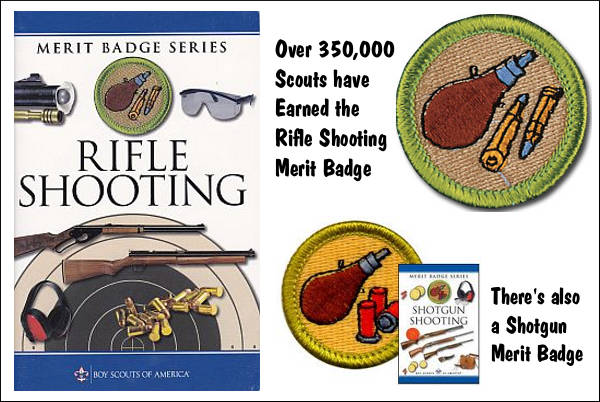
Last year 43,196 young Americans earned a very special marksmanship distinction. Can you guess what that was? Here’s a hint — the award helps a young person become an Eagle Scout. That’s right, last year 43,196 Boy Scouts earned the Marksmanship Merit Badge for rifle shooting. This is one of the toughest badges to earn, according to Scouting leaders, but it is still one of the most popular badges among Scouts — it fact it is the second most earned elective merit badge. Since 1910, over 350,000 Scouts have earn Rifle Shooting Merit Badges. Millions more have participated in Boy Scout Shooting programs. Merit badges are offered for both Rifle Shooting and Shotgun shooting.
Mark Keefe, editor of the American Rifleman explains: “According to Scouting magazine, the Rifle Shooting Merit badge was number two of the non-required badges earned by all Boy Scouts cross country last year with 43,196 Rifle Shooting merit badges sewn on sashes. Since 2009, again according to Scouting, nearly 350,000 Rifle Shooting merit badges have been earned. That’s a lot of merit badges — and a lot of .22 Long Rifle downrange.”
The Marksmanship Merit Badge has been offered by the Boy Scouts of America (BSA) since the first Boy Scout Handbook in 1910. Keefe explains: “Back in 1910 to earn the ‘Marksman’ Badge of Merit, you had to ‘Qualify as a marksman in accordance with the requirements of the National Rifle Association.’ And NRA and the BSA of have had a strong partnership for more than a century, and both organizations remain committed to teaching firearms safety and marksmanship.”
Ever find yourself sitting in an airport, bored out of your gourd? Well here’s how to make good use of your time — listen to a gun-centric Podcast. There are a number of interesting Podcasts for shooters and firearms fans. A Podcast is like an old-fashioned radio show, but delivered over the internet. You can listen “live” or save the Podcast file for later review. That’s great when you’re on an airplane and don’t have a web connection. Download some Podcasts to your smartphone before you get to the airport and then you can play them back during your flight.
Our friends at the NRA Blog have researched Podcasts for fans of the shooting sports. It turns out that Podcasts are more popular than ever: “The Great Podcast Renaissance is upon us! Podcasts have been around for about 10 years now. It’s easier now than ever for anyone and everyone to make their own podcast, which is why the number of podcasts and variety of show topics have greatly increased.”
The Gun Girl Radio Podcast is hosted by our friends Julie Golob and Randi Rogers, both top action shooting competitors. Julie served with the U.S. Army before embarking on her professional shooting career. Randi has been a champion in various shooting disciplines including Cowboy Action and 3-Gun.
2. The Firearms Radio Network
With more than a dozen different podcasts, the Firearms Radio Network (FRN) offers a large range of audio programming. Whether you’re a tactical shooter, or a handgunner, or a hunter, you’ll find something of interest. This network also offers a regular podcast dedicated to hand-loading. Here are some of our favorite FRN podcasts:
3. Tom Gresham’s GunTalk
Tom Gresham’s GunTalk is the only nationally-syndicated radio talk show about firearms, shooting and gun rights. It is available as a live radio broadcast as well as recorded podcasts. Each week Tom host notable guests from the firearms industry and shooting sports.
4. Hunt Talk Radio
Randy Newberg’s Hunt Talk Radio covers hunting politics, access to public lands, and conservation topics. Expert hunters and guides join Randy each week, sharing their field skills and stalking tips.
There’s a chap in New Zealand who has produced some of the most valuable (and well-researched) books on hunting you can buy. Nathan Foster’s Long Range Hunting series of books is a gold mine for rifle shooters seeking verified, first-hand knowledge of the performance of hunting cartridges, plus expert “how-to” advice on field skills, stalking, marksmanship, and ballistics.
Right now, Foster’s company, Terminal Ballistics Research (TBR), is offering Easter Special discounts on its most popular book titles. For starters, as a Easter weekend promotion, you can get 15% off the Practical Guide To Long Range Shooting in paperback or eBook format. This book is chock-full of information that will benefit competition marksmen as well as long-range hunters. You’ll find good advice on use of BDC and Mil-dot reticles, plus extensive sections on ballistics.
Other TBR books by Nathan Foster are on sale as well:
Do you know someone who wants to get started in pistol shooting? Here’s a new opportunity. The NRA now offers its Basics of Pistol Shooting Course in an online format. That makes it easy to cover the “classroom” part of the course on your own time. The $60.00 online course includes 11 step-by-step lessons (to be followed by live range training). CLICK HERE to enroll in online Pistol Training Course.
Train Online, Then Register for a Range Session
For the NRA Basics of Pistol Shooting course, Phase 1 is conducted in an online environment, completed on your own time (cost is $60.00, non-refundable). After successfully completing the online exam, students can register for Phase 2, the instructor-led training session. Phase 2 is conducted at your local range with an NRA Certified Instructor. You must successfully complete Phase 1 and Phase 2 in order to receive your NRA Basics of Pistol Shooting course certificate.
Designed and developed by experts to accommodate busy schedules, the web-based course takes a blended learning approach to firearms training with both online and physical components. Students have 90 days to work through 11 online lessons before registering for Phase 2, the NRA Certified Instructor-led phase at a local range. “America has more first time gun owners than ever and the NRA remains dedicated to being the number one provider of firearm training,” said Executive Director of NRA General Operations, Kyle Weaver. “Thanks to our online courses and network of more than 125,000 NRA Certified Instructors, it has never been easier to learn basic firearm skills.” The NRA offers other online training courses at Onlinetraining.nra.org. These offerings include a Range Safety Office (RSO) course, and a Range Development and Operations course.
After the success of its recent winter Ballistics seminar in Michigan, Applied Ballistics has decided to take its show on the road, offering additional Ballistics seminars in three different states (Texas, Michigan, and North Carolina). These three seminars will cover a wide range of topics, with the primary focus on basic to advanced ballistics principles as applied to long-range shooting. Registration is now open for the three (3) upcoming Ballistics Seminars:
This video explains the subjects covered by Applied Ballistics Seminars:
Ballistician (and current F-TR National Mid-Range and Long-Range Champion) Bryan Litz will be the primary speaker at the spring, summer, and fall seminars. He will present material from his books and the Applied Ballistics Lab, and he will discuss his experience shooting in various disciplines. The seminar will feature structured presentations by Bryan and other noted speakers, but a great deal of time will be alloted for questions and discussion. By the end of the seminar, participants should have a much better understanding of how to apply ballistics in the real world to hit long-range targets. Along with Bryan, other respected experts will include:
Emil Praslick III – Head coach of the U.S. Palma team and retired head coach of the U.S. Army Marksmanship Unit. Emil will discuss tactics, strategy, and mindset for successful wind-reading.
Eric Stecker – Master Bulletsmith and President of Berger Bullets. Eric will be presenting on precision bullet making technology.
Nick Vitalbo – Owner of nVisti Tactical Innovations and chief engineer for Applied Ballistics. Nick will discuss the state of the art in laser rangefinders and wind reading devices.
Mitch Fitzpatrick – Applied Ballistics intern and owner of Lethal Precision Arms. Mitch specializes in Extended Long Range (ELR) cartridge selection and rifle design.
Ballistic Solvers – How they work, best practices, demos.
Weapon Employment Zone (WEZ) Analysis – How to determine and improve hit percentage.
Optics and Laser Technology – State of the Art.
The seminars costs $500.00. But consider this — each seminar participant will receive the entire library of Applied Ballistics books and DVDs, valued at $234.75, PLUS a free copy of Applied Ballistics Analytics software, valued at $200.00. So you will be getting nearly $435.00 worth of books, DVDs, and software. In addition, a DVD of the seminar will be mailed to each attendee after the seminar concludes.


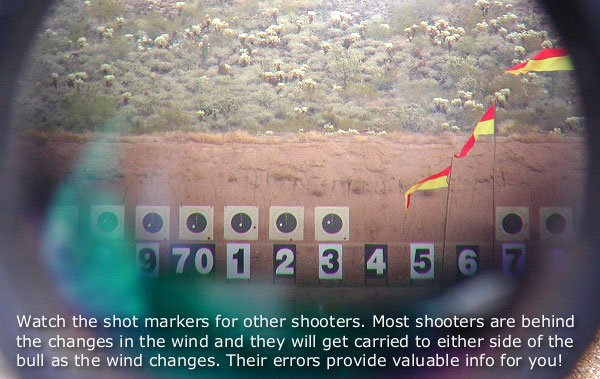
 To succeed in long-range shooting matches, given the high level of competition these days, you’ll need solid wind-reading abilities. We’ve found an article by SFC Emil Praslick III, retired USAMU Service Rifle coach and U.S. Palma Team Coach, that can help you make better wind calls in competition.
 Part One covers basic principles, tactics, and strategies, with a focus on the 200-yard stages. Emil writes: “There are as many dimensions to ‘wind reading’ as there are stages to High Power competition. Your tactical mindset, or philosophy, must be different for the 200 and 300 yard rapid-fire stages than it would be for the 600 yard slow-fire. In the slow-fire stages you have the ability to adjust windage from shot to shot, utilizing the location of the previous shot as an indicator. Additionally, a change to the existing conditions can be identified and adjusted for prior to shooting the next shot.”