We are in the midst of “March Madness” — the annual NCAA college basketball tournament. Here’s a clever piece by Hap Rocketto that examines the game of B-Ball and explains why shooting targets is actually more difficult than shooting hoops. This story originally appeared in the Hap’s Corner section of Pronematch.com. Hap is a rare talent in the gun world — a serious shooter who also has unique insights, and a great sense of humor. We recommend you visit Pronematch.com to enjoy the many other interesting Hap’s Corner postings.
by Hap Rocketto
I know shooting is tougher than basketball…. Come on, just how difficult is it for five tall guys to help each other toss a big ball into a basket? Granted basketball is more physically demanding than shooting a rifle, but I think that blasting a quarter-size group into the center of the target at 100 yards all by yourself is a far more difficult task than working as a team to dunk a ball.
Therefore, in the style of Late Night talk show host David Letterman, I have constructed a list of ten reasons why rifle shooting is tougher than basketball.
TOP TEN REASONS Why Rifle Shooting is Tougher Than Basketball
10. When you get tired in basketball the coach just calls time out and replaces you with someone fresh. Not so in shooting.
9. When’s the last time a basketball player had to make a shot with the sun in his eyes?
8. How often does a basketball player have a perfectly good shot blown out by the wind?
7. If a basketball player places a shot a little higher than intended, no problem. The backboard causes the ball to bounce into the basket. No such luck in shooting.
6. Rifle matches commonly run all day. When was the last time you saw a basketball game run more than an hour or so?
5. If you’re not making your shots in basketball, you can just pass the ball to someone who is hot. No such convenience in shooting.
4. Rifle bullets travel faster than the speed of sound (roughly 300 meters per second). Basketballs top out at around 15 meters per second.
3. A basketball player can shoot from anywhere on the court that is convenient and comfortable. All riflemen shoot from the same distance.
2. A basketball player may shoot as often as the opportunity arises and is not limited to the number of shots taken. A rifle match requires that each rifleman shoot the same number of record shots. If they shoot more than allowed, then a penalty follows.
1. And the Number One reason why shooting is tougher than basketball is that, if you miss a shot in basketball you, or a team mate, can just jump up, grab the ball, and try again. Try that in shooting.
The only real similarity between the two sports is that a competitor attempts to score points by shooting. In rifle it is through a hard-hold and easy squeeze in prone, sitting, kneeling and standing; while in basketball it is via hook shots, jump shots, lay-ups, or the dramatic, ever crowd-pleasing, slam dunk.
About the Author: Hap Rocketto is a Distinguished Rifleman with service and smallbore rifle, member of The Presidents Hundred, and the National Guard’s Chief’s 50. He is a National Smallbore Record holder, a member of the 1600 Club and the Connecticut Shooters’ Hall Of Fame. A historian of the shooting sports, his work appears in Shooting Sports USA, the late Precision Shooting Magazine, The Outdoor Message, the American Rifleman, the CMP website, and Pronematch.com.
Credit John Puol for finding this article and communicating with Hap Rocketto.
Midsouth Shooters Supply now carries the full line of shooting and reloading books from Krause Publications at very attractive prices. Looking for reliable reference works on reloading, or a gift for a shooting buddy? You’ll find something worthwhile among the Krause library of gun books, which includes the respected Gun Digest Shooter’s Guides. Match directors also take note — books make great match prizes. Paperback books cost no more than wood plaques but they will provide valuable information for years instead of just gathering dust in a closet. If your club offers training programs, Krause offers many titles that will help new shooters improve their skills.
Here Are Some of our favorite Krause Shooting and Reloading Titles:
Are you looking to improve your long-range shooting? Doubtless you’ve been thinking about upgrading your rifle or optics, but wonder what to buy (and how to get the best “bang for your buck”). In this video, Bryan Litz of Applied Ballistics offers “solid gold” advice on equipment selection for mid-level shooters (i.e. those who are somewhere between “newbie” and “Master of the Universe”). Bryan explains the logical first step is a barrel upgrade — a new tube from a top-barrel maker can make a huge difference. Then you should research the best factory ammo for your rifle, or get started in precision hand-loading. Bryan also offers advice on choosing a scope and optics accessories.
Equipment Upgrades: Barrel, Optics, Ammoby Bryan Litz
Every equipment element can be upgraded. You can run that factory rifle for a period of time, but the barrel eventually is going to be what holds you back. The twist rate probably won’t be fast enough to stabilize the high-BC bullets that you want to shoot at long range. So, the first thing you want to upgrade on your factory rifle is probably going to be the barrel. [With a new custom barrel] you’re going to get a fast twist rate, you’re going to get a chamber that’s optimized with a throat for your … bullet. And a good quality custom barrel is going to be easier to clean, won’t foul out as much, and it’s going to improve to overall accuracy and precision of your shooting. Barrel swaps are very common and routine thing for gunsmiths to do.
The next thing is improving your scope. If you don’t have a quality optic it’s going to hold you back. The job of the scope is to precisely and perfectly delineate [the target] within a half a degree (from 100 to 1000 yards is only a half a degree). The scope has got to put you on the money within that half a degree. So, it’s not a piece of equipment you want to go cheap on.
The other big factor is your ammunition. Getting into hand-loading is meticulous and it takes a long time to learn, but ultimately you’ll be making ammunition that is tailored for your rifle, and there simply won’t be anything better for your rifle than what you can develop through individual handloads.
So that’s typically the upgrade path: Get your factory rifle re-barreled, don’t skimp on a scope (or anything that attaches to it), improve your ammunition (whether by upgrading to better factory ammo or hand-loading on your own). All through this process is continuous learning… Once you have the best equipment (and it doesn’t get any better), the process of learning and education never ends. That is something you build on every single time you go to the range, and it’s what going to allow you to continually improve your skills.”
No matter what kind of rifle you shoot, whether it be an AR or a brenchrest rig, the principles are the same — develop a good load, learn the gun, hone your wind-reading skills, and practice in all conditions. Making a video of a practice session can help you identify and correct bad habits.
Bryan Litz says “don’t skimp on your scope”. Purchase a quality scope, rings, and scope level. Successful long-range shooting all begins with your view of the target.
Even with a top-of-the-line F-TR rig like this, you still have to practice diligently, putting in the “trigger time” needed to improve your game.
We recently showed a video of an incident at a pistol match that easily could have resulted in the death of a range worker. If you watched that video, you’ll understand that one momentary oversight is all it takes to put someone in the hospital (or the morgue). That’s why shooters should be prepared for the worst. Get first-aid training, and carry a basic first-aid kit whenever you go to the range.
Carry a Basic First-Aid Kit Shinnosuke Tanaka, reporter for RECOIL Magazine, offers some good advice: “OK, most of us have seen the [pistol match incident] video. YES, it is RSO’s fault not checking down range enough. BUT it’s your bullet that could hurt someone when it happen. So don’t let someone take care of safety for you, look around one more time after the command ‘Make ready’.”
Four basic firearms safety rules always apply. The Fourth Rule is: “Always be sure of your target and what is beyond it”. Shinnosuke adds: “My own fifth rule is ‘If there is doubt, don’t pull the trigger’.”
Shinnosuke cautions: “If you play with firearms you should know how to deal with gunshot wounds… Carry a simple medical kit. Here is my first aid kid, always carried on top of my shooting pack. Seek professional training and know how to use it. It’s your responsibility to stop the loss of your blood when an accident happens.”
Watch Gun Shot First Aid Video
If someone at a range is seriously injured by a gunshot, you should immediately summon emergency medical professionals. In addition, basic first aid can help stabilize the injured individual. This 55-minute video explains Basic First Aid for Gunshot Wounds:
Editor’s Comment: All long-range competitive shooters should watch this excellent video — whether you shoot with a team or as an individual. Three cameras were used so you can watch the shooter, the range flags, and the target simultaneously. After a discussion of scoring, the actual shooting starts at the five-minute mark in the video. Under the guidance of wind coach Gary Rasmussen, former U.S. F-Class Open Team Captain Shiraz Balolia shoots 100-7X for ten shots, following Gary’s wind calls. Shiraz is the President of Grizzly Industrial
Team Shooting with a Coach Shiraz tells us: “We come across a lot of shooters who have never shot under a coach. This video was produced to give shooters a basic understanding of shooting with a coach and the importance of releasing a good shot. In a team setting, you basically leave all the decision-making to the coach and aim where you’re told to aim. I’ve worked with Gary many times and it shows in the comfort level we have with each other. The coach plots the shots or a plotter advises the coach of any grouping that is not centered.”
Watch Gary Call the Wind and Shiraz Shoot 100-7X for Ten Shots
For best viewing, click the YouTube settings button to watch in 720p or 1080p HD (high definition).
Shiraz was shooting a 7mm F-Open rig: “My .284 Shehane rifle takes about 10 to 12 shots to settle down and that is probably why we made several scope adjustments while shooting. It is a great caliber and a step up from a straight .284 Winchester. The wind was relatively calm, but sometimes that slow wind with subtle angle changes can be very deceiving.”
The video was shot the first week of May 2013 at a range in Custer, WA located about 20 miles from Bellingham, Washington. The production team included Shiraz Balolia, Gary Rasmussen, three cameramen, and a target puller. Big Thanks to Grizzly Industrial for providing the camera crew and post-production talent.
You have probably watched one of the excellent shooting sports videos Ryan Cleckner has done for the NSSF. Ryan’s Understanding Minute of Angle (MOA) video has been viewed over one million times. Ryan is noted for his ability to explain complex topics in an easy-to-comprehend manner. Now Cleckner has authored a book, the Long Range Shooting Handbook, which expands on the topics covered in his popular video series. You can view Sample Chapters from Ryan’s Book on Amazon.com.
As a long-range shooting expert, Ryan Cleckner has impressive credentials. Cleckner was a special operations sniper (1/75 Rgr) with multiple combat deployments, and he has served a U.S. Army sniper instructor. Currently he works as a firearms industry executive and attorney.
The Long Range Shooting Handbook is divided into three main categories: What It Is/How It Works, Fundamentals, and How to Use It. “What It Is/How It Works” covers equipment, terminology, and basic principles. “Fundamentals” covers the theory of long range shooting. “How to Use It” gives practical advice on implementing what you’ve learned, so you can progress as a skilled, long range shooter.
Ryan Cleckner’s new book is designed as an introduction to important fundamental concepts such as MOA vs. Mils, External Ballistics, and Environmental Effects. Included are personal tips and advice based on Cleckner’s years of experience as a sniper instructor and special operations sniper.
Iain Harrison, editor of Recoil Magazine said: “Whether you’re looking to dip a toe into the complex world of long range shooting, or you’re a seasoned shooter with years of trigger time, Ryan Cleckner’s book will prove to be excellent reference material. Well written and easy to understand, it covers all the essential topics that a well-rounded shooter needs to master.”
Blast from the Past: As we get set up in Phoenix for the 2016 Berger Southwest Nationals, we thought we’d revisit one of our more interesting features from a few years back. At the 2010 SHOT Show, we had the unique opportunity to corner three “superstars” of High Power shooting, and solicit their wind-reading secrets. Carl Bernosky, David Tubb, and John Whidden all shared some championship-caliber wind wisdom in video interviews. If you shoot competitively, you’ll want to watch these videos. David’s video is worth watching twice because some of the key points he makes go by pretty quickly.
In the three videos below (in alphabetical order), Carl Bernosky (10-Time Nat’l High Power Champion), David Tubb (11-time Nat’l High Power Champion and 7-time Nat’l Long-Range Champion), and John Whidden (2-Time Nat’l High Power Long-Range Champion) shared some of the wind-doping strategies that have carried them to victory in the nation’s most competitive shooting matches. This is GOLD folks… no matter what your discipline — be it short-range Benchrest or Long-Range High Power — watch these videos for valuable insights that can help you shoot more accurately, and post higher scores, in all wind conditions.
We were very fortunate to have these three extraordinarily gifted champions reveal their “winning ways”. These guys REALLY know their stuff. I thought to myself: “Wow, this is how a baseball fan might feel if he could assemble Babe Ruth, Hank Aaron, and Ted Williams in the same room, and have them each reveal their hitting secrets.” Editor’s Note: These interviews were conducted before Bernosky and Tubb won their most recent National Championships.
The NRA Blog has published a nice set of super-sized playing card targets. These boast a variety of aiming points (large and small) so they work well for rifles as well as pistols. On the Queen of Diamonds, aim for the large bull-style designs in the “red zone” or aim for the smaller dots on the periphery. For a real challenge, try to shoot each one of the 26 small red diamonds in the curved, central white stripes.
On the Five of Clubs target, you can aim for the smaller club symbols, or shoot for the orange, purple, and green “dripping paint” bulls in the large, central club. The Ace of Spades target offers a colored bullseye in the center, plus a very small bullseye in the letter “C”. Last but not least, the Eight of Hearts is a perfect choice for a trip to the range on February 14th, Valentine’s Day.
The 2016 Berger Southwest Nationals event is less than a week away. If you need some last-minute practice before this match and you don’t have the time (or money) to load a couple hundred rounds of centerfire ammo, consider rimfire practice. Past F-TR National Champion James Crofts attributes much of his success to plenty of trigger time with his rimfire training rifle.
Rimfire Training for F-Classers
2014 and 2012 U.S. National F-TR Champion James Crofts is one of America’s top F-Class shooters. A member of the 2013 World Championship-winning F-TR Team USA squad, James knows a thing or two about long-range shooting, that’s for sure. But you may be surprised to learn how James sharpens his shooting skills at relatively short distances. You see, James often practices with a .22 LR rimfire rifle at distances from 50 to 200 yards. James tells us: “Shooting my F-Class rimfire trainer saves me money and improves my shot process and wind-reading abilities.”
Remington rimfire 40X barreled action in PR&T LowBoy stock with PT&G bolt.
Rimfire Training Teaches Wind-Reading Skillsby James Crofts
Training with the rimfire is extremely useful and can be done from 25 yards out to 200 yards. I am lucky and can shoot 50 yards right off my back deck. That is far enough that any miscue on rifle handling will show up on the target. I use a two dry-fire to one actual shot routine for my practices. This gives me much more positive reinforcement without any negative reinforcement.
Wind reading is extremely important with a .22 LR rifle. I use a set of smallbore flags to aid my wind calls. The smallbore flags are a must and force you to look at the flags and mirage on each and every shot. If you think the flags at Camp Butner move a lot, try smallbore flags around tall pine trees.
James Crofts — Photo by Kent Reeve.
Rimfire Training Is Cost-Effective
Rimfire ammunition is much less costly than centerfire ammo. Though .22 LR prices have risen in recent years (and rimfire ammo is harder to find), even now I can get a 500-round brick of .22 LR ammo for less than $75.00. That works out to fifteen cents a round. That’s a fraction of the cost of handloading .308 Win match ammo. Heck, you can pay 40 cents a piece for match-grade .308-cal centerfire bullets. Then you have to figure in brass, primers, and powder.
My CMP 40X Rimfire F-TR LowBoy Clone
My quest into the .22 LLR rimfire field started with an email from the Civilian Marksmanship Program (CMP) announcing Rem 40X stripped barreled actions for sale. I thought, “Hmmm… Could one of those little 40X barreled actions be turned into a F-Class training rifle?” My gunsmith Ray Bowman of Precision Rifle & Tool was brought in at this point.
After conferring with Ray, it was decided that he could indeed turn this into a F-Class training rifle. Ray contacted Dave Kiff of PT&G and ordered a new bolt for the Remington 40X rimfire action. Next was the stock decision. I decided to go with a PR&T Low Boy F-Class stock — this is an exact clone of the stock for my .308 Win F-TR competition rifle. Then a Jewell trigger was acquired to complete the components. Ray built this just like he would any custom rifle, other than using the stock barrel. The project turned out awesome. The rifle was a hammer from the beginning even with the stock barrel.
If you like long-range shooting, you’ll love this video…
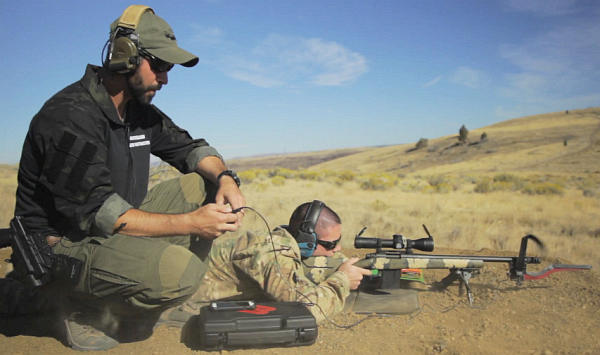
This well-made HD video showcases the operations of the Leupold Optics Academy. The Academy is a combined classroom and field training program focusing on advanced marksmanship skills for tactical shooters and long-range hunters. The field segment includes technical briefings, practice with mildot ranging, shooting from a variety of positions, and extreme-long-range sessions. At a private, backcountry range contracted by Leupold, Academy participants can engage targets out to 2200 meters. We think you’ll enjoy the video. We’d love to get a chance to shoot at that range.
Video find by EdLongrange. We welcome reader submissions.


 by Hap Rocketto
About the Author: Hap Rocketto is a Distinguished Rifleman with service and smallbore rifle, member of The Presidents Hundred, and the National Guard’s Chief’s 50. He is a National Smallbore Record holder, a member of the 1600 Club and the Connecticut Shooters’ Hall Of Fame. A historian of the shooting sports, his work appears in Shooting Sports USA, the late Precision Shooting Magazine, The Outdoor Message, the American Rifleman, the CMP website, and Pronematch.com.




 Shiraz tells us: “We come across a lot of shooters who have never shot under a coach. This video was produced to give shooters a basic understanding of shooting with a coach and the importance of releasing a good shot. In a team setting, you basically leave all the decision-making to the coach and aim where you’re told to aim. I’ve worked with Gary many times and it shows in the comfort level we have with each other. The coach plots the shots or a plotter advises the coach of any grouping that is not centered.”