Readers often ask for a good, authoritative resource on doping the wind and reading mirage. Many Forum members recommended M.Sgt. Jim Owens’ Wind-Reading Guide. With 22 sets of wind charts, this is offered for $14.95 as a printed book or $12.95 in CD format. Owens’ Reading the Wind and Coaching Techniques clearly explains how to gauge wind speeds and angles. Owens, a well-known High Power coach and creator of Jarheadtop.com, offers a simple system for ascertaining wind value based on speed and angle. The CD also explains how to read mirage — a vital skill for long-range shooters. In many situations, reading the mirage may be just as important as watching the wind flags. Owens’ $12.95 CD provides wind-reading strategies that can be applied by coaches as well as individual shooters.
As a separate product, Owens offers a Reading the Wind DVD for $29.95. This is different than the $12.95 CD. It is more like an interactive class.
Played straight through, the DVD offers about 75 minutes of instruction. M.Sgt. Owens says “You will learn more in an hour and fifteen minutes than the host learned in fifteen years in the Marine Corps shooting program. This is a wind class you can attend again and again. [It provides] a simple system for judging the speed, direction and value of the wind.” The DVD also covers mirage reading, wind strategies, bullet BC and more.
If you were challenged to hit a quarter (i.e. a 25-cent piece) at 800 yards, how would you respond? Well here’s the story of a man who did take that challenge, and proceeded to put a bullet right through the quarter. Forum member Randy D., aka “Birdog”, provides this entertaining account of how his friend Junebug drilled a quarter at 800 yards one Tennessee evening….
Hitting a Quarter at 800 Yards
Story and photos by Birdog
A friend from Indy visited the DOME last summer and returned home telling stories of eggs at 800 yards. He called me back and said his friends did not believe it and wanted to know if I could hit a quarter out at 800 and mail it to him.
Well, I had finally got the time for that challenge last Sunday. My friend Junebug came over and I told him about a new challenge. Junebug is sort of like Voldoc and does not like to be told it can’t be done and set his sights on the quarter. George Clay had his sleeved 700 6XC with 115gr DTACs and Bug had his Diamondback 6 BRDX and 103gr Vapor Trail bullets.
Junebug and Shayne. The quarter was at back fence row on left of photo, 80 yards short of a half-mile
Early to mid-afternoon is not the time for precision 800-yard shooting as the mirage was terrible and the wind was gusting in the high humidity and 95 temps. We took a few shots and got close but no HIT.
I told Junebug to go home and load some shells and come back at 7:00 and I believed we could make it happen. After 7:00 pm is the best time to shoot as the mirage disappears and the wind goes to zero. We met again at 7:00 and had Shayne Halliburton as witness. I took a few shots then Junebug took a few zeroing shots on metal. He was not satisfied with the grouping so he switched brass.
He had some new Hydro-formed brass that had never been fired. He took three sighters on the metal plate and the first two made two little black spots that were touching. Followed with a third shot that almost touched the first two. Darkness was setting in and I told Bug he better try the quarter now. Through my March scope I could barely see the bright quarter and my 1/16th dot completely covered the quarter.
Junebug moved the Diamondback to the quarter and touched her off. A half second later the bright spot on the black paper was gone. I jumped up and did a dance and war hoop and the Bug jumped up for a high five. Now we hoped we could find the quarter. Luckily it jumped out in front of the backer less than five feet and Bug found it immediately.
Junebug’s Rifle Specifications
Stock: Zebra-painted stock (Shehane ST1000 we believe)
Action: Stiller Diamondback
Scope: March 10-60x52mm with 1/8 MOA clicks
Cartridge: 6mm BRDX (6mmBR Norma 40° Improved similar to Dasher)
Bullet: 103-grain Vapor Trail
Gunsmith: Barrel smithed by Tim Claunch, Memphis, Tennessee
British Lee-Enfield Model SHT’22/IV Rifle, courtesy www.iCollector.com.
This past week, at SHOT Show, we met up with our friend Dennis Santiago. We chatted about Dennis’s experiences as a technical advisor for History Channel’s Top SHOT TV show. One of the notable Top Shot episodes involved the “Mad Minute”, a marksmanship drill practiced by the British Army in the decades preceding World War I. Dennis observed that the Top Shot competitors didn’t fare too well in their “Mad Minute” attempts, not scoring many hits in the alloted one-minute time period. That prompted Dennis to give it a try himself — seeing how many hits he could score in one minute with an authentic Lee-Enfield rifle. So, a while back, Dennis ran the drill at a range in California.
Dennis Does the Mad Minute:
Dennis, an active high power rifle competitor and instructor, enjoyed his “Mad Minute” exercise, though he assures us that this takes practice to perfect. Dennis tells us: “Here is a ‘Mad Minute’ drill, done using a period correct Lee-Enfield (SMLE) No.1 Mk III rifle and Mk VII ammo. I got to the Queen’s Regulations (15 hits in one minute) on the second run and put a good group on the target at 200 yards. This is ‘jolly good fun’ to do every once in a while. This is ‘living history’ — experiencing a skill from a time when the sun never set on the British Empire.”
“Mad Minute” was a pre-World War I term used by British Army riflemen during training at the Hythe School of Musketry to describe scoring a minimum of 15 hits onto a 12″ round target at 300 yards within one minute using a bolt-action rifle (usually a Lee-Enfield or Lee-Metford rifle). It was not uncommon during the First World War for riflemen to greatly exceed this score. The record, set in 1914 by Sergeant Instructor Alfred Snoxall, was 38 hits. (From WikiPedia.)
History of the Mad Minute Commentary by Laurie Holland
The original military requirement of the “Mad Minute” saw the soldier ready to fire with a round in the chamber, nine in the magazine, safety on. This course of fire is still followed by the GB Historic Breechloading Arms Association and other bodies in their recreated “Mad Minute” competitions.
The first 10 would go quickly, but reloads were critical, this not done by a magazine change as in a modern tactical or semi-auto rifle, but through slick use of ‘chargers’. It is this aspect which fouls so many of my colleagues up as it is very easy to cause a jam and a large part of 60 seconds can go in sorting it out!
Charger clips were selected for those that just held the rounds firmly enough to stop then falling out, were sand-papered and polished with a stove / fireplace polish called ‘Zebrite’ so that the rimmed rounds would slip through the clips like corn through a goose.
If you’re unfamiliar with the cock-on-closing Enfield action, it seems clumsy. With intensive practice it is very smooth and can be operated incredibly quickly. The trick is to whip the bolt back onto its stop and initiate a rebound movement that takes it and the cartridge well into the chamber thereby reducing the effort required to close the bolt and chamber the round.
Our friend, trick-shot ace Kirsten Joy Weiss, will be featured on the NRA All-Access TV show next week. As a performance shooter (and modern-day Annie Oakley) Weiss has focused her efforts to “bring the fun, challenge, and joy of shooting to a mainstream audience” via social media.
Watch Preview of NRA All Access with Kirsten Joy Weiss
Kirsten wants to be a good ambassador for the shooting sports, “spreading the positive reality of shooting”. Kirsten explains: “The fun challenge and joy of shooting is important to me because I really wanted to be a positive example. So when the media says the ‘guns are a bad thing and nobody does anything good with guns’, they can say ‘Well, what about her [Kirsten]’?”
A gifted “natural” shooter, Kirsten started shooting fairly late — at age 16. Despite her relatively late start, she learned very quickly, and managed to earn a place on the University of Nebraska shooting team. That literally opened up a new world for Kirsten: “During the course of my career, I’ve had a lot of success. I’ve gone to World Cups… in Zagreb, Croatia, in Munich, Germany. I’ve won National Championships, and got on to the U.S. Olympic short list, so it’s been a good career.”
In 2012, Kirsten was the top USA athlete-shooter at the Munich World Cup. She won the 2012 NRA Three-Position Women’s Smallbore Championship and also won the Standing Position, while finishing as the National Overall Woman Champion.
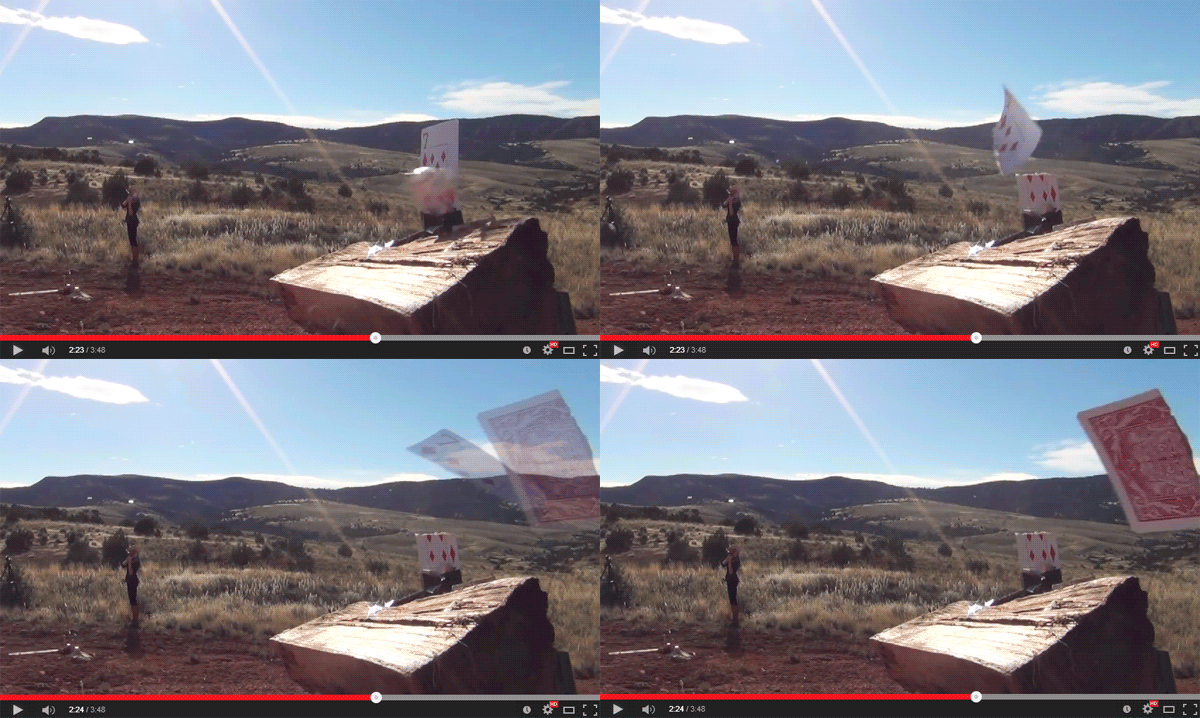
Kirsten tells us: “A lot of people don’t think of shooting as a sport, but it absolutely is, and I would even go so far as to say that it is an art form.” We don’t know if this is art, sport, or magic, but very few shooters have the skill or flexibility to make this upside-down shot…
This animated GIF shows Kirsten cutting a card in half with a .22 LR bullet. Impressive!
Sharpshooter (and competitive smallbore shooter) Kirsten Joy Weiss tried a special New Year’s trick shot for 2015. In keeping with the festive New Year’s spirit, Kirsten attempted to shoot the cork off a champagne bottle. After a few unsuccessful tries, she managed to hit the cork with at least two shots. But alas the cork did not fly. She actually hit the cork, but it did not release. That was surprising…
Undaunted, Kirsten changed her strategy, aiming for the neck of the bottle. This duplicates the process of “sabering” a champagne bottle — a method of liberating the bubbly by slashing off the end of the neck with a blade. Aiming for the neck of the bottle, Kirsten successfully blew off the top of the bottle. (Apparently, when “sabering” it is actually the pressure within the champagne bottle which does most of the work).
The Coriolis Effect comes into play with extreme long-range shots like this. The rotation of the earth actually moves the target a small distance (in space) during the course of the bullet’s flight. Photo by Dustin Ellermann at Whittington Center Range.
When you’re out at the range, the Earth seems very stable. But it is actually a big sphere zooming through space while spinning around its axis, one complete turn every 24 hours. The rotation of the earth can create problems for extreme long-range shooters. During extended bullet flight times, the rotation of the planet causes an apparent deflection of the bullet path over very long distances. This is the ballistics manifestation of the Coriolis Effect.
Bryan Litz of Applied Ballistics has produced a short video that explains the Coriolis Effect. Bryan notes that Coriolis is “a very subtle effect. People like to make more of it than it is because it seems mysterious.” In most common shooting situations inside 1K, Coriolis is not important. At 1000 yards, the Effect represents less than one click (for most cartridge types). Even well past 1000 yards, in windy conditions, the Coriolis Effect may well be “lost in the noise”. But in very calm conditions, when shooting at extreme ranges, Bryan says you can benefit from adjusting your ballistics solution for Coriolis.
Bryan explains: “The Coriolis Effect… has to do with the spin of the earth. You are basically shooting from one point to another on a rotating sphere, in an inertial reference frame. The consequence of that is that, if the flight time of the bullet gets significantly long, the bullet can have an apparent drift from its intended target. The amount [of apparent drift] is very small — it depends on your latitude and azimuth of fire on the planet.”
Coriolis is a very subtle effect. With typical bullet BCs and velocities, you must get to at least 1000 yards before Coriolis amounts to even one click. Accordingly, Bryan advises: “Coriolis Effect is NOT something to think about on moving targets, it is NOT something to think about in high, uncertain wind environments because there are variables that are dominating your uncertainty picture, and the Coriolis will distract you more than the correction is worth.”
“Where you could think about Coriolis, and have it be a major impact on your hit percentage, is if you are shooting at extended range, at relatively small targets, in low-wind conditions. Where you know your muzzle velocity and BC very well, [and there are] pristine conditions, that’s where you’re going to see Coriolis creep in. You’ll receive more refinement and accuracy in your ballistics solutions if you account for Coriolis on those types of shots. But in most practical long-range shooting situations, Coriolis is NOT important. What IS important is to understand is when you should think about it and when you shouldn’t, i.e. when applying it will matter and when it won’t.”
The Coriolis Effect — General Physics
The Coriolis Effect is the apparent deflection of moving objects when the motion is described relative to a rotating reference frame. The Coriolis force acts in a direction perpendicular to the rotation axis and to the velocity of the body in the rotating frame and is proportional to the object’s speed in the rotating frame.
A commonly encountered rotating reference frame is the Earth. The Coriolis effect is caused by the rotation of the Earth and the inertia of the mass experiencing the effect. Because the Earth completes only one rotation per day, the Coriolis force is quite small, and its effects generally become noticeable only for motions occurring over large distances and long periods of time. This force causes moving objects on the surface of the Earth to be deflected to the right (with respect to the direction of travel) in the Northern Hemisphere and to the left in the Southern Hemisphere. The horizontal deflection effect is greater near the poles and smallest at the equator, since the rate of change in the diameter of the circles of latitude when travelling north or south, increases the closer the object is to the poles. (Source: Wikipedia)
Have Fun with Rifles and Equipment You Probably Already Have….
Forum member Rod Vigstol (aka Nodak7mm) has written a great Introduction to F-Class for shooters getting started in this rewarding discipline. Rod’s article, which originally appeared in the Rifleman’s Journal Blog, covers F-Class basics and addresses concerns that “newbies” may have when trying a new shooting sport. Rod stresses that most guys who own a varmint-hunting or tactical rig likely have nearly all the gear they need to give F-Class competition a try.
Rod explains: “If you’re reading this, you have more than just a general interest in the shooting sports and in the awesome rifles that shoot tiny groups at insane distances. You probably even have friends that enjoy shooting as much as you do. The quandary you may find yourself in is your friends haven’t quite jumped into it head-first like you have and they haven’t spent a lot of money and time obtaining the equipment you have to go shoot these matches. But you know what? Your prairie-dog shooting buddy or coyote-hunter friend can attend these matches and shoot alongside with you. He or she more than likely already has the basic equipment needed to shoot a match.” Most varmint shooters already have a suitable, accurate rifle and the following equipment:
• A variable-power scope in the 4.5-14x range or higher.
• A front bipod like the trusty old Harris 9″-13″, or maybe even a basic pedestal front rest.
• A rear sand-bag or similar sand-sock to rest the butt stock.
• A basic shooting mat from Midway or at least a piece of carpet or canvas to lay on.
Rod also provides a handy checklist of items to bring to the range. These include: Canvas or carpet strip (to set under bipod), Notebook, Kitchen Timer, Cleaning Rod, Camp Chair, Elbow Pads, Shooting Hat, and Open Bolt Indicator (OBI). Along with rifle, bipod (or front rest), rear bag, and ammo, that’s pretty much all you need.
Rod encourages all shooters to give F-Class a try — even novices. Rod explains: “We have all been rookies, newbies, new kids on the block or whatever. So we all have a good idea of what may be going on in your mind, the questions and concerns you may have. I’m telling you this sport is full of fantastic people who deep down find it far more fulfilling to help a new shooter get started than running a clean target. You just have to take the first step to get involved.”
Christmas Day is just a week away. Books have always been popular holiday gifts. If you haven’t completed your holiday shopping, here are some recommended titles that should please the serious shooters and firearms enthusiasts on your shopping list. For shooting clubs, books also make great end-of-season member awards. Most of us would rather have a useful book than one more piece of wood to toss in a box in the closet.
Here Are TEN TITLES Recommended for Serious Shooters:
If you’re a serious long-range shooter, consider adding this book to your library. Relying on extensive ballistics testing, Modern Advancements contains some fascinating research results, including the effects of twist rate on muzzle velocity, BC, and precision. Other sections detail the evolution of modern rifle, bullet, and optics designs. And there is an important comparison test of chronographs. Laser rangefinders and wind measurement devices are explained in detail by contributing author Nick Vitalbo. This book is a valuable resource for anyone who wants to understand the current “state of the art” in today’s shooting world. There is a ton of “hard science” in this book — not just opinions.
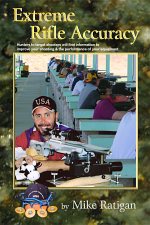
This book should be on the shelf of every short-range benchrest shooter. (Shooters in other disciplines will find the book helpful as well.) Butch Lambert says Mike’s book is “far and away the best Benchrest book written. Very comprehensive, it touches on every aspect of our game.” Mike’s 368-page book is dedicated to getting the most from modern rifle accuracy equipment with an emphasis on shooting 100-200-300 yard group benchrest tournaments. This book covers the most popular hardware plus new equipment offerings are covered, including external mount scopes, actions, triggers, stocks, wind flags, and more. Also covered are rifle handling techniques, note taking, tuning, bullet selection, goals, and match strategies. Mike provides many tips that will help active competitors update their own competitive program.
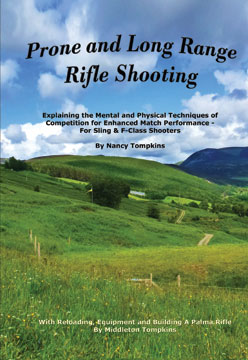
Nancy Tompkins is one of the greatest long-range shooters in American history. She has won five National Long-range Championships. Tompkins’ treatise is a must-read for serious Palma, F-Class, and High Power shooters. The revised Second edition includes F-Class equipment and techniques, and newly updated information. Color pictures. Topics include Mental & Physical training, Reading Wind & Mirage Shooting Fundamentals, International Competition, and Loading for Long Range. Nancy Tompkins is a 4-time winner of the National Long Range Championships, and has won countless other major events. Nancy has been on six Palma Teams (as both a shooter and a coach).
Tony Boyer, the most successful shooter in the history of short-range benchrest competition, shares many of his match-winning tips in this 323-page book. The book covers all aspect of the benchrest discipline: loading, windflags, rest set-up, addressing the rifle, and match strategies. This is a high-quality publication, filled with valuable insights. Every serious benchrest shooter should read Tony’s book. Boyer has dominated registered benchrest in a fashion that will never be duplicated, having amassed 142 U.S. Benchrest Hall of Fame points. The next closest shooter, Allie Euber, has 47 Hall of Fame points. This handsome, full-color book is 323 pages long, with color photos or color illustrations on nearly every page.
This book by 11-time National High Power Champion David Tubb focuses on position shooting and High Power disciplines. Section One covers fundamentals: position points, natural point of aim, breathing, triggering mechanics and follow-through, sling selection and use, getting started, getting better, avoiding obstacles. Section Two covers mechanics of offhand, sitting, and prone positions. Section Three covers shooting skills, including wind reading and mental preparation. Section Four covers the technical side of shooting, with extensive disuctions of rifle design, load development, reloading barrel maintenance, and rifle fitting. We consider this book a “must-read” for any sling shooter, and there is plenty of good advice for F-Class shooters too.
Many of our Forum members have recommended The Wind Book for Rifle Shooters by Linda Miller and Keith Cunningham. This 146-page book, published in 2007, is a very informative resource. But you don’t have to take our word for it. If you click this link, you can read book excerpts on Amazon.com. This lets you preview the first few chapters, and see some illustrations. Other books cover wind reading in a broader discussion of ballistics or long-range shooting. But the Miller & Cunningham book is ALL about wind reading from cover to cover, and that is its strength. The book focuses on real world skills that can help you accurately gauge wind angle, wind velocity, and wind cycles.
Rifle Accuracy Facts by Harold R. Vaughn, (Softcover and Hardcover, Used Price Varies)
Decades after it was written, Vaughn’s work remains a seminal treatise on accuracy. Vaughn was a serious scientist, working for the Sandia National Laboratories. Many “gun writers” toss out hunches about rifle accuracy. Vaughn, by contrast, did serious empirical testing and statistical analysis. Vaughn wondered why some guns shot well while seemingly identical rifles did not. Rifle Accuracy Facts covers a wide variety of topics, including internal ballistics, chamber design, barrel vibration, bullet imbalance, external ballistics, scope design and more. Writer Boyd Allen notes: “If you are serious about precision shooting, Vaughn’s book belongs in your library.”
The Accurate Rifle by Warren Page, $14.95 (Softcover), $20.99 (Hardcover)
We include this book in our list because it is an older classic that has been out of print for a while. Warren Page was the shooting Editor of Field & Stream magazine for 24 years. Long out of print, this seminal work on rifle accuracy was republished in 1996 with an updating chapter by Dave Brennan, long-time Editor of Precision Shooting magazine. If you are interested in the progress of rifle accuracy, it is worth reading this book to see how technology has developed over time (and what older methods still work today). This would make a great gift for an older shooter who grew up reading Warren Page articles in Field & Stream.
Steven Boelter’s 352-page book is a comprehensive study of all types of rimfire ammunition (including 17s and 22 mags), with over 600 photos. In a remarkable undertaking, Steven Boelter fired every brand and sample of rimfire ammo he could acquire (including .22 LR, 17 Mach 2, 17 HMR and .22 WMR), and recorded all the results. In all, Steven tested 11 brands and 137 different rimfire rounds, firing over 32,000 test rounds.
Always controversial, Bill Calfee is nonetheless a major player in the world of rimfire accuracy. Calfee-built rimfire rifles have set many records and won many titles. He harbors strong opinions about what works and what doesn’t, but if you are involved in rimfire competition you should read this book. This work covers all aspects of rimfire gunsmithing and accurizing: barrels, tuners, chambering, triggers, stock design, bedding, action design and much more. He examines each aspect of rimfire accuracy discussing all of the components and their contribution to the improved accuracy. We don’t agree with all of Calfee’s theories about accuracy, but this book still remains a “must-read” for those serious about precision rimfire shooting.
Profile by Kyle Jillson forNRABlog
In the December 2013 issue of Shooting Sports USA, Barb Baird of Women’s Outdoor News sat down with Nancy Tompkins, one of the most accomplished shooters out there. A past World and National Champion, Nancy likes to reach out and touch targets at 1,000 yards with accurate rifles. She’s been competing in Palma (.308 caliber at 800, 900, and 1000 yards), Long Range (1000 yards) and Smallbore prone for 41 years. Thanks to her father, Nancy began competing in the seventh grade and now shares the love of shooting with her daughters Michelle and Sherri Gallagher, her husband Mid Tompkins, and her goddaughter, Danielle Makucevich. Nancy has competed on numerous international Palma teams, traveling from her home base in Prescott, Arizona.
“There is nothing better than traveling, making new friends and competing with the best shooters in the world,” said Nancy. And she only shoots with the best equipment. Her 2013-vintage Palma rifle featured a McGee stock, Stolle Panda action, Krieger barrel, Anschütz trigger, Warner rear sight and a Right Sight (front sight). Her .22 LR Smallbore rifle sports an Anschütz action and trigger with a Hart barrel, McGee stock, Right Sight (front sight), and Warner rear sight.
As always, interviewer Barb Baird had a key question for Nancy: “What’s in your range bag, Nancy Tompkins?” Actually, Nancy stores stuff in her Creedmoor shooting stool for High Power matches and in a large plastic box from Home Depot for her Smallbore matches. Here’s what Nancy keeps at the range:
Sinclair timer
Allen wrenches, small screwdriver, and grease
SPF-15 lip balm
Magnifying glass
Two slings
Creedmoor shooting glove
Decot shooting glasses
TLC Gunworks elbow pad
Champions Choice shooting visor
CeCe’s custom ear plugs
One More Item — Nancy’s Lucky Mouse
Nancy’s cat, Sierra, placed a toy mouse in one of her shooting stools a few years ago. Nancy now considers it her lucky charm. To learn more about Nancy’s recommended equipment, and glean great tips on Long Range marksmanship, get Nancy’s excellent book, Prone & Long Range Rifle Shooting.
Nancy Tompkins has been shooting competitively for over 38 years. She has won the National Long Range Championships 5 times (1986, 1997, 1999, 2003, and 2015), the across the course National Highpower Championships (1998), the Metric Smallbore Nationals (2012) and the Fullbore Nationals (2012). She has also been the Wimbledon Cup winner (1993) and a 7-time Leech Cup winner (1995, 1997, 1999, 2003, 2005, 2011 and 2012). She has won both team and individual medals in the World Championships and has been on eight Palma Teams (as both a shooter and a coach).
Getting started in the shooting sports can be intimidating, especially for women. Thankfully, there are many training resources available. NSSF has compiled a series of target shooting tips for women, by women. These tips, presented by instructors Deb Ferns, Kay Miculek, and Lena Miculek-Afentul, cover basic shooting methods and safety. Topics include pistol grip, stance, eye dominance, and ear protection. These tips can benefit any novice shooter, not just the ladies.
Rifle Stance and Hold (for Action Shooting)
Champion 3-Gun shooters Kay Miculek and Lena Miculek-Afentul demonstrate rifle stance basics and how to properly hold an AR-platform rifle for action shooting.
Grip and Stance for Pistol Shooting
Mother/daughter team Kay Miculek and Lena Miculek-Afentul demonstrate proper grip and stance for shooting semi-automatic pistols in action disciplines.
Eye Dominance (and Hand/Eye Cross-Dominance)
Learn how to identify your dominant eye. Kay Miculek, a cross-dominant shooter, explains how other cross-dominant individuals can maintain a proper sight picture.
Ear Protection — Double-Up for Safety
Babes with Bullets Director Deb Ferns says the most common complaint among new shooters is, “It’s too loud!” Deb recommends “doubling up” — wearing muffs OVER soft foam earplugs. That’s “sound advice” for any shooter.


 Readers often ask for a good, authoritative resource on doping the wind and reading mirage. Many Forum members recommended M.Sgt. Jim Owens’ Wind-Reading Guide. With 22 sets of wind charts, this is offered for $14.95 as a printed book or $12.95 in CD format. Owens’ Reading the Wind and Coaching Techniques clearly explains how to gauge wind speeds and angles. Owens, a well-known High Power coach and creator of Jarheadtop.com, offers a simple system for ascertaining wind value based on speed and angle. The CD also explains how to read mirage — a vital skill for long-range shooters. In many situations, reading the mirage may be just as important as watching the wind flags. Owens’ $12.95 CD provides wind-reading strategies that can be applied by coaches as well as individual shooters.
 As a separate product, Owens offers a Reading the Wind DVD for $29.95. This is different than the $12.95 CD. It is more like an interactive class.
 Hitting a Quarter at 800 Yards


 Lee-Enfield No. 4 Rifle (1943), courtesy


 A gifted “natural” shooter, Kirsten started shooting fairly late — at age 16. Despite her relatively late start, she learned very quickly, and managed to earn a place on the University of Nebraska shooting team. That literally opened up a new world for Kirsten: “During the course of my career, I’ve had a lot of success. I’ve gone to World Cups… in Zagreb, Croatia, in Munich, Germany. I’ve won National Championships, and got on to the U.S. Olympic short list, so it’s been a good career.”
 Sharpshooter (and competitive smallbore shooter) Kirsten Joy Weiss tried a special New Year’s trick shot for 2015. In keeping with the festive New Year’s spirit, Kirsten attempted to shoot the cork off a champagne bottle. After a few unsuccessful tries, she managed to hit the cork with at least two shots. But alas the cork did not fly. She actually hit the cork, but it did not release. That was surprising…
 When you’re out at the range, the Earth seems very stable. But it is actually a big sphere zooming through space while spinning around its axis, one complete turn every 24 hours. The rotation of the earth can create problems for extreme long-range shooters. During extended bullet flight times, the rotation of the planet causes an apparent deflection of the bullet path over very long distances. This is the ballistics manifestation of the