Legendary shooter Jerry Miculek holds multiple world records, and has amassed over 80 major championship titles. He is considered “one of the fastest trigger fingers” on the planet. In this video, Jerry puts his skills to the test, using a Barrett m82A1 .50 BMG in a timed speed run. Watch the video, starting at the 1:20 mark, to see this amazing speed run.
Watch Miculek Shoot .50 BMG Offhand. Action Starts at 1:20:
Jerry shoots six (6) .50 BMG rounds in under one second (0.98 to be precise). And Jerry did that standing (offhand) without a rest. What can you say… the man is a beast.
If you look carefully, in this frame you can see a .50-Cal bullet in flight forward of the muzzle brake.
Jerry was a bit apprehensive at first: “This is by far the most horsepower I’ve had in my hands ever in my life. So the learning curve is going to be kind of really abrupt.” But as he shoulders the big Barrett and gets ready to punch six rounds on the clock, Jerry gets enthusiastic: “This is going to be fun guys … six rounds .50 BMG … Time to rock and roll!”
After filming this video, Jerry did more drills with the Barrett and he actually brought down his split times. Jerry reports: “I managed to get it down to 0.16 splits and I outran the bolt a few times. You can actually see that in the closing slow-motion footage. You just can’t expect such a massive gun to cycle as quick as a 1911 or your M&P/ Glock type pistols unfortunately.”
Dan Pohlabel is a member of the all-conquering Team Sinclair F-TR squad. This talented group of shooters hasn’t lost a team match in years. What’s the secret of Team Sinclair’s success? Well there is not one single factor. These guys have very accurate rifles, they work hard on load development, and they practice in all conditions. In this interview, Dan Pohlabel talks about F-TR competition, reviewing the hardware (and skill set) it takes to win. He offers some great tips on developing loads. You’ll find a longer version of this interview on the Sinclair Int’l website. CLICK HERE to Read Full Interview.
Q: What do you find most challenging in F-TR Shooting?
It has to be keeping up with the competition, our sport has grown so quickly with new talented shooters. Staying at the top requires having a laser of a rifle, perfect loads, near perfect wind reading, and, of course, breaking good shots.
Q: How can novice shooters improve their game?
Seek out the local F-TR shooters and go to matches with them, listen and learn. Attend team matches and offer to score for one of the teams. As a scorer, you will sit close enough to hear the coach make wind calls and see the results on the target. Through the spotting scope you will see changes in mirage and it’s the quickest way to learn the basics of wind reading. Choosing and buying equipment is relatively easy, learning to read the wind is a journey.
Q: What’s in your range bag for match days?
Rear bag, towel, shooting glasses, canned air, ear protection, data book, pen, rifle rain cover, hat, rifle tools, timer, ammo, and bug spray.
Q: What specialized gear can you not live without?
1. A good set of elbow pads. It’s hard to keep concentrating on shooting when your elbows are rubbed raw from days of competing on them.
2. Good bug spray. We shoot from the ground but our shooting mats aren’t that big. It’s hard to concentrate with bugs crawling or chewing on you.
Q: Load Development — How do you work up a load?
First, I call Derek Rodgers and get his load data, he is the best load development shooter I know! Otherwise, here is the procedure I recommend. Measure throat length with bullet of your choice, to determine how much room is left in the case. The above measurement determines what powders you can use. We use only Hodgdon Extreme powders. Shoot a ladder test, five rounds each in 0.2 grain increments, to find the accuracy node for that bullet/powder combination. Take the best two loads and do a jump test with five rounds each, test at .005″, .025″, .060″ jump. One of these groups will be significantly better than the rest, now you can tweak that measurement +/- .002” or .005” to get the best accuracy.
Test at least three different primers to determine which offers a little better ignition for your load, a 5-shot test will usually tell you which is the best. Go back and test the two best combinations in a 10-shot test at least twice, pick a cool overcast day and also a hot sunny day and compare results. Take your final “best load” back and do a “simulated match”, 20 shots, waiting at least 20 seconds between shots. If you like those results it’s probably a reliable and accurate load.
Q: What rear bag do you use?
I use a two-bag system, large bag on bottom with a smaller bag on top. I had the bags made of marine canvas, zippered and filled with plastic beads. I can adjust the amount of fill to make them a perfect height for my shooting position. Teammate Jeff Rorer uses a similar system and mine is nearly a copy of his rear bags.
Q: How often do you practice and how many rounds do you shoot per year?
In good weather I practice a couple times a week at the local range, a couple more dry-firing practices/week at home. I typically shoot between 2,000-2,500 rounds per year.
Q: How do you prepare mentally before a match?
[I do] lots of visualization — run the video in my head of what I expect to see and of my performance. I think about the correct strategy for the conditions, staying disciplined to the strategy.
Q: What do you avoid before a shoot?
No late nights or excessive alcohol. Very little caffeine in the morning. Leave your cell turned off. Avoid emotional people.
Q: What’s your procedure on a Match day?
I arrive early, get squadding card, move gear, watch wind speed/direction, check over rifle and gear, sit and relax, visualize and focus on the most important goal of the day. Most days we shoot three relays of 20 shots. It’s important to eat and hydrate continually all day. My focus and concentration are better when I snack all day with fruit and energy bars, and lots of water. While taking my turn in the pits, I try to relax and only focus on what is ahead of me and [not] what’s already happened.
Q: What is your favorite reloading product?
My favorite reloading product is the Sinclair Premium Neck Turning Tool with Handle, I also use the expander mandrels provided by Sinclair for sizing the brass in preparation for the turning process. Correct and repeatable neck tension begins with turning necks to a uniform thickness. Sinclair also has mandrels to size the necks after neck turning that accurately size the necks for a specific neck tension.
Q: What is your preferred scope?
The scope I find the most useful is the Nightforce Competition Scope. This scope is very light-weight, has 15-55X magnification, world-class quality glass, 10 MOA per revolution on the turrets, 1/8 moa adjustments. It’s perfect for F-Class competition.
Q: What advice do you have for someone wanting to get into the sport?
Find a local club with some F-TR shooters and ask for their help. Most shooters will be happy to take you with them to a match, listen and learn while you’re there. You may find out it’s not what you thought, or you may be hooked. If you decide to jump in, start with an inexpensive rifle. This sport is expensive and you don’t need a $5000 rifle to learn good wind-reading skills. Start with a used Savage F-TR rifle and learn the basics, shoot for a year at least before making a larger investment. The money you saved buying a used Savage rifle will help pay for your divorce lawyer, LOL.
Q: What training drills do you use?
Dry-firing the rifle at home is a good way to practice when you can’t get to the range and shoot. It allows me to practice set-up, rifle handling, and position. When I can practice at a local range, I also dry-fire between shots to increase the amount of repetitions and increase the time spent in position.
Q: Who has been your biggest influence in shooting?
Eric Bair, 2006 F-Open National Champion helped me get started and gave me great advice. Most of the shooters on Team USA and Team Sinclair help each other, nobody knows all the answers but we share what we have learned. Danny Biggs, 2008 and 2009 F-TR National Champion also helped me when I was struggling to learn some of the ranges. I learned a lot from Danny.
Many of us dream of taking and making a shot at one mile (1760 yards). Well Top Shot Champion Dustin Ellermann pushed the envelope even farther during a recent ultra-long-range session at the NRA’s Whittington Center in New Mexico. On his Facebook page, Dustin wrote: “I earned the ‘One Mile+ Shot’ mancard this week with 1MOA Solutions. We reached out to 2,100 yards with the Barrett M99 .50 BMG out in the hills of the Whittington Center. You can see the target area marked in the center of the photo. This is a locked-down mountain range, with 30,000 acres.”
Bullet flight time was 3.7 seconds, drop was 94 MOA, velocity at target was only 1,100 fps. The 7,500′ elevation and a 5 degree down-slope helped the ballistics. Dustin reports: “About six seconds after impact you would hear the ‘ding’.” [Editor’s note: Yes it really takes roughly six seconds for sound to travel 2100 yards. The speed of sound at 7500′ elevation* is 1053.61 fps, or roughly 351.20 yards per second. The distance-to-target of 2100 yards divided by 351.2 works out to a 5.98 second time delay.]
One of Dustin’s friends commented: “We rarely think about what the bullet does after it exits, but seeing the 60% drop in velocity [over the trajectory] and how long it was actually in flight (3.7 seconds) makes these types of shots so amazing! Congrats to you making the One Mile + club!”
*This is with temperature corrected -30° F below standard at sea level.
Applied Ballistics has created a new series of YouTube videos about precision long range shooting. Featuring ace long-range shooter and professional ballistician Bryan Litz, these videos address various topics of interest to long-range marksmen. In this week’s video, the second in the series, Bryan Litz examines the most common causes of ballistics shooting errors at Long Range.
Watch Applied Ballistics Video about Common Mistakes in Long Range Shooting:
Bryan Litz of Applied Ballistics often hears the question: “What are the main reasons people miss their target at long range?” To answer that question, in this video, Bryan explains the most important variables in Long Range shooting. Bryan says: “Probably the number one thing is range — you have to have a [precise] range to your target because your bullet is dropping, and to hit the target you need to correct for bullet drop.” Distance may be indicated on the target bay (or berm), but for open ranges you should ascertain distance-to-target with a quality laser rangefinder. Even when the distance to target is shown with a sign or marker, you may want to confirm the distance with your rangefinder. (You may be surprised — we’ve seen marked target distances at commercial ranges off by 25+ yards!) Bryan says: “Get a good laser range to the target and you’ll be within a couple yards”.
After distance to target, the most important variable is the wind. This is the most challenging factor because the wind is constantly changing. Bryan explains: “After 300 or 400 yards, the wind [will] move your shots off the target if you don’t correct for it. The best way to account for the wind is to measure it at your location with a Kestrel. The Kestrel can give you the speed and direction of the wind at your location, which can baseline your wind call for your long-range shot.” Bryan acknowledges that there will still be variables: “The wind isn’t always blowing the same downrange as at your location… and the wind is always changing”. Bryan notes that you need to account for variances in wind between the time you gauge the wind angle and velocity and the time you actually you take your shot.
The NRA’s Shooting Sports USA has a “new and improved” website. The new mobile-friendly format makes it easy to access current articles as well as locate interesting archived stories.
One great recent Shooting Sports USA article, Shooting is 90% Mental, was penned by Chip Lohman (SSUSA’s former Editor). With the help of two very smart Ph.D types, Judy Tant and Mike Keyes, Lohman examines the mental processes involved in the shooting sports. Chip’s co-authors have impressive credentials. Dr. Judy Tant is a Clinical Psychologist and National Bullseye Pistol Champion. Dr. Michael J. Keyes, is a licensed Psychiatrist and former physician for the U.S. Shooting Team.
If you shoot competitively, this is definitely a “must-read” article. The authors examine how the brain functions under stress, how “visualization” can be used to improved performance, how “brain speed” can be enhanced through proper training, and how the brain stores learned routines into “muscle memory.” And that’s just for starters — the article gives many concrete examples of techniques top shooters have employed to improve their “mental game” and shoot higher scores.
Brain Speed and Trigger Control: Research: Scientists believe that the newer frontal lobe may not be able to keep up with “deep” brain signals that transmit at nearly 300 mph. This is explained when athletes talk about “letting go,” rather than over-thinking the shot. This conscious signal can take up to 0.3 seconds from recognizing the desired sight picture to moving the trigger finger—too long to capture the opportunity for a perfect shot. However, if the signal is initiated spontaneously in the cerebellum where such procedures are thought to be stored through repetition, the reaction speed is much quicker. Signals are processed by the “deep brain” almost twice as fast as the problem-solving frontal lobes.
It’s great to see young people get involved in the shooting sports and achieve success through dedication, practice, and team-work. We congratulate the Pennsylvania Junior Team which took first place in the 6-man and 2-man Junior team matches this year at Camp Perry. Special kudos go to this year’s High Junior, PA team member Matt Lovre, shown at right.
The winning 6-Man Pennsylvania squad included Jack Graw, Joe Hendricks, Kevin Kerin, Matt Lovre, Alexander Thomas and Wyatt Thomas. Alexander Thomas reports: “Great day, great coach, [Berger] bullets flying true. Conditions were tough, but team members held together to shoot awesome scores and take the number 1 spot at Nationals!”
The Pennsylvania Junior Team’s match load featured .22 cal Berger 77gr OTM bullets pushed by Alliant Reloder 15 powder. The team’s AR-platform rifles were smithed by Dead Center Sports with White Oak upper receivers and Geissele triggers.
One Pistol, Two Barrels, Two Playing Cards — here’s a trick shot we just had to share. The talented Kirsten Joy Weiss does something we’ve never seen before, splitting TWO (2) playing cards with a unique, twin-barreled 1911-style pistol. Watch the video to see Kirsten pull off this double-barreled doozy of a trick, firing two bullets at the same time.
It took a few tries, but Kirsten makes the shot at the 3:14 time-mark:
Kirsten was enthusiastic about this unique trick: “Splitting two cards with two bullets fired at once? The double-barreled 1911 was just begging for a trick shot application. Arsenal Firearm’s 2011 A1 twin-barrel, 1911-style pistol is a heavy monster to wrangle, but a lot of fun to shoot!”
How good are the best High Power position shooters? Pretty amazing actually. Here are some targets from the 2015 NRA High Power Championship at Camp Perry. Shown above is a 100-10X (literally a perfect score) at 200 yards. This was shot sitting, rapid-fire by 11-time National High Power Champion Carl Bernosky. That’s impressive to say the least. As one Facebook fan noted: “Not bad for an old codger with a bad back….”
File photo of Carl Bernosky from previous competition.
The target below is a 100-0X, shot rapid-fire prone by an unknown sling shooter. That may not seem that impressive at first, but this was fired from THREE HUNDRED yards. It takes a mighty solid hold to produce a nice 10-shot cluster like that without dropping a point.
To put these impressive performances in perspective, Lapua’s Kevin Thomas reports: “For those who aren’t familiar with these targets, the center X-Ring on both of these targets is 3 inches across. The 10-Ring is 7 inches across [including line], roughly the size of a small sandwich plate.”
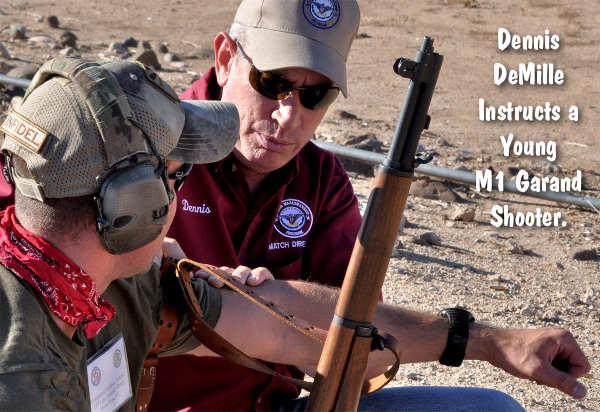
Dennis DeMille is a past Camp Perry National Champion, and he still one of the nation’s top Service Rifle shooters. Since retiring from the U.S. Marine Corps, Dennis has served as the General Manager of Creedmoor Sports. Some years back we had the chance to interview Dennis at the old Creedmoor offices in Oceanside, California. With his decades of competitive experience, Dennis has a wealth of knowledge. In this 3-minute interview, Dennis shares insights into the High Power shooting game. He discusses the most effective ways to train for competition, the fundamentals of good marksmanship, and how to recognize and perfect your natural point of aim. Dennis also offers solid advice on how to get the best “bang for your buck” when choosing shooting accessories for High Power and Across the Course competition.
This week, many of the world’s top marksmen have been competing at the National Long Range High Power Rifle Championships, held 29-31 July, 2015 at Camp Perry. The distances are great (1000 yards maximum) as are the challenges — the fickle winds blowing off Lake Erie can be unpredictable.
This year is extra special. The USA hosts the World Fullbore Long Range Championships next week at Camp Perry. The World Championships are held every four years, but any country may only host the event every 25 years. That means the next Fullbore Worlds in the USA could not take place before 2040. This year, teams from 11 countries will compete for national honors (and serious bragging rights). Many top international shooters have already arrived, and they are using the NRA Long Range High Power Championships as a “prelim” for the Fullbore Worlds next week.
Ace ISSF 300m shooter Reya Kempley shoots a hybrid rig with a Stolle Panda Action in an Anschütz smallbore-type metal stock.
Here’s the same rifle, as fitted with hand rest for position shooting. CLICK to Zoom:
British Palma Shooter David Luckman hung tough after suffering a dissappointing 8 (low right) on his first record shot. After serving up that 8 at 4 o’clock, David fought back, shooting all tens and Xs for the rest of his 10-shot string. (Orange stickers show record shots — the yellow dots mark sighters.) David doesn’t crack under pressure — he won the 2012 Long Range Championship at Camp Perry, and he is the reigning ICFRA World Long Range Fullbore (Palma) Rifle Champion.
Those targets are placed a long way off. Now imagine trying to shoot half-MOA with iron sights.
Past Long-Range Champion John Whidden shows good form. John runs a centerfire action in an Anschütz metal smallbore stock. He smithed this rig himself. John favors the ergonomics and adjustability of the Anschütz stock. He also really likes the small-diameter, rounded forearm on this design. “This stock suits me really well”, John told us.
This competitor has an Eliseo (Competition Machine) Tubegun in Patriotic Stars and Stripes Livery.
This U.S. Marine Corps shooter campaigned a classic “Battle Rifle” in the LR Championship, firing a semi-auto version of the M14. It looks like he named the rifle “Lucy”.
Photos from 2015 NRA Long Range High Power Rifle Championships courtesy NRABlog.com.


 Research: Scientists believe that the newer frontal lobe may not be able to keep up with “deep” brain signals that transmit at nearly 300 mph. This is explained when athletes talk about “letting go,” rather than over-thinking the shot. This conscious signal can take up to 0.3 seconds from recognizing the desired sight picture to moving the trigger finger—too long to capture the opportunity for a perfect shot. However, if the signal is initiated spontaneously in the cerebellum where such procedures are thought to be stored through repetition, the reaction speed is much quicker. Signals are processed by the “deep brain” almost twice as fast as the problem-solving frontal lobes.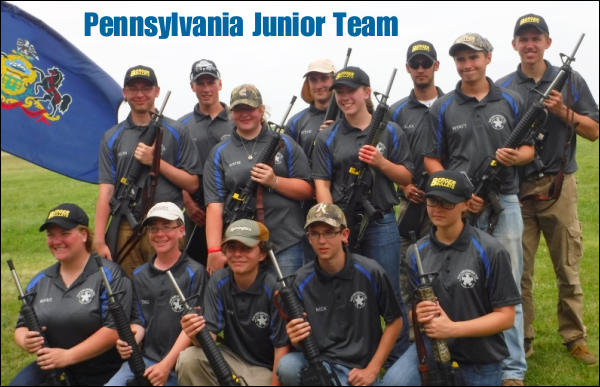
 It’s great to see young people get involved in the shooting sports and achieve success through dedication, practice, and team-work. We congratulate the Pennsylvania Junior Team which took first place in the 6-man and 2-man Junior team matches this year at Camp Perry. Special kudos go to this year’s High Junior, PA team member Matt Lovre, shown at right.