Larry Vickers is a respected firearms trainer who has served with the U.S. Special Operations Forces (SOF). In the course of teaching classes he’s learned that many gun owners waste money on impractical gun accessories. In his recent Ammoland.com article, “Don’t Be a Tacti-Cool Fool”, Vickers examines today’s trend of over-accessorizing firearms, particularly AR-platform rifles. Vickers doesn’t mince words… he states that too many people are spending too much money on poorly-designed hardware that may be “useless” at best.
Equipment Selection Advice from Larry Vickers
Every class I teach I see and hear students talking about the realization that some things about their gear and shooting in general just doesn’t add up on the range. Everything looks good in a Brownells Catalog but a significant amount of the parts and accessories offered on the market today are: a) useless; b) poorly designed; c) of questionable value; or d) downright dangerous.
No one is better at taking fully-functional, factory-made firearms and turning them into junk than a certain segment of the American gun-buying public.
Some people really don’t apply the common sense approach of not messing with what is potentially a life-saving tool. Sadly some of those same people will get on the Internet and talk bad about how the firearm they modified no longer functions and therefore is junk. Or they will recommend to fellow shooters the same parts and modifications they have used to turn their gun into, at best, a range toy.
Some of this shows up in my classes and usually by lunch on the first day the obvious flaws of the equipment at hand become apparent for everyone in the class, most of all to the owner of said equipment. It may have cost the shooter some money but in turn he learned a serious life lesson –be careful what you read on the Internet about firearms modifications and there is no substitute for shaking out your equipment at the range in a structured class.
I’ve said it before and I’ll say it again: you’ll learn more about guns and shooting in one class than you could in a month on the Internet.
READ about guns, gear, and shooting on the Internet. LEARN about guns, gear, and shooting on the range during well-thought-out and useful training. This approach is proven and consistently produces results and shooter confidence.
Larry Vickers is a retired U.S. Army Special Operations Forces veteran with 20+ years of service. Vickers served in Panama, the Middle East (Desert Storm), Somalia, Bosnia, and other locations. During his time with Delta Force, Vickers worked on weapons R&D, and served as a combat marksmanship instructor training new operational members of Delta.
“SCATT” — if you’re an Olympic Class air rifle or smallbore competitor you know what SCATT means. The Russian-made SCATT is a marksmanship training system with an electro-optical sensor that fits on the end of a barrel. The sensor “sees” the target and then tracks your muzzle movement relative to the center of the target, recording a “trace” that can be displayed on a computer. The latest SCATT MX-02 unit works for live-fire training as well as dry-fire training. To learn more about the SCATT electronic trainers, visit SCATTUSA.com.
Pro shooter Kirsten Joy Weiss demonstrates the SCATT MX-02 electronic training system:
The system traces and records valuable information such as hold pattern, shot hold duration, follow-through, recoil pattern, and much more. The latest SCATT MX-02 systems can be used both indoors and outdoors up to 300 meters (and possibly more). READ FULL SCATT MX-02 TEST HERE.
SCATT traces reveal muzzle movements during the aiming process.
Kirsten Joy Weiss, a top-level competitive position shooter, has tested the latest SCATT MX-02 training systtem. She put the MX-02 through its paces, and then produced an informative video that shows how it works. Click on the video above to see Kirsten use the MX-02 with her Anschütz rifle and other guns.
Kirsten was impressed with the SCATT MX-02 she tested:
“We live with tech woven into our every day, so if you had the chance to work with a computer to make you a better shooter — would you? Can a computer train you as well as your favorite coach or, dare to say, better than a human?”
Weiss says it’s like having a little coach with you recording your every move. “If R2D2 had a cousin who knew how to shoot,” Weiss quips, “his name would be the MX-02″.
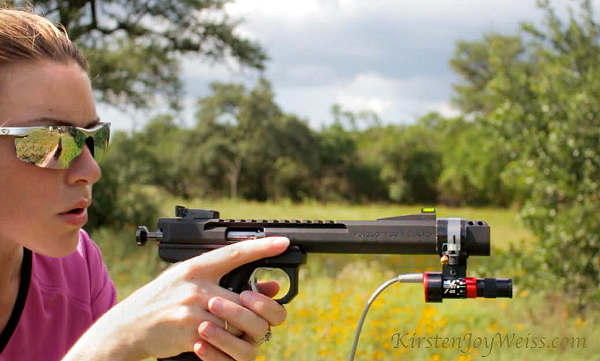
The SCATT MX-02 can also be used with target pistols.
Could you hit a buffalo at 1.27 miles (2240 yards) … with iron sights? Impossible as that may seem, that’s exactly what Ernie Jimenez did last month at the North Springs Shooting Range in Price, Utah (elevation 5,627′). Shooting a milsurp Swiss K31 rifle chambered for the 7.5×55 Swiss round, Jimenez placed four hits on a three-foot-high, bison-shaped steel target placed a staggering 2240 yards from the firing line. Not bad for a rifle which Jimenez acquired many years ago for just $99.00. Of course he did have plenty of misses along the way (and Ernie even managed to hit the plate shielding his camera).
This video is set to start half-way through, when the shooter starts making hits:
Some folks say you haven’t really mastered marksmanship unless you can hit a target when standing tall ‘on your own hind legs’. Of all the shooting positions, standing can be the most challenging because you have no horizontally-solid resting point for your forward arm/elbow. Here 10-time National High Power Champ Carl Bernosky explains how to make the standing shot.
Carl Bernosky is one of the greatest marksmen in history. A multi-time National High Power Champion, Carl has won ten (10) National High Power Championships in his storied shooting career, most recently in 2012. In this article, Carl provides step-by-step strategies to help High Power shooters improve their standing scores. When Carl talks about standing techniques, shooters should listen. Among his peers, Carl is regard as one of the best, if not the best standing shooter in the game today. Carl rarely puts pen to paper, but he was kind enough to share his techniques with AccurateShooter.com’s readers.
If you are position shooter, or aspire to be one some day, read this article word for word, and then read it again. We guarantee you’ll learn some techniques (and strategies) that can improve your shooting and boost your scores. This stuff is gold folks, read and learn…
How to Shoot Standing by Carl Bernosky
Shooting consistently good standing stages is a matter of getting rounds down range, with thoughtfully-executed goals. But first, your hold will determine the success you will have.
1. Your hold has to be 10 Ring to shoot 10s. This means that there should be a reasonable amount of time (enough to get a shot off) that your sights are within your best hold. No attention should be paid to the sights when they are not in the middle — that’s wasted energy. My best hold is within 5 seconds after I first look though my sights. I’m ready to shoot the shot at that time. If the gun doesn’t stop, I don’t shoot. I start over.
2. The shot has to be executed with the gun sitting still within your hold. If the gun is moving, it’s most likely moving out, and you’ve missed the best part of your hold.
3. Recognizing that the gun is sitting still and within your hold will initiate you firing the shot. Lots of dry fire or live fire training will help you acquire awareness of the gun sitting still. It’s not subconscious to me, but it’s close.
4. Don’t disturb the gun when you shoot the shot. That being said, I don’t believe in using ball or dummy rounds with the object of being surprised when the shot goes off. I consciously shoot every shot. Sometimes there is a mistake and I over-hold. But the more I train the less of these I get. If I get a dud round my gun will dip.* I don’t believe you can learn to ignore recoil. You must be consistent in your reaction to it.
5. Know your hold and shoot within it. The best part of my hold is about 4 inches. When I get things rolling, I recognize a still gun within my hold and execute the shot. I train to do this every shot. Close 10s are acceptable. Mid-ring 10s are not. If my hold was 8 inches I would train the same way. Shoot the shot when it is still within the hold, and accept the occasional 9. But don’t accept the shots out of the hold.
6. Practice makes perfect. The number of rounds you put down range matter. I shudder to think the amount of rounds I’ve fired standing in my life, and it still takes a month of shooting standing before Perry to be in my comfort zone. That month before Perry I shoot about 2000 rounds standing, 22 shots at a time. It peaks me at just about the right time.
This summarizes what I believe it takes to shoot good standing stages. I hope it provides some insight, understanding, and a roadmap to your own success shooting standing.
— Good Shooting, Carl
* This is very noticeable to me when shooting pistol. I can shoot bullet holes at 25 yards, but if I’ve miscounted the rounds I’ve fired out of my magazine, my pistol will dip noticeably. So do the pistols of the best pistol shooters I’ve watched and shot with. One might call this a “jerk”, I call it “controlled aggressive execution”, executed consistently.
If you have an interest in historic arms, or just enjoy a diversion from the world of precision centerfire rifles, muzzle-loaders can be fun. There are also many states where hunters with muzzle-loaders enjoy a longer (and/or earlier) hunting season.
If you want to learn more about muzzle-loaders, the NRA and the National Muzzleloading Rifle Association have created an excellent new book, the NRA How-To-Series on Muzzleloading. This 132-page handbook ($12.00) covers muzzleloading safety, fundamentals of muzzleloader shooting, black powder basics, shooting positions, cleaning, storage and more. The “how-to” guide covers rifle, pistol, and shotgun muzzle-loaders.
The How-To book is a good starter publication for anyone interested in muzzle-loaders. Along with the book, the NRA recommends that novices attend a muzzleloading course to learn safe shooting practices from qualified instructors.
This article, in longer form, appears on the USAMU Facebook page, as part of the “Handloading Hump Day Series”. This article explores three different “Philosophies” of precision reloading. Some handloaders seek to produce ammo that yields the very tightest groups (without factoring in the wind). Other shooters load their ammo to deliver the highest safe velocity. That’s because a projectile launched at higher velocity will drift less in the wind. The theory is that even if fast ammo doesn’t produce the tightest groups in zero wind conditions, it will yield higher scores in a the real world (where the wind blows). Lastly, some handloaders favor ammo that is ultra-consistent across a wide temperature range. This last philosophy dictates selection of a powder that is temp-insensitive, even if it may not produce the very best raw accuracy (or speed).
What’s Your Handloading Philosophy?
Objectives of Reloading — Accuracy, Velocity, Temp Stability What do you, the reader, primarily value in your handloads?
Viewpoint ONE: Accuracy Trumps Everything
Some shooters prize consistent, excellent medium/long range accuracy enough that they’re willing to give up some extra velocity (and reduced wind deflection) to obtain that. Their underlying philosophy could be stated: “Superior accuracy is present for every shot, but the wind isn’t”. One’s ability to hold well, aim well and read the wind are all factors in making this type decision. The photo below shows stellar raw accuracy. This is an 0.67″, 10-shot group at 300-yards fired from a text fixture. The group measures just 0.67″. (This shows the USAMU’s 600-yard load with 75gr bullets).
Anette Wachter (aka ’30CalGal’) is one of America’s top long-range sling shooters. A member of the U.S. National Rifle Team and a NRA High Master (both mid- and long-range), Anette has an impressive shooting resume. She has also recently started shooting 3-Gun and tactical matches. These “run and gun” matches involve rapid transitions, with shooting from a wide variety of positions. To help improve her 3-Gun shooting, Anette has developed a specific exercise regimen, which she calls the 3-Gun Biceps Series. Here’s a short sample:
ANETTE: One thing you can be sure of in a 3-Gun match is shooting from weird positions. I have noticed that the stage designers love port holes [in barriers]. There are many that are on the ground that you have to shoot through. Or perhaps it is not a port hole but just underneath a barrier. Imagine you are running to that spot with rifle in hand and you have to use one arm to brace your fall to the ground, while holding the rifle safely and facing down range in the other, and then get in to position to shoot, then back up again using one arm to push off of. I have an exercise I have been doing for a awhile that works great for this move…
The “Shooting Low Porthole Plank” starts off in a plank position — make sure your back is straight.
Every shooter needs to get his or her start someplace. We applaud the NSSF First Shots program that brings new shooters into the fold. If we want to “stem the tide” and resist pressures to close gun ranges and limit firearms use, we need to get new people involved in the shooting sports. And the first step in that process is getting first-timers to the range. Around the country, First Shot Seminars provide free instruction by trained firearms instructors, with guns and ammo provided at no charge to participants. The free First Shots program teaches newcomers firearms fundamentals, safety, and local regulations in a classroom setting, followed by a live-fire session with certified instructors.
Here are four FREE fun targets from the NSSF. These can be downloaded as PDF files for easy, scalable printing. Choose from four fun targets: Orange Clays, Fish in a Barrel, Cans on Fence, or Bacon Xs. To download any of the targets, right click and “Save Link As”. You can also click on the four large targets and they should open up in most browsers if you have the PDF reader installed. Have Fun!
Orange Clays
Fish in a Barrel
Cans on Fence
Bacon Xs
Download FREE Bullseye Targets
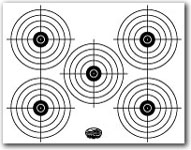
The NSSF also offers conventional bullseye-style targets on the NSSF Targets page. Here are two, high-contrast printable targets. With five (5) bullseyes per sheet, these are good for load development. They also work well at short range for pistol shooting.



 How to Shoot Standing
 5. Know your hold and shoot within it. The best part of my hold is about 4 inches. When I get things rolling, I recognize a still gun within my hold and execute the shot. I train to do this every shot. Close 10s are acceptable. Mid-ring 10s are not. If my hold was 8 inches I would train the same way. Shoot the shot when it is still within the hold, and accept the occasional 9. But don’t accept the shots out of the hold.