NRABlog.comstory by Kyle Jillson
If you know a shooter aged 12-21 who would enjoy some shooting sports action this summer, the NRA is now accepting applications for its annual competitive Shooting Camps for Junior Shooters. These camps, run by the Coach Education Program, help young shooters develop their marksmanship skills. CLICK HERE for application info.
“These camps have everything you need to take your game to the next level,” said NRA National Coach Trainer Daniel Subia. “Each day will be filled with exercises designed to help you master your body positioning, breath, and trigger control to consistently shoot high scores. You’ll be tired at the end of each day, but you’ll leave a better shooter than you were before.”
Intermediate Junior Pistol Camp: June 26 – June 28
Held in Canton, Ohio, this camp is for beginning and intermediate shooters and is limited to 25 students. The camp registration deadline is June 1.
Intermediate Junior Rifle Camp: July 5 – July 10
Located in Camp Perry, Ohio’s Petraca Range, this camp features two admission periods for its 60 slots. The first admission period, open March 11 – April 30 is for junior shooters who have previously participated in an NRA Junior 3P or 4P Smallbore sectional match. The Second admission, open May 1, is open to all shooters.
Junior Advanced Competitive Smallbore Rifle Camp: July 6 – July 14
Held in Jericho, Vermont, this 9-day camp is a demanding training opportunity for advanced athletes and is limited to 20 students. The camp registration deadline is May 1. “[This camp] is like Top Gun for smallbore athletes. We take the best and make them better. We’re not leaving anything out. We will do everything possible to make sure that every marksman leaves this camp as a sharpshooter or better”, said Daniel Subia. “Attendees can expect a challenging, incredibly rewarding training experience that will prepare them for competition at the highest level.”
To learn more about these training camps and download the application package, visit the National Junior Shooting Camps webpage. Questions? Contact Daniel Subia at coaching[at]nrahq.org.
They say “things are bigger in Texas”. Well shots are longer too. In this video, a shooter successfully hits a 1-MOA target at 3600 yards with a .375 CheyTac rifle. That required plenty of elevation to compensate for the bullet’s drop over its 2.045 mile trajectory. The shooter, Jim Spinella of New Jersey, needed a whopping 60.2 Mils of elevation (26.8 in rail, 22.6 in turret, 10.8 hold-over). Jim had to wait a long time to confirm the hit — with the metal gong situated more than than 2 miles from the firing line, it took the bullet 7.2 seconds to hit the target.
Big 350gr Bullets with a Wicked BC
The 3600-yard hit was made with CheyTac factory ammo using 350gr CNC-turned bullets. Spinella was impressed: “The ammo chronographed out at 3080 fps with velocity differences at no more the 7 fps, which was outstanding. We found the true BC over 3600 yards to average 0.810 (G1)”.
NOTE: You see three shots in the video, but Spinella took many more before a hit was achieved: “We peppered the 2 MOA area around the target with a couple of dozen rounds. We hit the rack the target is hanging on twice. This was a fun experience, and we took a lot of data away from it. We put a lot of work and planning into this in order to be in position to be lucky. So many things are ridiculously magnified at that distance. Every 1 mph change in wind [moves the bullet] about 6 feet. As the barrel heats up the velocity changes with it [and] 10 fps velocity differences, shot to shot, are almost 5 feet.”
This ultra-long-range adventure took place last September at the FTW Ranch in Texas. Spinella worked with a team of experts from Hill Country Rifles, builders of the custom .375 CheyTac rifle, to achieve a 3600-yard shot on a 36” round steel target. Hitting a target at 2.045 miles is no mean feat. That 36″ gong represents slightly less than 1 MOA at that range. A lot can happen to send a bullet off target during a 7.2 second flight.
Rifle: Hill Country Rifles custom .375 Cheytac, Stiller Precision action, 29″ Krieger barrel
Optics: Schmidt & Bender 5-25X56mm PM-2 scope
Actual Measured Distance: 3606.41 Yards
Target: 36″ circular steel plate
Altitude: 2000 feet
Temp: 70 degrees
Elevation: 60.2 mil
Windage: 3.5 mil left
CheyTac Caliber Comparison — .375 vs. .408
The shooter, Jim Spinella, prefers the .375 CheyTac to its .408-caliber Big Brother: “I shoot both the .408 and .375. Both are great ELR rounds and will get you out there a long way. In my experience, the .375 will get you out there a little bit further. My preference is the .375 Cheytac over the .408. This has nothing really to do with external ballistics. It has to do with fouling. My .408 will go from stellar accuracy to terrible between 40 and 45 rounds. It happens that quickly and accuracy returns after cleaning the barrel. I have never experienced this with the .375. After 100 rounds there is minimal copper fouling with the .375, but I clean around this round count. I don’t know why there is heavy cooper fouling in the .408, but it is common to this round and other shooters who shoot it regularly. That said, I lightly clean the .408 using Wipeout and go back to having fun with it after about 30 minutes.”
Brian “Gunny” Zins, 12-Time NRA National Pistol Champion, has authored an excellent guide to bullseye pistol shooting. Brian’s Clinic on the Fundamentals recently appeared in The Official Journal of the New York State Rifle & Pistol Association. The CMP scanned the story so you can read it online. CLICK HERE to read full article.
Top Tips from Brian Zins:
Trigger Movement: If trigger control is ever interrupted in slow fire the shot needs to be abored and the shot started over.
Relationship between Sight Alignment and Trigger Control: Often when the fundamentals are explained these two are explained as two different acts. Well, truth be told it’s really kind of hard to accomplish one without the other. They have a symbiotic relationship. In order to truly settle the movement in the dot or sights you need a smooth, steady trigger squeeze.
Trigger Finger Placement: Where should the trigger make contact on the finger? The trigger should be centered in the first crease of the trigger finger. Remember this is an article on Bullseye shooting. If this were an article on free pistol or air pistol it would be different.
Proper Grip: A proper grip is a grip that will NATURALLY align the gun’s sights to the eye of the shooter without having to tilt your head or move your or move your wrists around to do that. Also a proper grip, and most importantly, is a grip that allows the gun to return to the same position [with sights aligned] after each and every shot. The best and easiest way to get the proper grip, at least a good starting postion… is with a holster. Put your 1911 in a holster on the side of your body[.] Allow your shooting hand to come down naturally to the gun.
In recent years, Brian “Gunny” Zins has been shooting 1911s crafted by Cabot Guns.
Brian “Gunny” Zins currently holds 25 National Records.
Getting tutored by Olympic-class experts — now that’s a rare opportunity in the shooting world. ELEY Ltd., makers of precision rimfire ammo, has announced a special contest. Two lucky marksmen (one pistol shooter and one rifle shooter) will win the chance to train with the U.S. National Team at the Olympic Training Center in Colorado Springs. All ammunition for the one-day training session (in June, 2015) will be supplied by ELEY. (The winners must supply their own firearm.) The lucky winners will even be able to use the elite Olympic Training Center strength/conditioning facilities.
Training day sessions will be conducted by top coaches/atheletes from the U.S. National squad. Rifle coaches may include: Bryant Wallizer, Thomas Csenge, Michael Liuzza, Justin Tracy (2013 Prone National Champion), Dempster Christenson, Sarah Beard, Sarah Scherer, Emily Holsopple, Amy Sowash, Reya Kempley, and former National Rifle Coach Dave Johnson.
Pistol coaches may include: Keith Sanderson, Nick Mowrer, Jason Turner, Teresa Chambers, Morgan Wallizer (2004 rifle Olympian now training pistol), National Pistol Coach Sergey Luzov.
How to Enter Contest
For more information, or to enter the Training Day Contest, visit ELEY’s Training Contest Page on Facebook. NOTE — the deadline for contest entries is March 16, 2015.
Horizontal Wind-Drift vs. Distance
OK, here’s a challenge question for you.
Let’s see if you get it right.
Q: If the wind is blowing 10 mph from 9 o’clock and if my horizontal wind deflection is 0.7 inches at 100 yards, what is the horizontal drift at 1000 yards?
You may be thinking, “Well, since the target is ten times more distant, the wind-drift should be around 7 inches, maybe a little more since the bullet will be slowing down.” That sounds reasonable, right?
WRONG.
As you move from near to far, the increase in lateral deflection (from a 90° crosswind) is (roughly speaking) a function of the square of the multiple of distance. If your target is two times farther away, you use the square of two, namely four. If your target is five times farther away, you use the square of five, or twenty-five. In this example, the increased wind drift (from 100 to 1000 yards) is at least 0.7″ times (10 X 10) — over 70 inches (give or take a few inches depending on bullet type). We call that the Rule of the Square. This Rule lets you make a quick approximation of the windage correction needed at any yardage.
Precision Shooting and the Rule of the Square
I was going through some back issues of Precision Shooting Magazine and found many references to the Rule of the Square. This made me curious — I wondered how well the Rule really stacked up against modern ballistics programs. Accordingly, I ran some examples through the JBM Ballistics Trajectory Calculator, one of the best web-based ballistics programs. To my surprise, the Rule of the Square does a pretty good job of describing things.
EXAMPLE ONE — .308 Win (100 to 400 Yards)
For a 168gr Sierra MK (.308), leaving the muzzle at 2700 fps, the JBM-predicted values* are as follows, with a 10 mph, 9 o’clock crosswind (at sea level, 65° F, Litz G7 BC):
Drift at 100: 0.8 MOA (0.8″)
Drift at 200: 1.6 MOA (3.3″)
Drift at 400: 3.4 MOA (14.4″)
Here you can see how the Rule of the Square works. The rule says our drift at 200 yards should be about FOUR times the drift at 100. It the example above, 0.8″ times 4 is 3.2″, pretty darn close to the JBM prediction of 3.3″. Quoting Precision Shooting: “Note that the deflections at 100 yards are typically a quarter of those at 200; lateral deflections increase as the square of the range”. Precision Shooting, June 2000, p. 16.
EXAMPLE TWO — .284 Win (100 to 1000 Yards)
For a .284 Win load, with the slippery Berger 180gr Target Hybrids, the Rule of the Square still works. Here we’ll input a 2750 fps velocity, Litz G7 BC, 10 mph, 9 o’clock crosswind, (same 65° temp at sea level). With these variables, JBM predicts:
Drift at 100: 0.5 MOA (0.5″)
Drift at 500: 2.5 MOA (13.3″)
Drift at 1000: 5.9 MOA (61.3″)
Again, even with a higher BC bullet, at 1000 yards we end up with something reasonably close to the 100-yard deflection (i.e. 0.5″) multiplied by (10×10), i.e. 50 inches. The Rule of the Square alerts you to the fact that the effects of crosswinds are MUCH greater at very long range. In this example, our JBM-calculated drift at 1000 is 61.3″ — that’s over 100 times the 100-yard lateral drift, even though the distance has only increased 10 times.
Note that, even with a 5 mph 90° sidewind, the “Rule of the Square” still applies. The 1000-yard lateral deflection in inches is still over 100 times the lateral deflection at 100 yards.
Why This All Matters (Even in the Age of Smartphones) Now, some would say, “Why Should I Care About the Rule of the Square? My iPhone has a Ballistics App that does all my thinking for me”. Fair enough, but knowledge of this basic Rule of the Square enables a shooter to make an informed guess about necessary windage even without a come-up sheet, as long as he knows the distance AND can fire a sighter at 100 or 200 yards as a baseline.
For example, if I see empirically that I need 1″ windage correction at 100 yards, then I know that at 600 yards I need at least roughly (6 x 6 x 1″) or 36 total inches of drift correction, or 6 MOA. (To be precise, 1 MOA = 1.047″ at 100 yards). I can figure that out instantly, even without a ballistics chart, and even if my Smartphone’s battery is dead.
*Values shown are as displayed on the JBM-figured trajectory tables. The numbers can be slightly imprecise because JBM rounds off to one decimal place for both inches and MOA.
Do you like scary movies? This video will send chills up and down your spine. But it’s not about Space Aliens, or slime monsters — it’s about two-legged creatures that appear out of nowhere… while you’re shooting. Watch this video carefully. Something happens at 0.38″ that will make your heart race. Warning: Adult language — Not suitable for playback at work.
Why You Must Always, Always Be Careful When Shooting on Public Lands…
LESSON Learned: Always be aware of your backstop and beyond. If there is any possibility of someone venturing into the “danger zone”, mark off the target area, and designate a person to watch the area around the target. That designated spotter should instantly call a halt to shooting if any person or vehicle appears. It is also a good idea to place warning signs, but don’t count on these to be headed.
This video was filmed on BLM land out in the Nevada desert. In such public areas, one must be very careful about shooting. There may be hikers, bikers, explorers, and horse-riders nearby. An offroad motorcyclist might be moving at 65 miles an hour. At that speed he’ll cover 32 yards in just one second! With that possibility, you really have to be ultra-careful. To be forewarned of potential risks, you need to watch way out to the left and right, not just focus on the backstop and the bullet’s flight path.
The shooting area shown above is located on BLM land. All BLM rules and regulations apply. Remember it is everyone’s desert so always think “safety first”. The video-maker, JFComfort (aka “Joe”), explains: “We do the majority of our shooting on BLM land surrounding the Las Vegas Valley. We have found shooting in small groups in the desert works well for us. We have spent a lot of time out there in the past. I advise you not to shoot alone and be very mindful of off-road enthusiasts. Guys on quads, dirt bikes, and Rhinos seem to pop out of nowhere. Also keep a close eye out for other shooters, not everyone is safe, respectful and courteous.”
The Berger Southwest Nationals (SWN) kicked off Tuesday, February 10th, with an instructional clinic at the Ben Avery 1000-yard Range. This combined a lecture/Q&A session with live-fire training. Ballistics “Professor” Bryan Litz reports: “The clinic was a big hit as usual, with lots of competitor participation. There was a big crowd this year, as you can see.”
The clinic started with a class on Exterior Ballistics hosted by Bryan. This focused on why ballistics is important to competitive shooters, and how to balance ballistic performance objectives against real world constraints. Topics included bullet weight options for F-TR (155 to 215 grains), barrel/chamber considerations, plus the real-world trade-offs involved with heavy bullets (yes the BC may be better but recoil becomes an issue). Many of the questions related to content from Bryan’s recent books, and discussions in AccurateShooter.com’s Ballistics sub-Forum and Daily Bulletin.
Following the ballistics class, shooters made their way to the firing line for one-on-one instruction with experienced shooters in each discipline (sling, F-TR and F-Open). During this segment of the clinic, champion shooters worked directly with novice and intermediate shooters. Bryan said: “It was great to see the ‘top guns’ sharing their knowledge.”
Last but not least, Mid Tompkins directed a wind clinic with live fire demonstrations. Bryan reports: “Mid has a way of getting your attention. Personally, I thought his 2 MOA wind call that put the very first shot in the 5 inch X-ring at 1000 yards got everyone’s attention!” After the demonstrations, clinic “students” went to the firing line to put wind-clinic lessons into practice, and to verify their zeroes.
Mid Tompkins at the SWN Shooters’ Clinic
Here are some more images from the instructional clinic held last year at the 2014 SW Nationals.
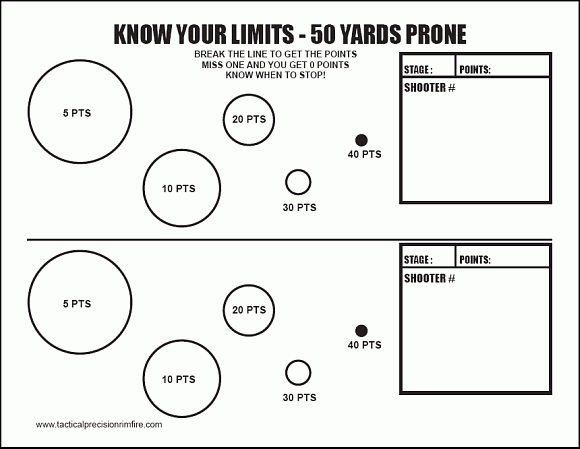
In the hit Hollywood movie “The Patriot”, the hero Benjamin Martin (played by Mel Gibson), tells his sons: “Aim small, miss small”. That advice was given to help his sons survive encounters with the British redcoats, but the “aim small, miss small” mantra can benefit target shooters as well.
We have found that novice and intermediate shooters can often improve their accuracy simply by using targets with smaller, more precise aiming points. Inexperienced shooters can benefit by starting with a large-size aiming circle, and then progressing to smaller and smaller target dots. This lets the shooter increase the challenge as his gun-handling becomes more steady and his aim improves.
Here are two rimfire training targets with “big to small” target circles. Start with the largest circles, then move to the smaller ones in sequence. This systematic drill provides increasing challenge shot-by-shot. Novices often are quite surprised to see their accuracy improve as they move from bigger to smaller aiming points. That provides positive feedback — always a good thing.
Right Click and “Save as” to download printable PDF versions of these targets.
The Original Pennsylvania 1000-Yard Club (Williamsport) is now accepting applications for its 2015 Long-Range Benchrest School. If you want to learn how to shoot accurately at very long range, one of the very best places to learn is the Williamsport 1000-Yard Benchrest School. The 8th Annual Benchrest School will be held Friday, June 5 through Sunday, June 7, 2015. Classes, taught by top 1K shooters, are held at the Williamsport Range, one of the best 1K ranges in the country.
From June 5-7 2015, the club will host a multi-day, long-range Benchrest Academy for novice to intermediate shooters. For $350 students will enjoy 1 night and 2 days of intensive training under the guidance of top 1000-yard shooters. Prospective students will be taught all aspects of long-range benchrest shooting by highly skilled instructors. All areas are covered: load development, precision reloading, bench skills, and target analysis. Much time is spent at the loading bench and on the firing line. And you don’t even need guns and ammo — all equipment and ammunition will be provided. The sign-up deadline is June 1st. To reserve a spot, email School Director/President Ryan Miller: ryanmiller @ htva.net.
School Schedule, Friday Through Sunday
On Friday night (June 5th), students will meet their mentors. Saturday (June 6th), the class moves to the range for a full day of hands-on technical training. Topics will include precision reloading, load development, gun handling, use of chronograph, analysis of shooting results, gun cleaning, and target analysis. The club will provide the rifles and all reloading components. Saturday’s training sessions are followed by a steak dinner which is included in the $350 seminar price.
On Sunday (June 7th), after an early training session covering bench set-up and match strategies, students will participate in a 1000-yard match, spending time both behind the trigger and in the pits. Instructors will explain how to read conditions, and will demonstrate target measuring and analysis after the relays. The program wraps up by 4:00 pm on Sunday.
To see what the 1K Benchrest school is like, watch the slide show/video below, produced by Sebastian Reist, an alumnus of the 2009 Williamsport 1000-yard BR school.
Please enable Javascript and Flash to view this VideoPress video.
Story Tip from EdLongrange. We welcome reader submissions.
Guest Article By Michelle Gallagher, Berger Bullets
Let’s face it. In the world of firearms, there is something for everyone. Do you like to compete? Are you a hunter? Are you more of a shotgun shooter or rifle shooter? Do you enjoy running around between stages of a timed course, or does the thought of shooting one-hole groups appeal to you more? Even though many of us shoot several different firearms and disciplines, chances are very good that we all have a favorite. Are we spreading ourselves too thin by shooting different disciplines, or is it actually beneficial? I have found that participating in multiple disciplines can actually improve your performance. Every style of shooting is different; therefore, they each develop different skills that benefit each other.
How can cross-training in other disciplines help you? For example, I am most familiar with long-range prone shooting, so let’s start there. To be a successful long-range shooter, you must have a stable position, accurate ammunition, and good wind-reading skills. You can improve all of these areas through time and effort, but there are other ways to improve more efficiently. Spend some time practicing smallbore. Smallbore rifles and targets are much less forgiving when it comes to position and shot execution. Long-range targets are very large, so you can get away with accepting less than perfect shots. Shooting smallbore will make you focus more on shooting perfectly center shots every time. Another way to do this with your High Power rifle is to shoot on reduced targets at long ranges. This will also force you to accept nothing less than perfect. Shoot at an F-Class target with your iron sights. At 1000 yards, the X-Ring on a long range target is 10 inches; it is 5 inches on an F-Class target. Because of this, you will have to focus harder on sight alignment to hit a center shot. When you go back to the conventional target, you will be amazed at how large the ten ring looks.
Also, most prone rifles can be fitted with a bipod. Put a bipod and scope on your rifle, and shoot F-TR. Shooting with a scope and bipod eliminates position and eyesight factors, and will allow you to concentrate on learning how to more accurately read the wind. The smaller target will force you to be more aggressive on your wind calls. It will also help encourage you to use better loading techniques. Nothing is more frustrating than making a correct wind call on that tiny target, only to lose the point out the top or bottom due to inferior ammunition. If you put in the effort to shoot good scores on the F-Class target, you will be amazed how much easier the long-range target looks when you return to your sling and iron sights. By the same token, F-Class shooters sometimes prefer to shoot fast and chase the spotter. Shooting prone can help teach patience in choosing a wind condition to shoot in, and waiting for that condition to return if it changes.
Benchrest shooters are arguably among the most knowledgeable about reloading. If you want to learn better techniques about loading ammunition, you might want to spend some time at benchrest matches. You might not be in contention to win, but you will certainly learn a lot about reloading and gun handling. Shooting F-Open can also teach you these skills, as it is closely related to benchrest. Benchrest shooters may learn new wind-reading techniques by shooting mid- or long-range F-Class matches.
Position shooters can also improve their skills by shooting different disciplines. High Power Across-the-Course shooters benefit from shooting smallbore and air rifle. Again, these targets are very small, which will encourage competitors to be more critical of their shot placement. Hunters may benefit from shooting silhouette matches, which will give them practice when shooting standing with a scoped rifle. Tactical matches may also be good, as tactical matches involve improvising shots from various positions and distances. [Editor: Many tactical matches also involve hiking or moving from position to position — this can motivate a shooter to maintain a good level of general fitness.]
These are just a few ways that you can benefit from branching out into other shooting disciplines. Talk to the other shooters. There is a wealth of knowledge in every discipline, and the other shooters will be more than happy to share what they have learned. Try something new. You may be surprised what you get out of it. You will certainly learn new skills and improve the ones you already have. You might develop a deeper appreciation for the discipline you started off with, or you may just discover a new passion.
This article originally appeared in the Berger Bulletin. The Berger Bulletin blog contains the latest info on Berger products, along with informative articles on target shooting and hunting.


 Brian “Gunny” Zins, 12-Time NRA National Pistol Champion, has authored an excellent guide to bullseye pistol shooting. Brian’s


 Horizontal Wind-Drift vs. Distance
 Now, some would say, “Why Should I Care About the Rule of the Square? My iPhone has a Ballistics App that does all my thinking for me”. Fair enough, but knowledge of this basic Rule of the Square enables a shooter to make an informed guess about necessary windage even without a come-up sheet, as long as he knows the distance AND can fire a sighter at 100 or 200 yards as a baseline.


 In the hit Hollywood movie “The Patriot”, the hero Benjamin Martin (played by Mel Gibson), tells his sons: “Aim small, miss small”. That advice was given to help his sons survive encounters with the British redcoats, but the “aim small, miss small” mantra can benefit target shooters as well.
 The
The 


 Position shooters can also improve their skills by shooting different disciplines. High Power Across-the-Course shooters benefit from shooting smallbore and air rifle. Again, these targets are very small, which will encourage competitors to be more critical of their shot placement. Hunters may benefit from shooting silhouette matches, which will give them practice when shooting standing with a scoped rifle. Tactical matches may also be good, as tactical matches involve improvising shots from various positions and distances. [Editor: Many tactical matches also involve hiking or moving from position to position — this can motivate a shooter to maintain a good level of general fitness.]


