|
|
April 12th, 2014
New Daily Bulletin readers may not know that our AccurateShooter.com website offers an entire set of FREE TARGETS. There are over 50 free targets, including: Sight-in targets, Load Development targets, Benchrest targets, NRA Highpower targets, Scope Testing targets, Fun Targets, Rimfire BR targets, 3D Bullseye targets, and even a special set of Rimfire Tactical targets.
Most of the targets come bundled in .zip archives, so you can easily download multiple targets with one click. The targets are saved in PDF format (Adobe Acrobat), so they are easy to print and the scale is correct no matter what your screen resolution.

In the photo above, Forum member FireMedic shows some fine shootin’ with our basic Accuracy Target. With small, red diamonds and extended black lines, this target allows very precise aiming at 100 and 200 yards. The gray dot on top provides a reference point for a 200-yard zero. FireMedic reports: “My 30″, 12 twist, 3 groove does pretty good for an old Savage chambered in .308 Win.” With an average group size of 0.208 inches we’d have to agree. Great Shootin’ FireMedic!
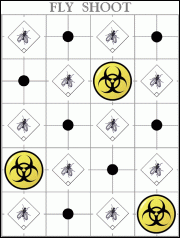
Above are two fun targets you might enjoy. The Atomic Target was originally created as a contest for our readers. The design is by Michael Forester of Auckland, New Zealand. Hit the bigger green and red neutrons, then try your luck with the smaller electrons. Or you can try to shot some “bug-holes” with our popular Fly Shoot Target. Watch out for the bio-hazard rings!
Of course, if you happen to have actual insect land on your target, you might just shoot an honest-to-goodness “bughole”. Here we see an accurate “direct hit” on a gnat’s a** by Dr. Clint D., described by GA Precision’s George Gardner as a “gnat protologist”. The shot was made at 100 yards with a very accurate GAP .260 Rem.

April 9th, 2014

 Story based on Lars Dalseide report for NRABlog. Story based on Lars Dalseide report for NRABlog.
One of the most popular events at the NRA Annual Meetings & Exhibits is the Pyramyd Air Air Gun Range. This April 25-27, NRA Headquarters Range Manager Michael Johns is back with his Range Safety Officers to put smiles on the face of every young marksman willing to take a turn at the firing line. “If you see a long line there at the Indiana Convention Center, odds are that it’s for the air gun range,” said Johns. “We have boys and girls, moms and dads, everyone waiting to plink… the day away.”
The Pyramyd Air Air Gun range will operate in the Indiana Convention Center lobby at these times:
| Thursday, April 24: |
2:00 p.m. – 6:00 p.m. |
Saturday, April 26: |
8:00 a.m. – 6:00 p.m. |
| Friday, April 25: |
8:00 a.m. – 6:00 p.m. |
Sunday, April 27: |
9:00 a.m. – 5:00 p.m. |
At the Air Gun Range, you’ll find air rifles and air pistols from:
|
Air Arms World Class Air Rifles
Air Venturi
AirForce Airguns
Anschutz
Beeman Precision Airguns
Benjamin
Crosman
Evanix
EyePal USA
|
Gamo
Hawke Optics
Remington
Sam Yang Big Bore Rifles
ShinSung
Sumatra Air Rifles
Stoeger Airguns
Umarex USA
Walther
|
A long time partner in this experience, Pyramyd sees the NRA Air Gun Range as more than marketing opportunity. “We’re focused on increasing the number of shooters and involving people of all ages in the shooting sports,” said Pyramyd founder and owner Joshua Ungier. “For Pyramyd Air, it isn’t just a business – it’s a passion.”

April 6th, 2014
The National Shooting Sports Foundation (NSSF) has taken over the Ruger Rimfire Challenge program. Now called the NSSF Rimfire Challenge, the program retains the format that has made it so popular. This remains a two-gun timed competition with rimfire rifles and pistols. Shooters engage steel targets at relatively close distances. The matches are for young and old alike, all skill levels, with mentoring by experienced shooters. The emphasis is on fun and safety.

The use of .22 caliber pistols, revolvers and rifles make the Rimfire Challenge more affordable than most centerfire matches. “The affordability of this program is something that participants really like and keeps them coming back,” said Zach Snow, NSSF’s Manager of Shooting Promotions. “Event fees are affordable as well.”
For participants, NSSF Rimfire Challenge offers categories for everyone — Open and Limited Divisions, plus Special Recognition competitions. To learn more about on program equipment, rules, courses of fire, scheduled matches and the first NSSF Rimfire World Championship, visit NSSF.org/Rimfire.
NSSF Rimfire Challenge Basics
- This is a two-gun event so you need a rifle and a handgun (which can be either a semi-auto pistol or revolver).
- Bolt-action rifles and lever-action rifles are allowed, but self-loading (semi-auto) rifles are most popular because they can shoot quickly.
- It is suggested that your firearms hold at least ten rounds each, as there is no reloading allowed during the actually stages.
- It is a good idea to have five (5) magazines per gun (5 each for rifle and pistol). That way you don’t have to reload between stages. If you have a 10-shot revolver, you can reload manually, or use speed loaders.
- At Rimfire Challenge Matches, each competitor get five (5) runs through each target stage.
- Eye and ear protection is required on the range at all times. This is true for spectators as well as competitors.
NSSF Rimfire Challenge Courses of Fire | NSSF Rimfire Challenge Rulebook
Many different stage designs can be employed at Rimfire Challenge matches. Here are two examples from the NSSF Rimfire Challengs Suggested Courses of Fire:
 
March 28th, 2014
 If you own a modern smart-phone, you have a shooting coach in your pocket. What we mean is that the video-recording capability of your smart phone can help improve your shooting. Have you ever watched yourself shooting, under match conditions? Well you may be shocked (and surprised) by what you see. Video reveals all. If you are flinching, you’ll see it. If you’re not returning your rifle to the same place on the rests after each shot, you’ll see it. If you are not maintaining a consistent cheek weld from shot to shot, you’ll see it. If you own a modern smart-phone, you have a shooting coach in your pocket. What we mean is that the video-recording capability of your smart phone can help improve your shooting. Have you ever watched yourself shooting, under match conditions? Well you may be shocked (and surprised) by what you see. Video reveals all. If you are flinching, you’ll see it. If you’re not returning your rifle to the same place on the rests after each shot, you’ll see it. If you are not maintaining a consistent cheek weld from shot to shot, you’ll see it.
If you are a serious competitive shooter (or aspire to be one), you should take a camera to the range next time you practice. Have a friend film you while you are shooting in “match-like conditions”, i.e. with time limits and a specific course of fire. After the filming session, review the video carefully.
Our IT guy, JayChris, has improved his shooting skills by filming his practice sessions and watching for gun-handling errors or other mistakes. Recently Jay won the F-Open division at the TCSA (Rattlesnake) match. Jay says his progress has been aided by video analysis:
“Video-tape yourself in match conditions (or under mock match conditions when practicing). I have video from my first season of shooting at a long range match some years ago. I can compare that to video shot in 2014. Going back to year one, I could see how much moving around I was doing. The video camera is a useful tool. I video myself every so often at the practice range, just to make sure I’m consistent. When reviewing the video, I’ve caught myself dropping a shot right after re-settling into a new position where I didn’t even notice I was doing it while shooting.”
Video analysis has helped our IT Guy, JayChris, shoot better and make fewer mistakes.

Watch Your Position on Video
Jay continues: “Watching myself and other shooters on video has shown me how important it is to establish a comfortable shooting position. I used to move all over the place between shots. I spent some time getting a feel for a position where I could eject and load without breaking my cheek/shoulder weld, and that I could hold through a 20-shot string. It’s probably not as super critical as sling shooting positions, but I think it makes a big difference. It also helps ensure that your view through the scope remains the same. If you have parallax, changing your cheek weld has consequences. This includes making sure your rifle is set on the bags at a comfortable height — too high or too low and you are straining yourself and adding muscle tension into the equation.”
Use Video To Analyze Mistakes After Matches
Video can help you identify inconsistent holds and gun-handling mistakes. A video review can be part of the regular “post-mortem” you should do after every match. Bryan Litz says: “After each match, carefully analyze how you lost points and make a plan to improve. Beginning shooters will lose a lot of points to fundamental things like sight alignment and trigger control. At every step along the way, always ask yourself why you’re losing points and address the issues.”
Video can help you spot problems (such as inconsistent head position or bad trigger technique) that cost you points. We had one friend who was complaining about “mysterious horizontal” at matches. A post-match video session revealed that he was yanking the trigger to the side, rather than pulling straight back. He then consciously worked on his trigger control and his scores improved noticeably.
 Video Equipment — What You Need Video Equipment — What You Need
If you own a digital point-and-shoot camera made within the last four years, chances are you can shoot video. It may not be HD video, but it will suffice for the task of analyzing your shooting technique. Apple iPhones and iPads (and some Android phones) can take excellent video as well, but you’ll have to figure out a mounting system if you’re out by yourself. If you don’t currently own any device that can shoot video, consider one of the choices below. You can get a great camera for under $250.00 these days. The selections below all feature wide-angle capability, so you can position the camera close to the shooter. That’s important when shooting at crowded ranges. The Panasonic Lumix ZS20 has built-in GPS functionality, so you can tag your photos/videos with latitude and longitude.
One tip — you do NOT need to record at 1920×1080 Full HD resolution. It’s nice that some of the latest cameras (including the GoPro) offer this resolution, but 1920×1080 files will be HUGE, and older computers may have trouble playing back the video. For your range movies (to be viewed on a computer), we suggest you record at 720p HD.
Recommended Cameras with Video Capability
March 28th, 2014
Report Based on Story by Lars Dalseide in NRABlog.com
This story is for the female shooters out there. Ever think about becoming an NRA Certified Instructor? You can make that happen at this year’s NRA Convention in Indianapolis. Starting on Friday, April 25th, the first day of the Annual Meetings & Exhibits, a few dozen ladies will gather at the Indiana Convention Center for a 3-day NRA Pistol Instructor course. All the instructors are women. The entire course runs $250. That covers the course materials, range use, firearm use, ammunition and range equipment.
  After all is said and done, you will be required to demonstrate solid and safe pistol handling skills and successfully complete qualification exercises as well as receive the endorsement of the NRA Training Counselor conducting the course. Accomplish that and you will become an NRA-certified pistol instructor. To learn more the NRA female instructor development program, contact Diane Danielson at femaleinstructors@nrahq.org or 703-267-3999 for an application. CLICK HERE for more details. After all is said and done, you will be required to demonstrate solid and safe pistol handling skills and successfully complete qualification exercises as well as receive the endorsement of the NRA Training Counselor conducting the course. Accomplish that and you will become an NRA-certified pistol instructor. To learn more the NRA female instructor development program, contact Diane Danielson at femaleinstructors@nrahq.org or 703-267-3999 for an application. CLICK HERE for more details.
In this video, Tatiana Whitlock talks about becoming an NRA Certified Instructor (1:40 time mark). Tatiana is also a martial arts expert, who favors the Israeli Krav Maga self-defense system.
NRA Instructor Tatiana Whitlock Show Her Skills with Firearms and Martial Arts
March 26th, 2014
 Gun Digest will be producing a new quarterly print magazine, called Modern Shooter. It appears that the magazine focuses mostly on AR-platform rifles, AR accessories, and defensive shooting. The new magazine parallels the new Modern Shooter television show, which debuts on the Sportsman Channel next January. Look for Modern Shooter magazine on newsstands in April. The new magazine will also be available in digital format at www.gundigeststore.com. Gun Digest will be producing a new quarterly print magazine, called Modern Shooter. It appears that the magazine focuses mostly on AR-platform rifles, AR accessories, and defensive shooting. The new magazine parallels the new Modern Shooter television show, which debuts on the Sportsman Channel next January. Look for Modern Shooter magazine on newsstands in April. The new magazine will also be available in digital format at www.gundigeststore.com.
Each issue of Modern Shooter will focus on a popular firearms category. For example, the premier issue explains how to maintain an AR rifle, and how to “Defend Your Castle” with an AR. This first issue features Richard Mann’s 12 training drills for AR-platform rifles, plus reviews of AR accessories: optics, sights, rails, and adjustable stocks. The premiere edition of Modern Shooter profiles Colt manufacturing, discussing the history of the company. Colt’s new LE6920MP-USA and AR15A4 rifles will be reviewed.
March 25th, 2014
Forum member Stan from Northern California (aka BigBamBoo) has produced a cool video showing a 1000-yard shooting session with his Surgeon Rifles .243 Win. As he shot prone from bipod, Stan filmed with two cameras, one aimed at the shooter and the other zoomed way out at the target 1000 yards away. Using frame in frame editing, Stan combined the two camera viewpoints so you can watch his trigger-pulling and simultaneously see what’s happening downrange. Stan hits steel five times in a row.
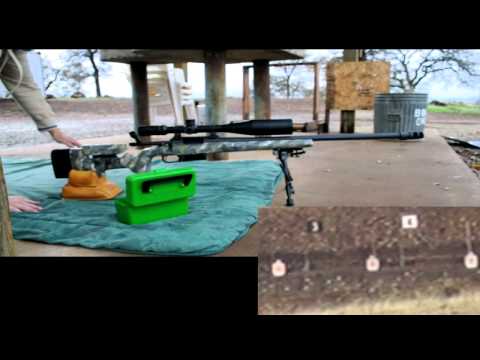
 If you listen carefully, you can hear the steel ring about three seconds after each shot (it takes that long for the sound to travel back). On a couple shots you’ll see dust kick up at the side of the target — but that’s not a miss. Remember his bullet is impacting on steel and what you’re seeing is dust kicked up on ricochet by a bullet fragment. If you listen carefully, you can hear the steel ring about three seconds after each shot (it takes that long for the sound to travel back). On a couple shots you’ll see dust kick up at the side of the target — but that’s not a miss. Remember his bullet is impacting on steel and what you’re seeing is dust kicked up on ricochet by a bullet fragment.
The main purpose of Stan’s shooting session was to evaluate a new Badger FTE muzzle brake. Watch the video and you can see that the big brake dramatically reduces both rearward movement and bipod hop. Stan was very happy with the brake’s effectiveness, as it allows him to keep his scope on target, and cycle quickly for the next shot. Stan reports: “Just keep an eye on the rifle. Watch the recoil — it’s greatly reduced with the muzzle brake. Makes spotting my shots very easy.”
LOAD: Lapua .243 Winchester brass, Sierra 107gr MatchKings, Wolf LR primers, 40.1 grains of H4350 powder.
Stan posts: “I recently sent my Surgeon Scalpel in .243 back to Surgeon to have a Badger FTE muzzle brake installed. Got a chance between rain storms to get to the range and do some shooting. As you can hear in the video…the wind was blowing pretty hard. But that just adds to the fun of shooting at long range. Turn up the volume and you should be able to hear the five hits on steel. If you set the playback resolution to 480p or better and go ‘full screen’, you should be able to see most of the hits.”
Why is the Sound of the Hit Delayed So Long?
The speed of sound at sea level, in dry 59° air, is 1116 fps. With the steel target 3000 feet (1000 yards) away, it takes 3000/1116 or 2.69 seconds for the sound of each hit to reach the shooter.
March 24th, 2014
If you only know Bryan Litz from his Applied Ballistics Books and DVDs, you may not realize that this guy is a great marksman (along with being an actual rocket scientist). This guy can shoot. At the recent Berger Southwest Nationals (SWN), Bryan took top honors among all sling shooters — and he managed to do that while performing many other important match duties. The pay-off for Bryan was getting his name on a really cool “ghost dancer” perpetual trophy. Litz joked: “With what the wind gods can do at shooting matches, it makes sense to have a trophy that puts you in touch with the spirit world.”

This is actually the second time Litz has finished first in Sling class at the Southwest Nationals. After his impressive win, we asked Bryan if he had any advice for other long-range competitors. First Bryan provided three tips concerning Ballistics, his special area of expertise. Next Bryan offered three more general tips about long-range competition — how to analyze your shooting, how to choose your ‘wind strategy’, and how to avoid the most costly mistakes, i.e. how to avoid the “train-wrecks”.

Litz Ballistics Tips
Ballistics TIP ONE. If you’re having trouble getting your ballistic software to match actual drops, you need to look at a number of possible reasons. Here are some common issues that can cause problems.
Click Values Are Not Exact. Scopes and iron sights don’t always produce accurate adjustments. In other words, if your ballistics program predicts 30 MOA of drop, and you dial 30 MOA but hit low, it might be that your sight actually only moved 28 MOA (for example). To see if your sight is adjusting accurately, shoot a tall target at 100 yards and measure group separation when dialing your sight.
Barometric vs. Station Pressure. This is a commonly misunderstood input to ballistics programs. You can avoid this pitfall by remembering the following: station pressure is the actual measured pressure at your location, and you don’t need to tell the program your altitude when using station pressure. Barometric pressure is corrected for sea level. If you’re using barometric pressure, you also have to input your altitude.
Muzzle Velocity. Chronographs are not always as accurate as shooters think they are — your true MV may be off by 10-20 fps (or more). If your drop is different than predicted at long range, it might be because your muzzle velocity input is wrong.
Mixing Up BC (G1 vs. G7). Knowledgeable long range shooters know that the G7 standard is a more representative standard for modern LR bullets. However, using G7 BCs isn’t just a matter of clicking the ‘G7′ option in the program. The numeric value of the BC is different for G1 and G7. For example, the G1 BC of the Berger 155.5 grain Fullbore bullet is .464 but the G7 BC is .237. If you were to enter .464 but click on G7, the results would be way off.
Ballistics TIP TWO. A properly installed level is absolutely essential for long range shooting. Without a good level reference, your long range wind zero will be off due to minor canting of the rifle from side to side. You can verify that your level is installed correctly on a 100-yard ‘tall target’. Draw a plumb line straight up the target and verify that your groups track straight up this line as you go up in elevation.
Ballistics TIP THREE. If your long range ballistic predictions aren’t tracking, always come back and verify your 100-yard zero. Sometimes a simple zero shift can be misconstrued as errors in long range ballistics predictions.
Litz Competition Shooting Tips
Competition TIP ONE. Improving your scores in long range competition is a constant process of self-assessment. After each match, carefully analyze how you lost points and make a plan to improve. Beginning shooters will lose a lot of points to fundamental things like sight alignment and trigger control. Veteran shooters will lose far fewer points to a smaller list of mistakes. At every step along the way, always ask yourself why you’re losing points and address the issues. Sometimes the weak links that you need to work on aren’t your favorite thing to do, and success will take work in these areas as well.
Competition TIP TWO. Select your wind shooting strategy carefully. For beginners and veterans, most points are typically lost to wind. Successful shooters put a lot of thought into their approach to wind shooting. Sometimes it’s best to shoot fast and minimize the changes you’ll have to navigate. Other times it’s best to wait out a condition which may take several minutes. Develop a comfortable rest position so you have an easier time waiting when you should be waiting.
Competition TIP THREE. Actively avoid major train wrecks. Sounds obvious but it happens a lot. Select equipment that is reliable, get comfortable with it and have back-ups for important things. Don’t load on the verge of max pressure, don’t go to an important match with a barrel that’s near shot out, physically check tightness of all important screws prior to shooting each string. Observe what train wrecks you and others experience, and put measures in place to avoid them.

Photos by Steve Fiorenzo
March 10th, 2014
At the 2013 Western CMP Games, SGT Robert Evans attained what many shooters seek their entire shooting careers — a Distinguished Rifleman’s Badge. Evans earned his DR badge with just one hand, after losing his right hand while serving in Iraq with the U.S. Army.

CLICK HERE to Read Full Story on CMP Website
Report based on story by Ashley Brugnone, CMP Writer/Editor
 SGT Robert Evans: Defying the Odds, Single-Handedly SGT Robert Evans: Defying the Odds, Single-Handedly
AFter joining the Army in 2003, SGT Robert Evans served two tours in Iraq, suffering a spinal injury on the first tour. On his second tour, his life changed forever. On May 31, 2007, Evans was commanding a Bradley Fighting Vehicle in Iraq. As the Bradley drove under an old Fedayeen guard shack, an IED on top of the guard shack detonated while Evans was reaching out of the turret. The blast amputated Robert’s right hand at the wrist.
Even as a young boy, Evans had always enjoyed shooting. He vowed to stay involved with the sport despite his injury: “I couldn’t give up shooting after I lost my hand. It’s always been too important to me,” he said. “No matter what is going on in my life, when the sights are aligned and the hammer is about to fall, nothing in the world matters at that second. It’s my nirvana.”
Evans worked his way back into the sport by starting in F-Class. The position allowed him to hold hard and pull the trigger, while also being able to use his optics. Then he got involved with J.J. O’Shea’s M1 for VETS Project. The project helps transition wounded combat veterans back into the world of shooting, with equipment arrangements, position training and mental preparations.

Working with the M1 for Vets group, Evans started shooting again. But there were challenges: “The first time I shot after my amputation, it was very frustrating,” he said. “I couldn’t hold still, and shooting left-handed was so foreign.” Being extremely right-eye dominant his entire life, the loss of his right hand caused him to relearn many things, including how to shoot. Learning how to reload and adjust for wind while slung up became a pain for Evans….

In 2008, after several months and rigorous hours of dry firing, Evans found himself crossing the threshold of Camp Perry — a dream he had waited to fulfill his entire life. He scored around 50 points standing, out of 100, on his first trip. Though not bad for someone with an amputation, that wasn’t enough for Evans. He wanted to become a Distinguished Rifleman.
SGT Evans during Team Match at 2013 CMP Western Games.

He began to realize his dream as he earned his first 10 points (towards Distinguished) at Camp Perry in 2012. It took him 15 months to LEG out. His next 6 points came at the 2013 Eastern Games in Camp Butner, NC, followed by 10 more points at the 2013 National Matches. There, hoping to “bronze out,” he managed to one-up himself to actually earn a silver medal.
Then came the 2013 Western Games at the Ben Avery Shooting Facility in Phoenix, AZ. Never giving up hope and remembering his long journey from the hospital bed to the firing line, he received his final 8 points. SGT Robert Evans had become a Distinguished Rifleman.

“There was a lot of pressure, speculation and competition as to who would be the first Combat Wounded Veteran to ‘go Distinguished’ within M1 for VETS,” he said. “I’m very proud to have earned my badge, but more importantly, I hope that more wounded veterans will realize that it is within their grasp. It’s not an impossibility anymore. I hope it motivates everybody to train a little harder and hold a bit tighter – not just wounded veterans. If I can do it, anybody can.”
Posted Courtesy of the Civilian Marksmanship Program, www.TheCMP.org
Author: Ashley Brugnone, CMP Writer/Editor
Commentary by German Salazar
Robert Evans’ inspirational effort is a fresh reminder of the value of marksmanship in creating a focused challenge and reward that can help our wounded warriors regain the confidence and motivation to succeed in all aspects of life.
Robert’s effort is very reminiscent of that of Karoly Takacs, a Hungarian pistol competitor who lost his right hand in a grenade accident in World War II. Determined to overcome the injury, Takacs taught himself to shoot left-handed after the war and earned gold medals in the 1948 and 1952 Olympic Games. Robert brings that Old World grit and determination into the modern day and into the context of our nation’s most historic and cherished award for marksmanship. Robert’s Distinguished badge will shine brightly as a beacon to those who face challenges in their lives and can find a path to renewal in the brotherhood of marksmen. We salute him for his efforts and for the inspiration he brings to us all.
Editor’s Note: Our contributor German Salazar is a Distinguished Rifleman, Distinguished Pistol Shot, Distinguished Smallbore Rifleman (NRA) and a dedicated student of shooting history. You can find many technical and shooting history articles at his RiflemansJournal.com website.
March 9th, 2014
Shooting heavy-duty steel targets is fun, and it’s a great way to practice your long-range skills, IF the target is the right size AND if it’s situated at appropriate distances. Unfortunately, many ranges don’t have steel rifle targets, or if they do, the targets are big gongs fixed in place. You can bring your own steel gongs to the range, however most setups are big, heavy, and hard to transport. Gongs are typically held by chains attached to very heavy, sawhorse-style supports that take two people to move.
Now there is a portable steel target plate that is relatively easy to move, and which is available in appropriate sizes for precision rifle shooters. The AR550 heavy-duty version of the Evil Roy Practice Target from GSS Competition works great for precision rifle practice at distances beyond 100 yards. And you can use the same plates for pistol practice at shorter distances. To reduce the chance of ricochets, there are no exposed bolts or clamps, and the target plate head is angled. When using the targets with rifles you want to avoid any bullets with penetrator tips, and GSS recommends keeping velocities under 3,000 fps. That still allows you to shot .308s, 6BRs, 6.5x47s, and .284s at competitive match speeds.

Choose from 6″, 8″, 10″ or 12″ Plate Diameters
The GSS circular targets, made from AR550 armor plate, come in four diameters: 6″, 8″, 10″, and 12″. We like the 6″ size for shooting at 600 yards, and the 10″ plate for 1000 yards. These sizes are very close to 1 MOA at those distances. This provides a good challenge for an F-Class or high power shooter. The circular plates can be mounted at two different heights, up to roughly 36 inches above the ground. The head of the Evil Roy Target will “bounce” a little when you hit it, so you get instant feedback.
HD Target Costs $175.00 — FREE Shipping for Limited Time
The GSS “Evil Roy” target plates are supported on a folding three-legged steel stand. This tripod base folds up to a 3-foot-long package for ease of carry and transport. NOTE: No tools are required for assembly, use, or storage. The portable stand folds to less than 3 feet long in just seconds, so it easily fits in the trunk of a small car. The GSS Evil Roy portable steel targets start at $155.00 plus $20.00 for the heavy-duty option. For a limited time, GSS is offering FREE Shipping on its steel targets (offer subject to change.) For more info, visit www.GSSCompetition.com.
|