A great episode of Impossible Shots runs tomorrow (March 5) on the Outdoor Channel. This particular episode won an award for Best Shooting Sports broadcast. To start off, the legendary Jerry Miculek tries out a new, high-capacity shotgun (used for 3-gun matches). Jerry takes his new scattergun (right out of the box), and sets a new speed-shooting record with it. Not to be outdone, in the next sequence, SSG Josh Richmond of the USAMU juggles and shoots multiple targets with his scattergun. SSG Richmond, USA Shooting’s Shotgun Athlete of the Year, has won Gold Medals at various World Cups around the world. He is one of the best double trap shooters on the planet.
Miculek Speed Drills with M&P 15
If you wonder how fast a self-declared “old guy” can be, watch this video of Jerry Miculek with a semi-automatic M&P 15 (AR-type) rifle he uses in 3-gun competition. Jerry puts five (5) rounds on target in just over one-half second. It sounds like full-auto fire, but if you watch the slow-motion playback sequences (timeline 0:50-1:12 and 1:34-1:53) you can see Jerry pull the trigger five times. Jerry’s “on-target” time for five shots was a mere 0.59 seconds (fifty-nine one-hundredths of a second)! To capture the rapid cycling of the rifle, the primary high-speed camera operated at 3600 frames per second. This allows “super slow-motion” playback that shows what really happens in the blink of an eye.
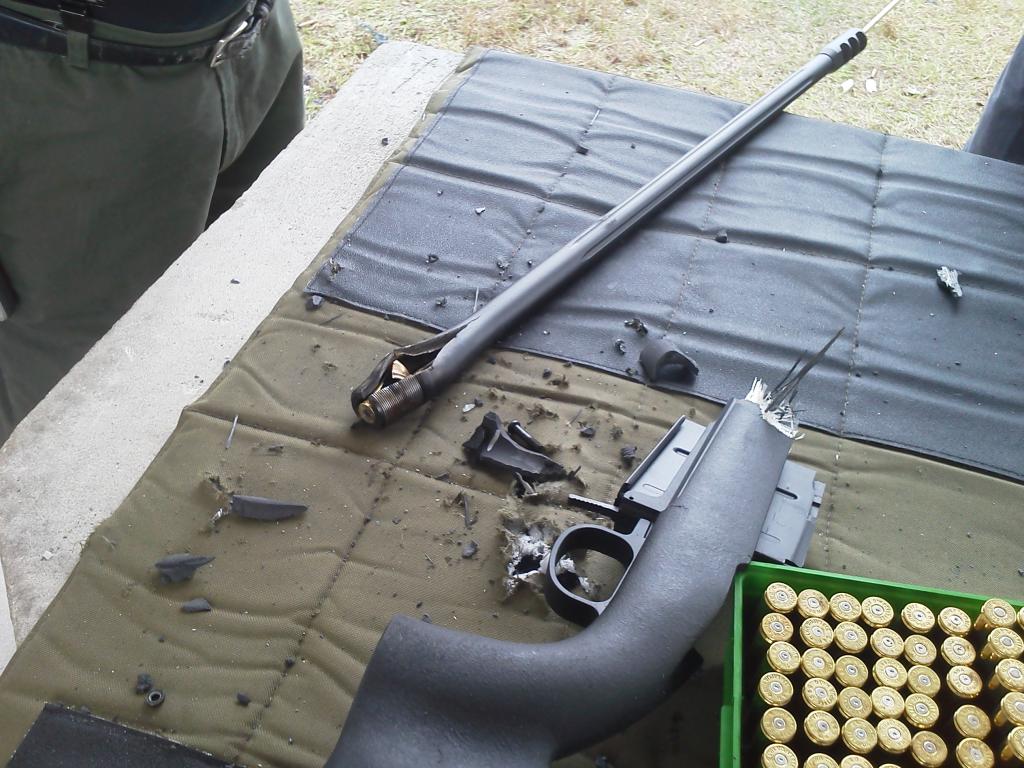
Discharging a .338 Lapua Magnum round with a cleaning rod in the barrel — that’s a recipe for disaster. What happens when a fired .338 caliber bullet and a cleaning rod try to occupy the same place at the same time? Well you get a catastrophic kaboom, with metal pieces flying all over the place, and a shooter very lucky to escape without serious injury. This incident occurred recently in Manatee, Florida, as reported by Sniper’s Hide member Queequeg. We thank SnipersHide.com for granting permission to publish these revealing images in the Daily Bulletin. CLICK HERE for more Kaboom info on the ‘Hide.
This story should serve as a chilling reminder to follow proper safety practices whenever you are at the range. Always check to make sure there is no obstruction in the bore BEFORE loading a live round.
.338 Lapua Magnum + Cleaning Rod + Inattention = Kaboom!
Click to zoom image
Kaboom at Manatee!
Sniper’s Hide member Queequeg recently published shocking photos of a catastrophic kaboom involving a .338 Lapua Magnum (Savage action). The action was blown off the rifle, shrapnel went through the roof, and the barrel split at the tenon before taking an excursion downrange. The action did crack in the front but the lugs remained engaged so the bolt did not slam to the rear (luckily for the shooter).
Here’s the report: “This happened [January 20, 2014] at the Manatee Gun and Archery Club. Al, Ren and myself were there with a couple other folks. Ren was at bench 12, I was at 13. The fellow at 11 was running a Savage .338 Lapua. He had a very bad day! He damn sure could have killed himself and quite likely Ren as well.”
Queeqeg added: “After the boom, I heard Ren ask ‘Are you alright’ and then turned to look in time to see the fellow reacting in total shock — literally stunned. Ren and I went over to him and could not see any major injuries. Ren was uninjured as well but had a lot of fiberglass splinters on him. The barrel nut is what I presume punched the two holes in the roof. The shooter is a regular there[.] He had been having a problem with sticky cases though he said he was certain the loads were mild. That’s why he was content to knock the sticky ones out with the rod. He simply forgot to remove the rod after knocking out the last stuck case. You can see what happened next.”
To learn more about this incident, go to the original Snipers Hide Forum Thread. There you’ll find more details and over four pages of related discussions.
The Important Lesson Here
What did the .338 LM shooter do wrong here? You will say — “Well that’s obvious, he left a cleaning rod in the barrel and then shot a round.” Yes, that was a potentially fatal error. But that was his second mistake — one that occurred only because he made a more fundamental judgment error first.
The FIRST mistake was not acknowledging the problem with his ammo. Had he heeded the warning signs, he would still have a rifle (and an unsoiled pair of trousers). When he first observed that he was having problems with extracting cases, a warning light should have gone off in his head. Presuming his extractor was not broken (and that the chamber was cut properly) he should have been able to extract his brass if he was running safe loads. The lesson here we all need to learn is that if you observe a serious ammo-related issue, it is time to stop shooting. Don’t try to invent work-arounds just to extend your range session, when there are clear signs that something is wrong, very wrong.
Larry Bartholome (aka “LBart” on our Forum) is the current F-Open USA National Champion. He also won the F-Open division at the recent Berger Southwest Nationals. A “Senior Citizen” now, Larry is still at the top of the F-Class game. If you were to pick the top ten F-Open shooters on the planet, Larry would be on the short list, that’s for sure.
In a recent AccurateShooter Forum thread, there was a discussion of caliber/cartridge choice for F-Open shooting — specifically whether 6mm cartridges can be competitive at long-range (as opposed to mid-range).
Larry, who currently shoots a 7mm-270 WSM, offered some wise words. Here’s some sage advice from Larry, a champion who has triumphed at the highest level, against the toughest competition. F-Class competitors will benefit from reading what Larry has to say, and taking it to heart:
Cartridge Choice for F-Class — What Really Matters
Matches are won with what people decide to shoot. The people win matches, not the calibers. A person makes his decision on what he is going to shoot with and [that person] wins or loses based on the decision.
The smaller cases and bore sizes have advantages in less recoil and more inherent accuracy. They are easier to shoot well. Because they shoot smaller groups on average they make the 10 ring seem bigger. With light winds that helps.
When the wind gets to changing and picking up this advantage is negated by the wind drift advantages of the larger calibers. Once the switches and velocity changes get beyond the mind’s ability to stay up with them, the small caliber advantage is minuscule.
My own thought is I need all the help I can get. I know I can’t read the wind. I play the percentages. [My 7mm offers] good grouping, good wind drift, lower recoil than the 30s. My 7mm/270 WSM was shooting very well in Phoenix, just as the other Bartlein barrels shot well in Raton. The points lost were mine, not the rifle’s or the caliber.
When the wind flags and mirage are telling you to hold left and your bullets are going left, no caliber in the world will help you. You are the one steering those bullets.
Most F-TR rifles are essentially prone rifles adapted for use with bipod and rear bags. They feature prone or tactical-style stocks designed to allow a firm grip on the gun, with cheek, hand, and shoulder contact. This has worked very well. Unquestionably, a skilled F-TR shooter can achieve outstanding scores with such a configuration — it works. However, “there’s more than one way to skin a cat”.
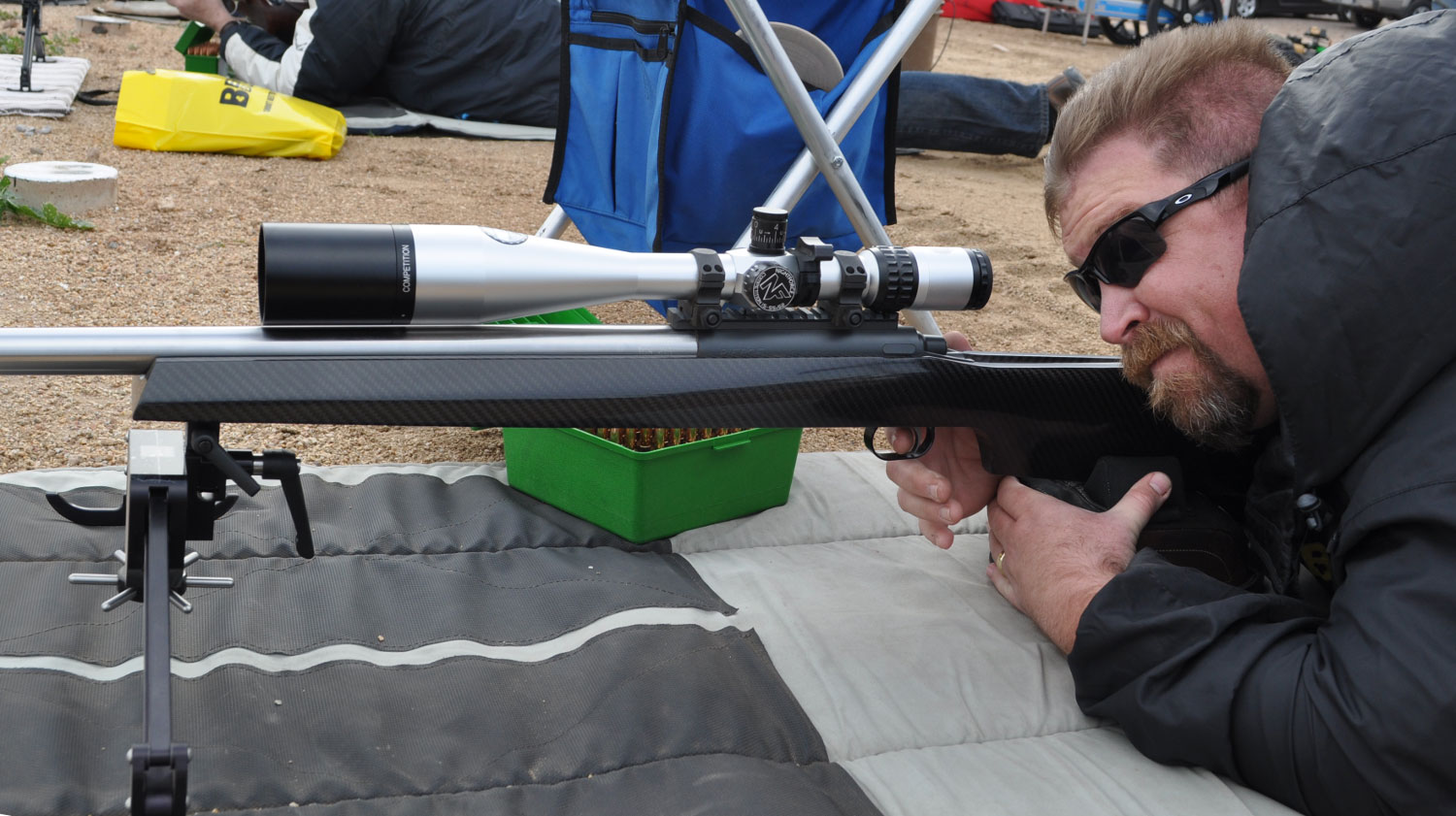
At the Berger Southwest Nationals, Eric Stecker introduced a new type of rifle, and a new type of gun-handling, to the F-TR ranks. Shooting “free-recoil” style* (i.e. with virtually no contact on his rifle) Eric managed to finished second overall in F-TR (with the highest X-count), beating some past national champions in the process. Thinking “outside the box” worked for Stecker in Phoenix. The success of Eric’s benchrest-style rifle and shooting technique definitely drew the attention of other F-TR shooters.
Click photo to zoom
VOICE FILE: Eric Stecker Talks About the SWN and his Radical F-TR Rifle.
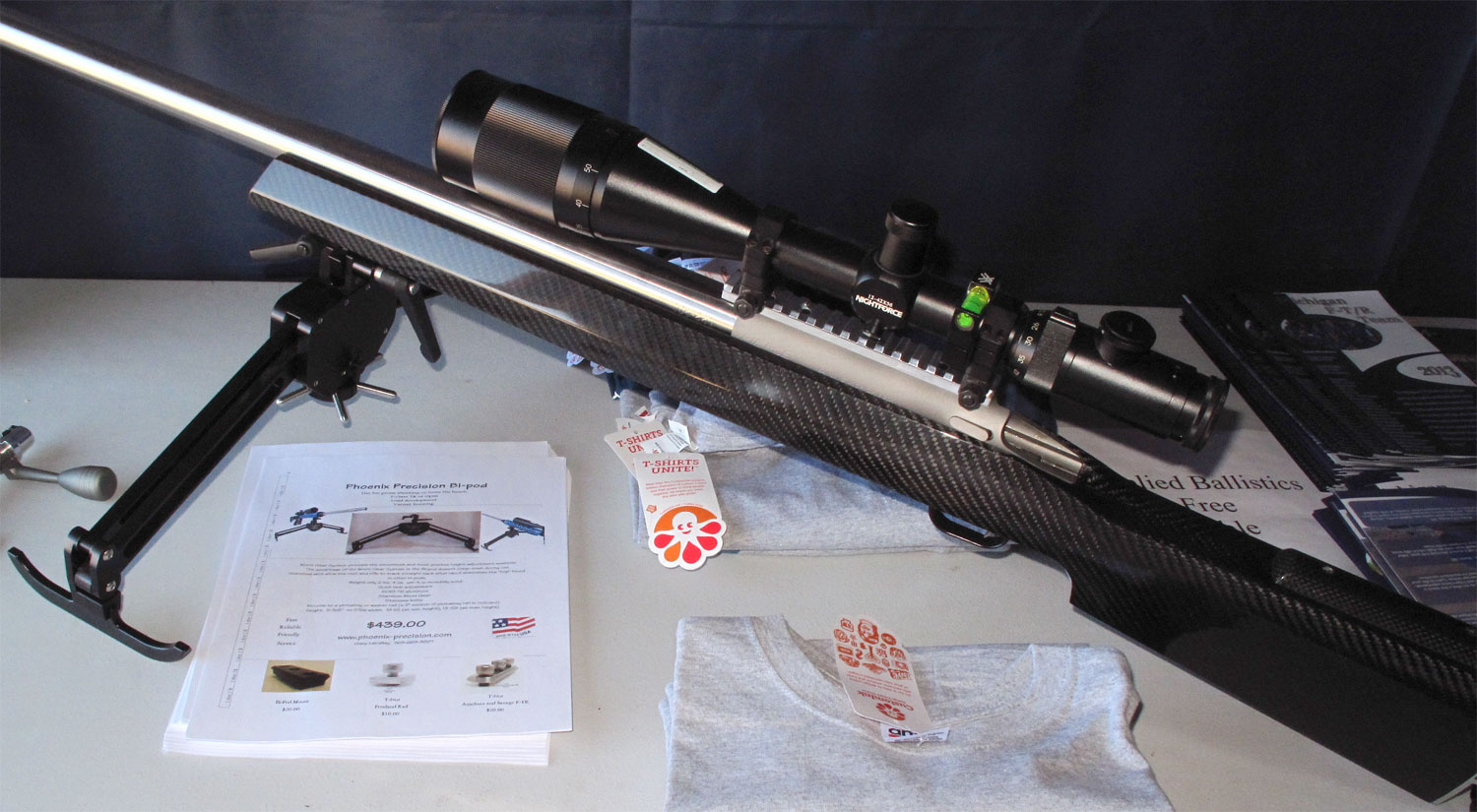
Eric’s F-TR rig was built by John Pierce using a stiff, light Scoville carbon-fiber stock. The stock is so light that Eric’s rifle came in 1.5 pounds under the F-TR maximum weight limit (8.25kg or 18.18 pounds). The gun features a Pierce action, Bartlein barrel, Jewell trigger, and a Gen 1 Nightforce 15-55X52mm Comp scope. From the get-go, Eric’s strategy was to “aim small” and shoot his rig like a bench-gun. He actually focused on shooting really small groups rather that just trying to keep shots within scoring rings and “hold waterline”. With a .308 Win that could shoot bugholes at 100 yards, this strategy paid off.
Rifle builder John Pierce explains the thinking behind this rifle: “The stock choice was mine — I had built two prototype rifles last year based on the premise that the game is Benchrest in the prone position. I still feel very strongly regarding [this concept]. I chose Bob Scoville for obvious reasons — he is an artisan and his stocks have won so much, they just flat work. We built Eric the latest configuration along these lines, and the tool worked for him. Without a doubt, Eric is a shooter, and we were all pleased to watch him perform so well.”
Eric sets up rifle before match. During live fire his hands do not contact the stock.
Eric employed a benchrest-style shooting technique with his F-TR rig — he shot pretty much free recoil, with no cheek pressure, no hand contact, and just a “whisper” of shoulder contact. Eric explains: “I shoot what’s called ‘free recoil’. Now the rifle is butted up against my shoulder very lightly, but no other part of my body touches the rifle except for my finger on the trigger.” Eric has even used this technique when shooting a 7mm cartridge in F-Open at other matches: “Someone suggested that this style wasn’t possible with the larger [7mm] cartridges, but I found it very successful so I continue to do it that way.”
VOICE FILE: Eric Stecker Talks About Shooting F-TR with Benchrest Technique.
Eric also employed an unconventional strategy — he was focused on shooting small groups (not just holding ring values): “Since I have started shooting F-Class, I treat [the target] like a benchrest target. What I mean by that is that I regard the center as my first shot, and so my objective is to create the smallest group. So, I will hold whatever… is required to end up with the bullet ending up in the center — that’s probably true of any F-Class shooter, but I guess the perspective’s a little different when you have a benchrest background.” Eric explained that “maybe I aim a little smaller than others might”, because in the benchrest game, “the slightest miss ends up costing you quite dearly”.
Click to Zoom Photo(This is not Eric Stecker’s rifle, but a “sistership” built by John Pierce.)
Eric Talks about F-TR Trends
Will other F-TR shooters build rifles suited for free-recoil-style shooting? Eric isn’t sure: “I don’t know if this type of rifle is the future of F-TR. I shoot a lot of benchrest, so putting those kinds of components into an F-TR gun made a lot of sense to me. One thing I like about F-TR is that there are a lot of different types of approaches being tried and some of them are successful. So I think it’s still pretty wide-open[.] But I think the really great part of what we found at the Southwest Nationals is that shooting [with] a benchrest-style approach certainly doesn’t hurt you. What I mean by that is … aiming small, trying to make the group as tight as possible rather than trying to hit a particular area. I actually tried to shoot tight groups — that was a focus and that worked for me — I had quite a high X-Count.” NOTE: Eric finished with 51 Xs, 14 more than F-TR Grand Agg winner Radoslaw Czupryna (37X). James Crofts had the second highest X-Count with 48 Xs.
Even Berger’s Boss did pit duty at the Berger SW Nationals.
*”Free Recoil” style shooting has its variations. Some would say “pure free recoil” would not even allow shoulder contact. Eric Stecker lightly touches the back of the stock with his shoulder.
If you want to learn how to shoot accurately at very long range, one of the very best places to learn is the Williamsport 1000-Yard Benchrest School. The 7th Annual Benchrest School will be held Friday June 6 through Sunday June 8, 2014. Classes, taught by top 1K shooters, are held at the Original Pennsylvania 1000-Yard Benchrest Club Range, one of the best 1K ranges in the country. View the range on the Williamsport website, PA1000yard.com.
Prospective students will be taught all aspects of long-range benchrest shooting by highly skilled instructors. All areas are covered: load development, precision reloading, bench skills, and target analysis. Much time is spent at the loading bench and on the firing line. And you don’t even need guns and ammo — all equipment and ammunition will be provided. For $300 students will enjoy 1 night and 2 days of intensive training under the guidance of some of our top 1000-yard shooters. The sign-up deadline is June 1st. To reserve a spot or get more info, email School Director/Vice President Ryan Miller: ryanmiller @ htva.net.
School Schedule, Friday Through Sunday
On Friday night (June 6th), students will meet their mentors. Saturday (June 7th), the class moves to the range for a full day of hands-on technical training. Topics will include precision reloading, load development, gun handling, use of chronograph, analysis of shooting results, gun cleaning, and target analysis. The club will provide the rifles and all reloading components. Saturday’s training sessions are followed by a steak dinner which is included in the $300 seminar price.
On Sunday (June 8th), after an early training session covering bench set-up and match strategies, students will participate in a 1000-yard match, spending time both behind the trigger and in the pits. Instructors will explain how to read conditions, and will demonstrate target measuring and analysis after the relays. The program wraps up by 4:00 pm on Sunday.
To see what the 1K Benchrest school is like, watch the slide show/video below, produced by Sebastian Reist, an alumnus of the 2009 Williamsport 1000-yard BR school. Sebastian, a talented professional photographer, captured the highlights of his Williamsport 1K training weekend:
Please enable Javascript and Flash to view this VideoPress video.
Story Tip from EdLongrange. We welcome reader submissions.
Valentine’s Day is almost here. To celebrate this romantic holiday, Kirsten Joy Weiss has devised a very special trick shot with her .22LR Volquartsen semi-auto rifle.
Braving winter weather, Kirsten manages to drill three shots into a heart shape on her target. This trick shot is performed, Kirsten adds, “for the love of shooting”. See more cool trick shots on Kirsten’s website, KirstenJoyWeiss.com.
The NSSF’s Where To Shoot mobile App has topped 100,000 downloads. The app, which rose to No. 4 on the Apple App Store’s list of free sports Apps, has been a hit with target shooters and gun owners. It is available FREE for both iOS (Apple) and Android devices.
The Where To Shoot App quickly and easily locates shooting ranges near you, drawing on North America’s most comprehensive directory of shooting ranges. Users can search by current location, state, or zip code and find specifics about each range, including shooting activities offered and contact information. Once you’ve location a place to shoot, the App helps you get directions to the range. The App also includes video tips for shooters, news, and firearm-safety information.
The app is modeled after NSSF’s popular WhereToShoot.org® website and is updated frequently with range information in every U.S. state and Canadian province. New tips for hunters and shooters are also added regularly. Download the app via the links above or by visiting wheretoshoot.org on your mobile device.
Snow on the ground? Can’t go shooting outside? Here’s one way to have fun indoors while practicing your aiming skills. LaserLyte offers a set of three cans equipped with laser-activated “kickers” on the base. When a laser hits the can in the right spot the can topples over. The laser activates a solenoid that releases a spring-loaded plunger. To reset the cans, simply stand them up and depress the plunger.
Watch Laserlyte Plinker Training Cans:
The LaserLyte® Laser Plinking Can Set is sold in a three-pack with three 9V batteries included. One battery will tip the can over about 8,000 times. Watch the video to see how it works. This would be fun with kids (just follow safe practices with the laser beams).
To direct a laser at the plinking cans, you’ll need a firearm fitted with an in-barrel laser (instead of live ammo). Or, alternatively, you can use the blue plastic LaserLyte training pistol ($54.95). For actual handguns, you can use the universal LT-Pro laser module, or a caliber-specific unit that fits the chamber of your gun. The blue training pistol is designed to work with the LT-Pro universal module, as you can see in the video below, a field test by Gunsandammo.com. The testers noted that the cans may be sensitive to very bright light sources.
At the SIG Sauer booth at SHOT Show, we had a chance to interview Max Michel, Sig Sauer’s Pistol Team Captain. Winner of multiple speed shooting world championships, Max is widely considered to be the fastest pistol shooter alive. How fast? Watch the video below. Max puts 18 shots on three targets with two (2) reloads, in a total of 4.79 seconds. That’s right, drawing from holster, he sends 18 rounds in under five seconds, with two mag changes in the process. That works out to a rate of fire of 225 rounds per minute — faster than a 19th-century Gatling Gun.
Max Michel on Fire — 18 rounds with 2 Mag Changes in Under 5 Seconds:
How did Max manage that incredible speed run? “I ate my Wheaties that morning”, Max joked. But in fact, Max acquired his amazing shooting skills the hard way — through years of dedicated practice. We asked Max about the kind of training required to attain “world-class” speed (and accuracy) with a handgun. It has taken him decades to reach this level of perfection. Max started shooting competitively while in elementary school (at age 8 or 9). He recalls coming home from school and dry firing for hours. He has spent thousands of hours practicing over the past two decades. Interestingly however, Max does most training drills at half speed. Watch the video to learn why Max trains at half speed:
Train to Win — Max Michel Reveals His Training Strategies:
At age 32, Max Michel is a legend within the world of competitive shooting. A four-time World Speed Shooting Champion, six-time USPSA National Champion, and three-time US National Steel Champion, Max is a dominant force in pistol shooting sports. Born and raised in New Orleans, Louisiana, Max began shooting when he was just 5 years old. In 1999 Max joined the USAMU’s Action Pistol Team and served in the U.S. Army for 10 years as an Army shooter and trainer. Today, Max is recognized worldwide as a top-tier athlete and instructor.
Over the past few years, interest in F-Class competition has grown dramatically. At the 2013 SHOT Show we had a chance to talk about F-TR competition with U.S. National F-TR Team members Mike Miller and Stan Pate, two of America’s top F-TR shooters. We are reprising this interview for readers who may have missed it the first time around. If you shoot F-TR (even if you’re a High Master), we think you’ll learn a few things from this interview.
In this interview, Mike and Stan agreed to share their vast store of knowledge about long-range shooting. In a wide-ranging dialog, we discussed many topics of interest to F-Class shooters: position set-up, bipod shooting techniques (and hardware), gun-handling, and bullet selection. In addition, Mike and Stan offer some great advice on wind reading and precision reloading. These general tips will benefit all competitors, no matter what their discipline.
If you shoot F-TR or you are considering getting involved in this fast-growing shooting sport, definitely watch this 14-minute video interview from start to finish. Mike and Stan are true F-TR gurus whose knowledge of the F-TR game has been gleaned from years of top-level competition. If you shoot a .308 from a bipod, we guarantee you can learn much from Mike and Stan. If you follow their advice, we bet you’ll see your scores improve in future matches.
Watch Video for Tips from U.S. National F-TR Team Members Mike Miller and Stan Pate


 A great episode of Impossible Shots runs tomorrow (March 5) on the Outdoor Channel. This particular episode won an award for Best Shooting Sports broadcast. To start off, the legendary Jerry Miculek tries out a new, high-capacity shotgun (used for 3-gun matches). Jerry takes his new scattergun (right out of the box), and sets a new speed-shooting record with it. Not to be outdone, in the next sequence, SSG Josh Richmond of the USAMU juggles and shoots multiple targets with his scattergun. SSG Richmond, USA Shooting’s Shotgun Athlete of the Year, has won Gold Medals at various World Cups around the world. He is one of the best double trap shooters on the planet.





 If you want to learn how to shoot accurately at very long range, one of the very best places to learn is the Williamsport 1000-Yard Benchrest School. The 7th Annual Benchrest School will be held Friday June 6 through Sunday June 8, 2014. Classes, taught by top 1K shooters, are held at the Original Pennsylvania 1000-Yard Benchrest Club Range, one of the best 1K ranges in the country. View the range on the Williamsport website,


 The NSSF’s Where To Shoot mobile App has topped 100,000 downloads. The app, which rose to No. 4 on the Apple App Store’s list of free sports Apps, has been a hit with target shooters and gun owners. It is available FREE for both iOS (Apple) and Android devices.


 Over the past few years, interest in F-Class competition has grown dramatically. At the 2013 SHOT Show we had a chance to talk about F-TR competition with U.S. National F-TR Team members Mike Miller and Stan Pate, two of America’s top F-TR shooters. We are reprising this interview for readers who may have missed it the first time around. If you shoot F-TR (even if you’re a High Master), we think you’ll learn a few things from this interview.


