We created the above target 15 years ago. Since then it has been used by tens of thousands of shooters. It has proven very popular as a load development target, since all your load data fits neatly in the boxes under each target. In fact this target is being employed by both rifle-makers and barrel-makers (including Criterion) to test their products. The target was designed for aiming efficiency. The diamonds have 1/2″ sides and you can align your reticle cross-hairs on the horizontal and vertical lines. It is a clean design that is easy to see even at 200 yards with a 20X scope. When we test, we usually crank in a little elevation, setting the point-of-impact higher, so that our shots fall in the gray circles. That way you leave the red diamonds intact for precise aiming. CLICK HERE to download Load Dev target.
We also use these two targets for load development and precision practice. The circle dot target can also be used for informal rimfire competition at 50 yards.
Right-Click Each Target to Download Printable PDFs.
How to Print Your Targets
Most of us have access to a printer at home or at work. That means you can print your own targets. You’ll find hundreds of free target designs online, including dozens of downloadable targets on our AccurateShooter.com Target Page. If you’re feeling creative, you can design your own target with a computer drawing program such as MS Paint.
Paper Stock Is Important
If you want your self-printed targets to show shots cleanly (and not rip when it gets windy), you should use quality paper stock. We recommend card stock — the kind of thick paper used for business cards. Card stock is available in both 65-lb and 110-lb weights in a variety of colors. We generally print black on white. But you might experiment with bright orange or yellow sheets. Forum Member ShootDots report: “They sell cardstock at Fed-Ex Kinko! I use either Orange or Yellow. That makes it easy to see the bullet holes clearly.” NOTE: Test before you use the 110-lb Cardstock. On some printers, with the heavier 110-lb card stock, you will need to have the paper exit through the rear for a straighter run.
Here are some Target-Printing Tips from our Forum members:
“Staples sells a 67-lb heavy stock that I have settled on. I use the light grey or light blue, either of these are easy on the eyes on bright days. I have used the 110-lb card stock as well and it works fine. It’s just a little easier to print the lighter stuff.” (JBarnwell)
“Cardstock, as mentioned, works great for showing bullet holes as it doesn’t tear or rip like the thin, lightweight 20-lb paper. I’ve never had a problem with cardstock feeding in the printer, just don’t stick too many sheets in there. If I need three targets, I load only three card stock sheets”. (MEMilanuk)
“20-lb bond works pretty well for me if I use a spray adhesive and stick the entire back of the paper’s surface to the backer board.” (Lapua40X)
How fast can you shoot a bolt-action rifle? We doubt you can out-pace the ace “Stangskyting” shooters from Scandinavia. Some of these guys can run more than two rounds per second, including mag changes! That’s impressive. Bulletin reader C. Lemmermann from Denmark told us: “In Scandinavia we have this competition called ‘Stangskyting’. It’s similar to the ‘Mad Minute’ but we only have 25 seconds to hit the target [at] 200-300m distance with a 6.5×55 [target rifle].” In the Stangskyting video below a shooter named Børklop puts 16 rounds on target in just 25 seconds. (He starts with a round in the chamber and cycles through three, 5-round magazines).
Børklop’s performance, with just a sling and iron sights, is impressive. He’s shooting a Sauer 200 STR target rifle with 5-round magazine. Note that Børklop manipulates the Sauer’s bolt with his thumb and index finger, while pulling the trigger with his middle finger. As good as Børklop is, some Stangskyting competitors are even better. Roy Arne Syversrud from Oslo, Norway tells us: “The best shooters in Norway can do 21 shots in 25 seconds, changing the mag three times.”
Here’s another Stangskyting video. Check out the speed with which John Olav Ågotnes works that action — simply amazing!
This Guy Could Break the “Mad Minute” Record
Børklop’s rate of fire, 16 rounds in 25 seconds, is the equivalent of 38.4 rounds in 60 seconds. That’s a notable number because the record for the “Mad Minute”, a British Army marksmanship drill, is 38 rounds in one minute. That record was set in 1914 by Sergeant Instructor Alfred Snoxall, and still stands. So as you watch Børklop, keep in mind that Snoxall shot that fast for a full minute with a Lee-Enfield nearly 100 years ago!
Børklop has an average cycling time of 1.56 seconds per shot, starting with a round in the chamber. To beat the record of 38 rounds, he would need to make seven mag changes in sixty seconds. All those mag swaps could reduce his average time per shot, making it difficult to achieve 38 hits in a minute. But, if Børklop could use 10-round mags with his Sauer STR, this guy has the skills to break the record.
To emphasize the capabilities of the WWI-era British shooter who set the record, Snoxall shot as fast as Børklop does, but Snoxall reloaded with stripper clips. Snoxall’s SMLE (Lee-Enfield) rifle also had relatively crude open sights and the stock was far less ergonomic than Børklop’s Sauer STR stock.
Here’s another Stangskyting video showing John Ågotnes shooting rapidfire with his Sauer 200 STR (Scandinavian Target Rifle) chambered in 6.5×55. By our count, Ågotnes manages 17 shots within the 25-second time period. That rate of fire (17 in 25 seconds) equates to 40.8 rounds in one minute!
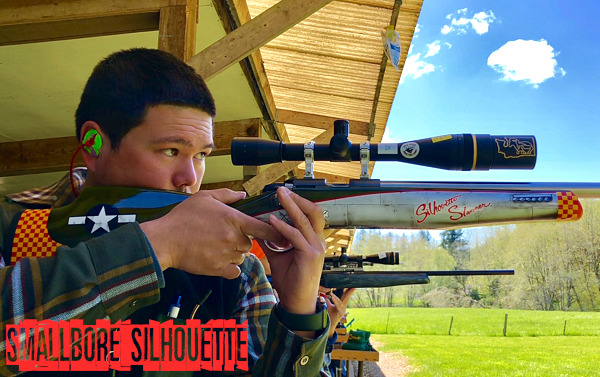
Shooting steel silhouettes is fun. For many of us, the “instant gratification” of knocking down steel is more fun than shooting paper. In fact, this very website came into being because the founder enjoyed shooting 600-yard steel silhouette matches in Southern California. That lead him to building a 6mmBR rifle and starting 6mmBR.com which evolved to become AccurateShooter.com.
Today’s video showcase covers a variety of metallic silhouette shooting disciplines. There are the classic smallbore and centerfire silhouette formats, shot from a standing position. One of the world’s top silhouette shooters, Eric Mietenkorte, shows how to shoot silhouette standing. But we also show varmint silhouette matches shot from prone position and from the bench. The Editor’s 600-yard silhouette matches were initially shot from prone (F-class style), and then later from a bench. Both formats were fun.
We also feature a cool video from New Zealand, showing handgun silhouette matches hosted at a beautiful, verdant range in Kiwi country. The handgun shooters use a reclined, foot-forward prone position.
So, whether you shoot prone, sitting, or standing, shooting metallic silhouettes is fun and challenging. Hearing the clang of steel and seeing a metal silhouette tip over is true “instant gratification”.
Metallic Silhouette — A Mexican Import
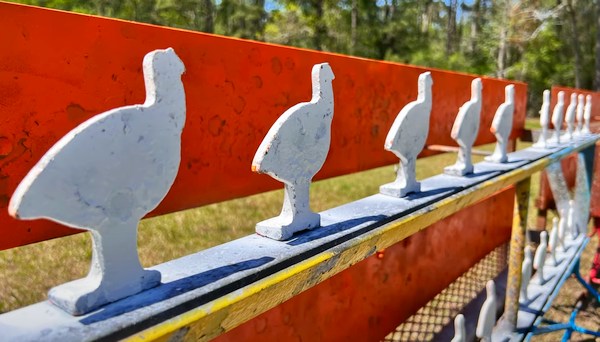
Silhouette shooting came to this country from Mexico in the 1960s. It is speculated that sport had its origins in shooting contests between Pancho Villa’s men around 1914. After the Mexican Revolution the sport spread quickly throughout Mexico. ‘Siluetas Metalicas’ uses steel silhouettes shaped like game animals. Chickens up front followed by rows of pigs, turkeys, and furthest away, rams. Being that ‘Siluetas Metalicas’ was originally a Mexican sport, it is common to hear the targets called by Spanish names Gallina (chicken), Javelina (pig), Guajalote (turkey) and Borrego (ram). Depending on the discipline one is shooting, these animals are set at different distances from the firing line, but always in the same order. CLICK HERE for NRA Rifle Silhouette Rules.
In this next video, silhouette champion Eric Mietenkorte talks about proper hold: “Consistency is key! Form a solid stance that is repeatable and allows you to have a natural point of aim. If you don’t come down on target adjust your feet, don’t rotate your body with your torso muscles.”
Erich explains his aiming method: “Pick a spot on the target and shoot for that. Try not to hesitate, if you’re on target, take the shot. It’s easy to get locked up by trying to make a great shot better. Make sure to follow through, keep that trigger pulled back. Don’t forget to have fun!”
Beautiful Rosebud Silhouette Range in Alberta, Canada
This video was created at the scenic Rosebud Silhouette and Benchrest Club in Alberta, Canada. The video offers an introduction to both centerfire (High Power) and smallbore Metallic Silhouette Rifle disciplines, including equipment and match format. These fun and challenging sports can be shot year-round, as you can see in the video below, which includes winter sequences.
Texas Varmint Benchrest Silhouette
If you like accurate rifles and reactive targets, you’ll enjoy this 48-minute video from Shooting USA TV, which features long-range varmint silhouette competition in Texas, the Lone Star State. We have participated in these kind of matches on the West Coast — they are definitely a ton of fun. The sport combines the pure accuracy of benchrest competition with the fun of knocking down critter targets. These are smaller than standard silhouettes, so it’s quite a challenge to hit them at 300 yards and beyond.
In this episode, host John Scoutten competes with his 6.5 Creedmoor PRS rifle. He found that 1-MOA Coyotes offered plenty of challenge at 385 meters! Most shooters at this Texas match use benchrest-grade rifles with premium front rests.
A similar Varmint Silhouette bench/prone match is held monthly at the Pala Range in Southern California. Prone shooters compete side-by-side with bench shooters. Ten steel “critter” targets are set at each of five yardages: 200m – Field Mice (“pikas”); 300m – Crows; 385m – Ground Squirrels; 500m – Jack Rabbits; 600 yards – Prairie Dogs. Competitors shoot 50 targets, 10 each at five different yardages, alternating among the five distances. So you might start at 500m then do 200m next, then do 600 yards etc. — the target distances are in mixed order to enhance the challenge.
Rimfire Speed Silhouette from the Bench
Fast and full of action, the Speed Silhouette competition is an exciting event shot on the clock. Competitors take 16 shots from 30 to 60 yards. The event is timed and the timer stops whenever the shooter finishes their final target by knocking it down. This event is a blast to shoot, and may even be more fun to watch live, as the results unfold within seconds of each relay start.
New Zealand Handgun Metallic Silhouette
New Zealand is one of the world’s most beautiful island nations, so we can’t think of a better venue for a silhouette match. This video features a handgun silhouette match with targets at multiple distances. The competitors use a special reclining position on the ground, with the handguns (mostly revolvers) aligned on the side of the leg.
Silhouette Shooting Scoring Procedures
This video from the Metallic Silhouette Shooters Society (MSSS) covers the basic rules of rimfire and centerfire silhouette matches. And then the video explains how the shooting strings during silhouette matches are scored. Yes the system is binary (knock-down vs. miss), but there are details, such as when a plate is hit but doesn’t fall. CLICK HERE for a second MSSS video that explains how to get started in silhouette shooting and lists the equipment you’ll need.
With spring soon changing to summer, we are in peak varmint season in many parts of the country. In an area with a high number of critters, a semi-auto varmint rifle is a good choice. You get quick follow-up shots, with reliable 20-rd and 30-rd magazines.
For this Saturday at the Movies Showcase we feature a variety of semi-auto, AR-platform rifles chambered for efficient, high-velocity varmint ammo. Cartridges include: .17 WSM, .17 Remington, .20 Practical, .204 Ruger, .22 Grendel, .223 Rem, and 6mm ARC. We conclude with a video that reviews a variety of lead-free .223 Rem ammo types.
Rock Chuck Hunting in Eastern Oregon
This video has some great backcountry footage. The host nails a number of rockchucks with his .223 Rem-chambered AR-15. The shooter says that the default AR-15 cartridge works great for varmints: “The .223 Remington becomes a rockchuck hunter’s friend with the right load: Nosler 40gr Ballistic Tip loaded over a stuffed case of H335 powder. This achieves 3800 FPS with excellent accuracy.”
.17 Remington AR-15 — Small Bullet, Ultra-High Velocity
The .17 Remington wildcat is based on the .223 Remington case necked down to .172″, with the shoulder moved back. High muzzle velocity (4000+ FPS), flat trajectory, and very low recoil are the .17 Remington’s primary attributes. It has a maximum effective range of about 440 yards on prairie dog-sized animals, but the low BCs of the small .17-cal bullets makes them quite susceptible to crosswinds at such distances.
This Varminter.com video was created in spring 2022, just in time for Rockchuck and Thermal Coyote hunts. The host noted: “This was my first experience with the .17 Remington, but I was not unaware of its history and steady popularity among varmint and predator hunters. Although finding an available and affordable .17 Remington bolt-action rifle is nearly impossible nowadays, building one in an AR-15 was simple and straight-forward.” The video has full description of all the components for the build. The .17 Rem is fast — the 25gr bullet runs 3777 FPS from an 18″ barrel (see 01:42 time-mark). READ Full Story.
.17 WSM Rimfire in Franklin Armory F17-L
What’s the ultimate rimfire varmint rifle? An AR chambered for the .17 WSM could be the answer. Eric Mayer of Varminter.com states: “The Franklin Armory F17-L in .17 Winchester Super Magnum (WSM) has a lot of firsts. It is the first semi-automatic rifle in .17 WSM now available to the general public. It is the first gas-piston system, AR-15 rimfire rifle built in partnership between Franklin Armory and Osprey Defense.”
Eric has used the .17 WSM AR shooting ground squirrels, rock squirrels, prairie dogs, and rabbits. Eric notes: “The report of the .17 WSM is nowhere near as loud as most of the centerfire [varmint] cartridges. I found that when I shot the FA-17, it did not cause the other ground squirrels… to run for cover. The lack of recoil … allowed me to see right where I hit [and] if I happened to miss, [low recoil] made for quick corrections for wind, or distance.” READ Full Report
The .17 WSM is a much larger, more powerful round than the .17 HMR. See the size difference above.
Eric Mayer created his own custom .17 WSM AR-15 varmint rifle, built with a Franklin Armory F17-V4 Upper, Aero Precision Lower, and Magpul stock. This was used in California and Arizona. READ Full Story.
.20 Practical — Fast, Accurate, Easy to Form
The .20 Practical cartridge is simply a .223 Rem necked down to .20 caliber. This is a great choice for prairie dogs — and probably our favorite wildcat for the AR-15. Just neck down your .223 Rem brass, fit a .20-Cal barrel and you’re good to go. Robert Whitley notes the the .20 Practical “is a perfect cartridge for varmint hunting and general shooting — very accurate and fast! It functions 100% out of an AR-15.”
The .20 Practical offers some notable advantages for high-volume varmint shooters. The .20 Practical delivers very high velocity with very low recoil while still providing outstanding accuracy. The .20 Practical is great option for folks who favor “fast and light” — smaller, lower-mass bullets traveling at very high velocities. This little cartridge can launch 40-grainers at over 3900 FPS, and 32-grainers even faster. This makes the .20 Practical a great choice for an AR-based varmint rifle.
.20 Practical Ultimate AR Varminter
A decade ago AccurateShooter.com created a .20 Practical AR15 Ultimate Varminter with a custom 20-caliber upper from Robert Whitley of AR-X Enterprises, LLC. That project rifle was ultra-accurate — every 5-shot group out of the gun was less than the size of a dime. That gun was auctioned off, but Robert Whitley continues to produce custom 20 Practical AR-15 uppers.
You make .20 Practical cases by simply necking down .223 Rem brass to .20 caliber. You can start with standard .223 Rem brass and even load with standard .223 Rem dies. Just swap in a smaller expander and use smaller neck bushings.
Prairie Dog Hunt with .204 Ruger AR — Watch The P-Dogs Fly
The video was created during a 2018 prairie dog safari. It has stunning footage of hits on P-Dogs at multiple distances. You can see over FIFTY hits with some amazing P-Dog aerials. Watch the first flyin’ dog at 00:20 time-mark and there’s a truly spectacular gut-busting hit at 3:13. That shows the potency of a high-speed .20-cal projectile. The shooter was using a custom-built AR-15 chambered in a .204 Ruger. That cartridge was driving 35gr Berger hollow point bullets at a stunning 4050 FPS! The rifle was fitted with a Dakota silencer suppressor and many other custom components. If you’ve never tried prairie dog hunting, watch this video start to finish and you may be hooked.
6mm ARC AR-15 Varmint Rig
This Varminter.com video examines the 6mm ARC cartridge from a varmint hunter’s perspective. Created by Hornady, the 6mm ARC was designed for target shooting and medium-sized game both in bolt guns and Modern Sporting Rifles. Hornady states: “The 6mm ARC … fits in an AR-15-pattern action, functions reliably out of standard-capacity 24- or 17-round magazines. It delivers substantially better ballistics than the .223 Rem[.]” This video examines how the 6mm ARC performs in an AR-15 for varmint and predator hunting. The host reviews available factory varmint loads. The video also examines reloading components for the 6mm ARC — brass and bullets. CLICK HERE for full article.
Cottontail Rabbit Hunting with Suppressed .204 Ruger AR-15
As a varmint hunting tool, the .204 Ruger in an AR-15 is a versatile, worthy cartridge/rifle combo for the job. This video covers a cottontail rabbit hunt. The host states that “We were contacted by a farmer who was being slammed with cottontail rabbits eating out huge portions of his alfalfa fields.” This suppressed .204 Ruger AR-15 proved seriously effective on the rabbits, driving high-velocity rounds with impressive accuracy. See more details on the Varminter.com website.
The .22 Grendel is an extremely accurate and efficient cartridge based on the 6.5 Grendel necked down to .22 caliber. The case can drive 55gr varmint bullets at high velocities — over 3500 FPS. With a faster-twist barrel you can load up to 90gr bullets at 2500 FPS. The tester achieved velocities close to a 22-250. The short, fat case fits in AR-15 magazines, but may not feed as reliably during rapid fire. The tester did experience one double-feed.
Lead-Free Ammo Offerings Tested in .223 Rem AR-15
Some states — such as California — prohibit hunting with bullets that contain lead. If you plan to hunt in an area with such restrictions, you’ll need to find a lead-free substitute. Thankfully a number of manufacturers produce ammo with solid brass projectiles or other lead-free bullet designs. This Varminter.com video reviews .223 Remington no-lead ammunition from Cor-Bon, Hornady, Nosler and Winchester. These ammo types were tested in a AR-15 varmint rifle, used in a coyote hunt featured at the end of the video. SEE Full Story on Varminter.com.
Pistol shooting is fun — that’s reason enough to head to an indoor range. In addition, all CCW permit holders should definitely practice regularly. For many people, indoor shooting can be done in the evening, after work, relatively close to home. Indoor ranges are most convenient for those who live near urban centers, where the biggest threats to public safety currently exist. This article talks about indoor firearms training and the proper procedures you should follow at indoor ranges.
This Video Covers Basic Gun Range Safety Rules and Etiquette
FIVE IMPORTANT SAFETY PROCEDURES for Indoor Ranges
1. Follow the Three Fundamental Rules for Safe Gun Handling
ALWAYS keep the gun pointed in a safe direction. ALWAYS keep your finger off the trigger until ready to shoot. ALWAYS keep the gun unloaded until ready to use.
2. Follow ALL Range Officer Instructions
ROs are the first and final authority on any range and their decisions are generally final. Arguing with a Range Officer may just get you thrown out.
3. Don’t Bother Others or Touch Their Guns
Respect other shooters’ privacy unless a safety issue arises. Do NOT engage other shooters to correct a perceived safety violation unless absolutely necessary – inform the RO instead. NEVER handle or touch another shooter’s firearm without their permission!
4. Know Your Range’s Rules
Review and understand any and all range rules and requirements/expectations. For example, what is the range’s maximum rate of fire? Are you allowed to collect your brass?
5. Know What To Do During a Cease Fire
IMMEDIATELY set down your firearm, pointed downrange, and STEP AWAY from the shooting booth (or bench). Range Officers do not want shooters trying to “secure/unload” their firearms in a cease fire situation — they want the shooters separated from their guns instantly.
BAD RANGE BEHAVIOR — Five Things NOT to Do at the Range
Here are the five worst behaviors we’ve seen at indoor ranges. These behaviors are both dangerous and inconsiderate. Any one of these behaviors can get you permanently banned from an indoor range.
1. Sweeping other individuals after loading a weapon behind the firing line is very bad. All your weapons should be empty until you reach your shooting station.
2. Turning the handgun sideways while trying to clear a malfunction or insert/remove a magazine. This will point the muzzle at a fellow shooter. Or, after shooting a gun, the shooter fails to clear the weapon and then places the gun somewhere near the shooting station with the muzzle in an unsafe position.
3. Reacting unpredictably when firing a high recoil handgun. We’ve seen people take a second shot by accident with the muzzle way off target.
4. Not obeying range commands — in particular continuing to shoot during called cease-fires.
5. Poorly aimed shooting that hits target frames or carriers, causing ricochets.
Double-Up on Hearing Protection When Shooting Indoors
When shooting indoors we recommend quality muffs with earplugs underneath, offering double protection. When inside an enclosed range, with other shooters blasting away right next to you, you really need effective hearing protection. But you also need to hear range commands and be able to communicate. That’s why we recommend electronic muffs with plugs underneath.
For indoor pistol shooting, we like the Howard Leight Impact Pro Muffs. These offer an impressive 30 dB Noise Reduction Rating (NRR). In addition, the electronic functionality allows you to hear all range commands clearly. These muffs are a good value. These are available for $76.99 at Palmetto SA. Howard Leight also makes good protective safety eyewear with ANSI Z87.1-2010 (High Impact) rating. These milspec, wrap-around Genesis safety glasses can be purchased for $16.63 on Amazon (#ad).
Have you ever wondered how Olympic-class position shooters hold their aim so steady? Those bulky shooting coats help, but there is a lot of bio-mechanics involved also. Top shooters employ their body structure to help support the weight of their rifles, and to steady their aim. This interesting video, produced by GOnra Media, demonstrates rifle hold and body alignment for prone, standing, sitting, and kneeling positions. Olympic Gold Medalist Jamie Corkish (formerly Jamie Gray) demonstrates the proper stance and position of arms and legs for each of the positions.
Ideally, in all of the shooting positions, the shooter takes advantage of skeletal support. The shooter should align the bones of his/her arms and legs to provide a solid foundation. A shooter’s legs and arms form vertical planes helping the body remain stable in the shooting position.
Jamie Corkish, London 2012 Gold Medalist in Women’s 3 X 20, has retired from top-level competitive shooting. However, Jamie remains involved in the shooting sports as a Public Relations/Marketing representative for ELEY, a leading maker of rimfire ammunition. Jamie also works with shooting clubs and educational institutions to promote smallbore target shooting.
Images are stills from GOnraMedia video linked above.
Be prepared to have your mind blown by Max Michel. This guy is FAST. In this video he puts 18 shots on three targets with two (2) reloads, in a total of 4.79 seconds. That’s right, drawing from holster, he sends 18 rounds in under five seconds, with two mag changes in the process. That works out to a rate of fire of 225 rounds per minute. Consider this — Max shoots faster than a 19th-century Gatling Gun (which had a rate of fire of roughly 200 rounds per minute). And Max is accurate as well as speedy — 16 of Max’s 18 shots were in the targets’ A-Zones, with the other two just barely outside.
Click Speaker Icon to hear sound (audio) — it’s even more impressive with sound!
Max Michel is a legend within the world of competitive shooting. He is the SIG Sauer Team captain with an unrivaled record of major pistol titles. Max is a 7-time World Speed Shooting Champion, 7-time U.S. Steel National Champion, 13-time USPSA National Champion, and 20-time U.S National Champion. He is also a Guinness Record holder and past IPSC World Champion. Michel also owns multiple World Speed Shooting records as well as being the first Action Shooter to win all USPSA Area Championships in the same season. Born and raised in New Orleans, Louisiana, Max began shooting when he was just five years old. In 1999 Max joined the USAMU’s Action Pistol Team and served in the U.S. Army for 10 years as an Army shooter and trainer. Today, Max is recognized worldwide as a top-tier athlete and instructor.
This month USA Shooting celebrates 30 years as the American Governing Body for shooting sports within the U.S. Olympic and Paralympic Committee. USA Shooting will commemorate its anniversary throughout 2025 with special events, social media giveaways, and initiatives designed to further expand participation in competitive shooting sports. To learn more about USA Shooting’s 30th Anniversary programs, visit USAShooting.org and follow @USAShooting on Facebook, X, and Instagram.
“These three decades represent not just organizational longevity, but a remarkable journey of athletic excellence… and competitive innovation,” said Kelly Reisdorf, CEO of USA Shooting. Since its founding in 1995, USA Shooting has guided American marksmen and markswomen to 36 Olympic and Paralympic medals, developing world-class talent across all shooting disciplines.
“The trajectory of American competitive shooting has been defined by both winning at the highest levels and developing tomorrow’s champions,” said Tim Rupli, Chairman of USA Shooting. “We’ve cultivated American talent while championing the values of precision, discipline, and patriotic excellence[.]”
A Legacy of Champions
For three decades USA Shooting has produced shooting sports legends, including Kimberly Rhode, a 6-time Olympic medalist, and Vincent Hancock, the first shooter to win four gold medals in the same event. Most recently, USA Shooting athletes excelled at the Paris 2024 Olympic and Paralympic Games, securing six medals — including gold for Hancock in Men’s Skeet, silver medals for Sagen Maddalena in Women’s 50m Rifle 3 Positions, Conner Prince in Men’s Skeet, Austen Smith and Hancock in Mixed Skeet Team.
The legacy extends to stellar coaches like Lloyd Woodhouse, whose 23-year leadership of the U.S. shotgun team produced 10 Olympic medals across four Games and earned him recognition as the 2003 U.S. Olympic and Paralympic Committee Coach of the Year.
From Amateur Act to Global Force
USA Shooting traces back to the Amateur Sports Act of 1978, which established the National Rifle Association of America as the governing body for shooting sports. The mid-1980s saw the establishment of the U.S. Olympic Shooting Center and Olympic Shooting Park in Colorado Springs, creating a permanent home for the U.S. Shooting Team.
Looking Ahead: The 2028 Olympics in Los Angeles
As the organization celebrates its past, USA Shooting remains focused on the future — particularly the Los Angeles 2028 Olympic and Paralympic Games, which will mark the first Summer Olympics on American soil in over three decades. “Having the summer Games return to the United States presents an unprecedented opportunity to showcase our sport and athletes to a home audience,” Reisdorf added. “We’re positioning USA Shooting for its most successful Olympic cycle in our history.”
The digital archives of Shooting Sports USA magazine (SSUSA) features an Expert Forum on Wind Reading. This outstanding article on wind reading starts off with a section by ballistics guru Bryan Litz, author of Applied Ballistics for Long-Range Shooting. Then four of the greatest American shooters in history share their personal wind wisdom. Lanny Basham (Olympic Gold Medalist, author, Winning in the Wind), Nancy Tompkins (Past National HP Champion, author, Prone and Long-Range Rifle Shooting), David Tubb (11-Time Camp Perry National Champion), and Lones Wigger (Olympic Hall of Fame) all offer practical wind-reading lessons learned during their shooting careers.
Whether you shoot paper at Perry or prairie dogs in the Dakotas, this is a certified “must-read” resource on reading the wind. Here is a sample selection from the article:
Shooting Sports USA magazine (SSUSA) has a modern, mobile-friendly website with tons of great content. Log on to www.ssusa.org. There you’ll find current news stories as well as popular articles from the SSUSA archives. The SSUSA website also includes match reports, gear reviews, reloading advice, plus expert marksmanship tips from the USAMU.
Team Berger’s Larry Bartholome showcased his shooting prowess by winning the 2025 Western Wildcat Smallbore F-Class Championship. The event, held in March at the Ben Avery Shooting Complex and hosted by the Desert Sharpshooters Rifle Club, brought together the nation’s top smallbore F-Class shooters in a challenging 4-day competition.
Bartholome finished with a 6363 Grand Aggregate score and an impressive 434 Xs, showing remarkable consistency throughout the match. His Western Wildcat win comes on the heels of a strong third-place finish at the NRA Metric Prone National Championship. “The Western Wildcat is one of the most challenging smallbore matches in the country, and I knew I had to bring my absolute best”, said Bartholome. “Thank you to the Lapua group for producing such great .22 ammo. I couldn’t have won without it. The Lapua X-ACT [ammunition] I shot was outstanding.”
Bartholome’s victory at the Western Wildcat highlights not only his personal dedication and skill but also the critical role of precision equipment and top-tier ammunition in elite-level competition. His latest achievement adds to his distinguished career and reinforces his status as one of America’s best F-Class shooters in both centerfire and rimfire disciplines.
Bartholome prepared for the competition by testing ammo lots with his rifle at the Mesa, Arizona, Lapua Rimfire Performance Center. This facility allows testing of of multiple lots at both 50 and 100 meters to identify the best match for a shooter’s rifle. Lapua’s Rimfire Performance Centers, located in Mesa, AZ, and Marengo, OH, provide this ammo-testing service to competitive shooters. Appointments can be scheduled for those looking to refine their ammunition selection.


 How to Print Your Targets




 .20 Practical Ultimate AR Varminter


