Back in May, IBS shooter Rodney Wagner shot a 0.349″ (50-2X) 5-shot group that became the talk of the shooting community. This was the smallest 600-yard group shot in the history of recorded rifle competition. Rodney’s group cuts the existing IBS 600-yard record in half. Rodney put five shots under the size of a dime at the distance of six football fields. Just pause and think about that…
News of this amazing feat spread like wildfire via the internet. People were amazed at what Rodney accomplished. Here are some actual comments posted on various shooting forums:
308Nut: Simply Astounding.
Coues Sniper: That’s insanity.
PapaJohn: I strut around like a peacock if my rifles will shoot under a half-inch at 100 yards. His group was better than that at six times the distance… that’s just unfathomable. I don’t see anyone breaking that record for a loooooooooooong time!
Given the spectacular (and historic) nature of Rodney’s 600-yard group, many folks wanted to learn more about Rodney’s equipment and his shooting techniques. For that reason, we’ve compiled this follow-up report. Rodney was kind enough to provide a short video showing his equipment and shooting technique. In his video demonstration, Rodney runs off a 5-shot group in about 19 seconds. When he actually shot the 0.349″ group, Rodney estimates he got the five shots down-range in 12-15 seconds. (He slowed down a bit for the video!)
Watch Rodney Wagner Fire Five Shots in Under 20 Seconds
Rodney comments: “You’ll notice I hold the stock with my left hand while working the bolt to keep it from losing its ‘track’ (that slows me down a lot). I have just gotten into the habit of doing that because I feel tracking is one of the most important things not to take for granted. With this technique I don’t have to ‘saw’ the stock into the bags as much when I get on to the record target.”
Record-Setting Load: Varget Powder, CCI Primers, and Berger 108s Jumped
Rodney’s record 0.349″ group works out to 0.055 MOA at 600 yards. To shoot a “zero” group at 600 yards you need the finest components and insanely good reloading techniques (not to mention the grace of God.) As he does with all his 600-yard ammo, Rodney pre-loaded before the match. This particular ammo had been loaded 5-6 days before the match. Here are specs on Rodney’s load:
32.5 Grains of Hodgdon Varget Powder and CCI 450 Primers.
108gr Berger BT Match bullets seated 0.020″ away from the lands.
Lapua 6mmBR brass fire-formed to 6 Dasher and turned to 0.265″ loaded round for a 0.268″-neck chamber.
Neck-sized with a 0.262″ Redding bushing.
Note that Rodney was using Berger 108s, not the 105gr VLDs or Berger’s popular 105gr Hybrids. Rodney found his Brux barrel shot best with the 108s: “I’d get really nice 4-shot groups with the VLDs, but it seemed there would be four together and one out. The 108s seem to have less fliers.” Rodney experimented with seating depths before he settled on a .020″ jump: “I shot them for a long time 3 to 5 thousandths in the lands, just barely in the lands. But I knew Sam Hall had really good luck jumping. So I went to .020″ jump and it all came together. The 108s have shot good like that in three different Brux barrels (all chambered with the same reamer) so I just start at that setting now — twenty off the lands.”
Record-Setting Equipment
Rodney was shooting a 17-lb Light Gun. It features a BAT Machine ‘B’ action, and a 29″ Brux barrel chambered for the 6mm Dasher with a 0.268″ neck. The 0.236″-land, 4-groove barrel was fairly new when the record group was shot — it had about 300 rounds through it, and had shot 30 rounds since its last cleaning. Rodney chambered the barrel himself. The stock is a Shehane ST-1000 fiberglass tracker, inletted and bedded by Tom Meredith. A March 10-60x52mm scope is held in Burris Signature Zee rings on a +10 MOA rail. These rings are inexpensive, but they work just fine, notes Rodney: “With the inserts I can align the scope mechanically and keep the windage pretty much centered in its travel.”
Supporting his rifle, Rodney used a Farley co-axial rest up front (on Super-Feet) and a Protektor Doctor bag in the rear. The Farley features a Borden top carrying an Edgewood bag. Rodney notes: “In the front, I use the black diamond blasting sand, because it doesn’t pack as hard as regular sand. You can buy it at tractor supply stores in the welding section. It’s not as heavy as heavy sand.”
In the rear, Rodney runs a flat-top Protektor Doctor bag with Cordura ears. Rodney uses Sinclair heavy sand in his rear bag. He says “it’s got some squish — not much but just a little — call it a medium-hard fill”. Interestingly, Rodney sets up the bag so that the flat on the bottom of the stock rides on the stitches between the ears: “I like the stock to touch the top of the bag between the ears — I don’t like to see daylight.”
Conditions for the Record — You May Be Surprised
Many folks who have commented on Rodney’s 0.349″ group have wrongly assumed that the 0.349″ group was shot in “perfect” zero-wind conditions. Not so. There were switchy 5 mph winds with gusts to 10 mph. Rodney notes that on his second target of the day, he had to hold in three different places to manage a decent-sized group. So for those who think the group was shot in miraculous conditions, we have to say that wasn’t the case.
Creating Ultra-Accurate 6mm Dasher Ammunition
Rodney takes great care in loading his brass, and he employs a few tricks to get superior consistency.
Fire-Forming — To prepare his cases for fire-forming, Rodney starts by turning his Lapua brass to just past where the new neck-shoulder junction will be: “I just cut enough for the 6mm Dasher neck. A little bit of the cut shows on the shoulder after forming.” Then Rodney runs a .25-caliber K&M mandrel through the whole neck, expanding the neck diameter. After the entire neck is expanded, Rodney re-sizes the top section with a Wilson bushing, creating a false shoulder. Then, as further insurance that the case will be held firmly in place during fire-forming, Rodney seats his bullets long — hard into the lands. When fire-forming, Rodney uses a normal 6mmBR load of 29.8 grains of Varget: “I don’t like to stress my brass before it has been hardened. I load enough powder to form the shoulder 95%. Any more than that is just wasted.” Rodney adds: “When fire-forming, I don’t want to use a super-hard primer. I prefer to use a Federal 205, CCI 200, or Winchester — something soft.” Using a softer primer lessens the likelihood that the case will drive forward when hit by the firing pin, so this helps achieve more consistent “blow lengths”.
Ammo Loading — Rodney is fastidious with his brass and weighs his charges very precisely. Charges are first dispensed with an RFD manual powder measure, then Rodney trickles kernel by kernel using a highly-precise Sartorius GD-503 laboratory scale. He tries to maintain charge-weight consistency within half a tenth of a grain — about two kernels of Varget powder.
One important technique Rodney employs is sorting by bullet-seating force. Rodney batch-sorts his loaded rounds based on seating force indicated by the dial gauge on his K&M arbor press: “I use a K&M arbor press with dial indicator strain gauge. When I’m loading I pay lots of attention to seating effort and I try to batch five rounds that feel the same. For record rounds I try to make sure I get five of the same number (on the dial). When sorting based on the force-gauge readout, you need to go slow. If you go too fast the needle will spike up and down before you can see it.”
In practice, Rodney might select five rounds with a gauge value of 25, then another five with a gauge read-out of 30 and so on. He places the first five like-value rounds in one row of his ammo caddy. The next like-value set of five will go in the next row down. By this method, he ensures that all five cartridges in a five-round set for a record target will have bullets seated with very consistent seating force.
Unlike some top shooters, Rodney does not regularly anneal his cases. However, after every firing, he does tumble his Dasher brass in treated corncob media. After sizing his brass, before seating the bullets, he runs a nylon brush in the necks: “The last thing I do before firing is run a well-worn 30 caliber nylon brush in the necks, using a small 6-volt drill for power. This is a quick operation — just in and out the neck”. Sometimes, at the end of the season, he will anneal, but Rodney adds: “If I can get 10 firings out of the case I’ve done good.” He usually makes up new brass when he fits a new barrel: “If it is a good barrel (that I may shoot at the Nationals), I’ll usually go ahead and prepare 200 pieces of good brass.”
Shooting Techniques — Piloting a 600-yard Group into the Zeros Gun-handling and Rate of Fire — As you can see from the video, Rodney shoots with very minimal contact on the rifle. He normally shoots a string fast, but he remains calm and steady — almost machine-like. In the video he runs five shots in about 19 seconds, but he figures he shot the 0.349″ group in 12-15 seconds. Rodney says: “I’m not quite as fast as Sam Hall but I can usually run ‘em under fifteen seconds, sometimes closer to 10 on a good day. But when I shot the 0.349″ I couldn’t see the flags for the last shot so I dipped the joystick down between 4th and 5th shots, and that took a couple seconds. The flags had not changed, so I kept the same point of aim for 4th and 5th shot. I’d been watching that flag all morning, so to satisfy my curiosity I kind of dipped down for a second.”
Aiming for the Nine — To shoot ultra-small at long range, you must aim very, very precisely. When shooting at 600 yards, Rodney lines up his cross-hairs on the white number “9” in the blue field above the ten ring. This is visible through his rifle-scope at 600 yards, and it provides an aim point smaller than the center “X”.
Rodney explains: “I always aim for the number 9 up in the blue field. It provides for a smaller aim point. I noticed a difference when I started doing that. I learned that from some guys from South Dakota. It made sense so I’ve been doing it ever sense.”
Tips for 600-Yard Shooters New to the Game
In the course of our interview with Rodney, we asked if he had any tips for shooters who are getting started in the 600-yard Benchrest Game. Rodney offered some sensible advice:
1. Don’t try to go it alone. Find an old-timer to mentor you. As a novice, go to matches, watch and ask questions.
2. Go with a proven cartridge. If you are shooting 600 yards stick with a 6mmBR or one of the 6BR improveds (BRX or Dasher). Keep it simple. I tried some of the larger cartridges, the 6XC and 6-6.5×47 Lapua. I was trying to be different, but I was not successful. It wasn’t a disaster — I learned something. But I found the larger cases were not as accurate as a 6BR or Dasher. Those bigger cartridges are competitive for score but not for group.
3. You don’t have to spend a fortune to be competitive. Buy a used rifle from somebody and find out if you like the sport. You can save a lot with a used rifle, but do plan on buying a new barrel immediately.
4. Don’t waste weeks or months struggling with a barrel that isn’t shooting. My best barrels, including this record-setting Brux, started shooting exceptionally well right from the start.
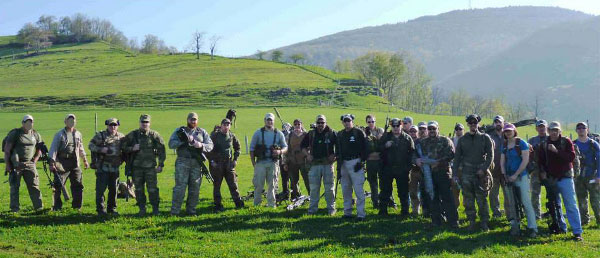
The 2013 Allegheny Sniper Challenge (ASC) took place May 17-19, in West Virginia. The ASC is a competitive tactical rifle match held in the mountains west of Seneca Rocks, West Virginia. It offers a relaxed but extremely challenging course of fire that includes high-angle and high-wind shooting with typical shots ranging between 200 and 1000 yards with varying degrees of complexity. Weather conditions can change dramatically over the course of the three-day event.
Our friends at Ashbury Precision Ordnance (APO) attended this year’s ASC match. APO’s Aaron Dearborn has posted a lengthy ASC match report on the APO Blog. Aaron writes: “We’d like to thank John and Rod from ASC for conducting yet another great practical rifle match in the beautiful mountains of West Virginia. It was three days of Magnum Rifles, Short Barrels, Heavy Bullets, and Wiley Winds! The APO shooting team had a great time and thoroughly enjoyed themselves. Our team shot custom ASW300 Winchester Magnums with Pinnacle Series 20″ barrels and Ruag 220gr Swiss-P match ammo. The average muzzle velocity [for] the two rifles is 2575 fps and they are very maneuverable!”
Aaron said the 2013 ASC lived up to expectations, and then some: “Rod and Jon outdid themselves with the selection of targets and shooting stages. They continue to push shooters out of their comfort zones and are always thinking up new ways to increase the stress during shooting in order to improve the core of shooters who compete in ASC matches. And as long as I am able to attend, I will continue to strive toward becoming a better shooter.”
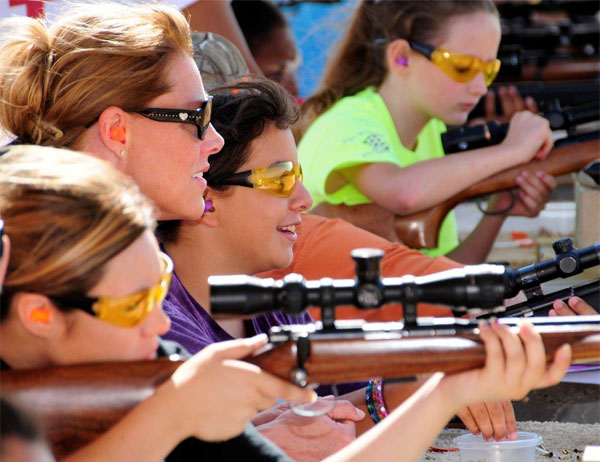
June 15th, 2013 is National Take Your Daughter to the Range Day. This is a great way to spend “quality time” with your daughter, and teach her the basics of firearms safety. At ranges nationwide, girls six and up will be able to try out a rifle, pistol, or shotgun. This event introduces young women to a sport that may become a life-long hobby, continuing a shooting tradition that helped make this country great.
Event co-founder and firearms instructor, Lynne Finch, believes it’s time to tear down the stereotypes and get those young ladies out to the range where they belong. “Boys learn to shoot in Scouts or with their Dads. Often, the girls are left behind because shooting isn’t ‘girly.’ Well, we can, and do shoot, and well. Learning to shoot gives young women confidence, helps to build self-esteem, and introduces them to a sport they can participate in their whole lives.”
The inaugural Take Your Daughter to the Range Day was held June 9, 2012, with 37 ranges in 15 states participating. The event is held each year on the third Saturday in June. Lynne Finch got the idea for the event after reading Julie Golob’s Book SHOOT, learning how Golob grew up going to the range with her father. Finch also learned from many other women how much they enjoyed going to the range with their parents during their youth. Sponsor support has made this event possible. 2013 Contributing Sponsors include: Brownells, Midway USA, Henry Rifles, Charter Arms, Front Sight Firearms Training Institute, and other organizations.
Shooting a 50 BMG, off-hand, at 1000 yards may seem absolutely nuts, but read on — this story should make you smile. At the Texas Triggers Ranch (Sonora, TX), former Army Ranger and Sniper Team Leader Ryan Cleckner, shooting OFF-HAND, hit a torso-sized steel silhouette target at 1000 yards with a 50-caliber Barrett M107. That would be impressive enough, but consider this — Ryan hit the target on his first shot. And yes he was shooting standing (on his hind legs), holding the 37-pound rifle with his arms (no support).
Watch VIDEO of Ryan Cleckner Shooting Barrett M107 Off-Hand at 1000 Yards
Jumbo-Sized Ammo, and Jumbo-Sized Recoil
The ammo Ryan used in his 50 BMG Barrett pushes a 661-grain bullet at 2900 fps muzzle velocity. This load (fired from this 37-pound rifle), has 12,357 ft-lbs of energy at the muzzle, and 81.88 ft-lbs of recoil energy. To put things in perspective, an 18-pound, .308 Win F-TR rifle, shooting a 168gr bullet at 2750 fps, has 7.99 ft-lbs of recoil energy. So, Ryan was shouldering a weapon that delivered more than Ten Times the recoil energy of a .308 Win. (Energy numbers calculated with Point Blank software). And he made it look easy. Kudos to Ryan for proving what a properly-trained marksman can do. Rangers Lead the Way….
Credit Steve Johnson of The Firearm Blog for finding this video.
Ruger has created a series of videos showcasing Metallic Silhouette, IDPA, SCSA (Steel Challenge), and USPSA shooting events. Log on to Ruger’s Beginner’s Guide to Shooting Competitions webpage to see informative videos on each of these popular sports. Below you can find the Video on Metallic Silhouette and the Video on SCSA Steel Challenge pistol competition. Silhouette is a great family sport and the Steel Challenge is the ultimate pistol speed-shooting event.
INTRO to RIMFIRE RIFLE METALLIC SILHOUETTE Competition
INTRO to STEEL CHALLENGE Pistol Competition
Ruger also offers many other cool videos, both on its Video Webpage and on Ruger’s YouTube Channel. On YouTube, you’ll find a great four-part Tactical Carbine video series, hosted by Dave Spaulding, winner of the 2010 Trainer of the Year award by Law Officer Magazine. Spaulding also hosts a set of Ruger videos on defensive handgun use. For novice handgunners, Ruger offers Beginner Shooting Tips with video segments covering each of these topics:
Introduction
Firearm Safety Rules
Pistol Functionality
Body Position Stance
Dominant Eye
Gripping the Handgun
Sight Picture
Aiming
Trigger Control
Loading and Unloading
Range Basics
Ready Position
Shooting Pairs
Shooting to Slidelock
Editor’s Comment: All long-range competitive shooters should watch this excellent video — whether you shoot with a team or as an individual. Three cameras were used so you can watch the shooter, the range flags, and the target simultaneously. After a discussion of scoring, the actual shooting starts at the five-minute mark in the video. Under the guidance of wind coach Gary Rasmussen, U.S. F-Class Open Team Captain Shiraz Balolia shoots 100-7X for ten shots, following Gary’s wind calls.
Team Shooting with a Coach Shiraz tells us: “We come across a lot of shooters who have never shot under a coach. This video was produced to give shooters a basic understanding of shooting with a coach and the importance of releasing a good shot. In a team setting, you basically leave all the decision-making to the coach and aim where you’re told to aim. I’ve worked with Gary many times and it shows in the comfort level we have with each other. The coach plots the shots or a plotter advises the coach of any grouping that is not centered.”
Watch Gary Call the Wind and Shiraz Shoot 100-7X for Ten Shots
For best viewing, click the YouTube settings button to watch in 720p or 1080p HD (high definition).
Shiraz was shooting a 7mm F-Open rig: “My .284 Shehane rifle takes about 10 to 12 shots to settle down and that is probably why we made several scope adjustments while shooting. It is a great caliber and a step up from a straight .284 Winchester. The wind was relatively calm, but sometimes that slow wind with subtle angle changes can be very deceiving.”
The video was shot the first week of May 2013 at a range in Custer, WA located about 20 miles from Bellingham, Washington. The production team included Shiraz Balolia, Gary Rasmussen, three cameramen, and a target puller. Big Thanks to Grizzly Industrial for providing the camera crew and post-production talent.
The CMP has just released a new DVD: Basic Rifle Marksmanship. The DVD features a series of lessons taught by leading instructors from the U.S. Army Marksmanship Unit (USAMU). Aimed at prone, high power, and service rifle shooters, this new DVD covers the fundamentals of target shooting (with a strong emphasis on position shooting with sling and irons). This $6.95 DVD (#784DVDBRM) is offered through the CMP eStore. Content is divided into eight lessons:
If you want to learn how to shoot accurately at very long range, one of the very best places to learn is the Williamsport 1000-Yard Benchrest School. The 6th Annual Benchrest School will be held Saturday June 8 and Sunday June 9, 2013. There are still a few slots available for this year’s session. Classes, taught by top 1K shooters, are held at the Original Pennsylvania 1000-Yard Benchrest Club Range, one of the best 1K ranges in the country. View the range on the Williamsport website, PA1000yard.com
Prospective students will be taught all aspects of long-range benchrest shooting from some of the most skilled marksmen in the country. All areas are covered: load development, precision reloading, bench skills, and target analysis. Much time is spent at the loading bench and on the firing line. And you don’t even need guns and ammo — all equipment and ammunition will be provided.
School instructors tell us: “This year’s benchrest school will be a 2-day weekend event. (There is also a ‘Meet and Greet’ gathering Friday evening). The school is a beginner class designed to teach the fundamental skills needed to be competitive at at 600 and 1000 yards. Saturday will be spent in class covering a range of topics including reloading dos and don’ts, load development and equipment handling. Sunday we will shoot an actual match to see what you’ve learned.”
Don’t hesitate if you want to grab one of the remaining slots for the 2013 school. Contact the school directors right away. For more info, visit contact Dave Gardner (Public Relations) at pa1000br@yahoo.com or 570-916-9095. To get an application, please contact Nancy Miller (Club Secretary) at nancymiller@htva.net or 607-426-1535. Cost for the class is $300.00 including lunch and dinner on Saturday.
To see what the 1K Benchrest school is like, watch the slide show/video below, produced by Sebastian Reist, an alumnus of the 2009 Williamsport 1000-yard BR school. Sebastian, a talented professional photographer, captured the highlights of his Williamsport 1K training weekend:
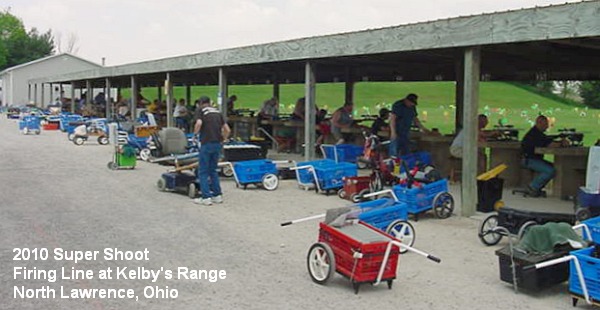
Ready for the Super Shoot? The 41st Annual Firearms Industry Super Shoot will be held on May 22-25, 2013, at Kelbly’s Rifle Range in North Lawrence, Ohio. This annual event draws some of the best 100-yard and 200-yard benchrest shooters in the world. Last year’s Super Shoot had almost 300 competitors from the USA and 14 other countries (about 15% of the competitors come from overseas).
2012 Super Shoot Highlights Video (Watch This — It’s Very Well Done!)
If you’ve never attended the Super Shoot before, and don’t know what to expect, former Sinclair International President Bill Gravatt offers some insights into this great event:
Super Shoot — What It’s All About
The excitement and anticipation leading up to a Super Shoot can be hard to explain to those who haven’t been to one. Every year, some shooters arrive at the Super Shoot a week early to dial in their rifles, learn wind conditions for the range, and enjoy the camaraderie of their fellow shooters. As the match draws closer, campers and RVs fill the area behind the range, and shooters stake out turf all over the property with their reloading and cleaning equipment setups.
Many shooters choose to load cartridges in the main barn directly behind the 60-bench firing line, while others decide to work in pop-ups, campers and other outbuildings around the facility. Benchrest shooters tend to load in small batches, and some most load cartridges between each match. Many shooters clean their rifles after each match, while others sometimes go two or three matches between cleanings, depending on the number of rounds they fire.
Another part of high-level benchrest competition that will amaze first-time attendees is the quality and amount of equipment benchrest shooters use. Just in front of the shooting benches and the targets, range flags of all kinds sprout up, from the typical “daisy wheel” flags to very sophisticated velocity indicators that show varying wind intensity. Shooters adjust their flags to align with the particular target in front of a specific bench, just slightly below the path of the bullet but still partially visible in the high-powered scopes.
The rifles represent a variety of actions, usually custom, with heavy benchrest barrels by various barrel makers. The most popular cartridge used is the 6mm PPC, but occasionally you will run into someone using a 6mm BR or a slightly modified 6mm BR, and as well as a few other cartridges. Rifle rests used are typically heavy tripods or plate rests. You see a lot of Sinclair rests, Farley rests, and a variety of others, including a few homemade rests. Bags are typically Edgewood or Protektor.
Super Shoot — Runners, Pickers and the Pursuit of Perfection
The techniques vary between shooters, and they are interesting to observe. Some shooters “run” their targets and will shoot a quick sighter and then run all 5 shots as fast as they can before conditions change. Others are “pickers” and shoot each shot carefully, going back and forth between the record target and the sighter target to verify wind conditions and bullet drift. These guys will sometimes shoot up to 10 sighters and use the full seven minutes. Both styles of shooting work and many shooters use both techniques depending on the match conditions[.]
Anyone who attends the Super Shoot will come away with a greater appreciation of precision benchrest shooting. Experienced benchresters already know there will be windy days that drive them crazy, and less experienced shooters can get completely lost when… holding off a shot in the wind. But the reward is worth it. It’s very satisfying to hold off a full inch at 100 yards because the wind changes during your string and drop your fifth shot into a sub 0.100″ group with only seconds remaining on the clock. And that’s what the Super Shoot is all about.
The Super Shoot begins with the Light Varmint Class, for guns that weigh 10.5 lbs or less, and consists of a Warm-Up match and five Registered Matches at 100 yards. Shooters are assigned to one of at least six relays and rotate through 12 benches between each of the registered matches. The rotation ensures each shooter faces various wind conditions found at different parts of the range. Competitors can fire an unlimited amount of sighter shots into the sighter target square. The shooters use these sighters to check changes in wind conditions and determine the amount of hold-off, if necessary.
Once the match starts and the “Commence Fire” command is given, shooters have seven minutes to fire five shots into the record target square. These five shots comprise their “group” score for the match. The groups are gauged using a target measuring device with a magnifier and measures the two outermost shots in the group from center point to center point. This group size is the shooter’s score for that match. The laymen’s way to calculate group size is to measure outside edge to outside edge and subtract the bullet diameter. Both procedures achieve roughly the same results. The group sizes for the five record matches comprise their 100 yard Light Varmint Aggregate. Obviously, the smallest aggregate wins.
The second day repeats the process, only competitors are shooting the Heavy Varmint Class rifles, weighing up to 13.5 lbs, at 100 yards. On the third day, the targets are moved to 200 yards and the Heavy Varmint Class is shot at that yardage. The reason for staying with the Heavy Varmint Class is that shooters who switch to heavier barrels can leave them on after shooting 100 yards. On Saturday, the final day of the match, the shooters compete with the Light Varmint guns at 200 yards.
There are winners for each yardage and gun: Light Varmint 100, Light Varmint 200, Heavy Varmint 100, and Heavy Varmint 200. There are also winners for each gun with the two yardages combined. The grand champion of the shoot is the Two-Gun Champion who has the lowest overall group aggregate for the four days of shooting.
For more information, email jim[at]kelbly.com or call (330) 683-4674. You can register onsite (at the Kelbly’s range) or CLICK HERE for 2013 Super Shoot Registration Form. NOTE: After May 10, 2013 registration fees are $130 per gun — no exceptions.
Report based on story by Vanessa Oler
Could your rifle hit a vehicle-sized target located 2.07 miles away (i.e. 3650 yards)? Well Billy Carter’s .375 CheyTac can. Last month, shooting at the NRA’s Whittington Center, Billy Carter hit a 12’x12′ target at the confirmed range of 2.07 miles. Carter was participating in the Whittington U Extreme Long Range III Course. Carter’s 3650-yard hits set a new Whittington U program record for long-distance shooting with a sub-50-caliber rifle. At that distance, 1 MOA is 38.22 inches! Edge to edge, a maximum 3.77 MOA-diameter circle would fit inside the 12′ x 12′ square target.
About the Rifle and Load
Carter’s M200 Intervention is chambered in .375 CheyTac. The beast weighs 31 pounds and measures 53″ overall, as fitted with 29″ barrel and muzzle brake. The optic is a Vortex Razor HD 5-20x56mm (MOA-click version). This First Focal Plane fat boy features a 35mm main tube. To reach out to 3650 yards, Carter was running a whopping 136.5 grains of Retumbo powder in his .375 CheyTac USA brass. That was ignited by Federal GM215M primers. All that Retumbo was pushing the CheyTac USA 350gr “Balanced Flight Trajectory” bullet, a custom copper-nickel-alloy projectile.
Hits on 12’x12′ target at 3650 yards (2.07 miles) Two-mile engagement at the Extreme Long Range III Course at the Whittington U on April 24, 2013.
How the 3650-yard Shot Was Made Carter enrolled in a series of Long-Range Marksmanship courses under the guidance of Jon Weiler, a former U.S. Army Sniper. In 2011, the NRA selected Weiler to help launch the Whittington U long-range training program. Progressing through the long-range courses at Whittington U, Carter began to realize his .50 BMG and 338 Lapua were insufficient for the upcoming Extreme Long Range III Course — with targets increasing in difficulty from 750 yards to 3650 yards. Carter heard industry insiders hinting that Australian sniper teams were using a .375 CheyTac to shoot at 3000+ yards. So Carter called CheyTac USA and ordered a M200 Intervention in the .375 CheyTac chambering.
The first day of the Long Range III course, rifles were sighted-in at 500 yards and students engaged targets at 1200 yards. On Day 2 a cold front and driven snow made shooting near impossible. So, on the third and last day, Carter and the other students decided to go out as far as possible.
This range had four targets: 1890 yards, 2970 yards, 3040 yards, and 3650 yards. Carter figured he could skip the first two, but Weiler said “You have to build up to it”. Carter recounted, “I took 15-20 rounds to work my way up to the 3040 target. At that point you have to take a break. I pulled out my kestrels and started doing the math. My scope had no more vertical space, so I was forced to use five MOA at 3040, then calculate a full value 3 o’clock wind. Basically speaking, I was shooting out of my scope at that point. And hoping. ”
The first three shots, I wasn’t there and I knew it wasn’t going to work. But then I got close. The adrenaline started rushing and I couldn’t stop. I’m almost there, I thought.” Weiler, at the spotting scope, kept an even tone: “Same hold.” Carter shot again. Weiler let the excitement rise in his voice: “I can now say you’ve hit that 3650 target twice.”
Interview with Billy Carter
Carter is V.P. of Carter’s Shooting Center (CSC) in Houston, Texas. CSC is one of the largest private firearms retailers in the country.
“This was unreal. To think just a month before, I didn’t even know the velocity of my load! To pull off a two-mile hit was such a rush… it was dream come true.” Carter gave credit to Weiler: “John was an excellent instructor, designing the course to help you stairstep your way up to incredible distances. It wasn’t like you were just going to spend all day blindly shooting at some impossible target. He teaches you how to succeed at shooting long distance by starting with the basics — correct prone stance, trigger control, and rifle positioning.”


 Back in May, IBS shooter Rodney Wagner shot a 0.349″ (50-2X) 5-shot group that became the talk of the shooting community. This was the smallest 600-yard group shot in the history of recorded rifle competition. Rodney’s group cuts the existing IBS 600-yard record in half. Rodney put five shots under the size of a dime at the distance of six football fields. Just pause and think about that…


 One important technique Rodney employs is sorting by bullet-seating force. Rodney batch-sorts his loaded rounds based on seating force indicated by the dial gauge on his K&M arbor press: “I use a K&M arbor press with dial indicator strain gauge. When I’m loading I pay lots of attention to seating effort and I try to batch five rounds that feel the same. For record rounds I try to make sure I get five of the same number (on the dial). When sorting based on the force-gauge readout, you need to go slow. If you go too fast the needle will spike up and down before you can see it.”

 Aiming for the Nine — To shoot ultra-small at long range, you must aim very, very precisely. When shooting at 600 yards, Rodney lines up his cross-hairs on the white number “9” in the blue field above the ten ring. This is visible through his rifle-scope at 600 yards, and it provides an aim point smaller than the center “X”.




 Shooting a 50 BMG, off-hand, at 1000 yards may seem absolutely nuts, but read on — this story should make you smile. At the


 Shiraz tells us: “We come across a lot of shooters who have never shot under a coach. This video was produced to give shooters a basic understanding of shooting with a coach and the importance of releasing a good shot. In a team setting, you basically leave all the decision-making to the coach and aim where you’re told to aim. I’ve worked with Gary many times and it shows in the comfort level we have with each other. The coach plots the shots or a plotter advises the coach of any grouping that is not centered.”
 The CMP has just released a new DVD:
  If you want to learn how to shoot accurately at very long range, one of the very best places to learn is the

 Ready for the Super Shoot? The 41st Annual Firearms Industry Super Shoot will be held on May 22-25, 2013, at


 Carter enrolled in a series of Long-Range Marksmanship courses under the guidance of
  The first day of the Long Range III course, rifles were sighted-in at 500 yards and students engaged targets at 1200 yards. On Day 2 a cold front and driven snow made shooting near impossible. So, on the third and last day, Carter and the other students decided to go out as far as possible.


