Report based on story by Vanessa Oler
Could your rifle hit a vehicle-sized target located 2.07 miles away (i.e. 3650 yards)? Well Billy Carter’s .375 CheyTac can. Last month, shooting at the NRA’s Whittington Center, Billy Carter hit a 12’x12′ target at the confirmed range of 2.07 miles. Carter was participating in the Whittington U Extreme Long Range III Course. Carter’s 3650-yard hits set a new Whittington U program record for long-distance shooting with a sub-50-caliber rifle. At that distance, 1 MOA is 38.22 inches! Edge to edge, a maximum 3.77 MOA-diameter circle would fit inside the 12′ x 12′ square target.
About the Rifle and Load
Carter’s M200 Intervention is chambered in .375 CheyTac. The beast weighs 31 pounds and measures 53″ overall, as fitted with 29″ barrel and muzzle brake. The optic is a Vortex Razor HD 5-20x56mm (MOA-click version). This First Focal Plane fat boy features a 35mm main tube. To reach out to 3650 yards, Carter was running a whopping 136.5 grains of Retumbo powder in his .375 CheyTac USA brass. That was ignited by Federal GM215M primers. All that Retumbo was pushing the CheyTac USA 350gr “Balanced Flight Trajectory” bullet, a custom copper-nickel-alloy projectile.
Hits on 12’x12′ target at 3650 yards (2.07 miles) Two-mile engagement at the Extreme Long Range III Course at the Whittington U on April 24, 2013.
How the 3650-yard Shot Was Made Carter enrolled in a series of Long-Range Marksmanship courses under the guidance of Jon Weiler, a former U.S. Army Sniper. In 2011, the NRA selected Weiler to help launch the Whittington U long-range training program. Progressing through the long-range courses at Whittington U, Carter began to realize his .50 BMG and 338 Lapua were insufficient for the upcoming Extreme Long Range III Course — with targets increasing in difficulty from 750 yards to 3650 yards. Carter heard industry insiders hinting that Australian sniper teams were using a .375 CheyTac to shoot at 3000+ yards. So Carter called CheyTac USA and ordered a M200 Intervention in the .375 CheyTac chambering.
The first day of the Long Range III course, rifles were sighted-in at 500 yards and students engaged targets at 1200 yards. On Day 2 a cold front and driven snow made shooting near impossible. So, on the third and last day, Carter and the other students decided to go out as far as possible.
This range had four targets: 1890 yards, 2970 yards, 3040 yards, and 3650 yards. Carter figured he could skip the first two, but Weiler said “You have to build up to it”. Carter recounted, “I took 15-20 rounds to work my way up to the 3040 target. At that point you have to take a break. I pulled out my kestrels and started doing the math. My scope had no more vertical space, so I was forced to use five MOA at 3040, then calculate a full value 3 o’clock wind. Basically speaking, I was shooting out of my scope at that point. And hoping. ”
The first three shots, I wasn’t there and I knew it wasn’t going to work. But then I got close. The adrenaline started rushing and I couldn’t stop. I’m almost there, I thought.” Weiler, at the spotting scope, kept an even tone: “Same hold.” Carter shot again. Weiler let the excitement rise in his voice: “I can now say you’ve hit that 3650 target twice.”
Interview with Billy Carter
Carter is V.P. of Carter’s Shooting Center (CSC) in Houston, Texas. CSC is one of the largest private firearms retailers in the country.
“This was unreal. To think just a month before, I didn’t even know the velocity of my load! To pull off a two-mile hit was such a rush… it was dream come true.” Carter gave credit to Weiler: “John was an excellent instructor, designing the course to help you stairstep your way up to incredible distances. It wasn’t like you were just going to spend all day blindly shooting at some impossible target. He teaches you how to succeed at shooting long distance by starting with the basics — correct prone stance, trigger control, and rifle positioning.”
The latest edition of the CMP’s On The Mark magazine contains a good article on firearms safety. While this story was written primarily for junior shooters, it offers good advice for shooters of all ages and skill levels. Here are some of the key recommendations:
1. Self-Discipline and Focus. Gun safety is not a matter of learning safety rules and then assuming you will always be safe with guns. Gun safety requires that you consciously practice safe muzzle control, check for open actions and keep your fingers outside of the trigger guard every time you handle a gun. That requires self-discipline and focus. You must discipline yourself to always pay attention to safety — for yourself and for those around you.
2. Everyone Is a Safety Officer. In an emergency when a safety hazard occurs or when someone in your presence does something unsafe with a gun, you can and must become an “Emergency Safety Officer.” If you see someone close the action on a gun or fail to open the action of a gun while handling it, it is necessary for you to step in and make sure the action is opened.
3. MAT — Muzzle, Action, Trigger. An easy way to remember the Rules for Safe Gun Handling is to use the key word MAT. MAT stands for Muzzle-Action-Trigger. Whenever you handle a rifle always start by controlling the MUZZLE. Next think about the ACTION — when handling any rifle or firearm, the action must be open with a CBI (Clear Barrel Indicator), ECI (Empty Chamber Indicator) or OBI (Open Bolt Indicator) inserted. Finally remember “T” for TRIGGER. Keep your finger off of the trigger until after placing the gun in the shooting position and preparing to fire a shot. It is especially important to keep the finger outside of the trigger guard when loading the gun and placing it in the shooting position.
Other CMP Safety Instruction Resources:
Junior Shooter’s Guide to Air Rifle Safety, NLU # 741. This 20-page booklet is written for
junior air rifle shooters, but it provides safety rules, procedures and guidelines that can be
used by youth or adult shooters in any range firing situation.
CMP Rifle Safety Guide, NLU #744. This 32-page booklet is written for owners of CMP rifles. This guide includes safe gun handling rules and safety guidelines, explains how the rifle operates, range safety rules, how to deal with special problems, tips for accurate shooting, proper care of your rifle and CMP Programs for new rifle owners.
Rifle Safety & Marksmanship Training CD-ROM, Item # 772. This CMP produced CDROM is designed for use by coaches, instructors and youth who are teaching or learning target rifle shooting. It presents a complete basic rifle marksmanship course plus an impressive array of additional resources. Order through the CMP eStore.
How to Receive On The Mark On The Mark is published quarterly by the Civilian Marksmanship Program. A typical issue of On The Mark includes 16-24 pages of new junior shooting program information as well as news about junior events, instructional tips and coaching information. One free On The Mark subscription is provided to each CMP-affiliated junior club, JROTC unit with marksmanship programs, and 4-H Shooting Sports Club. Individual subscriptions to On The Mark are available for $8.00 per year. To subscribe, download the OTM Order Form.
The MidwayUSA Foundation, Inc. and Scholastic Shooting Trust, a public charity established by Larry and Brenda Potterfield, received a $3,000,000 donation from the Potterfields to support junior shooting programs. These funds will be allocated to 204 separate endowments. Funds will support 192 shooting teams each receiving $10,000, seven state 4-H shooting programs, as well as five, new college curriculum shooting programs (receiving $100,000 each).
The Scholastic Shooting Trust (SST) Fund is owned and controlled by the MidwayUSA Foundation, Inc., a 501(c)(3) not-for-profit, public charity established by Larry and Brenda Potterfield in 2007. The SST Fund is an endowment intended to provide financial support for scholastic shooting programs. The SST Fund gives alumni and other interested parties of universities, colleges and high schools the ability to financially support a school’s competitive shooting program. The Foundation works with shooting teams, conservation groups and the shooting industry to raise funds in support of high school and collegiate shooting programs. To learn more about The MidwayUSA Foundation and Scholastic Shooting Trust, visit ScholasticShootingTrust.org or call 1-877-375-4570.
Miculeks Dominate Superstition Mountain Mystery 3-Gun
Here’s proof that the family that shoots together, wins together. Legendary shooter Jerry Miculek, his wife Kay, and their daughter Lena, all took home top trophies at the 2013 Superstition Mountain Mystery 3-Gun Match in Mesa AZ, March 22-24, 2013. The annual event hosted by the Mystery Mountain 3-Gun Club, included more than 300 shooters.
Jerry took top honors as the Match Champion, High Senior. Kay was the Women’s Open Champion and Lena won 2nd place in the Ladies Tactical Optics division and was also High Junior. That’s a great across-the-board performance for the Miculek clan. Learn more about them at Miculek.com.
Jerry says: “You get to the next level by being the first one on the range and the last one to leave.”
The Next Generation — Lena Miculek
Lena Miculek, the daughter of Jerry and Kay Miculek, was born and raised on Shootout Lane. Lena claimed her first National title at the Sportsman’s Team Challenge when she was only ten years old, and has since won four more National titles in both the Junior and Sportsman’s A divisions. In 2010 Lena followed in her fathers footsteps, competing in the USPSA Revolver Division.
Lena’s main focus is now on Multi-Gun competitions, specifically 3-Gun Nation events. Lena had a very successful first year of Multi-Gun shooting, culminating in a class win at the 3-Gun Nation shoot-offs in Vegas during the 2013 Shot Show. Lena also had a huge break-though in her shooting career at the 2012 IPSC Shotgun World Shoot in Hungary, where she was crowned the Ladies World Champion (Standard Division).
Just about every competitive or recreational shooter has someone who helped introduce them to the shooting sports or helped them develop their skills. For many competition shooters, a coach is the person they credit for helping them train successfully and win.
The NRA’s Coach Education Program helps train shooters to become capable mentors. Each year, hundreds of people become NRA Certified Coaches by attending a Coach School. Available for a variety of shooting disciplines including Shotgun, Air Gun, Smallbore, and Pistol, Coach Schools teach the necessary methods for encouraging shooters and developing their skills.
Throughout the year, Coach Schools are offered for a variety of disciplines. Two Coach Schools will be held very soon, one in South Carolina next week, and another in Ohio in April. Information on these two coach schools is in the table below. More coach school sessions are added regularly, so check the Coach Education Program website for updates. To learn more about the Coach Education Program or to hold a Coach School in your area, contact Samantha Olsen at (703) 267-1504 or solsen [at] nrahq.org.
Who Teaches the Coach School?
The NRA Coach Schools are taught by National Coach Development Staff who are Certified Coaches that have been carefully selected, based on their talents and expertise in the areas of sports, education, coaching, and shooting. In addition, these coach school instructors have attended special training on how to conduct informative and enjoyable schools.
How Can I Sponsor a School in my Area?
The NRA is accepting requests to sponsor smallbore and air rifle, pistol, shotgun and high power rifle coach schools. For information on how you or your organization can sponsor one of these events, click here for a Sponsor’s Guide. For questions about the Coach Education Program, email coaching@nrahq.org.
Article based on story by Kyle Jillson for NRABlog
Kirsten Weiss was the 2012 NRA Women’s Smallbore Three Position (3-P) Champion. In this video, Kirsten condenses ten years of competitive shooting experience into an easy-to-understand segment about the fundamentals of aiming, head position, and proper cheek placement. Kirsten explains, “proper aiming is a relationship between the eye, the sights, and the target. Head position on the stock is the basic prerequisite to good aiming. And the cheek placement must be consistent every single time.” Kirsten also has a tip for scope fitting: “Once your cheek placement is comfortably achieved… make sure the scope comes to you — don’t move your head to the scope, [which requires] changing head/neck position. Adjust your scope to your eye in a comfortable way.”
So why are the fundamentals so important? Kirsten explains: “Even elite snipers and top-level competition shooters go back to basics to review and refresh their knowledge every once in a while. This reinforces knowledge, ingrains proper technique, and polishes out developmental flaws.”
Kirsten Weiss of Cornwall, PA was the 2012 NRA Women’s National Champion at the NRA Smallbore 3-P Championships held at Camp Perry, OH. She won the 2012 3-P smallbore championship in only her second trip to Camp Perry. Her first came nine years ago.
Back then she was still learning what it takes to be a top competitive shooter. Her skills still raw, she placed second in the Sharpshooter Category. Not good enough. She resolved to get better — and she did.
Weiss would go on to earn a spot on the Nebraska Cornhuskers rifle team. Her tenacity and techniques would garner recognition from USA Shooting and a sponsorship from Lapua Ammunition after a top eight finish at the Olympic Trials. She also has a been involved in hunting since age twelve. In fact, it was in the field that the foundation of her shooting skills began.
There was quite a bit of interest in our recent Bulletin post about ‘negative’ black-to-white targets for F-Class practice. After seeing that story, some readers wanted to obtain reduced-sized “negative targets” for 300-yard F-Class training. Well guys, you’re in luck. One of our Forum members, Sleepygator, has produced “reduced-distance” targets (with black ring-lines on white background) that he could use at 300 yards for practice. Only the center 10 and X rings are black, so you can see bullet holes easily “in the white” on most of the target (and this uses less ink when printing). There is an official reduced-distanced standard for 300-yard F-Class matches. This utilizes the NRA No. MR-63FC – F-Class Target Center which is pasted over the MR-63 target. It provides a 1.42″ X-Ring, 2.85″ 10-Ring, and 5.85″ Nine-Ring. (The dimensions of F-Class targets are found in the NRA High Power Rules, Sec. 22, part 4.)
To duplicate the 300-yard target, Forum member SleepyGator has prepared a printable version of the MR-63FC Target Center, along with a pair of training targets with two bulls and five bulls. The two-bull and five-bull targets mirror the scoring rings on the MR-63FC, but they display only the innermost three rings and two rings respectively. All three targets are Adobe Acrobat files that can be easily printed. You may need to adjust the scale (sizing) on your printer to get the dimensions exactly correct. As noted above, when printed, the 10-Ring on all three targets should measure 2.85″. This should provide some handy practice targets you can use between matches. Thanks to SleepyGator for providing these targets. You can download all three as a .Zip archive. After downloading the .Zip file, just click on the .Zip archive to extract the individual targets.
ON THE MARK is published quarterly by the Civilian Marksmanship Program. You can download the latest 35-page Fall 2012 issue for free. ON THE MARK is dedicated to providing news and information about junior shooting activities to leaders and coaches of junior shooting clubs, teams and camps. A typical issue of ON THE MARK includes 16-38 pages of new junior shooting program information as well as news about junior events, instructional tips and coaching information. Bonus inserts and brochures are regularly included which detail programs for junior competition and training programs or provide equipment and training material purchase opportunities.
Free Subscriptions for CMP-Affiliated Junior Clubs
One free ON THE MARK subscription is provided to each CMP-affiliated junior club, JROTC unit with marksmanship program, and 4-H Shooting Sports Club. Individual subscriptions to ON THE MARK are available at $8.00 per year. To subscribe to ON THE MARK, download the OTM Order Form.
Editorial Submissions
To submit stories, match reports, or photos for possible inclusion in ON THE MARK, contact: Steve Cooper, OTM Editor, P.O. Box 576, Port Clinton, Ohio 43420; phone (419) 635-2141, ext 1108; fax (419) 635-2573 or email scooper@thecmp.org.
How Easy it is to Have Fun with Rifles and Equipment You Probably Already Have….
Forum member Rod Vigstol (aka Nodak7mm) has written a great Introduction to F-Class for shooters getting started in this rewarding discipline. Rod’s article, which appears in German Salazar’s Rifleman’s Journal website, covers F-Class basics and addresses concerns that “newbies” may have when trying a new shooting sport. Rod stresses that most guys who own a varmint-hunting or tactical rig likely have nearly all the gear they need to give F-Class competition a try.
Rod explains: “If you’re reading this, you have more than just a general interest in the shooting sports and in the awesome rifles that shoot tiny groups at insane distances. You probably even have friends that enjoy shooting as much as you do. The quandary you may find yourself in is your friends haven’t quite jumped into it head-first like you have and they haven’t spent a lot of money and time obtaining the equipment you have to go shoot these matches. But you know what? Your prairie-dog shooting buddy or coyote-hunter friend can attend these matches and shoot alongside with you. He or she more than likely already has the basic equipment needed to shoot a match.” Most varmint shooters already have a suitable, accurate rifle and the following equipment:
• A variable-power scope in the 4.5-14x range or higher.
• A front bipod like the trusty old Harris 9″-13″, or maybe even a basic pedestal front rest.
• A rear sand-bag or similar sand-sock to rest the butt stock.
• A basic shooting mat from Midway or at least a piece of carpet or canvas to lay on.
Rod also provides a handy checklist of items to bring to the range. These include: Canvas or carpet strip (to set under bipod), Notebook, Kitchen Timer, Cleaning Rod, Camp Chair, Elbow Pads, Shooting Hat, and Open Bolt Indicator (OBI). Along with rifle, bipod (or front rest), rear bag, and ammo, that’s pretty much all you need.
Rod encourages all shooters to give F-Class a try — even novices. Rod explains: “We have all been rookies, newbies, new kids on the block or whatever. So we all have a good idea of what may be going on in your mind, the questions and concerns you may have. I’m telling you this sport is full of fantastic people who deep down find it far more fulfilling to help a new shooter get started than running a clean target. You just have to take the first step to get involved.”
Following shoulder surgery, our Contributing Editor German Salazar moved to F-TR shooting, replacing his sling and iron sights with bipod and scope. German has done remarkably well for an F-TR newbie, winning his first two 500-yard matches (in F-TR class) at Phoenix-area ranges. German has been shooting his “old Palma rifle with a scope and bipod attached”. This rig features a Gilkes-Ross action in a Robertson/Sitman Highpower Prone stock with an Anschütz 5020 trigger and 30″ 1:11″-twist Krieger barrel. The rifle is fitted with a Canadian-made Rempel “Ski” bipod and a Leupold BR 24X scope.
On his Riflemans’ Journal website, German has crafted a helpful article with advice for “sling shooters contemplating a busman’s holiday into F-Class.” Even seasoned F-Class shooters can learn something from German’s observations in his F-TR: Scoping it Out article. Here are some highlights from the article:
Carpet Under the Bipod
“I quickly learned that a piece of carpet was an essential component under the bipod. Without the carpet, [on dirt surfaces] the bipod tends to dig into the dirt with every shot, resulting in odd elevation shots. On the concrete it isn’t quite as essential, but it smooths the recoil movement appreciably and is worthwhile. [I used] a short-nap carpet remnant for this, but my car floor mat also worked well.”
Clicking vs. Holding Off
“I’ve been shooting iron sights and clicking sight knobs for most of my life; trying to hold off made me very uncomfortable and the reflex pull of the trigger just wasn’t there. Once I returned to holding center and clicking, I was more comfortable and was able to execute my shots more quickly and cleanly. By zeroing the windage knob I can also easily return to a previous setting when conditions warrant.”
Reading Mirage with Spotting Scope
“In conversations with other F-Class shooters in our club, I found that few were using a spotting scope to see mirage; they were largely relying on the rifle scope. However, the rifle scope is focused on the target, as it must be to eliminate parallax, and thus cannot show mirage with the same clarity as a spotting scope that is focused roughly halfway down the range.”
Positioning Your Spotting Scope
“I position the spotting scope in the same manner as I did when shooting from the sling. It is very close to me and can be used without moving the head from the cheekpiece. The object, as always, is to minimize movement in order to maintain a consistent position and to minimize the time lost between the last glance at the mirage and breaking the shot.”


 Carter enrolled in a series of Long-Range Marksmanship courses under the guidance of Jon Weiler, a former U.S. Army Sniper. In 2011, the NRA selected Weiler to help launch the Whittington U long-range training program. Progressing through the long-range courses at Whittington U, Carter began to realize his .50 BMG and 338 Lapua were insufficient for the upcoming Extreme Long Range III Course — with targets increasing in difficulty from 750 yards to 3650 yards. Carter heard industry insiders hinting that Australian sniper teams were using a .375 CheyTac to shoot at 3000+ yards. So Carter called CheyTac USA and ordered a M200 Intervention in the .375 CheyTac chambering.
 The first day of the Long Range III course, rifles were sighted-in at 500 yards and students engaged targets at 1200 yards. On Day 2 a cold front and driven snow made shooting near impossible. So, on the third and last day, Carter and the other students decided to go out as far as possible.

 3. MAT — Muzzle, Action, Trigger. An easy way to remember the Rules for Safe Gun Handling is to use the key word MAT. MAT stands for Muzzle-Action-Trigger. Whenever you handle a rifle always start by controlling the MUZZLE. Next think about the ACTION — when handling any rifle or firearm, the action must be open with a CBI (Clear Barrel Indicator), ECI (Empty Chamber Indicator) or OBI (Open Bolt Indicator) inserted. Finally remember “T” for TRIGGER. Keep your finger off of the trigger until after placing the gun in the shooting position and preparing to fire a shot. It is especially important to keep the finger outside of the trigger guard when loading the gun and placing it in the shooting position.
 The MidwayUSA Foundation, Inc. and Scholastic Shooting Trust, a public charity established by Larry and Brenda Potterfield, received a $3,000,000 donation from the Potterfields to support junior shooting programs. These funds will be allocated to 204 separate endowments. Funds will support 192 shooting teams each receiving $10,000, seven state 4-H shooting programs, as well as five, new college curriculum shooting programs (receiving $100,000 each).
 The Next Generation — Lena Miculek
 Just about every competitive or recreational shooter has someone who helped introduce them to the shooting sports or helped them develop their skills. For many competition shooters, a coach is the person they credit for helping them train successfully and win.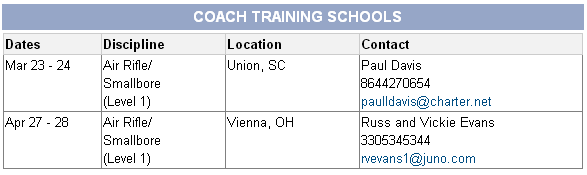
 Kirsten Weiss of Cornwall, PA was the 2012 NRA Women’s National Champion at the NRA Smallbore 3-P Championships held at Camp Perry, OH. She won the 2012 3-P smallbore championship in only her second trip to Camp Perry. Her first came nine years ago.


