AccurateShooter’s Target Page provides over 50 FREE downloadable targets. You’ll find all types of targets — sight-in targets, varmint targets, rimfire targets, bullseye targets, tactical targets, load development targets and more. CLICK HERE for all our free targets, including our popular LOAD DEV target.
On this load development target, all your load data fits neatly in the boxes under each target. The diamonds have 1/2″ sides and you can align your cross-hairs on the horizontal and vertical lines. When we test, we crank in a little elevation, setting the point-of-impact higher. That way our shots fall in the gray circles, leaving the red diamonds intact for precise aiming.
Storm Tactical Targets — Hundreds of FREE, Printable Targets
If you want an even greater selection of targets, specialized for PRS and NRL shooters, Storm Tactical offers a vast collection of tactical targets, available in three different versions: MOA, MIL Yards, and MIL Meters. These target sets were created with input from Sniper’s Hide. Storm Tactical also created a great rimfire target set. This includes side-by-side target blocks for fun, one-on-one competition. If you shoot NRL22 or just enjoy shooting with a buddy, we highly recommend the rimfire target set.
Overall there are 299 Storm Tactical Targets in four sets.
CLICK links to launch each Storm Tactical target collection. Then you can click the download icon to save to your hard drive. OR, you can scroll up and down to select the target(s) you like which you can tell your printer to print. We do recommend downloading the complete archives. File sizes are listed.
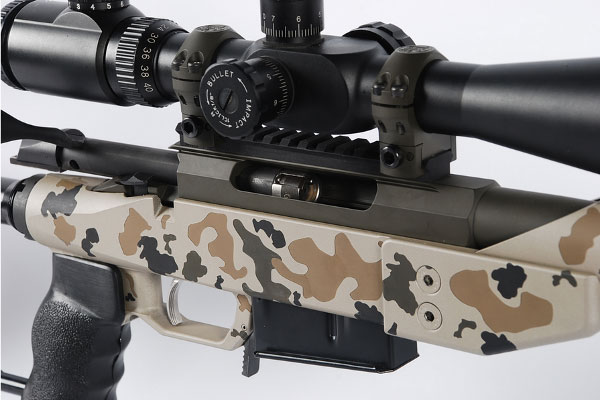
Here’s a Tikka T3 in Third Eye Tactical cerakoted chassis.
Rimfire Twin Target, for One-on-One Shooter Challenges
You’ll find this fun target on the third page of the Rimfire Target Pack. Just download the PDF file and instruct your printer to deliver page three. Or print out all six (6) rimfire targets if you like.
Thank to efforts by the NSSF, and the ATF adopting eForms, you can now get a suppressor purchase authorization with a far shorter wait time. NSSF began working to improve ATF NFA form processing in 2013 when it pressed the agency to institute electronic form processing, or eForms. This has had significant positive effects in reducing NFA wait times. As a result you can pay the required Federal $200 tax and obtain suppressor purchase authorization much more quickly.
Suppressors are now legal in 42 U.S. States. There are certain legal requirements for obtaining a suppressor, including paying a $200 Tax Stamp. To own a suppressor you must be legally eligible to purchase a firearm, pass a BATFE background check, pay a one time $200 Transfer Tax, and satisfy age requirements. The process for paying the $200 requires submitting an ATF Form 4 for each suppressor that you purchase. You can submit either electronically or via paper. The Form 4 authorizes transfer of the suppressor from the dealer or manufacturer to you. MORE INFO HERE.
A significant drop in processing wait times on submitted National Firearms Act (NFA) forms is shown in a new Bureau of Alcohol, Tobacco, Firearms and Explosives (ATF) report. The ATF has revealed that the average wait time on a paper NFA Form 4 — the most popular NFA form submitted — dropped to an average of 245 days for processing, while average processing times for electronic eForm 4s dropped to 53 days. Previously, wait times on Form 4s were near 280 days for paper form processing and between 90 and 190 days for electronic processing. NSSF has learned that in some cases fully electronic Form 4s were processed in as few as four days and in some cases on the same day.
Form 3 processing times also dropped with reports of of them being processed in as few as four days. Form 5 processing wait times for the tax-exempt transfer and registration of firearms dropped down to 19 days for paper forms and an average of one day for the electronic form.
OPINION: Suppressors Should Not Be Subject to NFA Regulation
NSSF continues to support the Hearing Protection Act and other proposed legislation that would remove silencers, commonly called suppressors, from the National Firearms Act. Suppressors are devices that provide hearing protection for hunters and target shooters. They are legal to own in 43 states and to hunt with in 42 states. Removing suppressors from the NFA would free up considerable ATF resources unnecessarily spent processing paperwork.
With over 340 shooting-related videos, the Alabama Arsenal YouTube Channel is a remarkable resource. This video channel provides detailed field tests of tactical-type rifles, ARs, and pistols. The testers have access to some very impressive ranges, and many of the tests are far more thorough than you’ll typically find with most gun magazines and gun-centric YouTube channels. For example, Alabama Arsenal (AA) has a series of 1000+ round pistol test videos. These are well worth watching if you are considering purchase of a defensive handgun.
Today we showcase multiple rifle videos covering two centerfire rifles, and three precision rimfire rigs. After these field test videos, you’ll find an interesting technical video which investigates how suppressors can affect muzzle velocity.
Barrett MRAD .300 PRC at 2200 Yards — Extreme Long Range
Here’s a rugged tactical rifle put to the test at Extreme Long Range. This video, featuring a Barrett MRAD chambered for the .300 PRC cartridges, features accuracy testing out to 2200 yards (1.25 miles). There is some good drone footage covering the long path to the target. The shooter noted that the bullets fired from his .300 PRC “go sub-sonic somewhere between 1800 and 1900 yards”, creating additional ballistics challenges at this yardage.
Savage 110 Elite Precision for PRS Production Class
In this video AA’s team reviews the Savage Elite Precision Rifle with MDT ACC Chassis. Retailing for about $1810.00 in 6mm Creedmoor, this is one of the better production class options for PRS and NRL competition. Starting at the 3:10 time-mark, the video shows how all the adjustments function on the MDC ACC Chassis. Guns America Digest did a full review of this rifle, and was quite impressed.
Rimfire .22 LR Bergara B-14R in WOOX Furiosa Hybrid Chassis
Alabama Arsenal recently tested a .22 LR Bergara B-14R rimfire rifle fitted with the WOOX Furiosa hybrid chassis system, an Italian-made product featuring wood sections over a strong aluminum core chassis. The bolt operation and ergonomics of the B-14R simulate a Remington 700 very closely, making this rifle good for rimfire cross-training. The B14-R model tested was the version with carbon-wrapped barrel.
The WOOX Furiosa is an innovative, unique aftermarket replacement chassis. This high-tech hybrid stock/chassis combines wood sections over a full-length, aerospace-grade aluminum skeleton chassis, giving it the “feel” of a wood stock with the strength and stability of a metal stock. We like the way the stock feels on the trigger hand in particular and the smooth wood cheekpiece is also very nice. Made in Italy, the Furiosa is offered in three versions all with wood sections on the forearm, grip area, and cheekpiece. Choose natural Walnut Brown, Micarta Black, or Midnight Grey. Alabama Arsenal tested a B14-R fitted with the Micarta Black version. Below are photos of a centerfire rifle in a WOOX Furiosa hybrid chassis, with the Brown Walnut elements.
CZ 457 Varmint Precision Trainer and Chassis
In this video, Alabama Arsenal compares two higher-end versions of the popular CZ 457 rimfire rifle, a great choice for the NRL22 and PRS 22 disciplines. The test compares the CZ 457 in a Manners composite stock with a CZ 457 version in a Varmint Precision aluminum chassis. Right now basic CZ 457 rifles start at about $540.00, with the Varmint Precision models running $930 for the metal chassis version and $1130 for the Manners carbon-fiber composite stock model.
Informational Video about Rifle and Pistol Suppressors
Alabama Arsenal regularly tests its firearms with suppressors. Over time, the testing team has leaned much about modern sound moderators, comparing features and learning how to install and maintain quality suppressors. Here is an interesting video that shows how suppressors affect shot velocities.
Field Testing — Do Suppressors Change Bullet Velocity
Want to see more content like this? Here are LINKS…
Alabama Arsenal has nearly 300 videos on its YouTube channel. In addition, you’ll find dozens of firearms photos and other shooting-related content on Alabama Arsenal’s social media pages: Facebook; Instagram; and Twitter. You can support the Arsenal’s gun testing by subscribing to the Alabama Arsenal’s PATREON Page.
Former Army Ranger sniper instructor Ryan Cleckner is the author of the best-selling Long Range Shooting Handbook. Cleckner hosts a series of videos that cover shooting techniques appropriate for tactical and PRS-type disciplines. Here are five short videos that cover various aspects of shooting techniques and rifle set-up. We think PRS/NRL competitors (and long-range hunters) can benefit from these videos.
“Consistency is the key to accuracy.
You need to think about a system of how you’re going to shoot that is not only comfortable, but [is] repeatable when you’re shooting.” — Ryan Cleckner
In this first video, Cleckner explains proper scope position. Ryan finds that some shooters place the scope too far forward or too far rearward. If the scope is too far back you may have issues with eye relief and stock reach to shoulder. If it is too far forward, you may have cheek-weld problems or get neck strain.
Cleckner offers a simple method to check your scope position: “To see if your scope is set up properly … close your eyes, lay your head on your gun, get completely comfortable, and only when you are set-up, then open your eyes. If you can’t see clearly through your scope, CHANGE something [such as comb height or scope position]”. “When you open your eyes, if you see some scope shadow [i.e. the black ring around the edge of the scope picture], figure out which way you need to move your head to get rid of that shadow, and then make adjustments to either your position, the rifle, or the scope.”
Cleckner prefers shooting off a bag when in the prone position, when that is practical. The bag provides a more stable support than a small Harris-type bipod, doesn’t require pre-loading the rifle, and there is less bounce or hop on recoil.
Former Army Ranger sniper team leader Ryan Cleckner explains how important it is to keep your rifle straight up and down when long-range precision shooting. Cleckner demonstrates with an AR-10 modern sporting rifle how slight cant to your rifle can cause a miss over long distances.
Here Cleckner covers some of the basic points of trigger control on tactical-style rifles. These basic principles apply to both single-stage and two-stage triggers. NOTE: For benchrest rigs, with ultra-light pull weights, more refined techniques may be appropriate.
In tactical events, when you’re shooting on the clock and loading from a detachable magazine, you should manipulate the bolt smoothly but strongly. Here Cleckner demonstrates how to cycle a tactical-type rifle. He says, “You should be running the bolt on your rifle with authority. Run it like you mean it!” NOTE: Completely different techniques are appropriate for custom benchrest rifles that manually feed.
Long Range Shooting Handbook — A Good Resource
Cleckner’s Long Range Shooting Handbook covers a wide range of topics important for precision marksmanship — both shooting skills and technical matters. You can view Sample Chapters from Ryan’s Book on Amazon.com. Cleckner’s book is designed as an intro to key concepts such as MOA vs. Mils, External Ballistics, and Environmental Effects. Included are personal tips and advice based on Cleckner’s years of experience as a sniper instructor and special operations sniper.
The Long Range Shooting Handbook is divided into three main categories: What It Is/How It Works, Fundamentals, and How to Use It. “What It Is/How It Works” covers equipment, terminology, and basic principles. “Fundamentals” covers the theory of long range shooting. “How to Use It” gives practical advice on implementing what you’ve learned, so you can progress as a skilled, long range shooter. Overall, this is one of the best resources available for tactical shooters and PRS/NRL competitors.
GunsAmerica Digest has a new Suppressor Academy webpage that provides host of helpful information about suppressors (aka “silencers” and “cans”). The Suppressor Academy online resource page features in-depth articles with important information for anyone considering acquiring a suppressor. The articles explain the key benefits of suppressors, how to choose a suppressor, and how to comply with Federal and state laws regulating suppressors. Below we link to four Suppressor Academy articles. Click the title for each topic to read the full-length article.
Suppressors are now legal in 42 U.S. States. There are certain legal requirements for obtaining a suppressor, including paying a $200 Tax Stamp. To own a suppressor you must be legally eligible to purchase a firearm, pass a BATFE background check, pay a one time $200 Transfer Tax, and satisfy age requirements. (SEE ALL Requirements). In most (but not all) of those states you can use a suppressor for hunting. The eight (mostly blue) states which still prohibit civilian suppressor ownership are: California, Delaware, Hawaii, Illinois, Massachusetts, New Jersey, New York, and Rhode Island. READ FULL ARTICLE on GunsAmerica Digest.
Suppressors serve one main purposes — to reduce the sound levels produced when firing pistol or rifle rounds. But GunsAmerica Digest editor True Pearce notes there are many other reasons to own a suppressor. A suppressor can reduce muzzle blast and felt recoil. The suppressor may prevent hearing damage that occurs through bone conduction better than earplugs and muffs because it reduces the noise energy at the source. When hunting, the reduced shot noise can help avoid spooking game. Having a suppressor also makes it easier to communicate when working as a team on a hunt. And, when compared to a muzzle BRAKE, suppressors are much less likely to kick up dust, dirt, sand, and snow when you shoot prone. READ FULL ARTICLE on GunsAmerica Digest.
There is some confusion surrounding the laws concerning suppressors, which are now legal in 42 U.S. States. In most jurisdictions that allow suppressor ownership, no additional state permit or license is required. But you do have to comply with Federal requirements when acquiring the suppressor. You may wish to create a trust to own the suppressor — there are some important practical advantages to having a suppressor trust. The Traditional NFA Gun Trust allows multiple responsible parties, i.e. “trustees”, to legally have possession of the suppressor. Each trustee must be verified and for each suppressor owned by the trust there will be a $200 Tax Stamp. READ FULL ARTICLE on GunsAmerica Digest.
When shopping for a suppressor there are many factors to consider: price, build quality, materials, sound level reduction effectiveness, weight, ease of mounting, and ease of cleaning and maintenance. We recommend that all suppressor buyers research the options. Check the manufacturer’s reputation, check diagrams for disassembly and maintenance. There are always trade-offs. Shorter suppressors may save some weight, but if they don’t cut the decibels as well you may be disappointed. You also need to consider the caliber — will your suppressor be used on multiple firearms? If so then get one that fits the largest caliber you will shoot. READ FULL ARTICLE on GunsAmerica Digest.
With the growing popularity of tactical shooting competitions, unfortunately more and more young males are now suffering from psychological issues, some of which are quite serious. For this reason, the National Institute of Healthe (NIH) recently published an advisory stating that health professionals should watch for worrisome issues that commonly arise with participants in PRS and NRL competitions:
“Notice: Individuals who compete in PRS/NRL activities may exhibit multiple mental and emotional issues. This is related primarily to competition stress and financial anxiety over excessive costs of PRS/NRL participation. We recommend immediate intervention, particularly if the individual is married.”
These PRS/NRL shooters may exhibit “anger, anxiety, and inability to control emotions” warned the NIH. This typically happens after a poor shooting performance or when the individual contemplates the vast sums of money he has spent on PRS/NRL guns, gear, optics and ammo. The anger and anxiety can be most extreme when a competitor is soundly defeated at the range by other shooters with very inexpensive rifles. This can create anger and even lead to violence or worse, suicidal thoughts.
Compulsive Spending Behavior Among PRS/NRL Participants
In addition, the NIH warned that the initial “rush” and thrill of PRS/NRL competition has lead to compulsive spending behavior, similar to a “gambling addiction”. The individual spends more and more money on gear and equipment when there is no good reason to do so and no performance gain. Analysts explain that the very act of shopping and spending provides an addictive brain reaction which can cause PRS/NRL participants to spend more and more money even after they stop shooting matches. The spending becomes compulsive.
Post Range Shooting Disorder — PRSD
Analyzing the behavior and emotions of precision shooters, psychotherapists have adopted a new terminology for the mix of troublesome issues that PRS/NRL competitors exhibit in great numbers. The disturbed condition has been deemed “PRSD” which stands for Post Range Shooting Disorder (PRSD).
PRSD is most acute with PRS/NRL competitors who spend huge sums of money yet perform poorly at matches. The anxiety is increased with young married men who cannot reveal to their spouses the true costs of their precision shooting hobby. That in turn leads to guilt, conflict, and higher rates of divorce.
Psychotherapists have observed multiple symptoms of PRSD among competitive shooters, particularly those who have spent over $5000 on their shooting gear yet regularly get beaten by others with cheap factory rifles. That leads to anger, frustration, and other negative emotions.
Do you know someone with PRSD? Look for these common symptoms and behavior patterns:
1. Lack of control over purchasing and spending
2. Challenged relationships (esp. Wife issues)
3. Inability to control emotions
4. Lack of focus during working hours
5. Negative self-perception and self-loathing
6. Avoidance of certain places (such as ranges where scores were poor)
7. Sleep disturbances and nightmares
8. Making grumpy posts on social media
9. Boredom in reloading room
10. Increased beer consumption
How to Cope with PRSD
Psychotherapists and counselors have found that PRSD can be significantly lessened with conscious, sustained effort over the course of many weeks. They recommend a five-stage plan:
1. Stop buying new tactical rifles and optics, and maxing out your credit cards.
2. If married, give $3 to your wife for every $1 you spend on your gun hobby.
3. Limit monthly PRS/NRL spending to one-half of your rent/mortgage.
4. Stop keeping score at PRS/NRL matches — chill and relax.
5. Get another hobby.
Precision Rifle fans should watch Shooting USA this week. On Wednesday, March 27, 2024 Shooting USA offers a special edition devoted to the 2023 Armageddon Gear (AG) Cup Invitational. The AG Cup posts the biggest cash money match in Precision Rifle Competition. It’s an elimination format shot over three days of challenging competition on stages of fire created at K and M Precision’s ranges in West Tennessee. On the final day, the top competitors face ten courses of fire to determine who will claim the Armageddon Gear AG Cup. This is the fifth year of the invitation-only match for America’s top Precision Rifle shooters, with the potential reward of huge cash prizes.
This 2023 AG Cup video has good footage of the stages and views downrange.
It’s the fifth year for the richest rifle tournament in the world. The AG Cup is the brainchild of Tom Fuller, the owner of Armageddon Gear, and to say it’s a success is a bit of an understatement. Over $70,000 in prize money was up for grabs, with a huge cash prize for the overall match winner.
Shooting USA runs on the Outdoor Channel Wednesdays 9:00 PM Eastern and Pacific, 8:00 PM Central.
No Outdoor Channel on cable? Then you can subscribe to Stream the Broadcast on the internet.
This video shows highlights from the 2022 AG Cup, with many stages illustrated.
Arena Training Facility — 2300 Acres
The 2300-acre Arena Training Facility is a premier shooting facility with multiple shooting ranges from 50m to 2100m. Arena’s 1000-yard covered Known Distance range offers multiple benches, steel and paper targets out to 1000 yards. On Arena’s UKD (unknown distance) range shooters can engage steel out to 2300 yards. This 2100m UKD range boasts a 3-Story Shooting Tower, Air-Conditioned Shoot House, and multiple Positional Challenges.space.
Armaggedon Gear — Tactical Accessories Armageddon Gear, founded by former U.S. Army Ranger Tom Fuller, sells support bags, gun cases, slings, suppressor covers, scope covers, and a wide variety of other accessories popular with the PRS/NRL crowd. Armageddon Gear now provides products to the U.S. Military, Law Enforcement, as well as PRS/NRL competitors.
We enjoy shooting steel targets with rifle, pistols, and shotguns. Hitting a steel target provides instant gratification with a loud “ping” and possible movement. You can shoot small, low-cost reactive steel targets with rimfire guns at short range. Or get the stronger high-grade AR500 steel targets for centerfire shooting at 50 yards and beyond. We’ve enjoyed varmint matches with steel targets placed at 100-yard intervals from 200 to 700 yards.
Action pistol and rifle matches are typically conducted with steel targets, some that spin, and others that may even be set on moving tracks. Dueling trees are another popular type of steel targets. These have multiple plates that swing horizontally from side to side. For long-range rifles, self-resetting targets are popular. These typically have a tombstone-style steel plate set with a spring-loaded base. When hit, the target goes down, but then pops back up again after a few seconds.
Dustin Ellermann’s Steel Target Playground
In this video, popular Top Shot champion Dustin Ellerman shows his entire Steel Target facility with dozens of targets. This range has one of the most diverse collections of steel targets in any single location.
Know Your Limits Portable Steel Targets
Know Your Limits (KYL) target sets typically provide a series of swinging targets of multiple sizes, running from larger to smaller. This provides increasing challenge with each shot. This Guns and Guitars Channel video showcases two portable KVL target sets you can easily transport in your car/truck. The host states: “I love how portable and easy to set up it is, I love how many targets you get… and most importantly, I love that Shooting Targets 7 offer the best price for AR500 steel targets on the internet.”
Best Steel Targets for a Home Range
This video covers steel targets from Shooting Targets USA and MGM Targets. The video explains how to choose targets for your home range — covering the key factors to “consider when buying steel targets.” Interestingly, this Tactical Rifleman channel also has a video about building a range on your own property. The host notes: “There is so much more to it than just pushing up a berm and buying some steel targets. Med plan, legal restrictions, drainage, targetry, and 50 other things should be planned out BEFORE you start digging. CLICK HERE for “How to Build Make Your Own Shooting Range” video.
Do-It-Yourself REBAR Target Stands — Very Low Cost
This Guns and Guitars Channel Video shows how to make making the CHEAP and sturdy target stands from REBAR. The host says: “These things are basically bullet-proof and would probably stand up against a charging rhino. You can build these stands using a 10-foot length of 1/2″ rebar from your local hardware store. Bending it is not super easy, but it can be done without a rebar bender, just watch the video!”
Steel Target Arrangements for Action Shooting Matches
This video from Tactical Hyve shows a variety of steel targets used in action shooting scenarios. The host is a knowledgeable gear analyst and a very good shooter. If you are looking to get started in action pistol disciplines this is a good video to watch.
Steel Target and Target Stand Varieties
This video reviews the key features and functions of a variety of steel targets — from large torso silhouettes to reactive dueling trees. The video also reviews various target stands and supports. This is worth watching if you are considering buying steel targets for your shooting club or home range.
Shooting Steel Targets Safely — Tips from Hickok45
In this video, YouTube host Hickok45 offers valuable safety tips on shooting steel targets, based on his 30+ years of steel shooting experience. This guy knows his stuff — as proven by the fact that he now has over 7.6 million subscribers to his Hickok45 YouTube channel.
TOP SHOT: The steel targets in the top photo are part of the extensive facility operated by Big Daddy Hoffman 1911. See more on his popular YouTube Channel, now with 314,000 subscribers.
Americans love AR-platform rifles. However, they can be maintenance-intensive, as hot gasses are directed right back into the action to operate the bolt. Because ARs have a somewhat unique (and dirty) semi-auto operating system, we think all AR owners should learn how their rifles operate — from the inside out. This feature provides an “inside look” at the AR, with X-Ray and Cutaway views created through advanced 3D computer modeling.
AR15 Functions Revealed with 3D Computer Animation
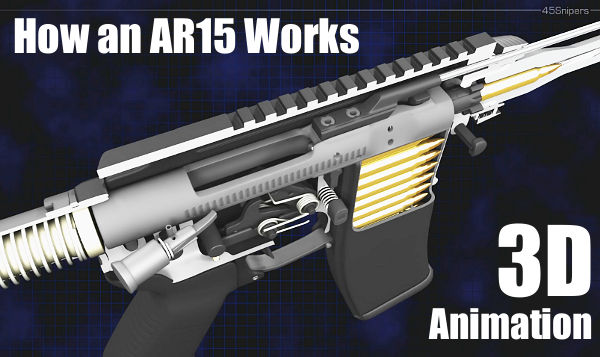
Ever wondered how the parts inside an AR15 work together? Just exactly how does the reciprocating bolt carrier feed rounds from the magazine? How do the elements in the trigger group work and reset after each shot? How does the gas system bleed gas from the barrel and operate the bolt carrier? These and other questions are answered in this eye-opening video from 45Snipers. Using “cutaway” 3D computer animation, this 5-minute video shows all features of an AR15 inside and out. This fascinating firearms animation allows the viewer to look inside the upper and lower receivers, into the bolt carrier, chamber, barrel, and magazine.
This video starts off slow and has annoying background music, but it is well worth watching if you own or shoot any AR-platform rifle. It illustrates all the key operations during the charging, loading, firing, and ejection processes. The cutaway animation shows how rounds are stripped from the magazine and then chambered. It then shows how every part of the trigger group works, and how the firing pin strikes the primer. You can even watch the bullet move down the barrel before the empty shell casing is removed from the chamber and tossed out the ejection port. Here are sample frames from the video:
How AR-Platform Rifles Work — General Introduction
To help reader understand the general operation of AR-type rifles, this video shows the control functions of an AR and how the upper and lower sections work together.
Cutaway 3D Animation of AR15/M16 Action — Watch Video
Here is an excellent “cutaway” animation by Thomas Schwenke that shows how an AR-15 functions — how the entire loading cycle works from start to finish.
AR platform rifles are semi-automatics version of the M16. These feature distinctive upper and lower receivers which can be readily separated via front and rear pins. The upper includes the barrel, handguard, forward gas tube, and bolt assembly, while the lower contains grip, trigger group, fire selector, and mag well. In addition the lower is attached to the stock which encloses the buffer assembly.
The original ArmaLite AR-15 was a select-fire, air-cooled, gas-operated, magazine-fed rifle designed by American gun manufacturer ArmaLite in 1956. It was based on Armalite’s AR-10 rifle chambered for the 7.62×51 NATO (.308 Win). In 1959, ArmaLite sold its rights to the AR-10 and AR-15 to Colt. Some key modifications were made — most notably, the charging handle was re-located from under the carrying handle to the rear of the receiver. The redesigned rifle was adopted by the U.S. military as the M16 carbine, which went into production in March 1964.
With custom rifles growing more and more expensive each year it is great to see that factory-built “precision” rifles can be fully competitive in PRS/NRL competition.
A Savage ace recently won matches in both the NRL Hunter Series and the Precision Rifle Series (PRS). Team Savage shooter Matt Alwine kicked off March with a first-place triumph in the NRL Hunter Series at the Mason Valley Steel Hunter match. This marks the third consecutive win in the 2024 NRL Hunter Series for the team and Alwine. The following weekend, Matt Alwine obtained an additional first-place win at the Central Coast Chaos match in the Precision Rifle Series in California.
Alwine topped the field at the Mason Valley Steel Hunter match in Julian, California using a Savage 110 Ultralite Elite custom chambered in 25 Creedmoor. Alwine secured first in Open Heavy, and first overall in the Open Light division. At the Central Coast Chaos match in San Luis Obispo, California Alwine secured top marks with a 110 Elite Precision in 6mm Creedmoor, where Alwine placed first in Production Class.
The NRL Hunter Match Series challenges skilled marksmen and women, testing their ability in a variety of shooting scenarios. For future match dates and details on the NRLH Hunter Match Series visit nrlhunter.org/matches-2024. Additional match details, as well as up-to-date scoreboards upcoming matches, can be found at www.precisionrifleseries.com.
Video Reviews of the Savage 110 Elite Precision:
This Alabama Arsenal video shows the Savage 110 Elite Precision on PRS Match stages using bags, tripods, and bipods, firing from stone barriers, field frames, and wood platform supports. If you are in the market for a PRS rifle, this video, which now has 346,000 views, is well worth watching. It covers specific features including trigger, chassis, magazines, and Atlas attachment.
With these most recent wins, Team Savage continues to move through the 2024 shooting season triumphantly. Visit SavageArms.com for Savage Team updates and more information on Savage’s NRL/PRS chassis rifles.


 If you want an even greater selection of targets, specialized for PRS and NRL shooters, Storm Tactical offers a vast collection of tactical targets, available in three different versions: MOA, MIL Yards, and MIL Meters. These target sets were created with input from Sniper’s Hide. Storm Tactical also created a great rimfire target set. This includes side-by-side target blocks for fun, one-on-one competition. If you shoot NRL22 or just enjoy shooting with a buddy, we highly recommend the rimfire target set.