A Canadian F-Class shooter (who shall remain nameless) was surprised when he saw this “flat-line” target displayed from a ShotMarker system. That’s 30 shots with almost no vertical at all. So what gives? The ShotMarker uses acoustic sensors to plot shot location. It is normally accurate to within a few millimeters. The shooter posted: “I’ve never had this happen before with a waterline. This is myself and another shooter, 30 rounds total, including four sighters at 900 meters in super strong winds that twitched back and forth every minute.”
So what happened? It turns our that the system’s wires were not connected correctly. AccurateShooter IT expert (and top F-Class Shooter) Jay Christopherson posted: “The wires are connected incorrectly… you’ve got the sensors crossed”. This ShotMarker system error can be diagnosed by doing a “tap test” as explained by Cal Waldner: “Thats a crossed sensor wire! That’s why a tap test needs to be done every time you rig the equipment. If a wire is crossed then you will catch it on the tap test.”
Other folks who viewed this target photo on Facebook said that they have seen a similar problem, so this is NOT an uncommon fault:
“Yup, my club had the same issue (and results) in an early outing with one of our ShotMarker units. The system reads the target area as a horizontal rectangle not as a square.” — Laurie Holland.
“I have seen this exact same result with the sensors plugged incorrectly.” — Dino Christopoulos
“This happened to several people at one match early on. Sensors crossed.” — Jen Bondurant
“I thought I was shooting a great waterline once [but the] wires were crossed — [a mistake from] setting up in the dark.”– Jerry Stephenson
The ShotMarker System — Technology and Performance
The ShotMarker was invented by Adam McDonald, a brilliant young Canadian who also created the AutoTrickler. The ShotMarker is an advanced system for plotting shot impacts on targets using acoustic sensors placed in the four corners of the target frame. The central Sensor Hub at each target transmits to the Access Point at the firing line using LoRa, a low frequency RF protocol. Unlike Wifi, this power-efficient design works at over 2 miles and provides hassle-free connectivity even without direct line of sight.
The sensor unit in each corner of your frame contains two precision MEMS ultrasonic microphones which are capable of measuring a supersonic bullet within 1mm – when the frame is perfectly still.
Real-world accuracy will be limited by motion of the sensors and the air while shots are being detected. Typically, every shot will be reported within a few millimeters, with ideal performance being realized on a stable frame in calm conditions.
Today is National Hunting and Fishing Day. To help the avid hunters among our readers, here are Twenty Tips that can help ensure a safe and successful hunt. These tips have been compiled from our AccurateShooter Hunting Forum, with help from Hunting Editor Colton Reid (who has already been out hunting this month). Some items are preparatory — such as working with maps, sighting in the rifle, and improving physical fitness. We also talk about equipment — having the right gear, from proper boots to a GPS for multi-day hunts.
Of course there are entire volumes written on hunting, but these 20 Tips can benefit all hunters. Follow these suggestions and you should have a safer hunting experience with greater likelihood of success. If you liked these pointers, you’ll find two dozen more helpful hints on the NSSF Website.
Preparations Before The Hunt
1. Map Your Hunt and Notify Others — Before your hunt, make a plan and notify friends and family members about WHERE you are going and your intended return date and time. Print out a Google Satellite map and locate landmarks and trailheads. Mark where you plan to park your vehicle and give a copy of this map to friend and/or family members. A hunter may injure himself by falling off a rock, or tumbling in a creek-bed. After that kind of injury the hunter may be confused or unable to walk. If you get stranded in the wilderness, you want trusted persons to know where you are. So, before you leave on a trip, provide a map to a friend or family member. Show them where you will leave your vehicle, and where you expect to be every day of your hunting adventure.
2. Licenses and Permits — Make sure you have a valid hunting licenses and all the necessary tags. Begin this process with ample time before your intended hunt(s). The NSSF adds: “If you are crossing state or national borders, find out about any special considerations you must take care of. Border crossings can mean knowing about firearm transport laws or Chronic Wasting Disease-related regulations.”
3. Work on Your Fitness — On a multi-day hunt you may be trekking many miles. You need to be in good shape. If you are out of shape you may be putting yourself in a precarious situation, particularly if you underestimate the terrain difficulty. As the NSSF says: “Not being able to handle the conditions lessens your chances of success, can turn a great experience into an agonizing one and can endanger your health.”
4. Do Your Homework — Study the area you will be hunting. Talk to other hunters. Look at satellite photos. Get a real sense of the walking and terrain challenges. For a multi-day hunt, MAKE a PLAN. The NSSF states: “Eliminate surprises. Learn as much about where you will be staying, the area you will be hunting, what the weather might be like and what you need to bring[.]”
5. Rifle and Ammo — Make sure your rifle is sighted-in and your ammo is tested. Sight-in your rifle with the ammo you plan to use on your hunt. CLICK HERE for 4-Shot Sight-in Method. After sighting-in from the bench, confirm your zero by shooting from typical hunting positions (kneeling and with forearm supported on a rock or post).
6. Shooting Positions — Practice the shooting positions you will use in the field. Practice sitting, kneeling, and prone positions. You should also practice with shooting sticks, using your day pack as a rest, and with a bipod. Try to have a rock-steady rest before taking your shot.
7. Back-Up Irons — If possible, select a rifle with back-up iron sights. While modern scopes are very durable, they can and do fail (glass can crack). If you’ve invested a lot of time and money in your hunt, back-up iron sights can keep you in the game even if your riflescope fails.
8. Communications and GPS — Bring a GPS if you are in a wilderness area far from civilization. It’s a good idea to bring a cell phone, but you may not have coverage if you’re quite a distance from populated areas. A smart-phone also doubles as a digital camera to record your trophies. For navigation and safety, consider getting Garmin inReach Explorer+. This high-tech handheld unit features interactive SOS, connecting you to the GEOS 24/7 search-and-rescue monitoring center. They also allow you to send and receive text messages, no matter where you are, via advanced inReach satellite technology. Yes you can communicate even if you are miles from the nearest cell tower.
9. Select Good Gear — Make sure you have GOOD BOOTS that are comfortable — you’ll spend a lot of time on your feet. You may want a pack with harness for your rifle so you have both hands free. On a multi-day trip, make sure you can carry enough water, and that you will stay warm enough at night. Good practices for backpacking apply to multi-day hunts.
10. Make a Checklist — Create a complete checklist of the gear and supplies you need. That includes arms, ammunition, rangefinder, binoculars, proper clothing (including spare clothes), hunting accessories, sleeping gear (on multi-day hunts), toiletries, medications. Don’t forget a good first aid kit — lots of bad things can happen during any wilderness trip. You can cut a hand, break an ankle or worse.
During The Hunt
11. Have a Plan — know where you plan to go and when. Try to be where you want in the early morning and early evening hours when deer are likely most active.
12. Take Your Time — If you spot a deer and get too excited and don’t take your time you may spook him. Go slow and glass. If possible, wait for the animals to bed down and relax. Then work out the best way to approach your prey. Remember, “You get so few opportunities, don’t screw it up!”
13. Glass More, Walk Less — Let your eyes do the walking — get good binoculars and use them. With their heightened senses of smell and hearing, deer/elk are able to spot you way better than you can spot them. If you are walking around a lot, chances are you are getting spotted by your prey.
14. Riflescopes Are Not Binoculars — Never use a riflescope as a substitute for binoculars. The temptation to do so is real, but when one does this, one is by definition pointing the muzzle of the gun at unknown targets. We like binoculars with built-in rangefinders. When glassing at long range, try supporting your binoculars on your pack.
15. Be Sure of Your Target before Shooting — Every year during whitetail season, farmers everywhere are forced to spray-paint their cattle or risk having them “harvested” by hunters who don’t bother confirming the species in their sights. Hunters with “buck fever” can make mistakes. When in doubt, don’t shoot.
16. Know When to Unload — When finished hunting, unload your firearm before returning to camp. You should also unload your gun before attempting to climb a steep bank or travel across slippery ground.
17. Hearing Protection — While pursuing and stalking your prey you’ll want full sensory use of your ears. But when you’re finally ready to take the shot, slip in hearing protection. A shot from a large-caliber hunting rifle can exceed 170 decibels. Unprotected exposure to noise from a SINGLE 170+ dB shot can cause permanent hearing damage. (Source: ASHA.org). If you make a follow-up shot, you double that noise hazard. Therefore a hunter with a non-suppressed rifle should have hearing protection available.
You can keep a pair of quick-insert plugs on a cord around your neck. Or, get the Howard Leight Quiet Band QB2HYG. This is a plastic ring with earbuds, you can keep around your neck.
“Once a hunter is successful, the REAL work begins.” — Colton Reid
18. Harvesting the Animal — When dressing your animal, be careful with the meat. You’ll want very sharp knives. Some hunters prefer knives with replaceable, razor-sharp blades. Don’t rush the task. Make sure you don’t get moisture or dirt on meat. The three spoilers of meat are heat, moisture, and dirt.
19. Pace Yourself When Packing Out — If you DO succeed, and bring down a big buck, will you be able to dress the animal and carry out the meat? Always be prepared to hike out with extra weight. If you are successful, make sure not to waste the meat you worked so hard for. Choose a pack that can help you carry a heavy load. Remember, this is not an insignificant challenge — you may be carrying 60 to 100 extra pounds in addition to your other gear. Again, take your time. Rest as needed. Don’t hurt yourself.
20. Remember to Enjoy the Experience — Our Hunting Editor, Colton Reid, offers this sage advice to all hunters, but particularly to novices: “Have fun, and appreciate your hunt, whether you bag a buck or not. It is a privilege to experience the wilderness and to get away from the city. Enjoy it while you’re out there. And keep your spirits up. You may get tired, but remember that ‘comes with the territory’. At the end of the day, yes you may be exhausted. And you may want to quit and go home. But stay positive, stay focused. Be patient, the experience is worth it.”
CLICK HERE for Hunter Training/Mentoring Programs State-by-State.
Prepare For Your Hunt — Get Fit and Practice Positions
As part of the NRA’s Tips & Tactics video series, Kristy Titus explains how to prepare for a hunt. Titus, co-host of the Team Elk TV show has hunted around the globe. She grew up in the outdoors, running pack mules in Oregon with her father. In this video, Kristy discusses fitness training and demonstrates field positions that can be employed during a hunt.
Kristy explains: “Hunting can lead you into some steep, rough country. It’s really important that you train both your body and your mind to handle the elements and the rigors of hunting So, if you plan on going on a mountain hunt, get out and train your body. Train with your firearm. Get off the bench and have some fun with this. Do some positional shooting or, if you want to add a stress dynamic… have someone put you under a time parameter.”
Visit WhereToHunt.org
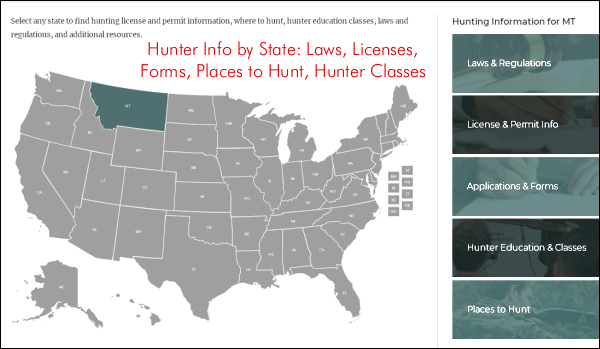
There’s a great online resource for hunters that will help you find game locations in your state and ensure you have all the proper permits and game tags. WheretoHunt.org features an interactive map of the country. For all 50 states, the NSSF has compiled information about hunting license and permits, where to hunt, hunter education classes, laws and regulations and more. For each state you’ll also find a link for required applications and license forms.
With hunting season underway (or coming up soon), we know that many readers will be out in the field — with a set of binoculars. On most game hunts, you’ll speed a lot more time glassing with binocs than looking through your riflescope. With wide field of view and extended low-light capability, a good set of binoculars will be your most important game-finder. And with premium LRF binoculars, such as the new Vortex Fury, one tool serves both for spotting and laser ranging.
“Without the stabilization of your binoculars [provided by] a tripod … you will be missing a majority of the game you are glassing for.” — Outdoorsmans.com
In this article, Vortex Optics’ Mark Boardman, an experienced hunter, explains the benefits of using a tripod with high-magnification binoculars. Everybody knows that powerful spotting scopes work best when mounted to a stable tripod or otherwise secured to a steady mount. Yet when most folks use binoculars, they never even think of using a tripod, despite the fact that tripod adapters are available for many premium binoculars.
Outdoorsmans Tripod Adapters Outdoorsmans.com sells tripod adapters for various kinds of binoculars. These really work: “Mounting your binoculars to a quality tripod is a must for the serious western hunter. Without the stabilization of your binoculars [by] mounting them to a tripod … you will be missing a majority of the game you are glassing for.”
A serious hunter should learn how to glass with tripod support, using methods outlined here. With binoculars offering more that 8X magnification, you can really benefit from a steady mount. You’ll be amazed at the difference the tripod will make.
Story tip by EdLongrange. We welcome reader submissions.
We’ve done some bullet casting in the past, both for handgun bullets, and the large, heavy (400gr+) projectiles used with Black Powder Cartridge Rifles. We can say, unequivocally, that newbies should seek out the assistance of a skilled, experienced mentor, who is familiar with the important safety procedures that must be employed. Working with molten lead can be dangerous. And it also takes some skill to get good results (without visible casting flaws), particularly with very large bullets.
There are valuable resources that can help you get started with the casting process. Wolfe Publishing offers two DVDs that cover the bullet casting process from start to finish. Bullet Casting 101 takes you through the basics: showing you how to choose the correct alloy for your application, prep molds, maintain the optimal temperatures, and lube and size bullets. The important steps are laid out clearly. In addition, Bullet Casting 101 helps you select the right equipment and preferred molds for your particular application. (To create uniform rifle bullets that shoot accurately, you really do need high-quality molds.)
Wolfe Publishing offers a companion DVD, Casting Premium Bullets for Handguns, that covers more advanced techniques for high-volume pistol bullet production. This DVD covers both single-cavity molds and multiple-cavity “gang” molds. (Gang molds can be frustrating at first; it is harder to maintain perfect temp control and mold separation is more complex). The DVD also reveals the sources of most common casting flaws, and explains how to detect cracks, voids and other common problems.
You’ll save considerable time and effort if you really understand how to avoid common mistakes before you start pouring lead. And you’ll get the best results if you learn how to “blend” the optimal alloy for the job. Maintaining the right mold temperature is also critical for good results. These topics and more are covered in these two DVDs, priced at $20.00 each on Amazon.
Good Books about Bullet Casting
Along with these DVDs, there are some excellent print resources about bullet casting. Here are two good bullet casting books we recommend. Every serious bullet caster should own Lyman’s Cast Bullet Handbook, now in its 4th Edition. We also like Casting Premium Bullets for the Black Powder Cartridge Rifle by Paul Matthews (Wolfe Publishing).
We used the Matthews book to improve our cast bullets for a Pedersoli 45/70. Notably, with factory-made cast bullets, that rifle shot about 3″ groups at 100 yards. With custom cast bullets, accuracy was nearly twice as good. We were also able to choose a custom mold that produced bullets with a much higher BC, which helped with long-range matches.
Lyman has just released an expanded, updated Second Edition of its AR Reloading Handbook. The original handbook was the first reloading manual dedicated exclusively to the most popular semi-auto rifle in the USA. The Second Edition of this comprehensive Lyman AR Reloading Handbook has been updated to include more cartridge types and significantly more load data. This provides AR shooters with reloading info for the vast majority of popular chamberings used in AR-platform firearms. GET BOOK HERE.
Reloaders will appreciate the extensive pressure-tested data covering a very wide selection of bullet types and powder types. The Second Edition provided data for newer cartridges such as the .224 Valkyrie, .22 Nosler, .24 Nosler, 350 Legend, as well as sub-sonic data. In addition, articles by well-known authorities are included, covering topics such as “Building An AR” and “AR15 Gas System Lengths”. This book is available right now direct from Lyman and will soon be avialable through Amazon.
Features of Lyman AR Reloading Handbook (Second Edition)
— Reloading data for popular AR-platform cartridge types, including the .223 Rem, .224 Valkyrie, 6.8 Rem, .300 AAC, 7.62×39, 350 Legend, 450 Bushmaster, .50 Beowulf and more.
— Many informative articles on specialty topics such as Reloading for Suppressors and Building ARs.
— Load Data covers all major brands of bullets and powders.
— Load Data for cast bullet data and sub-sonic loads.
AR-Platform Insights — Operation and Maintenance Tips
Here are two helpful videos for AR owners. The first uses 3D computer animation to show how AR-platform rifles work — from the inside. The Cutaway views show the operation of the gas system and bolt while cycling. The second video, by legendary competitive shooter Jerry Miculek, provide helpful guidance on AR disassembly and maintenance.
Book publishing tip from EdLongRange. We welcome reader submissions.
If you buy one book about Long Range Shooting, this should be it. Based on sophisticated testing and research, this 356-page hardcover from Applied Ballistics offers important insights you won’t find anywhere else. Modern Advancements in Long Range Shooting – Volume II, the latest treatise from Bryan Litz, is chock full of information, much of it derived through sophisticated field testing. As Chief Ballistician for Berger Bullets (and a trained rocket scientist), author Bryan Litz is uniquely qualified. Bryan is also an ace sling shooter and a past F-TR National Champion. Moreover, Bryan’s company, Applied Ballistics, has been a leader in the Extreme Long Range (ELR) discipline.
AUDIO FILE: Bryan Litz Talks about Modern Advancements in Long Range Shooting, Volume 2. (Sound file loads when you click button).
Volume II of Modern Advancements in Long Range Shooting ($39.95) contains all-new content derived from research by Applied Ballistics. Author Bryan Litz along with contributing authors Nick Vitalbo and Cal Zant use the scientific method and careful testing to answer important questions faced by long range shooters. In particular, this volume explores the subject of bullet dispersion including group convergence. Advanced hand-loading subjects are covered such as: bullet pointing and trimming, powder measurement, flash hole deburring, neck tension, and fill ratio. Each topic is explored with extensive live fire testing, and the resulting information helps to guide hand loaders in a deliberate path to success. The current bullet library of measured G1 and G7 ballistic coefficients is included as an appendix. This library currently has data on 533 bullets in common use by long range shooters.
Bryan tells us that one purpose of this book is to dispel myths and correct commonly-held misconceptions: “Modern Advancements in Long Range Shooting aims to end the misinformation which is so prevalent in long range shooting. By applying the scientific method and taking a Myth Buster approach, the state of the art is advanced….”
Bullet Dispersion and Group Convergence
Part 1 of this Volume is focused on the details of rifle bullet dispersion. Chapter 1 builds a discussion of dispersion and precision that every shooter will benefit from in terms of understanding how it impacts their particular shooting application. How many shots should you shoot in a group? What kind of 5-shot 100 yard groups correlate to average or winning precision levels in 1000 yard F-Class shooting?
Chapter 2 presents a very detailed investigation of the mysterious concept of group convergence, which is the common idea that some guns can shoot smaller (MOA) groups at longer ranges. This concept is thoroughly tested with extensive live fire, and the results answer a very important question that has baffled shooters for many generations.
Part 2 of this Volume is focused on various aspects of advanced hand-loading. Modern Advancements (Vol. II) employs live fire testing to answer the important questions that precision hand loaders are asking. What are the best ways to achieve MVs with low ES and SD? Do flash hole deburring, neck tension, primer selection, and fill ratio and powder scales sensitivity make a difference and how much? All of these questions are explored in detail with a clear explanation of test results.
One of the important chapters of Part 2 examines bullet pointing and trimming. Applied Ballistics tested 39 different bullet types from .224 through .338 caliber. Ten samples of each bullet were tested for BC in each of the following configurations: original out of the box, pointed, trimmed, pointed and trimmed. The effect on the average BC as well as the uniformity in BC was measured and tabulated, revealing what works best.
Part 3 covers a variety of general research topics. Contributing author Nick Vitalbo, a laser technology expert, tested 22 different laser rangefinders. Nick’s material on rangefinder performance is a landmark piece of work. Nick shows how shooters can determine the performance of a rangefinder under various lighting conditions, target sizes, and reflectivities.
Chapter 9 is a thorough analysis of rimfire ammunition. Ballistic Performance of Rifle Bullets, 2nd Edition presented live fire data on 95 different types of .22 rimfire ammunition, each tested in five different barrels having various lengths and twist rates. Where that book just presented the data, Chapter 9 of this book offers detailed analysis of all the test results and shows what properties of rimfire ammunition are favorable, and how the BCs, muzzle velocities and consistency of the ammo are affected by the different barrels.
Chapter 10 is a discussion of aerodynamic drag as it relates to ballistic trajectory modeling. You will learn from the ground up: what an aerodynamic drag model is, how it’s measure and used to predict trajectories. Analysis is presented which shows how the best trajectory models compare to actual measured drop in the real world.
Finally, contributing author Cal Zant of the Precision Rifle Blog presents a study of modern carbon fiber-wrapped barrels in Chapter 11. The science and technology of these modern rifle barrels is discussed, and then everything from point of impact shift to group sizes are compared for several samples of each type of barrel including standard steel barrels.
In our Shooters’ Forum, there was an discussion about a range that was threatened with closure because rifle over-shoots were hitting a farm building over two miles from the firing line. One reader was skeptical of this, asking “how’s that possible — were these guys aiming at the stars?” Actually, you may be surprised. It doesn’t take much up-angle on a rifle to have a bullet land miles down-range. That’s why it’s so important that hunters and target shooters always orient their barrels in a safe direction (and angle). Shooters may not realize how much a small tilt of the barrel (above horizontal) can alter a bullet’s trajectory.
How many degrees of muzzle elevation do you think it would take to hit a barn at 3000 yards? Ten Degrees? Twenty Degrees? Actually the answer is much less — for a typical hunting cartridge, five to seven degrees of up-angle on the rifle is enough to create a trajectory that will have your bullet impacting at 3000 yards — that’s 1.7 miles away!
Five degrees isn’t much at all. Look at the diagram above. The angle actually displayed for the up-tilted rifle is a true 5.07 degrees (above horizontal). Using JBM Ballistics, we calculated 5.07° as the angle that would produce a 3000-yard impact with a 185gr .30-caliber bullet launched at 2850 fps MV. That would be a moderate “book load” for a .300 Win Mag deer rifle.
Here’s how we derived the angle value. Using Litz-derived BCs for a 185gr Berger Hunting VLD launched at 2850 fps, the drop at 3000 yards is 304.1 MOA (Minutes of Angle), assuming a 100-yard zero. This was calculated using a G7 BC with the JBM Ballistics Program. There are 60 MOA for each 1 degree of Angle. Thus, 304.1 MOA equals 5.068 degrees. So, that means that if you tilt up your muzzle just slightly over five degrees, your 185gr bullet (2850 fps MV) will impact 3000 yards down-range.
Figuring Trajectories with Different Bullets and MVs
If the bullet travels slower, or if you shoot a bullet with a lower BC, the angle elevation required for a 3000-yard impact goes up, but the principle is the same. Let’s say you have a 168gr HPBT MatchKing launched at 2750 fps MV from a .308 Winchester. (That’s a typical tactical load.) With a 100-yard zero, the total drop is 440.1 MOA, or 7.335 degrees. That’s more up-tilt than our example above, but seven degrees is still not that much, when you consider how a rifle might be handled during a negligent discharge.
Think about a hunter getting into position for a shot. If careless, he could easily touch off the trigger with a muzzle up-angle of 10 degrees or more. Even when shooting from the bench, there is the possibility of discharging a rifle before the gun is leveled, sending the shot over the berm and, potentially, thousands of yards down-range.
Hopefully this article has shown folks that a very small amount of barrel elevation can make a huge difference in your bullet’s trajectory, and where it eventually lands. Nobody wants to put holes in a distant neighbor’s house, or worse yet, have the shot cause injury. Let’s go back to our original example of a 185gr bullet with a MV of 2850 fps. According to JBM, this projectile will still be traveling 687 fps at 3000 yards, with 193.7 ft/lbs of retained energy at that distance. That’s more than enough energy to be deadly.
Will you be traveling to other states this winter? Are you concerned about the laws that might apply when you are transporting firearms across state lines? Or are you puzzled about the requirements for obtaining a carry permit in your own state? If you have any of these questions, you should definitely get expert guidance on State statutes and regulations controlling firearms. To do that, you can purchase Attorney Bryan Ciyou’s Gun Laws by State reference book. This is worth the money, and the $20 cost also includes access to an online legal database and other services.
Free State Law Summaries Online
If you don’t want to spend the twenty bucks, there is a FREE alternative. There’s a very helpful set of State Law Summaries on the web, presented by PewPewTactical.com. Despite the silly name, the PewPewTactical website has an abundance of information that is particularly beneficial for pistol shooters and CCW holders.
One of the best features of PewPewTactical.com is the Gun Laws by State online reference guide. We looked through four of these State Law Summaries and were impressed by the depth of the coverage. But we caution — if you have specific legal questions, particularly with recently-enacted statutes, you should consult a licensed attorney for your state (or the state to which you will travel). In addition, many of the State Law Summaries have not been updated for a year or two. But they are still a good place to start. Below are links to state law articles from PewPewTactical.com. To access any State summary, simply click the State name below:
Here’s the super-speedy way to turn case-necks. Our friend Erik Cortina figured out how to turn his match cartridge case-necks using his milling machine. Erik told us: “While in Raton [a while back], Mid Tompkins told me that he turns his brass on milling machine. He said he could do about 500 in two hours, so I decided to try it.”
Erik fitted a Don Nielson “Pumpkin” neck-turner to the mill, and he used a modified 21st Century case holder to secure the brass. As you can see from this video, Erik was very successful with the process. The tool spins at 1500 rpm, turning Lapua 6.5-284 cases that have been necked up to 7mm.
Video Shows Eric Cortina Neck-Turning Cases with Milling Machine:
Cartridge Brass: Lapua 6.5-284 necked up to 7mm
Lubricant: Lithium grease inside and outside of neck
Neck-Turner: Nielson Pumpkin running at 1500 RPM
It’s hard to argue with Erik’s results. Here are his turned Lapua cases, which have neck-wall thickness consistent to two ten-thousandths of an inch. Think you could do better turning manually?
Some of Erik’s Facebook friends had questions about this process:
Q: Who makes the shell-holder?
Erik Cortina: I did! The shell-holder you can get from 21st Century. I Tig-welded a punch as a handle.
Q: I love the idea of working smarter not harder! Any galling issues? What are your mitigation techniques?
Erik Cortina: No issues. I use lithium grease in spray can. Makes a foam that I dip necks into.
Q: Shouldn’t either the case or the cutter be floating to allow most precise neck turning?
Erik Cortina: Up until [I tried this] I believed the same thing. I was going to build a floating case holder but decided to try rigid setup on a few cases before I built it. Results were great. Neck thickness doesn’t vary more than .0002″, which is same as when I was doing it with floating case holder on the lathe.
Q: Any problems with the Pumpkin changing the cut as it heats up?
Erik Cortina: No — there were no issues with that.
NOTE: Erik Cortina is a very skilled machinist who custom-crafted fittings used for this process. This kind of neck-turning with a milling machine may not be for the everyday hand-loader!
Nielson “Pumpkin” Neck-Turner
The circular orange cutting fixture on Erik’s Milling Machine is a Don Nielson “Pumpkin” neck-turning tool. Don designed this tool to be used by hand or with power. The Pumpkin boasts an eccentric mandrel that allows the cut to be adjusted easily in precise .0001″ increments. Benchresters like this as it allows for very precise control of cut depth and neck-wall thickness.
Nielson Neck Turner with carbide mandrel. Photo Courtesy Butch’s Reloading.
Airport photo by Politikaner under Creative Commons License.
With hundreds of readers traveling to Raton, New Mexico next month for the 2020 F-Class Nationals (October 25 – November 1, 2020), and with many others planning hunting trips out of state, we thought we’d repeat an article providing important information about air travel with firearms. If you will be flying with firearms this fall, you should read this article. You need to familiarize yourself with current Federal Regulations on gun transport before you get anywhere near an airport. Thankfully, the Transportation Security Administration (TSA) has a web page that states the important requirements for airline passengers traveling with firearms* and/or ammunition.
You’ll want to visit the TSA Firearms and Ammunition webpage, and read it carefully. In addition, before your trip, check the regulations of the airline(s) with which you will fly. Some airlines have special requirements, such as weight restrictions.
Here are the TSA’s key guidelines for travel with firearms:
More Airline Travel Tips from Tom McHale
Tom McHale has written an excellent article for the Beretta Blog, Ten Things You Need to Know about Flying with Guns. We suggest you visit the Beretta Blog to read this informative story. Here are two of Tom McHale’s Travel Tips:
Weigh your gun case and ammunition
Most airlines will allow up to 11 pounds of ammunition. And, like any luggage, you will be charged more for any baggage weighing more than 50 pounds. This sounds like a lot, but when traveling to the Crimson Trace Midnight 3 Gun competition last year, my case with shotgun, rifle, pistol and ammunition tipped the scale past the 50 pound mark.
Pack ammo in the same locking case
This is another area that’s misunderstood and full of internet myth. Your ammo just needs to be stored in some type of safe container and not loose. Technically, you can keep ammunition in magazines, but I wouldn’t recommend it. It meets the letter of the law storage requirement, but too many airline and TSA agents will give you grief. Use a plastic ammo box or original cardboard packaging and you’ll be fine carrying that in the same lockable case as your gun.
*SEE United States Code, Title 18, Part 1, Chapter 44. A “firearm” is defined as: any weapon (including a starter gun) which will, or is designed to, or may readily be converted to expel a projectile by the action of an explosive; the frame or receiver of any such weapon; any firearm muffler or firearm silencer; and any destructive device. As defined by 49 CFR 1540.5 a loaded firearm has a live round of ammunition, or any component thereof, in the chamber or cylinder or in a magazine inserted in the firearm.




 Outdoorsmans Tripod Adapters


 Part 2 of this Volume is focused on various aspects of advanced hand-loading. Modern Advancements (Vol. II) employs live fire testing to answer the important questions that precision hand loaders are asking. What are the best ways to achieve MVs with low ES and SD? Do flash hole deburring, neck tension, primer selection, and fill ratio and powder scales sensitivity make a difference and how much? All of these questions are explored in detail with a clear explanation of test results.
 In our Shooters’ Forum, there was an discussion about a range that was threatened with closure because rifle over-shoots were hitting a farm building over two miles from the firing line. One reader was skeptical of this, asking “how’s that possible — were these guys aiming at the stars?” Actually, you may be surprised. It doesn’t take much up-angle on a rifle to have a bullet land miles down-range. That’s why it’s so important that hunters and target shooters always orient their barrels in a safe direction (and angle). Shooters may not realize how much a small tilt of the barrel (above horizontal) can alter a bullet’s trajectory.


