|
|
June 28th, 2018

Well folks, it’s almost July — the means we’re moving into “peak heat” summer conditions. It’s vitally important to keep your ammo at “normal” temps during the hot summer months. Even if you use “temp-insensitive” powders, studies suggest that pressures can still rise dramatically when the entire cartridge gets hot, possibly because of primer heating. It’s smart to keep your loaded ammo in an insulated storage unit, possibly with a Blue Ice Cool Pak if you expect it to get quite hot. Don’t leave your ammo in the car or truck — temps can exceed 140° in a vehicle parked in the sun.

 To learn more about how ambient temperature (and primer choice) affect pressures (and hence velocities) you should read the article Pressure Factors: How Temperature, Powder, and Primer Affect Pressure by Denton Bramwell. In that article, the author uses a pressure trace instrument to analyze how temperature affects ammo performance. Bramwell’s tests yielded some fascinating results. To learn more about how ambient temperature (and primer choice) affect pressures (and hence velocities) you should read the article Pressure Factors: How Temperature, Powder, and Primer Affect Pressure by Denton Bramwell. In that article, the author uses a pressure trace instrument to analyze how temperature affects ammo performance. Bramwell’s tests yielded some fascinating results.
For example, barrel temperature was a key factor: “Both barrel temperature and powder temperature are important variables, and they are not the same variable. If you fail to take barrel temperature into account while doing pressure testing, your test results will be very significantly affected. The effect of barrel temperature is around 204 PSI per F° for the Varget load. If you’re not controlling barrel temperature, you about as well might not bother controlling powder temperature, either. In the cases investigated, barrel temperature is a much stronger variable than powder temperature.”

Temp Strips allow shooters to monitor their barrel temperature. Excessive barrel heat can raise load pressures as well as shorten barrel life! |
June 27th, 2018

NOTE: If you prefer drying your brass in an oven we recommend a temp setting no higher than 200° F. Better yet, use a dedicated case dryer that cannot possibly over-cook your cases.
Tech Tip by Craig Arnzen of Area419.com
As wet-tumbling brass has become more popular in recent years, guys have tried a LOT of ways to get their brass dry — towels, hair dryers, and even food dehydrators. (See Top Ten Brass Drying Methods). Another common method — albeit with some potential issues — is putting your wet brass in the oven to dry. Provided you monitor TEMP and TIME, this method is fast, effective, and easy (as long don’t use the wife’s favorite cooking pans — that’ll get you in trouble.)
With oven-drying, however, unexpected issues can arise, as illustrated by this worrisome story: “I put my brass in for an hour at 200° F and turned it off. Next thing I know I realize my wife has the oven pre-heating to 350° F. Is my brass ruined?”
 If you search the AccurateShooter.com Shooters’ Forum, you’ll find at least three threads with stories like that (i.e. higher-than-expected oven temps when drying brass), and answers on both sides of the line. I know this, because it happened to me — I had some 6XC brass drying and the wife pre-heated the oven. Concerned about my cases, I consulted a genuine annealing expert, Andrew Rixon. If you search the AccurateShooter.com Shooters’ Forum, you’ll find at least three threads with stories like that (i.e. higher-than-expected oven temps when drying brass), and answers on both sides of the line. I know this, because it happened to me — I had some 6XC brass drying and the wife pre-heated the oven. Concerned about my cases, I consulted a genuine annealing expert, Andrew Rixon.
Andrew is the Director of Engineering and Manufacturing at Alpha Munitions, makers of premium-grade rifle brass. I had baked a batch of Alpha’s new 6XC brass, which is exceptionally consistent and well-made.
Before Andrew would answer my question though, he gave me a little lesson on what really happens during annealing:
“Annealing is performed by heating the brass to specific temperatures. There are three phases of annealing: recovery, recrystallization, and grain growth. All of which have specific temperatures and or exposure times related to them. It is key for cartridge brass annealing processes to hit the recrystallization phase which allows for strain-free grains to grow. The growth of strain-free grains eliminate dislocations, drastically decreasing hardness and increasing ductility. For recrystallization to occur the material temperature must be within 600-1000 degrees Fahrenheit (F).”

He then got into really answering the question, and was (fortunately) definitive in his answer: “If the temps do not exceed 450 degrees F then there is nothing to worry about as it did not exceed the critical temperature for annealing to occur.” Editor: Caution — do NOT assume that the temperature marked on the oven knob is the actual temperature INSIDE the oven, particularly near the back. Some older ovens can be off as much as 75 degrees F. Be conservative!
Well, there you have it. If you’ve baked your brass, you’re probably OK. If you got it hotter than 450° F then there can start to be some changes to the metal, but we will let you learn more about that directly from Andrew, who is working on a lengthy, detailed article on the science of annealing, to be released later this summer.
This TECH TIP brought to you by Area 419

Want to learn more about Alpha Munitions? Visit AlphaMunitions.com.
June 26th, 2018
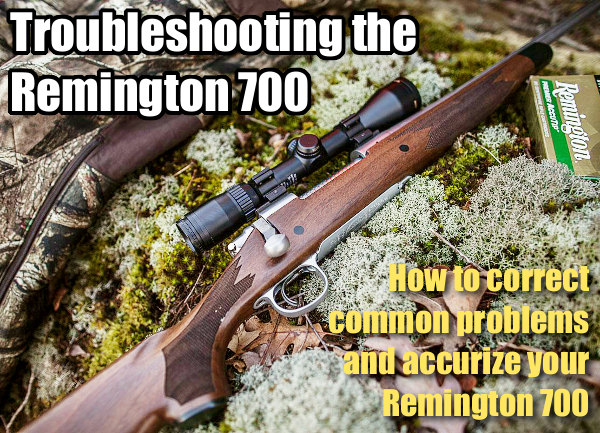
Turn a Rough Factory Rifle into an Accurate Hunting Rig
Kiwi Nathan Foster has produced a good video for hunters with “under-performing” Remington Model 700 rifles. In this video, Nathan helps a client turn a badly-behaving Rem 700 into a reliable tack-driver. A customer had sent Nathan this rifle to rectify stubborn copper fouling. After bedding the rifle, the customer discovered that the rifle produced terrible groups due to the stubborn bore.
Nathan told us: “This was a grand opportunity to study what can go wrong with the M700 rifle with regards to both do-it-yourself work and flaws within rifle production. To help structure the video, we used the chapters of our Accurizing Book as reference steps for the video. This footage also works in conjunction with our free Remington bedding tutorials on YouTube.
Those who have watched the full M700 Troubleshooting video say this is one of the most helpful videos yet released on problem-solving with a factory hunting rifle. This video is especially helpful for those just getting into the accuracy game, as it walks the viewer through the basics of rifle tuning, then proceeds to more advanced methods of improving a badly-behaving rifle.
This video focuses on the Remington M700 and Rem clones, such as the Bergara rifle. However the lessons and techniques in the video can apply to any type of bolt-action rifle suffering heavy copper fouling. The video features detailed footage of barrel break-in and barrel-lapping procedures. These procedures may be beneficial for rough factory barrels. IMPORTANT! AccurateShooter.com recommends different break-in and maintenance regimes for custom, hand-lapped premium barrels — be conservative with fine custom barrels. Our best custom barrels have all shot superbly with minimal break-in and zero use of abrasives during break-in.
Troubleshooting the Remington 700 Rifle with Nathan Foster
NOTE: This is a free 70-second trailer video. The FULL Remington Troubleshooting Video is 1 hour, 16 minutes long and can be streamed through Vimeo-on-Demand for $12.00. Access Full Video HERE.
Nathan Foster of Terminal Ballistics Research in New Zealand, is a expert hunter and highly-respected author of a series of hunting and long range shooting books. Nathan’s first book, The Practical Guide to Long Range Hunting Rifles, is a classic — one of the best treatises ever written on choosing and using a hunting rifle.
 |
CLICK HERE to Download Remington 700 Owner’s Manual
The Remington 700 is the most popular bolt-action rifle in America, according to Gunbroker.com sales figures for new and “previously-owned” rifles. So, chances are that you (or a family member) have a Rem 700 of some vintage sitting in the gunsafe. Click the link above for a PDF version of the Remington 700 Owner’s Manual (also covers models Seven, and 673). |
June 24th, 2018

The Bertalotto 17 HMR Cleaning Rod Bore Guide is actually made from aluminum arrow shafts.
When Hornady (and CCI) developed the 17 HMR cartridge, they really hit a home-run. And the rifle manufacturers quickly marketed some nice rifles to chamber this 17-cal rimfire round. But unlike .22 LR rifles which, typically, require very little cleaning, 17 HMRs demand frequent bore cleaning to maintain good accuracy. That’s because 17 HMRs shoot copper-jacketed bullets at 2550 fps velocities.
 17-Cal Bore Guides — The Challenge 17-Cal Bore Guides — The Challenge
The problem is, it’s hard to find a well-designed, quality bore guide for 17-caliber rimfire rifles. With many 17 HMR (and 17 Mach 2) rifles, you encounter mechanical interference when you try to use a standard bore guide to protect the delicate chamber edge and the bottle neck area of the chamber. A fixed ejector is in the way. On many 17 HMR rifles, this little “shark fin” ejector is right in line with the chamber and is fixed — it doesn’t retract. Therefore the kind of bore guide you might use for centerfire rifles won’t work in 17 HMRs — it will hang up on the ejector.
Polymer bore guides exist for this type of action, but they are typically open-bottom designs that do not enter and seal the chamber. These open-bottom designs don’t protect the delicate chamber edge or the bottleneck area of the chamber, and they also allow some seepage of solvents out of the chamber. That’s why Roy Bertalotto created his RVB Precision Bore Guide for 17 HMR rifles. The 7075 aluminum tube on his Bore Guide is thin enough to pass by the ejector, yet it is extremely rigid. (Photos below.)
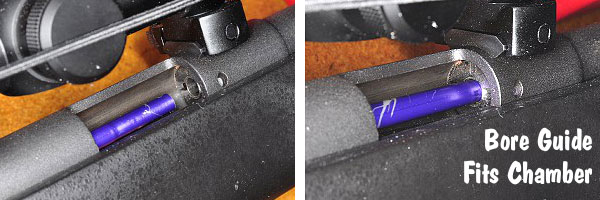
Roy explains: “My bore guide is made of 7075 anodized aluminum tubing, which is totally unaffected by any type of cleaning solution. One end is swagged down to fit completely into the chamber of a 17 HMR rifle. This guides your cleaning rod perfectly to the bore without touching the chamber walls or front edge of the chamber. The tight fit of the bore guide in the chamber also stops cleaning solvents from getting into the action, magazine, and trigger housing.” (Editor: Solvent seepage can do damage. We had a 17 Mach 2 rifle that rusted internally because solvents leaked past an open-bottom bore guide.)

 Using the RVB 17 HMR Guide – Once the bore guide is in place, slide the supplied aluminum bushing over the tube, and gently push the bushing into the rear of the action. This centers the guide rod in the action to keep the guide rod tube aligned. Once the guide rod and bushing are in place, you can use a 17-caliber cleaning rod* with patches and/or brushes to clean the barrel. Use the rod normally, but make sure your patches are quite small and don’t apply too much pressure as these small-diameter rods can kink if you try to force over-size patches down the bore. Using the RVB 17 HMR Guide – Once the bore guide is in place, slide the supplied aluminum bushing over the tube, and gently push the bushing into the rear of the action. This centers the guide rod in the action to keep the guide rod tube aligned. Once the guide rod and bushing are in place, you can use a 17-caliber cleaning rod* with patches and/or brushes to clean the barrel. Use the rod normally, but make sure your patches are quite small and don’t apply too much pressure as these small-diameter rods can kink if you try to force over-size patches down the bore.
The RVB Precision 17 HMR Bore Guide costs $19.95 plus $5.00 shipping. To order, email Roy Bertalotto via rvb100 [at] comcast.net. Roy will then send you shipping/payment details.
Roy tells us: “Yes, I make the bore guides out of 1616 aluminum arrow shafts. The only material on earth that fits EXACTLY what is needed. I buy the shaft material as simple tubing from Easton. It is hard anodized, the perfect wall thickness and doesn’t look too bad either.”
* NOTE: You really do need a dedicated .17-cal cleaning rod for this job. Most other rods are too fat to pass through the barrel. Dewey Mfg. makes a decent 17-caliber cleaning rod that is reasonably stiff and doesn’t kink too readily. It is available in 7″, 11″, 18″, 26″, and 36″ lengths, either bare stainless steel or with a nylon coating. For use with the Bertalotto Bore Guide, we prefer the nylon-coated version, in either 26″ or 36″ lengths, depending on barrel length.

If you have a high comb on your rifle, you may need extra length to avoid interference with the rod handle. Use this formula to determine correct rod length: Length of barrel + action or breech rod guide length + 2-3″ clearance + high comb if applicable = total rod length needed.
There are other quality 17-cal cleaning rods, but we’ve used the Dewey and it functioned well. The nylon coating cleaned easily and was gentle on the throat and crown. You should clean the coating before and after each use to ensure it does not embed grit or other contaminants.
June 22nd, 2018
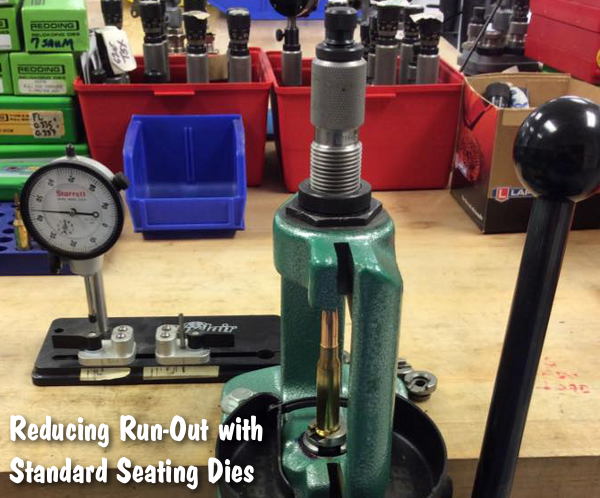
Each Wednesday, the U.S. Army Marksmanship Unit publishes a reloading “how-to” article on the USAMU Facebook page. This USAMU “Handloading Hump Day” article, the second in a series on improving concentricity, has many useful tips. If you use standard (non-micrometer) seating dies when loading some cartridge types, this article is worth reading. And visit the USAMU Facebook page next Wednesday for the next installment.

Once again, it’s time for USAMU’s “Handloading Hump-Day!” Last week, we addressed achieving very good loaded-cartridge concentricity (AKA “TIR”, or Total Indicator Runout) using standard, “hunting grade” reloading dies.
We explained how to set up the Full-Length Size die to float slightly when correctly adjusted for desired case headspace. We also cited a study in which this method loaded ammunition straighter than a set of [higher grade] match dies from the same maker. [One of the keys to reducing TIR with both sets of dies was using a rubber O-ring below the locking ring to allow the die to float slightly. READ Full-Length Sizing Die TIP HERE.]
Now, we’ll set up a standard seating die to minimize TIR — the other half of the two-die equation. As before, we’ll use a single-stage press since most new handloaders will have one. A high-quality runout gauge is essential for obtaining consistent, accurate results.
Having sized, primed and charged our brass, the next step is bullet seating. Many approaches are possible; one that works well follows. When setting up a standard seating die, insert a sized, trimmed case into the shell-holder and fully raise the press ram. Next, back the seating stem out and screw the die down until the internal crimping shoulder touches the case mouth.
Back the die out one-quarter turn from this setting to prevent cartridge crimping. Next, lower the press ram and remove the case. Place a piece of flat steel on the shellholder and carefully raise the ram. Place tension on the die bottom with the flat steel on the shellholder. This helps center the die in the press threads. Check this by gently moving the die until it is well-centered. Keeping light tension on the die via the press ram, secure the die lock ring.

If one were using a micrometer-type seating die, the next step would be simple: run a charged case with bullet on top into the die and screw the seating stem down to obtain correct cartridge OAL.
However, with standard dies, an additional step can be helpful. When the die has a loosely-threaded seating stem, set the correct seating depth but don’t tighten the stem’s lock nut. Leave a loaded cartridge fully raised into the die to center the seating stem. Then, secure the stem’s lock nut. Next, load sample cartridges and check them to verify good concentricity.
One can also experiment with variations such as letting the seating stem float slightly in the die to self-center, while keeping correct OAL. The runout gauge will show any effects of changes upon concentricity. However, the first method has produced excellent, practical results as evidenced by the experiment cited previously. These results (TIR Study 2) will reproduced below for the reader’s convenience.
| TIR Study 2: Standard vs. Match Seating Dies
50 rds of .308 Match Ammo loaded using carefully-adjusted standard dies, vs. 50 using expensive “Match” dies from the same maker.
Standard dies, TIR:
0.000” — 0.001” = 52%;
0.001”– 0.002” = 40%;
0.002”– 0.003” = 8%. None greater than 0.003”.
“Match” dies, TIR:
0.000”– 0.001” = 46%;
0.001” — 0.002” = 30%;
0.002” — 0.003” = 20%;
0.003” — 0.004” = 4%.
AccurateShooter Comment: This shows that, with careful adjustment, the cheaper, standard dies achieved results that were as good (or better) than the more expensive “Match” Dies. |
These tips are intended to help shooters obtain the best results from inexpensive, standard loading dies. Especially when using cases previously fired in a concentric chamber, as was done above, top-quality match dies and brass can easily yield ammo with virtually *no* runout, given careful handloading.
June 20th, 2018

We see comparison tests of cars, cameras, and other hardware. But how about chronographs? What could we learn by setting up three different chronographs, and running a 20-shot string over all three at the same time. One of our Forum members, Randy S. (aka AAA) did that very test with three of the best chronographs you can buy: LabRadar, MagnetoSpeed, and an Oehler model 35P. The MagnetoSpeed was attached to the barrel of an F-Class rig, with the LabRadar placed on the left side of the shooting bench. The Oehler 35P was positioned about 23 feet downrange. The photo above shows the set-up. A 20-shot string was recorded with the results in a spreadsheet.
AAA talks about this interesting experiment in a Shooters’ Forum Thread. Here is his report:
Comparison Testing Three Chronographs
We all have our favorite chronograph. Each gives a number, but how would that number compare to the same round fired with another chronograph? I wanted to know so a friend and I set up the following test with three chronographs: LabRadar, MagnetoSpeed V3, and Oehler Model 35P.
For the test we fired Berger 105gr VLDs over the three chronographs simultaneously. The test rifle was my 6mm BR Ackley (BRA) F-class rig with fire-formed brass and 200 rounds on the new barrel.
Chronogaphs Tested
LabRadar
MagnetoSpeed V3
Oehler Model 35P |
Temperature: 86 deg. F
Elevation: 854 feet
Cartridge: 6mm BRA (105gr Berger VLD)
Time between shots: 45 seconds |
To start off, five rounds were fired to make sure all systems were recording and to warm the barrel. Then the test was 20 shots fired across all three instruments with 45 seconds between shots. The Oehler was set 7.5 yards from the muzzle so 12 FPS was added to the recorded value.
We were using the internal trigger on the LabRadar. The manual says the Vo indicated is the actual muzzle velocity when using the internal trigger, but not if using the Doppler. The 12 FPS Oehler adjustment (back to MV) was based on the Berger Ballistics Calculator.
Results of the Triple Chronograph Shoot-Out:

LR-M is FPS variance between LabRadar and MagnetoSpeed V3. LR-O is FPS variance between LabRadar and distance-adjusted Oehler 35P. You can see all three chronos were very consistent. SD was identical with the LabRadar and MagnetoSpeed. CLICK HERE for spreadsheet.
The tester, Randy S. (aka AAA) says: “Judge for yourself, but I was impressed by all.”
Comments by Forum Members
Our Forum members expressed interest in this Triple Chronograph test. Some confirmed that the LabRadar and Magnetospeed give very similar FPS numbers, based on their own tests:
“Great test and thanks for sharing. I’ve tested my MagnetoSpeed and LabRadar together and results are always within 2-4 FPS of one another.” — Big D
“Very happy to see your numbers support my decision to buy a MagnetoSpeed. Had read reports comparing it to the Oehler and the numbers I get seem to be supported by my long range shooting results. Many thanks for taking the time and effort [to perform] this comparative test. Always good to get actual test results.” — Texas10
“I did a 4-shot test with my MagnetoSpeed and another shooter’s LabRadar a couple of days ago. The results were within 4 fps with the LabRadar being optimistic.” — Pat Miles
Forum Member Powderbreak studied AAA’s original spreadsheet from the chronograph trio test, then figured out the shot-by-shot FPS variance between the machines. He concluded that all the machines performed very well. Powderbreak posted:
Analyzing the Triple Chronograph Test — What Can We Conclude?
AAA did a great job of comparing the 3 chronos. What conclusions can be drawn?
1) I have not checked the manufacturer’s claims of accuracy, but the three chronos are very close to one another. There is no way for us to determine the actual true velocities, but we do not need to do so. Any of the chronos would be more than adequate for an accurate shooter.
2) The resolution of the three chronographs is actually pretty astounding. One foot per second (FPS) is a resolution of 0.033%.
3) AAA did a great job of reloading a very consistent round. With an extreme spread of 33 fps out of 3014 for 20 rounds, that is only 1.09% total spread of velocities.
4) There is a closer velocity match between the MagnetoSpeed and the LabRadar, but that does not mean the Oehler is less accurate. There is simply an offset between the Oehler and the other two. This could be due to the greater distance, the location, or the internal working of the Oehler.
5) Believe your chronograph, it is probably the most accurate reloading tool that you own.
Brian Litz of Applied Ballistics carefully explained the operation, set-up, accuracy and comparison of AB’s chronographs in his books. [Those books] are well worth the money, and give great insight into the workings of chronographs.” — Powderbreak
June 20th, 2018

On some internet shooting forums, self-declared “experts” advise new rifle shooters to stick to low-end factory rifles. These “experts” (many of whom don’t own a single really accurate rifle), claim that it will take years for a new shooter to learn how to shoot a rifle accurately. So, the argument goes, the accuracy offered by a precision-chambered rifle, with a custom barrel, is “wasted” on a new shooter.
We disagree with that viewpoint, at least when it comes to rifles shot from a rest. We’ve seen relatively new shooters, with help from a skilled mentor, do remarkably well with precision rifles right from the start. With a good bench gun, many new shooters can shoot well under 1 MOA on the first day. Certainly it takes time for a complete novice to learn how to handle the gun and to work the trigger smoothly. However, this editor has personally seen some inexperienced shooters try their hand at benchrest shooting, and within few month they are doing very well indeed at club shoots.
Accurate Rifles Reward Progress As Novices Build Skills
For bench shooting, we think a highly accurate rifle is a much better training device for a new shooter than a typical, cheap factory sporter. With a gun capable of 1.5-2.0 MOA at best, you can never really determine if a “flyer” is you or the gun. Conversely, when a novice shoots a gun that can put 5 shots through one ragged hole, if a shot goes way high or low, the shooter knows his aim, trigger control, or gun-handling is to blame. He (or she) can then correct the problem. And when the shooter does everything right, he or she will see a nice tight group on the target. The accurate rifle provides more meaningful feedback and it rewards progress. That helps the novice become a better shooter in a shorter period of time.

A while back, Forum Member Preacher and his “bunny hugger” niece from California proved this point. The young lady, with almost no shooting experience, took Preacher’s 6-6.5×47 and shot a sub-quarter-MOA, 3-shot group at 350 yards. Don’t tell her she needs to stick to a cheap factory rifle. Preacher reports: “My niece flew in from the west coast and came up to visit. When she saw a few of my full-blown varmint rifles, she wanted to shoot one. She did a super job even if she IS a ‘bunny hugger’. She pulled the 1.5 ounce Jewell on a few fired cases to check out the trigger pull and then got in behind the gun and put three shots into a 350-yard target with a one-inch circle.” We measured her group at 0.822″ (0.224 MOA). Don’t tell Preacher that accuracy is “wasted” on novices. He joked: “I sure don’t want her shooting at me ….”
Rifle Features BAT Action, Krieger Barrel, and Russo Laminated Stock:

For those who are interested, Preacher’s rifle features a BAT 3-lug action, 30″ Krieger 7.5-twist heavy contour barrel, and Russo stock (with clear coat by Preacher). Chambered in 6-6.5×47 Lapua, this gun “shoots the 108gr Bergers very well” according to Preacher. Yep, we agree with that — even when a novice “bunny-hugger” does the trigger-pulling.
June 16th, 2018

Our take on Bore-Store Gun sleeves is simple: They work great, so buy them and use them — for ALL your valuable firearms.
These thick, synthetic-fleece sacks cushion your guns, preventing nicks and scratches. The breathable fabric wicks away moisture, and the fibers are coating with corrosion inhibitors. I personally use Bore-Stores for in-safe storage with all my guns, and I have never had one of my guns rust inside a Bore-Store, even when I lived a stone’s throw from the ocean.
Bore-Stores are offered in a wide range of sizes, so you can find something to fit everything from a Snub-nosed revolver to a 32″-barrelled 50 BMG. Rifle-size Bore Stores can be purchased for $12.00 – $21.00 from Brownells. For long F-Class or tactical rifles, we recommend the 10″x52″ Scoped Shotgun Bag, Brownells item 132-000-003. You can also order direct from the Bore-Store manufacturer, Big Spring Enterprises, www.BoreStores.com. Big Spring will also craft custom sizes on request.
Get Your Guns Out of Foam-lined Cases — They Are Rust Magnets
For long-term storage, just about the worst thing you can do (short of leaving your rifle outside in the rain) is to store firearms in tight, foam-padded cases. The foam in these cases actually collects and retains moisture from the air, acting as the perfect breeding ground for rust.
 Remember, those plastic-shelled cases with foam interiors are for transport, not for long-term storage. Don’t repeat the mistake of a wealthy gun collector I know. He stored four valuable Colt Single Action Army (SAA) revolvers in individual foam-padded cases, and locked these away in his gun safe. A year later, every one of his precious SAAs had rusted, some very badly. Remember, those plastic-shelled cases with foam interiors are for transport, not for long-term storage. Don’t repeat the mistake of a wealthy gun collector I know. He stored four valuable Colt Single Action Army (SAA) revolvers in individual foam-padded cases, and locked these away in his gun safe. A year later, every one of his precious SAAs had rusted, some very badly.
June 14th, 2018

 Hunters and tactical shooters need scopes with good low-light performance. For a scope to perform well at dawn and dusk, it needs good light transmission, plus a reasonably large exit pupil to make maximum use of your eye’s light processing ability. And generally speaking, the bigger the front objective, the better the low-light performance, other factors being equal. Given these basic principles, how can we quickly evaluate the low-light performance of different makes and models of scopes? Hunters and tactical shooters need scopes with good low-light performance. For a scope to perform well at dawn and dusk, it needs good light transmission, plus a reasonably large exit pupil to make maximum use of your eye’s light processing ability. And generally speaking, the bigger the front objective, the better the low-light performance, other factors being equal. Given these basic principles, how can we quickly evaluate the low-light performance of different makes and models of scopes?
Here’s the answer: ScopeCalc.com offers a FREE web-based Low-Light Performance Calculator that lets you compare the light gain, perceived brightness, and overall low-light performance of various optics. Using this scope comparison tool is pretty easy — just input the magnification, objective diameter, exit pupil size, and light transmission ratio. If the scope’s manufacturer doesn’t publish an exit pupil size, then divide the objective diameter in millimeters by the magnification level. For example a 20-power scope with a 40mm objective should have a 2mm exit pupil. For most premium scopes, light transmission rates are typically 90% or better (averaged across the visible spectrum). However, not many manufacturers publish this data, so you may have to dig a little.

ScopeCalc.com’s calculator can be used for a single scope, a pair of scopes, or multiple scopes. Once you’ve typed in the needed data, click “Calculate” and the program will produce comparison charts showing Light Gain, Perceived Brightness, and Low-Light Performance. Though the program is easy to use, and quickly generates comparative data, assessing scope brightness, as perceived by the human eye, is not a simple matter. You’ll want to read the annotations that appear below the generated charts. For example, ScopeCalc’s creators explain: “Perceived brightness is calculated as the cube root of the light gain, which is the basis for modern computer color space brightness scaling.”
June 10th, 2018

If you didn’t catch our Deals of the Week last Monday, here’s another “heads up”. If you’re thinking of getting a LabRadar chronograph, now’s the time to buy. You can save $50.00 on this unit now through June 24, 2018. Take note — these devices are controlled with MAP pricing, so you won’t see other discounts. This is a factory-authorized, once-a-year Summer Sale.
This sale is notable because you never see this discounted below the $559.95 MAP price. The sale extends through 6/24/2018. You can get the LabRadar from top vendors including Creedmoor Sports, Bruno Shooters Supply, and Midsouth Shooters Supply.

About the LabRadar Chronograph
The LabRadar is probably the most sophisticated chronograph system ever offered to the general public. It is extremely precise yet easy to deploy. The LabRadar’s Doppler Radar technology offers many advantages compared to the traditional analog chrono — no tripods needed, no ambient light required, works on any type of projectile, no matter what caliber or speed. The LabRadar records all shot velocities, then calculates velocity extreme spread (ES), average velocity, and standard deviation (SD). It can also export all your shot data to your computer or laptop. And very soon a new LabRadar Mobile App will be offered that will let you control your LabRadar with an iOS or Android smartphone.
The LabRadar Ballistic Velocity Doppler Radar Chronograph can track a wide range of devices, calibers, and projectiles. It works with airguns, handguns, rifles — even suppressed weapons. (It can even time arrows fired from bows.) A key advantage of the LabRadar is that is can be set to the SIDE of your rifle — you don’t need to go downrange to set up screens on a tripod. You can put the LabRadar right on the bench. Ace shooter and bullet-maker Bart Sauter even uses his LabRadar during matches.

Full LabRadar Field Test/Review by Ray Gross
If you are considering purchasing a LabRadar Chronograph system, we strongly suggest you read the very thorough and informative LabRadar Review by Ray Gross, past Captain of the USA F-TR team.

|


