|
|
August 1st, 2014
At the 2014 National High Power Championships, Joe Hendricks recorded an inspirational come-from-behind victory that will long be remembered. But during this year’s competition, a 10-time past champion was noticeably absent from the firing line at Camp Perry. “Where’s Carl?” was the question many asked as the High Power Championships began.
Health concerns kept Carl Bernosky from competing at Camp Perry this year — serious health concerns. In fact, Carl is scheduled for back surgery today to deal with chronic pain and related neuro-muscular issues. Carl tells us: “I have had back problems for years but this March my bulging discs and sciatica flared with a vengeance. It was a very difficult time. It made functioning even with everyday tasks hard and shooting impossible. If you include something in your Bulletin please make sure that my friends and shooting competitors know how much I appreciate their kind words, thoughts and prayers. Thank you for thinking of me and hopefully I’ll be back on my feet soon. Please don’t let this in anyway overshadow Joe Hendricks’s well-deserved Championship. Joe shot superbly and I congratulate him on a great performance.”

We know that our Daily Bulletin readers wish Carl well and send their hopes that the surgery is 100% successful and that the healing process goes well. We all want to see Carl pain-free and back on the firing line. Carl is a great marksman — one of the best ever — and an equally great human being. We echo what one of his friends posted yesterday: “Carl is an absolute class act… humble, gracious, and a true gentleman. Heal up fast, Carl.”
In this exclusive interview filmed earlier this year (at SHOT Show), Carl talks about his approach to competition, and Carl offers helpful advice for fellow High Power competitors.
August 1st, 2014
 Have you got an old “Leapers” scope or other not-so-great optic that you’re embarrassed to mount on a rifle? Well now you can turn that ugly old optic into real money — two hundred dollars to be precise. Leica just announced a trade-in offer that provides a serious incentive to unload an old scope you don’t want or use. No broken scopes please — to qualify as a trade-in, the old scope much be functional with no broken parts. Here’s how the trade-in program works… Have you got an old “Leapers” scope or other not-so-great optic that you’re embarrassed to mount on a rifle? Well now you can turn that ugly old optic into real money — two hundred dollars to be precise. Leica just announced a trade-in offer that provides a serious incentive to unload an old scope you don’t want or use. No broken scopes please — to qualify as a trade-in, the old scope much be functional with no broken parts. Here’s how the trade-in program works…
When you purchase a new Leica ER i riflescope from any authorized North American Leica dealer, you can receive $200.00 cash back by simply trading in a functioning riflescope of any make or model. Purchase your scope and send your trade-in to Leica between August 1 and October 31, 2014, to receive $200 by mail. The Leica ER i comes in two models: 2.5-10x42mm and 3-12x50mm. Both are available in three reticle configurations: Classic L4-A, Ballistic, and IBS.
To qualify to receive the $200 cash back, you must fill out Leica’s Trade-in Form and mail it to Leica along with your functioning trade-in scope. You must also include:
1. Copy of the sales receipt for the new Leica ER i scope.
2. Completed original ER i warranty registration

There is no brand or price limit on the trade-in. Leica will accept any brand, make or model of trade-in scope, so long as it is “functional” and a clear image and reticle are visible through the scope.
In fact, you might even find a new scope for less than twenty bucks. We found a Tasco 4x15mm scope on sale at MidwayUSA for just $9.99. And — get this — Midway is even offering free shipping on this item with orders of $25.00 or more. So if you and your buddies buy a total of three scopes (as one order) you can get them all delivered for free! CLICK HERE for $9.99 Tasco.

With this Tasco, you can shell out whopping $9.99 for a qualifying trade-in scope, and save $200.00 on a life-time guaranteed Leica. That’s smart shopping.
August 1st, 2014
We first featured this amazing stock last year. We felt this creation was such a stunning piece of work that it deserved a second look. If you missed this masterpiece the first time around, feast your eyes…
Sebastian (“Seb”) Lambang, creator of the SEB Coaxial Rests and the Coaxial Joystick Bipod, has engineered an impressive new wood and aluminum F-Class stock. The stock features a long, box-section aluminum fore-end with a wood rear section and wood-trimmed “wings” on the front bag-rider. The aluminum fore-arm has “buick vents” for weight reduction. From the end of the action rearward, the stock is mostly wood, with light and dark fancy wood laminates on opposite sides (left and right).
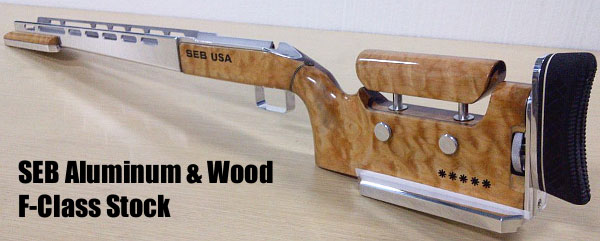

The foot of the buttstock has a very wide aluminum rear bag-rider with rails. The rear wood section appears to be two solid pieces of wood — but that is deceiving. Seb explains: “To save weight, the buttstock is hollow (using thin-walled wood)”. To strengthen the construction, Seb added carbon fiber inside the buttstock. So what you see is a wood outer shell with carbon fiber layers on the inside. The stock sports vertically-adjustable cheek-piece and buttplate. The thick, rubber buttpad should diminish felt recoil even when shooting big cartridges with heavy bullets.

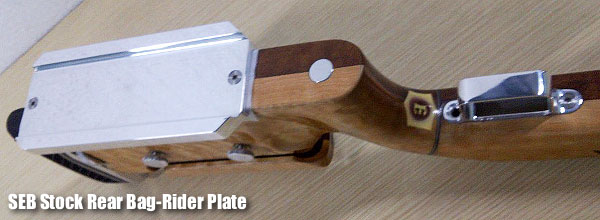

This is an interesting, innovative stock design. And as with everything Seb produces, the craftsmanship, fit and finish are superb. We may get a chance to see how well this new stock shoots at the F-Class World Championships later this month in Raton, New Mexico.
Seb also crafted a handsome set of angled scope rails with beautifully-machined scope rings. Imagine being able to custom-make one-off products of this quality in your own machine shop!

July 31st, 2014
Glock, Inc. has contributed $50,000 to the Civilian Marksmanship Program (CMP) in support of the new CMP Marksmanship Park, in Talladega County, Alabama. Glock has pledged $150,000 total to be delivered in three, annual donations. The initial payment of $50,000 was presented by Glock’s Bob Radecki to Orest Michaels, CMP chief operating officer, who stated: “We are pleased that GLOCK has stepped up with [its] support of our park, which will be the most progressive public shooting venue of its kind in the United States.”

Glock’s dollars should help the CMP Talledaga Marksmanship Park construction plan stay on schedule. The Talladega facility is projected to open in May, 2015. The first CMP Southern Games event is planned for June 2015. Potentially, a second Southern Games event will be held in December 2015. The CMP’s new shooting complex is situated in the rolling hills of Talladega County, approximately two miles from the Talladega Super Speedway.
Electronic Targets for High Power Shooters
The new CMP Marksmanship Park will feature a 54-lane High Power rifle range with electronic targets at 200, 300, and 600 yards, plus an all-electronic scoring 100-yard sight-in rifle range with 50 firing points. With its electronic targets, the Talladega Parks will be one of the most advanced shooting complexes in the Western Hemisphere.
The High Power ranges will be equipped with state-of-the-art, all-weather electronic targets.

For handgunners, the new Talladega Park will feature a 50-yard pistol range, three 50-yard action pistol bays, twelve 25-yard action pistol bays and a 50-foot pistol range. A portion of the pistol complex will employ electronic targets. For shotgunners, CMP Talladega will offer a 15-station sporting clays course and a trap field with a five-stand overlay.
An aerial view shows the trees that will serve as natural dividers between each range.

July 31st, 2014
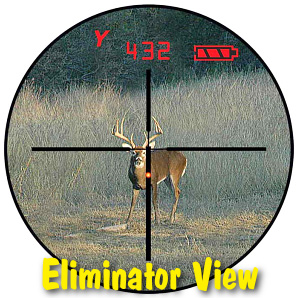 Burris Optics is currently offering significant rebates on three lines of scopes. You can get up to $100.00 in rebates on Burris Tactical and Fullfield II scopes. For the innovative Eliminator optics with built-in laser rangefinders, the savings are even bigger — you can get up to $200.00 in rebates with your purchase. We like the Eliminator scopes for Varmint hunting. The built-in rangefinder instantly calculates the needed hold-over, based on the target distance. Then the scope displays the corrected aim point as a red dot on the vertical cross-hair. Just put the red dot on your target and pull the trigger. The Eliminator does all the work for you — no turret clicking needed. Burris Optics is currently offering significant rebates on three lines of scopes. You can get up to $100.00 in rebates on Burris Tactical and Fullfield II scopes. For the innovative Eliminator optics with built-in laser rangefinders, the savings are even bigger — you can get up to $200.00 in rebates with your purchase. We like the Eliminator scopes for Varmint hunting. The built-in rangefinder instantly calculates the needed hold-over, based on the target distance. Then the scope displays the corrected aim point as a red dot on the vertical cross-hair. Just put the red dot on your target and pull the trigger. The Eliminator does all the work for you — no turret clicking needed.
CLICK HERE for Burris REBATE Details and Forms

Rebate Instructions
These Burris products are available now at Grafs.com. Rebates available for purchases made between July 1, 2014 and December 31, 2014. Mail-in form must be signed, dated, and post-marked by January 31, 2015. View Full Offer Details.

July 30th, 2014
Story Based on Report by Kyle Jillson for NRABlog.com
Joseph Hendricks won the 2014 NRA High Power Rifle Championship with a 1789-76X Score. Hendricks topped a large field of 288 total competitors. In second place, two points behind, was past champion Norm Houle with 1787-85X. Defending 2013 High Power Champion SSG Brandon Green was a close third, with 1786-89X. Green had the high X-Count for the match. The top “Any Sights” competitor was Kenneth Lankford, whose 1780-76X was the eighth-highest total overall.

Great Shooting Takes Hendricks from Fifth to First on Final Day
Dawn on the final day of the 2014 NRA High Power Rifle Championship saw Joe Hendricks sitting in fifth place. But by sundown the Team Remington shooter had become the national champion. What happened in between was a shining example of consistency and perseverance.
Hendricks started the final day (Tuesday) four points down of the leader, tied for third but with a low X-Count. “I assumed everybody would go clean … so I needed to go clean just to maintain my spot,” Hendricks said. And clean he went. All 60 of Joe’s shots on Tuesday fell within the 10-ring. In fact, he hit straight 10s for the last 100 shots of the 180-shot championship. That is an impressive feat.

Three Generations of Hendricks on the Firing Line
Hendricks has the unique privilege to shoot with his son, Joe Hendricks, Jr., and his father, Gary Hendricks. The rest of his family was there to cheer him on as well.
Altered Course of Fire on Final Day
Tuesday’s matches followed an unusual break after severe winds on Monday caused a complete cancellation of the matches. Normally, on the final day of the High Power Championship, competitors shoot matches at 200, 300, and 600 yards. This year, due to the Monday cancellation, competitors did not fire a 200-yard match, but instead fired the 300-yard match and TWO 600-yard matches.
View Photos from 2014 High Power Championships
When everyone found themselves back on the firing line Tuesday morning, the wind had died down. “The winds weren’t too tricky. I shot two nice groups at 300. Not the X-count I wanted, but I got all the points,” Hendricks explained. “When I got back to 600 I just tried to do the same thing. The wind dropped off enough a couple times that if I shot I’d lose points, so I waited until it came back.”
Hendricks finished with 1789-76X, two points ahead of Norman Houle (1787-85X), a three-time High Power National Champion. In third place, with 1786-89X, was SSG Brandon Green, last year’s High Power Rifle Champion.
July 30th, 2014
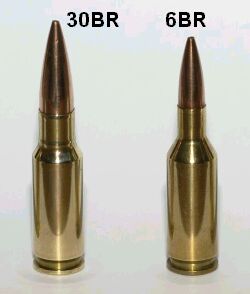 The 30BR is an amazing little cartridge. However, 30BR shooters do have to neck-up 6mmBR brass and then deal with some issues that can arise from the expansion process. One of our Forum members was concerned about the donut that can form at the new (expanded) neck-shoulder junction. Respected bullet-maker Randy Robinett offers tips on how to deal with the “dreaded donut”. The 30BR is an amazing little cartridge. However, 30BR shooters do have to neck-up 6mmBR brass and then deal with some issues that can arise from the expansion process. One of our Forum members was concerned about the donut that can form at the new (expanded) neck-shoulder junction. Respected bullet-maker Randy Robinett offers tips on how to deal with the “dreaded donut”.
The Forum member was concerned about thinning the brass if he turned his 30BR necks after expansion: “Everything I have found on 30BR case-forming says to simply turn off the bulge at the base of the neck caused by the old 6BR shoulder. I expanded my first case and measured the neck at 0.329″ except on the donut, where it measures 0.335″. Looking inside the case… reveals a groove inside the case under the donut. Now, it is a fact that when I turn that neck and remove the donut, the groove is still going to be there on the inside? That means there is now a thin-spot ring at the base of the neck that is .005 thinner than the rest of the neck. Has anyone experienced a neck cracking on this ring?”
Randy Robinett, who runs BIB Bullet Co., is one of the “founding fathers” of the 30BR who help prove and popularize the 30 BR for benchrest score shooting. Randy offers this advice on 30BR case-forming:
While the thinner neck-base was one of our original concerns, unless one cuts too deeply INTO the shoulder, it is not a problem. For my original 30BR chamber, thirty (30) cases were used to fire 6,400 rounds through the barrel. The cases were never annealed, yet there were ZERO case failures, neck separations, or splits. The case-necks were turned for a loaded-round neck diameter of .328″, and, from the beginning, sized with a .324″ neck-bushing.
The best method for avoiding the ‘bulge’ is to fire-form prior to neck-turning (several methods are successfully employed). Cutting too deeply into the shoulder can result in case-neck separations. I have witnessed this, but, with several barrels and thousands to shots fired, have not [personally] experienced it. The last registered BR event fired using that original barrel produced a 500-27x score and a second-place finish. [That’s] not bad for 6K plus shots, at something over 200 firings per case.
Check out the 30BR Cartridge Guide on AccurateShooter.com
You’ll find more information on 30BR Case-forming in our 30 BR Cartridge Guide. Here’s a short excerpt from that page — some tips provided by benchrest for score and HBR shooter Al Nyhus:
30BR Case-Forming Procedure by Al Nyhus
The 30BR cartridge is formed by necking-up 6BR or 7BR brass. You can do this in multiple stages or in one pass. Most of the top shooters prefer the single-pass method. You can use either an expander mandrel (like Joe Entrekin does), or a tapered button in a regular dies. Personally, I use a Redding tapered expander button, part number 16307. This expands the necks from 6mm to .30 cal in one pass. It works well as long as you lube the mandrel and the inside of the necks. I’ve also used the Sinclair expander body with a succession of larger mandrels, but this is a lot more work and the necks stay straighter with the Redding tapered button. This button can be used in any Redding die that has a large enough inside diameter to accept the BR case without any case-to-die contact.
Don’t be concerned about how straight the necks are before firing them the first time. When you whap them with around 50,000 psi, they will straighten out just fine! I recommend not seating the bullets into the lands for the first firing, provided there is an adequate light crush-fit of the case in the chamber. The Lapua cases will shorten from approx. 1.550″ to around 1.520″ after being necked up to 30-caliber I trim to 1.500″ with the (suggested) 1.520 length chambers. I don’t deburr the flash holes or uniform the primer pockets until after the first firing. I use a Ron Hoehn flash hole deburring tool that indexes on the primer pocket, not through the case mouth. — Al Nyhus
July 30th, 2014
Tonight, American Rifleman TV features the Bianchi Cup, one of the oldest, richest, and most prestigious pistol competitions on the planet. In 2014 over $500,000 in cash and prizes was up for grabs. That stellar pay-out (and the prestige of winning) attracts the world’s top pistoleros.

This Bianchi Cup event was founded in 1979 by former police officer and holster maker John Bianchi. Success in the Bianchi Cup requires a perfect balance of speed and accuracy. The 192-shot championship allows a maximum aggregate of 1920 points across four timed events: Practical, Barricade, Moving Target and Falling Plate. In addition to being grouped by age, gender, and shooting skill, competitors may opt to shoot in the Open, Metallic, or Production divisions.
Watch Preview of July 30 Episode of American Rifleman TV
This week’s episode also features a vintage Vickers belt-fed machine gun from World War I. You can view interesting segments from past American Rifleman TV episodes, along with “Gun of the Week” video reviews at AmericanRifleman.org/Videos:

July 29th, 2014
2014 and 2012 U.S. National F-TR Champion James Crofts is one of America’s top F-Class shooters. A member of the 2013 World Championship-winning F-TR Team USA squad, James knows a thing or two about long-range shooting, that’s for sure. But you may be surprised to learn how James sharpens his shooting skills at relatively short distances. You see, James often practices with a .22 LR rimfire rifle at distances from 50 to 200 yards. James tells us: “Shooting my F-Class rimfire trainer saves me money and improves my shot process and wind-reading abilities.”
Remington rimfire 40X barreled action in PR&T LowBoy stock with PT&G bolt.

Rimfire Training Teaches Wind-Reading Skills by James Crofts
Training with the rimfire is extremely useful and can be done from 25 yards out to 200 yards. I am lucky and can shoot 50 yards right off my back deck. That is far enough that any miscue on rifle handling will show up on the target. I use a two dry-fire to one actual shot routine for my practices. This gives me much more positive reinforcement without any negative reinforcement.
Wind reading is extremely important with a .22 LR rifle. I use a set of smallbore flags to aid my wind calls. The smallbore flags are a must and force you to look at the flags and mirage on each and every shot. If you think the flags at Camp Butner move a lot, try smallbore flags around tall pine trees.
Rimfire Training Is Cost-Effective
Rimfire ammunition is much less costly than centerfire ammo. Though .22 LR prices have risen in recent years (and rimfire ammo is harder to find), even now I can get a 500-round brick of .22 LR ammo for less than $75.00. That works out to fifteen cents a round. That’s a fraction of the cost of handloading .308 Win match ammo. Heck, you can pay 40 cents a piece for match-grade .308-cal centerfire bullets. Then you have to figure in brass, primers, and powder.

My CMP 40X Rimfire F-TR LowBoy Clone
My quest into the .22 LLR rimfire field started with an email from the Civilian Marksmanship Program (CMP) announcing Rem 40X stripped barreled actions for sale. I thought, “Hmmm… Could one of those little 40X barreled actions be turned into a F-Class training rifle?” My gunsmith Ray Bowman of Precision Rifle & Tool was brought in at this point.
After conferring with Ray, it was decided that he could indeed turn this into a F-Class training rifle. Ray contacted Dave Kiff of PT&G and ordered a new bolt for the Remington 40X rimfire action. Next was the stock decision. I decided to go with a PR&T Low Boy F-Class stock — this is an exact clone of the stock for my .308 Win F-TR competition rifle. Then a Jewell trigger was acquired to complete the components. Ray built this just like he would any custom rifle, other than using the stock barrel. The project turned out awesome. The rifle was a hammer from the beginning even with the stock barrel.

About James Crofts
This spring, James Crofts was chosen as the new Vice Captain for the USA F-TR National Team. James comes from a military background, having served 20 years in the U.S. Navy aboard fast attack submarines. James has also been a shooting member of the 8-man F-TR Team USA, and he is always one of the top shooters in any F-TR competition. James told us: “Now the work begins, but with Ray Gross as Captain I think we can handle it. It will be a tough act to follow. Darrell Buell and Mike Miller set the bar extremely high with back-to-back world championship gold medals.”

James Crofts — Photo by Kent Reeve.
July 29th, 2014
Nightforce now offers a 5-20x56mm SHV scope that retails for $1170.00 (non-illuminated) or $1299.00 (illuminated). This follows up on Nightforce’s successful 4-16x56mm SHV scope. The higher magnification range suits long range hunters and the large 56mm objective provides excellent low-light hunting capability. The 5-20 SHV offers plenty of travel: 80 MOA total elevation, 50 MOA windage.

The 5-20x56mm SHV boasts capped, waterproof turrets with 1/4-MOA click values, and 10 MOA per revolution on the elevation turret. The scope offers a side parallax control (25 yards to infinity), plus a European-style, fast-focus eyepiece.
Two reticles are offered for the 5-20x56mm SHV. The IHR features large dagger-style pointers, an open field at the top, and an cross in the center. The MOAR reticle has 1 MOA elevation and windage markings, with a floating center crosshair. With either reticle, illumination is optional at extra cost.
 
Our friend Len Backus of LongRangeHunting.com has checked out the new 5-20x56mm Nightforce and he is impressed: “With a 56mm objective the SHV’s light transmission is outstanding even at high power. Nightforce has added a ‘Zero Set’ feature which is a set-screw based stop system allowing you to dial back to your pre-set zero and stopping you from dialing past. It’s not quite as sharp a stop as their ‘Zero Stop’ but it will definitely do the trick. I bought my first Nightforce scope about 14 years ago. In summer of 2012 I had a four-hour private tour of the Nightforce headquarters. I remember being so impressed with the forward thinking going on there. It was obvious they were preparing for a major push on new technology and new products and this SHV is an absolute winner in that regard.”
Product Tip from EdLongrange. We welcome reader submissions.
|


