|
|
December 23rd, 2013
Effective hearing protection is a must whenever you are shooting firearms or when you are in the vicinity of gun-shots. For ultimate protection, we recommend a good set of tapered foam earplugs, topped by ear-muffs. However, there are situations when you may prefer lighter-weight hearing protection that can be quickly removed. For example, if you are standing well behind the firing line as an observer, or if you are working as a rangemaster or waddie some distance away from the shooters.
In addition to traditional ear plugs and ear-muffs, new band-style protectors provide a third sound-blocking option. Howard Leight, a top name in the sound-protection business, now offers the “Quiet Band”, a device with soft foam plugs attached to a plastic band worn around the neck. This “Quiet Band” product is comfortable, easy to deploy, and surprisingly effective.

 Three Quiet Band Models Three Quiet Band Models
There are three (3) types of Leight Quiet Band® sound protectors. We prefer the QB2 Supra-aural model (item QB2HYG, NRR 25). As shown in the photos, the NRR 25-rated QB2 positions cone-shaped foam pads next to the ear openings and holds them there with light pressure from the orange-colored band. There is also an Inner-aural version (item QB1HYG, yellow band, NRR 27), and a Semi-aural model (item QB3HYG, red band, NRR 21). Our preferred QB2 Supra-aural (orange band) model is just as comfortable as the QB3 (red band) version, and offers much better protection. The QB1 Inner-aural (yellow band) model requires that you place the ear buds in the ear canal, so it’s not really any easier to use than conventional earplugs. That’s why we like the QB2 Supra-aural model best of all. Other users agree. Here’s what two QB2 owners had to say:
 “I first saw these used by Hickok45 on YouTube and he talked positively about them. I got two and gave them a try. At first, I didn’t think they were going to work very well. After some fiddling, I found they work pretty darn good. With my ears, they fit the best if the band starts on top of my head, I insert the plugs then rotate the band behind my head. PRESTO, perfect fit. Shooting the 9mm and 12 gauge out back was comfortable with no ringing afterward. [They are] small and easy to transport — just throw in the range bag. Yet, they are big enough to keep around your neck out of the way[.] I can sit these Howard Leights down on the shooting bench without worrying about them getting dirty since the band is curved, placing the plugs in the air. I highly recommend them to anybody needing banded hearing protection.” — Tom W. “I first saw these used by Hickok45 on YouTube and he talked positively about them. I got two and gave them a try. At first, I didn’t think they were going to work very well. After some fiddling, I found they work pretty darn good. With my ears, they fit the best if the band starts on top of my head, I insert the plugs then rotate the band behind my head. PRESTO, perfect fit. Shooting the 9mm and 12 gauge out back was comfortable with no ringing afterward. [They are] small and easy to transport — just throw in the range bag. Yet, they are big enough to keep around your neck out of the way[.] I can sit these Howard Leights down on the shooting bench without worrying about them getting dirty since the band is curved, placing the plugs in the air. I highly recommend them to anybody needing banded hearing protection.” — Tom W.
|
“Great for woodworkers — These are lightweight AND very effective at reducing noise. When not in use the band hangs loosely around your neck, out of your way completely. Very cost effective for a great product!” — Sheri D.
Quiet Bands Are Much Less Expensive Than Earmuffs
Quiet Band® sound protectors can be purchased from many online vendors for under $6.00 per set, which includes a spare pair of ear buds. Amazon.com has the Leight QB2 Supre-Aural for just $3.57 per set, while Enviro Safety Products currently sells the QB2 for $4.20 per set. Replacement ear buds are available and sold by the pair. You can also buy a Ten-Unit Bulk Pack of QB2 Quiet Bands for $35.52 with free shipping. If you help run shooting matches (or training programs), you may want to buy these in bulk and provide them to Range Officers and pit workers. |
|
December 23rd, 2013
Massachusetts smallbore shooter Dan Holmes, well-known match shooter and gun writer Hap Rocketto, and Erik Hoskins have developed a great dedicated website for competitive small-bore and air rifle shooters. Over the past few years, Pronematch.com has delivered quality content, including match reports, shooting tips, rule changes/updates, tech reports, and a calendar of events.

 Pronematch.com also has a “human interest” feature, called the “Shooter Spotlights”. Holmes and his staff have interviewed dozens of shooters. Each marksman answers a few questions about his/her background in shooting, shooting techniques, match strategies, and personal items (such as “What is your favorite pre-match meal?). Pronematch.com also has a “human interest” feature, called the “Shooter Spotlights”. Holmes and his staff have interviewed dozens of shooters. Each marksman answers a few questions about his/her background in shooting, shooting techniques, match strategies, and personal items (such as “What is your favorite pre-match meal?).
The “Shooter Spotlights” let you “tap into” the wisdom of some of the county’s best shooters. Many of those interviewed offer some great tips, or they share fascinating anecdotes about the shooting sports.
We recommend you visit Pronematch.com, if nothing else to peruse the profiles, check the upcoming matches and read the popular “Hap’s Corner” stories. Hap is a talented writer who has provided plenty of content to ProneMatch.com. As just one example, Hap has written a fascinating Short History of Camp Perry and The National Championships.
December 22nd, 2013
 A varmint shooter’s target is not conveniently placed at a fixed, known distance as it is for a benchrester. The varminter must repeatedly make corrections for bullet drop as he moves from closer targets to more distant targets and back again. Click HERE to read an interesting Varmint Forum discussion regarding the best method to adjust for elevation. Some shooters advocate using the scope’s elevation adjustments. Other varminters prefer to hold-over, perhaps with the assistance of vertical markers on their reticles. Still others combine both methods–holding off to a given yardage, then cranking elevation after that. A varmint shooter’s target is not conveniently placed at a fixed, known distance as it is for a benchrester. The varminter must repeatedly make corrections for bullet drop as he moves from closer targets to more distant targets and back again. Click HERE to read an interesting Varmint Forum discussion regarding the best method to adjust for elevation. Some shooters advocate using the scope’s elevation adjustments. Other varminters prefer to hold-over, perhaps with the assistance of vertical markers on their reticles. Still others combine both methods–holding off to a given yardage, then cranking elevation after that.
Majority View–Click Your Scope
“I zero at 100 yards — I mean really zero as in check the ballistics at 200 and 300 and adjust zero accordingly — and then set the scope zero. For each of my groundhog guns I have a click chart taped into the inside of the lid of the ammo box. Then use the knobs. That’s why they’re there. With a good scope they’re a whole lot more accurate than hold-over, with or without hash marks. This all assumes you have a good range finder and use it properly. If not, and you’re holding over you’re really just spraying and praying. Try twisting them knobs and you’ll most likely find that a 500- or 600- or 700-yard groundhog is a whole lot easier than some people think.”
– Gunamonth
“I have my elevation knob calibrated in 100-yard increments out to 550. Range-find the critter, move elevation knob up…dead critter. The problem with hold-over is that it is so imprecise. It’s not repeatable because you are holding over for elevation and for wind also. Every time you change targets 50 yards, it seems as if you are starting over. As soon as I got completely away from the hold over method (I used to zero for 200), my hit ratios went way up.” — K. Candler
“When I first started p-dog shooting, I attempted to use the hold-over method with a 200-yard zero with my 6mm Rem. Any dog much past 325-350 yards was fairly safe. I started using a comeups table for all three of my p-dog rifles (.223 Rems and 6mm Rem). 450-yard hits with the .223s are fairly routine and a 650-yard dog better beware of the 6mm nowadays. An added benefit (one I didn’t think of beforehand) with the comeups table (elevation only), is that when the wind is blowing, it takes half of the variables out of the equation. I can concentrate on wind, and not have to worry about elevation. It makes things much more simple.” — Mike (Linefinder).
“I dial for elevation and hold for wind. Also use a mil-dot reticle to make the windage holds easier. For windage corrections, I watch for the bullet strike measure the distance it was “off” with the mil-dot reticle, then hold that much more the other way. Very fast once you get used to it.” — PepeLP
 Minority View–Hold-Over is Better Minority View–Hold-Over is Better
“I try to not touch my knobs once I’m zeroed at 200 meters. Most of my varmint scopes have duplex reticles and I use the bottom post to put me on at 300 meters versus turning knobs. The reason I try to leave my knobs alone is that I have gone one complete revolution up or down [too far] many times and have missed the varmint. This has happened more than once and that is why I try not to change my knobs if at all possible.” — Chino69
“I have been using the hold over method and it works for me most of the time but the 450 yards and over shots get kinda hard. I moved to a 300 yard zero this year and it’s working well. I do want to get into the click-up method though; it seems to be more fool-proof.” — 500YardHog
Compromise View–Use Both Methods
“I use both [methods] as well — hold over out to 250, and click up past that.” — Jack (Wolf)
“I use the target knobs and crank-in elevation. I also use a rangefinder and know how far away they are before I crank in the clicks. I have a scope with drop dots from Premier Recticle and like it. No cranking [knobs] out to 600.” –Vmthtr
December 22nd, 2013
Christmas is just a few days away. If your’re looking for a good gift for a serious shooter, consider a book. A well-written book can serve as a valued resource for many years. Right now Creedmoor Sports is running a special Holiday Sale on many popular book titles. Here are 12 book items on sale, and you’ll find more discounted books at CreedmoorSports.com.

Shooting Books on Sale at Creedmoor Sports
Shots Fired In Anger, $20.00 on Sale
(Reg. $27.95), Item BK-SFA
Hatcher’s Book of the Garand, $24.00 on Sale
(Reg. $29.95), Item BK-HBG
Ways of the Rifle, $59.00 on Sale
(Reg. $74.95), Item C1289
Handloading for Competition, $31.00 on Sale
(Reg. $34.95), Item C1286
David Tubb’s Highpower Rifle, $24.00 on Sale
(Reg. $29.95), Item C1251 |
Service Rifle Slings, $13.00 on Sale
(Reg. $14.95), Item BK-SRS
Air Rifle Shooting, $59.00 on Sale
(Reg. $73.95), Item AHG3980
Precision Shooting with M1 Garand,
$9.00 on Sale, (Reg. $12.95), Item C1270
Mental Training in Shooting, $39.00 on Sale
(Reg. $48.95) Item AHG8299
Slings and Things, $18.00 on Sale
(Reg. $19.95), Item BK-SAT |
December 21st, 2013
 Norma is making a big push to expand its presence in the North American market. As part of this effort, Norma is introducing seven (7) new types of cartridge brass for 2014. We’re pleased to report that Norma-USA will be importing top-quality brass for the 6.5 Grendel, and 6.5 Creedmoor, two popular target cartridges. In addition, for 2014, Norma will offer 7mm RUM, 7mm Blaser Magnum, 300 AAC Blackout (300 BLK), .300 RUM, and the .338 Blaser Mag. The Norma brass we have shot in other chamberings (6 PPC, 6mmBR Norma, 6XC, .243, 7mm RSAUM) has all been excellent, giving good accuracy. Case weights were very consistent and the neck-wall thickness was very uniform, particularly with the PPC and BR brass. The new 300 BLK brass is an important offering for AR shooters. (NOTE: You can also make 300 BLK cases from Norma or Lapua .221 Fireball brass). Norma is making a big push to expand its presence in the North American market. As part of this effort, Norma is introducing seven (7) new types of cartridge brass for 2014. We’re pleased to report that Norma-USA will be importing top-quality brass for the 6.5 Grendel, and 6.5 Creedmoor, two popular target cartridges. In addition, for 2014, Norma will offer 7mm RUM, 7mm Blaser Magnum, 300 AAC Blackout (300 BLK), .300 RUM, and the .338 Blaser Mag. The Norma brass we have shot in other chamberings (6 PPC, 6mmBR Norma, 6XC, .243, 7mm RSAUM) has all been excellent, giving good accuracy. Case weights were very consistent and the neck-wall thickness was very uniform, particularly with the PPC and BR brass. The new 300 BLK brass is an important offering for AR shooters. (NOTE: You can also make 300 BLK cases from Norma or Lapua .221 Fireball brass).
Though the annealing “shadow” may not be as visible as with Lapua brass, the case necks of Norma brass cartridges are indeed annealed near the end of the manufacturing process. This assures more consistent neck tension — something critical to accuracy. Most of the new cartridge brass offerings should be be available at vendors by early April, 2014. You can get Norma brass from Bullets.com, Grafs.com and Midsouth Shooters Supply, as well as many other online vendors.
New Norma-USA Brass Offerings for 2014:
- 6.5 Grendel
- 6.5 Creedmoor
- 7mm RUM
- 7mm Blaser Magnum
|
- 300 AAC Blackout (300 BLK)
- .300 RUM
- .338 Blaser Magnum
|
Product Tip from EdLongrange. We welcome reader submissions.
December 21st, 2013
It’s nice to see a leading firearms industry company fund “good works” and help charitable organizations. Hornady Manufacturing recently donated $38,009 to GRACE Foundation, a nonprofit organization dedicated to serving cancer patients, cancer survivors, and their families. Founded in 1949, Hornady is a family-owned business in Grand Island, Nebraska. The donation came from proceeds of the sale of Hornady® Critical Defense® Lite™ ammunition from November 2012 to November 2013.

“We at Hornady Manufacturing wanted to play an active role in the fight against cancer,” said Renae Waltemath, Director of Sales. “By donating a portion of the proceeds of each box of Critical Defense Lite ammunition sold over a 12 month period, we can directly assist organizations devoted to that cause. Choosing GRACE Foundation to receive a donation was easy since they help so many people in the Grand Island area, some of whom may be Hornady employees or family members affected by cancer.” Lisa Willman, co-founder of GRACE Foundation, said the gift significantly expands the number of people the organization can serve. “To give you an idea of what this means,” Willman explained, “the GRACE Foundation gave out over $21,000 in assistance over the entire third quarter of 2013. So a gift of $38,009 from one source is a huge help.” The Hornady gift is the largest single donation the organization has ever received.
December 20th, 2013
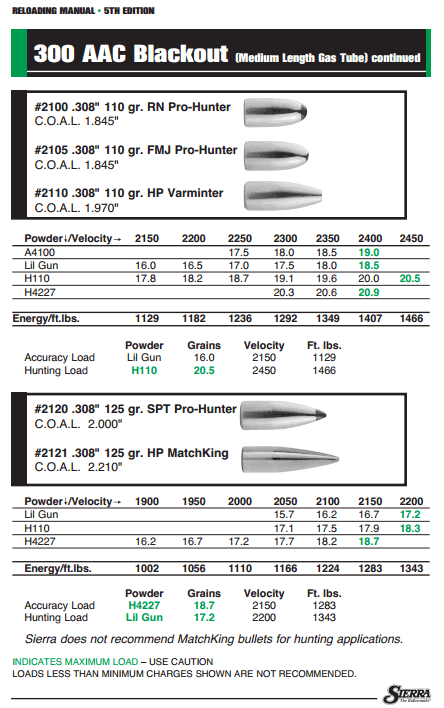
The 300 AAC Blackout (300 BLK, or 7.62x35mm) was created by Advanced Armament Corp. and Remington in order to provide the military with a way to shoot .30-caliber bullets from the M4 carbines with only a barrel change. It has since become popular with AR shooters for a wide range of uses including hunting and home defense. With the increased popularity of this cartridge, folks have been looking for reliable 300 BLK load information. Now, thanks to Sierra Bullets, we have some good load data for the 300 AAC Blackout. Sierra has released a FREE 6-page Load Guide for this cartridge, as part of the Sierra Reloading Manual (5th Edition).
CLICK HERE for Sierra 300 AAC Blackout Load DATA (PDF Format).
Here is ONE of SIX Pages in the Sierra Load Sheet for 300 AAC Blackout

About the 300 AAC Blackout (300 BLK)
The 300 AAC Blackout cartridge shares case-head dimensions and body taper with the .223 Remington. Not only does this allow for compatibility with existing magazines and bolts, but it allows reloaders to form their own brass from cut-down 5.56×45 mm or .223 Rem cases. You can also form 300 Blackout cases by necking-up .221 Fireball brass. Take Note: Lapua has started producing .221 Fireball brass — this should be available in the USA by early April.

The 300 AAC Blackout is a similar concept to previous wildcats, such as the 30-221 and 300 Fireball, as well as the proprietary 300 Whisper®, except that 300 BLK was the first to be a SAAMI-approved cartridge and any company is free to make firearms or ammunition.
300 AAC Blackout is also finding use with hunters, who may not have been able to legally hunt with .223 in their state, and who prefer .30 caliber bullets for medium-sized game. It provides similar effectiveness to the 7.62×39 or the slightly more powerful .30-30 cartridges except works in the more up-to-date AR-platform rifles. Effective hunting range is about 150 yards. Some innovators, such as Dave Whitford, have also experimented with the 300 BLK for Across-the-Course competition. READ Whitford story in Rifleman’s Journal..
December 20th, 2013
 Here’s good news for target shooters and hunters — there’s a new supplier of quality, match-grade ammo. Creedmoor Sports will be manufacturing .30-06, .308 Win, and .223 Rem ammunition beginning in May of 2014. It will be sold as “Creedmoor Ammo”, with hunting and match versions. Here’s good news for target shooters and hunters — there’s a new supplier of quality, match-grade ammo. Creedmoor Sports will be manufacturing .30-06, .308 Win, and .223 Rem ammunition beginning in May of 2014. It will be sold as “Creedmoor Ammo”, with hunting and match versions.
Help Design the Box — Get a Free CASE of Ammunition
Creedmoor Sports is looking for help designing the packaging for its new ammo line. If you successfully come up with the best graphics to be printed on the box, you’ll receive a cases of ammunition. Dennis DeMille, Creedmoor’s General Manager explains: “The person whose artwork we use, or slight variation thereof, will receive their choice of the very first case of one of those three calibers of ammunition.” Dennis adds: “Look at these boxes as your blank canvas. The ammunition, all calibers, will be in boxes of 50, and in cases of 100 (two boxes of 50)”.

Creedmoor’s Box Design Goals (Things to Keep in Mind):
The packaging design needs to appeal to competitive shooters, recreational shooters, and hunters alike. While any one package might not appeal to all groups, we don’t want one group to look at the box and think “That’s not for me”.
The ammunition WILL be match quality (we don’t want to give away any more details just yet), but changing the projectile would make it a match quality hunting round. Ideally what we want is one box design that will be suited for all applications.
The name of the Ammo will be “CREEDMOOR AMMO”, however, we don’t want to use the Creedmoor bursting bomb logo. If you have ideas for a new logo, please share those concepts with us at Creedmoor.
Send your ideas directly to Dennis DeMille, at demille [at] creedmoorsports.com. Please put “NEW AMMO BOX DESIGN” in subject line so that it doesn’t get lost among the many emails.
December 19th, 2013
Vihtavuori powder fans can rest a bit easier now…
 Breaking News: Just hours ago the Nammo Group announced that it has acquired the Finnish company Eurenco Vihtavuori OY, which produces Vihtavuori powders. This deal was finalized through the signing of a Share Purchase Agreement today, December 19, 2013. Breaking News: Just hours ago the Nammo Group announced that it has acquired the Finnish company Eurenco Vihtavuori OY, which produces Vihtavuori powders. This deal was finalized through the signing of a Share Purchase Agreement today, December 19, 2013.
The official press release adds that: “The agreement is subject to approval by French authorities. Filing is done and approval is expected to be granted within short time.” CLICK HERE to read Nammo/Eurenco Press Release PDF.

December 19th, 2013
 On his Riflemans’ Journal blog, German Salazar wrote an excellent article about cartridge Case-Head Separation. We strongly recommend that you read this article. German examines the causes of this serious problem and he explains the ways you can inspect your brass to minimize the risk of a case-head separation. As cases get fired multiple times and then resized during reloading, the cases can stretch. Typically, there is a point in the lower section of the case where the case-walls thin out. This is your “danger zone” and you need to watch for tell-tale signs of weakening. On his Riflemans’ Journal blog, German Salazar wrote an excellent article about cartridge Case-Head Separation. We strongly recommend that you read this article. German examines the causes of this serious problem and he explains the ways you can inspect your brass to minimize the risk of a case-head separation. As cases get fired multiple times and then resized during reloading, the cases can stretch. Typically, there is a point in the lower section of the case where the case-walls thin out. This is your “danger zone” and you need to watch for tell-tale signs of weakening.
The photo below shows a case sectioned so that you can see where the case wall becomes thinner near the web. German scribed a little arrow into the soot inside the case pointing to the thinned area. This case hadn’t split yet, but it most likely would do so after one or two more firings.

One great tip offered by German Salazar involves using a bent paper clip to detect potential case wall problems. Slide the paper clip inside your case to check for thin spots. German explains: “This simple little tool (bent paper clip) will let you check the inside of cases before you reload them. The thin spot will be immediately apparent as you run the clip up the inside of the case. If you’re seeing a shiny line on the outside and the clip is really hitting a thin spot inside, it’s time to retire the case. If you do this every time you reload, on at least 15% of your cases, you’ll develop a good feel for what the thin spot feels like and how it gets worse as the case is reloaded more times. And if you’re loading the night before a match and feel pressured for time — don’t skip this step!”

|


