Federal has created an award-winning Bullet Breakdown Video (below) that demonstrates how various hunting bullets perform in ballistic gelatin. This and other videos are found on Federal Premium Ammunition’s YouTube Channel. The Bullet Breakdown Video features four bullet types used in Federal Ammo: Nosler Ballistic Tip; Sierra GameKing; Trophy Bonded Tip; and Barnes Triple-Shock X-Bullet. (Note: you may want to turn down the volume before playback.)
Federal’s high-resolution, slow-motion video-graphy helps demonstrate which loads are the best for specific uses. The ultra-slo-mo footage provides a detailed view of each bullet penetrating ballistic gelatin blocks. These blocks closely mimic animal tissue and clearly display performance characteristics.
“The Bullet Breakdown Video is a great tool for hunters trying to decide on ammunition type,” said Federal’s Jason Nash. “Properly preparing for the hunt is crucial-and not all bullets are made the same. The bullet is the one link between hunter and game and can be the difference between success and failure. This video helps show hunters how different bullet construction affects terminal performance[.]” For more info, visit www.FederalPremium.com.
Made in Norway by GRS, the new Kelbly “X-Eater” stock combines an ergonomic grip with the superior tracking ability of the latest, low-profile designs. Height-adjustable cheek-piece and length-adjustable buttpad allow the shooter to tailor the stock to his preferences. The ergonomic grip/wrist helps the shooter steer the rifle precisely with greater control. The low-profile design aids tracking and helps tame the torque generated by the large 7mm and .30-cal cartridges favored by top F-Open competitors.
CLICK PHOTOS to See Full-Size Versions
The fore-end is made with the same twin-runner (catamaran-style) design as the previous GRS F-Class Open stock. (On the underside of the fore-end there are left/right rails with a relieved area in the center). The big change is that this new stock sits lower on the front bag compared to the first F-Class stock from GRS. The rear of the stock is designed for a two-stitch rear bag. Initially the stock will only be offered in Right Hand versions in black/blue and red/blue laminate.
CLICK PHOTOS to See Full-Size Versions
STOCK SPECIFICATIONS
Stratabond Laminate with lacquer finish
Adjustable Length of Pull (from 13.8 to 15.0 inches)
Height-Adjustable cheek-piece
Cushy 0.5″-thick Limbsaver/GRS recoil pad
Stock (by itself) weighs 4.07 pounds (with Rem 40X inlet)
Larry Scott, who runs GreatScottShooters.com, has a friend, Ray Mabry, who is a very talented wood-worker and carver. Ray does master-grade decorative work and checkering on gunstocks, and he also carves realistic nature subjects from wood. Larry says: “If you need stock checkering/carving or any wildlife creation, check out a friend of mine, Ray Mabry. His finished products are superb.”
Ray Mabry recently joined the AccurateShooter Forum, and you can see many fine examples of his work in this FORUM Thread. Ray tells us: “I do this work as a hobby. I do checkering and relief-carving on rifles. I also carve out of solid tupelo and bass blocks of wood. Along with rifle stock work, I carve wildlife subjects — I’ve carved eagles, owls, quail, ducks, and even prairie dogs. If you have a project in mind, call me at 270-885-6066 or send email to: rayzr [at] twc.com.”
Richard Schatz, the “Duke of Dashers”, has done it again. Just look at that group! Believe it or not, that is five shots at 600 yards. There are four shots in one ragged hole, with one a bit to the right. The group, initially measured at between 0.402″ and 0.410″, is very close to an IBS World Record. Assuming (on the high side) that that group measures 0.410″, that works out to 0.065 MOA. Wow.
Schatz, a past IBS 600-yard National Champion, shot this group in a Heavy Gun relay on May 18, 2014 at the Columbus Sportsman’s Association range in Columbus, Wisconsin. Richard was using his trusty 6mm Dasher, a 17-lb Light Gun that he has been shooting for years. His ultra-accurate load consisted of 103gr Spencer Bullets pushed by Varget and CCI 450 primers. The Lapua brass had recently been annealed and he batched his record rounds “by feel” based on the force needed to seat the bullets.
Richard said the group involved a good bit of luck, and perfect timing. The conditions were generally “switchy and difficult” at the match. However, in one Heavy Gun relay, Richard said “the wind flags just dropped straight down at the end of the sighter period. It’s like the range went dead.” Richard had windage on his scope so he just held off to correct for the calm. “I didn’t guess the hold-off correctly”, Richard admitted, “that’s why the shots ended up at the edge of the 9 Ring.”
Twenty Seconds of Near-Perfect Shooting
Richard got his five record rounds down range in about 20 seconds. He can shoot faster but, given the exceptional conditions, he took a little more time to aim: “Because the flags dropped and conditions stayed calm, I slowed down a little. I made more of a deliberate attempt to shoot a small group — a conscious effort to aim more precisely. Normally I’ll try to shoot the quickest I can get the dot close to the center of the X. I was trying to be a little more precise this time.”
Whatever Richard did, it sure worked. That’s a spectacular group — one of the smallest ever shot at 600 yards. Richard, a modest guy, credited the group to good conditions, and good luck: “Like I always say ‘the wind can blow ‘em in just as easy as it blows ‘em out’.” Richard says this rifle, with the current Krieger barrel, can typically put five shots in about two inches at 600 yards, in calm, stable conditions.
Very Close to an IBS Heavy Gun Record
The current IBS 600-yard, five-shot Heavy Gun group record is 0.404″, set by John Lewis in 2008. This recent group by Richard Schatz is very, very close to that mark. At Columbus, Wisconsin, four different measurers examined Richard’s group on May 18th. The four measurements were: 0.402″, 0.403″, 0.410″, and 0.409″ (see photo). Whether or not this is a new record will be determined by the IBS official measurement committee to which the target is being submitted. It’s worth mentioning that Richard Schatz currently holds the IBS 600-yard Heavy Gun score record, with a value of 50 points (and 0.634″ tie-breaker).
Rifle Specifications:
Nesika Action
Krieger 1:8″ twist barrel, 27″ length, 0.236″ bore
Chambered for 6mm Dasher with 0.272″ neck and 0.104″ Freebore
Shehane “Baby Tracker” stock
Nightforce 8-32x56mm NSX Scope
Load Specifications:
Clay Spencer 103gr bullets
Lapua 6mmBR brass (formed to Dasher)
Cases skim-turned for .0035 total clearance
Hodgdon Varget powder, 32.2 grains
CCI 450 primers
Muzzle Velocity 2980 FPS
The Bianchi Cup is underway. A record-setting 295 competitors are competing in the 35th anniversary of the NRA Bianchi Cup, which runs May 21-24 at the Green Valley Rifle & Pistol Club outside Columbia, Missouri. The first day at the 2014 MidwayUSA & NRA Bianchi Cup has just wrapped up and there’s plenty of shooting left. Scores are low and it’s still – theoretically – anyone’s game.
Story based on report by Kyle Jillson forNRABlog.com.
The richest and most prestigious handgun shooting tournament in the world, the NRA Bianchi Cup draws skilled pistol shooters from all over the globe. They come for glory… and the loot. This year there will be $500,000 worth of cash and prizes up for grabs.
This event was founded in 1979 by former police officer and holster maker John Bianchi. Success in the Bianchi Cup requires a perfect balance of speed and accuracy. The 192-shot championship allows a maximum aggregate of 1920 points across four timed events: Practical, Barricade, Moving Target and Falling Plate. In addition to being grouped by age, gender, and shooting skill, competitors may opt to shoot in the Open, Metallic, or Production divisions.
Last year’s Open champion, Doug Koenig, is looking to notch his 16th Overall Title and his strong start at the Practical Event is a good first step. Among the other defending champions, past Ladies champion Jessie Duff (photos below) is eyeing a fourth title. National Police Shooting Championship legend Robert Vadasz hopes to earn a sixth Bianchi Cup title in the Metallic Sight Division.
Special Prizes for First-Time Bianchi Competitors
Shooters making their first appearance at the Bianchi Cup will be eligible for a special award from title sponsor MidwayUSA. The top three first-time men, women, and juniors will receive cash prizes of $2,500 for first place, $1,500 for second, and $750 for third.
Forum member Jacob spotted this simple, but effective set of scope ring inserts on the Brownells Website. With these inserts, you can use a scope with 1″-diameter main tube in 30mm rings. Non-marring, matte black Delrin sleeves surround the scope tube so it can fit larger-diameter rings. Each sleeve comes in two parts for easy installation around your scope tube. This way you can use the same 30mm rings for all your scopes.
Ring Reducers are sold as front/rear kits. Cost is just $19.99 for the 1″ to 30mm converters, item 084-000-091. There are also sets that reduce 30mm rings to 25mm, and 1″ rings to 3/4″ or 7/8″.
Note: These Brownells units simply function as plastic bushings. Unlike Burris Signature Ring inserts, they do not allow you to “pre-load” windage or elevation. If your rings are misaligned, the Brownells Ring Reducers won’t correct that problem.
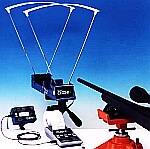
There is nothing more frustrating (or embarassing) than sending a live round into your expensive new chronograph. As the photo below demonstrates, with most types of chronographs (other than the barrel-hung Magnetospeed), you can fatally injure your expensive chrono if it is not positioned precisely.
When setting up a chrono, we always unload the rifle, remove the bolt and bore-sight to ensure that the path of the bullet is not too low. When bore-sighting visually, set up the rifle securely on the sandbags and look through the bore, breech to muzzle, lining up the barrel with your aim point on the target. Then (during an appropriate cease-fire), walk behind the chronograph. Looking straight back through the “V” formed by the sky-screens, you should be able to see light at the end of the barrel if the gun is positioned correctly. You can also use an in-chamber, laser bore-sighter to confirm the visual boresighting (see photo).
Adjust the height, angle and horizontal position of the chronograph so the bullet will pass through the middle of the “V” below the plastic diffusers, no less than 5″ above the light sensors. We put tape on the front sky-screen supports to make it easier to determine the right height over the light sensors.
Use a Test Backer to Confirm Your Bullet Trajectory
You can put tape on the support rods about 6″ up from the unit. This helps you judge the correct vertical height when setting up your rifle on the bags. Another trick is to hang a sheet of paper from the rear skyscreen and then use a laser boresighter to shine a dot on the paper (with the gun planted steady front and rear). This should give you a good idea (within an inch or so) of the bullet’s actual flight path through the “V” over the light sensors. Of course, when using a laser, never look directly at the laser! Instead shine the laser away from you and see where it appears on the paper.
Alignment of Chronograph Housing
Make sure the chrono housing is parallel to the path of the bullet. Don’t worry if the unit is not parallel to the ground surface. What you want is the bullet to pass over both front and rear sensors at the same height. Don’t try to set the chrono height in reference to the lens of your scope–as it sits 1″ to 2″ above your bore axis. To avoid muzzle blast interference, set your chronograph at least 10 feet from the end of the muzzle (or the distance recommended by the manufacturer).
Rifles with Elevated Iron Sights
All too often rookie AR15 shooters forget that AR sights are positioned roughly 2.4″ above the bore axis (at the top of the front sight blade). If you set your bullet pass-through point using your AR’s front sight, the bullet will actually be traveling 2.4″ lower as it goes through the chrono. That’s why we recommend bore-sighting and setting the bullet travel point about 5-8″ above the base of the sky-screen support shafts. (Or the vertical distance the chronograph maker otherwise recommends). NOTE: You can make the same mistake on a scoped rifle if the scope is set on very tall rings, so the center of the cross-hairs is much higher than the bore axis line.
TARGET AIM POINT: When doing chrono work, we suggest you shoot at a single aiming point no more than 2″ in diameter (on your target paper). Use that aiming point when aligning your chrono with your rifle’s bore. If you use a 2″ bright orange dot, you should be able to see that through the bore at 100 yards. Using a single 2″ target reduces the chance of a screen hit as you shift points of aim. If you shoot at multiple target dots, place them in a vertical line, and bore sight on the lowest dot. Always set your chron height to set safe clearance for the LOWEST target dot, and then work upwards only.
Other Chronograph Tips from Forum Members:
When using a chronograph, I put a strip of masking tape across the far end of the skyscreens about two-thirds of the way up. This gives me a good aiming or bore-sighting reference that’s well away from the pricey bits. I learned that one the hard way. — German Salazar
A very easy and simple tool to help you set up the chronograph is a simple piece of string! Set your gun (unloaded of course) on the rest and sight your target. Tie one end of the string to the rear scope ring or mount, then pull the string along the barrel to simulate the bullet path. With the string showing the bullet’s path, you can then easily set the chronograph’s placement left/right, and up/down. This will also let you set the chrono’s tilt angle and orientation so the sensors are correctly aligned with the bullet path. — Wayne Shaw
If shooting over a chrono from the prone position off a bipod or similar, beware of the muzzle sinking as recoil causes the front of the rifle to drop. I “killed” my first chronograph shooting off a gravel covered firing point where I’d not given enough clearance to start with and an inch or two drop in the muzzle caused a bullet to clip the housing. — Laurie Holland
What’s more fun that a barrel of monkeys? Well a barrel of ammo of course. Here’s an item for the man who has everything, or maybe the prepper who needs enough 5.56x45mm ammo to defeat a horde of zombies, plus their undead friends and relatives. For a mere $5999.99 you can get a barrel containing 12,500 rounds of Federal 5.56x45mm 62gr “Green Tip” ammunition. No joke — this is a real item offered for sale by Grafs.com. When you’re not shooting, your ammo barrel can do double duty as a handy side-table in your living room or man-cave. Just the thing to hold a plate of snacks and your favorite beverage.
In all seriousness, this is impressive Mil-Spec FMJ ammunition right off the production line. The 62-grain green-tipped bullets feature a hardened steel penetrator core. The boxer-primed cases are fully reloadable (though the miltary primer crimps would have to be removed). The ammo is delivered in a heavy-duty steel drum, with steel clamp-on lid with rubber seal. Each container is plastic-lined and packed (from the factory) with dessicant pouches for long term storage.
NOTE: In some jurisdictions there may be restrictions on this product (based on the quantity of rounds or other factors). Check your local laws and regulations.
To be honest, we’re not sure how we feel about the whole zombie-theme marketing efforts in the gun industry. However, if you’re into green-tipped bullets, and blasting replicas of the undead, then get ready for the biggest Zombie-themed shooting match of the year. Hornady’s epic Zombie in the Heartland Pandemic is two weeks away. This event will take place May 30 – June 1, 2014 at the Heartland Public Shooting Park in Grand Island, Nebraska. The Pandemic traditionally has a rich prize table worth over $150,000. Prize include pistols, rifles, shotguns, scopes, AR uppers, gun parts, and gear of all kinds. Get more info (and watch videos from last year) at www.ZombiesintheHeartland.com.
Thanks to Hornady and other sponsors, the Pandemic is a veritable theme park for shootists, with many fun stages and innovative targets. Many new and reactive zombie targets have been developed specifically for this match. The use of paper zombie targets has been minimized. Shotguns, rifles and handguns will be used on most stages.
In 2013, there were 10 Competitive Stages and 5 Sidematch Stages. Match directors expect at least the same number of stages for Pandemic 2014. Each presents a different shooting challenge, and a different threat. View the Zombie Guide Page for general information and firearms classifications.
The National Shooting Sports Foundation (NSSF) will award $100,000 in grants to public and private colleges for start-ups of new target-shooting clubs and teams. Up to $10,000 will be awarded to each qualifying school. Schools receiving grants range from large universities to community colleges. In the last grant session, 20 colleges received program start-up funding, including the University of Colorado at Boulder, North Idaho College, Slippery Rock University, Concordia College, Middlebury College and Wichita State University, to name several.
The grants are provided through NSSF’s Collegiate Shooting Sports Initiative, which has assisted more than 75 schools with building competitive and recreational shooting programs through more than $1 million in support. The program is credited with helping to spur growth in collegiate target shooting across the country.
Successful target shooting programs have developed from modest beginnings — sometimes involving just several enthusiastic students, a dedicated coach and the NSSF grant. “Students and coaches provide the passion, NSSF provides the seed funding,” said NSSF Manager of Shooting Promotions Zach Snow.
Visit www.nssf.org/college to learn about grant opportunities for college shotgun, rifle or pistol teams/clubs. The NSSF also offers a PDF Brochure on Establishing a Collegiate Shooting Program. This includes sample By-laws and Rules.


 Federal’s high-resolution, slow-motion video-graphy helps demonstrate which loads are the best for specific uses. The ultra-slo-mo footage provides a detailed view of each bullet penetrating ballistic gelatin blocks. These blocks closely mimic animal tissue and clearly display performance characteristics.


 Forum member Jacob spotted this simple, but effective set of scope ring inserts on the

 When setting up a chrono, we always unload the rifle, remove the bolt and bore-sight to ensure that the path of the bullet is not too low. When bore-sighting visually, set up the rifle securely on the sandbags and look through the bore, breech to muzzle, lining up the barrel with your aim point on the target. Then (during an appropriate cease-fire), walk behind the chronograph. Looking straight back through the “V” formed by the sky-screens, you should be able to see light at the end of the barrel if the gun is positioned correctly. You can also use an in-chamber, laser bore-sighter to confirm the visual boresighting (see photo).


 What’s more fun that a barrel of monkeys? Well a



 The grants are provided through NSSF’s Collegiate Shooting Sports Initiative, which has assisted more than 75 schools with building competitive and recreational shooting programs through more than $1 million in support. The program is credited with helping to spur growth in collegiate target shooting across the country.


