Colorado voters have sent a message that has caused a stir around the country. In the first-ever state recall election in Colorado history, two anti-gun politicians were sent packing. Colorado State Senate President John Morse was turned out of office on a 51-49% vote, while fellow Democrat State Senator Angela Giron was removed from office on a 56-44% tally.
The L.A. Times reports: “In an unprecedented backlash, two state lawmakers who helped stiffen Colorado’s gun laws were ousted Tuesday in a recall that turned into a nationally watched referendum on gun control.” Two new Republican-party Senators, Colorado Springs Councilman Bernie Herpin and Pueblo police officer George Rivera, were elected to replace Morse and Giron, respectively.
Senate President Morse lead the charge for new gun control laws, enacted in Colorado earlier this year without a single Republican vote. Critics attacked the legislation, saying it was fast-tracked through Colorado’s Democratic-controlled Legislature with insufficient public debate. Recall sponsors also faulted Morse and Giron for failing to listen to constituents’ concerns about Second Amendment rights.
The Shooting Wire reports:
“Both races were described by many in the mainstream media as a national litmus test on gun rights versus new regulations. If that’s the case, it may also prove that all politics are, indeed, local. Despite being outspent by more than 7 to 1, pro-gun advocates turned out more voters than their opposition. But Colorado residents told reporters that when it came down to it, the millions spent by either side wouldn’t matter. This recall was designed to send a simple message to elected officials.’If I don’t listen to my boss and do what he wants,’ one Colorado Springs voter told reporters, ‘I get fired. Why should our elected officials be any different?’.”
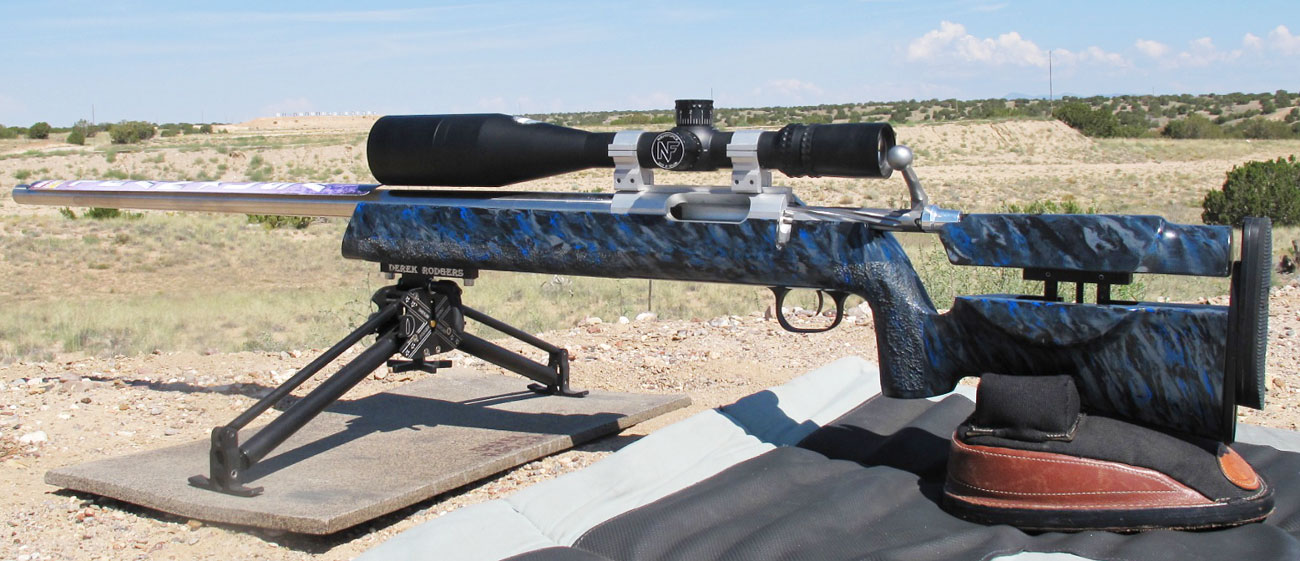
While attending the 2013 F-Class World Championships at Raton, we had a chance to talk with Derek Rodgers, who had just been named the 2013 U.S. F-TR National Champion. Derek’s F-TR Win at Raton makes him the only shooter to have won U.S. F-Class National titles in both F-Open and F-TR divisions. Derek was excited about his performance at Raton: “F-TR was my first love in competitive shooting and [winning the F-TR title] has always been a personal goal to achieve”. In this Q&A session, Derek tells us about his rifles and his Nationals-winning .308 Winchester load. Derek also provides some advice for new shooters in the F-TR game.
Q: Readers want to know about your rifle. How did your select your stock, action, and bipod? And tell us about working with your gunsmith Doan Trevor and the quality of his work.
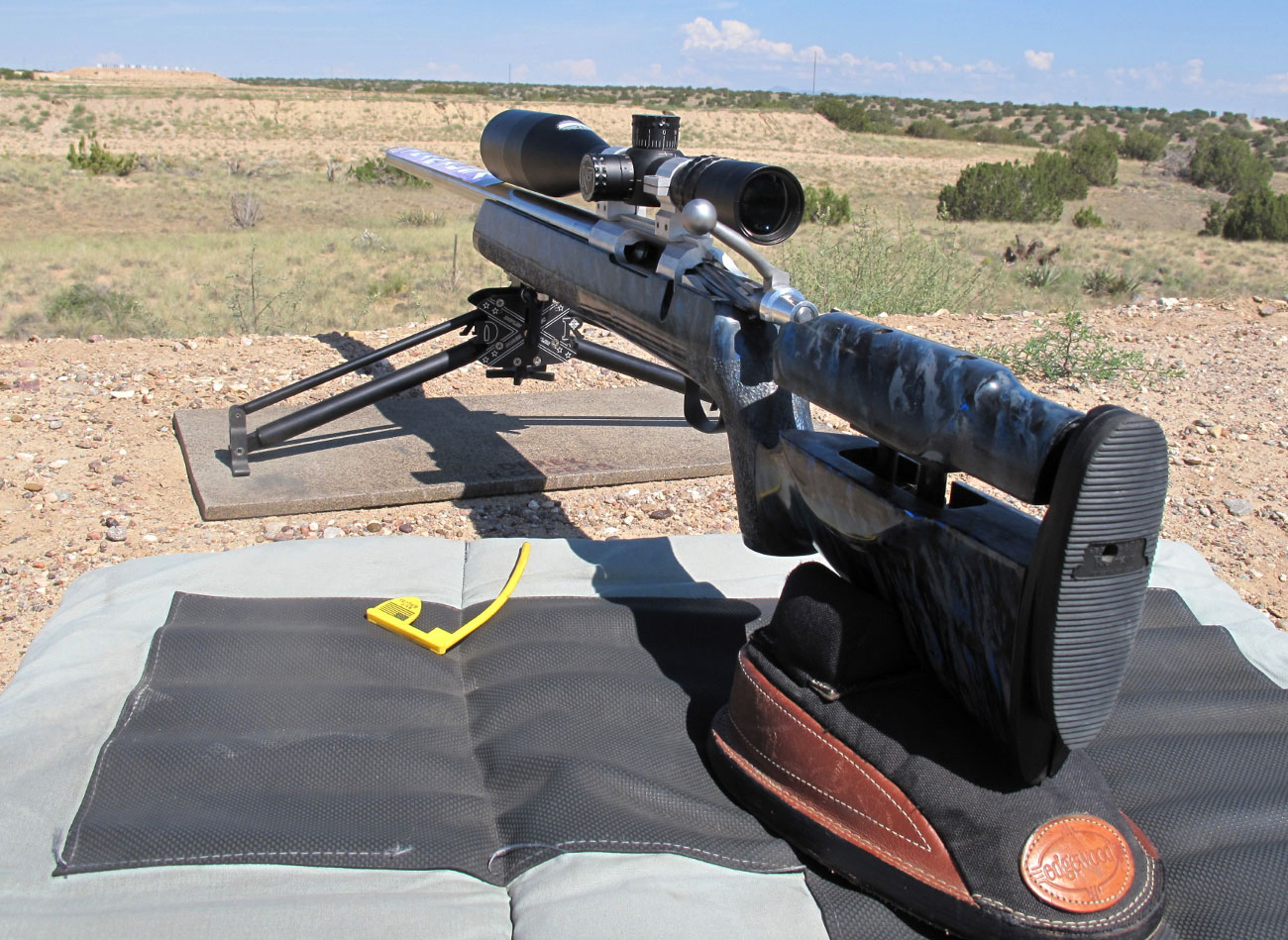
Derek: For my F-TR project, I carefully chose as many lightweight components as possible, without compromising performance. I wanted to put the weight savings (from light components) into a heaver, stiffer barrel. The rifle features a left port, left bolt Kelbly F-Class Panda action fitted with a Kelbly trigger. The stock was acquired as an uncut blank. It’s a McMillan Prone stock and is very comfortable in design. It also has a nice vertical pistol grip and gentle palm swell. This makes getting behind the gun feel very natural. [Editor’s Note: Though Derek is a right-hander, he shoots with a Left bolt-Left port action. This allows him to stay in the shooting position, right hand on grip, while manipulating the bolt (and feeding rounds) with his non-trigger-pulling hand.]
CLICK on Rifle Photos for Full-Screen Versions
Rifle photos by Dennis Welker.
Doan Trevor built the entire rifle. Doan even made all of the hardware on the gun. Doan was able to drop pounds vs. ounces as a result. Doan’s 3-way butt-plate hardware alone weighs just half a pound! Doan was highly attentive in helping me build the gun the way I wanted. His bedding and fitment is clean and he has creative ideas for the competitive shooter. While my stock is fiberglass, Doan really shines when it comes to building stocks from wood blanks. In fact, Doan built the stock used by second-place finisher Lige Harris, and also fourth-place Trudie Fay. I feel fortunate to have Doan so close. He’s truly a master craftsman who can quickly turn a project into reality.
I chose a Bartlein barrel on this rifle. It is an 1:11″ twist, 32″ long, heavy-contour barrel to stabilize heavy bullets. This barrel was a real hummer from the start. I shot six shells over the chronograph to determine initial chamber behavior and all six loads shot into 1 hole at 100 yards. Each cartridge had 0.5 grains increase in powder. That’s never happened to me before.
Up front, I used a Duplin Bipod. It weighs just 17.2 ounces and is made in North Carolina by Clint Cooper and supplied through Brownells/Sinclair. It is a new product for them and it has already proved to be an extremely lightweight, solid platform. Kelbly rings and an NXS 8-32X scope top the rifle off.
Q: Could you talk about your experience shooting at Raton — dealing with the challenging winds. Did you have any strategy going into the Nationals? Did that change?
Derek: The Raton winds can be intimidating to a person that has never shot there before. In fact, one of the first comments I heard was that it was ugly and nasty out there as the flags ripped straight out to the NW. I glanced downrange and thought it looked like another beautiful New Mexico day (being from NM does have its perks). There is usually no shortage of big wind out here. I’m fortunate to shoot 1K matches locally at a Del Norte Gun Range located outside of Albuquerque. It prepared me to shoot when I can see the mirage and proceed with caution when I can’t. It is the same elevation as the Whittington Center and gives me true testing with actual come-ups that will work dead on at both ranges. My strategy going in to the match was to shoot heavy 200 grain Berger hybrid bullets. I felt like it was the best compromise between BC and velocity. My load held an incredibly flat water-line and that gave me the confidence to either shoot through the entire string in tough wind or stop and wait until the switching winds returned to what I like to see. I was fortunate to pick the correct wind-sets and jump in when I needed to — or wait when the mirage didn’t look right. It paid off as I saw competitors’ targets raised with wide ring spotters. A few times I watched my clock and let a couple relays tick down to the last several minutes before finishing. The winds are quite challenging here and wind pickups and let-offs are huge! The wind calls are definitely magnified in Raton.
Q: You are the only shooter to have won both the F-Open and F-TR U.S. National Championships. How would you compare and contrast F-Open vs. F-TR?
Derek: Now that I’ve won both F-TR and F-Open National titles, I have finally captured the elusive F-TR national victory. F-TR was my first love in competitive shooting and [winning the F-TR title] has always been a personal goal to achieve. I could not be happier to win in my home state with a spectacular level of expertise in attendance. You really need to remain 100% focused in F-TR and try not to miss any condition change. If you do, you will pay dearly as the .308 Win just doesn’t have the extra horsepower to plow through the minor wind changes like Open guns can. Needless to say, F-Open shooters have their hands full in Raton as well; high BCs and fast, booming magnums aren’t the only way to get good scores. Open shooters need to be just as in-tune with the wind. Most of the Open Class shooters use sophisticated rests and cartridges superior to the .308 Win. However, I saw rough conditions disrupt many top shooters as they handed over their score cards to line officers. Although not in a front rest, I have learned to manage my F-TR gun to keep it tracking straight back under recoil. I had two main concerns in Raton this year with my F-TR rifle: 1) Keep all my shots on paper even if the winds blow 25+ mph; and 2) do NOT shoot another target! It’s very easy to do if your bipod slides over during recoil. That was less of a concern for me when I shot Open. Open Class rifles have a more stable foundation that stays in place better. However, just one crossfire at this level will take you out of contention to win anything in Open or F-TR. Both classes are very tough these days on the upper level and you can’t afford to give away points.
Q. What was your load for Raton and did you have to make any adjustments for the altitude or temperature?
Derek: My load for the upcoming Nationals was something I used earlier in the year to win the 2013 East Coast Sinclair Nationals: Berger 200gr Hybrids, Lapua brass, Varget powder, Wolf LR primers. I felt it was very consistent against some of the best F-TR shooters around. However, my biggest concern was my load being over-pressured in late summer. It was a hot year in New Mexico. In June, I made a couple trips to Raton and discovered my loads that I felt were safe were actually on the hot side. I tested locally in the heat of the day vs. calm cool mornings. I also spent quite a bit of time studying past load data / temperatures and came up with a game plan to work with what I had. I kept my fingers crossed that the ambient temperature would stay in the low 80s. I knew my load shot well from 50-80 degrees, but above that and I thought I may have problems with the groups coming apart late in a string. I saw this happen to me in the past with temp-stable powders in a .308 Win. In fact, .308 Win loads become much more critical when pushing the cartridge to its full capacity. Had the temps been in the mid to upper 90s, I’m sure the rifle would have shot differently.
Q: What advice would you offer to someone getting started in F-TR competition?
Derek: I think shooting F-TR has allowed me to really get an idea of what the wind is doing. If a new shooter is interested in trying it, the best tips I can offer is to partner up with a few experienced shooters that know how to hand-load carefully and compare shooting notes. This helps someone get traction with proven methods. Another tip would be to get matches under your belt–at different ranges. It may seem trivial, but each range is different. The shooter may benefit by seeing something that he hasn’t encountered before. The other thing I’d suggest to new shooters is not to worry about your score when starting. Keep shooting. More trigger time is key. I’d recommend working on eliminating your lowest ring value first. For example, if you’re lowest score was a 6, next match try to only shoot better than 7s. Once that is eliminated work on your 8s. When you consistently shoot 9s and 10s then you can be assured that your technique is solid and manageable. Higher scores and Xs will come….
Story based on report by Kyle Jillson inNRABlog
A few days ago we reported that the percentage of females involved in target shooting (pistol, rifle, shotgun) is growing significantly. Well, here’s proof. This past weekend, approximately 600 ladies participated in a Women On Target shooting clinic — that’s quite a turn-out. On September 7, the Oklahoma City Gun Club (OKCGC) hosted its 14th Annual Women’s Clinic in Arcadia, OK. At the clinic, 600 lady shooters learned pistol, rifle, and shotgun marksmanship skills and firearms safety procedures. More than 100 volunteers provided hands-on instruction. Remarkably, the event was sold out for months and the OKCGC actually had to turn away hundreds more interested women. All firearms and ammunition were provided by generous sponsors including the NRA Foundation, Benelli, DPMS Panther Arms, Glock, and Smith & Wesson.
“Since Women On Target’s formation, the Oklahoma City Gun Club has been an integral partner in introducing women to the safe and proper handling of firearms,” said Diane Danielson, Women On Target Instructional Clinic Coordinator. “Their clinic’s volunteers have taught beginning marksmanship skills to more than 2,000 women and the dedication and patience they display has helped the clinic remain the country’s largest for the past nine years.”
Women On Target mentors women new to recreational shooting and hunting sports in a safe and friendly environment with like-minded females. Since its inception in 1999, the program has introduced nearly 80,000 women to the shooting sports. Each year, more than 200 clinics are held throughout the United States.
You probably know Dustin Ellermann from the Top Shot TV show. Dustin, a self-trained “natural” marksman, was the Season 3 Champion. You may not know that Dustin also runs a Christian Camp for young people, Camp His Way. One of the Camp’s special programs is a weekend marksmanship camp taught by Dustin.
Multi-Activity Marksmanship Camp
At these sessions, the young campers get to shoot, practice archery, throw tomahawks, ride horses, and even try out blow-guns. Dustin reports: “This past weekend we had another amazing Marksmanship Camp. We had a great group of campers and of course lots of fun shooting/throwing/riding/slinging! Thanks to all our sponsors for helping us make this weekend awesome: 5.11 Tactical, Elzetta Design, NextLevel Training, Volquartsen Custom, GhostTargets.com, Cold Steel and more.” CLICK for equipment list.
Notice the young campers always wear ear and eye protection when shooting firearms. That’s as it should be. We wish adult shooters, including benchrest, smallbore, High Power, and F-Class competitors, followed this important safety practice.
Wipe-Out foam bore cleaner is a product we’ve used with great success on many rifles. With sufficient dwell time, it removes both carbon and copper fouling. You can combine it with Wipe-Out Accelerator or Patch-Out liquid to speed up cleaning time. Many shooters, including this editor, find that bore-brushing has been virtually eliminated with the regular use of Wipe-Out. (With some barrels however, you may still have to brush or use a bore paste if you notice stubborn carbon build-up in the throat area.)
Out standard procedure with Wipe-Out is to insert an O-ring-sealed cleaning rod guide into the chamber and then squirt through the muzzle in short puffs. Put a towel or rag on the comb of your stock and watch for a little bit of foam to exit the rod guide. We usually wait 30 minutes for the bubbles to dissipate, then do a second foam application. Be sure to clean off any excess foam before it drips on your stock.
Applying Wipe-Out from Breech
You can also apply Wipe-Out from the breech. To allow breech-first application, Wipe-Out cans now come with a short plastic tube and a plastic tip that fits in your chamber. These can also be purchased separately for $2.50. However, we’ve found the plastic tip is too big for some chambers and it is not always easy to get a good, secure seal even if it does fit. Jason Baney has come up with a solution. READ Jason’s Wipe-Out Article.
Use Fitted Tubing for Breech-First Applications of Wipe-Out
You can apply Wipe-Out through the breech very effectively if you use fitted, plastic tubing. While this works well for bolt-actions, breech application is particularly handy for the Garand, M1A and other semi-autos. Jason Baney has written a short article describing this process. In a nutshell, you need one piece of tubing that fits the chamber tightly and then connects with a second, smaller diameter tube that attaches to the Wipe-Out can. This avoids any “over-spray” of foam in the action area, providing a clean, simple solution. Just squirt for a second or so, and wait for white foam to come out of the muzzle. Be sure to keep Wipe-Out off fine wood stocks.
Are target shooters a dying breed? Apparently not according to a new NSSF study. Remarkably, 20% of all target shooters began participating in the past five years. That’s great news. The next generation of target shooters is more diverse and more urban than ever before — and there are more females getting involved in target shooting — a lot more. 37% of new target shooters are female, a big number compared to older generations. The NSSF’s newly-commissioned study shows that, in years ahead, our shooting ranges will see more lady shooters and more participants who come from urban/suburban areas (as opposed to rural communities).
The NSSF report shows that one-fifth of target shooters in America first started participating in the shooting sports between 2008 and 2012. That means 20 percent of all target shooters began participating in the past five years. That’s promising news.
Here Are Some Key Findings:
Younger: 66 percent of new shooters fall into the 18-to-34-year-old category compared to 31 percent in the same age category for established shooters.
Female: 37 percent of new target shooters are female compared to 22 percent of established target shooters.
Urban: 47 percent of new target shooters live in urban/suburban settings versus 34 percent of established target shooters.
Introducing New Shooters to the Sport — Tips from a Champion
In this video, Champion pistol shooter Doug Koenig offers advice on how to introduce newcomers to the shooting sports. With new shooters, Doug says you need to keep the experience safe and fun. Start with low-recoil firearms and use reactive targets to increase the “fun factor”.
Koenig’s Tips for Successful Range Sessions with New Shooters
1. Start off a new shooter with an airgun or a .22 LR. “You don’t want to start them out with the biggest, loudest firearm you have in your collection.”
2. Make sure the shooting is fun. “Use [reactive] targets — steel targets, knock-down targets, clay pigeons sitting on the bank — anything reactive, something they can see happen.” You want to keep people interested, keep them excited.
3. Remember the reason we go to the range — to have a good time. Don’t overload newcomers with stress. “Keep it fun, keep it safe, and keep everything in perspective.” Remember that [newcomers] “are the future of the shooting sports for all of us.”
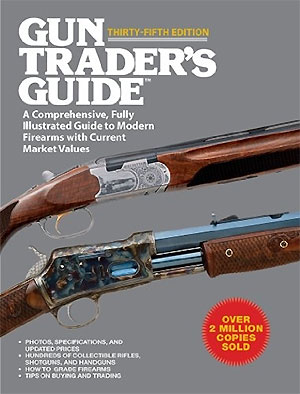
The new, 35th Edition of the Gun Trader’s Guide has just been released. This fully-illustrated resource features current market values for thousands of rifles, pistols, and shotguns. This 35th Edition, now with over 1000 photographs, boasts one hundred new entries since last year’s edition. Along with the Blue Blue of Gun Values, the Gun Trader’s Guide is one of the two definitive resources on gun prices. If you buy or sell firearms, the Gun Traders’ Guide is a must-have item that will pay for itself. Over two million copies of the Gun Trader’s Guide have been sold to date. Order soon to be one of the first to own the new 35th Edition. Amazon’s price is $22.97.
New this year is a Kindle Edition of the Gun Trader’s Guide to Rifles. Packed with 608 pages of material, this eBook edition of the Guide can be viewed on a Kindle, iPad, laptop, or your home computer. Introductory price is just $16.47, with release slated for September 13, 2013. You can pre-order now via Amazon.com.
Get Books Fast from Amazon.com
You can order the Gun Trader’s Guide, the Blue Book of Gun Values and other popular firearms and shooting books through the AccurateShooter Bookstore. To save you time, we’ve collected the best books on shooting, reloading, hunting, and gunsmithing all in one location. Ordering, secure billing, and shipping are all handled efficiently by Amazon.com.
Well, yes, that headline is a come-on. But there’s truth in the promise. The “miracle device” to which we refer is a simple wind indicator aka “windflag”. Remarkably, many shooters who spend $3000.00 or more on a precision rifle never bother to set up windflags, or even simple wood stakes with some ribbon to show the wind. Whether you’re a competitive shooter, a varminter, or someone who just likes to punch small groups, you should always take a set of windflags (or some kind of wind indicators) when you head to the range or the prairie dog fields. And yes, if you pay attention to your windflags, you can easily cut your group sizes in half. Here’s proof…
Miss a 5 mph Shift and Double Your Group Size
The table below records the effect of a 5 mph crosswind at 100, 200, and 300 yards. You may be thinking, “well, I’d never miss a 5 mph let-off.” Consider this — if a gentle 2.5 mph breeze switches from 3 o’clock (R to L) to 9 o’clock (L to R), you’ve just missed a 5 mph net change. What will that do to your group? Look at the table to find out.
Values from Point Blank Ballistics software for 500′ elevation and 70° temperature.
Imagine you have a 6mm rifle that shoots half-MOA consistently in no-wind conditions. What happens if you miss a 5 mph shift (the equivalent of a full reversal of a 2.5 mph crosswind)? Well, if you’re shooting a 68gr flatbase bullet, your shot is going to move about 0.49″ at 100 yards, nearly doubling your group size. With a 105gr VLD, the bullet moves 0.28″ … not as much to be sure, but still enough to ruin a nice small group. What about an AR15, shooting 55-grainers at 3300 fps? Well, if you miss that same 5 mph shift, your low-BC bullet moves 0.68″. That pushes a half-inch group well past an inch. If you had a half-MOA capable AR, now it’s shooting worse than 1 MOA. And, as you might expect, the wind effects at 200 and 300 yards are even more dramatic. If you miss a 5 mph, full-value wind change, your 300-yard group could easily expand by 2.5″ or more.
Forest of Windflags at World Benchrest Championships in France in 2011
If you’ve already invested in an accurate rifle with a good barrel, you are “throwing away” accuracy if you shoot without wind flags. You can spend a ton of money on fancy shooting accessories (such as expensive front rests and spotting scopes) but, dollar for dollar, nothing will potentially improve your shooting as much as a good set of windflags, used religiously.
All target shooters strive for perfect shot placement. Well one man has come closer to perfection than any other shooter who ever lived. You are looking at Michael Stinnett’s .0077″ NBRSA world-record group, the smallest 100-yard 5-shot group ever shot in the history of rifle competition. (We’re told the group was certified at .0077″ though labeled .008″ on this photo. A moving backer verified that this was FIVE shots.)
Call it stunning, call it humbling, call it amazing. It is, quite simply the apotheosis (“perfect example”) of accuracy. This is what we all hope to achieve. It’s staggering to see that a rifle can drill FIVE perfectly-overlapped holes — the last virtually indistinguishable from the first — at a target a football field (100 yards) away. Yes the stars aligned for Mike, but it’s great to see a benchmark like this, if only to remind us what is possible in our sport of precision shooting. (Sighters appear below record target.)
Below is a larger-than-life-size view. Using this photo we measured the group with target-calculating software, and it came out .006″ (the software only goes to three digits). We recognize that it would be much better to work from the real target rather than a photo, so we are not challenging the official measurement in the least. But this does confirm that this is a phenomenally small five-shot group.
Many folks have asked about the gun and ammo that produced the .0077″ group. The Light Varmint-class Benchrest rifle was chambered as a .30-caliber wildcat, the 30 Stewart, which is based on the 6.5 Grendel case necked up. Mike was using Hodgdon H4198 powder behind BIB 114gr, 10-ogive bullets. Notably, the record-setting ammo was pre-loaded before the match. Here is Mike’s tuner-equipped rifle. CLICK HERE for more information on the rifle and cartridge.
Best Group Ever Record Rifle Equipment Report
Action: Kelby Panda “Speedy Shorty” with solid bolt and PPC-diameter bolt face. Kelby was asked to build several actions which were identical with the intent to eliminate any variance in head space between the two new rifles. This helped me use a single set-up on sizing dies for both rifles and ammo is interchangeable. Both actions were sent to Thomas ‘Speedy’ Gonzalez to be blue-printed and have Jewell triggers installed.
Reamer: 30 STEWART (I just call it a 30 PPC as that is what everyone expects, but it is in fact a custom design and Ralph deserves about 99% of the credit).
Barrels: Krieger was selected for the barrels. After discussions with Randy Robinett of BIB Bullets, a 1:17″ twist was identified as the correct, safe solution. Ralph Stewart has cut all my chambers using a custom-designed reamer. [Our goal] was consistent headspace and Ralph has been able to keep my barrels within .0002 variance. The barrel tuner also comes from Ralph Stewart.
Stock: Larson (including action bedding)
Scope: Leupold 45X Competition in Kelby Single Screw Tall Rings
Brass: Lapua (Base case is 6.5 Grendel)
Bullets: Randy Robinett (BIB) 30 Cal. 114gr, 10 Ogive (secondary bullet; primary is 112gr BIB)
If you are looking for a spotting scope, here’s a very good deal. The 20-60X Vortex Viper spotting scope (angled or straight) is now on sale at Cabela’s for just $479.99. That’s much cheaper than we’ve ever seen it, and it is currently listed elsewhere for up to $649.00. This spotter features a large 80mm multi-coated front objective, 20-60X zoom eyepiece, and scratch-resistant polymer armor on the scope body. There is a rotating tripod attachment ring, and a Picatinny rail for mounting accessories. The $479.99 Cabela’s sale price includes the 20-60X eyepiece. This is a limited-time offer — price subject to change.
While Vortex says this scope has “extra-low dispersion” glass, this model should not be confused with Vortex’s more expensive Razor HD line of spotting scopes. Nonetheless, this Viper spotter is all the spotting scope most hunters or iron-sight high power shooters need. If you’re trying to spot 6mm bullet holes beyond 500m, you will want to move up to something better.
Product Tip from EdLongrange. We welcome reader submissions.


 Colorado voters have sent a message that has caused a stir around the country. In the first-ever state recall election in Colorado history, two anti-gun politicians were sent packing. Colorado State Senate President John Morse was turned out of office on a 51-49% vote, while fellow Democrat State Senator Angela Giron was removed from office on a 56-44% tally.






 You probably know Dustin Ellermann from the Top Shot TV show. Dustin, a self-trained “natural” marksman, was the Season 3 Champion. You may not know that Dustin also runs a Christian Camp for young people,


 Applying Wipe-Out from Breech


 Are target shooters a dying breed? Apparently not according to a new NSSF study. Remarkably, 20% of all target shooters began participating in the past five years. That’s great news. The next generation of target shooters is more diverse and more urban than ever before — and there are more females getting involved in target shooting — a lot more. 37% of new target shooters are female, a big number compared to older generations. The NSSF’s newly-commissioned study shows that, in years ahead, our shooting ranges will see more lady shooters and more participants who come from urban/suburban areas (as opposed to rural communities).

 Well, yes, that headline is a come-on. But there’s truth in the promise. The “miracle device” to which we refer is a simple wind indicator aka “windflag”. Remarkably, many shooters who spend $3000.00 or more on a precision rifle never bother to set up windflags, or even simple wood stakes with some ribbon to show the wind. Whether you’re a competitive shooter, a varminter, or someone who just likes to punch small groups, you should always take a set of windflags (or some kind of wind indicators) when you head to the range or the prairie dog fields. And yes, if you pay attention to your windflags, you can easily cut your group sizes in half. Here’s proof…


 If you are looking for a spotting scope, here’s a very good deal. The


