|
|
July 29th, 2013
Soldiers from the U.S. Army Marksmanship Unit (USAMU) captured the overall individual and team championships at the 52nd Annual Interservice Rifle Championships, held July 16-23 at the Marine Corps Base in Quantico, Virginia. More than 100 competitors from the Army, Army Reserve, Marine Corps, Navy, and National Guard fired on targets at 200, 300, 600, and 1,000-yard distances.

SSG Brandon Green won his third individual championship and was also a member of the winning Army team, which claimed its seventh consecutive team championship and 16th in the past 19 years. Posting a 992-56X score, Green made history with his third championship. He is the only Army marksman to ever win the Interservice championship three times and the second armed service member to do so in the competition’s 52-year history. “The whole match went very well,” Green said. “The weather was perfect, the guns and ammo shot well. You have to be focused out there and be on top of your game because the guy shooting next to you is just as good as you are.”

New 1000-Yard Service Rifle Record Set
SFC Daniel Peters won the service rifle long-range championship. Peters also set a new service rifle 1,000-yard record with a score of 200-11X. SSG Ty Cooper won the match rifle long-range championship. SGT Augustus Dunfey won the prestigious Lt. Col. C.A. Reynolds Memorial Trophy for high score in the 10-man team match with an outstanding 499-22X.
USAMU Wins All Team Matches
The USAMU swept all team matches, including the 1,000-yard, Commanding General, Marine Corps Infantry Trophy, and 10-man Interservice Rifle Team Championship matches. “The team continues to be successful because of the holistic approach that the unit takes towards marksmanship,” said Capt. Ryan Calhoon, operations officer. “We combine a world-class custom firearms shop; a load facility that continues to develop and test ammunition for our weapons; and world-class shooters[.]”
File Photo from 2010 Interservice Rifle Championships

Next Stop — Camp Perry
The USAMU rifle team is now focused on Camp Perry, Ohio, where team members will conduct the annual Small Arms Firing School followed by competing in the National Rifle Championships and National Trophy Matches.
July 29th, 2013
 3-Gun Nation (3GN) has redesigned the 3GunNation.com website, adding many key enhancements. The most important new feature is a Google-based, interactive mapping system that shows 3GN clubs around the country. Each 3GN range location is “pinned” on an interactive map. Just click on the pin to find more information. Zoom the map with your mouse scroll wheel to find three-gun friendly ranges in your area.
In addition, 3GunNation.com now features all past issues of the 3-Gun Nation E-Magazine. Simply click on the magazine tab to access hundreds of pages of 3-Gun eZine content. The home page now also features the 3GN leader boards, updated automatically after each match.

“With new competitors joining the 3GN ranks on a daily basis, the need to post and track scores is paramount” said Chad Adams, 3-Gun Nation Vice President. “3GN has reached a point in which our members demand their scores and rankings quickly, easily and in real-time. Thanks to our partners at Rangelog, we are now able to do just that.”
July 28th, 2013
We are often asked, “Which is better for a gun safe — an electronic lock or a dial lock?” We actually like both kinds of locks — depending on the application. We review the pros and cons of both electronic and mechanical locks in our comprehensive Gun Safe Buyers Guide. A digital keypad lock provides quick entry, while a quality, commercial-grade dial lock can deliver decades of reliable service, with no worries about dead batteries or worn-out keypads.
New Dual-Access Electronic + Dial Locking System
Until recently you had to choose one or the other — Electronic Lock or Dial Lock. But imagine if you could have the best of both worlds — keypad speed plus dial lock dependability. Well Cannon Safe has finally made that possible. Cannon is now offering a Dual-Access Combination Lock on its higher-end safes (Armory Series, Cannon Series, Commander Series). Cannon is currently the only safe company with a combined digital/mechanical lock system. Cannon’s new EMP dual-access lock offers rapid access, simplicity and day-to-day security of an electronic lock backed up by the assurance of a manual (rotary dial) combination lock.

Watch Demo of EMP Dual-Access Lock on Cannon Safe
 NOTE: The EMP dual-access lock is NOT available as an upgrade to older safes (yet). It is currently available with new Armory Series, Cannon Series, and Commander Series Cannon-made safes.
Cannon Safe’s President, Aaron Baker, declares: “Cannon’s EMP lock is the cutting edge of high security lock technology. It allows the … ease and security of a Type 1 high security lock with the peace of mind of a mechanical override, all of this rolled into the ultimate UL Type 1 rating. This is a huge step forward for safes and for the experience a safe owner will have in the future.” To learn more about the EMP Safe Locking System, visit www.cannonsafe.com.
July 27th, 2013
Little Crow Gunworks has updated its popular “World’s Finest Trimmer” (aka WFT). The new WFT 2 version is more versatile — it can now easily change from one cartridge family type to another. That makes the $69.95 product an even better value. Trimming works the same way as before — just push the cartridge case into the trimmer and cut depth is pre-set. When ordering the WFT 2, choose a trim chamber for your particular cartridge family (such as .308, 7mm-08, .243 Win). You can trim multiple cartridge types (with one trim chamber) by ordering the largest chamber in the family you plan to trim. To trim cartridges from a different family, simply order (and install) a different chamber insert.
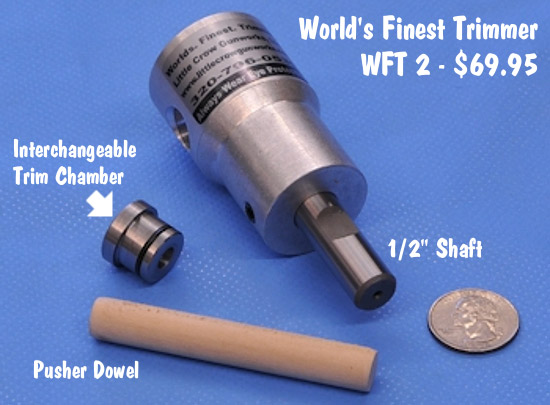
The WFT 2’s designers explain: “The two main improvements are the ability to trim up to 45 caliber and interchange trim chambers. The WFT 2 has a half-inch shaft and requires a half-inch chuck to drive it. The feature most customers asked for was the ability to interchange trim chambers. After many prototypes (and much testing) the solution came from our friend, Jim Lambert. Instead of press-fitting the trim chambers, as on our original WFT, the trim chambers on our WFT 2 feature a slight slip-fit-in bearing with a groove cut for an O-ring which creates a press fit.”
How to Change Trim Chambers
Changing out trim chambers is accomplished by removing the cutter and pushing out the trim chamber with the knock-out dowel that is provided with the WFT 2. To install the trim chamber, set the trim chamber on a flat surface and steadily push the housing onto the trim chamber. To set cut depth (COAL trim length) place a ‘master case’ in the trim chamber and slide the cutter up to the case mouth. The tighten the set screws.
Product Tip from EdLongrange. We welcome reader submissions
July 27th, 2013
 Americans are buying more guns than ever. FBI NICS Gun Purchase Background Check data (as adjusted by the NSSF), shows that June 2013 gun sales are up 3.0% over the same period Last Year (See Chart 1). This marks the 37th straight month that NSSF-adjusted NICS figures have increased when compared to the same period the previous year. (This year’s January increase was even more dramatic — see Chart 2). What’s even more interesting, in June 2013, Americans purchased more than twice as many guns as they did a decade ago in June 2003 — roughly 870,000 vs. roughly 405,000. That’s a big difference.
CHART 1 — Adjusted NICS Checks in Month of June

CHART 2 — Adjusted NICS Checks in Month of January

Understanding the Numbers
The June 2013 NSSF-adjusted National Instant Criminal Background Check System (NICS) figure of 872,025 is an increase of 3.0 percent over the NSSF-adjusted NICS figure of 846,437 in June 2012. The adjusted NICS data were derived by subtracting out NICS purpose code permit checks used by several states such as Connecticut, Illinois, and Utah for CCW permit application checks as well as checks on active CCW permit databases. Though not a direct correlation to firearms sales, the NSSF-adjusted NICS data provide a more accurate picture of current market conditions. For additional information on NICS or to view a complete set of the current monthly reports, please visit the NICS website.
July 26th, 2013
 A $10 million-dollar CDC report ordered by President Obama determined that victims of crime who were armed with a firearm suffered fewer injuries than crime victims who were un-armed.
Well, at least the CDC came up with the right answer, but we’re flabbergasted at the cost of this study. Dustin Ellermann, past Top Shot Champion, comments: “$10,000,000 to discover the obvious… [at least] maybe now the anti-gunners will stop yelling ‘If you have a gun it will most likely be used against you!'”
According to Texas Fish & Game Blog, the CDC Report, entitled Priorities For Research to Reduce the Threat of Firearm-Related Violence, reveals that “studies that directly assessed the effect of actual defensive uses of guns (i.e., incidents in which a gun was ‘used’ by the crime victim in the sense of attacking or threatening an offender) have found consistently lower injury rates among gun-using crime victims compared with victims who used other self-protective strategies.”
Here are some comments on a related NewsMax.com story about the CDC report:
I am glad that an official Obama research project shows the same thing that Professor Gary Kleck found in his research about 20 years ago. Professor Kleck found that an honest citizen that had a gun saved himself from death more than 1 million times a year and often did not have to fire a shot. Usually when the crook saw that the citizen was armed that was the end of it.
Why does our government have to spend millions of dollars to do a study to find out what everyone else on earth in the history of man has already known?
July 26th, 2013
 Kestrel 4500 Shooter’s Weather Meters with integrated Applied Ballistics software are finally shipping. Bryan Litz, founder of Applied Ballistics LLC, reports: “Long range shooting just got a little easier. We are pleased to announce that the Applied Ballistics Kestrels have arrived! They are now available for immediate shipment. Pre-orders will ship today.” To order, follow this link for the Applied Ballistics Store.
These Kestrel 4500 Shooter’s Weather Meters include a full-featured ballistics solver and databases of bullets so you can accurately plot trajectories. The Applied Ballistics software accesses the environmental data (wind speed, humidity, altitude etc.) recorded by the Kestrel to provide a more precise trajectory.

Features of Kestrel 4500 with Applied Ballistics Software
With integrated Applied Ballistics software, Kestrel users are now able to select from either G1 or G7 ballistic coefficients (BC) when calculating a trajectory. The new Kestrel 4500 Shooter’s Weather Meter also offers the very extensive “Litz”-measured BC library of over 225 bullets. In addition to these features, users can “train” the software to match a specific rifle based on observed impacts at long range with the ballistics calibration feature. With more accurate BC data, shooters are empowered to make more precise trajectory calculations. The new Kestrel Shooter’s Weather Meter can also receive data from wind sensor arrays designed and sold by Applied Ballistics. Like all Kestrels, the Shooter’s Weather Meter is IP67 waterproof and ruggedized to MIL-STD-810F standards.
Every Kestrel meter is pocket-sized, rugged, accurate, waterproof, easy-to-use, and backed by an industry-leading, five-year warranty.
July 26th, 2013
Sig Sauer team captain Max Michel reclaimed his title as the world’s fastest speed shooter with a pair of titles and a new world record at the World Speed Shooting Championships, held in Frostproof, Florida last week. Heavy rains and winds added an additional level of difficulty to the match, which attracts the world’s best steel challenge competitors.

Max Sets Rimfire World Record
Michel began the weekend with a world-record setting time, winning the rimfire pistol event by almost two seconds with his 61.84 second time. Michel paired a SIG SAUER 1911 MAX lower with a .22 LR conversion upper to take the title. A long-time supporter of Steel Challenge shooting, SIG SAUER returned as a platinum sponsor of the event.
Max Wins Main Event by 7.5 Seconds
Michel’s 75.58 total time brought home the main match title with a commanding 7.5 second lead over the runner-up finisher. This is Michel’s fourth World Speed Shooting Championship, which places him in a tie for the most titles at the event.
“We could not be more proud of Max and his accomplishments,” said Jarrod McDevitt, Rifle Product and Competitive Shooting Program Manager. “From the West Coast Steel Challenge to the Pro-Am to the World Speed Shooting Championship, Max has been unstoppable.”
Watch Max Michel Demo Drill (This Guy is Blazing Fast!)
At age 30, Max Michel is a legend within the world of competitive shooting. A four-time World Speed Shooting Champion, six-time USPSA National Champion, and three-time US National Steel Champion, Max is a dominant force in pistol shooting sports. Born and raised in New Orleans, Louisiana, Max began shooting when he was just 5 years old. In 1999 Max joined the USAMU’s Action Pistol Team and served in the U.S. Army for 10 years as an Army shooter and trainer. Today, Max is recognized worldwide as a top-tier athlete and instructor.
Follow Max Michel, Jr., on Facebook at http://www.facebook.com/maxmichel.us.
Follow SIG SAUER on Facebook at http://www.facebook.com/SigSauerInc.
July 25th, 2013
Story based on report by Lars Dalseide for NRABlog.
This week prone shooters are competing at the NRA National Smallbore Rifle Championships at Camp Perry. First on the agenda was the Metallic Sights Match. Shot at distances of up to 100 yards, the Metallic Championship is the aggregate of six separate matches fired over a two-day period. Courses of fire include a Dewar course (20 shots at 50 yards and 20 shots at 100 yards), 40 shots at 50 meters, and 400 shots at 100 yards.
NRABlog Archive Photo of Reya Kempley in an “Any Sights” Prone Match at Camp Perry.

Coming out on top, with a score of 2400-202X (‘X’ stands for bullseyes) was New York’s Reya Kempley. This talented young lady beat all the men, including top marksmen from the USAMU. Congrats to Reya for an outstanding performance. Here are the top five smallbore metallic sights competitors:
|
NRA Smallbore Prone Rifle
Metallic Sights
|
| Place |
Name |
Score |
| 1 |
Reya Kempley |
2400-202x |
| 2 |
Eric Uptagrafft |
2399-194x |
| 3 |
Michael Seery |
2399-187x |
| 4 |
Michael Mcphail |
2399-186x |
| 5 |
Joseph Hein |
2398-193x |
Smallbore 3P Photo Gallery
Earlier this week the Smallbore Three-Position Matches were held at Camp Perry. Here are 3P “any sights” and metallic sights event photos from the GOnraMedia Archive:


July 24th, 2013
Story based on report by Lars Dalseide for NRABlog
Fifteen members of the Great Britain Rifle Team descended upon the Viale Range at Camp Perry this week in preparation for the John J. Pershing Trophy Match. Sporting red team shirts and a touch of British swagger, they’re lead by by a man known as Jon Leech. A veteran of the sport, Leech is there to share his decades of experience to this new group of hopefuls. “They’re not juniors, though some have taken a while to mature,” he said with a laugh. “But they’re bringing with them a lot of experience.”

History of Pershing Trophy Match
The Pershing Trophy Match takes place every four years. Every time it is shot, the location alternates from the United States to Great Britain. When shot in Great Britain, it is known as the Field Marshal Earl Roberts Trophy Match. With ten shooters per team, competitors take to the line and fire 20 shots at 50 yards and 20 shots at 100. The first match, shot in 1931, was won by the Brits. Since then the Americans have dominated the event, winning 13 times overall compared to four times for the British.
Led by Leech, along with captain Neil Gibbons, the Brits have assembled a strong team this year. “This team was put together specifically for this match,” explained Leech. “This is my fourth time at Camp Perry. First in 1979 to shoot smallbore. I’ve come here just to coach this year. Pass on some knowledge to the folk who came over. We have 15 people in total — 3 officials and 12 shooters – that we’ll get that down to 10 shooters so we can beat America.”
Marksmanship Training in the Basement of Lloyds of London
A broker at the famed insurance house Lloyds of London, Leech brings a colorful background to the smallbore shooting world. A fencer at first, it was a fluky bit of chance — and a little of the Lloyd’s magic — that introduced him to the world of rifles.
“I was at Lloyds and noticed a guy sitting next to me with a collection of targets. I asked ‘Where did you do that?’ to which he replied ‘In the range underneath our building’. I didn’t even know there was such a range. I started shooting there in 1972 and kept at it.”
Spending his youth shooting in tournaments throughout Europe, he now finds himself behind the shooter rather than behind the trigger … at least when it comes to international competitions. And, as an official with the International Shooting Sports Federation (ISSF), his passport includes stamps from Bangkok, Rio de Janeiro, Copenhagen, and Croatia. “We really do enjoy our shooting together,” commented Leech. “Traveling as a shooter, I’ve met some fabulous people which is a lot of what shooting is all about. This is Band of Brothers stuff.”
|


