Forum member Nodak7mm has discovered an ideal way to store your rifle cleaning rods in your garage or loading room. Using inexpensive Berkley Fishing Rod Racks, Nodak7mm has secured a half-dozen Dewey rods on the back of a door. You could also mount the racks along a wall or on the side of a storage cabinet. This installation takes up minimal space and the Berkley Racks cost just $9.96 per set at Walmart. If you prefer wood, Wally World also sells a nice lacquered pine 6-rod wall rack for $17.54.
Nodak7mm explains: “I was moving some fishing poles around and ended up with an extra pair of Fishing Rod wall racks. I said to myself, ‘I bet this would hold my Dewey cleaning rods’. I mounted the pair on the inside of a closet door in my man cave and put my cleaning rods in it. It works like a charm and is far cheaper than a specially-made rack that only lets the rods hang. One can even slam the door with the rods mounted and they stay put. This rod rack set is found at almost any decent fishing tackle store, is made by a nationally recognized name and does a great job of holding the cleaning rods securely and safely. Best thing about them is the pair only costs $10 or less.”
There is a new player in the field of elite die-makers: Whidden Gunworks. John Whidden’s Georgia-based company is producing outstanding full-length sizing dies and micrometer-top seater dies for 7/8-14 thread presses. The dies look great, work great, and produce very straight and accurate ammo. The Whidden dies are finished beautifully inside and out. They are priced competitively and they are available for popular “extreme accuracy” cartridges such as the 6PPC, 6mmBR, 6mmBRX, 6 Dasher, 6XC, 6.5×47, .260 Rem, .284 Win, and .308 Win (and more). If you are looking for a die set for your new precision rifle, you should definitely check out the Whidden dies. Two-die set, FL Sizer and Micrometer-top Seater, costs $184.99. Sizer die alone is $74.99, while Seater die alone is $109.99.
Many of our Forum members have started using Whidden dies — and they are reporting very positive results. I personally own and use a set of Whidden dies, and I am very, very impressed with them. Here’s my report:
Editor’s Report on Whidden Dies I have a set of Whidden Gunworks dies for my personal 6BRDX (a chambering similar to 6 Dasher but with longer neck). The dies are excellent and they produce very straight ammo. My loaded rounds (made with a Whidden bushing-type FL sizer and Whidden micrometer-top seater) are showing less than .0015″ run-out measured on the bullet, with the majority closer to .001″ run-out. (This is with Lapua Scenar L bullets, which have great jacket uniformity and concentricity.)
One thing I immediately noticed about the Whidden seater die is that there is a very close correspondence between the seater “hash marks” and true changes in seating depth. By this I mean when you dial a value change of 10 on the micrometer scale, you get very close to a .010″ change in seating depth. It is not perfect, but it is definitely more precise than most other micrometer-top seater dies I’ve used (both hand dies and 7/8-14 thread screw-in types).
Cartridges loaded with my Whidden sizer and seater dies have proved very accurate. My 6BRDX is shooting in the mid-ones for five shots at 100 yards. I also have a micrometer-top Wilson inline seater die that was custom-bored with my chamber reamer. As far as I can tell, the ammo loaded with the screw-in Whidden seater is every bit as accurate as rounds loaded with the Wilson die using an arbor press. Additionally, with the Whidden micrometer die, I can hold extremely tight tolerances on base-to-bullet-ogive lengths.
In the past, with my 6mmBR, I favored an inline die because I thought it offered better control over seating depth. But given how well the Whidden seater works, I’m not sure I’d gain anything with my Wilson hand die. At least when used with a quality Harrell’s benchrest press, the Whidden seater gives up little or nothing to the hand die, and that’s big news in my experience.
You will like the look and feel of these Whidden dies. The finish inside and out is very, very good — the dies have a quality feel and run very smoothly. Both the sizer and seater have a fluted section — this offers a better “grip” when you’re screwing in the dies. The outside of the seater has a smooth, gloss-anodized finish — it exudes quality. The markings on the seater’s micrometer ring are crisp and very legible, with large, high-contrast white-on-black lines and numbers.
One other very cool feature of the Whidden sizing dies is that custom-sized tapered expanders will soon be offered. Whidden plans to offer expanders in .0005″ (one-half thousandth) increments. This is great if you have, say, a .265 bushing and a .266 bushing but you want just a little less neck tension than the .265 offers. With the tapered expander, I can use a 0.265 bushing followed by an 0.2655 expander — allowing more precise control of neck “grip”.
Whidden Die Features
Die Dimensions well-matched to PT&G reamers used for match chambers.
Sizing dies spec’d for easy chambering and extraction without overworking brass.
All sizers include shoulder datum collar to measure shoulder “bump” and headspace.
Neck bushing or no-neck bushing configurations.
Bushing dies use standard Redding/Wilson type bushings.
Neck diameter of non-bushing FL sizers can be set to customer specification.
Extended threads on short cartridge sizer dies such as BRs.
Coming soon: custom expander balls (in half-thousandth increments) to adjust neck tension and provide minimum working of the case neck.
Seater: Floating sleeve on micrometer seater enhances concentricity of loaded rounds.
Seater: Large, high-contrast markings for easy adjustment.
Custom Dies for Wildcats or Your Cartridge
Custom-made for your wildcat or standard cartridge.
Can work from fired brass or a chamber drawing to match your chamber exactly.
Neck-bushing die, or no-bushing die with neck diameter bored to customer specification.
Available Die Sets
Here is the current caliber list. Micrometer seaters are available in all calibers listed below except 22BR and 22 BRX.
John Whidden Talks about Sizers, Seaters, and Expanders
There are two sides to our die business. First we are stocking dies in many calibers that are of interest to those who visit this website (such as the 6PPC, 6mm Dasher, 6.5×47 Lapua, .260 Rem, 7mm Shehane, .308 Winchester). These dies are a good fit to the “match chamber” reamers and very few people with these calibers should have to have “Pure Custom” dies made. We have both sizers and micrometer-top seaters ready to go for the many cartridge types listed above. The sizer dies will include a shoulder datum collar that makes it easy to measure shoulder “bump” during the full-length sizing process. This is important to control headspace precisely.
On the “Pure Custom” side, we have a huge amount of flexibility. We can make one-of-a-kind sizers and seaters for wildcats in a short period of time and at an excellent price. We can work with the customer to make full-length sizers, neck sizers, shoulder bump dies, small base dies, or most anything else they can need. We can of course provide micrometer-top seaters for these cartridges as well. We can make non-bushing sizers with specific neck inside diameters tailored to customer specifications.
We will also be offering custom-sized expanders. These expanders will fit our dies as well as Redding dies. Our tapered expanders will be available in .0005” (one-half thousandth) increments for the common calibers. In our shop we have had excellent results using expanders in the dies as long as the expanders provided the correct amount of neck tension and didn’t overwork the brass. Expanders have gotten a bad reputation in recent years but we find them to be excellent tools when the same precision is applied to their use that careful handloaders apply to the rest of their process. Expanders can be most valuable for those who choose not to neck-turn their brass (because the expander pushes neckwall variations to the outside).
One last thing — many gunsmiths with their own wildcats (or “specialty” chambers) have asked us to provide dies for their customers. We gladly do batches of custom dies and encourage gunsmiths to contact us. — John Whidden
Many of our readers have quite a bit of money invested in premium cleaning rods. When you carry your rods to the range, you want to keep them protected so they don’t get warped, kinked or damaged. Benchrite.com, a supplier of benchrest gear and precision shooting supplies, offers very sturdy and nicely-crafted cleaning rod cases made from stainless tubing. You can purchase a single rod case, but we expect most shooters will prefer the Benchrite 2-rod or 3-rod case sets. These handy systems combine multiple rod-cases in 2-rod or 3-rod portable transport caddies that store your rods securely in your vehicle or on the bench.
Benchrite’s two-rod and three-rod case sets are set up for specific rod brands and styles, but rod brands or styles may be mixed in the set on special order with no difference in pricing. Stainless rod tubes are 48″ long and will accommodate 44″ rods with a jag or brush attached. Benchrite rod cases employ a collet method to securely hold the rods in the tubes — no thumb screws, rubber bands, or hold-down blocks. For $24.00, Benchrite also offers a padded, vinyl carry bag that fits the three-rod sets perfectly.
Product tip from Boyd Allen. We welcome reader submissions.
The .223 WSSM and 6mmBR Disaster
Report by Dr. Jim Clary
Under most circumstances, shooters don’t have to worry about chambering the wrong cartridge into the wrong rifle. After all, the cartridges are well marked and we all know which rifle we are shooting on any given day. In many cases, incorrect cartridges cannot be chambered — larger cases will not fit in smaller chambers, for example. No problem! That being said, I can tell you that even an experienced, careful and normally safe shooter can make a mistake.
The following is an account of just such a mistake that could have resulted in death or dismemberment. Fortunately, the shooter was not hurt, but the rifle was completely destroyed.
Last year, a friend purchased a Savage Precision right bolt, left port, single shot bolt action in 6mmBR Norma. It was an incredible prairie dog gun and he spent the summer burning powder and busting dogs. In October, he purchased a stainless steel Browning A-Bolt Varmint in .223 WSSM. The weather in the upper Midwest turned sour by the time he got the brass tuned up and he only got to fire it a few times before he was “socked in” for the winter. Thus, he spent his evenings loading ammo for the spring thaw.
During a break in the weather, he grabbed both rifles and a couple of bags of .223 WSSM and 6mmBR cartridges and headed to the range to check out his new loads. In case you are not familiar, the 6mmBR is smaller in diameter and a mite shorter than the .223 WSSM. Because of this, it will chamber in a .223 WSSM, but the .243 caliber (6mm) bullet is too big for the .22 caliber bore. That is what happened to my friend.
The rest is history — when he squeezed the trigger, all hell broke loose. The entire bottom of the rifle blew out, including the magazine assembly. The explosion actually cut the stock into two pieces. However, the bolt held and amazing as it may seem, the .243 bullet was “swaged” right out of the .223 barrel.
6mmBR (left) and .223 WSSM (right) cartridges above the remains of Browning A-Bolt rifle.
One Small Mistake Is All It Takes
Now, realize that my friend has been shooting all manner of firearms, safely, for over half a century. He is meticulous, thorough and conscientious in his approach to reloading and shooting. However, he made one mistake. He put some lose 6BR cartridges in a baggie as he packed up from a prairie dog hunt last summer, without noticing that the baggie was marked .223 WSSM in black marker. Then, when the break in his winter weather came, he grabbed the bag, believing it to be the WSSM cartridges and didn’t check the head stamp.
Couldn’t happen to you? How many times have we emptied our pockets of cartridges and dropped them into a plastic container on the shooting bench? How many times have we set down to a marathon reloading session, loading several calibers in a row? How many times have we put the wrong bullets, cases or primers into the incorrect container? My point is that even the safest of us can make a mistake. So, look at the picture above and take a bit more time when you reload your ammunition at home or chamber a round in the field. It might save your life.
Forum member K.W., aka ‘CigarCop’, has spotlighted his handsome long-range F-Class and Bench Rifle in our Forum’s Show Off Your Bat! thread. This is built with a BAT Multi-Flat action, Brux barrel, and a fiberglass McMillan F-Class stock. As you can see, it’s one handsome rifle. Be sure to click the image below to see the much more impressive wide-screen image!
The smithing was done by Bob Green and CigarCop was full of praise for Bob’s work: “I can’t really say enough about Bob Green, his attention to every detail and his ability to build an awesome shooting rifle… but once again he turned a pile of parts into a masterpiece! Picked this one up yesterday and enjoyed a Cigar with him as well. Built on a Bat MB Multi-flat in .284 Win with a Brux 1:8.5″ twist barrel. I put ten rounds through her today to get her up and running! It’s almost identical to my 6.5x47L that [Bob] also built. Once again, thanks Bob!”
Bob Green told us: “There was nothing really unusual about this build — this is the quality we try to maintain on all our guns. The barrel was chambered with the client’s reamer to a min-spec SAAMI .284 Win. The Multi-Flat BAT is pillar-bedded and bolted in, with no extra weight added to the stock. CigarCop provided the nice metal spacers on the buttstock and I polished them up. The finish is plain black but it looks good.”
Based in York, Pennsylvania, Bob Green is one of AccurateShooter.com’s recommended gunsmiths. To learn more about his Bob’s work visit GreensRifles.com, email Bob [at] Greensrifles.com, or call (717) 792-1069.
This review first appeared in 2011. Having graduated from college in 2012, Kelly is now working full-time, and he has started a business,KellysGunSales.com.
Most readers recognize Kelly Bachand from the popular Top Shot TV show on the History Channel. Kelly didn’t win the $100K grand prize, but he was a talented competitor who became an audience favorite with his accurate rifle shooting and “toughness under fire” (Kelly survived more one-on-one challenges than any other competitor). Last spring, with the cooperation of Forster Products, AccurateShooter.com supplied Kelly with a new Forster Co-Ax® Press. As a college student, Kelly had previously reloaded with a low-priced Lee Challenger Press — all that his “starving student” budget would allow. (In fairness to the Lee — it did produce some match-winning ammo for Kelly over the years.)
Kelly has been very impressed with the Co-Ax Press and he put together a video review for us. Kelly likes the ease with which dies can be swapped in and out of the press, and he also enjoys the added mechanical leverage provided by the coaxial design. Kelly favors the Forster’s straight-drop, spent primer-capture system. On other, conventional presses, spent primers and debris can collect around the base of the press, or end up on the floor, on your carpet, or on your bench-top.
Forster Co-Ax Press Design Features The Co-Ax’s spring-loaded shell holder jaws float with the die, allowing cases to correctly center in the die. Dies snap easily in and out of the jaws so you can change dies in a couple of seconds. Many folks believe this improves die alignment, producing loaded rounds with less runout.
We really like the primer recovery system on the Co-Ax. Spent primers pass straight down into a cup — no more primers and carbon on the carpet. Every other single-stage press we’ve tried will toss a spent primer now and then, and primer residue builds up around the ram shaft.
PROS: Floating jaw shell-holder design delivers low run-out ammo. Smooth stroke without wobble. Best spent-primer collection system.
CONS: Clearance can be an issue with some very tall dies (but you can mill the yoke to accommodate). Dies must be equipped with cross-bolt style lock rings. We recommend the Hornady lock-rings.
If you need power for case sizing, the Co-Ax delivers three times the mechanical advantage of some conventional presses. The Co-Ax’s dual parallel guide-rod design also ensures that the ram movement is straight and smooth throughout the power stroke. With a center-mounted handle, the Co-Ax works equally well for both right- and left-handed reloaders.
The Co-Ax press accepts any standard 7/8″x14 threaded reloading die. You will need to use cross-bolt-style lock-rings on your dies. We recommend the Hornady rings. These are steel and have a hex-head cross-bolt. The Co-Ax requires no expensive shell-holders. The standard “S” jaw set supplied with the press fits nearly all common calibers except: 378 Wby., 45-70, 256 Win. Mag., 44 S&W, 416 Rigby, 416 Rem., 45-90 and 348 Win. These calibers can be used if you purchase the optional “LS” Jaws.
Jeffrey Block has created a great new FREE software program, OnTarget, that measures shot groups quickly and precisely. All you need is a photo or scan of your target. The program allows you to set your target distance, and provides caliber-specific tools to precisely mark the center of each shot. Once you’ve marked each bullet hole, Jeff’s OnTarget program automatically calculates group center, maximum group spread (CTC), average distance to center, group width and height, and group offset from point of aim. The program will even measure multiple groups on the same target.
After just a few minutes spent learning the program’s tool buttons, we were able to plot shot groups on a variety of targets with ease. Once you select the target distance and bullet diameter, figuring group size is a simple matter of centering a circle tool over each bullet hole. Then the program “connects the dots” and provides all the info you could want automatically.
The program worked with bullet holes as small as 17 caliber and as large as 50 caliber. It is very precise, but remember that if your target photo was taken at an angle, distorted perspective can cause slight errors in measurement. Therefore, for the ultimate precision, you want to start with a flat scan of the target.
OnTarget Compared to Measuring Manually
We found OnTarget to be especially useful for groups with widely dispersed bullet holes, or very small bullet holes, such as 17 caliber holes. We’ve found that it’s difficult to measure 17-cal group sizes with a standard caliper, because the tool itself obscures the tiny holes. With OnTarget, the program can zoom up your target view, making it much easier to plot the center of each shot. And with a widely dispersed group of shots, the program automatically finds the two most distant shots. You can’t mistakenly pick the wrong pair of shots to measure.
Flash Tutorial Shows How It Works
Jeff created an excellent animated Animated Tutorial demonstrating OnTarget’s functions. It shows how to import a target image or scan, how to set target distance and scale, how to set bullet size and circle each bullet hole, and how to save the marked and measured target. VIEW OnTarget TUTORIAL
MEASURING REAL TARGETS — Actual Examples
Here are examples we created with OnTarget. The first photo shows a 17 Mach 2 target. These tiny 17-cal holes are notoriously hard to measure. With OnTarget, it’s a snap. You just load the target image into the program, zoom in with the controls, and then click on the center of the holes. The program automatically calculates group size, displaying measurements in both inches and minutes of angle (MOA)
Original Target (with ruler for scale)
Target Captured and Displayed in Program
Detail of Group, Enlarged by Program
10-shot Groups? — No Problem
Here’s another target, showing 6mm bullet holes at 600 yards. The first image shows the target image loaded into the program with the ten holes circled in red.
Target Displayed in Program
For this target we have used the Aiming Point option. The Aim Point was set at the center of the “X” and the program calculates average distance from the Aim Point. Very cool.
Detail of 10-Shot Group, Enlarged by Program
No Scanner Needed
The OnTarget program grabs target scans directly from a flatbed scanner using Microsoft’s Windows Image Acquisition system. But don’t worry if you don’t have a scanner. You can just take a digital photo of your target and OnTarget will import it quickly and easily. To set target scale, a simple tool allows you to mark a known length on the target (such as the diameter of the “X” Ring), and the program will then size the target accordingly. Is OnTarget precise and accurate? Here’s what Forum Member Steve W. says: “I used the extreme spread measurement of a group on one of my 600-yard match targets… as it was officially scored at the match. By clicking the +—+ icon, then clicked the cursor in the centers of the two extreme spread holes, I then entered that value in the reference window. After that it was simple because the bullet placement cursor’s circle was the same size as the black outline of the actual bullet holes on the picture of the target. OnTarget’s measurement came up within .006″ of the official 2.772 inch measurement of the group. That’s pretty darned close; well inside the human judgment of aligning the tips of a micrometer on the bullet holes.”
Bottom Line — Great Program — Download It Today
Jeffrey Block has done a great service for shooters by creating the FREE OnTarget program. It is easy to learn, it functions great, and it can save you time and effort measuring targets. It also lets you easily archive and compare multiple targets produced during load development or rifle testing. You can record ammo type, date, location, weather etc. in note fields accessed by “Group Info” and “Target Info” tabs.
Keep in mind that OnTarget was NOT created to replace existing methods for scoring competition targets. But for all other target measuring purposes it does a great job. Visit Jeff’s website, OnTargetShooting.com, view the tutorial, and check out OnTarget for yourselves.
To learn more about OnTarget, see more measuring samples, and read advanced Power-User Tips, visit our full OnTarget Product Review.
McMillan Group International (McMillan) has added three new lines of ammunition: Extreme Velocity ammo (optimized for long range), McMillan Precision ammo (match quality for hunting), and McMillan Tactical ammo. All three new types of ammo are loaded with premium bullets. McMillan claims that its precision cartridge-loading methods ensure: “better concentricity, better uniformity of velocity, [and] better uniformity of pressure”. Along with these three NEW ammo types, McMillan already offers African Dangerous Game ammunition (ADG).
McMillan Extreme Velocity Ammunition — Long Range McMillan’s Extreme Velocity (ExVel) ammunition utilizes high-BC Berger Bullets exclusively. Powders are selected for High FPS and low ES to minimize vertical spread at long range. ExVel ammo was designed with input from Bob Beck of Extreme Outer Limits TV.
McMillan Precision Ammunition — Hunting In its new Precision line, McMillan offers traditional hunting cartridge types. Barnes LRX, TSX, and TTSX bullets with excellent accuracy AND strong terminal performance are used. All critical cartridge measurements are held to precision tolerances and Powders are selected for consistent velocity. Each round is hand inspected.
McMillan Tactical Ammunition McMillan’s Tactical ammunition offers .308, .300 WM, .338 LM, and 50 BMG cartridges loaded to “match-quality standards”. Bullets are carefully selected for mission-specific applications and powders are selected for low ES to minimize vertical spread at extreme long ranges. Each round is hand inspected.
At SHOT Show we checked out the all-new, side-focus 15-55x52mm Competition™ Scope from Nightforce Optics. This comes in both Silver finish and Matte Black. The black version looks like an NXS. The silver looks good but the finish is pretty shiny and contrasts with the black controls (some folks will like that, others won’t). We worked the knobs and side-parallax controls. The clicks are positive and the dial resistance seems just about right (very similar to an NXS). The ED (low-dispersion) glass in the new 15-55X provides high contrast, low chromatic aberration, and 92% light transmission. And this scope is a LOT lighter than the current 12-42x56mm — nearly half a pound less! The new 15-55x52mm sells for $2231.00.
Watch Video to See NF 15-55x52mm Competition Scope (and B.E.A.S.T. sneak preview.)
The big news is that, with a weight of just 27.8 ounces, the new 15-55X Nightforce Competition Scope is 24% lighter than the NF 12-42×56 Benchrest model, and 20% lighter than the NF 12-42×56 NXS. Like the NXS series, the new Competition scope offers side parallax adjustment; and, it will focus from 25 yards to infinity, making it suitable for rimfire and airgun shooting as well as centerfire competition. The turrets provide positive and repeatable .125 MOA (eighth-minute-of-angle) clicks. Each rotation provides 5 MOA of adjustment. And we’re pleased to see that the Competition Scope offers a full 60 MOA of travel — for both windage and elevation. That’s impressive. We’re pleased to see the new scope offers a fast-focus, European-style diopter eyepiece (photo below right). Two reticles will be offered initially: the CTR-1 (fine crosshair with target dot) and DDR (double dot with hold markers). You can see the reticles in the video above.
Thankfully, you won’t have to wait long to get a 15-55x52mm Comp Scope. Nightforce says it will start shipping in mid-February. CLICK HERE for more information.
Vintage Military Rifle Matches
Across the country, vintage military rifle matches are growing in popularity. It’s easy to understand why — the matches are fun, the rifles are affordable, and the rules discourage the use of expensive aftermarket sights and fancy triggers. It comes down to good marksmanship… and good ammo.
To help competitors in the Vintage military rifle game, Hornady has devleoped a line of Vintage Match ammunition. Currently available in four cartridge types, Vintage Match ammunition replicates the original military performance specifications of older military rifles. To function safely and reliably in older guns, this Vintage Match ammo is loaded to pressures well below CIP max.
Hornady Vintage Match ammunition was developed for shooters involved in the increasingly popular CMP Vintage Rifle and Vintage Sniper Matches. This “Vintage Match” product offers an off-the-shelf, match-grade alternative to surplus or hand-loaded ammunition. The four varieties of Vintage Match ammo are: 6.5×55 Swede, .303 British (Enfield), 7.62x54R (Moisin Nagant), and 8×57 IS/JS (Mauser)*.


 Forum member Nodak7mm has discovered an ideal way to store your rifle cleaning rods in your garage or loading room. Using inexpensive Berkley Fishing Rod Racks, Nodak7mm has secured a half-dozen Dewey rods on the back of a door. You could also mount the racks along a wall or on the side of a storage cabinet. This installation takes up minimal space and the Berkley Racks cost just $9.96 per set at Walmart. If you prefer wood, Wally World also sells a nice lacquered pine 6-rod wall rack for $17.54.
 I have a set of Whidden Gunworks dies for my personal 6BRDX (a chambering similar to 6 Dasher but with longer neck). The dies are excellent and they produce very straight ammo. My loaded rounds (made with a Whidden bushing-type FL sizer and Whidden micrometer-top seater) are showing less than .0015″ run-out measured on the bullet, with the majority closer to .001″ run-out. (This is with Lapua Scenar L bullets, which have great jacket uniformity and concentricity.)


 Available Die Sets

 There are two sides to our die business. First we are stocking dies in many calibers that are of interest to those who visit this website (such as the 6PPC, 6mm Dasher, 6.5×47 Lapua, .260 Rem, 7mm Shehane, .308 Winchester). These dies are a good fit to the “match chamber” reamers and very few people with these calibers should have to have “Pure Custom” dies made. We have both sizers and micrometer-top seaters ready to go for the many cartridge types listed above. The sizer dies will include a shoulder datum collar that makes it easy to measure shoulder “bump” during the full-length sizing process. This is important to control headspace precisely.
 Many of our readers have quite a bit of money invested in premium cleaning rods. When you carry your rods to the range, you want to keep them protected so they don’t get warped, kinked or damaged.


 Most readers recognize Kelly Bachand from the popular Top Shot TV show on the History Channel. Kelly didn’t win the $100K grand prize, but he was a talented competitor who became an audience favorite with his accurate rifle shooting and “toughness under fire” (Kelly survived more one-on-one challenges than any other competitor). Last spring, with the cooperation of Forster Products, AccurateShooter.com supplied Kelly with a new
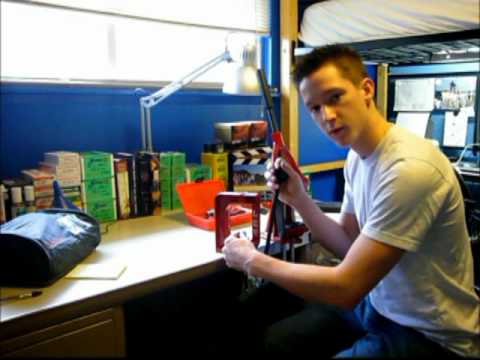
 The Co-Ax’s spring-loaded shell holder jaws float with the die, allowing cases to correctly center in the die. Dies snap easily in and out of the jaws so you can change dies in a couple of seconds. Many folks believe this improves die alignment, producing loaded rounds with less runout.


 After just a few minutes spent learning the program’s tool buttons, we were able to plot shot groups on a variety of targets with ease. Once you select the target distance and bullet diameter, figuring group size is a simple matter of centering a circle tool over each bullet hole. Then the program “connects the dots” and provides all the info you could want automatically.


 McMillan’s
 In its new
 McMillan’s

 At SHOT Show we checked out the all-new, side-focus


