Happy New Year to all our readers worldwide, and especially the nearly 20,000 members of the AccurateShooter Forum. We hope 2013 brings you happiness in your lives and success in your endeavors. And we wish for small groups, good scores, and successful hunts in the New Year.
We hope that, in 2013, you’ll enjoy your precision rifles, spending “quality time” at the range with friends who share your “addiction to accuracy”. We’ve made major upgrades to our site this year, acquiring new high-speed dedicated servers, and adding a staff “Answerman” to provide direct help for our members. We hope you’ll continue to enjoy our feature articles, our Daily Bulletin, our match reports, and our Free Forum Classifieds. The formula seems to be working — our audience is bigger than ever and it just keeps growing. And with the demise of Precision Shooting Magazine in November 2012, AccurateShooter.com’s role as an information resource is more important than ever.
Forum Membership Grows 23% in 2012
We experienced big growth in our Shooters’ Forum in 2012. Membership grew by 23% as member ranks swelled from 16,000 members to nearly 20,000 members! Forum traffic (pageviews) rose 40% in 2012 — that’s a huge increase in one year. And more people are successfully buying and selling in our FREE Forum Classifieds section than ever before.
Daily Bulletin Is a Big Hit
The AccurateShooter Daily Bulletin has become a “must read” for anyone interested in serious rifle accuracy. Daily Bulletin viewership is up 37% in 2012 compared to the year before. In the Bulletin you’ll find money-saving sale notices, timely match reports, and a host of reloading and accurizing tips. The Bulletin has become THE source for exclusive “scoops” on new products and new shooting technologies. Eric Stecker of Berger Bullets says: “You guys have become the ‘USA Today’ of the precision shooting market.” 365 days a year we offer a unique combination of shooting tips, gear reviews, industry news, and highlighted bargains and special sales.
Big Plans for 2013 — With Your Help…
In the months ahead we plan to release more feature stories, more videos, more informative ‘how to’ articles, and some major gear comparison tests. We also hope to do audio interviews (“podcasts”) with top shooters such as Carl Bernosky, Sam Hall, and John Whidden. We’ll continue to offer serious field tests and inside “scoops” on the latest precision shooting products. And now that Precision Shooting Magazine has folded, we hope to fill that void with articles from some of your favorite PS writers.
We need your support. For over eight years the site has relied largely on volunteer efforts by dedicated shooters. But as the site grows, adding new types of content and more sophisticated features, we need the assistance of professional gunsmiths, writers, and movie editors. Those guys don’t work for glory alone.
For the site to continue to deliver more cutting-edge content, we need to bring in paid helpers. Right now, the site reaches over 125,000 shooters every WEEK. If the majority of those users could provide a small donation every year, we could deliver more stories, more tests, more Gun of the Week features, and more videos.
In the past quarter about 90 site users have donated to the site. I want to thank all those who have generously contributed (at any time). But that still leaves tens of thousands of users who access the site regularly without contributing.
Here’s our proposal. First, if you have used our FREE Classifieds to successfully sell your rifles or shooting gear, consider sending in a dollar or two from your sale proceeds. Second, for those who use the site regularly, consider donating One Dollar a Month. That’s less than the price of a cup of coffee and much less than many websites now charge for their “premium content areas”.
Consider this — what do you pay for a movie ticket these days? Probably $8.50 or more for 90 minutes of escapism. For a buck a month ($12 a year) you can help this site provide a YEAR’s worth of info, tests, and shooting news that you won’t find anywhere else.
How to Contribute
Making a donation to the site is simple and easy. Just click on the orange “Donate” button at right. If you have a credit card, you don’t need a Paypal account to contribute. Any sum is welcome — donations need not be large.
Help Support this Site by Making a Secure Donation.
If you don’t like Paypal, you can send a check. Make the check payable to our Asst. Editor Jason Baney. Please list your Forum Log-In Name (if any), and mail the check to:
Nightforce Benchrest Model vs. NXS by Jason Baney, AccurateShooter.com Asst. Editor
Anyone who has considered purchasing a Nightforce scope inevitably asks: “Which one best suits my application — NXS or Benchrest model?” Shooters also ask: “Why is there such a price difference between the NXS and Benchrest (BR) models?” This article compares the features of the two models (NXS and BR), and provides some guidelines for choosing the right Nightforce scope for your needs.
The NXS line is priced a bit higher, costing about 40% more than the comparable Benchrest model. NXS scopes are also a bit more robust, and feature a side parallax adjustment (side-focus), whereas the BR scopes have an adjustable front objective for correcting parallax. Another main difference is click value, as the BR scopes have 1/8 MOA clicks while the NXS scopes currently feature 1/4 MOA clicks. The “zero-stop” feature is something to consider as well, as it is only available on the NXS models and allows the shooter to quickly spin the elevation turret back down to a close range zero, usually 100 yards, without counting clicks.
Click Value: 1/4 MOA vs. 1/8 MOA
The tighter 1/8 MOA click value is generally more desirable for long range shooting as eighth-minute clicks allow the shooter to adjust Point of Impact more precisely than quarter-minute clicks. The 1/4 MOA clicks are worth about 2.6″ at 1000 yards, while a 1/8 MOA click will move your POI only 1.3″ at 1000. It is easy to see why the 1/8 MOA click value may be preferable when trying to dial in on a 3-5 inch X-Ring or 10-Ring. This is one reason why so many F-Classers favor eighth-minute clicks. The F-Class X-ring is just 5″ in diameter.
If you wanted 1/8 MOA clicks, it used to be that you had to choose the Nightforce BR model. That has changed. Nightforce now offers 8-32X and 12-42X NXS models with 1/8 MOA clicks. The 1/8 MOA-click NXS lineup is ideal for those who prefer side-parallax control AND more precise click values. Another consideration regarding click value is the availability of milrad clicks. “Mil” clicks are desirable when the scope has a mildot or MLR reticle, or similar reticle based on a milradian scale. Mil clicks are only available on NXS scopes at this time.
Ruggedness — NXS has the Edge Durability is not usually an issue with target shooters as the scope will mainly be used in benign environment on a fixed-distance range. So, as long as a scope tracks and performs reliably, most target shooters won’t fret about durability. For those that may use their rifles in a tactical or field situation, or when hunting, the added robustness of the NXS scope may prove quite important. Now the BR scopes are no slouch as far as durability compared to similar scopes, but, in my experience, they cannot take quite the abuse that the NXS scopes can.
Side-Focus Parallax vs. Front Adjustable Objective
As far as the side parallax adjust vs. adjustable objective, this usually boils down to personal preference. The side-focus parallax adjustment NXS model fits one additional focus lens in the scope body — a lens not required in the front-adjusting Benchrest model. According to Nightforce, this one extra lens in the NXS can reduce potential light transmission by 1.0 to 1.5 percent in the NXS compared to the BR model. However, most human eyes will not notice the difference, and overall resolution should be virtually the same. The side-focus NXS models will be much more convenient from a prone position than will the BR scopes as it is not necessary to reach out of position to correct parallax. The BR scopes tend to be more convenient in fixed distance environments like benchrest or F-class, where there tends to be multiple shots at a similar distance, or there is plenty of time to adjust parallax. Compared to the NXS models, the BR scopes use more movement to produce the same amount of parallax adjustment — so you can say the BR offers “finer” adjustment. By contrast, the NXS side-focus delivers a coarser yet quicker adjustment requiring less movement to “dial-in” minimal parallax.
Zero-Stop Feature on NXS Only Another point of consideration is the availability of a “zero-stop.” This is particularly useful in the same situations that the NXS scopes make the most sense. Namely, tactical or field situations where there may be stress combined with longer shots where dialing the turrets is required. The zero stop allows the shooter to set a stop point, usually a 100-yard zero. Then no matter where the turret is positioned in its span of travel, the zero can be quickly re-established by spinning the turret down until it stops at the pre-set zero.
At present, the Zero-stop is available on all Nightforce variable NXS models except the 12-42×56. So you CAN get the zero-stop on the 8-32 NXS, but not the 12-42 NXS.
CONCLUSION
With the new 1/8 MOA NXS models now available, the decision on which Nightforce scope to buy, will come down to focus/parallax adjustment, field hardiness, and price. Though it may still be a hard decision in certain situations, hopefully this discussion has made the decision a bit easier. All in all, Nightforce scopes are a great value and they offer enough choices to satisfy nearly all shooting situations. Nightforce Scopes can be purchased through EuroOptic.com and other Nightforce dealers.
On his Riflemans’ Journal blog, German Salazar wrote an excellent article about cartridge Case-Head Separation. We strongly recommend that you read this article. German examines the causes of this serious problem and he explains the ways you can inspect your brass to minimize the risk of a case-head separation. As cases get fired multiple times and then resized during reloading, the cases can stretch. Typically, there is a point in the lower section of the case where the case-walls thin out. This is your “danger zone” and you need to watch for tell-tale signs of weakening.
The photo below shows a case sectioned so that you can see where the case wall becomes thinner near the web. German scribed a little arrow into the soot inside the case pointing to the thinned area. This case hadn’t split yet, but it most likely would do so after one or two more firings.
One great tip offered by German Salazar involves using a bent paper clip to detect potential case wall problems. Slide the paper clip inside your case to check for thin spots. German explains: “This simple little tool (bent paper clip) will let you check the inside of cases before you reload them. The thin spot will be immediately apparent as you run the clip up the inside of the case. If you’re seeing a shiny line on the outside and the clip is really hitting a thin spot inside, it’s time to retire the case. If you do this every time you reload, on at least 15% of your cases, you’ll develop a good feel for what the thin spot feels like and how it gets worse as the case is reloaded more times. And if you’re loading the night before a match and feel pressured for time — don’t skip this step!”
Here’s good news for purchasers of reloading components. Powder Valley Inc. (PVI) is “holding the line” on prices of powder, primers, brass, and bullets. In so doing, Powder Valley is “keeping the faith” with its customer base. By contrast, many local gun shops and big box retailers have jacked up prices on guns, ammo, and reloading supplies in response to a spike in demand. With the hue and cry for new gun control legislation, gun owners have rushed to stores to get guns, ammo, and reloading components. Predictably, some retailers have raised prices on everything from primers to all types of semi-auto firearms. Not so with Powder Valley. If you check the PVI website, you’ll see that prices for almost all products in stock are basically the same as a month ago (before the events in Newtown). Unlike some other vendors, Powder Valley has refrained from ramping up prices. We commend PVI for this.
Here is what Powder Valley owner Bryan Richardson told us about his company’s pricing policy:
“We watched back in 2009 as companies jacked up their prices due to supply and demand. This may make sense for some retailers and manufacturers. However, this is not the way we do business, nor will ever do business. It is completely against our conviction.
My wife and I established our business in 2000 with a mission statement of: ‘Providing the finest in reloading components and other shooting sports related products at the best possible price. In doing so, we will conduct business with the utmost respect and consideration for the customer’s needs by constantly demonstrating honesty and integrity.’
Therefore, increasing prices due to current market and political conditions is contrary to our mission of conducting business with the utmost respect and consideration for the customer’s needs. It is my opinion that if we want our industry to survive… we cannot price consumers out of shooting. Therefore, when you see our prices increase or decrease it is simply based off of the manufacturer’s or importer’s pricing. I think history shows that consumers remember the companies who elevated their prices for short-term profits and those who did not. We are here for the long haul and want to grow our business through building our customer base, not increasing our prices.”
Up in Wisconsin, a gentleman named Joe Maisto crafts some exceptionally nice competition cartridge boxes. Each box is hand-machined (no molds, no CNC), with the holes precisely fitted to the cartridge you shoot. Joe has been building his boxes since 1996, first from wood, and now from more durable (and easier-to-clean) polymers. Joe started with a hinge-top 25-round box (with magnetic latch) for short-range benchresters. He still makes that box, but now he also offers 40-round boxes, high-top boxes (for bigger, taller cartridges), open top cartridge blocks, and combo blocks with holes for cases and a built-in tray. Our buddies in the short-range benchrest game say the Maisto boxes are perfect for carrying rounds from the loading bench to the firing line. GO TO Joseph Maisto website.
25-Round Cartridge Boxes
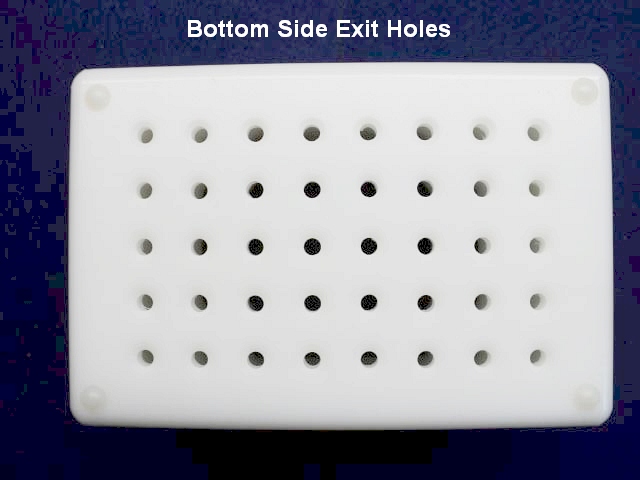
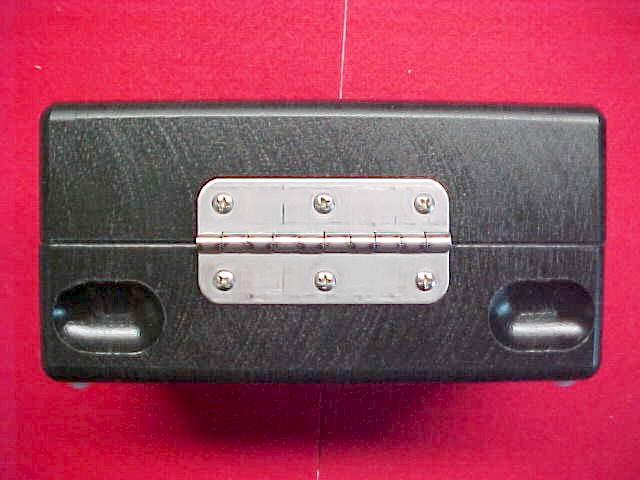
These units were designed in 1996. The originals were machined of Walnut, Cherry, or Birch. They were lovely, laborious, and expensive. To make the price more affordable, the wood units have since been retired in favor of high density polyethylene (HDPE). The front holes are separated for “record rounds”. Holes are bored with a minimum of clearance, and up to the shoulder. Additionally, each cartridge slot has a smaller hole in the bottom to allow debris to exist. These $60.00 boxes feature a quality stainless steel hinge with small but strong magnets that provide secure closure. While these were originally crafted for PPC cases, Joe offers various hole diameters for different-sized small cartridges.
40-Round Cartridge Boxes
For those who want more capacity (for longer strings of fire), Joe offers 40-round cartridge boxes. These allow shooters to change loads on the line, or simply have more rounds in a single box. With finger grooves front and back, the 40-rd boxes work for both left and right handers. Just like the 25-rd boxes, the 40s have a stainless hinge and magnetic closure. Price is $130.00.
Large Cartridge Box
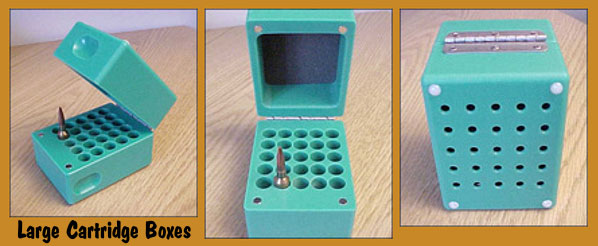
Joe’s Large Cartridge Boxes are taller to accommodate the bigger cartridges used for long-range shooting. These feature magnetic latching and and bottom exit holes, just like the Joe’s original PPC boxes. Joe notes that, for some cartridges, the Large Boxes “have 20 holes instead of 25 because of the larger cartridge head size”. When ordering the Large Boxes, you need to specify cartridge dimensions and cartridge overall loaded length (COAL). Price is $65.00 per box.
Cartridge Blocks
These cartridge “blocks” are made from the same material as Joe’s cartridge boxes. Each has finger grooves and exit holes. Joe says: “The size of the block is perfect for manipulating primed cases under a powder measure where space is a factor.” The 20-round block costs $19.00. Joe also offers a version with a recess on one side for empties. These have either 10 or 14 holes and cost $28.00.
Joseph A. Maisto www.benchrest.com/maisto
3647 Debby Lane
Franksville, Wl 53126
PH: (262) 886-1610
Email: jmaisto [at] wi.rr.com
Here’s a cool Torx driver from Brownells that belongs in every shooter’s tool box. The Magna-Tip Tactical/LE Field Torx Kit features a driver with five (5) Torx bits to fit popular scope rings and bases. A storage compartment in the handle holds the bits when not in use. A built-in magnetic socket in the handle holds each bit securely in the shank. We think this is a great new product. When Eyeballing a Torx screw, it’s hard to tell which size bit is required, and the short, L-shaped Torx wrenches that come with ring sets get lost all too easily. The $17.99 Torx Driver Kit, (Brownells Item 080-000-757), will help shooters keep all their often-used Torx bits safely in one place.
In the 1980s, Glen Eberle was an Olympic Biathlete with Team USA. Recognizing the benefits of a lighter, more durable rifle stock, Glen invented a radical new biathlon stock that literally “changed the game”. Glen’s lighter stock allowed biathletes to ski faster. His stock was also more rugged than conventional designs, so it could better survive the inevitable tumbles that occur in competition.
Since retiring from Biathlon competition, Eberle has built a successful Idaho-based company that supplies tough field packs and accessories for hunters and the military. But Glen never lost interest in stock design, and over the past few years he has developed an innovative new tactical chassis that is quite different than anything on the market today.
Eberlestock Model 11 Stealth Rifle Chassis system Fits Rem 700s
The Eberlestock Model 11 Stealth Rifle Chassis system is compact, light-weight and strong. Designed to fit Remington 700 actions, the Eberlestock model 11 chassis offers a drop-in, no-gunsmithing solution for tactical shooters. For the Rem 700 and Rem-clone actions, the Model 11 Chassis employs Accuracy Int’l Classic detachable box magazines (DBMs). The folding-stock version of the new Eberle chassis is very compact. Eberle claims it is “the shortest [folding-stock] sniper system in the world”.
The Model 11 Stealth Chassis is in Production Now
The basic Model 11 Stealth Rifle Chassis weighs 4 pounds and costs $1895.00. First availability will be for the Remington Model 700 short action. Next offerings will be for Rem Model 700 long actions, followed by stocks to fit models from other manufacturers. A variety of configuration options are offered, including folding butt-stock and a fore-stock with mounting rails. For more info, visit www.Eberlestock.com, or call Eberlestock USA in Idaho at 877-866-3047 or 208-424-5081.
Yesterday we featured a “mystery man” in a old family photo from a 1950s Christmas. We challenged readers to identify the young boy in cowboy hat who later grew up into one of America’s greatest rifle shooters. Most folks thought our mystery celebrity was Texan G. David Tubb. Others, no doubt focusing on the hat, suggested it was benchrest Hall-of-Famer Tony Boyer. And there were votes for Mid Tompkins and trick-shooter Bob Munden (who recently passed away). But most of you guys guessed right — the “littlest cowboy” was, in fact, 10-time National High Power Champion Carl Bernosky.
How Times Have Changed in America
Carl tells us: “I think the photo was from 1959, when I was three years old. That was on Christmas with my family. Since then, I have upgraded the holster, switched from revolvers to pistols, and gave up the pipe!”
Carl misses the ‘good old days': “It’s hard to believe how much has changed in America. Things were really different in the 50s and 60s. It was great for a boy growing up. We spent a lot of time outdoors, and people trusted each other more.” Carl said: “I remember going on a hunting trip with my Dad. We had to fly from Pennsylvania to someplace out west. Somewhere I’ve got a photo showing my Dad and I carrying our guns in soft cases on to the aircraft. We just walked through the airport and carried our guns right on to the plane. You sure don’t want to try that today!”
Now that he’s all grown up, Carl makes a living producing rifles and gunstocks for hunters and competition shooters. Carl’s company, Carl Bernosky Shooting Sports, offers a variety of stocks made from laminates and fancy woods. A highly-skilled woodworker, Carl can customize stock designs for any customer’s unique requirements. Shown below are some of his creations, prone rifles (in fancy wood) on the left, and an F-Open rifle in Rutland Laminate on the right.
Waylon Jennings famously crooned: “Mamas, don’t let your babies grow up to be cowboys”. Well the young fella in the fuzzy photo didn’t grow up to be a cowboy, but he did become one of the greatest rifle shooters in history. Can you guess who this is?
- Guess Who Is in the Photo -
(Answer will be revealed in tomorrow’s Daily Bulletin).
The photo was taken on a Christmas morning, decades ago, when our mystery man was around three years old. He told us: “Starting with toy guns, then BB guns, then 22s, and then centerfires — doing stuff with rifles was just part of my upbringing. This is something I did with my family. That’s my grand-dad in the photo with me.” What happened to the toy six-shooters and fancy double-holster rig? Our mystery subject lamented: “Oh that’s long gone. Wish I still had that rig, it would bring back memories….”
Benchrest shooter Gene Bukys has smashed the existing Sporter Class 100+200 yard Grand Aggregate record, lowering the NBRSA record from 0.1886 to 0.1777. That’s a big deal in the short-range benchrest game. This record was shot in October, 2012 at the Arizona Nationals.
On Benchrest Central, NBRSA SW Regional Director Tom Libby reported:
“Yes it’s said that ‘Every Thing is Bigger in Texas’. Well in this case ‘Smaller is Better’ and Gene has done it with his new World Record for five 5-shot groups at both 100 and 200 yards in the Sporter Class Grand Aggregate.
The Old Record: .1886
The New Record: .1777
[That includes five targets at EACH distance, ten targets total.]
Great Job Eugene G. Bukys!
It is my understanding that Gene has bought a new special cowboy hat to start putting his awards on it but don’t get to close to him as the brim will hit you in the head.”
Bukys and Barrel Tuners
Commenting on Buky’s record-setting performance, Boyd Allen writes: “Gene has a fine record as a shooter, and his rifles have tuners (at least the bag guns do, I’m not sure about the rail.) In contrast to other users of tuners, I’m told that Gene tunes his to the middle of a node, locks it down, and does not move it again, preferring to tune with normal means. I think that the effectiveness of this approach is pretty evident — the proof is now in the record books! Gene would tell you that he has never seen a barrel’s accuracy increased by the addition of a tuner, but that, with a tuner, accuracy nodes are wider. I would add that, while Gene’s tuner is an important component, we must acknowledge Gene’s outstanding shooting skills — this man can win with or without a tuner.”


 Download free screen-saver from 123newyear.com.


 In the past quarter about 90 site users have donated to the site. I want to thank all those who have generously contributed (at any time). But that still leaves tens of thousands of users who access the site regularly without contributing.

 Durability is not usually an issue with target shooters as the scope will mainly be used in benign environment on a fixed-distance range. So, as long as a scope tracks and performs reliably, most target shooters won’t fret about durability. For those that may use their rifles in a tactical or field situation, or when hunting, the added robustness of the NXS scope may prove quite important. Now the BR scopes are no slouch as far as durability compared to similar scopes, but, in my experience, they cannot take quite the abuse that the NXS scopes can.
 Another point of consideration is the availability of a “zero-stop.” This is particularly useful in the same situations that the NXS scopes make the most sense. Namely, tactical or field situations where there may be stress combined with longer shots where dialing the turrets is required. The zero stop allows the shooter to set a stop point, usually a 100-yard zero. Then no matter where the turret is positioned in its span of travel, the zero can be quickly re-established by spinning the turret down until it stops at the pre-set zero.
 On his


 Here’s good news for purchasers of reloading components.








 In the 1980s,


 How Times Have Changed in America


 Benchrest shooter Gene Bukys has smashed the existing Sporter Class 100+200 yard Grand Aggregate record, lowering the


