Review by James D. Mock
Around the first of November, I received a call from Boyd Allen. During one our conversations about all things Benchrest, he mentioned that Barnes made conventional match bullets. This I did not know. Most hunters are familiar with the excellent Barnes premium hunting bullets, but many like me did not know that they make match bullets also, marketed as “Match Burners”.
After contacting the good folks Barnes to request some Match Burners for a review in Precision Shooting Magazine, I received a box of 6mm 68gr match bullets and a box of 6mm 105gr VLDs. By the time I got these, I learned that Precision Shooting would no longer print a magazine.
These bullets sat around the house for quite some time, but I finally got around to testing them. First of all I weighed many of the bullets and found that the nominal 68gr bullets averaged 68.07 grains and the 105s averaged 105.08 grain. The 68gr bullets were .845 inches long and measured .2432 on the body and .2435 on the pressure ring of these flat-base bullets. The VLDs measured 1.192 inches long with a diameter of .2433 at the largest point and the boat tail measured .180 long with a diameter at the base of .210.
Flat-Base 68gr Match Burners Prove Very Accurate
Although I shot the 68gr bullets in some fairly “strong” conditions, they performed well as you can see below. I loaded the rounds with 28.4 grains of the new Accurate LT-32 powder (from Western Powders).
Above is a target with three 3-shot groups shot with the 68-grainers. I chose the following seating depths: (from left to right) .020 off jam*; .010 off jam; and .005 off jam. Since then I have shot a few more groups, and have been pleasantly surprised.
Barnes Match Burner 105gr VLDs Perform Well
For the 105 VLDs I chose my Dasher with a 26.5″ Bartlein gain twist (1:8.25″ to 1:7.75″). Like the 68gr bullets, these VLDs were a pleasant surprise. I plan to shoot these bullets again as soon as the weather improves.
*Editor’s Note: The term “Jam” (or “Jam Length”) is used to describe a maximum practical bullet seating dimension, typically measured from base to bullet ogive. As James uses the term, “Jam” means the maximum functional length to which he can seat a bullet in his brass, with his selected neck tension, before the bullet starts to move backwards in the case (in the direction of casehead) when he closes the bolt. Thus, if James specifies a load that is “.010 off Jam”, this means that James has seated the bullet ten-thousandths shorter than maximum functional length in his gun. His bullets are still engaged in the rifling at “.010 off Jam”, and probably still touching the rifling at “.020 off Jam”. The “Jam” length is specific to James’ barrel and brass. In different barrels, “Jam Length” can vary according to numerous factors — bore dimensions, land configuration, neck tension, bullet geometry et cetera.
In 2012’s final week, the Port Malabar Rifle & Pistol Club of Palm Bay, Florida held the Fifth Annual Snowbird X-Miss Midrange Prone and F-Class Match. This NRA Registered Tournament drew almost 60 competitors from around the country plus Fritz Braun from Brazil. For the first time ever, the Snowbird had a 300/500/600 event the first day with 600-yard match the second two days. Competitors saw various kinds of weather varying from chilly to 74 degrees. There were some drizzles on the last day of the individual matches but the rain held off long enough for all to complete the event
Kent Reeve took the High Overall 3-Day aggregate for the Mid-Range Prone with a score of 1797-132X. Second overall went to Sam Yarosh with a score of 1793-109X. Third overall to Wayne Forshee with 1788-91X. In F-Open, reigning FL State F-Open Champion Mark Finizio won the 3-day event with a score of 1790-100X. Second was Ken Adams, 1780-77X and third place overall went to Tom Goodman, 1778-68X. Complete results are listed on www.pmrpcrifle.com.
Many Record-Setting Performances at the X-Miss Match
Numerous NRA National Records were set at the 2012 Snowbird X-Miss event. Kent Reeve shot an incredible 200-22X at 600 yards. LeeAnn Finizio set F-Open Ladies’ records at two yardages: 300 yards, (197-[?X]); 600 yards ( 200-14X). Sam Yarosh shot a new record of 197-12X in the 500-yard any sight police category.
Team Event on Sunday
On Sunday, December 30, 2012, there was a team match. The F-Class Open Division saw a tight race among Miami’s Signal 20 F-Class Team, the S&S Precision Rifle Team, and the BNX F-Class team. Team BNX ended up in first place ahead of runner-up S&S Precision Team, shown below.
The Snowbird X-Miss Match was conceived to let folks shoot in the dead of winter when they can’t compete at home. At the Snowbird X-Miss Match NRA classifications are used AND rifles are classed by type: Palma, Iron Sight, Service Rifle, and Scoped Rifle. And the usual F-Open and F-TR divisions are recognized. Awards are given to all these types. Thus a shooter with a 6.5-2284 scoped rifle is not competing against someone with an iron-sighted AR15 Service Rifle. The Snowbird will be held again next season at the end of 2013.
Major sponsors this year included Sinclair International, S & S Precision Rifles, D & B Supply, Bartlein Barrels, Krieger Barrels, Berger, and Sierra. Others included Creedmoor Sports, PMA, K & M, Lee Precision, Forester Products, Redding, Dewey, Precision Reloading, and Jim Owens.
Remington will introduce a new bolt-action rifle at SHOT Show, the Model 783. Remington positions the new model 783 as a mid-level offering between the Model 770 and Model 700 SPS, according to John Fink, Freedom Group Rifle Product Manager. This new rifle was first revealed in an American Rifleman article by Richard Mann, who tested an early production version in September 2012. Mann reports: “The ‘7’ in the model designation comes from the 700 line of rifles, the ‘8’ is kind of a throwback to the affordable but reliable model 788, which was discontinued 20 years ago, and the ‘3’ is for the three in 2013. The suggested retail price is $451, but you can expect street prices to be closer to $400.”
Remington is claiming sub-MOA accuracy for the Model 783, as demonstrated by the “teaser” photo sent out to Remington customers earlier this week:
Adjustable Trigger with Insert
The rifle features a polymer stock, cylindrical action, and an adjustable trigger with a control insert (as used on the Savage AccuTrigger and Marlin Pro-Fire trigger). Remington’s “CrossFire Trigger System” is pre-set at 3.5 lbs pull weight. According to the reviewer, Remington’s CrossFire Trigger is “similar in appearance to the Savage AccuTrigger and the Marlin Pro-Fire Trigger; it has a center lever that locks the trigger until it is fully depressed.” (We think selecting “CrossFire” as a product title was a dumb move by Rem’s marketing guys.)
Model 783 Has Barrel Nut System
Remington has borrowed a trick from Savage, employing a barrel nut system for fitting barrels to model 783 actions. The model 783’s two-lug bolt features a Sako-style sliding-plate extractor — this is a departure from the system on a Rem 700. Scopes can be mounted with two Model 700-spec front scope bases. However, Remington plans to offer integral scope mounts in the near future.
Designed for game hunters, the model 783 will initially be offered in four chamberings: .308 Winchester (short action), .270 Winchester, .30-06 Springfield, and 7mm Rem. Magnum. Remington says it will roll out more chamberings by the middle of 2013. In addition a compact-stock version with a shorter length of pull will be offered. Barrels are 22″ or 24″ with a “magnum contour”. Model 783 rifles will be produced in the Freedom Group’s Mayfield, Kentucky manufacturing plant.
In our Shooters’ Forum a reader recently asked: “How much neck tension should I use?” This prompted a Forum discussion in which other Forum members recommended a specific number based on their experience, such as .001″, .002″, or .003″. These numbers, as commonly used, correspond to the difference between case-neck OD after sizing and the neck OD of a loaded round, with bullet in place. In other words, the numbers refer to the nominal amount of interference fit (after sizing).
While these commonly-used “tension numbers” (of .001″, .002″ etc.) can be useful as starting points, neck tension is actually a fairly complex subject. The actual amount of “grip” on the bullet is a function of many factors, of which neck-OD reduction during sizing is just one. Understanding these many factors will help you maintain consistent neck tension as your brass “evolves” over the course of multiple reloadings.
Neck Tension (i.e. Grip on Bullets) Is a Complex Phenomenon
While we certainly have considerable control over neck tension by using tighter or looser bushings (with smaller or bigger Inside Diameters), bushing size is only one factor at work. It’s important to understand the multiple factors that can increase or decrease the resistance to bullet release. Think in terms of overall brass-on-bullet “grip” instead of just bushing size.
One needs to understand that bushing size isn’t the beginning and end of neck tension questions, because, even if bushing size is held constant, the amount of bullet “grip” can change dramatically as the condition of your brass changes. Bullet “grip” can also change if you alter your seating depth significantly, and it can even change if you ultrasonically clean your cases.
Bullet grip is affected by many things, such as:
1. Neck-wall thickness.
2. Amount of bearing surface (shank) in the neck.
3. Surface condition inside of neck (residual carbon can act as a lubricant; ultrasonic cleaning makes necks “grabby”).
4. Length of neck (e.g. 6BR neck vs. 6BRX).
5. Whether or not the bullets have an anti-friction coating.
6. The springiness of the brass (which is related to degree of work-hardening; number of firings etc.)
7. The bullet jacket material.
8. The outside diameter of the bullet and whether it has a pressure ridge.
9. The time duration between bullet seating and actual firing (necks can stiffen with time).
10. How often the brass is annealed
— and there are others…
Seating Depth Changes Can Increase or Decrease Grip on Bullet
You can do this simple experiment. Seat a boat-tail bullet in your sized neck with .150″ of bearing surface (shank) in the neck. Now remove the bullet with an impact hammer. Next, take another identical bullet and seat it with .300″ of bearing surface in another sized case (same bushing size/same nominal tension). You’ll find the deeper-seated bullet is gripped much harder.
Neck-Wall Thickness is Important Too
I have also found that thinner necks, particularly the very thin necks used by many PPC shooters, require more sizing to give equivalent “grip”. Again, do your own experiment. Seat a bullet in a case turned to .008″ neckwall thickness and sized down .003″. Now compare that to a case with .014″ neckwall thickness and sized down .0015″. You may find that the bullet in the thin necks actually pulls out easier, though it supposedly has more “neck tension”, if one were to consider bushing size alone.
In practical terms, because thick necks are less elastic than very thin necks, when you turn necks you may need to run tighter bushings to maintain the same amount of actual grip on the bullets (as compared to no-turn brass). Consequently, I suspect the guys using .0015″ “tension” on no-turn brass may be a lot closer to the guys using .003″ “tension” on turned necks than either group may realize.
Toward a Better Definition of Neck Tension
As a convenient short-cut, we tend to describe neck tension by bushing size alone. When a guy says, “I run .002 neck tension”, that normally means he is using a die/bushing that sizes the necks .002″ smaller than a loaded round. Well we know something about his post-sizing neck OD, but do we really have a reliable idea about how much force is required to release his bullets? Maybe not… This use of the term “neck tension” when we are really only describing the amount of neck diameter reduction with a die/bushing is really kind of incomplete.
My point here is that it is overly simplistic to ask, “should I load with .001 tension or .003?” In reality, an .001″ reduction (after springback) on a thick neck might provide MORE “grip” on a deep-seated bullet than an .003″ reduction on a very thin-walled neck holding a bullet with minimal bearing surface in the neck. Bushing ID is something we can easily measure and verify. We use bushing size as a descriptor of neck tension because it is convenient and because the other important factors are hard to quantify. But those factors shouldn’t be ignored if you want to maintain consistent neck tension for optimal accuracy.
Consistency and accuracy — that’s really what this all about isn’t it? We want to find the best neck tension for accuracy, and then maintain that amount of grip-on-bullet over time. To do that you need to look not only at your bushing size, but also at how your brass has changed (work-hardened) with time, and whether other variables (such as the amount of carbon in the neck) have changed. Ultimately, optimal neck tension must be ascertained experimentally. You have to go out and test empirically to see what works, in YOUR rifle, with YOUR bullets and YOUR brass. And you may have to change the nominal tension setting (i.e. bushing size) as your brass work-hardens or IF YOU CHANGE SEATING DEPTHS.
Remember that bushing size alone does not tell us all we need to know about the neck’s true “holding power” on a bullet, or the energy required for bullet release. True bullet grip is a more complicated phenomenon, one that is affected by numerous factors, some of which are very hard to quantify.
Here’s a good deal for fans of the “Terrific Twenties” — .204-caliber, low-recoil cartridges. Midsouth Shooters Supply now has Barnes 26gr “Varmint Grenade” bullets on sale. Midsouth has marked down 250-count boxes of these 26-grainers from $36.74 (reg. price) to $31.99 (sale price). The promo price works out to just $12.79 per hundred bullets. If you have a .204-Cal rifle, and are planning a prairie dog safari or ground squirrel hunt in the months ahead, you may want to grab these bullets while they’re on sale. These 26-grainers will work with 20-Cal cartridges from the .204 Ruger all the way down to the diminutive .20 Vartarg.
SHOT Show 2013 kicks off in two weeks in Las Vegas. One of our top priorities is to talk with the bullet makers from Berger, Hornady, Lapua, and Nosler.
At SHOT Show 2012 we chatted with Berger Ballistician Bryan Litz about Berger’s popular line of Hybrid bullets. Berger now offers a wide range of Hybrids in multiple calibers and weights. In fact, for .30-Caliber shooters, Berger now offers six different Hybrid match bullets, with weights from 155 grains up to 230 grains. New .338 Cal Tactical Hybrids were released in 2012 and big .375 Cal, and .408 Cal Hybrids are in the works (read more below).
Bryan tells us: “The hybrid design is Berger’s solution to the age old problem of precision vs. ease of use. This design is making life easier for handloaders as well as providing opportunities for commercial ammo loaders who need to offer a high performance round that also shoots precisely in many rifles with various chamber/throat configurations.”
For those not familiar with Hybrid bullets, the Hybrid design blends two common bullet nose shapes on the front section of the bullet (from the tip to the start of the bearing surface). Most of the curved section of the bullet has a Secant (VLD-style) ogive for low drag. This then blends in a Tangent-style ogive curve further back, where the bullet first contacts the rifling. The Tangent section makes seating depth less critical to accuracy, so the Hybrid bullet can shoot well through a range of seating depths, even though it has a very high Ballistic Coefficient (BC).
In the video we asked Bryan for recommended seating depths for 7mm and .30-Caliber Hybrid bullets. Bryan advises that, as a starting point, Hybrid bullets be seated .015″ (fifteen thousandths) off the lands in most barrels. Watch the video for more tips how to optimize your loads with Hybrid bullets.
Berger is Developing New Large-Caliber and Hunting Hybrids
In related news, Berger announced that it will be offering a series of .338-caliber Hybrids. First Berger is reintroducing the Gen 1 .338 Cal, 300gr Hybrid bullet in Berger’s Hunting line. Berger will also be making a 250gr Hybrid Hunting bullet using the same type of jacket as the original Gen 1 300gr Hybrid bullet. In addition, Berger has released a .338 Cal 250gr Match Hybrid OTM Tactical bullet, along with a 300gr Match Hybrid OTM Tactical projectile.
More big bullets are on the drawing board. Our source says “.375 Caliber and then .408 Caliber are the next new calibers to be made at Berger”. These are in the design phase, and Berger needs to build a new machine, so the .375s and .408s will not be available until 2013 at the earliest.
By Michael Bussard, edited by John B. Allen, David Kosowski, Charles F. Priore, Jr.
If you’re a serious shooter, the latest 4th Edition of the Ammo Encyclopedia (released in August, 2012), belongs in your library. This 972-page book is probably the most comprehensive and up-to-date book in print covering current and obsolete cartridges and shotshells. Bussard’s Ammo Encyclopedia is a massive resource work. The 4th Edition now boasts over 100 chapters.
One of the best features is a 12-page color section depicting actual size drawings of 265 current rimfire/centerfire cartridges and shotshells. You won’t find that many “life-size” cartridge drawings in one place even on the internet. Cartridge profiles and ballistic charts have been expanded to include all new factory cartridges. The authors have even included air rifle pellets and historical images and charts. Softcover, 972 pages.
Comments from guys who bought the book:
“This book contains a vast array of information on many modern and even obsolete ammunition. Definately recommend for any modern reloader novice or experienced.” – Duggaboy460
“It’s a great reference book for individuals who reload their own ammunition. There is a lot more info in this Edition. Everyone who likes this information should have it in their library.” – Reloader
“I like the general and technical comments that are available for each and every cartridge. Information that predicts if a cartridge will stay in production for many more years or rapidly become obsolete.” – RSL1
Happy New Year to all our readers worldwide, and especially the nearly 20,000 members of the AccurateShooter Forum. We hope 2013 brings you happiness in your lives and success in your endeavors. And we wish for small groups, good scores, and successful hunts in the New Year.
We hope that, in 2013, you’ll enjoy your precision rifles, spending “quality time” at the range with friends who share your “addiction to accuracy”. We’ve made major upgrades to our site this year, acquiring new high-speed dedicated servers, and adding a staff “Answerman” to provide direct help for our members. We hope you’ll continue to enjoy our feature articles, our Daily Bulletin, our match reports, and our Free Forum Classifieds. The formula seems to be working — our audience is bigger than ever and it just keeps growing. And with the demise of Precision Shooting Magazine in November 2012, AccurateShooter.com’s role as an information resource is more important than ever.
Forum Membership Grows 23% in 2012
We experienced big growth in our Shooters’ Forum in 2012. Membership grew by 23% as member ranks swelled from 16,000 members to nearly 20,000 members! Forum traffic (pageviews) rose 40% in 2012 — that’s a huge increase in one year. And more people are successfully buying and selling in our FREE Forum Classifieds section than ever before.
Daily Bulletin Is a Big Hit
The AccurateShooter Daily Bulletin has become a “must read” for anyone interested in serious rifle accuracy. Daily Bulletin viewership is up 37% in 2012 compared to the year before. In the Bulletin you’ll find money-saving sale notices, timely match reports, and a host of reloading and accurizing tips. The Bulletin has become THE source for exclusive “scoops” on new products and new shooting technologies. Eric Stecker of Berger Bullets says: “You guys have become the ‘USA Today’ of the precision shooting market.” 365 days a year we offer a unique combination of shooting tips, gear reviews, industry news, and highlighted bargains and special sales.
Big Plans for 2013 — With Your Help…
In the months ahead we plan to release more feature stories, more videos, more informative ‘how to’ articles, and some major gear comparison tests. We also hope to do audio interviews (“podcasts”) with top shooters such as Carl Bernosky, Sam Hall, and John Whidden. We’ll continue to offer serious field tests and inside “scoops” on the latest precision shooting products. And now that Precision Shooting Magazine has folded, we hope to fill that void with articles from some of your favorite PS writers.
We need your support. For over eight years the site has relied largely on volunteer efforts by dedicated shooters. But as the site grows, adding new types of content and more sophisticated features, we need the assistance of professional gunsmiths, writers, and movie editors. Those guys don’t work for glory alone.
For the site to continue to deliver more cutting-edge content, we need to bring in paid helpers. Right now, the site reaches over 125,000 shooters every WEEK. If the majority of those users could provide a small donation every year, we could deliver more stories, more tests, more Gun of the Week features, and more videos.
In the past quarter about 90 site users have donated to the site. I want to thank all those who have generously contributed (at any time). But that still leaves tens of thousands of users who access the site regularly without contributing.
Here’s our proposal. First, if you have used our FREE Classifieds to successfully sell your rifles or shooting gear, consider sending in a dollar or two from your sale proceeds. Second, for those who use the site regularly, consider donating One Dollar a Month. That’s less than the price of a cup of coffee and much less than many websites now charge for their “premium content areas”.
Consider this — what do you pay for a movie ticket these days? Probably $8.50 or more for 90 minutes of escapism. For a buck a month ($12 a year) you can help this site provide a YEAR’s worth of info, tests, and shooting news that you won’t find anywhere else.
How to Contribute
Making a donation to the site is simple and easy. Just click on the orange “Donate” button at right. If you have a credit card, you don’t need a Paypal account to contribute. Any sum is welcome — donations need not be large.
Help Support this Site by Making a Secure Donation.
If you don’t like Paypal, you can send a check. Make the check payable to our Asst. Editor Jason Baney. Please list your Forum Log-In Name (if any), and mail the check to:
Nightforce Benchrest Model vs. NXS by Jason Baney, AccurateShooter.com Asst. Editor
Anyone who has considered purchasing a Nightforce scope inevitably asks: “Which one best suits my application — NXS or Benchrest model?” Shooters also ask: “Why is there such a price difference between the NXS and Benchrest (BR) models?” This article compares the features of the two models (NXS and BR), and provides some guidelines for choosing the right Nightforce scope for your needs.
The NXS line is priced a bit higher, costing about 40% more than the comparable Benchrest model. NXS scopes are also a bit more robust, and feature a side parallax adjustment (side-focus), whereas the BR scopes have an adjustable front objective for correcting parallax. Another main difference is click value, as the BR scopes have 1/8 MOA clicks while the NXS scopes currently feature 1/4 MOA clicks. The “zero-stop” feature is something to consider as well, as it is only available on the NXS models and allows the shooter to quickly spin the elevation turret back down to a close range zero, usually 100 yards, without counting clicks.
Click Value: 1/4 MOA vs. 1/8 MOA
The tighter 1/8 MOA click value is generally more desirable for long range shooting as eighth-minute clicks allow the shooter to adjust Point of Impact more precisely than quarter-minute clicks. The 1/4 MOA clicks are worth about 2.6″ at 1000 yards, while a 1/8 MOA click will move your POI only 1.3″ at 1000. It is easy to see why the 1/8 MOA click value may be preferable when trying to dial in on a 3-5 inch X-Ring or 10-Ring. This is one reason why so many F-Classers favor eighth-minute clicks. The F-Class X-ring is just 5″ in diameter.
If you wanted 1/8 MOA clicks, it used to be that you had to choose the Nightforce BR model. That has changed. Nightforce now offers 8-32X and 12-42X NXS models with 1/8 MOA clicks. The 1/8 MOA-click NXS lineup is ideal for those who prefer side-parallax control AND more precise click values. Another consideration regarding click value is the availability of milrad clicks. “Mil” clicks are desirable when the scope has a mildot or MLR reticle, or similar reticle based on a milradian scale. Mil clicks are only available on NXS scopes at this time.
Ruggedness — NXS has the Edge Durability is not usually an issue with target shooters as the scope will mainly be used in benign environment on a fixed-distance range. So, as long as a scope tracks and performs reliably, most target shooters won’t fret about durability. For those that may use their rifles in a tactical or field situation, or when hunting, the added robustness of the NXS scope may prove quite important. Now the BR scopes are no slouch as far as durability compared to similar scopes, but, in my experience, they cannot take quite the abuse that the NXS scopes can.
Side-Focus Parallax vs. Front Adjustable Objective
As far as the side parallax adjust vs. adjustable objective, this usually boils down to personal preference. The side-focus parallax adjustment NXS model fits one additional focus lens in the scope body — a lens not required in the front-adjusting Benchrest model. According to Nightforce, this one extra lens in the NXS can reduce potential light transmission by 1.0 to 1.5 percent in the NXS compared to the BR model. However, most human eyes will not notice the difference, and overall resolution should be virtually the same. The side-focus NXS models will be much more convenient from a prone position than will the BR scopes as it is not necessary to reach out of position to correct parallax. The BR scopes tend to be more convenient in fixed distance environments like benchrest or F-class, where there tends to be multiple shots at a similar distance, or there is plenty of time to adjust parallax. Compared to the NXS models, the BR scopes use more movement to produce the same amount of parallax adjustment — so you can say the BR offers “finer” adjustment. By contrast, the NXS side-focus delivers a coarser yet quicker adjustment requiring less movement to “dial-in” minimal parallax.
Zero-Stop Feature on NXS Only Another point of consideration is the availability of a “zero-stop.” This is particularly useful in the same situations that the NXS scopes make the most sense. Namely, tactical or field situations where there may be stress combined with longer shots where dialing the turrets is required. The zero stop allows the shooter to set a stop point, usually a 100-yard zero. Then no matter where the turret is positioned in its span of travel, the zero can be quickly re-established by spinning the turret down until it stops at the pre-set zero.
At present, the Zero-stop is available on all Nightforce variable NXS models except the 12-42×56. So you CAN get the zero-stop on the 8-32 NXS, but not the 12-42 NXS.
CONCLUSION
With the new 1/8 MOA NXS models now available, the decision on which Nightforce scope to buy, will come down to focus/parallax adjustment, field hardiness, and price. Though it may still be a hard decision in certain situations, hopefully this discussion has made the decision a bit easier. All in all, Nightforce scopes are a great value and they offer enough choices to satisfy nearly all shooting situations. Nightforce Scopes can be purchased through EuroOptic.com and other Nightforce dealers.
On his Riflemans’ Journal blog, German Salazar wrote an excellent article about cartridge Case-Head Separation. We strongly recommend that you read this article. German examines the causes of this serious problem and he explains the ways you can inspect your brass to minimize the risk of a case-head separation. As cases get fired multiple times and then resized during reloading, the cases can stretch. Typically, there is a point in the lower section of the case where the case-walls thin out. This is your “danger zone” and you need to watch for tell-tale signs of weakening.
The photo below shows a case sectioned so that you can see where the case wall becomes thinner near the web. German scribed a little arrow into the soot inside the case pointing to the thinned area. This case hadn’t split yet, but it most likely would do so after one or two more firings.
One great tip offered by German Salazar involves using a bent paper clip to detect potential case wall problems. Slide the paper clip inside your case to check for thin spots. German explains: “This simple little tool (bent paper clip) will let you check the inside of cases before you reload them. The thin spot will be immediately apparent as you run the clip up the inside of the case. If you’re seeing a shiny line on the outside and the clip is really hitting a thin spot inside, it’s time to retire the case. If you do this every time you reload, on at least 15% of your cases, you’ll develop a good feel for what the thin spot feels like and how it gets worse as the case is reloaded more times. And if you’re loading the night before a match and feel pressured for time — don’t skip this step!”


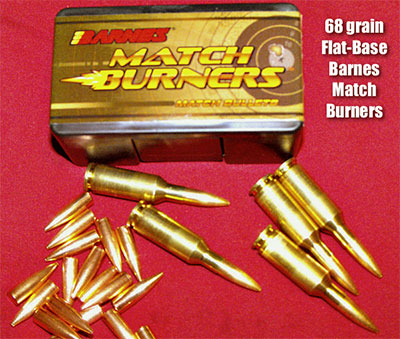 After contacting the good folks Barnes to request some Match Burners for a review in Precision Shooting Magazine, I received a box of 6mm 68gr match bullets and a box of 6mm 105gr VLDs. By the time I got these, I learned that Precision Shooting would no longer print a magazine.


 Adjustable Trigger with Insert
 In our
 Neck-Wall Thickness is Important Too


 By Michael Bussard, edited by John B. Allen, David Kosowski, Charles F. Priore, Jr.
 Download free screen-saver from


 In the past quarter about 90 site users have donated to the site. I want to thank all those who have generously contributed (at any time). But that still leaves tens of thousands of users who access the site regularly without contributing.

 Durability is not usually an issue with target shooters as the scope will mainly be used in benign environment on a fixed-distance range. So, as long as a scope tracks and performs reliably, most target shooters won’t fret about durability. For those that may use their rifles in a tactical or field situation, or when hunting, the added robustness of the NXS scope may prove quite important. Now the BR scopes are no slouch as far as durability compared to similar scopes, but, in my experience, they cannot take quite the abuse that the NXS scopes can.
 Another point of consideration is the availability of a “zero-stop.” This is particularly useful in the same situations that the NXS scopes make the most sense. Namely, tactical or field situations where there may be stress combined with longer shots where dialing the turrets is required. The zero stop allows the shooter to set a stop point, usually a 100-yard zero. Then no matter where the turret is positioned in its span of travel, the zero can be quickly re-established by spinning the turret down until it stops at the pre-set zero.
 On his


