Even with high-quality brass from Lapua, Norma, and RWS, occasionally you may find one or two cases per box which have a small flake or obstruction in the flash-hole. This will appear like a thin crescent on one side of the flash hole (see photo). You should inspect ALL new brass before loading to identify any pieces with a partially-obstructed flash hole. It’s a good idea to remove any flake or thin crescent left as an artifact of the flash-hole forming process. Because the flash-hole itself is normally centered and of the correct diameter, it is not necessary to ream the flash-hole to a larger diameter. All you really need to do is remove the small obstruction(s). This can be done quickly with inexpensive tools.
Use a Small Pin Vise to Remove Flash-Hole Obstructions
Folks have asked if there is a tool that can remove obstructions from a Lapua small, BR-sized flash hole without opening the hole size. The Lapua PPC/BR flash hole is spec’d at 1.5mm, which works out to 0.059055″. Most of the PPC/BR flash-hole uniforming tools on the market use a 1/16″ bit which is nominally 0.0625″, but these often run oversize — up to 0.066″.
If you want to just clear out any obstructions in the flash hole, without increasing the flash hole diameter, you can use an inexpensive “pin vise” with an appropriate drill bit. For $1.00, eHobbyTools.com sells a 1.5mm drill bit, item 79186, that matches the Lapua flash hole exactly. Other vendors offer a #53 pin vise drill bit that measures .0595″ or .060″ (depending or source). An 0.0595″ bit is close enough. You can find pin vises and these small-diameter drill bits at hobby stores.
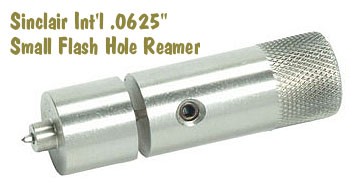
For quite some time, Sinclair Int’l has sold a similar device for small (PPC and BR-size) flash holes. Like the new 07-3081 unit for large flash holes, the 07-3000 Reamer for small flash holes works from the outside, so it can index off the primer pocket. It reams to .0625″, and also costs $45.99. The standard dimension for Lapua 220 Russian and 6mmBR flash holes is 1.5mm or .0590″. This tool will permit standard-size decapping rods with .0625″ tips to work without binding. However, note that both Forster and Redding normally supply .057″ decapping pins with their PPC and BR dies. So, it is NOT necessary to ream your Lapua BR/PPC flashholes, unless you prefer to do so for uniformity. It IS, however, a good idea to check BR/PPC flash holes for burrs before loading the first time.
NOTE: If you purchase either the 07-3081 or 07-3000 Sinclair Flash Hole Reamer tools, we recommend you mic the cutter tip before you process a bunch of cases. Sometimes a tip comes through that is oversize. This will ream the flash holes larger than you may intend.
FNH USA has released a new .45 ACP handgun with a 15-round capacity — the FNX-45. This hammer-fired, DA/SA pistol is a commercial version of the gun FNH developed for the Joint Combat Pistol Program. The new FNX-45 features ambidextrous controls. The standard FNX-45 is offered with a matte black frame and stainless slide, or a khaki frame with blackened stainless slide. For better hand fit, FNX-45s ship with four interchangeable grip backstraps. MSRP for the standard model is $809.00.
FNH will also offer a Tactical version of the FNX-45. This features high-profile night sights and two mounting bases to accept multiple styles of optional red-dot electronic sights. The Tactical model, shown below, has a longer barrel, which is threaded to accept sound suppressors and compensators. The magazines for the FNX-45 Tactical model also have jumbo baseplates for faster mag swaps.
“We are pleased to announce the release of the FNX-45″, said Ken Pfau, Senior Vice President of Commercial and Law Enforcement Sales for FNH USA. “This handgun was modeled after the FNP-45 service pistol originally introduced in 2007 under the U.S. Joint Combat Pistol Program.”
Both standard and Tactical models come with a 15-round magazine and a MIL-STD 1913 mounting rail on the underside for lights and lasers. For more information about the FNX-45 or other FN products, visit www.FNHusa.com or the FNH USA Facebook Page.
Sniper’s Hide has released its first-ever, full-length DVD: Day One: Precision Rifle Training for the Tactical Shooter. This 91-minute DVD focuses on the fundamentals of marksmanship and is the first in a series being produced by Frank Galli and his crew at SnipersHide.com. Since 2009 Sniper’s Hide has offered subscription-based online training videos from within the Sniper’s Hide forum. The Day One DVD is the next evolution in Sniper’s Hide video-based training. The DVD run-time is 1 hour and 31 minutes, with a heavy emphasis on the basics. Day One Precision Rifle Training for the Tactical Shooter is available now in the Sniper’s Hide Store for $60.00.
Companion “Day One” Digital Book for iPads
Sniper’s Hide also offers a companion Day One interactive digital book for iPad users. This iBook features text, photos, and video instruction with a heavy focus on the fundamentals of marksmanship. Designed to compliment the Day One DVD, the interactive “Day One” iBook features instructional text plus video clips from the Day One DVD. Following the same block of instruction as the DVD, this iBook gives the end user another way to view the instruction. Precision Rifle Basics for the Tactical Shooter for iPads can be purchased for $12.99 from the iBookstore or iTunes store.
Watch Sample Video from DAY ONE: Precision Rifle Training
SnipersHide.com is one of the most popular online communities for tactical-style shooters. The Sniper’s Hide Forum now boasts over 75,000 registered members, and Sniper’s Hide also sponsors major shooting competitions which draw the best tactical shooters in the country.
In his Riflemans Journal Blog, German Salazar has authored an excellent article on IMR 4320 — The Forgotten Powder. German tested IMR 4320 and found that it produced outstanding results both in the .308 Winchester and the 30-06. This means that shooters have another very effective propellant option for their .308 and 30-06 match rifles. With H4895 and Varget being hard to obtain lately, you may want to give IMR 4320 a try.
German writes: “IMR 4320 falls right between 4895 and 4064 on the burn rate scale for most cartridges — in other words, right where Varget falls. Yet, despite having a very useful burn rate, 4320 has languished for decades while newer powders of similar burn rate have gained in popularity. I was interested in seeing what current production IMR 4320 would do in the .308 with the 155gr Palma bullets. My interest was sparked by the obvious fact that Varget and H4895 have been very hard to get lately while IMR 4320 sits on the shelves.”
German loaded up some .308 Win loads with IMR 4320 and moly-coated Sierra 155gr Palma bullets. German’s “practical max” load delivered 2990 fps in his long-barreled Palma rifle. This is certainly competitive speed-wise.
German observed that: “IMR 4320 has very small granules and throws very consistently from the powder measure — it is very much like Reloder 15 in granule size — so for those who prefer to throw charges it’s a good choice.”
Satisfied with the chron results, German loaded more rounds with the two most promising charge weights and used them in a 500-yard prone match at Ben Avery (ambient temps were 60s-80s F). Here is his report:
“As in the chrono tests, all IMR 4320 loads were with moly-coated Sierra 155 Palma bullets, Winchester brass and PMC primers. Powder charges should be reduced at least 1.0 grain for bare bullets. The load with 45.0 grains of IMR 4320 gave me a 199-12X with the single 9 being a high shot just off the 10 ring line at 12:00. Overall, I would rate that load as good, very useable for the intended purpose of 500 or 600 yard shooting (it’s 2844 fps) but no better than my H4895 load for that purpose.
Next I fired the heavier 47.0 grains ‘practical max’ load and that was an eye opener. The score was 200-15X in conditions that were windier than those in which the first load was fired. Elevation was noticeably tighter and shots were exactly on call. This load gives 2990 fps, so it has real potential as a Palma load. While no 500-yard test can ensure results at 1000, given the MV and reasonably low SD of this load as well as the good performance at 500, I won’t hesitate to shoot it at 1000 at the first opportunity. Warning: this was a STRONG LOAD and may not be safe in your gun.
Overall, I’m very satisfied with what I’ve seen in these past few days from IMR 4320 and plan to shoot it in some of our upcoming Palma and 1000-yard matches with the 155s. It appears to be a very useful alternative to some of the harder to get powders.”
IBS Annual Meeting on January 11-12 in Pennsylvania
The 2013 International Benchrest Shooters (IBS) Membership Meeting will be held January 11 and 12, 2013 at the Harrisburg Holiday Inn and Conference Center. There will be a 7:00 pm social gathering on Friday the 11th. The Open Membership begins Saturday the 12th at 9:00 am. Ballots are currently being mailed and all will be in mail by Tuesday December 4th. If you have not received your ballot by December the 11th contact Joan at joan [at] internationalbenchrest.com
The Holiday Inn and Conference Center is located at 145 Sheraton Drive, New Cumberland, PA 17070 (Off the I-83 at PA turnpike). Call (717) 774-2721 for reservations.
IBS and Precision Shooting Magazine
Since 1970, the IBS has used Precision Shooting Magazine as it official publication; the magazine ceased printing effective November 2012. Obviously, this situation is not of our making yet we have to deal with it nevertheless. As a result of PS’s apparent demise, the IBS must seek another way to keep its membership informed. The Executive Board met via teleconference on November 15, 2012 and voted to put the issue to the membership.
Agenda Item ballots will be mailed on or about November 28th and will also include a simple survey form. Members will be asked to register their preference for one of two options. Those options are: integrate IBS information and match reports into Precision Rifleman (the new NBRSA magazine), which will require a dues increase to $60; OR use the current IBS website-with enhancements-as the way to communicate with members. The latter option will result in a reduction in dues by 20% to 40%.
All ballots and surveys must be postmarked by January 1, 2013. I encourage ALL members to respond. The Executive Board will make a final decision on January 12th.
Jeff Stover, IBS President
IBS Tentative 2013 Event Schedules are posted
Shooters can start marking their calendars for the upcoming shooting season. The IBS has compiled a “tentative” schedule for 2013 matches. Click the links below to view the Short-Range Group, Short-Range Score, and Long-Range Schedules for next year (PDF files):
We are organizing our crew for the 2013 SHOT Show, which runs January 15-18 in Las Vegas, at the Sands Expo Center. To whet your appetite, here is a product report from SHOT Show 2010 that you may have missed the first time around. In this video Robert Ruch, CFO of Forster Products, shows off the Forster’s 3-in-1 Case Trimming Tool. This is a very smart tool that can dramatically speed up your case prep operations.
Tool Cuts Brass to Length, and Chamfers Inside and Outside
Forster’s new 3-in-1 Carbide cutting tool works with all existing Forster case trimmers. This unit does three jobs at the same time. It trims the case to length, it puts a 14-degree chamfer on the INSIDE of the neck, AND (last but not least), it cuts a 30-degree chamfer on the OUTSIDE of the neck. It does this all quickly and efficiently — in a matter of a few seconds. We tested the new tool ourselves on a few cases. The tool is solid and well made. The carbide cutting tips do perform a very clean cut. Be aware, however, if you have turned your necks already, you may have to reset the blade positions before you start trimming your brass.
Forster’s CFO, Robert Ruch, demonstrates the 3-in-1 case trimming/chamfering tool in the video below. As you can see, the tool turns very smoothly (no chatter) and the job is finished in a few seconds. The actual cutting time, per case, is just a few second. The tool has an MSRP of $70.00, but we expect it to sell for around $50.00 at major vendors. It can be fitted on Forster trimmers and other hand lathes with a .490″ shaft diameter.
John Whidden Demonstrates Forster Co-Ax Press and Trimmer
In this promo video, produced for the Outdoor Adventure ‘What-the-Stuff’ TV show, John Whidden of Whidden Gunsworks, talks about the benefits of precision case trimming and demonstrates how to use the unique Forster Co-Ax Press.
Doan Trevor is a master gunsmith and stock-maker who works in the old style. He still hand-crafts stocks from start to finish, and does all the metal-work on the custom rifles he builds. Starting with highly-figured woods, Doan carves and shapes his stocks largely by hand, with meticulous attention to detail. Each rifle he builds is optimized for its intended discipline, and custom-fitted for the customer.
With the help of his talented wife Sue (who does the photography and builds the web pages), Doan has created a wonderful website, DoanTrevor.com, that is a feast for the eyes. You can see beautiful wood-stocked rifles being hand-crafted. Doan also illustrates how he creates custom metal parts, and how he beds barreled actions into the finished stocks.
Set aside a few minutes and visit Doan’s website. Be sure to click on the site’s secondary pages: Rifle Building, Woodworking, and Metalworking. You’ll find dozens of high-quality photos and fascinating information on gun-building.
For more information, visit DoanTrevor.com, or call (505) 890-0368, 10am-5pm M-F.
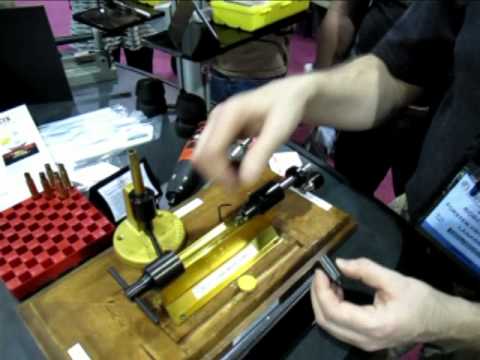
SCATT Company, based in Russia, produces an advanced marksmanship training aid that is now being used by many of the world’s top prone and position shooters. The SCATT system uses a gun-mounted infrared (IR) sensor that precisely tracks the movement of the rifle during the aiming process. This tracking data can then be displayed on a computer screen or special electronic targets. In development since 1991, the SCATT system was first employed by the Russian Federation shooting team. However, the SCATT technology was released commercially and is now being used by many other national teams including: USA, China, France, Germany, Japan, and Switzerland.
SCATT Training Systems employ an electronic optical sensor fixed to a gun’s barrel, frame, or the compressed air cylinder of an air gun. The shooter then aims at the electronic target. A trace of the point of aim can then be followed on a ‘real-time’ display screen. When the shooter pulls the gun’s trigger, the point of impact is then displayed on the screen. (This is dry-fire only — no projectiles are loaded). All results of training sessions can be recorded for later analysis. Russian research has shown that SCATT training is both effective and efficient. Using SCATT, beginning marksmen can acquire competitive skills two to three times more quickly than with conventional practice methods alone.
SCATT Shows How an Olympian Holds
The video below shows the aiming patterns of Olympic bronze medalist Miss Snježana Pejčić, a 10m Air Rifle shooter. The SCATT system records the air rifle’s muzzle motions as green traces while Snježana dials in her aim. Her final shot positions (and scores) are recorded when the large circle appears.
SCATT Company has dealers worldwide for its training systems, electronic targets, and shooting accessories. To order SCATT systems in the USA, contact:
Center Shot Sports
www.CenterShot.com
4300 Rogers Ave., Suite 20,
Box 213
Fort Smith, AR 72903
Phone: 479-262-2584
E-mail: info [at] centershot.com
If you’re looking for an affordable holiday gift for a shooting buddy or family member, a gift that will be appreciated month after month, consider a magazine subscription. Every month your buddy or relative will get something new in the mail — so it’s like sending a dozen gifts over the course of the year. Your Editor receives a couple magazine subscriptions that were gifts from my brother, and I really do look forward to the magazines’ arrival in my mailbox each month. And each time I open up a new issue of Nat Geo or Shooting Times I think, “Thanks Bro — that was a thoughtful gift — you made my day.”
In our Shooters Forum, one newcomer wanted some advice on selecting a reticle for F-Class optics. He wondered about the advantage of Forward Focal Plane (FFP) vs. conventional scopes and also wondered if one type of reticle was better for “holding off” than others.
In responding to this question, Forum regular Monte Milanuk provided an excellent summary of aiming methods used in F-Class. For anyone shooting score targets, Monte’s post is worth reading:
Aiming Methods for F-Class Shooting — by Monte Milanuk
F-Class is a known-distance event, with targets of known dimensions that have markings (rings) of known sizes. Any ‘holding off’ can be done using the target face itself. Most ‘benefits’ of forward focal plain (FFP) optics are null and void here — they work great on two-way ranges where ‘minute of man’ is the defining criteria — but how many FFP scopes do you know of in the 30-40X magnification range? Very, very few, because what people who buy high-magnification scopes want is something that allows them to hold finer on the target, and see more detail of the target, not something where the reticle covers the same amount of real estate and appears ‘coarser’ in view against the target, while getting almost too fine to see at lower powers.
Whether a person clicks or holds off is largely personal preference. Some people might decline to adjust their scope as long as they can hold off somewhere on the target. Some of that may stem from the unfortunate effect of scopes being mechanical objects which sometimes don’t work entirely as advertised (i.e. one or two clicks being more or less than anticipated). Me personally, if I get outside 1-1.5 MOA from center, I usually correct accordingly. I also shoot on a range where wind corrections are often in revolutions, not clicks or minutes, between shots.
Some shooters do a modified form of ‘chase the spotter’ — i.e. Take a swag at the wind, dial it on, aim center and shoot. Spotter comes up mid-ring 10 at 4 o’clock… so for the next shot aim mid-ring 10 at 10 o’clock and shoot. This should come up a center X (in theory). Adjust process as necessary to take into account for varying wind speeds and direction.
Others use a plot sheet that is a scaled representation of the target face, complete with a grid overlaid on it that matches the increments of their optics — usually in MOA. Take your Swag at the wind, dial it on, hold center and shoot. Shot comes up a 10 o’clock ‘8’… plot the shot on the sheet, look at the grid and take your corrections from that and dial the scope accordingly. This process should put you in the center (or pretty close), assuming that you didn’t completely ignore the wind in the mean time. Once in the center, hold off and shoot and plot, and if you see a ‘group’ forming (say low right in the 10 ring) either continue to hold high and left or apply the needed corrections to bring your group into the x-ring.
Just holding is generally faster, and allows the shooter to shoot fast and (hopefully) stay ahead of the wind. Plotting is more methodical and may save your bacon if the wind completely changes on you… plotting provides a good reference for dialing back the other way while staying in the middle of the target. — YMMV, Monte




 Sniper’s Hide has released its first-ever, full-length DVD:


 In his




 SCATT Company has
 F-Class is a known-distance event, with targets of known dimensions that have markings (rings) of known sizes. Any ‘holding off’ can be done using the target face itself. Most ‘benefits’ of forward focal plain (FFP) optics are null and void here — they work great on two-way ranges where ‘minute of man’ is the defining criteria — but how many FFP scopes do you know of in the 30-40X magnification range? Very, very few, because what people who buy high-magnification scopes want is something that allows them to hold finer on the target, and see more detail of the target, not something where the reticle covers the same amount of real estate and appears ‘coarser’ in view against the target, while getting almost too fine to see at lower powers.

 Others use a


