Sierra Bullets has just announced a new .375-caliber, 350 grain HPBT bullet — the latest in Sierra’s MatchKing line of projectile. Designed for custom long-range applications, this 350-grainer is the largest MatchKing Sierra produces, and it offers a jaw-dropping 0.805 G1 BC (at 2,200+ fps).
With that impressively high BC, the new .375-caliber MatchKing should “buck the wind” very well at long range. The new bullet features an 11-caliber ogive, and 9-degree boat tail. Sierra says the overall shape is “forgiving” to tune and should work well at a variety of seating depths. These bullets will be available in 50-count boxes (stock #9350T), or bulk boxes of 500 bullets (stock #9350).
Redding is releasing a dedicated small-case powder measure with a charge weight range of 1 to 25 grains. This specialized Model 10X powder measure should work well for small varmint cartridges such as the .221 Fireball, .20 Vartarg, and the 17 Hornet. The powder cavity and micrometer settings put the charge for a 17 Hornet right in the middle of the powder measure’s capacity — the most accurate part of its range. That’s good news for small rifle cartridge reloaders.
In addition, 17 Fireball and 17 Hornet shooters will be pleased to not that Redding has introduced a 17-caliber drop tube adapter that fits the small-diameter necks of these compact varmint cartridges. With this 17-cal adapter (Redding part #03817), you can throw charges directly into 17-caliber cartridge brass, without the need for separate small-neck funnels.
Features of New Redding 10x Powder Measure:
• Micrometer-controlled powder metering chamber
• Hemispherical Cup for smoother operation
• Cast iron and hard chrome construction
• Positive metering chamber lock
• Adjustable powder baffle
The 17 Hornet is based on the venerable rimmed .22 Hornet case. However, the case is not just necked-down from .22 caliber. The case designers reduced body taper, moved the shoulder, and changed the shoulder angle to 25°. This effectively modernized the old .22 Hornet case, improving efficiency while retaining the max OAL, so that the 17 Hornet can work in any action big enough for the .22 Hornet. Hornady’s “Superformance” 17 Hornet loaded ammo is designed to push a 20gr bullet at an impressive 3650 fps.
The June Digital Edition of GUNS Magazine is now available for free online. Just click this link to view the June Edition. NOTE: When the log-in screen appears, simply click the “CONTINUE” button. You do NOT have to fill in your name or email address. You can also read previous monthly editions by clicking on the Archive Tab. The last three (3) years of GUNS Magazine can be accessed for FREE online.
Articles by Jake Gottfredson in June Edition
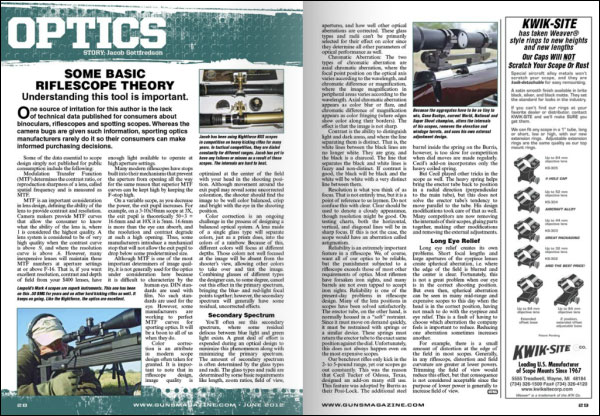
The June Edition of GUNS Magazine contains two interesting articles by our friend (and AccurateShooter contributing writer) Jacob (“Jake”) Gottfredson. In the first article, Some Basic Riflescope Theory, Gottfredson identifies key principles of optics and shows how they apply to riflescope design and construction. He explains the term “Modulation Transfer Function” (MTF), and how this can be used to quantify both contrast and resolution. The author also explores the topics of color correction, chromatic aberration, and color fringing. Jake notes how color correction and focus precision are directly related. Jake also explains the difference between “clarity” and “resolution”. You can have a scope with good clarity but poor resolution or vice-versa. If a scope shows cloudiness it lacks clarity. If the scope can’t show a test grid in sharp focus, it lacks resolution. There are many other important insights Jake provides in this well-written article. We recommend you read the article and perhaps event print it out for future reference. If you are shopping for an expensive scope, Jake provides specific criteria by which you can judge a scope’s quality and repeatability.
600-Yard Playing Card Shoot — Tiny Target, Far Away
The second offering by Gottfredson in the June issue of GUNS Magazine, is an entertaining report about a 600-yard fun shoot using playing cards. Regular-sized 2.5″ x 3.5″ playing cards with a 3/4″ red dot are placed in the center of an 8.5″ x 11″ target sheet. To help aiming, the target sheets have a black ring about 5″ in diameter. After a sighter session, shooters are allowed 10 shots in 7 minutes from 600 yards. That’s a pretty tough challenge, but with a very accurate rifle, multiple card hits are possible. Jake reports that, at his “card shoot”, the two top competitors, Gary Chaney and Andrew Smith, each hit the card six (6) times, with Gary breaking the tie by hitting the 3/4″ red dot. If this sounds like fun, read the full story, and perhaps you can set up a similar match at your shooting club. Gottfredson even includes “10 Tips for Success” such as: “7. Shoot fast, trying to get all rounds downrange in the same wind. Stop when it changes and wait for it to return or hold off if it does not….”
In addition to two Gottfredson articles, the June Edition of GUNS Magazine has a helpful feature on the .243 Winchester by John Barsness. This provides a short history of the cartridge and Barsness discusses 6mm bullet options for hunters using the .243 to harvest game.
Imagine a “smart scope” that can range your target AND calculate windage correction. Such technology may appear in riflescopes fairly soon. The Israeli Government’s Soreq Nuclear Research Center has received a U.S. patent for a new laser-based technology that can gauge wind vectors as well as target distance, using a laser rangefinder coupled to a rifle-scope. The Israeli system is called LIDAR, an acronym for Laser Identification Detection And Ranging. This new technology could, potentially, be a major boon for long-range shooters, both military and civilian. Ironically LIDAR was first developed for environmental monitoring (not for use with weapons). A LIDAR system was used for 3-D mapping and modeling of wind-driven plumes from the Israel Electric Company’s Rabin power plant.
Credit The Firearm Blog for breaking this story on the new Israeli LIDAR technology for sniper scopes. Below you’ll find the LIDAR Patent Application Abstract, which has a good summary of how LIDAR reads the wind.
The new Israeli LIDAR unit gauges wind speed by detecting fluctations in laser signals sent out from the integrated scope/LRF, reflected back from the target, and then received by photodiodes in the scope/LRF. Other scopes have used built-in LRFs to measure distance-to-target, but Israel’s patented LIDAR goes one step further, using the laser to gauge BOTH target distance AND wind vectors (i.e. velocity + direction). This information is entered automatically into software. The software then calculates a ballistic solution compensating for distance, wind angle, and wind velocity. If it really works, LIDAR represents a remarkable technological achievement. The Israelis claim LIDAR works for targets at distances of 500m or greater. Why won’t it work at closer ranges? Presumably the wind-induced laser fluctuations are too small to register at closer distances.
Current Integrated LaserScopes for Hunters While the Israeli LIDAR system may seem like science fiction, it’s not that far removed from the lastest commercial optics. Engineers on both sides of the Atlantic have already integrated laser rangefinders (LRFs) into rifle-mounted “consumer” optics. Just this year, Burris introduced an affordable “consumer” scope, the Eliminator, that ranges the distance to target and then displays the ballistically correct aiming point on the vertical crosshair. The amount of hold-over is automatically calculated with reference to ballistics formulas. At right is a view through the Burris Eliminator; the illuminated dot shows the calculated aiming point.
While such technology can help a shooter compensate for bullet drop, windage compensation is another matter. A shooter must still gauge crosswind angle and velocity, and then hold left or right accordingly. If the LIDAR system can perform this task reliably, that is a major advancement.
DARPA “One Shot” System to Have Wind-Reading Capability
Meanwhile, in the United States, the Defense Advanced Research Projects Agency (DARPA) is proceeding forward with a One-Shot Sniper System, another “Super-Scope” that will have day/night capability, and calculate both elevation AND windage correction automatically. Prototypes have already been tested, demonstrating that a laser beam can be used to “measure the average down-range crosswind profile”. The wind data is combined with readings of temperature, humidity, and target range to provide a very sophisticated ballistic solution. DARPA’s Spec for the One Shot program calls for a 12-42X Direct View Optic (DVO), a Riflescope Display Assembly (RDA), and an Integrated Spotting Scope (ISS) with rangefinder that ranges to 2 km, and provides “crosswind measurements”. The system will be “menu-selectable” for .308 Win, .338 Lapua, and .300 Win Mag. DARPA has budgeted big bucks for the One Shot system. The ISS, by itself, is expected to cost $85,000 per unit (for the first 15 units).
These systems will never replace the utility of an experienced shooter who possesses the skills of wind reading, but it is a real boon for less experienced shooters. In terms of military utility, it is a game changer. I’ve seen and used a prototype of the One Shot, and it does perform as advertised. — SFC Emil Praslick III, USAMU Coach
Can Wind-Reading Systems Work in the Real World?
From what we can tell, the LIDAR system, and America’s competing One Shot System, are both designed to measure crosswind speed and angle AT THE TARGET primarily. But as any experienced long-range shooter knows, wind is rarely constant along the entire path of the bullet. There can be a 10 mph left wind near the firing point, a 5 mph tailwind in mid-trajectory, and a 20 mph right wind 1000 yards away. Importantly, wind close to the shooter has more effect on the bullet’s path than wind far downrange — that’s a matter of simple geometry. Therefore, any wind-reading system could provide incorrect solutions if it is not able to read and calculate different wind vectors along the full bullet flight path. Presumably LIDAR and One Shot systems will attempt some kind of crosswind averaging, but that will be a very challenging task, without multiple wind sensors downrange.
Today, Memorial Day, Americans will honor the sacrifices of military men and women who paid the ultimate price in their service to our nation. More than one million American men and women have died in military service during wartime, including more than 655,000 battle deaths. Observances this Monday, May 30th, will range from parades to memorial ceremonies and organized moments of silence. More than 100,000 people are expected to attend organized activities at national cemeteries.
“The fallen warriors we honor on Memorial Day cherished liberty and freedom enough to lay down their lives to preserve our way of life,” said Secretary of Veterans Affairs Eric K. Shinseki. “We owe them eternal gratitude and we must pass those sentiments on to future generations.” Sec. Shinseki will deliver the keynote address at a Memorial Day ceremony at Fort Richardson (AK) National Cemetery.
The Department of Veterans Affairs (VA) will continue a tradition of hosting numerous ceremonies at its national cemeteries and other facilities nationwide. President Obama will speak at Arlington National Cemetery. For the schedule of other Memorial Day weekend programs at VA national cemeteries, visit www.cem.va.gov.
Memorial Day was originally called Decoration Day when the tradition of decorating Civil War graves began in 1866. This day of remembrance still brings loved ones to the graves of the deceased, often with flowers as grave decorations. To honor veterans buried in national cemeteries, Dept. of Veterans Affairs (VA) staff and volunteers typically place small individual American flags on each grave. Alternatively, “avenues of flags”, flanking both sides of the cemetery entrance, are displayed. (These may include burial flags awarded to the survivors of veterans interned in the cemetery). The VA maintains more than three million gravesites at its 131 national cemeteries. In 2010, more than 111,800 burials took place in national cemeteries.
The 40th Annual Firearms Industry Super Shoot, held at the Kelbly’s Range in North Lawrence, Ohio, concluded yesterday, May 26. Now in its 40th year, the Super Shoot is the biggest short-range benchrest competition on the planet, drawing upwards of 400 competitors each year. The Super Shoot attracts top 100-yard/200-yard Benchrest shooters from throughout the world.
According to reports from Ohio, Jeff Summers is the Overall Two-Gun Super Shoot Champion. We’re told that Larry Costa finished second, Jeff Gaidos took third, fourth was Wayne Campbell, and Gene Bukys secured fifth position overall. Posting on Benchrest Central, Scotty Crawford wrote: “This is Jeff’s second Super Shoot win. I would like to know how many top tens he has had at the Super Shoot. The cream always rises to the top…. Congratulation to Jeff and Larry Costa and to all the winners.”
Here are some preliminary results for the LV and HV matches. Note: These rankings are subject to final verification, and they are not official. We are still waiting for ranked results from Saturday’s 200-yard Light Varmint (10.5-lb class) competition, and the actual combined scores for the Two-Gun.
Heavy Varmint (13.5-lb) 100 Yards
1st Bill Goad 0.1766
2nd Jeff Summers 0.1918
3rd Bart Sauter 0.1934
4th Hal Drake 0.1972
5th Ken Pritt 0.2056
Heavy Varmint (13.5-lb) 200 Yards
1st Jeff Gaidos 0.2428
2nd Jeff Summers 0.2656
3rd Larry Costa 0.2729
4th Wayne Campbell 0.2769
5th Barney Small 0.278
Heavy Varmint (13.5-lb) Grand Agg
1st Jeff Summers 0.2287
2nd Larry Costa 0.2413
3rd Jeff Gaidos 0.246
4th Wayne Campbell 0.2617
5th Ken Pritt 0.2626
Light Varmint (10.5-lb) 100 Yards
1st Jim Carmichel 0.1922
2nd Cris Harris 0.1946
3rd Tony Boyer 0.1984
4th Jack Neary 0.2044
5th Kip Jones 0.2074
The Bianchi Cup pistol competition concluded yesterday. Officially, the annual competition in Columbia, Missouri is known as the National Championship of NRA Action Pistol. But to everybody it’s the Bianchi Cup — the richest handgun tournament in the world. Overall and Men’s Champion was Doug Koenig. Team S&W Captain Julie Golob fought off a strong challenge from Jessie Rabb to win the Ladies’ Division. Robert Vadasz, a Border Patrol Agent, was crowned Metallic Champ, while Adam Lennert took home the Senior Champion Title. There were a number of skilled Junior shooters this year. The best of the lot was young Tiffany Piper.
Joyce Rubino, Larry and Brenda Potterfield, Junior Champion Tiffany Piper, Metallic Champion Robert Vadasz, Bianchi Cup Champion Doug Koenig, Women’s Champion Julie Golob, Senior Champion Adam Lennert and Production Champion Vance Schmid.
Bianchi Cup — Classic Four-Stage Course of Fire
The MidwayUSA/NRA Bianchi Cup is a combination of Speed and Accuracy. Competitors shoot from both standing and prone positions and are also required to shoot with both strong and weak hands at various stages. Stages may combine stationary and moving targets. As conceived by former police officer and holster-maker John Bianchi, the Bianchi Cup originated in 1979 as a Law Enforcement Training match. The Course of Fire consists of four separate matches:
The Practical Event: From the appropriate shooting line, the shooter fires at distances from 10 yards to 50 yards under varying time limits.
The Barricade Event: From within shooting boxes and behind barricades, a shooter fires at targets on either side of the barricade at different distances and under varying time limits.
The Falling Plate Event: From the appropriate shooting line, the shooter fires at 8 inch round steel plates arranged in banks of six at distances from 10 to 25 yards under varying time limits.
The Moving Target Event: From within shooting boxes at distances ranging from 10 to 25 yards, the shooter fires at a target moving from left to right with the target being exposed for only 6 seconds.
Camera Land’s One-Penny Tripod Promo Camera Land is offering a Vortex $129.99 Ball-head Tripod for just one penny ($0.01) if you purchase a Vortex spotting scope from the product list below. Cameraland’s marketing team states: “We thought it would be a nice thing to offer a special deal to all those forum members who support us so we came up with a wonderful offer. If you buy any new Vortex Viper Spotter from the list below, for an extra $.01 we’ll include a Vortex Dakota Tripod (PN#-DKA) with a Ball Head.”
Get a Tripod for a Penny More
If you purchase a Vortex Viper or Vortex Razor Spotting scope from the about list, Camera Land will include a Vortex Dakota Tripod (PN#-DKA) with a Ball Head for just one penny more. The Dakota ball-head tripod currently sells for $129.99.
Sale tip from EdLongrange. We welcome reader submissions.
If you purchased Berger’s “6mm BR Column” bullets recently, check your lot number on the box. Berger Bullets has recalled lot number 4192 of 6mm BR Column bullets (Berger item #24407). If you have this lot number please contact Berger at (714) 447-5425, and Berger will ship you high-quality replacement bullets. We are not sure why these bullets are being recalled, but rest assured that Berger will provide high-quality replacements promptly. Note: It is known that part of lot number 4192 was originally shipped to Powder Valley.
About the 6mm BR Column Bullet Design
Berger’s “6mm BR Column” bullets were created for short-range (100-300 yards) benchrest applications. This name does not mean the bullet is designed just for the 6mm BR cartridge. Rather it is designed for all 6mm short-range benchrest (BR) rifles, most of which are 6 PPCs (for group shooting at least). The “Column” in the name comes from the fact that Berger optimized the height of the lead core column inside the bullet. Testing revealed that bullets which had very uniform core column heights shot more accurately and were also easier to tune. Berger says the new 6mm BR ‘Column’ projectiles started shipping in mid-March, 2012.
The 2012 CMP Eastern Games and Creedmoor Cup took place May 5-13, 2012 at Camp Butner, NC. CMP events ran May 5 through May 8, followed by the Creedmoor Cup matches May 9-12. In the Creedmoor Cup segment, SGT Sherri Gallagher won the overall individual Championship (and Match Rifle Division), shooting 2386-138X out of a possible 2400. Just one point behind was fellow USAMU shooter SSG Brandon Green, with 2385-123X. Sherri also won the Creedmoor EIC match. Sherri proved, once again, that she’s hard to beat when she’s “on her game”. Top Service Rifle shooter was Army Reservist CPT Samuel Freeman (2375-106X), followed by SSG Tyrell Cooper (2370-94X). USAMU Team Praslick won the 4-person Team Match Rifle Championship, while USAMU Team Peters won the 4-person Team Service Rifle Championship. CLICK HERE for complete 2012 Eastern Creedmoor Cup Match Results.
Creedmoor Sports’ General Manager Dennis DeMille was “Top Shot” at the CMP Games. Dennis won the Garand Match by six points, and Dennis also took the coveted Three-Gun Aggregate Trophy. Glendale Rutherford won the Springfield Match, while Sean Leighton won the Vintage Military Match. The M1 Carbine Match had a high turn-out, with 99 shooters. William Bowling (360-4X) took top honors by one point over William Aten (359-2X). In the popular Rimfire Sporter Match, Jacob Guay (594-41X) edged Ron Villanueva (594-39X) on X-Count to win the title.
In another tightly contested match, the team of Douglas Armstrong and Kenneth Clowdis (390-13X) won the Vintage Sniper Team Match by one point over Paul Patel and Howard Burrill (389-16X) of team ‘Hardleg 1′. However, Paul Patel topped a huge field of 122 shooters to win the Individual Vintage Sniper Rifle Match, with a two-point margin over runner-up Doug Armstrong.


 Sierra Bullets has just announced a new .375-caliber, 350 grain HPBT bullet — the latest in Sierra’s MatchKing line of projectile. Designed for custom long-range applications, this 350-grainer is the largest MatchKing Sierra produces, and it offers a jaw-dropping 0.805 G1 BC (at 2,200+ fps).

 Redding is releasing a dedicated small-case powder measure with a charge weight range of 1 to 25 grains. This specialized Model 10X powder measure should work well for small varmint cartridges such as the .221 Fireball, .20 Vartarg, and the 17 Hornet. The powder cavity and micrometer settings put the charge for a 17 Hornet right in the middle of the powder measure’s capacity — the most accurate part of its range. That’s good news for small rifle cartridge reloaders.

 The

 Imagine a “smart scope” that can range your target AND calculate windage correction. Such technology may appear in riflescopes fairly soon. The Israeli Government’s
 While the Israeli LIDAR system may seem like science fiction, it’s not that far removed from the lastest commercial optics. Engineers on both sides of the Atlantic have already integrated laser rangefinders (LRFs) into rifle-mounted “consumer” optics. Just this year, Burris introduced an affordable “consumer” scope, the


 Heavy Varmint (13.5-lb) 100 Yards


 Camera Land’s One-Penny Tripod Promo

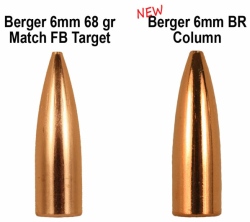 If you purchased Berger’s “6mm BR Column” bullets recently, check your lot number on the box. Berger Bullets has recalled lot number 4192 of 6mm BR Column bullets (Berger item #24407). If you have this lot number please contact Berger at (714) 447-5425, and Berger will ship you high-quality replacement bullets. We are not sure why these bullets are being recalled, but rest assured that Berger will provide high-quality replacements promptly. Note: It is known that part of lot number 4192 was originally shipped to
 The 2012 CMP Eastern Games and Creedmoor Cup took place May 5-13, 2012 at Camp Butner, NC. CMP events ran May 5 through May 8, followed by the Creedmoor Cup matches May 9-12. In the Creedmoor Cup segment, SGT Sherri Gallagher won the overall individual Championship (and Match Rifle Division), shooting 2386-138X out of a possible 2400. Just one point behind was fellow USAMU shooter SSG Brandon Green, with 2385-123X. Sherri also won the Creedmoor EIC match. Sherri proved, once again, that she’s hard to beat when she’s “on her game”. Top Service Rifle shooter was Army Reservist CPT Samuel Freeman (2375-106X), followed by SSG Tyrell Cooper (2370-94X). USAMU Team Praslick won the 4-person Team Match Rifle Championship, while USAMU Team Peters won the 4-person Team Service Rifle Championship.
 Creedmoor Sports’ General Manager Dennis DeMille was “Top Shot” at the CMP Games. Dennis won the Garand Match by six points, and Dennis also took the coveted Three-Gun Aggregate Trophy. Glendale Rutherford won the Springfield Match, while Sean Leighton won the Vintage Military Match. The M1 Carbine Match had a high turn-out, with 99 shooters. William Bowling (360-4X) took top honors by one point over William Aten (359-2X). In the popular Rimfire Sporter Match, Jacob Guay (594-41X) edged Ron Villanueva (594-39X) on X-Count to win the title.


