|
|
March 2nd, 2010
 Lyle Denniston, reporter for the Scotus (Supreme Court of the United States) Blog, attended the oral argument in McDonald v. Chicago (Docket 08-1521) this morning. Analyzing the comments and questions of the Justices, Denniston concluded that the High Court is very likely to extend the Second Amendment to state and municipal actions, on the basis of the Due Process Clause of the 14th Amendment. However, the Justices were skeptical of the argument that “incorporation” of the Second Amendment was likewise mandated by the “privileges and immunities” section of the 14th Amendment.
CLICK HERE for transcript of Oral Argument
(PDF file, 77 pages, 342kb).
Denniston writes: “The Supreme Court on Tuesday seemed poised to require state and local governments to obey the Second Amendment guarantee of a personal right to a gun, but with perhaps considerable authority to regulate that right. The dominant sentiment on the Court was to extend the Amendment beyond the federal level, based on the 14th Amendment’s guarantee of “due process,” since doing so through another part of the 14th Amendment would raise too many questions about what other rights might emerge.”
During the course of the oral argument, the Justices disagreed as to the scope of the Second Amendment — whether it should be limited to a “core right” of self-defense or whether it could be applied much more broadly in future cases. The Scotus Blog explained: “The liberal wing of the Court appeared to be making a determined effort to hold the expanded Amendment in check, but even the conservatives open to applying the Second Amendment to states, counties and cities seemed ready to concede some — but perhaps fewer — limitations. The eagerly awaited oral argument in McDonald, et al., v. Chicago, et al. found all members of the Court actively involved except the usually silent Justice Clarence Thomas. And, while no one said that the issue of “incorporating” the Second Amendment into the 14th Amendment had already been decided before the argument had even begun, the clear impression was that the Court majority was at least sentimentally in favor of that, with only the dimensions of the expansion to be worked out in this case and in a strong of likely precedents coming as time went on.”
We recommend that those interested in Second Amendment issues read the full Scotus Blog Entry, which includes detailed explanations of the key arguments, and analyses of how individual justices stand on the question of how the Second Amendment should be applied to the States — i.e. whether broadly or narrowly.
CLICK HERE to read SCOTUS BLOG re McDonald v. Chicago.
March 2nd, 2010
Today, the U.S. Supreme Court is hearing oral arguments in McDonald v. City of Chicago, a major Second Amendment case that will determine whether cities and states must honor the Constitutional Right to keep and bear arms, set forth in the Second Amendment to the U.S. Constitution. It will be argued that the protections of the Second Amendment should extend to state and local government activity, based on the provisions of the 14th Amendment.
The key words from the 14th Amendment are “No State shall make or enforce any law which shall abridge the privileges or immunities of citizens of the United States; nor shall any State deprive any person of life, liberty, or property, without due process of law . . . . ”

You can consider McDonald v. City of Chicago as the sequel to the 2008 landmark case — the District of Columbia v. Heller — in which the Supreme Court reaffirmed that the Second Amendment is an “individual” right to keep and bear arms. The Court’s decision, however, applied only to areas regulated by the federal government, such as the District of Columbia. As a result the Heller decision inspired further legal attempts to clarify how the right to keep and bear arms applies to citizens nationwide.
After Heller, many lawsuits were filed to overturn municipal and state laws that prevented individuals from owning handguns. In Chicago, several residents brought suit challenging the city’s long-standing gun ban. These residents, among them 76-year-old Otis McDonald, wanted a handgun to protect themselves and their families. McDonald, interviewed by ABC News, lives in a crime-ridden neighborhood and wants a gun to defend himself in his home: “If I’ve got a gun, and if others have guns in their homes to protect themselves, then that’s one thing that police would have to worry about less.”
How broadly or narrowly the Second Amendment will be applied to state regulations is the key question in today’s hearing in McDonald v Chicago. Today, one hour has been set for oral arguments. Attorney Alan Gura, who won the Heller case, will argue for the petitioners Otis McDonald, et al. Former U.S. Solicitor General Paul Clement will argue for the NRA, which is also a party to the case. Chicago’s defense will take up the remainder of the time.
Final Decision is Months Away
Legal experts will attempt to predict how McDonald v. Chicago will be decided, based on the questions/comments of the Justices during oral argument. However, we will have to wait many months before the Supreme Court’s actual written ruling. In a case of this significance, we can expect a lengthy written opinion (with dissents), that may not be issued until summer 2010.
Report and Photo Courtesy NSSF
March 2nd, 2010
Brownells has commenced a 37,000 square foot expansion of its Montezuma, Iowa, warehouse. Along with the new space, plans call for the addition of several new warehouse employees, plus more technology to assist order-picking, packing, and shipping.
According to company President, Pete Brownell, “The extra space makes room for the additional inventory needed to maintain our industry-leading in-stock position and to also help us get our orders out even more efficiently.”
CEO Frank Brownell told us, “I remember working for Dad in the basement of the old movie theatre on the town square. We couldn’t imagine filling the current building when we moved in back in the 1970s and we’ve had to add on every five years.”

March 1st, 2010
IBS 600-yard National Champion and recent 600-yard Shooter of the Year Sam Hall has been hard to beat when he’s got his 6BR or his Dasher dialed in. Sam recently told us that he’s been experimenting with the 6.5×47 Lapua cartridge, thinking that a larger, higher-BC bullet might perform better in the wind.


Sam’s competitors are probably hoping we’ll report that Sam is struggling with the new cartridge, and can’t get his new 6.5×47 to shoot. Well, guys… no such luck. Sam recently took his 6.5×47 Heavy Gun out in some fairly windy conditions, but still returned a spectacular four-shot group at 600 yards. Sam measured the group at 0.357 inches. We measured it at 0.371″ with OnTarget software, but that was going off a photograph, which can be less precise. Either way, 4 shots in well under 0.4 inches at 600 yards is spectacular.
As Sam told us, however, “I just wish I’d shot that in competition… with a fifth shot of course.” Even though Sam’s group was shot in practice, it’s still an amazingly small group — one that suggests that the 6.5×47 Lapua may have great potential as a Benchrest cartridge. The group size, in MOA, is 0.059!

Sam’s load was 37.0 grains of Reloder 15 with 130gr Berger VLDs and CCI BR4 primers. The gun is a Bat-actioned, 47-lb “true heavy” built by Leonard Baity using a McMillan 50BMG stock. The barrel is a 29.5″ Brux, 1.25″ straight contour, with a 1:8.5″ twist. Sam reports:
The gun has a BAT MB 1.55″ round action. The reamer was a Kiff (PTG) .290 neck with .160 freebore. The loaded round is .288 at the neck. I made a mistake labeling the target. The primers were CCI BR4s, not 450s. The 130gr Bergers VLDs are lot 0225 (the early ones). They are in the rifling as far as I can get them (jam). I use a .287 Redding bushing in my Redding “type S” FL dies. I seat with a Wilson seater. The stock is a McMillian Light 50 BMG stock full of lead from McMillian. With the 40x Leupold it weighs 47 pounds. The fore-end is 3.5 inches wide. Leonard Baity did the complete rifle. I had him to put a rail (3 inches wide) on the back so I could use my adjustable rest Leonard made me a few years ago for my Shehane Maxi-Tracker stock. Even though this rifle is only 14 pounds lighter than the 61-pound aluminum stock Maxi-Tracker 6mm Dasher I shot last year, it feels like it is 25 pounds lighter. It is much, and I mean MUCH more manageable carrying this rifle around than the Maxi-Tracker. I can actually use my Farley, joy-stick rest with the rifle. I just replace the 3 inch bag with a 3.5 inch wide bag. I can make adjustments much faster with the Farley than I can twisting knobs.
The reason I built the 6.5×47 Lapua is to try to beat the wind we have here in NC in the spring. Plus, the fact I love to shoot and experiment. The 6.5 bullets are not affected as much by the wind as the 6mms. I started shooting 600-yard competiton with a 6.5-284. I could predict where the bullet was going to hit much better with it than the 6mms I shoot now. In windy conditions, the 6mms seem to “dance around” when sighting in. The heavy 6.5 seems to say on track and Point of Impact is more predictable. In 600-yard competition, score is half the game. I figured if I could get a 6.5 shooting somewhere close to a 6BR or 6BR Improved, I would be ahead of the game in the wind. So far this rifle is agging at 600 yards pretty close to my Dasher and BRX, but not better. After I found this load that shot the 0.357 inch 4-shot group, I went out and shot four more, 4-shot groups in some wind of 10-20 mph and the rifle agged 2.08 inches.
I am still haunted by a “flier” in each group. I am still trying to work that out. The 0.357 group I will say was a fluke because it is the only group I have shot that did not have a flier. The rifle sure won’t group like that every time, but that one time sure was pretty! You may ask why I shoot 4-shot groups during load development and practice. Three is not enough, but four will tell you what the rifle will do, plus I can shoot more groups before the barrel gets too warm.
Our first match is next month at Piedmont. I am going to give this rifle a try. Time will tell if I will stick with this round for serious 600-yard competition or back to the 6mms. — Samuel Hall
March 1st, 2010
Creedmoor Sports notified us that they have Geissele Triggers (for AR platform rifles), and Lapua Brass in stock. These triggers are often back-ordered for months, so if you need one, you should give Creedmoor a call at 800-273-3366. Chose the Geissele GT-SR trigger for $279.00, or the new SSA model for $170.00.

If you have been looking for Lapua Brass, Creedmoor has ample quantities for most of the popular cartridges: .223 Rem, .220 Russian, 6mmBR, .243 Win, 6.5×47 Lapua, 6.5-284 Norma, .308 Win, 30-06, .338 Lapua Magnum.
CLICK HERE for Lapua Brass at Creedmoor Sports
You may want to stock up now while supplies are available. To give you an idea on price, Creedmoor sells a 100-ct box of .308 Win Brass for $75.95.
March 1st, 2010
Eleven members of the 2010 World Championship team were selected following the Spring Airgun Championships, which served as Part II of the World Championship Team selection for the men’s and women’s open air rifle and pistol events. Six air rifle and five air pistol shooters qualified to represent the U.S.A. this August at the 50th ISSF World Championships in Munich, Germany.
 The 2010 World Championship team for airgun was determined by the match scores from the first two days of the 2009 Winter Airgun Championships (held last December), added to the match scores from both days of the Spring Airgun Championships and the best two finals from both matches. For complete results from the 2010 Spring Airgun Championships, please visit www.usashooting.org.
Olympic gold and silver medalist Matt Emmons qualified for the World Championship team in Men’s 10m Air Rifle with an overall score of 2600.7 points. U.S. Army Marksmanship Unit (USAMU) member Matt Rawlings grabbed the second spot in Men’s Air Rifle with a total score of 2584.2 and Jonathan Hall earned the third spot with 2577.1 total points.
Leading the Men’s Air Pistol team will be 2008 Olympian Brian Beaman, who finished with an overall score of 2507.4 points. Two-time Olympian and 2008 bronze medalist Jason Turner will finished right behind Beaman with 2506.2 points. Three-time Olympian and USAMU member Daryl Szarenski grabbed the third spot after firing a total score of 2502.1 points.
Two-time Olympian Emily Caruso lead the way in Women’s Air Rifle with 1800.4 total points. Jamie Beyerle, a 2008 Olympian, took the second spot with an overall score of 1798.8 points and TCU’s Sarah Scherer qualified in third place with 1796.4 points. Teresa Meyer finished first in Women’s Air Pistol after firing 1691.8 total points, while Brenda Shinn, a 2008 Olympian, took the second spot with 1679.0 points.
CLICK HERE for Info on 50th ISSF World Shooting Championship (PDF)

February 28th, 2010
 While in Southern California recently I couldn’t pass up the invitation to spend some time with my friend Michelle Gallagher, the Marketing Coordinator for Berger Bullets. After my obligatory visit to Disneyland, Michelle offered me a tour of the Berger Bullets factory. That is something even a Sierra guy knows not to pass up!
The machines now run 24 hours a day to keep up with market demands. To increase production, Berger recently started a third shift, allowing the machines to run at maximum capacity. We walked into the factory to the sound of a machine pressing out bullet jackets: “ca-chung, ca-chung, ca-chung.” It is so loud that hearing protection is worn by the operator. Copper is fed into the jacket-making machine from a large coil. Then a series of sequentially deeper, narrower punches create one complete bullet jacket for every revolution of the machine’s huge crankshaft. The operator monitors the whole cycle, selecting jackets at random to test for dimensional accuracy.
After the jackets are formed, lead is placed into the jackets. As with the copper jacket material, the lead is fed into a large machine from a coil. Lead cores are then cut to length and given an approximate shape, a process called swaging. This particular core-forming machine has been in use since before WWII! Michelle said “these machines still work great so there is no reason to switch to anything else”.
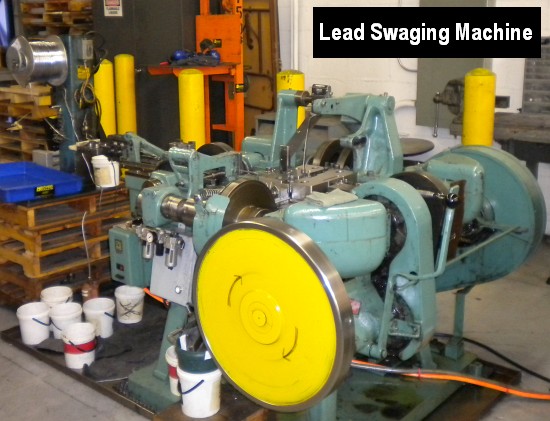
Next the copper jackets and lead cores are combined and shaped using a successive series of precision dies. The bullets are swaged (squished really) from the bottom up once the lead is inserted into the jacket via a tube feeder. This ensures there are no air bubbles between the lead core and copper jacket. I watched as one such machine was set up and calibrated. It was started then tested and adjusted a number of times before it was left to run automatically. Even then, handfuls of bullets are frequently tested for weight, concentricity, and dimensional accuracy. I was told that if any lot is found to be bad — for whatever reason — the entire lot is just thrown away! Sorry, but this means no boxes of seconds or “blems” at bargain prices from the Berger factory.
Some details of Berger’s operation surprised me. A number of tasks that I assumed would be automated are still done by hand, ensuring both accuracy and consistency. Bullets are weighed, packaged, and checked by hand. I overheard one employee say that they had a few thousand bullets to weight-sort before they could be packaged because they feared something may have been slightly off during production. That was a time-consuming task, but they did weight-sort bullet by bullet to make sure nothing had gone wrong.
 New Product Packaging
Berger is now offering “quantity packaging” for the most popular bullets in a number of different calibers. I was also surprised to see boxes in colors other than yellow on Berger’s shelves. Michelle explained to me that the yellow boxes are retained for match or target bullets. The thinner-jacketed hunting bullets now go in orange boxes while moly-coated bullets are packed in black boxes.
One last point worth noting is that if, like me, you (foolishly) wear a Sierra shirt to a tour of Berger Bullets, you will promptly be given a Berger shirt and hat to wear during the visit.
Michelle, thanks so much for the tour! — Kelly Bachand
February 28th, 2010
A few years ago, as a custom OEM order, Lapua produced a variety of cartridge cases for Dakota Arms. You may have seen the Dakota 20 Practical brass made by Lapua. Dakota ran out of money, so some of this brass was retained by Lapua. For quite some time, Lapua has been warehousing quantities of .423 Dakota cases and .30-06 Springfield cases, but now the left-over inventories are for sale at Grafs.com. All of Lapua’s remaining 30-06 and .423 Dakota brass (produced originally for Dakota Arms) are being offered for sale at www.grafs.com. Once they’re gone, they are GONE!

Lapua 30-06 100 Years Brass
The .30-06 cases are regular Lapua cases with a unique, 30-06 100 Years head stamp commemorating the 100 years of this cartridge. This special run 30-06 brass is Graf’s item DU4HH7067, prices at $16.57 per 20 cases.

.423 Dakota Brass
While there are few .423 Dakota rifle in circulation, there has been good interest from wildcatters and other. Grafs comments: “This is perfect brass for adventurous wildcatters looking for a large case to play with. They’re a rimless design, having a .585″ head and are 2.475″ in length. After that, they can be anything you want with a little Imperial and some elbow grease.” The .423 Dakota brass, Graf’s item DU4HH4230, costs $19.99 for 20 cases.
February 27th, 2010
Vihtavuori (VV) has started producing N570, a new high-energy, double-base powder suited for magnum cartridges. The burn rate of N570 is similar to Vihtavuori N170 and Hodgdon H870, making it somewhat faster than 24N21 or Retumbo. The new N570 has the slowest burn rate of the five powders in N500-series of high-energy propellants. N570 is an extruded tubular powder with a large kernel size (similar to VV 20N41 and 20N29) and a high bulk density.

The characteristics of this slow burning, high-energy powder are well-suited for large volume cases like the 6.5-284 Norma, 300 Winchester Magnum, 300 Remington Ultra Mag, 338 Lapua Magnum or the 30-378 Weatherby Magnum.
 Reloading Data for the new N570 Powder is available in the latest edition of the Vihtavuori Reloading Guide. (PDF).
CLICK HERE for Vihtavuori Reloading Guide (8th Ed.).
The new N570 was developed at the request of magnum cartridge reloaders. Vihtavuori told us: “Powder users have repeatedly asked for a powder suited to the needs of the largest magnum rifle cartridges. We have developed our new N570 High Energy powder to meet this special need in the market. N570 was developed to bring out the very best performance and velocity in large volume magnum rifle cartridges.”
VV Recommends Weighing N570 Charges
Because N570 has very large kernels, Vihtavuori advises that reloaders should always WEIGH N570 charges rather than rely on throws from powder measures: “We recommend that charges of this high-energy N570 powder be weighed, as measures do not always deliver consistent charges. This is especially true when the powder being used is of such a large kernel configuration. This may lead to a potential for either under- or over-charged cases, if the charges are thrown straight from the measure and not weighed.”
Vihtavuori Powders are imported in the USA by Hodgdon Powder Company and Kaltron Outdoors, and are marketed worldwide by Nammo Lapua, www.lapua.com.
February 27th, 2010
Military veterans make up a significant part of the NRA’s membership and Board of Directors. They shoot in the NRA’s competitive matches and often become NRA-Certified Instructors to teach gun safety and basic marksmanship.
In appreciation of the sacrifices made by members of the military, the NRA now offers a FREE one-year membership to all active-duty servicemen and women. The complimentary military membership provides all regular member benefits, including a subscription to one of three print magazines: American Hunter, American Rifleman, and America’s 1st Freedom. This offer applies to personnel currently serving with the Army, Navy, Marines, Air Force, or Coast Guard.
CLICK HERE for FREE NRA Membership for Armed Services Personnel.
 
Other Programs for Active Military and Veterans
The NRA conducts many more programs of interest to the military, from tactical competitions to tuition-free armorer schools. The NRA has also supported many Wounded Warriors Hunts. A free Veteran’s Day shoot has been held for several years at the NRA Range in Fairfax, Virginia.
|


