Last weekend, a prestigious competition, the V2 Finale, was held in Texas. This double-elimination match is the culmination of the F-Class Points Series conducted around the country. The F-Class Points Series V2 Finale was held May 23-26, 2024 at the Bayou Rifles Juliff Range in Rosharan, Texas. This is a unique competition with head-to-head pairs competition from start to finish. The event attracted leading F-Open and F-TR shooters including many past National Champions. There were tough conditions this year, with hot and very humid weather. To learn more about the F-Class Points Series visit FclassPointsSeries.com.
We congratulate the 2024 V2 Finale Champions, Norm Harrold in F-Open, and Scott Kyle in F-TR division.
F-Open third-place finisher Erik Cortina told us: “The fourth Vihtavuori V2 Finale was a success. Bayou Rifle Club proved to be a challenging range and gave way to many nail-biting matches. After three days of grueling competition, two shooters came out on top. Norm Harrold won F-Open and Scott Kyle won F-TR”. CLICK HERE to see more photos from the recent competition.
Here the Top 8 V2 Finale F-Open competitors receive their awards. Left to right are: Norm Harrold (Champion), Joe Fairley (2nd), Erik Cortina (3rd), Peter Johns, Tim Vaught, Matthew Bassala, Doug Skogman, and Jay Christopherson.
This Erik Cortina video features interviews with many top shooters including Norm Harrold (F-Open winner), and Scott Kyle (F-TR winner). The two F-Class John short videos below feature music (very cool).
High-Tech Hardware on the Firing Line
There was some interesting hardware on the firing line. With the electronic target systems used, competitors could see shot locations/scores via mobile WiFi devices. Many shooters also had spotting scopes which allowed then to watch wind and weather conditions on the 1000-yard range. And to beat the heat some shooters had battery-powered portable fans.
Above Erik Cortina, Cortina Precision, shoots his F-Open rifle with SEB NEO-X Front Rest.
Match photos from 2024 courtesy Denys Beauchemin, aka “Turbulent Turtle” in our AccurateShooter Forum. CLICK HERE to see more photos in 2024 V2 Finale Photo Archive.
Many of the Canadian F-TR shooters used a handy unitized base pad for their bipods. This provided consistent support and smooth tracking for both ski-type bipod feet.
Here are six of the Top 8 F-TR shooters: Scott Kyle (Champion), Brad Traynor (2nd), Allen Tempke (3rd), Ray Weaver, Robin Retzloff, Eric Bisson. Not present are Skip Barkley and Adam MacDonald.
Match Organizers Thank Vihtavuori and Other Sponsors
“We’re thrilled to extend our partnership with Vihtavuori for the 2024 V2 Finale event! As one of our original sponsors, their direct support has been instrumental in bringing this event to life and supporting its growth, commented Tod Hendricks, F-Class Point Series member. “Now serving as the lead sponsor, Vihtavuori’s continued generosity ensures that events like ours can flourish, offering fresh and exhilarating experiences in the competitive shooting sports arena.” Along with Vihtavuori, other V2 Finale sponsors included: Borden Accuracy, SEB Rests, Brux Barrels, and PrecisionPay. Our friend F-Class John served as Match Director.
This was a high-tech match with video cameras and electronic target monitors. Shown above is the main video recording station on the firing line. This was used by Erik Cortina to monitor/record match video feeds. The video below shows the Bayou Rifles Juliff 1000-yard range where the V2 Finale was held.
F-Class Points Series Rules and Course of Fire
The F-Class Points Series is a yearlong F-Class points system and leaderboard, that culminates in the V2 Finale, which pits F-Class competitors against each other in a bracket-style double elimination match. Sixty-four competitors, 32 for each class (F-Open and FT/R), are invited to the Finale based on their series ranking. Since the V2’s inaugural series in 2021, partnerships have begun in Canada, South Africa, Italy, and Australia. The 2024 Finale was held May 23-26 at Bayou Rifles in Rosharon, Texas.
CLICK HERE for V2 Finale and F-Class Points Series rules. For more information on the F-Class Points Series and V2 Finale, visit FClassPointSeries.com.
This new-format match pits F-Class competitors against each other in a bracket-style double elimination match. The elite field (32 per class) is selected via a preceding Points series. In the past targets were placed at 1000 yards. In something unusual for an American F-Class match, in the V2 Finale all shooting will be done via PAIR FIRING, with shooters going head-to-head with alternating shots. The listed course of fire for 2024 is:
3.1. 2 CONVERTIBLE SIGHTERS AND 15 SHOTS FOR RECORD AT 1000 YARDS, PAIR FIRE
3.2. 2 CONVERTIBLE SIGHTERS AND 10 SHOTS FOR RECORD AT 1000 YARDS, PAIR FIRE
3.3. 5 SHOTS FOR RECORD AT 1000 YARDS, PAIR FIRE
How is a modern, metal-chassis rifle built? This very cool video from Masterpiece Arms answers that question. The nicely-edited video shows the creation of a Masterpiece Arms tactical rifle from start to finish. All aspects of the manufacturing process are illustrated: 3D CAD modeling, CNC milling of the chassis, barrel threading/contouring, chamber-reaming, barrel lapping, laser engraving, and stock coating. If you love to see machines at work, you will enjoy this video…
If you will be flying with firearms this summer, here are six videos you should watch before you travel. You need to familiarize yourself with current Federal Regulations on gun transport before you get anywhere near an airport. Thankfully, the Transportation Security Administration (TSA) has an official INFO page that states the important requirements for airline passengers traveling with firearms and/or ammunition.
You’ll want to visit the TSA Firearms and Ammunition webpage, and read it start to finish. In addition, before your trip, you should check the regulations of the airline(s) with which you will fly. Some airlines have special requirements, such as weight restrictions.
We have two other key tips: 1) WEIGH Your Guns and ammo (as packed) BEFORE you get to the airport — so you comply with all airline flight limits without being surcharged; 2) Carry a printed copy of TSA and airline baggage regulations pertaining to firearms — this can help when dealing with airline personnel.
TSA offers this general advice: “You may transport unloaded firearms in a locked, hard-sided container as checked baggage only. Declare the firearm and/or ammunition to the airline when checking your bag at the ticket counter. The container must completely secure the firearm from being accessed. Locked cases that can be easily opened are not permitted. Be aware that the container the firearm was in when purchased may not adequately secure the firearm when it is transported in checked baggage.”
Traveling by Air with Firearms — Advice from Legal Expert
This is a good video by a very knowledgeable attorney. Washington Gun Law President William Kirk goes over everything you need to know in order to fly safely, and legally, with a firearm if you travel domestically. Kirk states: “While many believe this is a complicated formula of various state laws, in actuality TSA regulations govern all travel domestically with a firearm. There are very specific rules which must be followed in order to do this correctly.”
Colion Noir — Air Travel with Packed Firearms
Popular YouTube host and lawyer Colion Noir has created a good video that shares important points about traveling with firearms. Colion says: “Don’t risk making costly mistakes — get informed and ensure your firearm journey is hassle-free and lawful.” In this video, Colion covers these key points:
1. Bag Check: Learn the crucial pre-flight checklist to avoid any unwanted surprises at the TSA checkpoint.
2. Airline Check: Discover the differences in airline policies and ensure a smooth journey by reviewing your chosen carrier’s firearm guidelines.
3. Law Check: Stay on the right side of the law by understanding the gun regulations in every state you’ll visit during your trip.
4. The Gun Case: Explore the essential details about the TSA-required hard-sided lockable case and find out which one is my top choice.
5. Ammo Transport: Learn the correct way to transport ammunition separately from your firearm, all while staying within the weight limit.
Step-By-Step Guide to Gun Transport — Good Tips
This 18-minute Spiritus Systems video provides some very valuable practical tips for gun owners traveling by air. The host explains what to look for in a rifle case and locking system. He also explains how to pack the rifle and gear efficiently and how to label and track your gun/ammo cases. If you’re new to airline travel with guns, this video is worth watching start to finish. Here are highlights are listed by video times:
00:01 Introduction and Regulations
00:51 Storage Container Options
2:50 Type of Lock You Should Use
6:25 Tape Tip
7:16 Contact Information, and Labeling Your Bag
8:07 Firearm Considerations / Configuration
10:03 Documents
12:30 Tracking Your Bag
13:20 Packing Your Ammo
16:00 Prepping Your Magazines
How to Efficiently Pack Your Rifles and Gear
Our friend F-Class John often travels by air to major F-Class matches (most recently to the V2 Finale in Texas). John has learned how to transport valuable match rifles and optics most efficiently and economically. In these two videos F-Class John shows how to pack your rifles and equipment, and how to employ carry-on bags to secure optics and other non-regulated equipment.
TSA Video about Airline Travel with Guns and/or Ammo
This is the latest official TSA video covering gun/ammo transport via airlines. When packing for a flight be sure to start with an empty bag (make sure there are no forgotten gun parts or ammo inside before you pack). If you’re planning to travel with a firearm, follow the tips in this video and remember that you may NEVER bring a firearm in your carry-on bag. Also make sure you are not “packing” when entering the airport even if you have a CCW permit. TSA.gov Firearms/Ammo Transport INFO Page.
Official TSA Guidelines for Airline Travel with Firearms and Ammo
When traveling, comply with the laws concerning possession of firearms as they vary by local, state, and international governments.* Declare each firearm each time you present it for transport as checked baggage. Ask your airline about limitations or fees that may apply.
Firearms must be unloaded and locked in a hard-sided container and transported as checked baggage only. As defined by 49 CFR 1540.5 a loaded firearm has a live round of ammunition, or any component thereof, in the chamber or cylinder or in a magazine inserted in the firearm. For civil enforcement purposes, TSA also considers a firearm to be loaded when both the firearm and ammunition are accessible to the passenger.
Only the passenger should retain the key or combination to the lock unless TSA personnel request the key to open the firearm container to ensure compliance with TSA regulations. You may use any brand or type of lock to secure your firearm case, including TSA-recognized locks.
Bringing an unloaded firearm with accessible ammunition to the security checkpoint carries the same civil penalty/fine as bringing a loaded firearm to the checkpoint. You may find information on civil penalties at the Civil Enforcement page.
Firearm parts, including magazines, clips, bolts and firing pins, are prohibited in carry-on baggage, but may be transported in checked baggage. Replica firearms, including firearm replicas that are toys, may be transported in checked baggage only.
Rifle scopes are permitted in carry-on and checked baggage.
TSA Guidelines for Transporting Ammunition on Flights
Ammunition is prohibited in carry-on baggage, but may be transported in checked baggage. NOTE: Check with your airline for quantity limits for ammunition.
Firearm magazines and ammunition clips, whether loaded or empty, must be securely boxed or included within a hard-sided case containing an unloaded firearm. Read the requirements governing the transport of ammunition in checked baggage as defined by 49 CFR 175.10 (a)(8).
Small arms ammunition (up to .75 caliber and shotgun shells of any gauge) must be packaged in a fiber (such as cardboard), wood, plastic, or metal box specifically designed to carry ammunition and declared to your airline.
Ammunition may be transported in the same hard-sided, locked case as a firearm if it has been packed as described above. You cannot use firearm magazines or clips for packing ammunition unless they completely enclose the ammunition. Firearm magazines and ammunition clips, whether loaded or empty, must be boxed or included within a hard-sided, locked case.
*INTERNATIONAL: If you are traveling internationally with a firearm in checked baggage, please check the U.S. Customs and Border Protection website for information and requirements prior to travel.
Most of our readers are rifle guys, but it’s fun to shoot a pistol match now and then. You don’t need a lot of equipment, and if you shoot IDPA (Int’l Defensive Pistol Assn.) matches, you can really win with a $400 pistol and $25.00 worth of bulk 9mm ammo. That’s a bargain compared to what you’ll spend on a competitive PRS or F-Class rig and custom hand-loads.
If you want to get into the IDPA game, Shooting Sports USA has a good article that explains the basic rules and classifications. IDPA is not your grandad’s bullseye pistol match. There is movement and action. Stages are timed, and competitors engage targets from cover if available. Singled-handed shooting is sometimes required, as is shooting while moving. You can compete with pretty much any handgun suitable for self-defense — but no $4000 Raceguns with fancy optics. The fact that you can be 100% competitive without spending a ton of money is what makes IDPA so popular.
Shooting Sports USA polled IDPA shooters at the 2016 IDPA Nationals to determine their favorite gun brands and models. The #1 choice was the 9mm Glock 34 for the SSP (Standard Service Pistol) and ESP (Enhanced Service Pistol) Classes. Next most popular was the Smith & Wesson M&P Pro. We expect in 2024 many competitors are now using SIGs and Walthers, while Glock usage has declined.
Along with SSP and ESP, there are three other main IDPA classes: Custom Defensive Pistol (CDP) for .45 ACPs (mostly 1911 types), Concealed Carry Pistol (CCP), and Revolver (REV). All classes have a minimum power factor. Scores are based on time and shot placement on the IDPA target.
IDPA Scoring System
The official IDPA Target (right) has multiple scoring zones. If you don’t hit the target’s center mass zone or head zone (both appear green in illustration), you drop one or three points. Here’s the formula: Score (in seconds) = Time + Points Down + Penalties. In IDPA, “points down” (and penalties) are added to your time. If you hit the outer edge of the target, you get 3 points down. Nearer center can be 1 point down. Center hit or head shot is 0 points down. See IDPA Scoring for Dummies.
Five Tips for New IDPA Shooters
This Editor got his start in competitive shooting with local IDPA matches. I shot a 9mm Glock 34, and a 9mm SIG Sauer P226, and even did one match with a .38 Spl S&W Snubbie. I eventually settled on the SIG P226, as it fit my hand better than the Glock, was more accurate, and was every bit as reliable. The P226 also pointed better than the Glock for me — something that helps with target acquisition. Here are FIVE TIPS for new IDPA competitors:
1. Dry-Fire Practice at Home
You can improve your grip and sight acquisition dramatically with 30 minutes of dry-firing every week. Get some quality snap caps and go to it. One tip — don’t do this in your back-yard if the nosy neighbors can see. We had one friend who was dry-firing in his yard and got an unexpected visit from the local police (with guns drawn). That can turn out badly to say the least…
2. Practice One-Handed Shooting (Both Strong-Hand and Weak-Hand)
Most of the worst misses I saw during IDPA matches were during stages requiring one-handed shooting. A lot of pistol shooters have spent all their time shooting two-handed. That’s the best technique, but in an IDPA match, you may be required to shoot one-handed on some stages. If you’re a righty, shooting with the left hand only will feel really weird, and your accuracy will be poor unless you practice. We suggest starting your one-handed training with a rimfire pistol, then transition to your centerfire pistol.
3. For 9mm, Don’t Bother to Hand-load Your Ammo
This may seem like sacrilege, but if you’re only shooting one match a month, it’s probably not worth the time and money to reload 9x19mm. I did reload my 9mm ammo on a progressive for a couple years. After looking at money and time, I just started buying commercial 9mm ammo which worked fine. I was only saving a few cents per round by reloading, and that wasn’t worth the time invested.
4. Get a Good Holster That Fits Right
In IDPA matches you normally draw from holster during the match. I saw a lot of people struggle because they had Kydex holsters that would not release easily, or leather holsters that fit too tight or rocked during draw. Try a few different brands at the local store.
5. Be Smooth, Be Calm, and AIM Your Shots
Many folks come into IDPA thinking it’s all about speed. But there are score zones on the official IDPA target, so you need to focus and AIM. Don’t just “run and gun”. If you stay calm, align your sights in the center of the target for EVERY shot, you will end up with a higher score with fewer “points down”. Speed will come with time. It is better to make sure each one of your shots is a hit.
A Kestrel Wind Meter will record wind speed with its impeller wheel. However, to get the most accurate wind velocity reading, you need to have your Kestrel properly aligned with the wind direction. To find wind direction, first orient the Kestrel so that the impeller runs at minimal speed (or stops), and only then turn the BACK of the Kestrel into the wind direction. Do NOT simply rotate the Kestrel’s back panel looking for the highest wind speed reading — that’s not the correct method for finding wind direction. Rotate the side of the Kestrel into the wind first, aiming for minimal impeller movement. The correct procedure is explained below by the experts at Applied Ballistics.
How to Find the Wind Direction with a Kestrel Wind Meter
Here is the correct way to determine wind direction with a Kestrel wind meter when you have no environmental aids — no other tools than a Kestrel. (NOTE: To determine wind direction, a mounted Wind Vane is the most effective tool, but you can also look at flags, blowing grass, or even the lanyard on your Kestrel).
Step 1: Find the wind’s general direction.
Step 2: Rotate the Wind Meter 90 degrees, so that the wind is impacting the side (and not the back) of the wind meter, while still being able to see the impeller.
Step 3: Fine-tune the direction until the impeller drastically slows, or comes to a complete stop (a complete stop is preferred). If the impeller won’t come to a complete stop, find the direction which has the lowest impact on the impeller.
Step 4: Turn the BACK of the Kestrel towards the direction from which the wind is blowing. Then press the capture button, and record your wind speed.
Do NOT simply point the Kestrel’s back into the wind until you get the highest wind speed — that’s not the correct method.
Congratulations to Team Vihtavuori member Doug Koenig on winning the 2024 CMP Bianchi Cup Championship, one of the world’s most prestigious pistol tournaments. Koening took the 2024 title with an impressive 1920-183X Grand Aggregate. Koenig’s 2024 Bianchi Cup title marked a major milestone. This was Koenig’s 20th time winning the prestigious pistol championship. To learn more about Doug’s accomplishments, visit KoenigShooting.com.
The 2024 CMP Bianchi Cup was hosted by the Green Valley Rifle & Pistol Club in Hallsville, Missouri on May 21-24, 2024. For the second year, the Civilian Marksmanship Program (CMP) governed the international competition. In partnering with Green Valley, the CMP seeks to grow the event with more shooters and new divisions. The Bianchi Cup, known as the gold standard in action pistol shooting, has a 40+ year history and attracts the world’s leading competitive pistol shooters.
Koenig, who loads his pistol ammo with Vihtavuori N320 powder, was in a tight race with fellow Team Vihtavuori member Bruce Piatt. Piatt finished in a close second place, followed by SSG Walter Johnson, SSG Anthony Heinauer, and Benito Martinez. The top finishers were only separated by a mere 5 bullseyes.
These two videos show Doug Koenig in action in past years at the Bianchi Cup Range.
Gun Storage Check Week is the time to ensure your firearms are stored safely and securely. This week, make sure your guns are secure. NSSF, the Firearm Industry Trade Association, is promoting Gun Storage Check Week, June 1-7, 2024, to remind gun owners to review their storage practices to prevent accidents, suicides and thefts.
“Securely storing guns when they’re not in use can save lives. It’s really that simple,” said Joe Bartozzi, President and CEO of NSSF. “No one wants their gun in the hands of an unsupervised child, a person in crisis, someone who does not understand how to safely operate firearms, or a thief. If something bad happens because your gun isn’t stored securely, you’ll regret it, probably forever.”
This video covers gun safety rules and secure storage of firearms.
Gun Storage Check Week’s safety resources highlight many options to store firearms securely so that guns are off limits to unauthorized persons. Secure gun storage devices include:
Cable Locks — Available free of charge through NSSF’s Project ChildSafe® program Lock Boxes — Secure storage solution for guns kept for home security and in vehicles Lockable Gun Cases — for security, portability, and travel Full-size Gun Safes — For owners with multiple firearms to protect against fire and theft.
Win a FREE Lockbox and/or Get a FREE Cable lock
Lock boxes come in a range of models using keys, access codes or biometrics to open them. Go to gunstoragecheck.org to enter the Gun Storage Check Week Sweepstakes for a chance to win one of 25 ShotLock Lock Boxes. To enter, CLICK HERE, then scroll down page and fill out the online entry form. Even if you don’t win, FREE cable gun locks are also available through NSSF’s Project ChildSafe program.
The NRA has scored a major legal victory, winning a unanimous decision by the U.S. Supreme Court, which ruled that New York State officials acted improperly in trying to influence multiple financial entities and insurance companies to halt their relationships with the NRA.
The Shooting Wire reports: “Yesterday, the U.S. Supreme Court unanimously ruled that the National Rifle Association’s free speech rights were violated when the top financial regulator for New York State pushed banks and insurance companies to sever ties with [the NRA]. The opinion wasn’t just unanimous, it was written by Justice Sonia Sotomayor, not one of the ‘usual’ 2A supporters. But her opinion wasn’t about the mission of the NRA, it was about the organization’s ‘plausible allegation’ that the New York regulators violated the First Amendment.”
Justice Sotomayor wrote, “The critical takeaway, is that the First Amendment prohibits government officials from wielding their power selectively to punish or suppress speech, directly or (as alleged here) through private intermediaries.” Sotomayer continued: “Government officials cannot attempt to coerce private parties in order to punish or suppress views that the government disfavors.”
The majority opinion did suggest that NY insurance regulatory officials were allowed to pursue violations of New York’s state insurance laws. However, the the First Amendment violation occurred when New York’s Insurance Commissioner acted “to threaten enforcement actions against DFS-regulated entities in order to punish or suppress the NRA’s gun-promotion advocacy. Because the complaint plausibly alleges that Vuollo (the commissioner) did just that, the court holds that the NRA stated a First Amendment violation.”
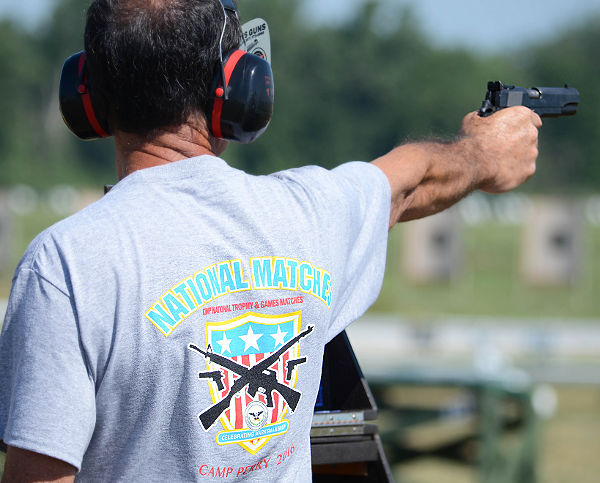
There will be major rimfire and centerfire pistol competitions at the 2024 CMP National Matches at Camp Perry, Ohio. Hundreds of shooters will participate in these popular individual and team events, which commence in mid-July.
The rimfire/centerfire pistol competitions begin on July 15, 2024 with the handgun Small Arms Firing School (SAFS) followed by M9 Pistol Excellence-In-Competition (EIC) pistol matches. The SAFS will be led by USAMU, Military Team, and CMP instructors. Following classroom instruction and practice on the range, SAFS participants will fire an M9 EIC Match with the goal of earning points towards the prestigious Distinguished Badge.
On July 17, the .22 Rimfire 900 Aggregate, Team Matches, and Rimfire EIC matches will be held. In the past, these matches have been hugely popular — with 480+ Rimfire competitors from novices to experts.
Following the rimfire pistol matches, there will be centerfire Pistol Aggregate and Team Matches on July 18, followed by .45 Pistol Aggregate and Team matches on July 19. Then, on Saturday the 20th, the big President’s 100 Pistol Match, National Trophy Individual Match, National Trophy Pistol Team Matches, and GSSF Glock National Challenge will be held. There will be plenty of talent on the firing line. In recent years, over 90% of the top 50 Service Pistol shooters were Distinguished. The last pistol matches run on Sunday the 21st, with Pistol Games Awards at the end of the day.
This video shows .45 ACP centerfire pistol competitors at Camp Perry
Interested in competing in the Camp Perry Pistol Matches this summer with either a .22 LR Rimfire pistol or centerfire pistol? It’s not too late to register. CLICK HERE for Pistol Match Online Registration.
by Sierra Bullets Ballistic Technician Paul Box
All of us who have been in reloading and shooting for any period of time have read how sectional density has been regarded as a bullet’s ability to penetrate. Back before high velocity came along and modern bullet design, the easiest way to get more “power” and penetration was by increasing the diameter and mass. After all, a bowling ball will hurt more than a golf ball, right?
Let’s take a closer look at sectional density.
The formula for calculating sectional density is pretty simple and straight forward. Take the bullet weight and divide by 7000. This number is then divided by the bullet diameter squared. Two bullets of equal weight and the same diameter will have equal sectional sectional density. No regard is given to the bullet construction. This is where the fly hits the soup in considering sectional density as far as penetration is concerned.
Section Density Formula: (Bullet Weight divided by 7000) divided by Bullet Diameter squared.
Bullet construction is the biggest factor in how it is able to penetrate. The best example I can think of here is to look at the Sierra .224 55 Gr. FMJBT GameKing #1355 compared to the 55 Gr. BlitzKing #1455. Both are .224 and weigh 55 grs. Both have a sectional density of .157. But there is a huge difference in their construction. The FMJ has a thick jacket and is designed to penetrate. The BlitzKing is designed for fast and rapid expansion with little concern for how deep they will penetrate.
The next time you’re choosing a bullet, look at the construction and less at the sectional density number. It’s all about the construction anyway. If you have any questions or would like to discuss sectional density or bullet penetration further, please give us a call at 800-223-8799 or shoot us an email at sierra@sierrabullets.com.


 Along with SSP and ESP, there are three other main IDPA classes: Custom Defensive Pistol (CDP) for .45 ACPs (mostly 1911 types), Concealed Carry Pistol (CCP), and Revolver (REV). All classes have a minimum power factor. Scores are based on time and shot placement on the IDPA target.