How well can the little 6mm Dasher perform at 1000 yards when the conditions are good, and the shooter is riding a hot streak? Well here’s a shot-by-shot record of Scott Nix’s 4.554″ ten-shot group shot at the Deep Creek Range outside Missoula, Montana at the Northwest 1000-yard Championship a few years back. All 10 shots were centered for a 100-6X score. That’s about as good as it gets. If Scott had stopped after 5 shots, his group would have been under three inches.
Video Demonstrates Amazing 1000-Yard Accuracy
Watch the video. You can see the group form up, shot by shot. It’s pretty amazing. Scott’s first shot (at the 45-second mark of the video) was right in the X-Ring, and four of Scott’s first five shots were Xs. That’s drilling them! This video was recorded from the pits at the 1000-yard line, during record fire.
Deep Creek Range
The Deep Creek Range in Missoula, MT is one of the nicest places to shoot in the Intermountain West region. The range is located in the mountains within a few minutes drive of Missoula, and there is camping on-site. When conditions are good at Deep Creek, records get broken. To learn more about shooting at Deep Creek, contact Jamey Williams at jameydan[at]gmail.com.
Here is an aerial view of the Deep Creek Range (Drone video by David Gosnell):
This 12″ Bullseye Pistol Diagnostic Target helps improve handgun marksmanship. The target diagnoses common problems with one-handed shooting based on shot impact zones. While this target is designed for righties, left-handed shooters can use the target too. Just observe the opposite tips.
Do you know someone who wants to get started in pistol shooting? Here’s a helpful resource. The NRA now offers its Basics of Pistol Shooting Course in an online format. That makes it easy to cover the “classroom” phase of the course on your own time. The $60.00 online course includes 11 step-by-step lessons (to be followed by live range training). CLICK HERE to enroll in online Pistol Training Course. (Note: An initial NRA age verification screen may appear first).
Train Online, Then Register for a Range Session
For the NRA Basics of Pistol Shooting course, Phase 1 is conducted in an online environment, completed on your own time (cost is $60.00, non-refundable). After successfully completing the online exam, students can register for Phase 2, the instructor-led training session. Phase 2 is conducted at your local range with an NRA-Certified Instructor. NOTE: There will normally be an additional fee for Phase 2. You must successfully complete BOTH Phase 1 and Phase 2 in order to receive your NRA Basics of Pistol Shooting course certificate.
Designed and developed by experts to accommodate busy schedules, the web-based course takes a blended learning approach to firearms training with both online and physical components. Students have 90 days to work through 11 online lessons before registering for Phase 2, the NRA Certified Instructor-led phase at a local range.
“Thanks to our online courses and network of more than 125,000 NRA Certified Instructors, it has never been easier to learn basic firearm skills,” said Kyle Weaver, NRA General Operations Exec. Director. The NRA offers other online training courses at Onlinetraining.nra.org. Along with pistol course, these offerings include Rifle Training, Shotgun Training, a Range Safety Office (RSO) course, and a Range Development and Operations course.
Know someone getting started with handguns? Here is a useful video focusing on safety:
Soon after Lapua released the 6.5×47 cartridge, wildcatters recognized the potential of a necked-down 6mm version of the case. The 6-6.5×47 has emerged as a great, do-it-all cartridge that performs well in High Power competition, 600- and 1000-yard benchrest, and PRS tactical matches. But the 6-6.5×47 is not just for paper-punching. An efficient cartridge with great inherent accuracy, the 6-6.5×47 can be an excellent, flat-shooting, long-range varmint round. Here we feature Stan Stewart’s BAT-actioned 6-6.5×47 varminter. Fitted with a Krieger 1:10″ barrel, Stan’s rifle excels with a wide variety of varmint bullets. Whether driving 70-grainers at 3700 fps, or pushing the Berger 88gr High-BC FB bullet at 3400 fps, this 6-6.5×47 delivers half-MOA (or better) accuracy, in a well-balanced, easy-handling rifle.
The 6-6.5×47 for Precision Long-Range Varminting
The rifle carries a 12-42x56mm Nightforce NSX in Nightforce rings “hand-lapped for optimal fit/alignment”.
‘Seller’s Remorse’ Spurs 6mm Project Report by Stan Stewart
After selling my 6mm Remington Ackley Improved a couple of years ago and wishing I hadn’t, I begun to think about a new custom rifle for work on Prairie Dog towns and New York wood chucks at 600+ yards. I have a .223 AR and 22-250 for medium ranges but I missed my 6mm AI for long-range work so I started asking questions.
The 22-250 is a fine chambering, but it is hard on barrels, and I think the 6mms may have an accuracy edge out past 400 yards. Also, shooters today enjoy a vast collection of really great 6mm bullets. Barrel life and bullet options were two main reasons I decided to build a 6mm rather than another .224-caliber gun. But the question remained… what 6mm chambering to choose?
I started doing serious research on the 6-6.5×47. I received a lot of good advice from AccurateShooter.com and other websites on the pros and cons. I also talked to gunsmiths — quite a few recommended the new cartridge as well. Some of the cartridge attributes I liked was the small rifle primer, enough case capacity to efficiently reach 3700 fps with a 70gr bullet and 3400 fps with an 85-grainer without being terribly over-bore. Most important was the 6-6.5×47’s reputation for inherent accuracy without being finicky like my 6mm AI. So, having chosen my cartridge, I started asking for gunsmith recommendations. Again the folks on the AccurateShooter.com Forum were very helpful. After many conversations I settled on Dave Bruno in Dayton, Pennsylvania. He was a good choice.
Putting Together the New Rig with Premium Components
From the get-go, I knew I wanted a BAT action and Krieger barrel. BAT Machine and Krieger Barrels enjoy a great reputation in the shooting industry. BATs are beautifully-machined, smooth, and strong. Krieger cut-rifled barrels are known for dependable accuracy and long barrel life. While many 6-6.5×47 shooters choose an 8-twist barrel to shoot the 100-108gr bullets, I would be using smaller, varmint-weight bullets, so I selected a 1:10″ twist Krieger. This would allow me to shoot bullets from 60 grains up to 90 grains. Dave chambered the barrel with a .269″ neck and fluted the barrel to save weight. I also had Dave install a Vais muzzle brake. Dave fitted the BAT with a 2 oz. Jewell trigger, mounted a +20 MOA scope rail, then pillar-bedded the BAT into a McMillan Hunter-Class-style fiberglass stock.
Load Development for Varminting
I had selected a few powders and bullets recommended by other 6-6.5×47 shooters and started by seating all the bullets .005″ off the lands. The powders I selected were Varget, Vihtavuori N-550, and Reloder 15.
I was very pleased with the 88gr Bergers. In initial testing, they grouped well and I was able to drive them to 3400 fps easily. As I wanted a gun for long-range varmint work, I was hoping the 1:10″-twist barrel would provide enough stability for the heavier weight bullets. It did — the 10-twist worked great! I was able to shoot the lighter weight bullets and the 88s were superb. With a BC of 0.391, leaving the barrel at 3400, these bullets were still traveling at 2600 fps at 600 yards!
I did a lot of testing, recording group sizes for a variety of different bullets (see below) and powders. With group size/velocity data in a spreadsheet I was able to “crunch the numbers” and choose my preferred loads. The data drew a clear picture of what the rifle shot best. Here is a chart showing comparative group sizes, arranged by bullet type. On the last three lines, powders are listed by average for all bullets.
Choosing a Varmint Bullet for Precision and Performance
Stan Stewart didn’t just grab a box of bullets off the shelf and head off to the varmint fields. He researched a broad selection of varmint bullets suitable for a 10-twist barrel. He did extensive group testing with a wide range of bullets from 70 grains to 90 grains. Shown below is a “line-up” of some of the bullets Stan tested in his gun.
Stan logged all load data, velocities, and group sizes in a very detailed Excel spreadsheet. Stan’s testing revealed that the light bullets delivered superb accuracy, but they were less than ideal for long shots out past 400 yards. Stan tried the Bart’s 70, Sierra 70 BlitzKing, Berger 80, Hornady 87, Berger 88 Lo-Drag, and Berger 90. Among these choices the Berger 88-grainer was the clear winner for long range (see test targets at right). With an 0.391 BC, this unique “Match Varmint High-BC Flat-Base” offers good ballistics, and high velocities. Stan’s average group size with the 88s was 0.40 inches, bettered only by the Bart’s 70-grainer. Stan’s 6-6.5×47 can launch the Berger 88s at a healthy 3400 fps, providing a highly accurate, flat-shooting solution.
Initially, Stan had high hopes for the Hornady 87-grain V-Max. Stan told us “I also tried the 87 gr Hornady but they didn’t perform to expectations. I am a big Hornady fan but these bullets varied in weight and just didn’t want to group well.” [Editor’s Note: While many varmint shooters have had great luck with the Hornady 87gr V-Max, this is not the first report we’ve received of disappointing results with these bullets. In the Editor’s own 8-twist 6BR, the 87s never shot as well as Bergers, Lapuas, or Sierras in the 85-90 grain range.]
Final Thoughts on the 6-6.5×47 Lapua
I have owned three rifles chambered in 22-250 and will always own a rifle in this caliber because it is inherently accurate and drives a 50gr bullet at 3800 fps. No question the 22-250 can be deadly out to 500 yards. However, I’ve found that shooting past 400 yards with the light bullets is difficult if there is any wind at all. That’s why I liked my 6mm AI for those longer shots and why I decided on the 6-6.5×47 Lapua. I couldn’t be happier with my choice. The only thing that could make it better is if Lapua would produce the 6-6.5×47 as an “official” factory 6mm cartridge with 6mm necks right out of the box. But overall, I am very happy with the cartridge, and I thank Dave Bruno for producing a superbly accurate varmint rifle.
With over 340 shooting-related videos, the Alabama Arsenal YouTube Channel is a remarkable resource. This video channel provides detailed field tests of tactical-type rifles, ARs, and pistols. The testers have access to some very impressive ranges, and many of the tests are far more thorough than you’ll typically find with most gun magazines and gun-centric YouTube channels. For example, Alabama Arsenal (AA) has a series of 1000+ round pistol test videos. These are well worth watching if you are considering purchase of a defensive handgun.
Today we showcase multiple rifle videos covering two centerfire rifles, and three precision rimfire rigs. After these field test videos, you’ll find an interesting technical video which investigates how suppressors can affect muzzle velocity.
Barrett MRAD .300 PRC at 2200 Yards — Extreme Long Range
Here’s a rugged tactical rifle put to the test at Extreme Long Range. This video, featuring a Barrett MRAD chambered for the .300 PRC cartridges, features accuracy testing out to 2200 yards (1.25 miles). There is some good drone footage covering the long path to the target. The shooter noted that the bullets fired from his .300 PRC “go sub-sonic somewhere between 1800 and 1900 yards”, creating additional ballistics challenges at this yardage.
Savage 110 Elite Precision for PRS Production Class
In this video AA’s team reviews the Savage Elite Precision Rifle with MDT ACC Chassis. Retailing for about $1810.00 in 6mm Creedmoor, this is one of the better production class options for PRS and NRL competition. Starting at the 3:10 time-mark, the video shows how all the adjustments function on the MDC ACC Chassis. Guns America Digest did a full review of this rifle, and was quite impressed.
Rimfire .22 LR Bergara B-14R in WOOX Furiosa Hybrid Chassis
Alabama Arsenal recently tested a .22 LR Bergara B-14R rimfire rifle fitted with the WOOX Furiosa hybrid chassis system, an Italian-made product featuring wood sections over a strong aluminum core chassis. The bolt operation and ergonomics of the B-14R simulate a Remington 700 very closely, making this rifle good for rimfire cross-training. The B14-R model tested was the version with carbon-wrapped barrel.
The WOOX Furiosa is an innovative, unique aftermarket replacement chassis. This high-tech hybrid stock/chassis combines wood sections over a full-length, aerospace-grade aluminum skeleton chassis, giving it the “feel” of a wood stock with the strength and stability of a metal stock. We like the way the stock feels on the trigger hand in particular and the smooth wood cheekpiece is also very nice. Made in Italy, the Furiosa is offered in three versions all with wood sections on the forearm, grip area, and cheekpiece. Choose natural Walnut Brown, Micarta Black, or Midnight Grey. Alabama Arsenal tested a B14-R fitted with the Micarta Black version. Below are photos of a centerfire rifle in a WOOX Furiosa hybrid chassis, with the Brown Walnut elements.
CZ 457 Varmint Precision Trainer and Chassis
In this video, Alabama Arsenal compares two higher-end versions of the popular CZ 457 rimfire rifle, a great choice for the NRL22 and PRS 22 disciplines. The test compares the CZ 457 in a Manners composite stock with a CZ 457 version in a Varmint Precision aluminum chassis. Right now basic CZ 457 rifles start at about $540.00, with the Varmint Precision models running $930 for the metal chassis version and $1130 for the Manners carbon-fiber composite stock model.
Informational Video about Rifle and Pistol Suppressors
Alabama Arsenal regularly tests its firearms with suppressors. Over time, the testing team has leaned much about modern sound moderators, comparing features and learning how to install and maintain quality suppressors. Here is an interesting video that shows how suppressors affect shot velocities.
Field Testing — Do Suppressors Change Bullet Velocity
Want to see more content like this? Here are LINKS…
Alabama Arsenal has nearly 300 videos on its YouTube channel. In addition, you’ll find dozens of firearms photos and other shooting-related content on Alabama Arsenal’s social media pages: Facebook; Instagram; and Twitter. You can support the Arsenal’s gun testing by subscribing to the Alabama Arsenal’s PATREON Page.
“Shoot Like a Champion”. Bryan Litz, author of Applied Ballistics for Long-Range Shooting, says he often sees notes like this tucked in shooter’s gear (or taped to an ammo box) at matches. What “marksmanship mantras” do you use? Do you have a favorite quote that you keep in mind during competition?
On the Applied Ballistics Facebook Page, Bryan invited other shooters to post the motivating words (and little reminders) they use in competition. Here are some of the best responses:
“Shoot 10s and No One Can Catch You…” — James Crofts
“You Can’t Miss Fast Enough to Win.” — G. Smith
“Forget the last shot. Shoot what you see!” — P. Kelley
“Breathe, relax, you’ve got this, just don’t [mess] up.” — S. Wolf
“It ain’t over ’til the fat lady sings.” — J. McEwen
“Keep calm and shoot V-Bull.” — R. Fortier
“Be still and know that I am God[.]” (PS 46:10) — D.J. Meyer
“Work Hard, Stay Humble.” — J. Snyder
“Shoot with your mind.” — K. Skarphedinsson
“The flags are lying.” — R. Cumbus
“Relax and Breathe.” — T. Fox
“Zero Excuses.” — M. Johnson
“SLOW DOWN!” — T. Shelton
“Aim Small.” — K. Buster
“Don’t Forget the Ammo!” (Taped on Gun Case) — Anonymous
PARTING SHOT: It’s not really a mantra, but Rick Jensen said his favorite quote was by gunsmith Stick Starks: “Them boys drove a long ways to suck”. Rick adds: “I don’t want to be that guy”, i.e. the subject of that remark.
Here’s a really great video about firearms crafting produced by Beretta, a legendary Italian gun-maker founded in 1526 — nearly 500 years ago. This movie, entitled “Human Technology”, is one of most impressive videos we’ve ever featured on this site. It’s that good. You’ll see an amazing blend of modern technology along with old-world artisanship — “a mesmerizing meld of the high-tech and the traditional”. (Daniel Xu, Outdoor Hub.)
Video set to auto-play. Click speaker icon to hear sound.
“Human Technology is a singular and symbolic movie, its cast entirely made up of Beretta workmen, thus illustrating the perfect synthesis between craftsmanship and technology,” Beretta writes. This artistic movie by Ancarani Studio illustrates all the aspects of the manufacturing of a high-end Beretta shotgun. This video is a study in contrast. The movements of robotic assembly machines are juxtaposed with the centuries-old craftsmanship of stock carvers. Beautifully filmed and edited, this video should amaze and entertain anyone who loves fine firearms. (Full-screen HD Recommended.)
Beretta — Incredible history. Beretta was founded in 1526, almost five centuries ago. Remarkably, the enterprise is still owned by the Beretta family.
This report is from Bryan Litz and the ScienceofAccuracy.com website.
As long as there have been rifles, there has been a debate as to how much – if any – the rifle moves prior to the bullet exiting the bore. The first video below shows a Barrett MRAD chambered in .338 Lapua Magnum firing a 300gr Lapua Scenar bullet. Capturing projectiles at 100k+ frames per second allows us to visualize aspects of the firing sequence that are otherwise invisible to the human eye.
Click Video to see barrel with suppressor (on right) move with recoil before bullet exits.
What is clear from this video is that the rifle system is moving rearward while the bullet is traveling through barrel and subsequently through the suppressor. During the “in-bore” portion of bullet travel, any deviation of the muzzle orientation from the initial point of aim can cause a point of impact change. This is because the bullet will exit while the barrel is pointed somewhere different than when the shot was initially fired. Much of the shot’s point-of-aim orientation can be maintained through consistent marksmanship fundamentals and recoil management techniques. However, most shooters are not likely capable of managing it to less than 0.001″ for EVERY shot, especially given on lightweight magnum rifles.
Here’s another example with a 180gr bullet in a Rem 700 BDL .30-06 rifle. “Every time we watch a video like this it reminds us that guns like this, the majority of accuracy and precision come from the gun/sight/support system, not the ammo. When you consider that 0.005″ of muzzle deflection, (orthogonal to the bore) results in ~1.5 moa of dispersion (.75 in any direction) and you see this massive barrel movement prior to bullet exit, it’s clear that the vast majority of dispersion [for typical rifles] is coming from this movement”.
Precision rifle systems, such as benchrest, PRS, and F-Class rifles, tend to minimize the movement away from the bore axis prior to bullet exit to achieve the best possible precision. A common theme among the most precision systems is higher-weight rifles with lower-weight projectiles. This relates to basic physics: Newton’s Third of Motion “For every action, there is an equal and opposite reaction.” With all else held equal, if the rifle weighs more and the bullet weighs less, there is a lower magnitude of motion prior to the bullet leaving the barrel.
In our latest book, Modern Advancements in Long Range Shooting Volume III, Chapter 3 covers the Theory of Precision for Rifles which mathematically describes and estimates the precision potential of rifles based on rifle mass and kinetic energy of the bullet. The chapter includes all the live fire test data to support the theory and great discussion on the testing performed can be found on our podcast at the Science of Accuracy Academy website.
Former Army Ranger sniper instructor Ryan Cleckner is the author of the best-selling Long Range Shooting Handbook. Cleckner hosts a series of videos that cover shooting techniques appropriate for tactical and PRS-type disciplines. Here are five short videos that cover various aspects of shooting techniques and rifle set-up. We think PRS/NRL competitors (and long-range hunters) can benefit from these videos.
“Consistency is the key to accuracy.
You need to think about a system of how you’re going to shoot that is not only comfortable, but [is] repeatable when you’re shooting.” — Ryan Cleckner
In this first video, Cleckner explains proper scope position. Ryan finds that some shooters place the scope too far forward or too far rearward. If the scope is too far back you may have issues with eye relief and stock reach to shoulder. If it is too far forward, you may have cheek-weld problems or get neck strain.
Cleckner offers a simple method to check your scope position: “To see if your scope is set up properly … close your eyes, lay your head on your gun, get completely comfortable, and only when you are set-up, then open your eyes. If you can’t see clearly through your scope, CHANGE something [such as comb height or scope position]”. “When you open your eyes, if you see some scope shadow [i.e. the black ring around the edge of the scope picture], figure out which way you need to move your head to get rid of that shadow, and then make adjustments to either your position, the rifle, or the scope.”
Cleckner prefers shooting off a bag when in the prone position, when that is practical. The bag provides a more stable support than a small Harris-type bipod, doesn’t require pre-loading the rifle, and there is less bounce or hop on recoil.
Former Army Ranger sniper team leader Ryan Cleckner explains how important it is to keep your rifle straight up and down when long-range precision shooting. Cleckner demonstrates with an AR-10 modern sporting rifle how slight cant to your rifle can cause a miss over long distances.
Here Cleckner covers some of the basic points of trigger control on tactical-style rifles. These basic principles apply to both single-stage and two-stage triggers. NOTE: For benchrest rigs, with ultra-light pull weights, more refined techniques may be appropriate.
In tactical events, when you’re shooting on the clock and loading from a detachable magazine, you should manipulate the bolt smoothly but strongly. Here Cleckner demonstrates how to cycle a tactical-type rifle. He says, “You should be running the bolt on your rifle with authority. Run it like you mean it!” NOTE: Completely different techniques are appropriate for custom benchrest rifles that manually feed.
Long Range Shooting Handbook — A Good Resource
Cleckner’s Long Range Shooting Handbook covers a wide range of topics important for precision marksmanship — both shooting skills and technical matters. You can view Sample Chapters from Ryan’s Book on Amazon.com. Cleckner’s book is designed as an intro to key concepts such as MOA vs. Mils, External Ballistics, and Environmental Effects. Included are personal tips and advice based on Cleckner’s years of experience as a sniper instructor and special operations sniper.
The Long Range Shooting Handbook is divided into three main categories: What It Is/How It Works, Fundamentals, and How to Use It. “What It Is/How It Works” covers equipment, terminology, and basic principles. “Fundamentals” covers the theory of long range shooting. “How to Use It” gives practical advice on implementing what you’ve learned, so you can progress as a skilled, long range shooter. Overall, this is one of the best resources available for tactical shooters and PRS/NRL competitors.
GunsAmerica Digest has a new Suppressor Academy webpage that provides host of helpful information about suppressors (aka “silencers” and “cans”). The Suppressor Academy online resource page features in-depth articles with important information for anyone considering acquiring a suppressor. The articles explain the key benefits of suppressors, how to choose a suppressor, and how to comply with Federal and state laws regulating suppressors. Below we link to four Suppressor Academy articles. Click the title for each topic to read the full-length article.
Suppressors are now legal in 42 U.S. States. There are certain legal requirements for obtaining a suppressor, including paying a $200 Tax Stamp. To own a suppressor you must be legally eligible to purchase a firearm, pass a BATFE background check, pay a one time $200 Transfer Tax, and satisfy age requirements. (SEE ALL Requirements). In most (but not all) of those states you can use a suppressor for hunting. The eight (mostly blue) states which still prohibit civilian suppressor ownership are: California, Delaware, Hawaii, Illinois, Massachusetts, New Jersey, New York, and Rhode Island. READ FULL ARTICLE on GunsAmerica Digest.
Suppressors serve one main purposes — to reduce the sound levels produced when firing pistol or rifle rounds. But GunsAmerica Digest editor True Pearce notes there are many other reasons to own a suppressor. A suppressor can reduce muzzle blast and felt recoil. The suppressor may prevent hearing damage that occurs through bone conduction better than earplugs and muffs because it reduces the noise energy at the source. When hunting, the reduced shot noise can help avoid spooking game. Having a suppressor also makes it easier to communicate when working as a team on a hunt. And, when compared to a muzzle BRAKE, suppressors are much less likely to kick up dust, dirt, sand, and snow when you shoot prone. READ FULL ARTICLE on GunsAmerica Digest.
There is some confusion surrounding the laws concerning suppressors, which are now legal in 42 U.S. States. In most jurisdictions that allow suppressor ownership, no additional state permit or license is required. But you do have to comply with Federal requirements when acquiring the suppressor. You may wish to create a trust to own the suppressor — there are some important practical advantages to having a suppressor trust. The Traditional NFA Gun Trust allows multiple responsible parties, i.e. “trustees”, to legally have possession of the suppressor. Each trustee must be verified and for each suppressor owned by the trust there will be a $200 Tax Stamp. READ FULL ARTICLE on GunsAmerica Digest.
When shopping for a suppressor there are many factors to consider: price, build quality, materials, sound level reduction effectiveness, weight, ease of mounting, and ease of cleaning and maintenance. We recommend that all suppressor buyers research the options. Check the manufacturer’s reputation, check diagrams for disassembly and maintenance. There are always trade-offs. Shorter suppressors may save some weight, but if they don’t cut the decibels as well you may be disappointed. You also need to consider the caliber — will your suppressor be used on multiple firearms? If so then get one that fits the largest caliber you will shoot. READ FULL ARTICLE on GunsAmerica Digest.
Hodgdon Powder Company (Hodgdon) offers a series of professionally-produced, “how-to” instructional videos on its online Reloading Data Center. These 3.5-minute videos present rifle, pistol, and shotshell reloading basics in an easy-to-understand, step-by-step format. These mobile-friendly, informative videos can also be viewed on a smart phone or tablet.
Along with these videos, you’ll find a ton of useful information on Hodgdon’s updated Reloading Data Center at hodgdon.com. From the landing page choose rifle, pistol, shotgun, or muzzle-loader, and then click “Get Details”. This will launch a page where you can find loads by selecting Cartridge, Bullet Weight, Powder Maker, and Powder Type (such as Varget or H4350).
Click to Watch Hodgdon Rifle Reloading Video:
Click to Watch Hodgdon Pistol Reloading Video:
In addition to these videos, Hodgdon’s Reloading Data Center (RDC) provides a wealth of information on Hodgdon®, IMR®, Accurate, Ramshot®, and Winchester® propellants. Along with reliable load data, you’ll find explanations of reloading basics, safety procedures, plus answers to frequently asked questions (FAQ).


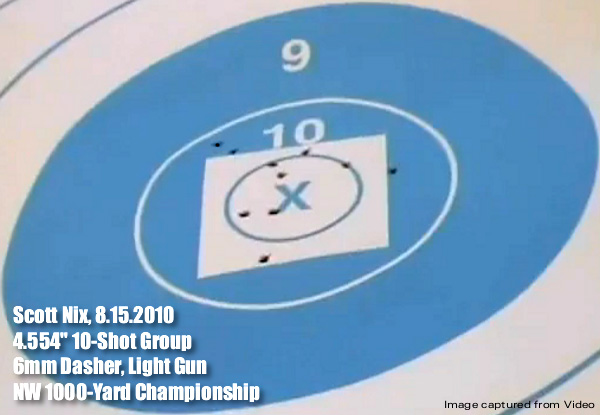
 How well can the little 6mm Dasher perform at 1000 yards when the conditions are good, and the shooter is riding a hot streak? Well here’s a shot-by-shot record of Scott Nix’s 4.554″ ten-shot group shot at the Deep Creek Range outside Missoula, Montana at the Northwest 1000-yard Championship a few years back. All 10 shots were centered for a 100-6X score. That’s about as good as it gets. If Scott had stopped after 5 shots, his group would have been under three inches.


 ‘Seller’s Remorse’ Spurs 6mm Project


 Final Thoughts on the 6-6.5×47 Lapua


 “Shoot Like a Champion”. Bryan Litz, author of


