In the archives of The First Shot (the CMP’s Online Magazine), SGT Walter E. Craig of the USAMU discusses physical conditioning for competitive shooters, particularly High Power competitors. Fitness training is an important subject that, curiously, is rarely featured in the shooting sports media. We seem to focus on hardware, or esoteric details of cartridge reloading. Yet physical fitness also matters, particularly for High Power shooters. In his article, Craig advocates: 1) weight training to strengthen the Skeletal Muscle System; 2) exercises to build endurance and stamina; and 3) cardiovascular conditioning programs to allow the shooter to remain relaxed with a controlled heart beat.
SGT Craig explains: “An individual would not enter a long distance race without first spending many hours conditioning his/her body. One should apply the same conditioning philosophy to [shooting]. Physical conditioning to improve shooting skills will result in better shooting performance[.] The objective of an individual physical training program is to condition the muscles, heart, and lungs thereby increasing the shooter’s capability of controlling the body and rifle for sustained periods.”
In addition to weight training and cardio workouts (which can be done in a gym), SGT Craig advocates “some kind of holding drill… to develop the muscles necessary for holding a rifle for extended periods.”
For those with range access, Craig recommends a blind standing exercise: “This exercise consists of dry-firing one round, then live-firing one round, at a 200-yard standard SR target. For those who have access only to a 100-yard range, reduced targets will work as well. Begin the exercise with a timer set for 50 minutes. Dry-fire one round, then fire one live round and without looking at the actual impact, plot a call in a data book. Continue the dry fire/live fire sequence for 20 rounds, plotting after each round. After firing is complete, compare the data book to the target. If your zero and position are solid, the plots should resemble the target. As the training days add up and your zero is refined, the groups will shrink and move to the center.”
Fitness training and holding drills help position shooters reach their full potential. Here is 6-Time U.S. National Long Range Champion John Whidden.
Training for Older Shooters
Tom Alves has written an excellent article A Suggested Training Approach for Older Shooters. This article discusses appropriate low-impact training methods for older shooters. Tom explains: “Many of the articles you will read in books about position shooting and the one mentioned above are directed more toward the younger generation of shooters in their 20s. If you look down the line at a typical high power match these days you are likely to see quite a few folks who are in their middle 30s and up. Many people in that age range have had broken bones and wear and tear on their joints so a training program needs to take that into account. For instance, while jogging for an extended period for heart and lung conditioning may be the recommended approach for younger folks, it may be totally inappropriate for older people.”
The Beretta BRX1 is a modern rifle with some unique properties. It is a fast-cycling “straight-pull” rifle with the ability to quickly change the bolt position from right side to left side. It uses a rotating multi-lug bolt, similar to what you’ll find on AR-platform rifles. The closing system employs an 8-lug bolt (or 16-lug for magnums). Currently, three chamberings are offered in the USA: .308 Win, .300 Win Mag, and .30-06 Springfield. And there are also some previous production models in 6.5 Creedmoor. Multiple barrel lengths are offered: 20.1″, 22.4″, 24.4″ (51, 57, 62 cm). Barrel and chamber are cold-hammer forged together from a single steel piece. The trigger can be adjusted to three pull weights from 2.1 pounds (950 grams) to 3.3 pounds (1500 grams). CLICK HERE for factory specifications and more information.
Accuracy has been good by hunting rifle standards. Beretta offers a 3-shot, sub-MOA Guarantee for the BRX1, stating that “the accuracy certificate for each firearm is available online”. Testers have confirmed that this rifle should be capable of putting three shots in about 1″ at 100 yards.
You’ll find a good review of the Beretta BRX1 on the All4Shooters Website. In 100m outdoor range testing, they were able to get a 1.18″ five-shot group, and the testers confirmed the rifle was fast to cycle and operate: “The straight-pull repeater comes with a linear reloading system. In concrete terms, this means that no rotation or lever movement is required. This promises particularly fast reloading due to an especially smooth bolt action. Without any problems, it was possible to cycle the rifle with one finger.” The testers confirmed the rifle can change from right-hand to left-hand very quickly: “The bolt handle can be removed in a few seconds, and the shooter can change the ejection side. In combination with the central safety, you have a fully-fledged left- or right-handed gun within a short time.”
Overall the testers were impressed: “The new Beretta BRX1 has everything you need on board: a muzzle thread, a one-piece Picatinny rail, a high-quality red-orange magazine (5+1 rounds), ambidexterity, barrel change option, and a great, very smooth straight-pull action.”
January 2024 Field Test of BRX1 Latest Model
This is a good, recent review (1/19/2024) by the BackFire channel. The tester liked the straight-pull action, stating that cycling the BRX1’s bolt does not “jostle the rifle” as with a conventional bolt action. This allows smoother and faster follow-up shots.
We were concerned that the BRX 1 doesn’t have a conventional action frame. As you can see in the above photo, when the bolt carrier assembly is retracted there is nothing above the bolt except the scope rail. However, this rifle has been thoroughly tested by the Beretta team, including one rifle that saw 10,000 rounds of .300 Win Magnum (see Backfire video at 10:40). Beretta notes that the “BRX1 has successfully passed the same NATO tests carried by Beretta on military weapons. Thanks to the experience in the military and law enforcement world, BRX1 mounts a locking system featuring a rotating bolt head with 8 locking lugs — or 16 for magnum calibers.”
There was a safety recall on Beretta BRX1 rifles early on, shortly after the original release in 2021. The issue arose from users incorrectly installing the bolt handle: “a user has reversed the charging handle on the bolt without positioning it correctly in its seat.” A part was modified to eliminate the issue.
SHORT VIDEOS Showing BRX1 Features
Here are some helpful “short” videos. The first (top left) shows how to cycle the action rapidly. The second video (from Beretta Gallery Dallas) shows how to attach the bolt assembly, and notes that one must ensure the hammer is cocked/retracted before sliding the bolt assembly on to the action. The third video illustrates how to move the bolt handle from one side to the other.
Tactical Version with Extended Magazine TFB-TV Review
For 2024, Beretta has introduced a new, camo-finish version of BRX1. This has been dubbed the BRX1 Tactical. Like other BRX1 rifles, this camo BRX1 features a left/right swappable straight-pull action that is very fast to cycle.
In this video, released just last week (1/17/24), the TFB-TV team tests the new Beretta BRX1 Tactical: “This tactical edition, a standout with its multicam finish, is a specialized variant of the Beretta BRX-1, which has gained popularity in Europe for its precision and reliability. The BRX-1 Tactical is enhanced for practical functionality with a 3D printed magazine adapter, allowing it to accept Magpul P-Mags, adding to its versatility.” This video covers the BRX1’s notable features including smooth action, adaptability, and stock ergonomics. The video also compares the new BRX1 Tactical to the original European BRX-1 model, highlighting the main changes — principally the stock configuration and the new bigger magazine.
The USAMU has published a “how-to” article about bullet sorting. While many of us may sort bullets by base-to-ogive length (and/or weight), the USAMU story explores the “how and why” of sorting bullets by Overall Length (OAL). Read the article highlights below, and make your own decision as to whether OAL sorting is worth the time and effort. Bryan Litz of Applied Ballistics says that sorting by OAL is not a bad idea, but base-to-ogive bullet sorting probably represents a better investment of your time.
Bullet Sorting by Overall Length
We’d like to share a specialized handloading technique which we’ve long found beneficial to our long-range (600 yards and beyond) accuracy. Sorting of bullets for extreme long range (LR) accuracy is not difficult to do, but some background in theory is needed.
Here at USAMU’s Handloading Shop, we only sort individual bullets for the most demanding Long-Range applications and important competitions. Only the most accurate rifles and shooters can fully exploit the benefits of this technique. The basic sorting process involves measuring the Overall Length (OAL) of the bullets, and grouping them in 0.001″ increments. It’s not unusual to find lots of match bullets that vary as much as 0.015″-0.020″ in length throughout the lot, although lots with much less variation are seen as well. Even in bullet lots with 0.015″ OAL variation, the bullet base-to-ogive length will show much less variation. Hence, our basic sort is by bullet OAL. One obvious benefit of sorting is easily seen in the attached photo. The few bullets that are VERY different from the average are culled out, reducing probable fliers.
How does one know what OAL increments to use when sorting? The answer is simple. As each lot of bullets is unique in its OAL distribution, it’s best to sample your bullet lot and see how they are distributed. In the attached photo, you will see a set of loading trays with a strip of masking tape running along the bottom. Each vertical row of holes is numbered in 0.001″ increments corresponding to the bullets’ OAL. A digital caliper makes this task much easier. As each bullet is measured, it is placed in the line of holes for its’ OAL, and gradually, a roughly bell-shaped curve begins to form.
Note that near the center, bullets are much more plentiful than near the edges. At the extreme edges, there are a few that differ markedly from the average, and these make great chronograph or sighting-in fodder. We recommend using a sample of 200 bullets from your lot, and 300 is even better. Some bullet lots are very consistent, with a tall, narrow band of highly-uniform bullets clustered together over just a few thousandths spread. Other lots will show a long, relatively flat curve (less uniform), and you may also see curves with 2 or more “spikes” separated by several 0.001″ OAL increments.
Bullet Sorting — OAL vs. Base-to-Ogive vs. Weight
Expert advice from Bryan Litz, Applied Ballistics
I’m often asked what is a the best measure to sort bullets by, and the answer (to this and many other questions in ballistics) is: it depends.
Choosing to sort by overall length (OAL), base to ogive (BTO), bearing surface, weight, etc. can get overwhelming. Shooters typically look for something they can measure, which shows a variation and sort by that. It’s common for dimensional variations to correlate. For example, bullets which are longer in OAL are typically also shorter in BTO, and have longer noses. All these are symptoms of a bullet that was pushed a little further into the pointing die, or possibly had more than average lube while being swaged. So in essence, if you sort by BTO, you’re measuring one symptom which can indicate a pattern in the bullets shape.
So, the question still stands — what should you measure? You’ll always see more variation in OAL than BTO, so it’s easier to sort by OAL. But sometimes the bullet tips can be jagged and have small burrs which can be misleading. Measuring BTO will result in a lower spread, but is a more direct measure of bullet uniformity.
Then there’s the question of; how much variation is too much, or, how many bins should you sort into? Shooters who see 0.025” variation in BTO may choose to sort into 5 bins of 0.005”. But if you have only 0.005” variation in the box, you’ll still sort into 5 bins of 0.001”. What’s correct? You have to shoot to know. Live fire testing will answer more questions, and answer them more decisively than any amount of discussion on the subject. The test I recommend is to identify bullets on the extreme short end of the spectrum, and some on the extreme long end. Load at least 10 rounds of each, and take turns shooting 5-shot groups with them. If there is a difference, it will be evident. The results of the testing will answer your question of: should I sort based on X, Y, or Z?”
You can read more discussions on this and other similar subjects in our Accurateshooter.com Shooters’ Forum. Here’s a link to a thread discussing bullet sorting: Bullet Sorting Thread
Safari Club International (SCI) invites hunters and sportsmen to attend the 52nd Annual Hunters’ Convention in Nashville, Tennessee. This major event will be held January 31st through February 3rd, 2024 at the Nashville Music City Convention Center. “Safari Club International’s Annual Convention is an opportunity for hunters to experience the latest from leading brands in the hunting industry … our Convention [brings] the best of the hunting industry to our members” said W. Laird Hamberlin, SCI’s CEO.
The large Music City Convention Center will host exhibitors from all over the world. Attendees can check out the latest firearms and hunting gear, take part in seminars, and book hunts from multiple continents. This year’s convention will host guest speakers Craig Boddington, Dan Adler, Dave Holt, and Ramsey Russell. There will also be over 20 live and online SCI auctions with bidding on once-in-a-lifetime guided hunts, exceptional firearms, fine art, and jewelry.
With outfitters and guides from around the world, plus gun and ammo manufacturers, the SCI Annual Convention has been called the “Superbowl of Hunting Shows”.
The SCI Convention Will Feature Live Music by Legendary Performers
The 2024 SCI Convention will also feature some great live music, with performances by big name musical artists .38 Special, Jason Aldean, Big & Rich, and Foreigner.
Map for Music City Convention Center in Nashville, TN:
Though some manufacturers introduce new rifles mid-year, many officially launch new rifles at SHOT Show each January, though often with late fall previews before the actual show. There have been some very innovative rifles introduced recently, including the Nosler Carbon Chassis Hunter shown above and the new PWS UXR featured in a separate article.
In today’s Saturday Showcase, we feature seven videos that cover a huge variety of rifle types — from air rifles to long-range, large-caliber ELR rigs. The first video below covers 11 different rifles, and the other six videos cover more than two dozen other rifles. Watching these videos is a good way to see a host of different rifle options in a short period of time.
11 New/Recent Rifles with Factory Promo Videos
This videos features new offerings from Mossberg, Benelli, Stag Arms, Bergara, and more. There’s also the return of a classic, the Marlin 336.Rifles listed in this video (with video times):
When you’re in mountainous backcountry pursuing big game, you don’t want to be hauling around a 12-pound rifle. Thankfully, with carbon fiber and other modern materials, there are quality hunting rifles at 6 pounds or less. The host of this video notes: “When you go hunting, the last thing you want is to carry a heavy gun with you that gets you tired and weighs you down. The good news is that this is not necessary anymore. In times of titanium carbon fiber, and Kevlar, hunting rifles get lighter and lighter while keeping all the high-quality, reliability, and accuracy that you expect of them. So, without further ado, let’s take a look at these lightweights that will serve you well.”
Savage Arms KLYM Light Rifle
Here is innovative engineering from Savage Arms. The impressive new Savage KLYM rifle employs carbon fiber components for major weight savings. The HuntStand team had a chance to field test the new KLYM rifle series: “Based on a new carbon-fiber platform, Savage KLYM cuts weight so you can go farther in your quest for beasts off the beaten path.” With its Proof Research carbon fiber-wrapped stainless barrel and FBT carbon fiber stock, the new KLYM is listed as weighing under 6 pounds.
Recommended Take-Down Camp Rifles
We think every avid hunter can use a take-down rifle. Able to separate into two shorter sections, a good take-down rifle can be carried conveniently in a day pack, yet assembled easily in a minute. This video covers a variety of take-down rigs, most of which are chambered for rimfire cartridges. Some of these rifles are ultra-light, weighing less than 4.5 pounds without optic.
Accurate .22 LR Rifles for 2024
This PewPew Zone video showcases multiple .22 LR rifles. Shown above is the CZ 457 with Manners Precision stock. The rimfire rifles featured in this video (in order) are: Lithgow LA 101, Anschutz 1761, Tikka T1x MTR, CZ 457 Varmint Precision Trainer, Savage Mark II FV, and Ruger Precision Rimfire.
Long Range Rifles
This video focuses on larger-caliber rifles intended for long-range target shooting and tactical applications. Rifles featured in this video include: Barrett MRAD MK22, Howa 1500, Bergara B14, Accuracy Int’l AXSR, Tikka T3X TAC A1, Daniel Defense Delta 5, Ruger Precision Rifle. Unfortunately, the interesting rifle shown on the static intro frame is more of a teaser and is not separately tested.
Best Air Rifles for 2024
Air rifles are fun and very inexpensive to shoot. There are a variety of air rifle disciplines now: from benchrest competition, 3-position shooting, air rifle silhouette, tactical matches, and the popular Field Target Competition. You can shoot air rifles for a small fraction of the cost of centerfire firearms.
A radical new tactical rifle, the UXR (User Xchange Rifle) was just introduced by PWS (Primary Weapons Systems). This unique, revolutionary rifle allows users to quickly switch chamberings by exchanging just three parts: barrel, magwell, and bolt head. Initially available in 5.56×45 and .300 BLK variations, the UXR platform will also be available in .308 Win and 8.6 BLK configurations later this year.
Our friend True Pearce of GunsAmerica Digest Tests the new PWS UXR:
The new UXR rifle has a unique, patent-pending Xchange system. The upper receiver of the UXR is the only serialized part of the setup, enabling the shooter to easily transition from configuration to configuration, caliber to caliber. Adaptability is the core principle of the UXR, showcased in its many customizable features such as an adjustable buttstock that can fold left or right, an adjustable cheek plate, and ambidextrous-able selector switch, magazine release and even the charging handle.
The UXR platform also features a proprietary “modified long-stroke piston system” which allows the rifle to run reliably with any UXR barrels regardless of caliber. This internal system allows the user to swap calibers and barrels without needing to adjust the gas system each time. And the newly-designed Bore Evacuator reduces back pressure, especially when a suppressor is being used, making the UXR a good choice for suppressed shooting.
For more information on the UXR, visit Primaryweapons.com/firearms/uxr. PWS will have the UXR at the Industry Day at the Range on January 22, 2024, and it will be showcased at SHOT Show 2024.
The RCBS Lock-Out Die can also be used with some Dillon and Hornady progressive presses.
If you load pistol or rifle ammo with a progressive press, we strongly recommend you get a Lock-Out Die from RCBS. This unique reloading die will prevent your progressive press from advancing if the dispensed powder charge is more or less than about 0.3 grains too high or too low. The Lock-Out Die really works. Your Editor uses it on his RCBS 2000 progressive press. I can affirm that a Lock-Out Die has “saved my bacon” a half-dozen times over the years when there was an over-charge (which could cause a Kaboom) or a low charge (which could cause a squib load).
The Lock-Out Die works by using a central die detection rod that sets its vertical position based on the height of the powder column in the case. Through an ingenious design, if the powder column height is too low or too high, the rod locks in place as you start to pull the press handle. This halts the press before the ram can lift and the cartridge plate can advance. Unlike a beeping alarm system (which can be ignored or defeated), the Lock-Out Die physically stops the movement of the press ram and prevents a bullet being seated in the “problem” case.
It takes a bit of tweaking to get the Lock-Out Die detection rod setting just right, but once it is correctly positioned, the Lock-Out Die works smoothly in the background. The Lock-Out Die won’t interfere with the loading process unless it detects a high or low charge — and then it positively stops the progressive loading cycle.
While crafted for use in RCBS progressive presses, the RCBS Lock-Out Die can also be used on a Dillon XL Progressive (see video below) or Hornady Lock-N-Load progressive — though it does take up one station which could otherwise be used for a final crimp die (after the seating die). The RCBS 2000 has one more station than a Dillon 550/650, so it’s an ideal platform for using the Lock-Out Die.
Learn More at UltimateReloader.com
On the UltimateReloader.com website, run by our friend Gavin Gear, you’ll find an excellent two-part series on the function and set-up of the RCBS Lock-Out Die. Part One explains how the Lock-Out Die functions, using cut-away illustrations. Part Two shows how to install and adjust the Lock-Out Die on various progressive presses. The Ultimate Reloader video at the top of this article shows setup of the RCBS Lock-Out Die on the Dillon XL-650 progressive press, while the Reloading Bench video below shows the Lock-Out Die on a Hornady LnL progressive.
Ever wish you could look inside your rifle, to see how the trigger and fire-control system work? Well now that is possible with the magic of 3D computer graphics. Modern software allows detailed “cutaway” side-views (see below), as well as 3D views with 360° rotation. The software can also provide X-Ray-type views into the gun’s internals — as you can see above. And computer animation can show the complete firing process from trigger pull to chambering of the next round.
Rem 700 Cutaway View from Right Side
This article provides some very cool 3-D “Cutaway View” animations of the popular Remington 700 action, probably the most successful American bolt-action ever created.
READERS — Take the time to watch the video! The Rem 700 animation is really outstanding! EVERY bolt-action shooter should watch this video all the way through.
Cutaway 3D Animation of Rem 700 Action — Watch Video
The Model 700 series of bolt-action rifles have been manufactured by Remington Arms since 1962. All are based on basically the same centerfire bolt action. They are typically sold with an internal magazine depending on caliber, some of which have a floor-plate for quick-unloading, and some of which are “blind” (no floor-plate). The rifle can also be ordered with a detachable box magazine. The Model 700 is a development of the Remington 721 and 722 series of rifles, which were introduced in 1948.
The Remington 700 is a manually-operated bolt action with forward, dual opposed lugs. It features “Cock On Opening”, meaning the upward rotation of the bolt when the rifle is opened cocks the firing pin. A cam mechanism pushes the firing pin’s cocking piece backward. The bolt face is recessed, fully enclosing the base of the cartridge. The extractor is a C-clip sitting within the bolt face. The ejector is a plunger on the bolt face actuated by a coil spring. The bolt is of 3-piece construction, brazed together (head, body. and bolt handle). The receiver is milled from round cross-section steel.
This video was made with the help of the World of Guns: Gun Disassembly interactive encyclopedia with 3D rendering. This remarkable web-based software allows users to view the inner workings of hundreds of different rifles and pistols — everything from a .22 LR Ruger to a .55-caliber Boys Anti-Tank rifle. There are also 25,000+ parts diagrams. This is a remarkable technical resource. SEE MORE HERE.
Are you seeing unpredictable changes in Point of Impact on your target? Think you may have a scope issue? Well maybe not — when was the last time you checked your BARREL?
Yes scopes do fail, and scope bases/rings do get loose. But sometimes problems with erratic POI shifts are caused by a LOOSE BARREL. This issue came up a while back in our Shooter’s Forum. One member complained that his zero was shifting from day to day — by as much as two inches at 100 yards. He was convinced he had a scope problem, based on erratic POI:
“I think my scope loses 1 to 3 MOA per day. When I shot my rifle Monday it was dead on. On Tuesday it was 1″ low. Then on Wednesday it was 1 or 2″ lower. I don’t get it. — the elevation knob never touched. Scope will track and return to zero that day perfect. Yes EVERYTHING has been checked, nothing loose. What is the chance the erector tube spring has gone south? For the record this is a Vortex GE. Never had a bad scope, but this has me wondering”. — LB
On Forum member told LB to send the scope right back to the manufacturer. Two other members suggested mounting the scope on a different rifle to test. Good advice. That’s generally a smart strategy before you conclude a scope has gone bad…
Could Problem Be the Scope Base?
Two Forum members, ExPiper and Dickn52, suggested checking the scope base, recounting their past experiences with troublesome bases. This was intelligent — anyone with a POI problem should check all the optics attachments:
“Went crazy one day chasing my impacts on a 100-yard target. Shots would group fine for three then go nuts for 4-5. I cranked and un-cranked for about an hour. Then I reached up and the base wobbled on the rifle. Removed scope, tightened base screws and back in business.” — Dickn52
“Years ago I had a problem [where] shots were climbing with almost every shot. I was blaming the scope. However, when removing the scope I noticed that the 20 MOA base was cracked and getting wider with every shot. Needless to say I replaced the base and the problem was solved. — ExPiper
Eureka Moment — The problem was the BARREL, not the Scope
There were many helpful suggestions, but member PirateAmmo steered LB to the real problem — a loose BARREL: “We had a problem on a home-built AR-platform rifle once, barrel was loose a tad…”
Member Snert chimed in: “Yep — I had a PPC that suddenly went 19″ low. Picked up gun off bench by barrel and felt a wiggle. I tightened the barrel and the POI went 19 inches up”.
Problem Solved — Barrel Tightened up and POI Back to Normal
The gentleman with the POI problem took the advice of PirateAmmo and checked his barrel. BINGO! Low and behold, the barrel WAS loose.
LB posted: “Barrel loose by about 2%, checked it twice before and didn’t find it the first two times”.
After LB re-tightened his barrel, his rifle started shooting normally again. No more shooting low by 1-2 inches. Problem solved. The fix didn’t cost a penny and now LB doesn’t have to send a perfectly good optic back to the manufacturer.
Lesson learned? Check ALL the variables before you assume a scope has gone bad. Along with the barrel, also check your action screw tension, and of course the scope base and rings.
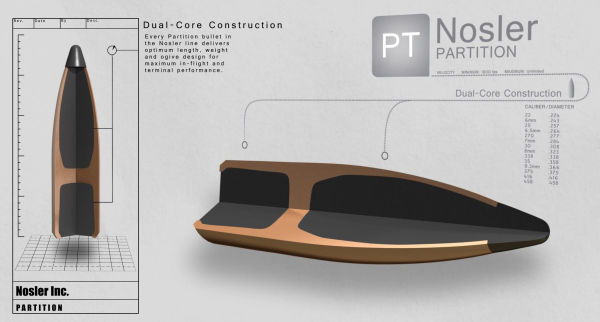
John Nosler lived 97 years, passing in 2010. During his long lifetime, John was an iconic figure in the shooting and hunting world. Considered a true pioneer in bullet and ammunition design, Nosler developed the famous Partition bullet in the 1940s. Born on April 4, 1913 in Brawley, California, John built his business from scratch. He founded his bullet company in 1948. He was considered to be one of the great innovators whose designs helped create the premium bullet category and influenced ammunition manufacturers worldwide.
Moose-Hunt Inspires Partition Bullet Design
While hunting in Canada, John experienced a bullet failure on the hide of a mud-caked bull moose. He then began developing a revolutionary new projectile, which he called the “Partition”, because of the barrier that separated the bullet into two sections. One year later, John and a friend traveled back to British Columbia with his new Partition bullets, which were designed to provide deep penetration and expansion. The men bagged two moose with two shots, and the rest is history.
NRA Golden Bullseye Pioneer Award
In recognition of his contribution to the shooting sports industry, John was the unanimous choice for the inaugural 2007 NRA Golden Bullseye Pioneer Award. The award was the highlight of a long and fruitful career. Even though he officially retired in 1988 when his son and daughter-in-law, Bob and Joan Nosler purchased the company, John still managed to come to the office on a daily basis until his health declined.
Today, John’s son Bob Nosler still presides over the company as president and CEO of Nosler, Inc., based in Bend, Oregon. Along with bullets, the company now produces cartridge brass, loaded ammunition, and hunting rifles.
To learn more about John Nosler and his bullet designs, get your hands on Going Ballistic, a “Professional Memoir” told by John Nosler to outdoor writer Gary Lewis. CLICK HERE to hear a short John Nosler audio clip or to order the book from the author.
John Nosler remained an avid hunter and shooter even late in life. Gary Lewis recalled that, at age 92, John Nosler attended the opening of a new shooting range outside Bend, Oregon. Even in his nineties, Nosler managed to drill two shots inside nine inches at 1000 yards. John Nosler leaves a legacy that will benefit hunters and shooters’ nationwide. The John A. Nosler Endowment of The NRA Foundation, sponsors the NRA’s Basic Rifle Training Program which instructs novices in safe rifle handling.


 In the archives of The First Shot (the CMP’s Online Magazine), SGT Walter E. Craig of the USAMU discusses physical conditioning for competitive shooters, particularly High Power competitors. Fitness training is an important subject that, curiously, is rarely featured in the shooting sports media. We seem to focus on hardware, or esoteric details of cartridge reloading. Yet physical fitness also matters, particularly for High Power shooters. In his article, Craig advocates: 1) weight training to strengthen the Skeletal Muscle System; 2) exercises to build endurance and stamina; and 3) cardiovascular conditioning programs to allow the shooter to remain relaxed with a controlled heart beat.


 The large Music City Convention Center will host exhibitors from all over the world. Attendees can check out the latest firearms and hunting gear, take part in seminars, and book hunts from multiple continents. This year’s convention will host guest speakers Craig Boddington, Dan Adler, Dave Holt, and Ramsey Russell. There will also be over 20 live and online SCI auctions with bidding on once-in-a-lifetime guided hunts, exceptional firearms, fine art, and jewelry.


 If you load pistol or rifle ammo with a progressive press, we strongly recommend you get a Lock-Out Die from RCBS. This unique reloading die will prevent your progressive press from advancing if the dispensed powder charge is more or less than about 0.3 grains too high or too low. The Lock-Out Die really works. Your Editor uses it on his RCBS 2000 progressive press. I can affirm that a Lock-Out Die has “saved my bacon” a half-dozen times over the years when there was an over-charge (which could cause a Kaboom) or a low charge (which could cause a squib load).


 This video was made with the help of the

 NRA Golden Bullseye Pioneer Award
 To learn more about John Nosler and his bullet designs, get your hands on Going Ballistic, a “Professional Memoir” told by John Nosler to outdoor writer Gary Lewis.


