.009″ — The Record That Stood for 40 Years.
In 1973 Mac McMillan shot an amazing 100-yard, .009″ five-shot group in a benchrest match. The .009″ group was measured with a 60x microscope for verification. Mac McMillan shot the group using a handbuilt prototype McMillan rifle with an early McMillan stock.
Mac’s .009″ group was the “Holy Grail” of rifle accuracy. This .009″ record was considered by many to be unbreakable, a record that would “stand for all time”. Well, it took 40 years, but someone finally broke Mac’s record with an even smaller group. In 2013, Mike Stinnett shot a .0077″ five-shot group using a 30 Stewart, a .30 caliber wildcat based on the 6.5 Grendel. Stinnett’s .0077″ group now stands as the smallest 100-yard group ever shot in registered benchrest competition.* Read About .0077″ group HERE.
Stinnett’s success doesn’t diminish the significance of Mac McMillan’s .009″ group in the history of benchrest competition. For four decades Mac’s group stood as the ultimate standard of rifle accuracy*. For those of you who have never seen Mac McMillan’s .009″ group, here it is, along with the NBRSA World Record certificate. The target now hangs in the McMillan Family Museum.
*Somebody else might claim a smaller group, but unless moving backers or electronic targets were used, it cannot be verified. Moving target backers are used at registered benchrest matches to ensure that five (5) shots are actually fired in each group. That eliminates any doubt.
This story features a unique, American-designed rimfire rifle, chambered for the potent .17 HMR round. The current generation Browning T-Bolt has a tang-mounted ambidextrous safety, a choice of barrel contours, lengths, and finishes, and a variety of stock options. What sets the T-Bolt apart from other rimfire rifles is the way the action cycles. There is not a conventional bolt that requires four distinct motions (lift bolt handle up/pull back/move forward/rotate handle down). With the T-Bolt you simply pull the handle straight back to extract a round, then return it forward to chamber a new round from the Double Helix magazine. The cocking effort is divided between back pull and forward movement so the effort is relatively light and easy.
Among current rimfire rifles, the Browning T-Bolt ranks high for fit and finish. The bluing is very nice and the T-Bolt even boasts a gold-plated trigger shoe. Many different stock types have been offered in recent years including some very nice AA Maple stock models as shown below (click to zoom). These T-Bolt rifles exhibit very fine craftmanship. Current models are made in Japan under license to Browning.
Click image for full-screen T-Bolt photo with detail.
Browning T-Bolt Sporter AA Maple Model
RECEIVER – Steel; High polished finish; Drilled and tapped for scope mounts
BARREL – Medium Sporter; Blued finish; Free-floating; Semi-match chamber; Recessed crown
ACTION – Straight pull bolt action; Top-tang safety; Adjustable trigger
STOCK – AA Maple; Gloss finish; Checkered
FEATURES – Sling swivel studs installed
PRODUCTION – Limited quantities
T-Bolt Owner Talks about Function and Accuracy
“I have a Browning T-bolt in .17 HMR, but with the maple stock. It is probably my favorite .17 HMR rifle (also the most expensive). The rifle feels smaller than some of my other .17 HMR rifles. I think the length of pull is a little shorter. I do like the light weight and trim handling of the rifle and the straight-pull bolt can be cycled really quickly. Mine is quite accurate and will shoot one-inch groups at 100 yards with both Hornady ammo and the CCI A17 ammo.” — RexRay, Varminter.com Forum member.
Pros and Cons of the Browning T-Bolt
The T-Bolt has a reputation for good accuracy, provided you have a good lot of .17 HMR ammo (we recommend checking for bullet run-out before you shoot for groups). The straight-pull action works as advertised — it is fast, smooth, and easy-to-operate. The Double Helix magazine (covered below) is excellent. It is very compact yet ultra-reliable. Another plus is that the T-Bolt has been produced in many different versions, with a variety of stocks, and even a stainless action version.
What are the negatives? Some of the stocks have a somewhat short length-of-pull, but this is easily solved with spacers. The main complaint is the factory trigger — some owners say it is too heavy at about 4 pounds, though the break is clean. For varmint work, we could live with the stock trigger and put money saved into optics.
If you prefer a very light trigger, JARD makes a T-Bolt replacement trigger. Featuring an aluminum housing, the JARD T-Bolt trigger can be ordered with 12-, 16-, or 20-ounce pull weights. The JARD trigger offers a crisp, clean break significantly lighter than stock. But at $254.95 the JARD trigger is fairly expensive. Additionally there have been a couple complaints about slam fires at the lowest weights so we recommend the 20-ounce. Here is one owner review, from a Rimfire Central thread: “The new Browning T-Bolt is a great rifle in all aspects except for the trigger. In my case when I received my JARD trigger it was an almost drop-in installation with very little adjusting or fooling around. For me it made a decent little rifle a great little rifle.”
Browning Double Helix 10-Round Magazine
The T-Bolt’s patented 10-round rotary Double Helix™ magazine is a unique design that feeds very reliably and is easy to load. The Double Helix magazine uses a torsion drive spring and interlocking gear design to maintain correct timing and exact cartridge alignment for smooth, reliable feeding. The translucent gray body allows for easy verification of the number of remaining cartridges. We like the fact that the Double Helix provides TEN-round capacity while fitting nearly flush with the bottom of the action.
The Browning Double Helix rotary box magazine system is easy to load, easy to carry, and easy to use. The smooth, rounded exterior contours of the Double Helix, along with twin gripping grooves, tapered shape and a slightly extended baseplate design make insertion positive, while the spring-assisted drop-free magazine ejection feature allows for rapid magazine changes. T-bolt owners confirm that feeding and reliability is excellent — the magazine design puts cartridges in perfect alignment with the chamber.
Other Browning T-Bolt Variants
In recent years, Browning has produced T-Bolt rifles in a variety of models, with many different stock types and various barrel lengths/contours. Most of the photos above showcase the AA Maple Sporter T-Bolt, which is currently out of production, though still available from some dealers (if you search). We like the looks of the AA Maple T-Bolt, but there many other stock options including dark brown, Black, Green, and various camouflage finishes. Use the links below to see other T-Bolt configurations.
Current production T-Bolts are offered in four rimfire chamberings: .17 HMR, .22 LR, .22 Magnum, and .22 WMR. Barrel contours and lengths (from 2″ to 22″) vary from model to model. Shown below is the New-for-2024 T-Bolt Target SR (Suppressor Ready) and two other current models. Then we feature five notable discontinued T-Bolt rifle models. CLICK HERE to see all discontinued T-Bolt variants — many of which are still available if you search gun vendors.
.17 HMR Cartridge — Fast and Deadly on Small Varmints
We are big fans of the .17 HMR round. It’s just about perfect for ground squirrels, and is effective on prairie dogs out to about 200 yards. The three main .17 HMR producers have been CCI, Federal, and Hornady, but you will also see Browning and Remington .17 HMR ammo. Choose from 17gr or 20gr bullets — both work well in the varmint fields. A good source for all types of .17 HMR ammo is TargetSports USA.
Here is a Comparison Test of Multiple Types of .17 HMR Ammo
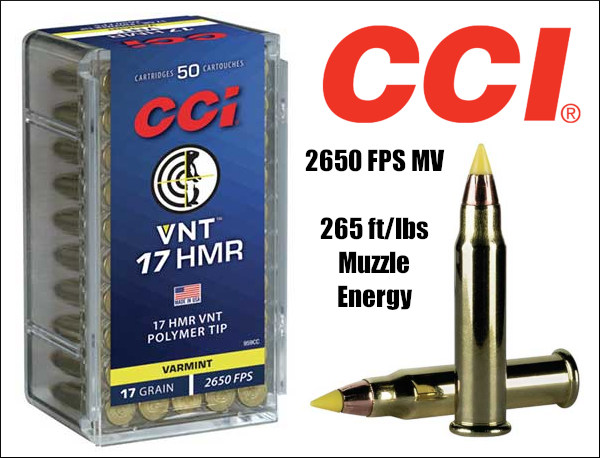
CCI .17 HMR TNT offers 2650 FPS Velocity
For varmint work we like CCI’s modern .17 HMR VNT ammo. This boasts class-leading 2650 FPS muzzle velocity. Engineered to combine good accuracy with high impact energy, this CCI TNT ammo features a 17gr polymer-tipped bullet designed for rapid expansion. We also like the Hornady .17 HMR Varmint Xpress ammo, rated at 2550 FPS with 17gr V-Max bullets.
Here is a video every shooter should watch. It reminds us that our sport demands 100% attention. Lose track of individuals down-range and the results could be tragic. This video will give you chills (starting at about the 0:25 mark). We need to remember to follow all the firearms safety rules, and apply them all the time. At the range, all it takes is one brief moment of inattention to create a life-threatening situation. Never assume the downrange area is safe. Use your own eyes and ears.
This video shows a competitor shooting a stage at an action pistol match. He starts when instructed by the Range Safety Officer (RSO). But unbeknownst to both RS0 and competitor, a volunteer is downrange working on targets. Watch carefully. At 0:27 the shooter sweeps left to right, engaging a paper silhouette target to his right. Then, at 0:30, as he begins a mag change, his head turns downrange. A few yards away is a white-shirted range worker! The shooter yells “Hey what’s going on?!”
What’s going on indeed… The RSO should have ensured that nobody was downrange before the shooter even stepped up to the firing line. If other competitors standing to the side had been alert, they might have seen the worker changing targets and called for a halt. And the target-worker himself — even if he was wearing earmuffs, he should have noticed that live fire had commenced just yards away…
We also have to wonder about the stage design. This set-up made it very difficult to see downrange. The white panels (see 0:10-0:20) definitely hid the target worker from view. In hindsight, given the way the stage was laid out, this was truly an “accident waiting to happen”. It’s fortunate that no one got injured in this incident. But this chilling video provides a lesson to all shooters — “Safety First”.
How could this “near-fatality” have been averted? Post your comments below.
60th Anniversary of the 10/22 Rifle
In celebration of the 60th Anniversary of its 10/22 rimfire carbine, Sturm, Ruger & Co. (Ruger) is offering a the 60th Anniversary 10/22 Carbine. This, the Sixth Edition of the Ruger Collector’s Series, features a nice Magpul stock, and has unique collector’s memorabilia features. The 60th Anniversary 10/22 ships in a Collector’s Series box with a Sixth Edition Ruger Collector’s Series metal street sign and pin.
The 60th Anniversary 10/22 boasts a stainless barrel and silver-finished receiver with a modern, gray Magpul Hunter X-22 stock. The blackened bolt is laser-engraved with a 60th Anniversary marking. The rifle features a red bolt handle and trigger while incorporating popular features including non-glare blade front sight, ghost ring adjustable rear aperture sight, extended magazine release, and Picatinny scope rail. The Anniversary model also retains common 10/22 features like the push-button, cross-bolt manual safety and 1/2″-28 threaded hammer-forged barrel that accommodates popular muzzle accessories.
For more information on the Ruger Collector’s Series 10/22 visit Ruger.com, Facebook.com/Ruger or Instagram.com/Rugersofficial.
Anschutz .22 LR rifle set up for F-Class competition. Photo courtesy Sportschieben Blog.
Here’s a fun new discipline that will grow in years ahead — Smallbore F-Class with .22 LR rimfire rifles. Rest-supported prone rimfire matches have been held around the world for quite some time, but only a few years ago was the discipline officially codified in the NRA Smallbore Rulebook. And the first-ever Smallbore F-Class National Championship was held in July 2018 in conjunction with the Smallbore Nationals at Camp Wa-Ke’-De in Bristol, Indiana. The Nationals involved multiple days of prone shooting at 50 meters and 100 yards. For more information read Hap Rocketto’s Shooting Sports USA Smallbore F-Class Report.
Smallbore F-Class competitors may shoot F-TR style with a bipod, or use a front rest. In the above photo from the inaugural NRA National Championship you can see a shooter with SEB Coaxial Rest at top, with a competitor using a low-profile bipod at bottom. Note the extended handle used to adjust bipod elevation. This is not a coaxial joystick, but rather a long handle attached to the mariner wheel.
Smallbore F-Class — The Future Looks Bright
With the high cost of centerfire ammunition, and the limited number of 1000-yard (or even 600-yard) ranges, we can envision that Rimfire F-Class will become a popular event at ranges across the country. Clubs don’t even need benches — just a 100-yard target bay and flat ground for the shooters. You can start with an inexpensive rimfire rig and Harris bipod. Then work up from there. Here is a custom rimfire F-TR style rig that belongs to F-Class ace and past centerfire F-TR National Champion James Crofts.
Rimfire F-Class and Fun Prone Matches with Front Rest or Bipods
Rimfire F-Class offers the fun of centerfire shooting at a much lower cost. Shooting is done prone with either a front rest or a bipod. You can shoot a relatively inexpensive rifle such as a CZ 457 MTR, or a custom build that has the same design features, weight, and ergonomics as a full-size F-TR or F-Open rifle. The choice is yours. We like shooting smallbore F-Class, because you can find decent .22 LR ammo for just $0.20 per round. By contrast, you’ll probably spend at least $1.20 per round for F-Class centerfire ammo (counting bullet, powder, primer, and part of the brass cost).
Top-Tier Vudoo V22-S Target Rifle for Rimfire F-Class
Vudoo Gun Works now offers an impressive .22 LR Single Shot Target Rifle that should prove ideal for rimfire F-Class (Open division). It features the new V22-S single-shot action, McMillan stock, and Flavio Fare BR-VS trigger.
Rimfire F-Class in the Canary Islands
This video comes from the Canary Islands, part of Spain. The voice-over is in Spanish but there are English sub-titles. The host explains: “In this video we summarize the main characteristics of this [shooting sport] that is practiced at 50 meters, 100 meters, and 200 meters with your .22 LR. Learn how to prepare your rimfire carbine and learn how to score your own targets by following our simple explanations. In another video we will delve into shooting techniques, shooting accessories and field accessories.”
Here is another rimfire F-Class video from the Canary Islands. This shows how the sport can be done with a variety of rimfire rifle types, even including a .22 LR AR clone. Some shooters are using a wide-base bipod, others are using normal Harris-type bipods, while others are using a large, benchrest-style front rest.
Rimfire F-Class-Style Local Fun Match in Oregon
In this video, F-Class John shoots an F-Class-style local fun match in Oregon. He is using a .22 LR rimfire rifle that has a full-size stock very similar to his custom F-Open centerfire rifles. This allows him to easily switch from centerfire F-Class to rimfire prone shooting with front rest and rear bag. The local fun match rules are a little different than an official F-Class match, but the shooting skills required are the same. Shooting this kind of local rimfire match allows John to keep his F-Class skills at a high level at a fraction of the cost of shooting centerfire F-Open.
Rimfire F-Class in Russia
NOTE: This video was filmed in Russia. The dialog is in Russian (without English subtitles), but it is still interesting to watch. Shooting F-Class with .22 LR ammo has become popular in Russia and other parts of Europe. You can have fun on a relatively short (200m) range with low-cost ammo.
Smallbore F-Class Course of Fire
The Smallbore F-Class Nationals was completed on paper targets at 50 yards and 100 yards. According to Shooting Sports USA: “The tournament ran during the any sight and metric phases of the 2018 NRA National Smallbore Rifle Championships, featuring a daily course of fire which mirrored the sling shooters, 40 shots at 50 meters on the A-50 target, a Metric Dewar, followed by 40 shots at 100 yards on the A-33 target. Although the international targets were shot throughout, the first two days were titled ‘conventional’ and the last two ‘metric’.”
The specifics of the match such as rifle requirements, rests, and sights may be found in the Provisional Smallbore Rifle F-Class Rules (Section 23), found on page 65 of the current NRA Smallbore Rifle rulebook. Any rules not covered in Section 23 will [reference] the normal rules of Sections 1 through 22.
SUMMARY: Powder can have a very long shelf life. You need to watch for changes in smell and color. A reddish tinge, almost like rust on the powder, is a bad sign, as is a foul odor, not to be confused with a normal chemical smell. Either of these signs indicate it is time to dispose of your powder by means other than shooting.
Ever wondered about the stability of the propellants in your reloading room? There are some important things you should know about powder storage, to ensure consistent powder performance and safety. Western Powders (which has been acquired by Hodgdon) published an informative Q & A series entitled Dear Labby: Questions for our Ballistics Lab . Here are some excerpts that pertain to powder storage and shelf life. Worried that your powder may be too old? Western’s experts explain how to check your propellants for warning signs.
Proper Powder Storage
Q: I live in southern Arizona where it is very hot. I am told powders will become unstable if stored in an area not air-conditioned. My wife says no powder or primers in the house. Can powder be stored in a refrigerator? What about using a fireproof safe? I would appreciate your ideas. — M.C.
Lab Answer: SAAMI guidelines are pretty clear on issues of storage. They recommend storing smokeless powder in containers that will not allow pressure to build if the powder is ignited — ruling out gun safes and refrigerators.
In their original containers, the lifespan of smokeless powders is quite long, even in hot, arid climates. In fact the lifespan is typically longer than the average handloader would need to store them. Stored safely in a garage or outbuilding, your powder should last years. If you see the powder developing a reddish tint, or giving off a foul odor, it is time to discard it.
Clumps in Powder Container
Q: I ordered some of your Accurate 1680 powder back about in December. I just now opened it … and it is full of clumps. My knowledge tells me that means moisture. Am I wrong? I just now broke the seal and it has been stored in a ammo can with desiccant packs around it and a dehumidifier running 14-16 hours a day. I can’t imagine this being my fault, if this does indicate moisture. I don’t know if the pink part on the label is suppose to be red or not, but it is definitely pink, so if it was red I am wondering if I was shipped an old container? I hope that this isn’t bad and I am stuck with it…
Lab Answer: All powder contains a certain amount of moisture. When the powder is stored or during shipping, it can go through temperature cycles. During the cycling, the moisture can be pulled to the surface and cause clumping. Clumping can also be caused by static electricity if too dry or the powder has limited graphite content. You can break up the clumps before metering and they shouldn’t be a problem. This will not affect the powder performance, so your product is fine. Accurate 1680 labels are designed in Pink. As a side note, specification for testing powder is at 70° F and 60% humidity.
Shelf Life and Packaging Dates
Q: Does powder ever get to old to use and what identifying marks does your company put on the canister for when it is made, You have helped me out a while ago when I asked about keeping my cowboy shooting under 950 fps and it works great less stress on the hand and the recoil is very minimum. — R.B.
Lab Answer: On one pound bottles, the number is on the corner in a silver box. If the powder was poured today, it would read 012815 followed by a lot number. The whole number would look something like 012815749. Eight pound bottles have a sticker on the bottom with an obvious date code. The lot number appears above the date.
Top to bottom: Remington firing pin assembly with ISS, Tubb SpeedLock alloy-composite system without ISS (current versions have dual, opposite-wound springs), and Remington short action firing pin assembly without ISS.
The U.S. Army Marksmanship Unit regularly publishes technical articles on the USAMU Facebook page. One informative USAMU article covered mechanical issues and related ignition irregularities that can cause vertical fliers even with good ammunition in an otherwise excellent rifle. We highly recommend you read this article, which offers some important tech tips.
Vertical Dispersion: Mechanical/Ignition Issues?
Poor or inconsistent ignition has long been known to be one of the “usual suspects” when one encounters vertical fliers that just shouldn’t be there. By having a sense of some of the basic principles involved, and a few basic areas to check, the shooter may avoid colsiderable frustration, not to mention time, expensive loading components and barrel wear.
Is your well-built rifle of high-quality components plagued with vertical fliers across more than 1-3 handload combinations? Consider the bedding, crown and scope/sight mounts. Are they correct? If so, then you might check for ignition issues before boldly undertaking an extensive, expensive, and quite possibly fruitless quest for the “magic handload”.
SEEING IS BELIEVING: While the author had been aware for many years that poor ignition should be considered and ruled out when dealing with vertical fliers in an otherwise-excellent rifle, actually seeing the problem and its almost instantaneous cure really drove the lesson home.
He was working with a “dot” rifle – a .22 LR match rifle that really stacked bullets into little piles at 50 yards and beyond. With one lot of ELEY Tenex, it produced consistent “bughole” groups at 50, but with another, selected lot of Tenex, similar groups were regularly ruined by single, vertical fliers that did not appear in other rifles. Rather than spending days burning up expensive, select ammunition looking for “magic lots”, he contacted a well-respected rimfire gunsmith and explained the situation.
Without so much as batting an eye, the highly-experienced ‘smith tore into the rifle’s action, and quickly found the cause(s) of the problem. He discovered a demonstrably weak firing pin spring, plus a chip out of the face of the firing pin where it contacted the cartridge rim.
After replacing and tuning the offending parts, the rifle immediately began shooting tiny, bughole groups with the previously “unacceptable” lot of Tenex. Centerfire rifles can also benefit from ensuring positive, consistent ignition. A wise riflesmith is literally worth his weight in gold!
So, what are some issues we as shooters can inspect in our rifles to help determine if ignition woes could be part of our problem? At the club level, ask yourself if that “experienced” Remington, Winchester 70, or even Springfield-based match bolt gun you’re using is still running its’ original 40-80 year-old factory striker spring? If so, a new replacement is cheap insurance against current or future problems. (And BTW, it might be best to stick to the normal, factory-spec spring weight. A super-powerful spring can cause vertical, just as a weak one one can.) Along with that, a routine check for proper firing-pin protrusion is a quick preventive measure that can rule out potential issues.
Other areas to consider are the centering and consistency of the firing pin’s operation in the bolt. Admittedly, with the increasing use of precision-machined custom actions, this is becoming less an issue every day. Below is the firing pin assembly from a custom BAT action:
However, particularly with factory actions, a very quick and easy check is to remove the bolt, let the firing pin go forward, and look at the firing pin tip through the firing pin hole. Is the tip off-center in the hole, and possibly striking it as it moves forward? Is the hole out-of-round or burred from being struck repeatedly? If so, a trip to the riflesmith is likely in order.
Similarly, machining issues in the bolt/firing pin system can lead to rough and erratic firing pin movement, in which the firing pin drags against an internal surface of the bolt. In high-quality rifles these issues are relatively rare, but not unheard-of, and it takes mere minutes to rule them out. It may be worthwhile to remove the cocking piece/firing pin/spring assembly and look for any unusual gouges, dings, peening, burrs or signs of abnormal wear.
This task is especially easy with Winchester 70s, Springfields, and the similar Mauser 98s, involving little more than the push of a button and unscrewing the cocking piece assembly. This is just one of the many reasons these tried-and-true actions have earned such a loyal following in the field, among hunters who must maintain their rifles away from a shop.
Particularly with older rifles, watch for and remove excess grease (or even Cosmoline!) from both the firing pin assembly and inside the bolt. This can help improve firing pin speed and consistency. Other bolt-action designs may need a take-down tool or other measures.
As part of this inspection, AFTER ENSURING THE RIFLE IS UNLOADED, slowly cock the rifle, dry-fire, and repeat several times. Listen carefully near the action for inconsistency in the sounds it generates. Does the striker falling make the same sound each time? Do you hear or feel grinding upon operation? If so, where?
Be sure to check the operation of the cocking piece (bolt shroud), firing pin within the bolt shroud, the cocking piece cam and the rear of the bolt body where the cocking piece cam operates. As with our examination for abnormal wear marks discussed above, look for marks indicating roughness or a possible need for light polishing. Then, clean and lightly grease the bearing surfaces while you’re at it.
Remington 700 bolt shroud and cocking cam
These are relatively easy checks that shooters can undertake to perform a preliminary inspection on their own. Other mechanical issues can also cause ignition issues, chiefly centered around the action of the trigger, sear and sear spring. If these are suspected, a trip to an experienced, qualified riflesmith for diagnosis is recommended. We hope you find this information helpful! Join us again next week, and in the meantime, enjoy the shooting sports safely!
SHOT Show 2024 kicks off in Las Vegas, Nevada in less than three weeks, starting with Industry Day at the Range on 1/22/24 where new guns can be tested at the Boulder City Rifle & Pistol Club range.
SHOT Show draws visitors from around the world. At SHOT Show 2023, exhibitors, buyers, media, and industry professionals hailed from 50 states and over 115 countries. The 2024 SHOT Show will have more than 2,500 exhibitors on the show floor, including the Suppliers Showcase. Total exhibit space for the 2024 show in these two venues is estimated to be more than 800,000 net square feet –equivalent to more than 18 acres or enough space to park 547 F-16 fighter jets. The SHOT Show boasts 13.9 miles of aisles — a distance more than half a marathon.
Firearms and ammunition are a $9.4 billion industry. The total economic impact of the sporting arms and ammunition industry is more than $80.7 billion, which supports more than 393,000 jobs.
More than 52,000 professionals in the shooting, hunting, outdoor and law enforcement industry attended SHOT Show in 2023. There could be even more this year. The SHOT Show’s website is SHOTShow.org and you’ll find daily reports on the SHOT Show Blog. You can also follow SHOT Show on Twitter @NSSFSHOTShow, on Facebook, LinkedIn, YouTube, and @shotshow on Instagram.
The Coriolis Effect comes into play with extreme long-range shots like this (2100 yards at Raton, New Mexico). The rotation of the earth actually moves the target a small distance (in space) during the long duration of the bullet’s flight.
When you’re out at the range, the Earth seems very stable. But it is actually a big sphere zooming through space while spinning around its axis, one complete turn every 24 hours. The rotation of the earth can create problems for extreme long-range shooters. During extended bullet flight times, the rotation of the planet causes an apparent deflection of the bullet path over very long distances. This is the ballistics manifestation of the Coriolis Effect.
Bryan Litz of Applied Ballistics discusses and explains the Coriolis Effect in his Ballistics Books and Seminars. Bryan notes that Coriolis is “a very subtle effect. People like to make more of it than it is because it seems mysterious.” In most common shooting situations inside 1K, Coriolis is not important. At 1000 yards, the Effect represents less than one click (for most cartridge types). Even well past 1000 yards, in windy conditions, the Coriolis Effect may well be “lost in the noise”. But in very calm conditions, when shooting at extreme ranges, Bryan says you can benefit from adjusting your ballistics solution for Coriolis.
Bryan explains: “The Coriolis Effect… has to do with the spin of the earth. You are basically shooting from one point to another on a rotating sphere, in an inertial reference frame. The consequence of that is that, if the flight time of the bullet gets significantly long, the bullet can have an apparent drift from its intended target. The amount [of apparent drift] is very small — it depends on your latitude and azimuth of fire on the planet.”
Coriolis is a very subtle effect. With typical bullet BCs and velocities, you must get to at least 1000 yards before Coriolis amounts to even one click. Accordingly, Bryan advises: “Coriolis Effect is NOT something to think about on moving targets, it is NOT something to think about in high, uncertain wind environments because there are variables that are dominating your uncertainty picture, and the Coriolis will distract you more than the correction is worth.”
“Where you could think about Coriolis, and have it be a major impact on your hit percentage, is if you are shooting at extended range, at relatively small targets, in low-wind conditions. Where you know your muzzle velocity and BC very well, [and there are] pristine conditions, that’s where you’re going to see Coriolis creep in. You’ll receive more refinement and accuracy in your ballistics solutions if you account for Coriolis on those types of shots. But in most practical long-range shooting situations, Coriolis is NOT important. What IS important is to understand is when you should think about it and when you shouldn’t, i.e. when applying it will matter and when it won’t.”
Do you compete in rimfire benchrest, silhouette, or NRL22 matches? Then you’ll want to check out the Shooting Sports USA .22 LR Ammo Roundup on the SSUSA.org website. That article covers .22 LR ammunition from Lapua, ELEY, SK, RWS, Norma, Wolf, and Aquila. Notably there’s a detailed discussion of Lapua’s new Long Range and Super Long Range ammo. In addition, SSUSA confirms that SK ammo (made in Germany by Nammo, parent of Lapua) and Wolf Match Target ammo (made by ELEY) both offer quite good performance for a moderate price.
The article notes that there is a much wider range of .22 LR ammo types available now than a few years ago. It’s not just a choice between cheap products and high-end match ammo. As SSUSA explains: “It used to be that .22 LR was either quite expensive match grade ammo, or it was cheap plinking or hunting ammo. Today, competitors have choices in grades of .22 LR match ammunition to suit their pocketbook or firearms.” We’ve seen good results with relatively inexpensive Norma Tac-22, and the SSUSA article says that SK performs well above its price level.
Seven Brands of .22 LR MATCH AMMUNITION
Lapua Super Long Range and Long Range .22 LR
Lapua Super Long Range and Long Range ammunition comes from Finland, and is designed for the growing long-range rimfire disciplines with targets at 100-300 yards. Lapua says this ammo delivers very low ES and SD numbers. Our friend F-Class John has tested this ammo and confirmed it performs very well (SEE video above). “Each production lot of Lapua’s new rimfire products are test-fired in 50-round groups for dispersion”, Capstone’s Marketing Director, Geoff Esterline, said. “The results determine whether it makes Super Long Range or Long Range packaging.”
ELEY .22 LR Ammunition
ELEY has long been a top choice for .22 LR competition — both position shooting and benchrest. ELEY now offers 11 different varieties of .22 LR match ammunition, ranging in price from $7 (Benchrest Outlaw) to $20 (ELEY Tenex). If you compete in the rimfire benchrest, you should definitely try some ELEY ammo.
SK .22 LR Ammunition
Numerous .22 LR ammunition types are offered by SK, suitable for a variety of disciplines — from NRL22 to Biathlon. Generally cheaper than ELEY Match ammo, SK offers good “bang for the buck”. F-Class John says it performs great considering the price. The SSUSA article notes that: “German manufacturer SK has eight match-grade .22 LR offerings, including two for pistols, one for semi-automatic rifles, and one for frigid, wintertime conditions.”
RWS .22 LR Ammunition
Sometimes hard to locate at vendors in the USA, RWS is popular among European competition shooters. The top-tier RWS ammo is a choice of many competitive shooters. RWS currently offers nine Premium Line .22 LR varieties and three Professional Line offerings. The SSUSA tester noted that RWS Rifle Match ammo shot great in his Bergara BMR, shooting one-ragged-hole groups at 50 yards and about one MOA at 100 yards. That’s great performance for $10/box ammo.
Norma .22 LR Ammunition
Norma recently introduced XTREME LR-22, a new type of competition rimfire ammo with a radical new bullet. This unique, patented bullet design has a special base with a cone (see diagram). Norma claims that this “rocket tail” design reduces drag by creating less negative pressure at the back end of the bullet. It will be interesting to see how this new bullet design works in rimfire ELR competition.
Wolf .22 LR Ammunition
SSUSA says that Wolf Match Target is a top performer in the under-$10 per box category. This is because, according to SSUSA: “It is manufactured by ELEY in England (and loaded with Vihtavuori powder) and re-branded, if online information is correct.” Wolf Match Target is available from Target Sports USA for $74.99 per thousand ($0.15 per round).
Aguila .22 LR Ammunition
Made in Mexico, Aguila .22 LR rimfire ammo is the bargain item among the seven ammo-makers featured by SSUSA. It is widely available at very affordable prices.
We wouldn’t choose Aguila for a benchrest or three-position match, but it could be more than adequate for a local NRL-22 match or a steel-target competition at relatively short range. Aguila .22 LR ammunition starts at under $3.00 per box. And right now Midsouth offers a 2000-round Case of Aguila for just $114.99. That works out to just $2.87/box or six cents per round.


 .009″ — The Record That Stood for 40 Years.


 In recent years, Browning has produced T-Bolt rifles in a variety of models, with many different stock types and various barrel lengths/contours. Most of the photos above showcase the AA Maple Sporter T-Bolt, which is currently out of production, though still available from some dealers (if you search). We like the looks of the AA Maple T-Bolt, but there many other stock options including dark brown, Black, Green, and various camouflage finishes. Use the links below to see other T-Bolt configurations.





 Is your well-built rifle of high-quality components plagued with vertical fliers across more than 1-3 handload combinations? Consider the bedding, crown and scope/sight mounts. Are they correct? If so, then you might check for ignition issues before boldly undertaking an extensive, expensive, and quite possibly fruitless quest for the “magic handload”.


 SHOT Show 2024 kicks off in Las Vegas, Nevada in less than three weeks, starting with


 When you’re out at the range, the Earth seems very stable. But it is actually a big sphere zooming through space while spinning around its axis, one complete turn every 24 hours. The rotation of the earth can create problems for extreme long-range shooters. During extended bullet flight times, the rotation of the planet causes an apparent deflection of the bullet path over very long distances. This is the ballistics manifestation of the


