Close-up of the Tri-Way Trimmer with clear plastic chip guard removed.
Giraud Tool offers a case trimmer/chamferer device that works with a power drill (or other power source). Giraud’s patented Tri-Way Trimmer is a self-contained unit powered by your drill or motor. Using a sharp carbide blade it will trim your cases to length, deburr, and cut both inside and outside chamfers — all in one pass. That’s pretty impressive for a $110.00 tool that fits in the palm of your hand.
Product Features
1. Fully adjustable for cartridge length (and depth of chamfer).
2. Carbide blade cuts a 15° inside case mouth chamfer and 45° outside chamfer.
3. Case holder supported by sealed ball bearing raceway.
4. Tool includes removable, transparent plastic chip guard.
5. Tool can work in any orientation (vertical, horizontal, or any angle).
The Giraud Tri-Way Trimmer is designed to be powered by a portable hand drill, drill press, or other dedicated rotating power source. The tool indexes off the shoulder of your cases, but the blade adjusts so that cartridge overall length (COAL) can be controlled with precision. Constructed out of 6061-T6 aluminum and 303 stainless steel, the Tri Way tool should last a lifetime. Note: This tool is not universal. The Tri Way is dedicated to a single cartridge and “related” cartridges with similar body dimensions. Thus you need a specific tool for each cartridge family. For example, the .308 Win tool will also trim .243 Win, .260 Rem, and 7mm-08.
Cartridge Sizes Available for Giraud Tri Way Trimmer:
.223 Remington (Also trims .17 Remington, .204 Ruger, .222 Remington, .222 Remington Magnum)
7.62 x 39mm (Russian)
.300 Blackout (Also trims .17 Rem Fireball, .20 Vartarg, .221 Fireball)
.308 Winchester (Also trims .243 Winchester, .260 Remington, 7mm-08)
.30-06 Springfield (Also trims .25-06, .270 Winchester, .280 Remington)
.300 Winchester Mag (Also trims Also trims .264 Winchester Magnum, 7mm Remington Magnum, .308 Norma Magnum)
Product Tip from EdLongrange. We welcome reader submissions.
On October 7th, Smith & Wesson, a leading American gunmaker for over 169 years, celebrates the Grand Opening of its new Tennessee Headquarters and production center. The Grand Opening event will feature a shooting day, product demonstrations, and fun events.
Since 1852, Smith & Wesson had been based in Springfield, Massachusetts. Now a big change is taking place. The company announced in September 2021 that it would relocate its headquarters from Massachusetts to East Tennessee, along with distribution, assembly, and other major operations. The Smith & Wesson Headquarters Grand Opening and Fall Festival event takes place Saturday, October 7 from noon to 8 p.m. at 1852 Proffitt Springs Road in Maryville, TN.
The Shooting Wire reports that: “The new Maryville facilities will house the company’s headquarters, plastic injection molding, pistol and long gun assembly and distribution centers. The company’s longtime home, Springfield, Massachusetts, will remain operational with all forging, machining, metal finishing, and revolver assembly staying behind. More than 1,000 S&W employees will still be employed there, but it’s a decided diminishment for the facilities that have been home to the company since 1832. More than 750 jobs are relocating from Springfield, Massachusetts, Deep River, Connecticut and Columbia, Missouri, to Maryville.”
Smith & Wesson’s President and CEO Mark Smith cited several key factors in the decision to move S&W’s corporate HQ from Massachusetts to Tennessee:
Support for the 2nd Amendment
Business friendly environment
Quality of life for employees
Cost of living and affordability
Access to higher education institutions
Availability of qualified labor for operations
Favorable location for efficiency of distribution
GunTalk Media Will Stream Live from the Grand Opening Gun Talk Media will broadcast LIVE from the Grand Opening of Smith & Wesson’s new facility on October 7, 2023. Beginning at 1:00 pm EST Ryan Gresham and Kevin Jarnagin host a LIVE broadcast throughout the day, giving viewers who might not be able to attend an inside look at the grand opening.
This broadcast provides an exclusive look at the new premises, interviews with key personnel, and insights into the latest offerings from one of the most renowned firearms manufacturers in the world.
Gun Talk LIVE Schedule on Saturday, October 7, 2023:
1:00 pm: S&W – Mark Smith, President & CEO
1:30 pm: S&W/Mighty Oaks Foundation – Chad Robichaux, Founder of Mighty
2:00 pm: USCCA – Maria Julianna
3:00 pm: S&W – Jerry Miculek, S&W Brand Ambassador
3:30 pm: Gatorz Eyewear – Scott Melton, Product Manager
4:00 pm: C&G Holsters –Chris Burns, Founder & President
4:30 pm: Rugged Rare – Travis Ferguson, VP of Sales & Marketing
5:00 pm: Black Rifle Coffee Company – Michael Shea
Grand Opening Silent Auction To Support Local Tennessee Charities
There is a special auction connected with Smith & Wesson’s TN Grand Opening. The Smith & Wesson Grand Opening Silent Auction is auctioning off over $20,000 worth of Smith & Wesson and partner products to support local East Tennessee charities. This Silent Auction is open to the public, and concludes 10/7/203 at 7:00 pm EST. CLICK HERE to see All Auction items.
Sherri Jo Gallagher, the second woman in history to win the NRA High Power National Championship, sports Eye Protection at Camp Perry. The first lady High Power Champion was Sherri’s mother, Nancy Tompkins.
In response to a Bulletin article about Protective Eyewear, one of our Canadian readers posted a personal story. His account demonstrates the importance of wearing eye protection whenever you shoot — no matter what type of firearm you are using — even air rifles. We hope all our readers take this to heart. All too often at rifle matches we see shooters, even some top competitors, risking their vision by failing to wear eye protection.
Eye and Hearing Protection are now MANDATORY for Highpower Rifle competitors and Pistol shooters in all CMP-affiliated matches. The 2020 CMP Highpower Rifle, Pistol, and CMP Games Rulebooks all contain the following rule: “All competitors and competition officials are required to wear appropriate eye and hearing protection when on shooting range firing lines during highpower rifle or pistol firing. All competitors must comply with this requirement before they can participate in a CMP sponsored or sanctioned competition. Competitors are responsible for selecting their eyewear and hearing protection.”
Eye Protection — Lesson Learned by Nicholas from Canada
As a boy on a mixed farm on the plains the first shooting stick I owned was a Red Ryder BB gun. My Dad bought it for me as I showed a keen interest in the shooting and hunting sports. I was about 9 years old at the time.
We had literally thousands of sparrows in our large farm yard and they liked to roost on the steel railings in the barn loft. I took to slowly thinning out their ranks by flashlight at night as these little winged pests settled in the farm buildings.
One evening as I slayed sparrow after sparrow in the barn loft — with about a dozen farm cats following me to consume these easy meals, I fired at another bird centered in my flashlight beam.
However, my aim was a bit low — and the copper pellet hit the steel beam square on. Instantly I felt a sharp pain as the BB bounced back and hit me squarely between the eyes on the bridge of my nose – drawing blood from the partial penetration into the skin. A half inch either way and I’d have lost an eye!
Never, never, never shoot at any target with a steel background with any firearm, even a BB gun – is the hard lesson I learned, and wear the best shooting glasses that money can buy!
PLEASE REMEMBER THAT!!
Editor’s Comment: Among competitive pistol shooters, the use of safety eyewear is universal. You’ll never see Rob Leatham, Julie Golob, or Jerry Miculek competing without eye protection — for good reason. The handgun sports’ governing bodies effectively enforce mandatory eye protection policies. We wish the same could be said for competitive rifle shooting. We often see benchrest, High Power, and F-Class competitors shooting without eye protection. We’ve heard all the excuses, yet none of them trump the safety considerations involved.
We recommend that all shooters and hunters employ eye protection whenever they use firearms or are at a location where live fire is taking place. You only have two eyes. A tiny bullet fragment or ricochet is all it takes to cause permanent blindness in one or both eyes. As rifle shooters, we place our eyes a couple inches away from a combustion chamber operating at pressures up to 70,000 psi. I know quite a few guys who will religiously put on safety glasses when running a lathe or a drill press, yet the same guys won’t use eye protection when shooting their rifles — simply because it is “inconvenient”. That’s nuts. It doesn’t matter is you are a cub scout or a multi-time National Champion — you should wear eye protection.
I will give you a personal example. A year ago I was shooting a 9mm pistol. One of the cartridges had a primer burst outward blowing small particles, some brass, and a piece of the pistol’s extractor right back into my eyes. Thankfully I was wearing good wrap-around safety glasses. No injuries at all. But without those safety glasses, this could have been very serious. I always wear safety glasses with ALL firearms. Shown below is the same kind of primer blow-out I experienced, but with a .270 Win rifle cartridge.
Be wise — protect your eyes. To learn more about eyewear safety standards, and to learn about the latest options in ANSI Z87-certified protective eyewear, read our article on Eye Protection for Shooters.
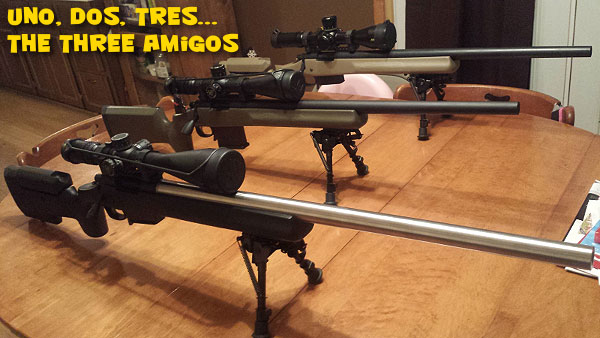
Jerod’s Tactical Trio
Many guys are lucky to have just one accurate tactical rifle fitted with a custom barrel and high-end optics. Well forum member Jerod (aka Stinnett1981) has three!
Jerod calls his tactical trio the “Three Amigos”. All are built with Manners Composite stocks and Bartlein barrels. But there are three different chamberings. In order below (from top to bottom) are: .308 Win (Bartlein 5R, 1:10″ twist); .223 Rem (Bartlein 5R, 1:8″ twist);,and 6.5×47 Lapua (Bartlein 5R 1:8.5″ twist). Read on for a full description of each build.
The tan rifle is Jerod’s .308 Winchester. It has a Manners T4A stock, trued Rem 700 SA, Badger M5 DBM, and Bartlein 5R 10-twist HV contour finished at 23″. The optic is a Bushnell XRS 4.5-30X50mm FFP with G2 reticle scope.
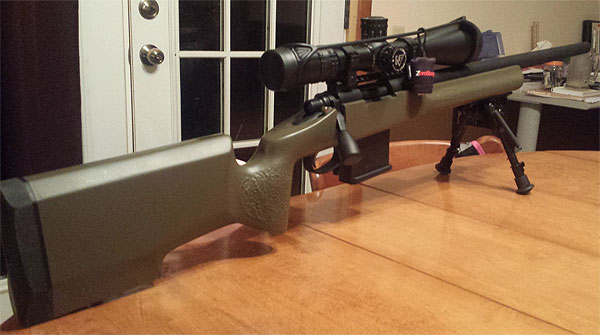
The Green rifle is a .223 Remington. This has a Manners T4 stock, trued Rem 700 SA, Badger M5 DBM, and Bartlein 5R 8-twist HV contour finished at 23″. On top is a Nightforce NXS F1 3.5-15X50mm FFP with MLR 2.0 reticle scope. Jerod says: “This scope and reticle are awesome.”
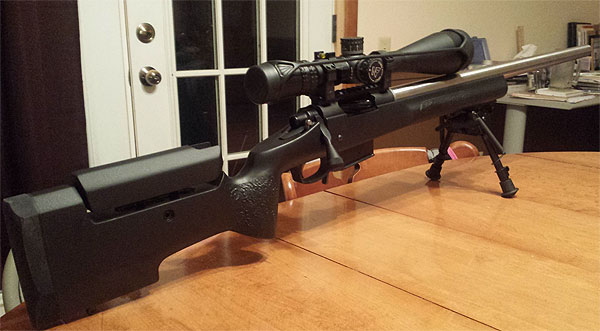
The Black rifle is chambered for the 6.5-47 Lapua. Components are: Manners T4A stock, Stiller TAC 30, Badger M5 DBM, Bartlein 5R 8.5-twist bull barrel (1″ at muzzle) finished at 26″. The scope is a Nightforce NXS 8-32X56mm with NP2DD reticle.
What Comes Next — A Rimfire Maybe?
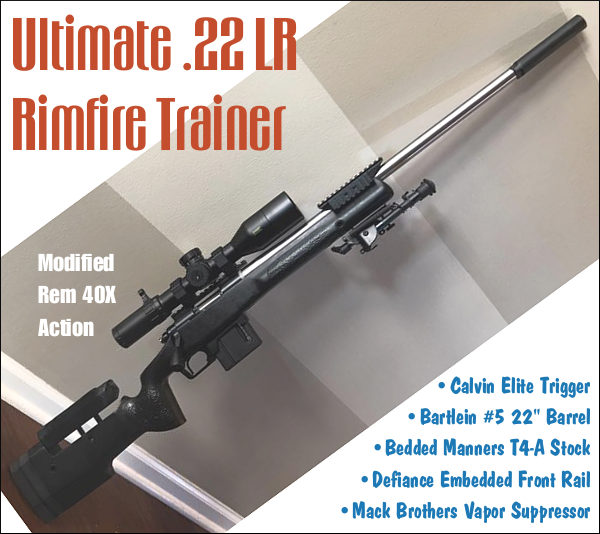
While Jarod’s Three Amigos make up a very impressive tactical troika, we’d like to see one more rifle added to the mix — a .22 LR rimfire rig, set up with a similar stock. That would be perfect for low-cost cross-training, or competition in Rimfire Tactical matches. Jerod could build the “fourth Amigo” using a rimfire action. Here is just such a rifle, built by Brian of GA Precision with a modified Rem 40X action in a Manners T4A stock (matching Jerod’s centerfire stocks). Pretty cool eh?
Could This Be the Fourth Amigo? 40X Rimfire in Manners Stock
Brian, a gunsmith at GA Precision, built this rimfire rig with GAP colleague Anthony Soukup.
When your cases become hard to extract, or you feel a stiff bolt lift when removing a cartridge, it’s probably time to full-length size your cases, and “bump” the shoulder back. We generally recommend bumping shoulders each time you reload, after the initial fire-forming. Benchrest and F-Class benchrest shooters, running relatively high pressures, typically full-length size every load cycle, bumping the shoulder .001-.003″. High Power shooters with gas guns generally full-length size every time, and may need to bump the shoulders .003″ or more to ensure reliable feeding and extraction.
Use Shims for Precise Control of Shoulder Bump
Some shooters like to set the “default” position for their full-length die to have an “ample” .003″ or .004″ shoulder bump. When they need less bump, a simple way to reduce the amount of shoulder movement is to use precision shims in .001″ (one-thousandth) increments.
Here are reports from Forum members who use the shims:
“Great product. I have my die lock ring(s) adjusted for the shortest headspace length on my multiple chambers 6BRs and 6PPCs. When needing a longer headspace, I just refer to my notes and add the appropriate shim under the lock ring. Keep it simple.” — F.D. Shuster
Mats Johansson writes: “I’ve been using [shims] since Skip Otto (of BR fame) came out with them. I set up my dies with the .006″ shim, giving me the option of bumping the shoulder a bit more when the brass gets old and hardens while still having room to adjust up for zero headspace, should I have missed the original setup by a thou or two. Hunting rounds can easily be bumped an extra .002-.003″ for positive, no-crush feeding. Being a safety-oriented cheapskate, I couldn’t live without them — they let me reload my cases a gazillion times without dangerous web-stretching. Shims are a must-have, as simple as that.” — Mats Johansson
Sinclair Die Shim Kit — Seven Shims for $14.99
Sinclair Int’l (through Brownells) offers a seven-piece set of Sizing Die Shims that let you adjust the height of your die (and thereby the amount of bump and sizing) in precise .001″ increments. Sinclair explains: “Some handloaders will set their die up to achieve maximum sizing and then progressively use Sinclair Die Shims between the lock ring and the press head to move the die away from the shellholder. Doing this allows you to leave the lock ring in the same position. These shims are available in increments of .001″ and work very well.”
Seven Shims from .003″ to .010″
Sinclair’s $14.99 Die Shim Kit (item 22400) includes seven shims in thicknesses of .003, .004, .005, .006, .007, .008, and .010. For ease of use, shim thickness is indicated by the number of notches cut in the outer edge of each shim. Even without looking you can “count” the notches by feel.
Ever wanted to see how Nosler bullets and cartridges are made? Here’s your opportunity. The Rocky Mountain Elk Foundation (RMEF) has produced a video (“Quality First”) that offers a behind-the-scenes look inside Nosler’s Oregon factory that produces bullets, brass, and ammunition.
Video Showcases Nosler Production Facility and Ballistics Lab
RMEF representatives were provided with unprecedented access into Nosler’s famously-guarded manufacturing plant to show the technology used by Nosler to produce bullets and ammunition. The “Quality First” video showcases Nosler’s complex production processes that include technologically advanced machinery, and stringent quality control measures.
After the intro, this video illustrates Nosler’s bullet construction techniques with a cool animation sequence. The video then showcases the Nosler ballistics lab, inspection room, and packaging line.
The “Quality First” video starts with the history of the company, tracking Nosler’s development from the 1940s. Then the video shows the bullet construction techniques followed by a ‘walk-though’ in the factory, showing the sophisticated machinery used to make bullets, brass, and ammunition. “‘Quality First’ isn’t just a saying that’s printed on our factory walls, it’s the guiding principle that affects every decision we make” says Mason Payer, Senior Marketing Manager at Nosler.
Information Resources — Load Data and Nosler Blog
The enhanced Nosler website also features comprehensive LOAD DATA, plus informative content in the Nosler Blog. The Load Data page works well on smartphones. Go to the Load Data Index Page, then simply scroll down to a caliber. Then select your cartridge type and bullet weight(s). The rifle listings are quite comprehensive, covering .17 caliber up to .458 caliber. Here are examples of Nosler load data for the 6mm Creedmoor with popular 105-107gr bullets, along with the .284 Winchester with 175gr bullets.
About Nosler and Support for Rocky Mtn. Elk Foundation
Founded in 1948, Nosler, Inc. is a family-owned company located in Bend, Oregon. Nosler is most known for hunting bullets such as the Partition®, Ballistic Tip®, AccuBond®, E-Tip® and most recently the AccuBond® LR and RDF. Nosler manufactures premium component bullets, reloading brass, ammunition and semi-custom rifles for domestic and international customers.
A long-time proponent of the Rocky Mountain Elk Foundation, Nosler donates a portion of the proceeds from the sale of five Partition bullets to benefit RMEF’s mission and recently added proceeds from Trophy Grade® and Expansion Tip™ ammunition to increase support.
Video find by ELR Researcher. We welcome reader submissions.
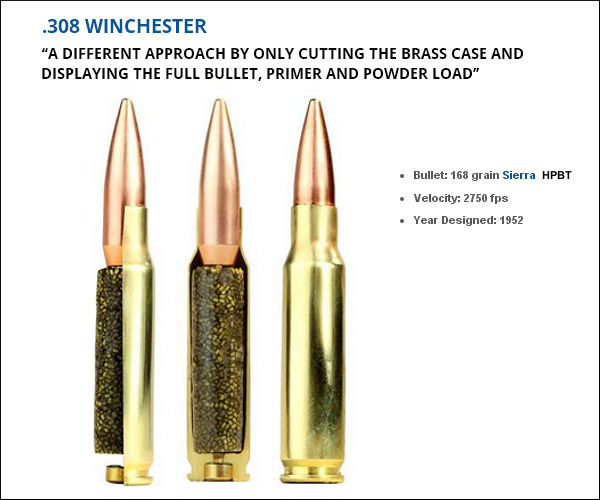
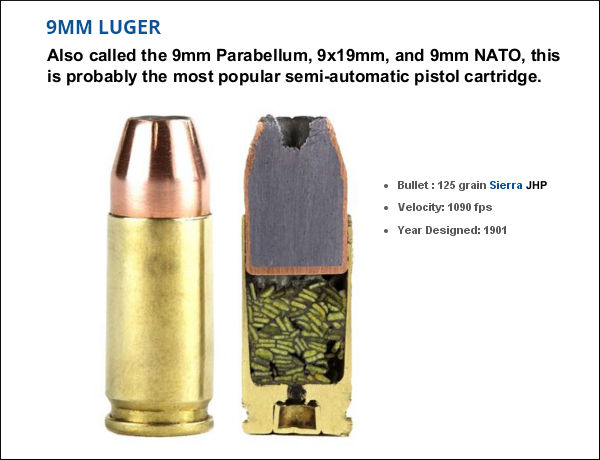
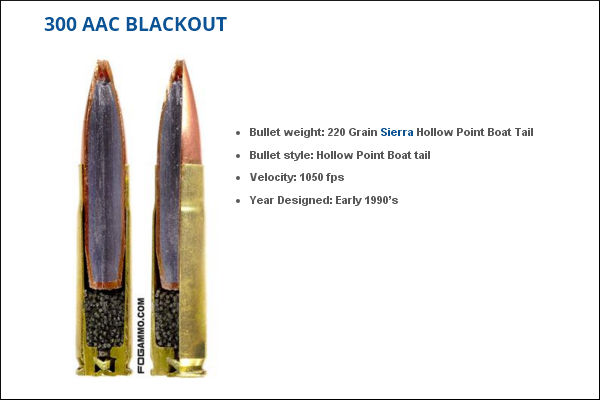
Here’s something you don’t see every day — the inside of loaded cartridges, sliced halfway through. This lets you see how bullet core, jacket, cartridge case, powder, and primer all fit together. Give credit to the folks at FOG Ammunition for creating this interesting series of cut-through ammo images. We show four cartridges here: the .308 Winchester, 9mm Luger, 300 BLK, and .50 BMG. You’ll find two more (the .223 Remington and .45 ACP) at www.FogAmmo.com.
This .308 Winchester model took on a different approach by only cutting the brass case and displaying the full bullet, primer and powder load. A spec amount of powder was used to create the model powder form. An estimated 10% volume was added during the forming process, along with an undetermined amount of air pockets.
This bisection is a 9mm Luger Jacketed Hollow Point round with flake powder held together with super glue. After this self-defense round was cut by a trained professional the round was polished by hand. This might look like stick powder, but those are in fact flakes stacked up in cross-section. Designed in 1901 by Georg Luger, this popular cartridge is used by civilians, military, and law enforcement.
For this model of the .300 AAC Blackout (aka 300 BLK), a Dremel tool was used to create a pie cut within the bullet and brass case. A measured amount of power, roughly 65% of spec charge, was placed inside the case with super glue. This cartridge was originally optimized for subsonic use with a suppressor, so the amount of powder used is small relative to the nominal case capacity. That leaves more room for the relatively large .30-caliber bullet.
Last but definitely not least is the .50 Caliber BMG round (aka .50 Browning Machine Gun). Famed for its wartime use in the M2 Machine gun, the .50 BMG round is also used in civilian Long Range competitions. A typical .50 BMG cartridge holds over 225 grains of powder. That’s almost ten times the amount in a 5.56×45 NATO Round! To demonstrate the size of the .50 BMG, check out that .223 Rem for comparison.
This stunning Westley Richards & Co. shotgun was made for the 1981 nuptials of Lady Diana Spencer and HRH Prince Charles. It is rare, has a unique history of ownership, and is also elaborately decorated.
Jim Supica, Director of the NRA Firearms Museum, has written a trio of articles about gun collecting. If you are thinking of starting your own collection of firearms, you should read Supica’s informative articles. The first talks about the basics of gun collecting, the second explains the five key factors that govern gun values, and the third article explains where to find rare and valuable arms. Today we want to highlight the five factors that contribute most to a gun’s value, according to Supica:
Make and Model, Condition, Rarity, History, Art — These are the five factors that … appeal to collectors and help determine the value of collectible guns.
Make and model tends to be the starting point for evaluating collectible guns for most collectors and will be a basic threshold requirement for those with specialized collections.
Factors here include the quality of a particular manufacturer’s products, the historical usage of the guns in question, and the brand’s aura of romance. As an example of that last (and most intangible) factor, consider that Colt Single Action Army revolvers were for several decades the most prevalent focus for collectors interested in full-size revolvers from the post-Civil War to turn of the 20th Century-era, and there is no question that Colts were widely used during that time. In recent years, there has been a refreshing trend in gun collecting to look at a broader range of guns than the traditional blue chip Colts, Winchesters, and Lugers.
Colt Single Action Army Revolvers remain among the most prized (and collectible) firearm.
2. Condition (and Originality)
Obviously, condition plays a major role in the value of a collectible firearm. The classic advice to new collectors in this regard has always been to hold out for guns in the best condition and pay the extra premium they demand. This condition-emphasis seems to have developed in the 1970s and 1980s. In the early post-WWII years of gun collecting there was more interest in rare variations and history, and fewer collectors to whom a few percentage point difference in remaining original finish was of much concern.
Although the highest-condition guns continue to bring record prices, it seems that the pendulum is beginning to swing back the other way, a trend met with my hearty approval. The appeal of “mint” guns has been largely lost on me, and seems to be more appropriate to coin or stamp collecting than a field in which the possible historic usage of the artifact holds so much interest and significance. There is a definite segment of the collector market that is not overly concerned with perfect condition, so long as the gun is original and has not been messed with in a more recent (and, in my opinion, usually misguided) attempt to enhance its desirability.
3. Rarity
In terms of rarity, the well-worn saying that “just because a gun is rare doesn’t mean it’s valuable” remains true to a certain extent. There may only be five known examples of a particular gun, but if only three people care about it, the market is saturated. However, there does seem to be more interest in cornering the rare variations within established collecting fields. There is a bit of a resurgence of the collecting philosophy of completing a punchlist of models and variations within a specialization, and this lead to vigorous competition for the rarest examples in these fields. In emerging collecting fields, when new research is published revealing the rarity of certain variations there can develop a brisk interest in those guns.
4. History
Individual guns with a known history of ownership by a specific individual or usage in a specific historical event have always captured the fascination of collectors, as well as historians and the general public. This seems to reflect a basic human interest and shows no sign of abatement. A positive trend here seems to be an increase in general understanding of the type of documentation which must accompany a historically attributed firearm to give it the credibility to justify a premium price, and the importance of creating and preserving such documentation.
This Beretta has extra value because it was owned by pilot Chuck Yeager. Photo NRA Museum.
5. Art (Decorative Embellishment)
Fine engraved guns are collected more for their artistic value than for their worth as firearms. Here the market for classic works by the great engravers of the 19th and early 20th Centuries remains strong, as well as for factory-engraved pieces from more recent years. Interest in recent non-factory engraving seems to have diminished, as has… the trend of adding modern engraving to older firearms.
Here is a matching set of three three beautifully engraved pistols by the late Indiana engraving wizard Ben Shostle — a Luger, a Mauser, and a Colt. Photo courtesy Amoskeag Auction Company.
Factory-custom engraving should not be confused with mass-produced, factory-made commemorative firearms, which flooded the market in the 1960s and 1970s. A couple of major manufacturers worked this genre to death, and prices on commemoratives have been stagnant for many years now, although the market for these shows some signs of renewal.
CAUTIONARY WORDS about RESTORATION
With prices for high-condition original finish guns running away from the budgets of many collectors, period-of-use refinished guns and older factory-refinished guns are finding more enthusiastic buyers than they did a few years ago.
The availability of excellent-quality restoration services is another factor that I anticipate may impact collector preferences in the future. The top restoration artists are reworking guns to “as new” condition with such skill that it has become increasingly difficult for even knowledgeable collectors to distinguish mint original finish guns from the best restorations.
When such restoration is disclosed to a prospective buyer (as it ethically should be), the prices the gun will bring are significantly below a similar gun with original finish, and may be less than the original cost of the pre-restoration gun plus the cost of the rework. This creates a mighty incentive for deception by a motivated seller, either by active misrepresentation (a.k.a. “fraud”) or passively by simple failure to mention the modification.
Do you often load at the range? Or maybe you need to transport loading gear when you travel in your RV. Well here is a smart transport option — a metal box that holds tools, dies, arbor press, case-trimmer, even a ChargeMaster.
Some guys have built their own loading tool-boxes from wood. Other may stuff gear in a couple of plastic range boxes. But clever Chris Covell came up with an even better solution. Chris sourced a handsome, sturdy metal Horse Grooming Box from eBay. Chris reports the multi-feature metal box “works perfectly for reloading. My ChargeMaster is now out of the wind.”
Bullets, Trickler, and Priming Tool on Top
On top, below the hinged metal lid, is a large compartment that holds Covell’s funnels, scales, priming tool, trickler and other vital gear (photo on right). This top compartment is deep enough to handle wide-mouth funnels with no problem.
Slide-Out Drawer with Dividers
Below the top level is a handy sliding drawer with multiple dividers. This is perfect for holding Covell’s inline seating dies, case-neck deburring and chamfering tools, among many other smaller bits and pieces.
In the bottom of the Horse Grooming box is a large compartment that holds bigger gear. In the bottom section, Covell places his RCBS Chargemaster Lite, along with a case-trimming tool, an arbor press, and various other bulky tools. Check it out:
Folks who load at the range need to bring a lot of gear — reloading presses, powder dispensers, scales, funnels, sizing/seating dies, brass prep tools and more. And there may be other important items to transport — such as ammo caddies, LabRadar mounts, over-size rest feet, and even barrel fans. With this metal box you can easily organize (and protect) al that gear. This box was sourced affordably via eBay.
Chris Covell’s Range Box was featured on the Benchrest Shooting and Gunsmithing Private Group Facebook Page. You may want to sign up for this Group — with membership you can access a wealth of information for accuracy-oriented shooters.
If you’ve been thinking about a big purchase at Brownells, here are some money-saving codes. Brownells is currently offering $30 Off a $200 purchase, $20 Off a $175 purchase, $15 Off a $150 purchase, and $10 Off a $100 purchase. In addition, you can get 10% off all purchases of $150 or more. It’s simple to get these discounts — there are no buyers’ clubs to join, no forms to fill out. Just use the appropriate Discount Code during online check-out.
Listed below are the Codes to use. Simply use the appropriate Code for your purchase at Brownells.com. These codes have no listed expiration date, so Brownells could terminate them at any time. Accordingly, we recommend you do your shopping soon. Also if the highest value code no longer works, try a lesser value CODE.
NOTE: None of the above codes include FREE or Discounted Shipping. But Code CARTSHIP offers Free Shipping/Handling for orders over $149.00 (with no other discounts). Depending on the weight/size of the item, this might be a better deal than saving $10-$20.


 In response to a Bulletin article about
 Eye Protection — Lesson Learned
 Editor’s Comment: Among competitive pistol shooters, the use of safety eyewear is universal. You’ll never see Rob Leatham, Julie Golob, or Jerry Miculek competing without eye protection — for good reason. The handgun sports’ governing bodies effectively enforce mandatory eye protection policies. We wish the same could be said for competitive rifle shooting. We often see benchrest, High Power, and F-Class competitors shooting without eye protection. We’ve heard all the excuses, yet none of them trump the safety considerations involved.
 Jerod’s Tactical Trio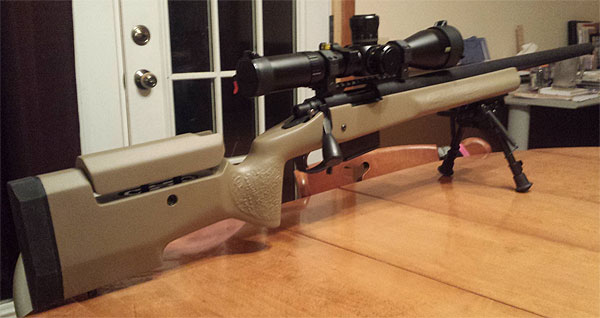




 Bullets, Trickler, and Priming Tool on Top


