Finnish gun manufacturer SAKO Ltd. crafted the impressive S20 series of “hybrid” rifles. These are offered in a Hunter model and a Precision model. Both feature an internal aluminum chassis, adjustable trigger, and integral Picatinny rail on top. Users can change fore-ends and rear sections to suit different disciplines. Use the rifle for a PRS match one weekend and hunt with it the next.
SAKO states: “The user will be able to switch between the stocks and fore-ends quickly and easily and can change the rifle from a tactical to a hunting rifle or vice versa in a matter of minutes with no need to re-zero optics after assembly. The stocks can be taken down easily by loosening up two screws between the rear stock and fore-end.” Both 20″ and 24″ barrel versions have been offered, with a wide variety of chamberings/calibers: .243 Win, 6.5 Creedmoor, 6.5 PRC, .270 Win, 7mm Rem Mag, .308 Win, .30-06 Springfield, .300 Win Mag.
The SAKO S20’s stainless steel action features a 3-lug, push-feed bolt with plunger ejection. The Cerakoted receiver of the S20 features a machined Picatinny rail for easy scope mounting. The trigger of the S20 is adjustable for pull weight and for position within the trigger guard (± 7mm) to ensure good length of pull for the shooter. The muzzle of the rifle is 5/8×24 threaded, allowing for the addition of muzzle devices such as suppressors or brakes (some models come with factory brakes installed).
The Picatinny rail is machined directly on the receiver. The S20 action features a 3-lug bolt with 60° bolt throw. SAKO says the “high locking-lug surface area increases both safety and performance.” The full length of the action mates with a matching V-bed in the aluminum chassis. S20 factory accessories include monopod, muzzle brake, barricade stop and a thumb rest add-on.
SAKO sells the S20 in a variety of configurations. You can buy a single stock system or with both stocks. The Hunter model is offered with a variety of camouflage finishes. The SAKO website lists six different camo options for the S20 Hunter model: First Lite Fusion, Roughtech Green, Roughtech Desert, Hunter Camo, Polyfade Gray, and Polyfade Gray/Green.
PHOTO: SAKO Hunter Model S20s are available with Camouflage stocks in multiple colors and patterns.
The SAKO S20 Precision model has a more vertical grip, wider fore-end (with rail mount), and a flat section in the buttstock that enhances bag riding. This can be used for tactical-style competition as well as varminting and hunting. M-Lok system allows mounting of bipods and other accessories.
SAKO S20 Review in GunsAmerica Digest
A few years ago GunsAmerica Digest published a very thorough SAKO S20 Hybrid field test and review. That article explained how to swap stocks and fore-ends and how to adjust the trigger. The reviewer, Jeff Cramblit, noted the smooth function of the action and gave high praise to the modular stock system:
“Sako was right all along, the S20 is a ‘Hybrid’ rifle. My favorite configuration after all the testing … is the Hunter buttstock and the Precision forearm. This gives me the ability to use all my rail mounted accessories and I like how the thumbhole stock feels even better than the Precision grip. It [was] 11 pounds 5.5 ounces when outfitted with the Leupold Mark 5HD 3.6-18x and the Hatch bipod[.]
The Sako S20 is an impressive rifle. It carries and balances well, shoots fantastic, has a great trigger, smooth action, reliable magazines, and the fact that you can have it your way is an added bonus.”
SAKO S20 Proves Very Effective for Hunting
The SAKO S20 is definitely a good hunting rifle. SAKO has offered the S20 with many popular hunting chamberings including: .243 Win, 6.5 CM, 6.5 PRC, .270 Win, 7mm Rem Magnum, .308 Win, .30-06 Springfield, .300 Win Magnum. The photo above was taken by a hunter in Europe who purchased the S20. He used it successfully to nail a wild hog.
SAKO S20 Specifications
Calibers/Chamberings: .243 Win, 6.5 CM, 6.5 PRC, .270 Win, 7mm Rem Magnum, .308 Win, .30-06 Springfield, .300 Win Magnum. Receiver: Grey Cerakoted Stainless Steel with integral scope bases Barrel: 20″ or 24″, Grey Cerakote, Cold Hammer-Forged (some models fluted); muzzle 5/8×24 threaded Trigger: Adjustable 2 to 4 pounds Stock: Chassis mounted Hunter or Precision model, adjustable cheek piece, adjustable length of pull Magazine Capacity: 5- or 10-rounds for standard cartridges, 3- or 7-rounds for magnum cartridges
Take-Down Stock with Modular Front and Rear Sections
The takedown stock of the SAKO S20 allows for great modularity, so that S20 rifles can be configured according to owner preferences with different rear stocks and fore-ends. The S20’s aluminum chassis is covered by a strong but comfortable outer shell material that SAKO calls H.I.R. – High Impact Resistant. The same H.I.R. material is used on car dashboards. The outer shell is currently offered in two styles — a thumbhole hunter and a more tactical style with straight toe and conventional grip.
Full Adjustability — Even Trigger Position
Adjustable ergonomics are a big part of the S20 design. The multi-adjustable trigger (available in both single-stage and two-stage variants) can be moved backwards or forwards to better fit different hand sizes. An adjustable cheek piece and LOP spacers help provide a proper fit.
M-Lok System Allows Easy Mounting of Accessories
The new SAKO S20 can accept a wide range of accessories, attached via aluminum M-LOK placements. SAKO-made accessories include Rear Mono-Pod, Barricade Stop, and Thumbrest. And yes SAKO threads the muzzles 5/8×24 for use with brakes and suppressors. This video shows how accessories mount:
Field Sports Unboxing Video of SAKO S20 with Hunter Stock
This S20 “first look” video was created by the UK Fieldsports channel. The reviewer was impressed with the S20’s interchangeable stock system: “The modularity allows the rifle to be configured to the shooter’s preferences with different rear stocks and fore-ends. At launch, SAKO introduced both the tactical precision stock and the ergonomic hunting stock, the latter being an improved version of a traditional thumbhole stock more like a pistol grip. Switching between rear stocks is fast and easy, virtually changing the rifle from a target rifle to a hunting rifle, or vice versa, with the correct grip, in a matter of minutes.”
The Fieldsports review added: “Overall, the adjustable ergonomics are a big part of the S20 design. The multi-adjustable trigger can be moved backwards or forwards to better fit different hand sizes and to achieve the optimal trigger position, and its weight and length of pull can be adjusted. The quick-adjustable cheek piece and spacer adjustable length of pull help to achieve the best possible shooting posture. Combined with a wide selection of M-LOK and QD compatible accessory options, S20 adapts to all body sizes and shooting situations.”
Field Test of SAKO S20 — Sub-MOA Accuracy with .300 Win Mag
In this test, using factory ammunition, the shooter achieved sub-MOA accuracy with a SAKO S20 Precision chambered in .300 Win Mag. The very first three shots out of the gun went into about 3/4″ with two shots touching (SEE 04:25 – 4:50 time-marks). The tester offered this rifle description: “Boasting a cold hammer-forged, fluted stainless steel barrel with a recessed crown and a durable Cerakote® finish, this precision rifle ensures impeccable accuracy in virtually any environment. The sculpted stock features an adjustable cheek pad and recoil pad for a customizable fit[.] An M-Lok monopod is easily fitted for added stability in the rear, while the adjustable trigger ensures a consistent, user-specific pull[.] The receiver is mounted to a full-length bedding for improved strength and durability. Plus, the oversized bolt handle ensures intuitive, snag-free manipulation, while a low throw profile easily clears your scope.”
Hunting season is starting soon in most states. For many, Fall hunting season involves liberating a rifle that sits in a safe most of the year, grabbing a box of cartridges, and heading to the wilds. But this “once a year thing” carries with it potential risks.
It is all to easy to grab some rounds that may look right, but which are, in fact, a slightly different chambering. Likewise it is possible some hunting rounds got put in the wrong box after last year’s hunting trip. Be very careful when you get ready for a hunting trip — check the headstamp, cartridge dimensions, and bullet diameter of all your rounds. If you make an ammo selection mistake, the consequences can be disasterous, as this story reveals.
The .223 WSSM and 6mmBR Disaster Report by Dr. Jim Clary
Under most circumstances, shooters don’t have to worry about chambering the wrong cartridge into the wrong rifle. After all, the cartridges are well marked and we all know which rifle we are shooting on any given day. In many cases, incorrect cartridges cannot be chambered — larger cases will not fit in smaller chambers, for example. No problem! That being said, I can tell you that even an experienced, careful and normally safe shooter can make a mistake.
The following is an account of just such a mistake that could have resulted in death or dismemberment. Fortunately, the shooter was not hurt, but the rifle was completely destroyed.
Last year, a friend purchased a Savage Precision right bolt, left port, single shot bolt action in 6mmBR Norma. It was an incredible prairie dog gun and he spent the summer burning powder and busting dogs. In October, he purchased a stainless steel Browning A-Bolt Varmint in .223 WSSM. The weather in the upper Midwest turned sour by the time he got the brass tuned up and he only got to fire it a few times before he was “socked in” for the winter. Thus, he spent his evenings loading ammo for the spring thaw.
During a break in the weather, he grabbed both rifles and a couple of bags of .223 WSSM and 6mmBR cartridges and headed to the range to check out his new loads. In case you are not familiar, the 6mmBR is smaller in diameter and a mite shorter than the .223 WSSM. Because of this, it will chamber in a .223 WSSM, but the .243 caliber (6mm) bullet is too big for the .22 caliber bore. That is what happened to my friend.
The rest is history — when he squeezed the trigger, all hell broke loose. The entire bottom of the rifle blew out, including the magazine assembly. The explosion actually cut the stock into two pieces. However, the bolt held and amazing as it may seem, the .243 bullet was “swaged” right out of the .223 barrel.
6mmBR (left) and .223 WSSM (right) cartridges above the remains of Browning A-Bolt rifle.
One Small Mistake Is All It Takes
Now, realize that my friend has been shooting all manner of firearms, safely, for over half a century. He is meticulous, thorough and conscientious in his approach to reloading and shooting. However, he made one mistake. He put some lose 6BR cartridges in a baggie as he packed up from a prairie dog hunt last summer, without noticing that the baggie was marked .223 WSSM in black marker. Then, when the break in his winter weather came, he grabbed the bag, believing it to be the WSSM cartridges and didn’t check the head stamp.
Couldn’t happen to you? How many times have we emptied our pockets of cartridges and dropped them into a plastic container on the shooting bench? How many times have we set down to a marathon reloading session, loading several calibers in a row? How many times have we put the wrong bullets, cases or primers into the incorrect container? My point is that even the safest of us can make a mistake. So, look at the picture above and take a bit more time when you reload your ammunition at home or chamber a round in the field. It might save your life.
Garmin Acquires Applied Ballistics LLC
There was big news this week in the shooting industry. Garmin Ltd. has acquired Applied Ballistics LLC, the company founded and run by Bryan Litz, a top software engineer, ballistics guru, and world-class rifle shooter. Applied Ballistics has developed some of the most sophisticated and accurate ballistics software. It can run on your computers and tablets, and Applied Ballistics software has also been integrated into mobile devices, rangefinders, and Kestrel Weather Meter wind reading units.
To mark this important development for Applied Ballistics, today we feature eight notable videos. These include NSSF “Elements of Long Range Shooting” videos hosted by Bryan Litz of Applied Ballistics. In that multi-part series, Bryan covers a variety of topics of interest to precision shooters. Watch other informative Long Range Shooting and Ballistics videos with Bryan Litz on the NSSF YouTube Channel.
Understanding Muzzle Velocity
In this 55-minute video Bryan Litz explains how to measure muzzle velocity with various chronograph types and then explains some methods for optimizing your ES/SD. Bryan explains: “Muzzle velocity is an important variable for long range shooters. This video covers some key concepts for beginners and also goes into some advanced topics that are not normally encountered to keep it interesting for experienced shooters as well.”
How to Employ AB Quantum Software
This video is a very useful guide on getting started with AB Quantum™. Bryan Litz demonstrates the essential setup process: 1) quickly building an accurate profile; 2) establishing your zero, and 3) verifying the data at 100 yards. The proof is on the target. After creating a new ballistics profile, Bryan uses the verified profile to shoot a successful group at 1000 yards.
Standard Deviation INFO | Wind Speed and Direction
Powder Storage — Temperature and Humidity
In this video, Bryan Litz offers very helpful advice on how to store powder properly to ensure that you do not experience unpredictable velocities and higher-than-normal ES/SD. You want to keep your powder in a location which avoid high spikes in temperature and humidity. In addition powder bottles should not be stored in a thick-walled gun safe.
Bullet Ballistic Coefficients
A bullet’s ballistic coefficient (BC) basically expresses how well the bullet flies through the air. Higher BC bullets have less aerodynamic drag than lower BC projectiles. You will see BCs listed as either G1 and G7 numbers. These correspond to different bullet shape models. Generally speaking, the G7 model works better for the long, boat-tail bullets used for long-range shooting. Notably, a bullet’s drag is NOT constant in flight. The true BC can vary over the course of the trajectory as the bullet velocity degrades. In other words, “BC is dynamic”. That said, you can make very accurate drop charts using the BCs provided by major bullet-makers, as plugged into solvers. However, long-range competitors may want to record “real world” drop numbers at various distances. For example, we’ve seen trajectories be higher than predicted at 500 yards, yet lower than predicted at 1000.
Big Boomers — Large-Caliber Rifles for Long Range
Bryan Litz defines “Large Caliber” as .338 caliber and bigger. These rifles can shoot heavy bullets with high BCs. That’s great for ELR shooting. However there are trade-offs. It can be hard to maintain good fundamentals of marksmanship (trigger control, sight alignment) when you’re fighting heavy recoil and burning 100+ grains of powder. Accordingly, Bryan recommend a muzzle brake with any cartridge .338 or above. Also, when considering lathe-turned solid bullets, remember that these typically have less sectional density compared to lead-cored bullets with similar profiles. This affects ballistics as well as recoil energy.
BONUS: Bryan Litz Interview with Erik Cortina
Bryan Litz is arguably the leading ballistics expert on planet earth. A talented shooter who has won major F-Class, ELR, and Palma matches, Bryan is a high-IQ scientist who has developed the ballistics software many of us now use in Kestrels and other devices to calculate scope clicks with extreme precision. In this interview, Bryan explains basic ballistics principles and also corrects some popular misconceptions. This is a great interview that has received much praise from viewers, one of whom has noted: “Bryan is a walking science lab. He puts out amazing data-based info[.]” With 107,000 views, this is Erik Cortina’s second-most popular video ever.
TEN Shots in 0.303″ (0.289 MOA) at 100 Yards
Look at that target showing TEN shots at 100 yards, with eight (8) shots in the main cluster at the top. The ten-shot group measures .303″ (0.289 MOA), as calculated with OnTarget Software. Not bad for a handgun — a very nice bolt-action XP-100 pistol! What do you think, can your best-shooting rifle match the 10-shot accuracy of this XP-100 pistol?
Report by Boyd Allen
This story goes back a few seasons… this remarkable XP-100 pistol belongs to Dan Lutke, a Bay Area benchrest shooter who publishes the results for the Visalia matches to the competitors and the NBRSA. He has been an enthusiastic competitor for an number of years, at various ranges, notably Visalia and Sacramento. The action is a Remington XP-100, to which a Kelbly 2 oz. trigger has been fitted. On top is an old Japanese-made Tasco 36X scope (these were actually pretty darn good). The Hart barrel (a cast-off from Dan’s Unlimited rail gun) was shortened and re-chambered for the 6x45mm, a wildcat made by necking-up the .223 Remington parent case. The custom stock/chassis was CNC-machined by Joe Updike from 6061 Billet Aluminum to fit the XP-100 action and mount a target-style AR grip with bottom hand rest. The gun was bedded and assembled by Mel Iwatsubu. In his XP-100 pistol, Dan shoots 65gr custom boat-tails with Benchmark powder.
This diagram shows the most common 6x45mm wildcat, which is a necked-up version of the .223 Remington parent cartridge. NOTE: The dimensions for Dan Lutke’s benchrest version of this cartridge may be slightly different.
ACAD drawing by Peter Gnanapragasam CC by SA 3.0, via Wikimedia Commons. Title Added.
Story tip from Boyd Allen. We welcome reader submissions.
Splatterburst 1″ circles, 62 per sheet, 10-pk $9.99. These can be pasted on other paper backers.
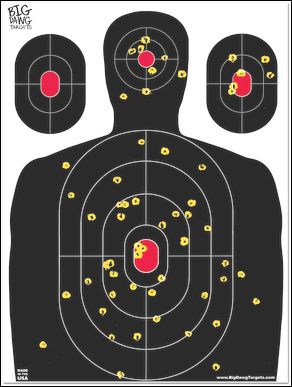
We’ve all seen conventional splatter targets with a single large black bullseye. When a shot hits the target, a halo (usually neon yellow) appears around the bullet hole. This makes it easier to see your shot placements indoors, or at long range outdoors. Today we feature a variety of other targets that also offer the cool halo/splatter effect. We’ve found grids, multiple bull targets, sheets with 62 one-inch circle pasters, handgun training targets, and even white background splatter targets (that produce black halos). Try out some of these targets for fun (kids love plinking with splatter targets).
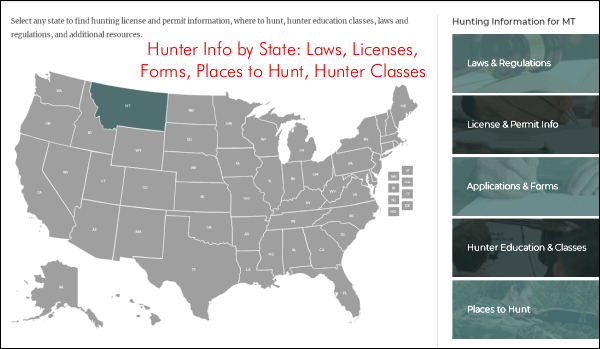
Click Map to launch interactive webpage with info for all 50 states.
Going hunting soon? Need to find out about hunting licenses, deer tags, local regulations, and the best hunting areas? Then visit WheretoHunt.org. This website has an interactive map of the country. Simply click on a state to find the info you need.
For all 50 states, the NSSF provides information about hunting licenses and permits, where to hunt, hunter education classes, laws and regulations and more. For each state you’ll also find a link for required applications and license forms. Have a safe and productive hunt this year.
Many short-range Benchresters have thought about converting their 6 PPC rig to shoot a 30BR for score matches, or a Dasher for mid-range (or even 1000-yard) games. That way you can have a rifle that does double (or triple) duty, giving you the most bang for your buck. Though an action with a PPC bolt won’t normally work with 30BR/6BR/Dasher cases with their larger .308-class rim (0.4728″ diameter), there is a pretty easy solution that allows you to cycle these bigger cartridges with a 6PPC-style bolt (designed to fit .220 Russian rims).
“Rebating case rims … lets you shoot a 30BR in score matches using your PPC action. All you need is a new barrel. This saves buying another bolt, receiver, or rifle.” — Butch Lambert
Butch Lambert of ShadeTree Engineering provided this tip. Butch notes that many 6 PPC benchrest group shooters also enjoy shooting in score matches. But to be really competitive in the BR for score game, that means shooting a 30BR, which has a wider, .308-class rim (0.4728″ diameter). Likewise, if you want to compete in 600-yard registered BR events or in varmint matches, you probably want to run a bigger case, such as the 6BR, 6mm Dasher, or 6-6.5×47. Those cartridges also have the larger 0.4728″ rims.
Rebate Your 30 BR Rims
To convert a PPC-boltface action to shoot bigger cases you can spend a ton of money to buy a new bolt. That can cost hundreds of dollars. The simpler solution is to turn down the diameter of the larger cases on a lathe. Butch explains: “We’ve seen plenty of interest in rebating case rims. This lets you shoot a 30BR in score matches using your PPC action. All you need is a new barrel. This saves buying another bolt, receiver, or rifle if you have a PPC boltface. Anyone who has access to a lathe can do this job pretty easily. Yesterday I turned 150 case in about an hour.”
At right is the lathe form tool Butch uses to rebate the case rims.
Do you often carry a concealed handgun? Then you can benefit from Beretta’s FREE 15-page e-book, Ten Essential Tips for CCW Holders. This eBook, in handy PDF format, helps gun owners select an appropriate handgun (and holster), understand legal obligations and responsibilities, and train effectively with the firearm. This short PDF eBook offers many useful tips to consider, in particular for gun owners who are contemplating the pros and cons of everyday carry for themselves.
As the Beretta CCW booklet says, “Carrying a concealed handgun requires a certain amount of confidence. You need to be confident in your knowledge of laws and regulations. You have to have confidence in your accuracy, and you need to trust that you can carry a gun effectively, securely and comfortably. If a gun is a burden for you to carry, you probably won’t.”
Surprising Facts About Actual Defensive Handgun Use
You may be surprised to learn when and how handguns are actually used for self-defense. Most defensive uses are at very short range and the incident only lasts a matter of seconds. You need to be prepared, and train to be proficient drawing and aiming your weapon. And remember, shooting is a last resort, when a safe retreat is not available.
55% of gunfights take place in 0-5 feet.
20% of gunfights take place in 5-10 feet.
20% of gunfights take place in 10-21 feet.
95% of gunfights take place in 0-21 feet. (Source: FBI)
The average man can cover 21 feet of ground in 1.5 seconds.
The average gunfight is over in 3-5 seconds.
3 to 4 shots are usually fired.
Most gunfights take place in low-light conditions.
On average, one shot in four strikes someone.
Here are two (2) sample pages from Beretta’s CCW eBook.
For many Americans, real incomes have stayed flat in recent years, while inflation has increased the cost of living very significantly in since 2020. Accordingly, it’s important to save money whenever possible. Prices are going up, but wages aren’t following (for most of us). Here are six ways shooters can save money on gear purchases and other shooting-related expenses.
1. Watch for Our Deals of the Week. Every Monday, in our Daily Bulletin, AccurateShooter.com offers some of the best deals to be found. We search the web to find great deals on ammo, reloading components, optics, tools, firearms, gun safes, electronics and more. It’s not unusual to find savings of 20-35% through our Deals of the Week. And many of our vendors are now offering special deals just for AccurateShooter.com readers.
2. Check Out the Forum Classifieds. There are great deals to be found every day in the AccurateShooter Shooters’ Forum. The latest deals are displayed in the right column of every Forum page. To see all the listings, browse through the Forum MarketPlace section which has four main categories:
Guns, Actions, Stocks, & Barrels
Tools, Dies, Rests, Reloading Components & Misc
Scopes, Optics, Sights, Rings, Bases Etc.
Commercial Sales by Paid Sponsors
3. Share a Ride to Matches. Fuel prices are on the rise — Regular-grade gasoline is over $6.05 per gallon in California now and around $4.33/gallon nationwide. With many shooters living 30-100 miles from the nearest range, fuel remains a big part of a shooter’s hobby budget. We’d say 90% of shooters drive solo to matches, often in large, gas-guzzling trucks. If you drive 200 miles round-trip to attend a match in a 20-mpg vehicle, you’ll burn over $43.00 worth of gasoline on your trip. That adds up. By simply sharing the ride with one fellow shooter you cut your fuel expenditures in half. And, if you alternate vehicles with a buddy from one match to the next, you save on vehicle wear and tear. At $0.84/mile (average overall operating costs for an SUV) consider the savings.*
4. Use Discount Codes to Save. It’s always smart to check for discount codes before you buy. In the Daily Bulletin, we feature “Deals of the Week” every Monday morning, and we provide discount Coupon Codes when available. These can reduce the price substantially or lower shipping costs. Search codes for Brownells, Creedmoor Sports, EuroOptic, Graf’s, Midsouth, Powder Valley, Sportsman’s Warehouse, KYGUNCO, MidwayUSA, and Precision Reloading. Check your email also — some discount codes are only announced in email newsletters. If you can’t find a Coupon Code for your preferred vendor, visit Gun.deals and/or RetailMeNot.com. Both those sites list current coupon codes, and RetailMeNot.com covers thousands of vendors.
5. Shop for “Demo” Optics. Modern high-quality optics can easily cost $1500.00 or more, often exceeding the value of the rifle on which they are mounted. However, you can often save 20-30% by purchasing demo optics. These are normally display units used at trade shows. They may have slight ringmarks, but otherwise they are “as new”, having never been carried in the field or used on a rifle that has fired live ammo. When purchasing demo scopes, you should always ask about the warranty before consummating the sale. However, most demo scopes from name-brand manufacturers come with full factory warranties. EuroOptic.com and SWFA.com are two respected vendors that offer a good selection of demo optics.
6. Train with Rimfire Rifles. Good match-grade centerfire, hand-loaded ammo, counting premium bullets, powder, primers, and brass (figuring 10X loads), can now exceed $1.60 per round. And if your $600 (as chambered and fitted) competition barrel is toast after 1500 rounds, add $0.40 for barrel deprecation per shot. So you’re effectively spending two bucks a round total! By contrast, you can get quite good .22 LR target ammo for under $0.18 per round. Good rimfire barrels last a long, long time, so you don’t have to be concerned about wearing out your barrel quickly. A quality rimfire barrel can retain its accuracy for 7,000 rounds or more. If you run the ballistics, a .22 LR round at 100 yards can emulate the wind drift experienced by a centerfire cartridge at long range. This allows for effective cross-training with much less expensive ammo.
*The average cost to operate a medium SUV in the US is approximately $0.84 per mile, as reported by AAA. This includes fuel, depreciation, repairs, parts insurance, and registration.
Starline Brass offers a series of videos with helpful reloading tips. Focused primarily on pistol cartridges, these short videos can help anyone get started with metallic cartridge reloading. If you load pistol rounds on a progressive, this video series is particularly helpful. The on-camera host is Hunter Pilant, son of Carroll Pilant of Sierra Bullets.
Preventing Double Charges
Tip: Use a bulky powder that fills your case more than half way with a correct charge. This will overfill the case if it is double-charged, making it very difficult to seat a bullet.
Tumble New Brass Before Loading the First Time
Tip: Tumble new pistol cartridge brass in used media for 30 minutes before loading for the first time. This will add enough graphite (carbon residue) to smooth case entry into dies. You can also lube the case mouths with graphite, or use spray lube.
Powder Through Expander — How to Eliminate Hang-ups
Tip: When loading pistol brass with a progressive press, sometime the powder-through expander is hard to remove, especially with short cases. There are two fixes — first, try deburring the inside of the case mouth on your cases. Second, the radius of the powder through expander plug can be modified to smooth entry and exit (see photo). Starline will do this modification for free.


 Hunting season is starting soon in most states. For many, Fall hunting season involves liberating a rifle that sits in a safe most of the year, grabbing a box of cartridges, and heading to the wilds. But this “once a year thing” carries with it potential risks.








 2. Check Out the Forum Classifieds. There are great deals to be found every day in the AccurateShooter
  3. Share a Ride to Matches. Fuel prices are on the rise — Regular-grade gasoline is over $6.05 per gallon in California now and around $4.33/gallon nationwide. With many shooters living 30-100 miles from the nearest range, fuel remains a big part of a shooter’s hobby budget. We’d say 90% of shooters drive solo to matches, often in large, gas-guzzling trucks. If you drive 200 miles round-trip to attend a match in a 20-mpg vehicle, you’ll burn over $43.00 worth of gasoline on your trip. That adds up. By simply sharing the ride with one fellow shooter you cut your fuel expenditures in half. And, if you alternate vehicles with a buddy from one match to the next, you save on vehicle wear and tear. At $0.84/mile (average overall operating costs for an SUV) consider the savings.*
 4. Use Discount Codes to Save. It’s always smart to check for discount codes before you buy. In the Daily Bulletin, we feature “Deals of the Week” every Monday morning, and we provide discount Coupon Codes when available. These can reduce the price substantially or lower shipping costs. Search codes for Brownells, Creedmoor Sports, EuroOptic, Graf’s, Midsouth, Powder Valley, Sportsman’s Warehouse, KYGUNCO, MidwayUSA, and Precision Reloading. Check your email also — some discount codes are only announced in email newsletters. If you can’t find a Coupon Code for your preferred vendor, visit
  5. Shop for “Demo” Optics. Modern high-quality optics can easily cost $1500.00 or more, often exceeding the value of the rifle on which they are mounted. However, you can often save 20-30% by purchasing demo optics. These are normally display units used at trade shows. They may have slight ringmarks, but otherwise they are “as new”, having never been carried in the field or used on a rifle that has fired live ammo. When purchasing demo scopes, you should always ask about the warranty before consummating the sale. However, most demo scopes from name-brand manufacturers come with full factory warranties.
  6. Train with Rimfire Rifles. Good match-grade centerfire, hand-loaded ammo, counting premium bullets, powder, primers, and brass (figuring 10X loads), can now exceed $1.60 per round. And if your $600 (as chambered and fitted) competition barrel is toast after 1500 rounds, add $0.40 for barrel deprecation per shot. So you’re effectively spending two bucks a round total! By contrast, you can get quite good .22 LR target ammo for under