A carpet is used up front for smoother tracking with the Joy-Pod’s flat, ski-style feet. The arms of the Joy-Pod were painted to match the stock. The rear bag features low-drag material on the ears.
F-Class competition grows in popularity every year. Unlike F-Open, the F-TR (Target Rifle) class is limited to the .223 Remington (5.56×45) or .308 Winchester (7.62×51) chamberings. F-TR rifles also use bipods rather than a front rest. But these are no ordinary Harris-style bipods. Modern F-TR bipods have a wide footprint for added stability and many F-TR shooters favor SEB Co-Axial joystick bipods (aka “Joy-Pods”). Today we are featuring an F-TR rig that showcases the types of components, and accessories used by top F-TR competitors — including a coaxial bipod and Labradar Chronograph. If you’re considering getting started in the F-TR game, take a close look at this modern F-TR build from Forum member DM.Oakes.
Modern F-TR Rig with Borden Action, Krieger Barrel, and SEB Joy-Pod
This handsome .308 Win F-TR rig features a smooth-running Borden BRM action, 30-inch 1:10″-twist Krieger barrel, and an X-Ring Laminated Wood stock. Up front is a coaxial “Joy-Pod” joystick bipod. This is a state-of-the art, wide footprint bipod used by many competitors at the Worlds in Canada. The long joystick allows the “driver” to quickly adjust both elevation and windage in a smooth, continuous motion. The Joy-Pod can be adjusted so it will hold setting during the shot — you don’t have to “hard-hold” the joystick. Many shooters let the joystick slide through their fingers as the rifle moves back on recoil. With a little practice (and careful placement of the rear sand-bag), the tracking is excellent and you can slide the gun right back to point of aim after each shot.
This F-TR rifle is shown during load testing with a LabRadar chronograph.
» Full LabRadar Field Test/Review by Ray Gross
If you are considering purchasing a LabRadar Chronograph system, we strongly suggest you read the very thorough and informative LabRadar Review by Ray Gross, past Captain of the USA F-TR team. Ray notes: “It takes me about 3 minutes to set up [my LabRadar] at the range. Because there are no downrange screens, I do not have to hold up other shooters on the range like I would when setting up a traditional chronograph. The convenience alone will mean that I will use it more often than my old chronograph. Every time I take it out, I enjoy it a little bit more.”
M1 Garand Springfield Armory July 1941 production. Facebook photo by Shinnosuke Tanaka.
Want an authentic surplus M1 Garand? You can get these classic battle rifles from the Civilian Marksmaship Program (CMP) through direct sales as well as online auctions. If you are looking to obtain an authentic, safe-to-shoot M1 Garand, the CMP is your best bet. Each M1 Garand rifle sold by the CMP is an genuine U.S. Government rifle that has been inspected, head-spaced, repaired if necessary, and test fired for function. Each rifle is shipped with safety manual, one 8-round clip, and chamber safety flag.
This CMP Video Explains the Process for Ordering an M1 Garand from the CMP:
M1 Garand Manufacturer Codes: SA (Springfield Armory), HRA (Harrington & Richardson Arms), IHC (International Harvester Co.), WRA (Winchester Repeating Arms)
The federal law that established the new CMP authorizes the Corporation to sell surplus .30 and .22 caliber military rifles, parts and ammunition to qualified U.S. citizens “for marksmanship”. Accordingly, the CMP sells government-surplus M1 Garands, .22 caliber target rifles, and small quantities of other rifles to qualified purchasers. CMP operations, warehousing, inspection, repair, test firing, sales order processing and distribution activities are headquartered in Anniston, Alabama.
M1 Garands at CMP Retail Store in Anniston, Alabama.
How to Order an M1 Garand from the CMP
To purchase an M1 Garand through the CMP, you must be an adult U.S. Citizen, who is a member of an affiliated organization, and who has participated in a “Marksmanship Activity”*. This basically means you need to join a a gun club and participate in a clinic or match. Proof of club membership and citizenship is mandatory for all ages. However, the marksmanship requirement is waived for those over 60 years. Garands must be ordered by mail or through official CMP Auctions. Orders are filled on a first-come, first-serve basis. Rifles of all grades are packed for shipment purely by “luck of the draw”. Most orders ship within 2-4 weeks. If price has changed after an order has been received, customers will be notified before new prices are charged. CLICK HERE for ordering information.
ATF Rule was overturned by U.S. District Court, but DOJ appealed that ruling.
The Second Amendment Foundation (SAF) and its partners are challenging the “Final Rule” issued by the Bureau of Alcohol, Tobacco, Firearms and Explosives (BATFE) redefining frames and receivers as firearms. A U.S. District Judge in Texas initially ruled against the BATFE, but the Bureau appealed that ruling. SAF has filed an appellate brief in the case, known as VanDerStok v. Garland. Joining SAF in the legal challenge are Defense Distributed, and JSD Supply.
SAF’s brief explains how ATF redefined the term “firearm” without any Congressional action. Last year, the agency announced a Rule expanding the definition of firearm to include unfinished firearm components and kits used in the process of manufacturing a firearm. SAF and its partners are asserting ATF violated the Administrative Procedures Act (APA). A federal District Court judge agreed and concluded that ATF had acted in excess of its statutory authority, and granted summary judgment.
SAF founder and Executive Vice President Alan M. Gottlieb promised the organization will pursue this case vigorously as it winds through the court system: “This case challenges the authority of the ATF to change rules and definitions of firearms without Congressional authority,” Gottlieb said. “We simply cannot allow any federal agency to make up its own rules as it goes along, without Congressional approval.”
Judge O’Connor’s ruling in VanDerStok v. Garland vacated the controversial ATF Final Rule that effectively changed the definition of a firearm under Federal law. However the BATFE has challenged that ruling.
SAF Executive Director Adam Kraut said the foundation expects to prevail on the portions of the Final Rule that we challenged: “The district court entered a judgment deeming the Rule illegal and vacating it,” Kraut said, “and we are asking the Fifth Circuit to affirm the district court’s decision to issue relief based on the APA. By promulgating the Rule, ATF has appropriated authority reserved for Congress. Such a usurpation of power is antithetical to our system of government and must be stopped.”
Bushnell Match Pro ED 15×56 Binocular with MRAD Reticle
Bushnell is now shipping its new Match Pro ED 15×56 binoculars, designed for precision and competition rifle shooters. These 15-power, high-magnification binoculars offer ED Prime glass and a proprietary, rotating Shot-Call MRAD reticle. This reticle allows fast shot calls and corrections — something important for PRS/NRL competition. Bushnell says these new 15×56 binoculars, when mounted securely, have “enough power to effectively replace your spotting scope with a wide field-of-view that puts less stress on your eyes and allows you to more easily observe projectile flight.”
Early prototype versions of the Match Pro ED 15×56 binocular have already proved their worth in PRS/NRL competition. Bushnell pro shooter Robert Brantley has used the Match Pro ED binocular in recent PRS matches where he’s won four consecutive Tactical Division titles. In this video, Brantley explains the key features of Bushnell’s 15X, reticle-equipped Match Pro ED binoculars:
“The new Match Pro binos offer the perfect setup for spotting and calling shots on the range,” said Brantley. “They offer … the ability to fine tune corrections with the Shot-Call reticle. It truly does offer the best of everything and I’m not ever going back to shooting without them.”
Two important features of the Match Pro ED binoculars are the Shot-Call reticle and BridgeSet Stabilizer. The offset MRAD reticle is designed for target sizing, ranging and follow-up shot correction. The reticle has a dedicated focus adjustment and can be rotated for leveling after IPD (interpupillary distance) adjustment. Users can lock in their preferred IPD with the integrated bridge-lock, which ensures the binoculars are set for quick use.
This unit has some cool features. The BridgeSet IPD stabilizer provides a barrel angle stop that keeps your inter-pupillary distance constant in the field. A first of its kind, the BridgeSet is like a zero stop for your binoculars. These binoculars also have dual adjustable diopters to keep both barrels perfectly focused. This is important because many folks have slightly different vision in their left vs. their right eyes.
Bushnell’s 15-power Match Pro ED binoculars boast fully multi-coated ED (Extra-Low Dispersion) Prime objective lenses and BaK4 Abbe-Koenig roof prisms with PC3 dielectric phase coatings to ensure 92% light transmission. These Match Pro ED binoculars also feature Bushnell’s EXO-Barrier for high resolution regardless of weather conditions. A rugged magnesium housing protects the internal mechanisms while IPX5 waterproof sealing shields the optics from moisture. Another very good feature is that you can mount a tripod adapter to either the front or rear bridges based on your preference. That’s handy. These binoculars weigh a hefty 56 ounces (3.5 pounds), so you’ll definitely want to mount them on a tripod.
Now in stock, Match Pro ED 15×56 binoculars are currently available for $699.99 at EuroOptic.com and other leading vendors. The Match Pro ED 15×56 binocular is backed by Bushnell’s 20-year Lifetime Ironclad Warranty. CLICK HERE to see full product profile on Bushnell.com.
L.E. Wilson Case Gage Depth Micrometer Tool Hands-On Tool Review by F-Class John
Are you looking for a better way to measure shoulder bump when sizing brass? When it comes to measuring your shoulder bump there has traditionally been just one way to do it and that’s with a set of calipers and some type of tool attached to a calipers jaw which contacts the case shoulder. While this method has worked well for decades there’s always been some inherent lack of consistency and repeatability. While a minor issue, the inability to get the exact number in completely dependent on the user’s pressure applied and the angle at which the jaws push on the brass.
Enter the L.E. Wilson Case Gage Depth Micrometer with its simple but effective use of Wilson case gauges to ensure a perfect measure of shoulder bump every time. The unit comes with the micrometer top as well as a check gauge which allows you to easily calibrate the micrometer whenever needed. On top of the micrometer unit, you’ll also need to purchase the appropriate case gauges for each of your cartridge types and then you’re ready to go. No other measuring instruments are needed (yep, no calipers are required).
Using the Wilson Depth Micrometer (perhaps a better name is Shoulder Bump Micrometer) is a straightforward process. Simply take your fired brass and insert it into the case gauge and place the micrometer top onto the primer side of the gauge. While holding the micrometer top firmly against the case gauge in one hand, slowly turn the micrometer until you feel it stop. You can back off and turn it again to verify the stop point and once you have it, look at the measurement on the micrometer. Now insert a sized piece of brass and repeat the procedure. Take note of the new number and subtract it from the fired brass number and you now have an exact amount of shoulder bump. Continue to adjust your sizing die until you have the correct amount of shoulder bump and you’re ready to size all your brass.
Watch Video to See how Shoulder-Bump Measuring Micrometer Tool Works
Guys, in this case a VIDEO is worth more than a thousand words. It may not be obvious from the photos how this system works. In fact, it is fast and easy. Drop brass into cartridge-specific case gauge, then put the Micrometer unit on top, and dial to touch. The video shows how this works.
SUMMARY — Tool is Fast, Precise, Repeatable, and Easy to Use — We Like It
The beauty of this tool is the simplicity with which it works. It uses a very accurate micrometer to simply measure how much further your brass is sitting forward inside the case gauge. After a couple uses, you’ll find that this tool is fast, accurate and incredibly repeatable. That gives you confidence that your brass is being sized properly. Ultimately, I found that using the micrometer top really became a joy as I set up a new set of dies and as I sized my brass, I could easily check the consistency as brass came off my press. If you’re looking to improve your sizing game, give the L.E. Wilson Case Gage Depth Micrometer a try. MSRP is $130.00.
Bang Clang! The 2023 Steel Challenge World Speed Shooting Championship is featured on Shooting USA TV this week. The Shooting USA Steel Challenge episode runs August 23, 2023 on the Outdoor Channel. Show times are: Wednesdays, 9:00 PM Eastern and Pacific, 8:00 PM Central. After those broadcast times, you can watch the show via Vimeo on Demand for $0.99 per episode.
This past April, the fastest speed shooters in the world showcased their skills at the Steel Challenge Championship at the CMP Talladega Marksmanship Complex in Alabama. The Steel Challenge course consists of eight 5-target close-range stages. This discipline has been called “drag racing with guns”. Draw and shoot 5 steel targets with time as your score. The shooter with the lowest overall time wins. This is a very popular event — when registration opened for the 2023 Steel Challenge, more than 700 slots filled in just 12 minutes.
The 2023 Steel Challenge at Talladega was featured this month on the NRA Shooting Sports USA site.
There are multiple pistol and revolver classes, both rimfire and centerfire, iron sights and optics. Increasing in popularity (and speed) are the rimfire rifle and pistol-caliber centerfire rifle classes. There are 13 gun classes in total, the most for any shooting championship. In the centerfire handgun match, the fastest times are posted by competitors using enhanced open guns with compensators and red-dot optics.
Here is a full length Shooting USA Steel Challenge Episode from 2017:
Shooting USA Video covers Course of Fire, Firearms Classes, and Target Layouts (1:20)
Definitely watch the 4-minute video (above) produced by Shooting USA. It explains the classes, shows the stages, and illustrates ALL the different gun classes, pistol AND rifle. You can also see some of the world’s fastest shooters including Jessie Harrison (1:47, 3:44) and Max Michel (3:48). Be amazed by the speed of semi-auto rimfire rifles — five targets hit in under two seconds!
The Steel Challenge was founded in 1981 by Mike Dalton and Mike Fichman, in Southern California. The two Mikes wanted an exciting alternative to paper targets and came up with the all-steel format. The Steel Challenge World Speed Shooting Championships have grown to one of the largest professional pistol competitions in America. In 2022, scores of competitors competed at the Talladega Marksmanship Park for glory and cash prizes. The Steel Challenge is governed by the Steel Challenge Shooting Association (SCSA) that consists of eight standardized stages with three types of steel targets: small circle, big circle, and square. Here is a steel challenge layout in Germany.
Ruger Super GP100 Revolver in 9mm Luger (9x19mm)
Wouldn’t it be cool if you could shoot your 9mm semi-auto pistol ammo in an ultra-accurate revolver? Well you can. Ruger adapted its existing Super Redhawk frame to create the Super GP100 9mm Luger (9x19mm) revolver. As you can see, the Super GP100 9mm features a stubby 8-round PVD-coated cylinder to better fit the 9x19mm round. According to Guns.com the 9mm GP100 “uses a cylinder and extractor cut for moon clips to speed up reloading [and] sports a 6-inch half-lug sleeved and shrouded barrel with an 11-degree target crown[.]”
Watch this GunBlast video review to see how this unique Ruger 9x19mm wheelgun performs. Reviewer Boge Quinn said this a “competition grade gun” with nice fit and finish. Out of the box the Super GP100 9mm had a 9.5-lb double-action pull and a 4.5-lb single action trigger pull. It took a while for the pull to smooth out Quinn noted. Also, he said that if you do NOT use the supplied moon-clips it is awkward to remove the spent cartridges: “You don’t have to use a moon clip, but I don’t know why you wouldn’t… it just works great that way.”
The 9×19mm Parabellum (aka 9mm Luger) cartridge was introduced in 1902 by German weapons manufacturer Deutsche Waffen und Munitionsfabriken (DWM) for the Luger semi-auto pistol. Now 120 years later, Ruger brings us a sturdy, 6″-barrel revolver for this popular cartridge. Ruger adapted its existing Super Redhawk frame for this Super GP100 9mm revolver. In this video, Ruger engineer Mark Gurney explains the features of the Super GP100 9mm revolver:
Super GP100 9x19mm Features
Triple-locking cylinder locked into the frame at front, rear and bottom for more positive alignment and dependable operation.
High-strength stainless steel cylinder is fluted and shortened to reduce overall mass and increase rotational speed. Cylinder has PVD finish for durability and ease of extraction.
Polished and optimized internals, a centering boss on the trigger, and centering shims on hammer deliver a smooth double-action trigger pull with crisp/consistent let-off.
Cylinder and extractor are cut for moon clips to speed reloading during intense competition. Ships with three full moon clips and moon clip tool. The ejector and chamber mouths have a light chamfer to aid loading with moon clips.
Hogue hardwood grip is hand-finished for a smooth, polished feel. Grip frame accommodates a wide variety of custom grips.
Transfer bar mechanism provides security against accidental discharge.
Cold hammer-forged barrel has precise rifling for accuracy and longevity.
Barrel features 11° target crown for competitive-level accuracy.
CMP Announces Western Fall Classic Event for October 2023
If you missed this year’s Civilian Marksmanship Program (CMP) Western Games and Highpower Matches in March 2023, here’s your second chance to attend. The CMP will be returning to the Ben Avery Shooting Facility October 10-15, 2023, for the Western Fall Classic – a condensed version of the Western CMP Games, CMP Pistol & CMP Highpower (HP) Rifle Matches. Despite the shorter schedule, the event will still offer a wide variety of events for rifle and pistol competitors. Adults and juniors of all experience levels are welcome to attend.
The CMP Western Fall Classic in Arizona will feature three days of popular CMP Games rifle competitions including: Garand/Springfield/Vintage & Modern Military Matches, a Carbine Match, a Rimfire Sporter Match, and the Vintage Sniper Match. In addition, handgun shooters can compete in CMP Match Pistol 2700, EIC Service Pistol, EIC Service Revolver, EIC .22 Rimfire Pistol, Military & Police Service Pistol, and As-Issued Pistol matches.
The Highpower Rifle portion of the Western Fall Classic will include a 2-Man Team Match, two days of CMP 800 Aggregate Matches, a CMP Service Rifle EIC Match and a Mid-Range 3×600 event. For educational purposes, a Rifle & Pistol Marksmanship 101 Classes with introductory EIC Matches are also part of the October lineup.
The Civilian Marksmanship Program is a federally chartered 501 (c) (3) non-profit corporation. It is dedicated to firearm safety and marksmanship training and to the promotion of marksmanship competition for citizens of the United States. For more information about the CMP and its programs, log onto www.TheCMP.org.
.17 HMR and .22 WMR Options Enhance Ruger Precision Rimfire for Varmint Work
Many readers may not know this, but the Ruger Precision Rimfire rifle is available in two additional rimfire chamberings: .17 HMR and .22 WMR. While .22 LR ammo is considerably cheaper, .17 HMR and .22 WMR shoot flatter and deliver much more energy. This makes the Ruger rig way more suitable for varminting. In fact we think this .17 HMR transforms the Ruger Precision Rimfire into a very good “carry-around” varmint rifle. We really like the .17 HMR — it’s our favorite rimfire cartridge for small varmints out to 160 yards.
Both cartridge types, .17 HMR and .22 WMR, also offer higher velocities, less wind drift, and flatter trajectory than the .22 LR. This is a benefit when cross-training. You can shoot at more distant targets with considerably less elevation dialed in your scope. And the windage corrections will be less extreme.
Ruger says: “Faster, flatter and with high-performing bullets, .17 HMR and .22 WMR cartridges expand the capabilities of the Ruger Precision Rimfire platform. Like its .22 LR predecessor, these new magnum offerings maintain the same ergonomics, trigger and manual of arms as the larger centerfire Ruger Precision Rifle.”
Here’s an excellent video review of the .17 HMR Ruger Precision Rimfire rifle by YouTuber 22 Plinkster. The reviewer was impressed with the rifle’s accuracy with 17gr ammo.
Both Ruger Precision Rimfire rifles feature 18″ hammer-forged barrels threaded for muzzle devices, including the Ruger® Silent-SR®. The 15″ free-float handguard with Magpul M-LOK slots provides generous scope clearance and easy mounting of M-LOK-compatible rails and accessories.
Like its .22 LR version, the magnum Ruger Precision Rimfire models featured an adjustable bolt throw (that can emulate a centerfire action if desired), along with trigger that adjusts from 2.25 to 5 pounds. The .17 HMR and .22 WMR models ship with a 0 MOA Picatinny rail and one, 15-round BX-15 Magnum magazine or one, 9-round JMX-1 rotary magazine. The BX-15 Magnum is a natural pairing for the new Ruger Precision Rimfire in magnum calibers. It is also compatible with Ruger 77/17®, Ruger 77/22® and Ruger American® Rimfire rifles chambered in .17 HMR and .22 WMR.
Even with high-quality brass from Lapua, Peterson, Norma, Alpha and RWS, occasionally you may find one or two cases per box which have a small flake or obstruction in the flash-hole. This will appear like a thin crescent on one side of the flash hole (see photo). You should inspect ALL new brass before loading to identify any pieces with a partially-obstructed flash hole. It’s a good idea to remove any flake or thin crescent left as an artifact of the flash-hole forming process. Because the flash-hole itself is normally centered and of the correct diameter, it is not necessary to ream the flash-hole to a larger diameter. All you really need to do is remove the small obstruction(s). This can be done quickly with inexpensive tools.
Use a Small Pin Vise to Remove Flash-Hole Obstructions
Folks have asked if there is a tool that can remove obstructions from a Lapua small, BR-sized flash hole without opening the hole size. The Lapua PPC/BR flash hole is spec’d at 1.5mm, which works out to 0.059055″. Most of the PPC/BR flash-hole uniforming tools on the market use a 1/16″ bit which is nominally 0.0625″, but these often run oversize — up to 0.066″.
If you want to just clear out any obstructions in the flash hole, without increasing the flash hole diameter, you can use an inexpensive “pin vise” with an appropriate drill bit. For $0.99 ($0.50 on sale), eHobbyTools.com sells a 1.5mm drill bit, item 79186, that matches the Lapua flash hole exactly. Other vendors offer a #53 pin vise drill bit that measures .0595″ or .060″ (depending or source). An 0.0595″ bit is close enough. You can find pin vises and these small-diameter drill bits at hobby stores.
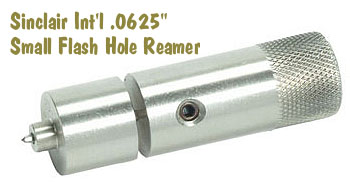
For quite some time, Sinclair Int’l has sold a similar device for small (PPC and BR-size) flash holes. Like the 07-3081 unit for large flash holes, the 073000 Reamer for small flash holes works from the outside, so it can index off the primer pocket. It reams to .0625″, and also costs $29.99. The standard dimension for Lapua 220 Russian and 6mmBR flash holes is 1.5mm or .0590″. This tool will permit standard-size decapping rods with .0625″ tips to work without binding. However, note that both Forster and Redding normally supply .057″ decapping pins with their PPC and BR dies. So, it is NOT necessary to ream your Lapua BR/PPC flashholes, unless you prefer to do so for uniformity. It IS, however, a good idea to check BR/PPC flash holes for burrs before loading the first time.
NOTE: If you purchase either the 073081 or 073000 Sinclair Flash Hole Reamer tools, we recommend you mic the cutter tip before you process a bunch of cases. Sometimes a tip comes through that is oversize. This will ream the flash holes larger than you may intend.


 ATF Rule was overturned by U.S. District Court, but DOJ appealed that ruling.





 .17 HMR and .22 WMR Options Enhance