We know that many of our readers have never personally participated in a short-range (100/200 yard) benchrest match. That’s understandable — moving backers are required in registered 100/200 benchrest (for group) matches, yet only a small percentage of ranges have that equipment. If you’re curious about the “point-blank” benchrest game, but haven’t had the chance to see it first-hand, check out this video created by youtuber “Taofledermaus”. On his YouTube Channel, you’ll find many other interesting shooting videos, including slow-motion target impact clips. This video shows the LV and HV guns, the flags, the gun-handling, the reloading set-ups, and of course, tiny little groups on targets.
Registered 100/200 Benchrest Match
Viewer Comments on the Video:
“There is a lot more to this game than just pulling the trigger. Record targets are 5-shot groups, 5 averaged together for an Aggregate. Most times the winning Agg is under .250″ for 25 shots at 100 yards. Rifles weigh 10.5 pounds for LV class. Used rifles can be had for about $1500. Then add in another $1000 for rest, bags, loading tools, bullets, powder, not to mention windflags.” — Vmhtr
“Benchrest shooting is sort of an ‘academy of shooting’. Lots of academic thought and measurements, handloading made with anal attention at detail. It’s much more thought than action. Most of those people made their tools themselves. [There are] It’s plenty of seniors because it takes patience, lots of patience. Sure a teenager ain’t gonna bother it.” — THP
“I was surprised they did all their hand loading right there on the spot. — I think you nailed it. It’s a super-precise sport. It’s expensive, it’s slow, and it requires a lot of travel, so it’s well-suited for retired folks. It’s gotta beat golfing!” — Tao
“I used to shoot 6mm PPC in a BR rifle. I spent so much time at the reloading bench that I just gave up on it all and switched to 22 rimfire gallery matches. Saved a lot of my sanity doing that….” — Walt
A varmint shooter’s target is not conveniently placed at a fixed, known distance as it is for a benchrester. The varminter must repeatedly make corrections for bullet drop as he moves from closer targets to more distant targets and back again. Click HERE to read an interesting Varmint Forum discussion regarding the best method to adjust for elevation. Some shooters advocate using the scope’s elevation adjustments. Other varminters prefer to hold-over, perhaps with the assistance of vertical markers on their reticles. Still others combine both methods–holding off to a given yardage, then cranking elevation after that.
Majority View — Click Your Scope
“I zero at 100 yards — I mean really zero as in check the ballistics at 200 and 300 and adjust zero accordingly — and then set the scope zero. For each of my groundhog guns I have a click chart taped into the inside of the lid of the ammo box. Then use the knobs. That’s why they’re there. With a good scope they’re a whole lot more accurate than hold-over, with or without hash marks. This all assumes you have a good range finder and use it properly. If not, and you’re holding over you’re really just spraying and praying. Try twisting them knobs and you’ll most likely find that a 500- or 600- or 700-yard groundhog is a whole lot easier than some people think.” — Gunamonth
“I have my elevation knob calibrated in 100-yard increments out to 550. Range-find the critter, move elevation knob up…dead critter. The problem with hold-over is that it is so imprecise. It’s not repeatable because you are holding over for elevation and for wind also. Every time you change targets 50 yards, it seems as if you are starting over. As soon as I got completely away from the hold over method (I used to zero for 200), my hit ratios went way up.” — K. Candler
“When I first started p-dog shooting, I attempted to use the hold-over method with a 200-yard zero with my 6mm Rem. Any dog much past 325-350 yards was fairly safe. I started using a comeups table for all three of my p-dog rifles (.223 Rems and 6mm Rem). 450-yard hits with the .223s are fairly routine and a 650-yard dog better beware of the 6mm nowadays. An added benefit (one I didn’t think of beforehand) with the comeups table (elevation only), is that when the wind is blowing, it takes half of the variables out of the equation. I can concentrate on wind, and not have to worry about elevation. It makes things much more simple.” — Mike (Linefinder).
“I dial for elevation and hold for wind. Also use a mil-dot reticle to make the windage holds easier. For windage corrections, I watch for the bullet strike measure the distance it was “off” with the mil-dot reticle, then hold that much more the other way. Very fast once you get used to it.” — PepeLP
Minority View — Hold-Over is Better
“I try to not touch my knobs once I’m zeroed at 200 meters. Most of my varmint scopes have duplex reticles and I use the bottom post to put me on at 300 meters versus turning knobs. The reason I try to leave my knobs alone is that I have gone one complete revolution up or down [too far] many times and have missed the varmint. This has happened more than once and that is why I try not to change my knobs if at all possible.” — Chino69
“I have been using the hold over method and it works for me most of the time but the 450 yards and over shots get kinda hard. I moved to a 300 yard zero this year and it’s working well. I do want to get into the click-up method though; it seems to be more fool-proof.” — 500YardHog
Compromise View — Use Both Methods
“I use both [methods] as well — hold over out to 250, and click up past that.” — Jack (Wolf)
“I use the target knobs and crank-in elevation. I also use a rangefinder and know how far away they are before I crank in the clicks. I have a scope with drop dots from Premier Recticle and like it. No cranking [knobs] out to 600.” –Vmthtr
Report by Ashley Dugan, CMP Staff Writer
The Civilian Marksmanship Program (CMP) has announced redesigned discounts for Purple Heart recipients and Veterans at select competitions throughout the year.
Those who earned a Purple Heart during their military service will receive 50 percent off CMP administered events like the CMP Travel Games, CMP Highpower Warm-Up Events and the National Matches, while Veterans will receive 10 percent off entry fees.
To receive a discount, individuals must provide a one-time verification such as a Veteran (Retired) Military I.D. or a copy of military records. Once proof is given, the CMP will update each individual’s file for future reference. Those eligible for a discount may register for applicable events online through Competition Tracker but must call the office to apply payment information. Refunds for discounts will not be issued after registration and payment has been made.
To further express gratitude toward those with military backgrounds, the CMP has added new Veteran awards to the National Matches within the 2400 Rifle Aggregate, M1 Garand Match, National Trophy Individual Match for rifle and pistol along with the 2700 Pistol Aggregate — with the highest scoring veteran in each match earning special recognition.
For questions on CMP Veteran and Purple Heart discounts, please contact Christina Roguski at croguski@thecmp.org or 419-635-2141 ext. 714. Learn about upcoming CMP events by visiting https://thecmp.org/competitions.
At the 2013 Western CMP Games, SGT Robert Evans attained what many shooters seek their entire shooting careers — a Distinguished Rifleman Badge. Evans earned his DR badge with just one hand, after losing his right hand while serving in Iraq with the U.S. Army.
Suppressors are increasing in popularity year-by-year in the USA both among hunters and tactical shooters. Suppressors (aka “silencers” or “cans”) dramatically reduce sound volume by 25-35 decibels. However, over time, suppressors can get fouled with propellant residues and hard carbon. Accordingly, on a regular basis, you’ll want to clean your suppressor.
Ballistol USA recently introduced a new Suppressor Cleaner which has proven quite effective. This acid-free cleaner also works very well to remove fouling and hard carbon on muzzle brakes. Shown above is a Cleaning Pack with two, 16.9 oz. bottles of Ballistol Suppressor Cleaner, and one pack of rubber corks which are used when filling a suppressor with the liquid cleaner.
With this Ballistol Suppressor Cleaner, it is relatively easy to clean the inside of a suppressor with a simple process. After removing the suppressor, plug one end with a rubber cork, fill with fluid, plug the other end, then wait 2-4 hours. Then drain and rinse. Ballistol states this “solves the common problems inherent with cleaning suppressors.” Ballistol USA president Patrick Palumbo explains: “Not only is it an excellent suppressor cleaner, but it does a great job at removing any stubborn fouling. I really like using this to clean AR bolts and muzzle brakes as well.”
The Suppressor Cleaner product description states: “The Suppressor Cleaner dissolves and neutralizes combustion residues. Suppressors are particularly difficult to clean if they cannot be dismantled. Although carbon suppressors with narrow sections on fins and small holes improve the performance of the suppressors, the suppressor cleaning is much more difficult. With the Ballistol Suppressor Cleaner, the residues in the dirty suppressor can be easily cleaned out. Suitable also for use in a sonic cleaner.”
Instructions: “Close suppressor on one side with rubber corks and fill completely. Leave the cleaner in the suppressor for at least 2 hours. All combustion residues will be dissolved automatically. In the case of suppressors with particularly high firing loads, heat the cleaner to approx. 40 °C and extend the exposure time to at least 4 hours. Then remove the cleaner. To dissolve remaining dirt, fill half of the damper with clear water. Close the second opening and shake vigorously. If necessary, repeat this rinsing process until the water no longer contains soot particles. If the suppressor cannot be closed (due to its design), it can be completely immersed in the cleaner. Also suitable for dismountable silencers. Insert dirty parts and clean with a brush and water after the reaction time.”
Guest Article By Michelle Gallagher, Berger Bullets
Let’s face it. In the world of firearms, there is something for everyone. Do you like to compete? Are you a hunter? Are you more of a shotgun shooter or rifle shooter? Do you enjoy running around between stages of a timed course, or does the thought of shooting one-hole groups appeal to you more? Even though many of us shoot several different firearms and disciplines, chances are very good that we all have a favorite. Are we spreading ourselves too thin by shooting different disciplines, or is it actually beneficial? I have found that participating in multiple disciplines can actually improve your performance. Every style of shooting is different; therefore, they each develop different skills that benefit each other.
How can cross-training in other disciplines help you? For example, I am most familiar with long-range prone shooting, so let’s start there. To be a successful long-range shooter, you must have a stable position, accurate ammunition, and good wind-reading skills. You can improve all of these areas through time and effort, but there are other ways to improve more efficiently. Spend some time practicing smallbore. Smallbore rifles and targets are much less forgiving when it comes to position and shot execution. Long-range targets are very large, so you can get away with accepting less than perfect shots. Shooting smallbore will make you focus more on shooting perfectly center shots every time. Another way to do this with your High Power rifle is to shoot on reduced targets at long ranges. This will also force you to accept nothing less than perfect. Shoot at an F-Class target with your iron sights. At 1000 yards, the X-Ring on a long range target is 10 inches; it is 5 inches on an F-Class target. Because of this, you will have to focus harder on sight alignment to hit a center shot. When you go back to the conventional target, you will be amazed at how large the ten ring looks.
Also, most prone rifles can be fitted with a bipod. Put a bipod and scope on your rifle, and shoot F-TR. Shooting with a scope and bipod eliminates position and eyesight factors, and will allow you to concentrate on learning how to more accurately read the wind. The smaller target will force you to be more aggressive on your wind calls. It will also help encourage you to use better loading techniques. Nothing is more frustrating than making a correct wind call on that tiny target, only to lose the point out the top or bottom due to inferior ammunition. If you put in the effort to shoot good scores on the F-Class target, you will be amazed how much easier the long-range target looks when you return to your sling and iron sights. By the same token, F-Class shooters sometimes prefer to shoot fast and chase the spotter. Shooting prone can help teach patience in choosing a wind condition to shoot in, and waiting for that condition to return if it changes.
Benchrest shooters are arguably among the most knowledgeable about reloading. If you want to learn better techniques about loading ammunition, you might want to spend some time at benchrest matches. You might not be in contention to win, but you will certainly learn a lot about reloading and gun handling. Shooting F-Open can also teach you these skills, as it is closely related to benchrest. Benchrest shooters may learn new wind-reading techniques by shooting mid- or long-range F-Class matches.
Position shooters can also improve their skills by shooting different disciplines. High Power Across-the-Course shooters benefit from shooting smallbore and air rifle. Again, these targets are very small, which will encourage competitors to be more critical of their shot placement. Hunters may benefit from shooting silhouette matches, which will give them practice when shooting standing with a scoped rifle. Tactical matches may also be good, as tactical matches involve improvising shots from various positions and distances. [Editor: Many tactical matches also involve hiking or moving from position to position — this can motivate a shooter to maintain a good level of general fitness.]
These are just a few ways that you can benefit from branching out into other shooting disciplines. Talk to the other shooters. There is a wealth of knowledge in every discipline, and the other shooters will be more than happy to share what they have learned. Try something new. You may be surprised what you get out of it. You will certainly learn new skills and improve the ones you already have. You might develop a deeper appreciation for the discipline you started off with, or you may just discover a new passion.
This article originally appeared in the Berger Blog. The Berger Blog contains the latest info on Berger products, along with informative articles on target shooting and hunting.
Here is the impressive T-Rex front rest from Rodzilla. In the world of front rests there have been many innovations over the past decade, but this front rest from Rodzilla really represents significant innovation. The T-Rex offers impressive capabilities that can truly take your shooting experience to the next level. Along with the T-Rex, Rodzilla also offers a lighter unit, the Raptor Front Rest, which is smaller and lighter for easier travel. The Raptor shares many of the advanced features of the T-Rex.
Review byF-Class John
At first glance the T-Rex may resemble some other coaxial front rests. The T-Rex has a joystick, three points of ground contact, and a platform for the rifle. But look closer and you’ll see this isn’t your typical rest. Designer/builder Rod Brakhage (the Rod in Rodzilla) has started from the ground up to create the most user-friendly, match-ready, modular front rest on the market. T-Rex MSRP ranges from $1995.00 to $2305.00 depending on options.
The T-Rex weighs just over 21 pounds — about the same as many mid-sized rests. However the T-Rex has a large footprint, rivaling the largest rests on the market. Rod tells us: “The T-Rex has a similar footprint to the SEB MAX… 12.5″ wide X 11.25″ front to back. However, at just over 21 lbs. my rest weighs less than a SEB NEO.” This combination (wide base with moderate weight) allows for an incredibly stable platform that is still quite portable.
Rugged Carry Case Makes Transport Easy
Rodzilla delivers the T-Rex in a custom-designed hard carry case that fits it perfectly and still has room for additional feet and accessories. This sturdy case makes taking the T-Rex to matches easy. The case is strong enough that I can stack things on top of it in my truck. One side note, if you plan on storing your rest in the case between matches, it’s wise to put a desiccant pack in the case to absorb moisture.
The T-Rex boasts an adjustable joystick that extends from 15.5″ to 21″ in length. With this adjustability, no matter what your stock length or design, you can find a comfortable position without having to stretch uncomfortably. And you won’t have to shop for a joystick extension.
Using the T-Rex is a pure pleasure when shooting prone F-Class or from the bench. That’s because of its revolutionary ability to make large vertical adjustments without getting out of position. This is accomplished with a detachable arm/handle you can actuate while behind the gun. (This is the long T-handle on the right side of the rest).
The simplest way to show why this is a game changer is to consider when you’ve just left the 800-yard line during a match. You head up to the 900-yard line, get all set up, the range officer calls a hot line and suddenly realize you didn’t adjust your elevation for the new yardage. Normally you’d have to turn your scope dials then get up from your position to adjust your front rest, or at best stretch uncomfortably in hopes of reaching your rest adjustments. With the T-Rex, you simply turn the right-side gross elevation handle while still in position, move to your new hold point, and begin firing.
This same principal applies to other situations that require adjusting vertical without breaking your shooting position. All of this is accomplished in conjunction with an incredibly sensitive, yet easy-to-adjust counterbalance system. Once set, the counterbalance ensures that smooth and fluid motion occurs in any direction without any resistance or fear of backlash that might affect your shots.
Very Wide Horizontal Range is Useful in Matches
When it comes to looking downrange, the T-Rex can deliver nearly twice the range of horizontal motion as that of some other rests. (In high ratio mode, there is about 70 MOA of horizontal travel.) This means you can quickly scan a wide expanse of targets/flags without having to change magnification or go to your spotting scope. The huge field of view is a great help when shooting in a condition that is switching and you want to view targets on either side.
Rodzilla offers a number of options for the T-Rex. The first choice is the top. Select the Rodzilla 5-Axis roller top or the new 5-Axis IBS-legal sandbag top. Or, if your budget permits, you can order both — they are easily interchangeable in minutes. The video below shows the easy top-swap procedure:
This video explains how to exchange tops on the Rodzilla T-Rex
5-Axis Top Advantages
Rod Brakhage tells us: “This innovative new 5-Axis top rotates independently of the base plate so no matter how the rest is set on the line you only need to move your rear bag to pan across the row of targets with no binding of the rifle. Also, the sides of the rifle run against vertical Delrin rollers.”
Color Choices for Rodzilla T-Rex Base
In addition to the choice of tops, there are four (4) standard colors on the website, but for an additional fee you can have it made in just about any color you want, which is pretty cool.
Choose Standard Feet, Sand Feet, or Both
When you order a T-Rex, you can choose standard bench feet or large, gorgeous sand/dirt feet. Or order them both, as I did. I use the bench feet at my regular club where I shoot from wood and concrete platforms, but the sand feet are great for matches held on dirt, gravel, sand, or grass. These sand feet provide an incredibly stable platform on the ground.
Linear Bearings Allow Ultra-Smooth and Precise Adjustments
Rodzilla’s Rod Brakhage is a smart, innovative designer committed to improving the shooter’s experience. One of Rod’s key innovations in the T-Rex is the use of linear ball bearings for both X and Y axis: “The horizontal/vertical assembly, or X-Y block, moves on 6 double-sealed ball bearings that travel on hardened shafts for effortless movement”.* This system delivers a smooth, fluidity of movement that lets you aim quickly and efficiently. Gone are the days of having to move PAST your aim point and then come back (to get the aim right), or resetting your joystick position after every shot. With the T-Rex, you make one smooth, precise move and your aim is set. And it stays set after the shot.
The T-Rex allows you to position your crosshairs with pinpoint precision every time and if you need to move them just a hair, you can do it with ease. In F-Class, we often hold between the target’s scoring lines to correct for wind variations (without touching the scope’s windage knob). With the T-Rex, I could make those holds quickly and precisely without wasting time bouncing back and forth.
Overall, I’ve come to really enjoy the repeatable confidence the T-Rex has given me whether I’m doing load development, practicing at the range, or shooting a match. So, if you’re in the market for a superb front rest that just might give you an edge or, at minimum, make your life easier, head over to TheRodzilla.com and learn all about the impressive, T-Rex Front Rest.
* Rod Brakhage explains: “The bridge travels up and down on double-sealed ball bearings on 1” hardened shafts. My design utilizes a rack and pinion with an 18″-long drive shaft for adjusting the height of the bridge. This system allows you to stay in shooting position and looking through the scope while adjusting the vertical placement of your crosshairs. Precisely dial your vertical to the center of your target with the joy stick at the exact height you prefer. A 1/4 MOA movement is very easy to accomplish with this design. Also, there is no need to lock the bridge as there is an adjustable clutch to hold the vertical position. The long drive shaft utilizes a scalloped hand wheel on the shooters side and a quick coupling adapter on the rest side. Once adjusted you merely pull back on the drive shaft and remove it or just set it on your shooting mat out of the way. The geared rack and pinion can be placed on the right for right-handed shooters or on the left.”
If you are looking for a high-quality, full-size 9mm pistol, you may want to consider the new Springfield Armory Echelon, introduced last year. This full-frame 9mm handgun recently earned the 2024 Golden Bullseye Handgun of the Year award from the NRA’s Shooting Illustrated magazine. That’s impressive. Users report that the Echelon is accurate with a very good trigger and excellent sights.
At first glance the New Echelon sort of looks like a Glock mated with a Walther, with a good, ergonomic grip (definitely better than a Glock grip). The striker-fired Echelon pistol boasts multiple patent-pending features designed to make the Echelon modular and highly adaptable.
Inside the Echelon is a patent-pending Central Operating Group (see above). Employing cutting-edge manufacturing techniques, this is an entirely self-contained and serialized stainless steel chassis. This design allows all the key operating units of the pistol to be easily moved between available grip modules in seconds. The pistol comes standard with the medium grip module and three interchangeable backstraps. Small and large grips can be purchased separately. All controls of the pistol are fully ambidextrous.
For mounting optics, the Echelon boasts self-locking pins to ensure consistent point of aim/point of impact with mounted optics. Notably, the pins can be positioned to fit a wide variety of optics.
The Echelon is offered with a choice of U-Dot™ tritium/luminescent or traditional three-dot tritium sights. The standard barrel is 4.5″, while a longer 5.28″ threaded barrel is also available. The pistol ships with two magazines with a capacity of 17+1 in flush fit configuration and 20+1 with extended basepad.
CLICK HERE for more information on the Echelon, including multiple videos. NOTE about ISSUES: Some testers have had issues with factory magazines, but it appears this could be caused by the user’s grip contacting the slide release. Reports of Echelon magazine base plate issues appear to be from improper mag reassembly by owners.
Ever shot a straight-pull (aka toggle-link) action rifle? We like these action types, which were developed for Biathlon competitors who needed to shoot fast, but were not allowed to use semi-auto actions. The biathlon-style toggle action features a lever on the side of the action. Pull the lever back with your index figure to open the bolt, then push forward with your finger to close the bolt*. It’s fast and efficient. With some practice, you can cycle the action in a couple of seconds — nearly as fast as a semi-auto.
The Volquartsen Summit .22 LR rifle is based on a concept originally developed by Primary Weapons Systems. Designed for both competition shooting as well as small game hunting, this unique rifle features a straight-pull, toggle-style action with a Ruger 10/22 profile. That means you can run 10/22 magazines, swap into stocks inletted for the 10/22, and even use after-market 10/22 barrels. The CNC-machined receiver features an integral 20 MOA Picatinny Rail. The Magpul stock adjusts for length of pull. Weight is 5.8 pounds, so this is easy to carry in the field.
The Summit features a lightweight carbon fiber-wrapped barrel, threaded 1/2×28 at the muzzle to be suppressor-ready. One of our favorite features on this little rifle is the trigger — which has a light, crisp 1.75-lb pull weight. Watch the video above to see the Summit .22 LR in action. The tester, 22Plinkster, was impressed with the rifle’s ease of use and accuracy. The Summit delivered a 0.277″ group at 50 yards, shot from the bench.
Good Field Test of Summit Straight-Pull Rifle by Dustin Ellermann
Past Top Shot Champion Dustin Ellerman demonstrates the Summit’s impressive accuracy by hitting small candies at 50 yards (06:13 start/06:55 impact). In rapid-fire drills, Dustin also shows the ease and speed with which the Summit action can be cycled.
Summits Now Offered in .17 HMR and .22 WMR Also
Last Year Volquartsen announced it would be expanding the Summit series to include other rimfire cartridge chamberings. Volquartsen is now offering a Summit .17 HMR and Summit .22 WMR.
These new .17 HMR and .22 WMR offerings will be available in stainless steel and lightweight aluminum configurations, with various barrel and stock options. All configurations will feature a 2.25-pound trigger pull, 0 MOA integral Picatinny rail, and a 9-round magazine capacity. Both 1/2 x 28 threaded barrel and non-threaded barrel options will be available. READ Full Report.
* Biathlon shooters cycle their Fortner toggle actions even faster, using their THUMB to close the bolt. This allows them to get the index finger on to the trigger blade faster. The whole process takes maybe a second — as fast as you can say “snick-snick”. To use the thumb effectively, you need a stock with a more vertical pistol grip. The Magpul stock on the Summit moves your thumb a bit too far back to use comfortably to close the lever without shifting the hand.
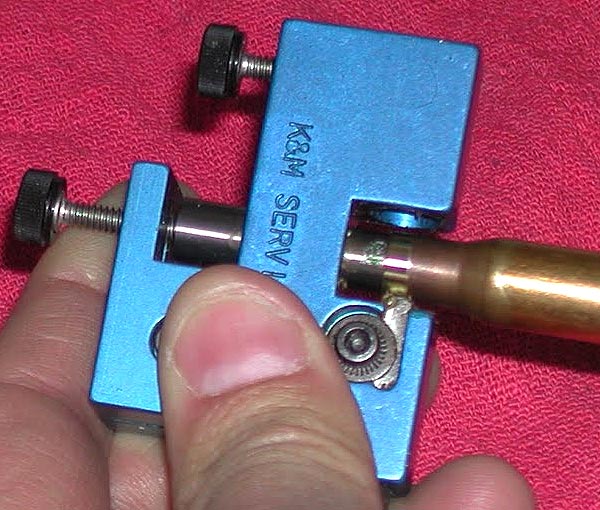
On our main AccurateShooter.com site, you’ll find a good article by GS Arizona on the Basics of Neck Turning. If you’re new to the neck-turning game, or are just looking for good tips on improving your neck-turning procedures, you should read that article. Below we offer some highlights and photos from the article, but you’ll need to read the whole story to view all the illustrations and follow all the procedures step by step.
Why Should You Consider Neck Turning?
Let’s assume that your rifle doesn’t have a tight neck chamber that requires neck turning; if you have a tight neck chamber, of course, the answer to the question is “because you have to”. For the rest of us, and that includes the vast majority of Highpower shooters, neck turning isn’t a requirement, but it can be a useful way to bring your ammunition a small but meaningful step closer to that pot of gold at the end of the rainbow: perfection. I’m not talking about a theoretical improvement, but a real one, an improvement that lies in equalizing and optimizing the neck tension of your loaded rounds. Inconsistent neck tension is a real contributor to increased muzzle velocity variance which itself is a significant factor in increased elevation dispersion at long range. So there’s our basic reason for neck turning: to equalize and optimize neck tension in order to reduce elevation dispersion.
The Tools of the Trade
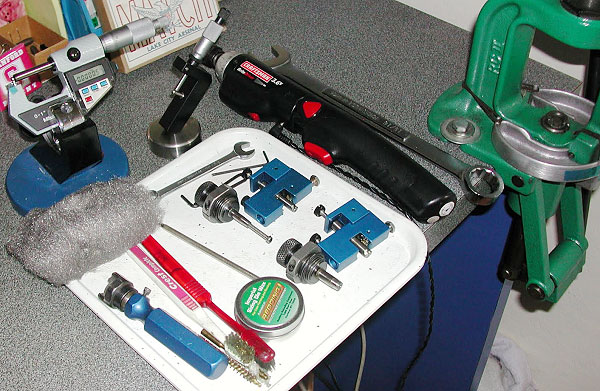
Here you see everything I use and a bit more. The press, a cordless screwdriver (always plugged in, turning is tough on the old battery), a couple of K&M neck turners (one set up for 6mm, the other for .30 caliber) an expander for each size, some Imperial lube, an old toothbrush or two to keep the cutter clean, a handle with a caseholder (for those emergencies when the screwdriver dies and there’s just one more case to go!), steel wool and a tubing micrometer finish the list of tools. Hey, I left the dial calipers out of the picture! They’re always handy, keep them around, but they are useless for measuring neck thickness, so don’t try. I usually use an Optivisor magnifier while I turn necks, very handy for a clear view of what’s happening on the neck.
Expanding the Neck
Put some lube on the inside of the case neck and run it into the expander. Really, this isn’t hard. I prefer to expand each case immediately before turning it as opposed to expanding all the cases and then turning them. Brass is somewhat springy and will tend to go back toward its original size; therefore, by expanding and turning immediately, you are more likely to have all cases fit the mandrel with the same degree of tightness and to get a more consistent depth of cut.
Cutter Adjustment for Cut Depth and Length
All the tools I’ve seen have pretty good adjustment instructions. The only thing they don’t tell you is that you should have five to ten spare cases to get it right initially. Anything of the right diameter will do while you learn, for instance, just use that cheap surplus .308 brass to do initial setup and save the precious .30-06 for when you know what you’re doing. Be patient and make your adjustments slowly; you’ll need to set the cutter for thickness as well as length of cut (just into the shoulder). The depth of cut (brass thickness) takes a bit of fiddling, the length of the cut is generally easy to set.
The Finished Product — A Perfectly Uniform Neck
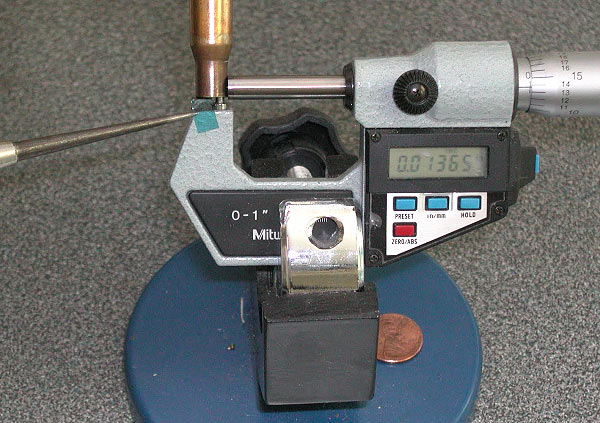
If you read the whole article, and follow the procedures using quality tools, you should get very good results — with a little practice. To demonstrate, here’s an example of my finished, neck-turned brass. You’ll see there is a perfect, 0.0125″ thick neck. It’s very uniform around the circumference, usually I only see 1 or 2 ten-thousandths variance. Now, with the necks uniformed like this, we can select the bushing size that will give us our preferred neck tension and experiment with various levels of tension, secure in the knowledge that all of the cases will actually have the desired neck tension.
About the author — “GS Arizona” was the writing handle for German Salazar, a top-tier rifleman and gun writer. Sadly, German passed from a medical condition in 2022. German was instrumental in helping this website and our Forum get started, and we remember him as a very dear, valued friend.
German was a great individual, and a great asset to the sport. An attorney by trade, with an engineering background, German was one of the very best gun writers, who had high master shooting skills to match his writing abilities.
At the request of our readers, we provide select “Deals of the Week”. Every Sunday afternoon or Monday morning we offer our Best Bargain selections. Here are some of the best deals on firearms, hardware, reloading components, optics, and shooting accessories. Be aware that sale prices are subject to change, and once clearance inventory is sold, it’s gone for good. You snooze you lose.
NOTE: All listed products are for sale to persons 18 years of age or older. No products are intended for use by minors.
1. Creedmoor Sports or Grafs.com
— Garmin Xero C1 Pro Radar Chronograph, $599.99
⏺ Superb game-changing compact radar chrono in stock
Looking for a radar chronograph that works great and fits in your pocket? Check out the Garmin Xero C1 Pro Chronograph that features an easy-to-use interface, great performance, and an excellent App for your smartphone. As of 2/4/2024 both Creedmoor Sports and Graf & Sons have the Garmin Xero C1 in stock for $599.99. If they sell out, Midsouth also has the Xero C1 Pro at $599.99.
2. Precision Reloading — Huge Sale on Forster Products
⏺ Save 10% or more on vast selection of Forster items
Now through 2/15/2024, you can get big savings on Forster Products at Precision Reloading. Save 10% or more on dies, case trimmers, primer seaters, neck-turning tools, bushings, and more. CLICK HERE to see all in-stock Forster items on sale now. Sale discounts are good through 2/15/2024.
3. Creedmoor Sports — Sightron SIII LR 10-50x60mm, $1109.99
⏺ Great price on excellent high-mag scope favored by many competitors
The SIII 10-50x60mm LR Target Dot scope is a very good choice for benchrest and F-Class competition. And now you can save $740 off MSRP. With 50 MOA total elevation travel, this scope is good for shooting from 50 to 1000 meters. Sightron’s patented ExacTrack technology provides precise windage and elevation adjustments while maintaining a positive point of contact with the erector tube. This scope is capable of winning major matches even though it is now less than half the price of some other high zoom magnification optics.
4. Brownell’s — S&W 638 or 642 Airweight, $419.99-$459.00 Plus $50 J-Frame REBATE
⏺ Two superb 5-Round lightweight (14.6 oz.) carry revolvers, with $50 Rebate
Smith & Wesson’s J-Frame revolvers are great carry guns. Get big savings now on the ultra-lightweight Model 638 and Model 642 Airweight wheelguns at Brownells. Both the 638 and 642 are under one pound (14.6 oz. empty)! We like the Model 638 because it has a shielded internal hammer. This allows you to shoot single-action during practice. The Model 642 has a fully-enclosed hammer so it is double-action only. The shielded hammer may be better for everyday carry. These Airweight revolvers have light alloy frames with stainless steel barrels and cylinders. Both pistols qualify for a $50 S&W Rebate.
5. Midsouth — Breechlock Press and Ram Swage Kit, $99.99
⏺ Great price on good single-stage press with swage bonus
The Lee Precision Breech Lock Challenger Press is a good starter single-stage press and/or a great secondary press for specialized functions (such as FL-sizing brass). This press can handle demanding brass prep operations, such as sizing cast bullets or swaging crimped primer pockets from mil-spec brass. Currently Midsouth offers the Challenger Press as a combo with the Ram Swage tool for clearing primer pocket crimps.
6. Palmetto SA — Sightmark Wraith Night Vision Scope, $449.99
⏺ Advanced thermal night-vision scope with major discount
Been wanting to try a night vision zoom optic? Consider the Sightmark Wraith 4K Mini Digital Riflescope, now on sale at a huge ($550) discount. This 2-16x32mm unit has cutting-edge digital optic technology. With its impressive 4K (3840×2160) CMOS sensor, the Wraith 4K Mini can detect objects up to 300 yards away even in the darkest of nights, presenting them vividly on a 1280×720 pixel FLCOS screen.
7. Amazon — Frankford Arsenal Tumbler Kit, $69.98
⏺ Good, reliable tumbler complete with media separator
You want your cartridge brass to be clean before resizing and bullet seating. A tumbler can clean large quantities of brass quickly and efficiently. One of the best tumblers for the price is the Frankford Arsenal Quick-N-EZ Vibratory Case Tumbler (#ad). This reliable tumbler holds up to 600 9mm or 350 .223 Rem cases. The included separator fits most buckets, allowing efficient collection of media after tumbling.
8. Amazon — Baofeng UV-5R Ham Radio 2 pack, $35.09
⏺ Double-duty radios receive Ham Radio signals and work as walkie-talkies
Whether planning for a trip or preparing for winter storms, it’s wise to have a back-up emergency communication system. The Baofeng UV-5R Ham Radio 2 pack (#ad) can receive emergency messages even if your phone and cable connections go out. This Ham Radio set provides two complete units that can be placed in separate locations so you can contact family members in a different city. The system can access 128 channels. These units can also be used as shorter-range Walkie-Talkies if needed.
9. Amazon — Caldwell Brass Catcher, $13.99
⏺ Popular and effective, this is a great accessory for AR rifles
Tired of picking up brass or dealing with hot casings? The Caldwell Brass Catcher (#ad) prevents brass from being scattered around your shooting area, while keeping hot brass from landing on you or others. This popular brass collector uses a hook and loop (Velcro-type) attachment to secure to your firearm. A wire frame runs around the bag opening, ensuring brass enters the bag without disruption to bolt cycling.
10. Amazon — Splatterburst Target 50 pack, $35.99
⏺ Good target with hi-viz bright yellow shot displays
Splatter targets make it easy to see your shot locations, even at significant ranges (300 yards and beyond). By contrast, bullet holes on regular paper targets can be hard to see past 200 yards. With these Splatterburst 12″x12″ Targets (#ad) you can instantly see your shots upon impact and spend less time checking your target. These targets feature five diamonds in a high-viz grid pattern for precise aiming. Chose a 10-pack for $12.99, a 25-pack for $22.99, or a 50-pack for $35.99.
As an Amazon affiliate, this site can earn revenues through sales commissions.


 A varmint shooter’s target is not conveniently placed at a fixed, known distance as it is for a benchrester. The varminter must repeatedly make corrections for bullet drop as he moves from closer targets to more distant targets and back again.
 Minority View — Hold-Over is Better

 To further express gratitude toward those with military backgrounds, the CMP has added new Veteran awards to the National Matches within the 2400 Rifle Aggregate, M1 Garand Match, National Trophy Individual Match for rifle and pistol along with the 2700 Pistol Aggregate — with the highest scoring veteran in each match earning special recognition.


 Position shooters can also improve their skills by shooting different disciplines. High Power Across-the-Course shooters benefit from shooting smallbore and air rifle. Again, these targets are very small, which will encourage competitors to be more critical of their shot placement. Hunters may benefit from shooting silhouette matches, which will give them practice when shooting standing with a scoped rifle. Tactical matches may also be good, as tactical matches involve improvising shots from various positions and distances. [Editor: Many tactical matches also involve hiking or moving from position to position — this can motivate a shooter to maintain a good level of general fitness.]