“Second Amendment? — We don’t give a damn.” That could be the mantra of many Democratic Party members of Congress. Now a radical anti-gunner from New Jersey has introduced new Federal legislation, H.R. 584, that would prevent all Americans from purchasing ANY quantity of ammunition online. All ammo sales would have to be in person with photo ID.
Congresswoman Bonnie Watson Coleman (D-NJ) (“Watson Coleman”) has revived legislation that would prohibit the sale of ammunition online. Last month, Watson Coleman introduced the Stop Online Ammunition Sales Act of 2023, a new version of restrictive legislation she authored in the past. The bill has been listed as H.R. 584 and referred to the House Committee on the Judiciary. As of February 24, 2023, H.R. 584 had 23 co-sponsors*, all woke Democrats, including the radical Rashida Tlaib, noted for her calls to defund the police (which shows how little she actually cares about reducing crime).
This unconstitutional bill, according to the NRA-ILA, would implement all of the following:
1. FORCE purchasers to submit a photo ID in person every time one buys ANY ammunition.
2. REPORT the identity of ammo purchasers to the U.S. Attorney General if the ammo buyers purchase more than 1,000 rounds within a 5-day period.
3. REGISTER ammunition buyers in a database maintained by the U.S. Department of Justice.
You know what the DOJ would do with the database of ammo buyers. It would be used to identify gun owners, creating a de facto registry of gun owners. That’s in direct violation of Federal law which forbids such a registry.
Guns.com reports: “The proposal [H.R. 584] would establish the licensing of ammunition dealers who then would be required to confirm the identity of customers seeking to purchase ammo by verifying a valid photo I.D. in person. As such, it would place a prohibition on the current widespread practice of buying ammo online and having it shipped directly to the customer’s door. The measure would also require these vendors to report all purchases of more than 1,000 rounds within a five-day period by the same person to the U.S. Attorney General as well as local and state law enforcement.”
Effects If ‘Stop Online Ammunition Sales Act’ Becomes Law
From a practical standpoint, this legislation would make ammunition much more difficult to buy in large quantities. And specialized ammo, for less popular chamberings, could be almost impossible to get, if people could only shop at local retail outlets. Being able to shop a dozen or more online vendors allows shooting enthusiasts to get a wide variety of ammo types at competitive prices. For example, with AmmoSeek.com, you can see the best rimfire and centerfire ammo deals from dozens of vendors.
Watson Coleman and her anti-Second Amendment co-sponsors want to make it MUCH more difficult to obtain ammunition, and she would be delighted if the cost of ammo doubled or even tripled. She hates firearms and hates gun owners.
Regarding H.R. 584, GunsAmerica contacted Alan Gottlieb, founder of the Second Amendment Foundation. Gottlieb was critical of the one-sidedness of legislation in that it presupposes all ammunition sold online ends up in the hands of criminals. Gottlieb noted: “Day in and day out men and women save their lives with ammunition they have bought online and the only response from Democrats is to call for bans on the sale of ammunition.”
Additional cosponsors of the bill include:
Jake Auchincloss [D-MA-4]
Joyce Beatty [D-OH-3]
Earl Blumenauer [D-OR-3]
Andre Carson [D-IN-7]
Joe Courtney [D-CT-2]
Jason Crow [D-CO-6]
Danny Davis [D-IL-7]
Madeleine Dean [D-PA-4]
Diana DeGette [D-CO-1]
Susan DelBene [D-WA-1]
Mark DeSaulnier [D-CA-10]
Glenn Ivey [D-MD-4]
Sydney Kamlager-Dove [D-CA-37]
Barbara Lee [D-CA-12]
Zoe Lofgren, Zoe [D-CA-18]
Betty McCollum [D-MN-4]
Kweisi Mfume [D-MD-7]
Seth Moulton, Seth [D-MA-6]
Eleanor Holmes Norton [D-DC-At Large]
Donald M. Payne, Jr. [D-NJ-10]
Mike Quigley [D-IL-5]
Rashida Tlaib [D-MI-12]
Jill Tokuda [D-HI-2]
We’re having a wicked winter in some parts of the nation. California is experiencing blizzards and snow-bound highway closures. In the middle of the nation, major snowstorms hit many states, and 470,000 customers lost electrical power after an ice storm in Michigan.
Rifle Transformed from Ordinary Varmint Rig to a Stunning F-TR Machine
As an antidote to these weather-related worries, for this Sunday GunDay we’re offering a bit of beauty amidst snow — a handsome rifle showcased in a white winter wonderland. This handsome rifle started life as a rather ordinary .204 Ruger Rem VSSF varmint rig. With a new barrel, a new stock, and a stunning flame-pattern hydro-dip coating, this is now an ultra-accurate .223 Rem F-TR competition rifle.
Flames in the Snow…
Forum Member Brandon Schlund (aka “Bois Blanc Boy”), photographed this handsome flame-themed F-TR rifle against the snowy background of Michigan’s Bois Blanc Island. Brandon posted this to our long-running Pride and Joy Rifle Forum thread. He notes: “This is my first F-TR build, which started out as a stock Remington .204 Ruger. I had the action blue-printed, firing pin was bushed by Speedy, and I had a new bolt handle and knob installed by John Pierce.” This rifle is now fitted with a 3-groove Pac-Nor 1:6.5″-twist barrel chambered in .223 Remington to shoot the 90gr Bergers. Other components are: Kelbly KTS stock, Phoenix bipod, and Sightron 8-32x56mm SIII scope. Brandon says: “It took a long time to get this gun where it is now but I’m truly happy with it!” Here’s the “before” photo:
The Transformation — F-TR Comp Rig Made from Rem .204 Ruger Varminter Report by Brandon Schlund
This rifle started out as a “plain Jane”, factory Remington VSSF II. I shot it on varmint hunts in factory configuration. Then I decided to transform the rifle into a .223 Rem F-TR gun. As the .204 has the same bolt face as a .223 made sense to go in that direction since I would be able to use the gun for varmint hunting as well as F-TR.
While I had shot some F-Class matches with my dad (Joe Schlund aka Bench on AccurateShooter) it wasnt much. When we did a PD hunt in Wyoming I primarily shot my .204 but I decided I wanted a cartridge that could reach out a little further and also do double duty — competition and varminting.
The first step in transforming this rifle was selecting a barrel. We ordered a Pac-Nor, 1:6.5″-twist, 3 groove, 30.5″ heavy Palma contour. This was then chambered with a PTG .223 ISSF reamer with 0.169″ freebore to run the .224 caliber heavies. I went with Pac-Nor because both my father and my brother Mark (aka Labrador2 on AccurateShooter) owned Kelbly-built F-TR rifles with the same barrels. Mark and my father couldn’t be happier with the results. Pac-Nor has great customer service along with a short wait time.
I sent the barrel and the factory Remington 700 action down to Kelbly’s where they did the chambering and cut the threads. While Kelbly’s had my action I had them blueprint it. A Kelbly KTS stock with the three-way buttplate and adjustable cheek piece came next. After getting behind Dad’s rifle and Mark’s gun there was no reason to look any further. With all its adjustments, the KTS stock fits very comfortably.
Loading for the .223 Rem with H4895 and 90gr Bergers
As a .223 Rem, this rifle has proven very accurate — it’s a bullet-hole cutter at 100 yards (low twos easy). Our best load is with Hodgdon H4895, 90gr Berger VLDs, CCI BR4 primers. This load is running at about 2835 FPS but YMMV (remember this is a LONG 30.5″ barrel). The Bergers are loaded .008″ into the lands with base-to-ogive of 2.035″.
Our loading technique may be tedious — with lots of sorting and measuring. But brother Mark, father Joe, and I all enjoy the steps. Our three .223 Rem match guns all love the same load which makes loading much easier. Believe it or not we use a Hornady Lock-N-Load progressive ammo plant, which is great when loading for three guns. Our consistency is fantastic with run-out a mere .001-.0015.
We also turn necks and weigh our primers. Does neck-turning and primer weighing really make a difference? Who knows but we try to eliminate more variables since we have to the time to do it, and we actually enjoy the procedures.
Pierce Engineering Installed Action and Modified Bolt
Being from Michigan, Pierce Engineering has done a lot of work for my family’s guns. For this project the Pierce team bedded the action and glued in a single-shot follower. The stock bolt handle/knob was too short for comfort in the KTS stock. Pierce added a longer handle and tactical knob to the bolt. I then installed a .223 Rem Lapua case base into the knob.
The complete .223 Rem rifle ready to shoot F-TR, as fitted with 8-32X56mm Sightron and Phoenix Bipod, weighs 17 pounds, 15 ounces.
Flame Graphics by Camo Creek Hydrographics
After the action was bedded by Pierce, the stock was sent to Camo Creek Hydrographics in Fenton, Michigan. I selected a flame-style design which Camo Creek applied through hydro-dipping. The stock went back to Pierce’s shop, which applied three coats of clear over the entire stock. The clear-coating really enhanced the flame graphics.
Firing Pin Bushed by Speedy
I sent the bolt to Thomas “Speedy” Gonzalez to have the firing pin hole bushed as otherwise the load could crater the primers pretty bad. Knowing I’d be shooting heavy-weight .22-Cal bullets with a stout load this was a good idea. Speedy also cut his trademark grooves into the bolt shroud which looks amazing. His work is top notch! There is zero cratering now, even with the hottest of loads.
Competition Components — 8-32x56mm Sightron and Phoenix Bipod
For an F-TR rig you need a quality high-magnification optic and a premium, wide-base bipod. I installed a 8-32x56mm SIII Sightron. This was another easy choice because of the attractive price and because my family has four other Sightrons that work great.
I installed a fore-end Picatinny rail to attach a Phoenix Bipod. I extended the Mariners wheel handles by adding short sections from an aluminum arrow shaft. This lets me adjust elevation without stretching forward. I also installed a Calvin Elite Timney Trigger set at 6 ounces.
$2500.00 Invested in Rifle Transformation and Upgrade
How much did this all cost? Brandon tells us “I have roughly $2500 into the rebuild of the gun from a .204 Ruger to the .223 Rem.”
Bois Blanc Island in Michigan
Here on Bois Blanc Island we don’t have many amenities, but we do have the ability to shoot 550 yards at our local gravel pit on state land. It’s snow-bound right now as you can see. But later in the year this will be our close-to-home training center.
Winter at Bois Blanc Island, Michigan — Here’s the gravel pit where we can load test during warmer weather. When I took this photo, it was a “balmy” 10-degree day.
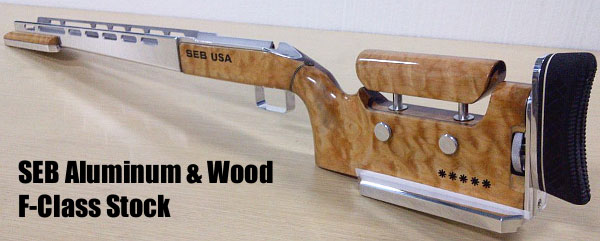
NOTE: This is an older article, but with the SW Nationals taking place last week, we thought our readers might enjoy a repeat view of a very rare and unique F-Class rig. This hybrid wood and aluminum stock is a “one-of-kind” custom, crafted by Sebastian (“Seb”) Lambang, creator of the SEB Coaxial Rests and Coaxial Joystick Bipod.
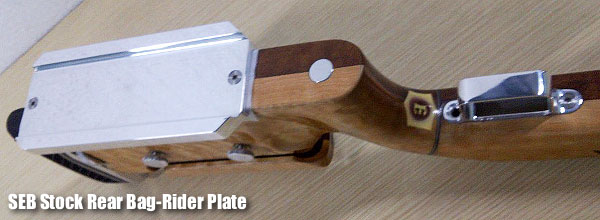
Back in 2013, our friend Sebastian (“Seb”) Lambang engineered an impressive wood and aluminum F-Class stock. The stock features a long, box-section aluminum fore-end with a wood rear section and wood-trimmed “wings” on the front bag-rider. The aluminum fore-arm has “buick vents” for weight reduction. From the end of the action rearward, the stock is mostly wood, with light and dark fancy wood laminates on opposite sides (left and right).
The foot of the buttstock has a very wide aluminum rear bag-rider with rails. The rear wood section appears to be two solid pieces of wood — but that is deceiving. Seb explains: “To save weight, the buttstock is hollow (using thin-walled wood)”. To strengthen the construction, Seb added carbon fiber inside the buttstock. So what you see is a wood outer shell with carbon fiber layers on the inside. The stock sports vertically-adjustable cheek-piece and buttplate. The thick, rubber buttpad should diminish felt recoil even when shooting big cartridges with heavy bullets.
This is an interesting, innovative stock design. And as with everything Seb produces, the craftsmanship, fit and finish are superb.
To go with this gun, Seb also crafted a handsome set of angled scope rails with beautifully-machined scope rings. Imagine being able to custom-make one-off products of this quality in your own machine shop!
Brownells is a well-known retailer of guns, gun parts, tools, accessories, ammo, and pretty much everything gun-related. What you may not know is that Brownells has a very active video production department that releases new “how-to” and product information videos every week. These videos offer helpful advice on gun cleaning/maintenance, reloading, as well as selecting/assembling components for various kinds of rifles. And every week Brownells serves up a new products video. There now over 1000 videos on the Brownells YouTube Channel, which is truly a remarkable resource.
Here are six of our favorite videos from Brownells. There’s a helpful guide to scope installation, AR owners will find some good advice on spare parts, new reloaders can learn how to use the OAL tool, and all gun owners should watch the video on ammunition storage.
Scope-Mounting — Common Mistakes to Avoid
Always be careful when mounting a rifle scope. This isn’t a super-complex or highly technical task, but there are ways you can mess it up. This video explains common pitfalls to avoid when mounting a scope.
1. Make sure the rings don’t touch ANY part of the turret housing, objective bell, or eyepiece.
2. Be certain the scope rings are tightly clamped to the scope base. Grasp the scope with one hand and the rifle with the other, then ensure there is no play.
3. Make sure there’s clearance between the objective bell and the rifle. No part of the scope should touch the rifle itself.
4. NEVER over-tighten the scope rings. You can actually crush the scope tube and damage the optic beyond repair. Stick to the torque specs!
How to Use Hornady OAL Tool and Hornady Bullet Comparator
Gun Tech Steve Ostrem explains how to properly use Hornady’s Overall Length Gauge to determine length-to-land precisely. The OAL Gauge uses a “Modified Case” that threads onto the tool and holds a bullet. Push on the back of the gauge until you feel the bullet just touch the rifling. (We do this gently at first, tapping the rod a couple time to ensure the bullet is aligned correctly). Once you’ve got the length, then use the tool with a comparator on your calipers to get the length-to-lands. NOTE: We recommend taking the measurement 3-4 times in a row to get a reliable number. With a little practice your should be able to get repeatable measurements within .0015″.
Air Travel with Firearms — Key Regulations You Must Follow
You can travel on commercial airlines with firearms. But you must follow the TSA regulations, and your particular airline’s rules. First, make sure your guns are UNLOADED before your leave home. Guns need to be carried in proper hard-sided cases that cannot be pried open. Be prepared to unlock the case if the TSA wants to inspect what’s inside. TSA agents can cut the locks if they need to open the case but can’t locate you. If you use special TSA-approved locks, TSA agents have master keys that let them open the case without destroying your locks. You CAN transport up to 11 pounds of ammunition — with restrictions explained in the video.
How to Store Ammunition Safely and Securely
This has been one of the most popular Brownells videos — with over 1.7 million views. Here’s the deal — ammunition WILL keep for a long time if you store it properly. DO store ammunition in a cool, dry place that doesn’t have wide temperature swings. Temperature cycling will also degrade primers and powder. Put it in airtight ammo cans to keep out the moisture. Tupperware containers will work too. Brownells also recommends putting moisture-absorbing silica packs in your ammo containers. DON’T just keep ammo in factory cardboard factory boxes stacked in the basement, attic, or garage (especially on the floor). Factory ammo boxes can absorb moisture which can degrade primers and corrode the brass cases. Yes, sealed military ammo will usually handle this kind of storage for quite a while, but it’s still not wise.
Must-Have Spare Parts for AR-Platform Rifles
In this video, two knowledgeable gun techs answer the question: “What spare parts should I keep on hand for my AR-15?” On the list are: Gas Rings, Buffer Spring, Extractor Spring and Pin. NOTE: You may want to try the one-piece spiral gas ring rather than the standard rings which require alignment. The cotter pin and cam pin can also easily get lost when the Bolt Carrier Group is disassembled for cleaning. On the lower receiver you’ll want spare springs and detents for the pivot/takedown pins. If you’re using lighter-power springs, keep standard-power spares on hand. If your rifle stops working, swap in the factory-spec springs to find out if the problem is the gun or your ammo. Also, if you have upgraded your trigger, always keep the original trigger as a backup.
Cleaning Advice for .22 LR Rimfire Rifles
Gun Techs Steve Ostrem and Caleb Savant debunk some myths about cleaning .22 LR barrels. One myth is that cleaning will harm the accuracy of a .22 LR barrel. Caleb thinks this myth is the result of people cleaning a barrel from the muzzle and damaging the muzzle crown, which CAN diminish accuracy. If it’s done right, cleaning won’t damage the bore. However, you certainly do NOT have to clean your 22 LR’s bore every time you go to the range. But DO clean the action every time you shoot the rifle, especially on a semi-auto. What about shooting a lot of lead bullets? Won’t that lead up the bore? The guys give us the straight skinny on lead fouling, too. When you see your .22 LR rifle’s groups opening up, you may want to consider cleaning.
This article is Copyright 2023 AccurateShooter.com. Reproduction on any other website gives rise to monetary damages.
The 2023 NRA Annual Meetings & Exhibits will take place at the Indiana Convention Center on April 14-16, 2023 in Indianapolis, Indiana. The Exhibit Hall is open all three days and will showcase over 14 acres of guns and gear from hundreds of manufacturers and retailers.
A bigger-than-ever Exhibit Hall will host approximately 800 exhibitors, events, receptions and demonstrations. Attendees can see the latest guns, knives, optics, ammo and accessories available on the market today. Organized events include the NRA Foundation Banquet and Auction, the NRA-ILA Leadership Forum, plus multiple seminars. There will be appearances from notable celebrities, and a major Saturday concert with leading musical artists.
At this 152nd Annual NRA Convention you can also book the hunt of a lifetime, purchase shooting and hunting accessories, view impressive gun collections, and hear influential, pro-2A experts.
The big event is just six weeks away. If you plan to attend the 152nd NRA Annual Meetings & Exhibits we recommend you register soon and get your hotel booked well ahead of time. With the current policies coming from the White House, there has been no more important time to support gun rights and the Second Amendment.
Vortex, the large American optics company, has acquired GeoBallistics, a Texas-based business that sells mobile platform ballistics software. The GeoBallistics software is offered for both iOS (Apple) and Android platforms. This software features an advanced 3DOF solver and continuously updated bullet library. GeoBallistics software has other very sophisticated features:
1. Four Operating Modes (HUD, Map, Chart, and Comp). 2. Atmospherics Bluetooth Connectivity with Kestrel and Weatherflow. 3. Map Mode with GPS Rangefinder (use to range targets, create range cards). 4. Rifle Data and Range Cards available and synched via internet cloud servers.
Vortex Will Support Current GeoBallistics Users
For shooters already utilizing the GeoBallistics software, nothing in the software and App experience will change. And Vortex will now provide customer service and support. To learn more about GeoBallistics Apps, visit GeoBallistics.com.
Vortex plans to add GeoBallistics products to the Vortex portfolio to continue “to enhance and simplify hunting and shooting while providing critical information quickly and accurately.”
“We’re always looking for new ways to help Vortex Nation enjoy unforgettable experiences in the field”, said Joe Hamilton, Vortex CEO. “Acquiring GeoBallistics means we can offer both consistency in our product line and make long-range ballistics simpler and more accessible for everyone.”
How to Use GeoBallistics App — Informative Video
In this video, Clay Hergert, owner of ATX Precision (and former SEAL Team Sniper) demonstrates the GeoBallistics App with BallisticsARC capabilities. Clay shows how to use BallisticsARC to create rifle profiles.
This article Copyright 2023 AccurateShooter.com. No reproduction on any other website is authorized.
Just last week hundreds of F-Class shooters competed at the Southwest Nationals in Phoenix, Arizona. The vast majority of F-TR shooters had rifles chambered for the .308 Winchester cartridge (7.62×51), but F-TR rules also allow the .223 Rem (5.56×45). There are some advantages to the smaller .223 Rem round — there’s notably less recoil, bullets and brass are significantly cheaper, and a lot less powder is required. For those who are considering campaigning a .223 Rem F-TR rifle, this story explains how an accurate .223 Rem load was developed. This load development was done by a father for his daughter who was getting started in F-Class competition.
Dad builds an F-TR Rifle for his Daughter and Develops Load
Jeremy Rowland decided to put together an F-TR rifle for his eldest daughter, who enjoys competitive shooting. For his daughter, Rowland chose the .223 Rem option because it has less recoil and components are less costly than the .308 Win. Here is Rowland’s account of how he developed a .223 Rem load. For more details (with data charts), read Jeremy’s FULL STORY on Sierra Bullets Blog.
Journey to Find a .223 Rem F-Class Load
by Jeremy Rowland, Reloading Podcast
My oldest daughter has been to several matches with me, and has even competed in several, using her .243. [A few seasons back] I decided, she would compete with a .223 Rem in F-TR. Looking for a good starter rifle, I settled on the Savage Axis Heavy Barrel since it has a 1:9″ twist. This would be a great little rifle for her to learn on. The rifle was shot unmodified, as it came from the factory. A Sinclair F-Class Bipod w/micro elevation adjustment was fitted to the front.
Next came finding the components I wanted to use for her match loads. After spending hours and hours running numbers on JBM stability calculator as well as in my iPhone Ballistic AE app, the 69 gr Sierra Tipped MatchKing® (TMK) looked really good. So that’s what I decided to go with. I jumped in head first and ordered a bulk pack of the Sierra 69 gr TMKs. I had settled on Hodgdon CFE 223 powder since it shows good velocity. I decided to go with once-fired Lake City brass with CCI BR4 primers.
Next came the testing. I decided to run a ladder test (one shot per charge from min to max looking for the accuracy node). The ladder test ranged from 23.5 grains to 25.6 grains, in 0.3 grain increments.
Bullet: 69 gr Sierra Tipped MatchKing®
Case: Lake City (mixed years, sorted by case capacity)
Primer:CCI BR4
Powder: Hodgdon CFE 223 (one round each from 23.5 to 25.6 grains)
Cartridge OAL: 2.378″
Base to Ogive: 1.933″ (.020″ off lands)
After his ladder test, Rowland settled on a load of 25.2 grains of Hodgdon CFE 223. He then fine-tuned his load with different seating depths: “I loaded up 5 rounds each at .020″ off lands, .015″ off lands, .010″ off lands, and .005″ off the lands. Here are the results from the best group for OAL/Ogive fine tuning. As you can see, I think I’ve found a winner in these 69 gr Sierra Tipped MatchKings.”
In a helpful NSSF video, Ryan Cleckner explains why you normally should avoid canting your rifle — rotating it clockwise or counter-clockwise. Cleckner explains that canting the rifle in one direction or another will change the point of impact: “When you rotate the rifle, not only does the [POI move] in the direction that you’re rotated, [but] it also loses some of its elevation as it rolls down.” This, Cleckner explains, can make you miss on one side or the other:
Cant to the Left — You’re going to miss low and left.
Cant to the Right — You’re going to miss low and right.
In this video, starting at the one-minute mark, Cleckner shows the effect of rifle canting when engaging a 600-yard target. A few degrees of cant (either to the left or to the right), moves the shot POI completely off the steel silhouette target. The POI change occurs mainly because you are lowering (and laterally shifting) the scope sight-line relative to the bore axis, effectively changing your zero.
David Tubb has explained: “Every 1 degree you are off on a cant, is about six inches of difference laterally at 1000 yards”.
Position Shooting with Sling — Rifle Cant Considerations
Cleckner’s discussion assumes that the scope or sights are set to hit center with the rifle level and plumb. That works for most situations when shooting prone off bipod, front mechanical rest, or front sandbag. However, many sling shooters, including David Tubb and John Whidden, do tilt or cant their rifles slightly inward because this allows a more comfortable hold with sling, or allows better eye-to-sight alignment. Holding the rifle at an angle can work — but the angle of cant must be consistent for every shot. Canting the rifle is not a sin by itself. However, after you confirm your zero on your target, the degree of cant must be the same for EVERY shot. You must maintain that exact same degree of rotation on each shot or you will experience the shot POI movement Cleckner illustrates. Consistency is the key.
John Whidden, 5-time Nat’l Long Range Champion, holds a Palma rifle. John now shoots a match rifle with an Anschutz stock which he holds more upright, but still with some counter-clockwise cant. John also installed his iron sights at an angle so that the adjustments are correct (and plumb) even with his canted hold: “While it may not be obvious in the picture, the sights on my rifle are set up so that they’re straight vertical and horizontal while I hold the rifle canted. Making sure your adjustments (scope or sights) are vertical and horizontal is a critical piece of the pie.”
Inexpensive Dual-Diameter Scope-Mounted Bubble Level
The best way to avoid inconsistent rifle canting is to use a bubble level fitted to rail or scope. One very affordable and versatile product is the Jialitte Scope Bubble Level. This features a 30mm milled inside diameter, plus an inner insert ring so it will also fit 1″-diameter main tubes. The Jialitte unit is nicely radiused, and has a low profile in the middle. User reviews have been very positive. You could easily pay $35.00 or more for a 30mm scope level. This costs just $10.99 on Amazon.
NOTE: If you prefer drying your brass in an oven we recommend a temp setting no higher than 200° F. Better yet, use a dedicated case dryer that cannot possibly over-cook your cases.
Tech Tip by Craig Arnzen of Area419.com
As wet-tumbling brass has become more popular in recent years, guys have tried a LOT of ways to get their brass dry — towels, hair dryers, and even food dehydrators. (See Top Ten Brass Drying Methods). Another common method — albeit with some potential issues — is putting your wet brass in the oven to dry. Provided you monitor TEMP and TIME, this method is fast, effective, and easy (as long don’t use the wife’s favorite cooking pans — that’ll get you in trouble.)
With oven-drying, however, unexpected issues can arise, as illustrated by this worrisome story: “I put my brass in for an hour at 200° F and turned it off. Next thing I know I realize my wife has the oven pre-heating to 350° F. Is my brass ruined?”
If you search the AccurateShooter.com Shooters’ Forum, you’ll find at least three threads with stories like that (i.e. higher-than-expected oven temps when drying brass), and answers on both sides of the line. I know this, because it happened to me — I had some 6XC brass drying and the wife pre-heated the oven. Concerned about my cases, I consulted a genuine annealing expert, Andrew Rixon.
Andrew is the Director of Engineering and Manufacturing at Alpha Munitions, makers of premium-grade rifle brass. I had baked a batch of Alpha’s new 6XC brass, which is exceptionally consistent and well-made.
Before Andrew would answer my question though, he gave me a little lesson on what really happens during annealing:
“Annealing is performed by heating the brass to specific temperatures. There are three phases of annealing: recovery, recrystallization, and grain growth. All of which have specific temperatures and or exposure times related to them. It is key for cartridge brass annealing processes to hit the recrystallization phase which allows for strain-free grains to grow. The growth of strain-free grains eliminate dislocations, drastically decreasing hardness and increasing ductility. For recrystallization to occur the material temperature must be within 600-1000 degrees Fahrenheit (F).”
He then got into really answering the question, and was (fortunately) definitive in his answer: “If the temps do not exceed 450 degrees F then there is nothing to worry about as it did not exceed the critical temperature for annealing to occur.” Editor: Caution — do NOT assume that the temperature marked on the oven knob is the actual temperature INSIDE the oven, particularly near the back. Some older ovens can be off as much as 75 degrees F. Be conservative!
Well, there you have it. If you’ve baked your brass, you’re probably OK. If you got it hotter than 450° F then there can start to be some changes to the metal.
The Rimfire Challenge Shooting Association (RCSA) is now an official partner of the +ONE Movement, a mentorship program organized by the National Shooting Sports Foundation (NSSF). “RCSA is looking forward to a long relationship with NSSF,” stated RCSA Board President Peter Swenson.
NSSF +ONE programs encourage mentorship related to firearm safety, firearm basics, shooting sports, and hunting. The +ONE program focuses on peer-to-peer development in shooting sports and hunting.
About the Rimfire Challenge Shooting Association
Designed to introduce new shooters to shooting sports in an exciting, family-friendly format, Rimfire Challenge matches focus on competition with .22 LR rifles and pistols. Matches are open to shooters of all shooting experience levels, with events conducted at ranges nationwide. The annual RCSA World Championship takes place each October. The RCSA promotes rimfire competition nationwide, supports beginning competitors and clubs, and solicits support for rimfire events from industry businesses.
Programs that inspire mentoring can make a huge difference. According to recent research, if just one out of three target shooters and hunters can introduce someone new to the shooting sports, we can help to secure a strong future for generations to come.
The NSSF encourages shooting sports enthusiasts and hunters to join the +ONE movement and invite someone to the range or afield. Learn more about the +ONE Movement by visiting LetsGoShooting.org and LetsGoHunting.org.
This article is Copyright 2023 AccurateShooter.com. No reproduction on any other site is permitted.


 Flame Graphics by Camo Creek Hydrographics




 If you search the AccurateShooter.com


