If you shoot high quantities of ammunition in pistol or rifle competition, you should consider acquiring a good progressive press. Because multiple operations (sizing, powder dropping, bullet seating etc.) take place with a single pull of a lever, a progressive press can produce way more ammo in a given period of time than any single stage press. With a progressive, on the ram up-stroke, the multiple stations can simultaneously remove spent primer, full-length size case, drop powder, seat bullet, and crimp (if desired). Most progressives are also set up to prime cases with the ram in the lower position — though some guys prefer to prime manually.
Progressive presses aren’t just for high-output pistol ammo or bulk rifle ammunition. Good progressives can be adapted to do certain reloading tasks for top-on-the line match ammo. You might use a progressive for decapping, priming, and sizing, then throw powder and/or seat bullets separately. Some Champion shooters do use progressives to load their match ammo! For example 5-Time National Long Range Champion John Whidden and 2020 Berger SWN F-Open Champion Jay Christopherson both use progessive presses for some (but not all) operations.
To help you get started with progressive presses, here are six videos from UltimateReloader.com that cover seven popular machines, from the elite Mark 7 Evolution to the affordable Lee Loadmaster. With many of these machines you can add separate vertical bullet feeder systems that further increase loading efficiency. Machines Covered: Lyman Mark 7, Dillon XL-650, Dillon XL-750, Dillon RL-550c, RCBS Pro Chucker 7, Hornady Lock-N-Load AP, and Lee Load Master.
Mark 7 Evolution Press — Distributed by Lyman
Dillon XL-650 vs. Dillon XL-750
RCBS Pro Chucker 7 with Bullet Feeder
Dillon 550C with 6mm Creedmoor and 9x19mm
Hornady Lock-N-Load AP Progressive
Lee Load-Master Features and Loading 9mm
SAFETY BONUS — Why You Need a Lock-Out Die
The RCBS Lock-Out Die can also be used with some Dillon and Hornady progressive presses.
If you load pistol or rifle ammo with a progressive press, we strongly recommend you get a Lock-Out Die from RCBS. This unique reloading die will prevent your progressive press from advancing if the dispensed powder charge is more or less than about 0.3 grains too high or too low. The Lock-Out Die really works.
The Lock-Out Die works by using a central die detection rod that sets its vertical position based on the height of the powder column in the case. Through an ingenious design, if the powder column height is too low or too high, the rod locks in place as you start to pull the press handle. This halts the press before the ram can lift and the cartridge plate can advance. Unlike a beeping alarm system (which can be ignored or defeated), the Lock-Out Die physically stops the movement of the press ram and prevents a bullet being seated in the “problem” case.
It takes a bit of tweaking to get the Lock-Out Die detection rod setting just right, but once it is correctly positioned, the Lock-Out Die works smoothly in the background. The Lock-Out Die won’t interfere with the loading process unless it detects a high or low charge — and then it positively stops the progressive loading cycle.
While crafted for use in RCBS progressive presses, the RCBS Lock-Out Die can also be used on a Dillon XL Progressive or Hornady Lock-N-Load progressive — though it does take up one station which could otherwise be used for a final crimp die (after the seating die). This Editor has used the RCBS Lock-out die very successfully on an RCBS 2000 progressive press for many years.
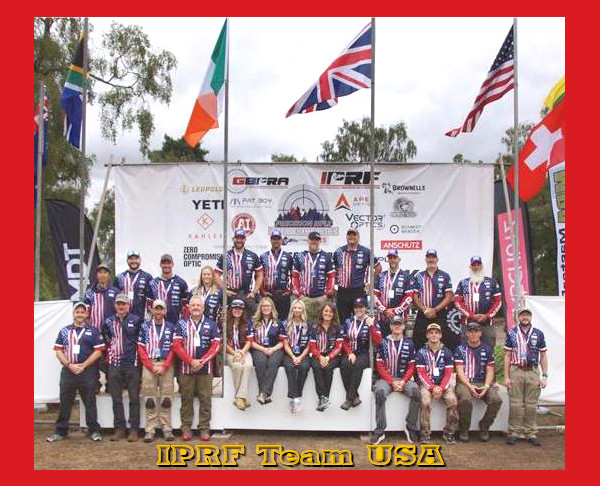
The International Precision Rifle Federation (IPRF), is a governing organization for tactical-style precision shooting, both centerfire and rimfire. Recently IPRF conducted its second-ever .22 LR Precision Rimfire World Championships, held this year in the United Kingdom. We’re proud to announce that Team USA won the 2025 IPRF rimfire title. Team USA took top honors at the 2025 IPRF PR22 World Championships, securing the gold medal with a dominant performance.
The IPRF Rimfire World Championships were held August 17-24, 2025 at the West Midlands Shooting Centre in Drayton, UK. Competing against the world’s best, Team USA finished with an impressive team score of 2089 to win the 2025 IPRF PR22 world title.
The victory was a result of outstanding individual and team achievements across multiple divisions. In the Open Division, Team USA not only secured team gold but also saw Matt Stiner take 2nd place individually, with an honorable mention to Erich Leipold for a strong performance that tied for third. The Lady’s Division was a clean sweep, with the team earning gold, Camdyn Powers winning 1st place, and McKenzie Burns securing 2nd. The Juniors Division also brought home team gold, with Dakota Wright and Reagan Stahmer earning 2nd and 3rd place, respectively. The Seniors Division added another team gold, with Dave Ostrowske claiming the 3rd place individual medal, while the Factory Division team earned a bronze medal, with Ronald Verran finishing in 3rd place.
“We are incredibly proud of Team USA’s remarkable success at the World Championships,” said Adam Braverman, V.P. of Sales & Marketing for Lapua. “Their dedication, skill, and unwavering commitment to excellence have rightfully earned them the title of world champions. Congratulations to every member of the team on this phenomenal victory.”
2025 Team USA shooters were chosen based on their performances at the U.S.A. PRS Rimfire and NRL22 championships, along with 8 qualifier matches held between January 2024 and March 2025. This selection process ensured that Team USA had great shooters who could dominate the IPRF PR22 Championship.
Video from Previous IPRF Rimfire Championship in Italy in 2023
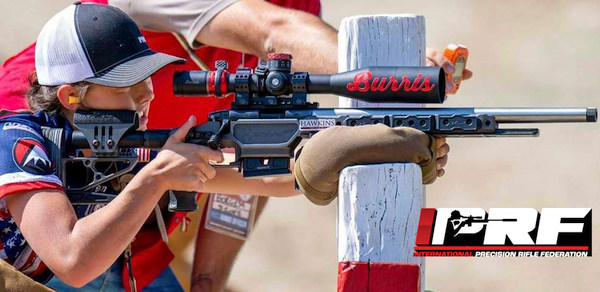
American team member Camdyn Powers at the 2023 IPRF Rimfire World Championship in Italy. Photo courtesy Burris Optics.
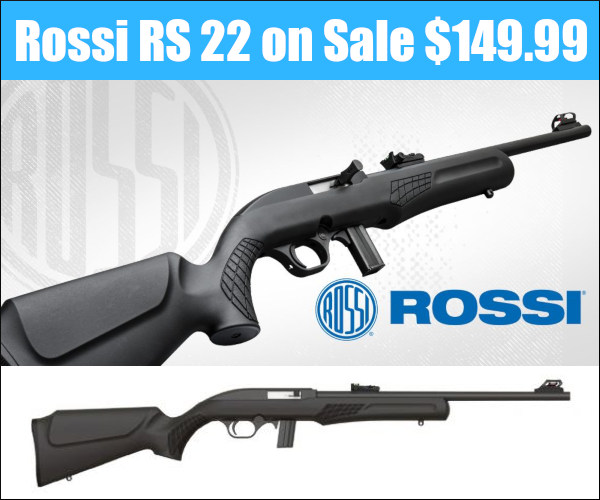
Looking for a very affordable first rifle for a young family member? Here’s one of the best low-cost options you can find among .22 LR rimfire rigs. The Rossi RS22 is a reliable, semi-auto rifle that comes equipped with barrel-mounted iron/fiber optic sights. There are also dovetails on the receiver for mounting scope rings. The RS22 also takes most Mossberg 702 magazines.
The Rossi RS22 features an 18″ free-floating barrel, adjustable fiber optic sights and a synthetic Monte Carlo stock. For added accuracy, 3/8″ dovetail mounts allow the mounting of a scope or other optic (and there is a model with a Picatinny rail).
There are multiple RS22 models. The basic RS22 with black stock and iron sights is $149.99 at Sportsman’s Warehouse. If you prefer a different stock color, Sportsman’s Warehouse also has the iron sights RS22 with Brown stock or Green stock for $149.99. Or get a Flat Dark Earth RS22 for $161.99 at Palmetto State Armory. If you will always be using a scope, consider the RS22 model with Picatinny scope rail and threaded barrel (but no iron sights) — it is on sale now for just $149.97 at Sportsman’s Warehouse.
Rossi RS22 Specifications:
Model: RS22 Semi-Auto, .22 LR
Barrel: 18″ Free-floating
Stock: Black Monte Carlo Synthetic Stock
Overall Length: 36.25″
Weight: 4.1 lbs.
NOTE: The Rossi RS22 on sale has a matte black stock.
Two Video Reviews of Rossi RS22
The above video review of the Rossi RS22 confirms its reliability and build quality. The reviewer praised the fiber-optic iron sights and liked the magazines. After fitting a scope to the rifle’s built-in dove-tail, the tester got excellent accuracy with CCI ammo at 25 yards. Ten shots basically formed one half-inch hole. (See video 8:24 – 8:50 and target at right.) That’s good enough for an NRL22 match. Pretty impressive for a $134 rifle!
Gunblast.com also tested the Rossi RS22. This “dandy little rifle” performed great, with flawless semi-auto feeding and cycling for hundreds of rounds. Accuracy was quite good. The tester praised the fit and feel of the stock and noted it has sling swivel studs and well-protected sights. The RS22 can also use 25-round Mossberg magazines.
Make sure your firearms are stored securely. The NSSF’s Gun Storage Check Week runs September 1-7, 2025. This national awareness campaign is intended to ensure gun owners store their firearms securely, both to prevent theft and to reduce the risk of misuse and suicide.
Secure firearm storage is the most effective way to help prevent firearm accidents, suicides, and theft. Many secure storage options are available, including lock boxes, cable locks, and full-size safes, to secure firearms when not in use in homes and vehicles. When firearms are not under your direct control, you should place them in locked storage. We recommend large, heavy gun safes for rifle and shotgun storage. It’s best to buy a larger, heavier gun safe than you may think you need initially. We recommend your read our Gun Safe Buyers Guide.
We can do more to help prevent firearm-related accidents, suicides and thefts. During Gun Storage Check Week you should review storage practices and make changes, as needed, to prevent unauthorized access. “No one wants their gun in the hands of an unsupervised child, a person in crisis, an individual who lacks knowledge of safely operating firearms or a thief”, says Joe Bartozzi, President and CEO of NSSF.
Opportunity to WIN a FREE Winchester Gun Safe
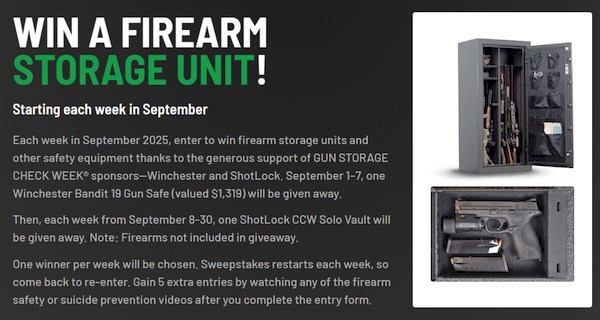
Those who visit GunStorageCheck.org will have chances to win firearm storage units and other safety equipment thanks to the generous support of Gun Storage Check Week sponsors — Winchester and ShotLock. For the week of September 1–7, one Winchester Bandit 19 Gun Safe (valued $1,319) will be given away. Then, from September 8 through the 30th, one ShotLock CCW Solo Vault will be given away each week, with one winner per week. The Sweepstakes restarts each week, so come back to re-enter. Note: Firearms are NOT included in giveaway.
Many online vendors are running sales this Labor Day Holiday weekend. You’ll find score of products marked way down, plus discount codes that can save you 15% or more on your purchases. Some sales run through end-of-day (11:59 pm) on Monday, September 1st, while other Labor Day sales extend into next week. Be sure to check the sale schedules.
Brownells Labor Day Sale — 15% Off Plus Sale Pricing
Save now with Brownell’s Labor Day Sale which is already underway. You get 15% Off popular $200+ parts and gear orders with promo code: LABORDAY15. Plus there is special SALE Pricing on a vast selection of popular products including actions, barreled actions, triggers, magazines and ammo.
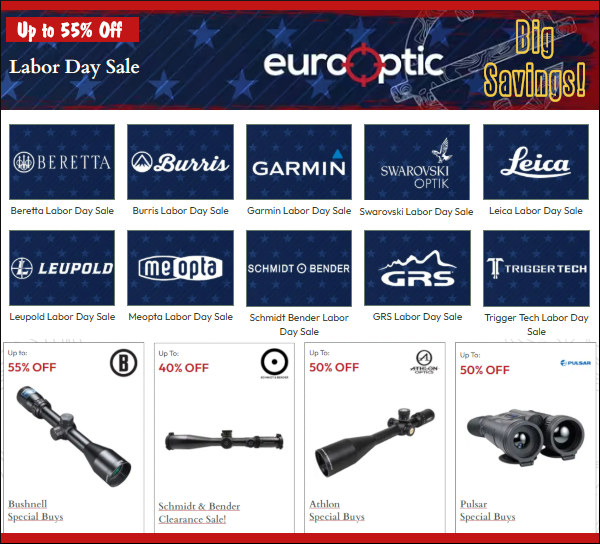
EuroOptic Labor Day Sale — Big Savings on Optics, Stocks & More
EuroOptic has a major Labor Day Sale with big savings on products from a dozen major brands. Discounts range up to 55% on Burris scopes, up to 47% on S&B scopes, up to 40% on Leupold and Leica optics, up to 47% on Meopta binoculars, up to 44% on GRS chassis/stocks, and up to 19% on Beretta shotguns and rifles. This is a great time to shop at EuroOptic with major savings on a huge range of products.
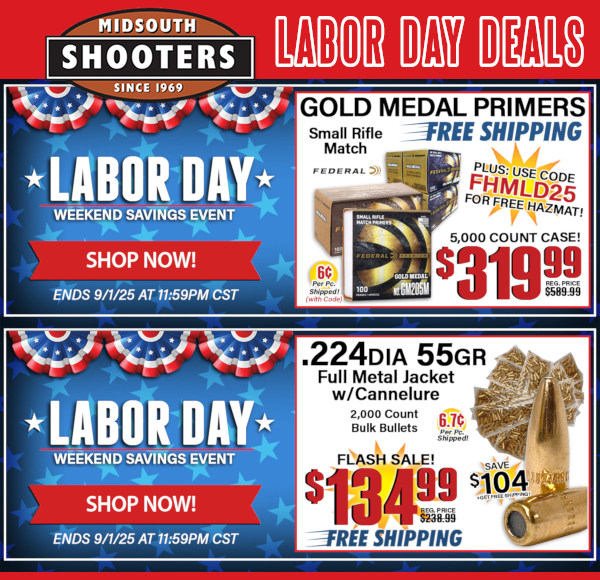
Not too long ago it was hard to find top-grade, American-made small rifle primers for under $110/1000. With this Labor Day Deal, you can get Federal’s superb GM205M Small Rifle Primers for just $64.99/1000 or $319.99/5000. PLus you can get FREE HazMat with code FHMLD25. If you shoot 3-Gun matches or are an active varminter with a .22-Cal rifle, this 55gr Bullet Special is a great deal — save a full $104 (44%) off the regular price. If you want either of these deals (or one of Midsouth’s other Labor Day Specials), don’t hesitate. These deals expire at 11:59 pm CT on September 1st, so act soon.
Primary Arms is running a huge Labor Day Sale, with major brand discounts on AR components (e.g. uppers and lowers), triggers, suppressors, and stocks. In addition there is a big Primary Arm Optics Closeout Sale with huge “Bonus Bucks” store credits. For example, with Primary Arms 3-18x50mm FFP Scope you get $100 in Bonus Bucks. This is a big sale, with new items appearing every few hours.
Sportsman’s Guide — Major Discounts and FREE Shipping $99+
For Labor Day weekend at Sportsman’s Guide there are up to 80% savings on select shooting gear and accessories, but with most savings 10% to 20%. A vast selection of hunting products are on sale including hunting blinds, tree stands, packs, camo clothing, boots and more. And bulk ammo from CCI, Fiocchi, and PMC is also on sale with major discounts for .380 ACP, 9mm, .223 Rem/5.56 NATO, 7.62×39, and .308 Win. For example, 1000 rounds of Blazer 9mm Ammo is $234.99, just $11.75 per 50rd box.
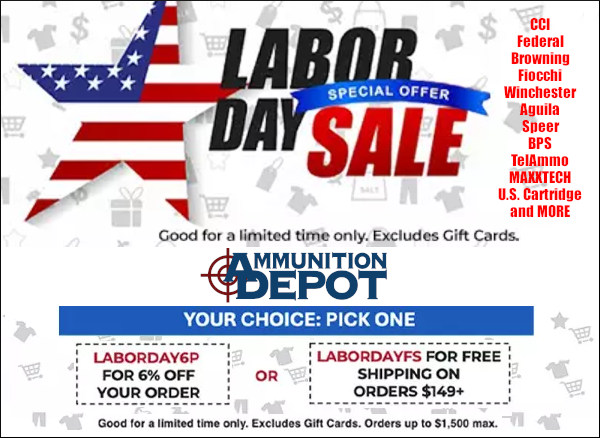
Ammunition Depot — Big Discounts On 16 Ammo Brands
If you need factory ammo for your rifles, pistols, or shotguns, head over to the Ammunition Depot. Right now there are discounts on a huge selection of ammo from 16 different ammo-makers including CCI, Federal, Fiocchi, Speer, Winchester and other big names. You can buy individual boxes, or bulk packs from 120 rounds up to 1000 rounds. On checkout you have two options. Use Code LABORDAY6P to save 6% on your ammunition order. OR, use Code LABORDAYFS to get FREE Shipping on $149+ ammo orders.
Enlightened Equipment — Outdoor Gear 20% Off + FREE Shipping
With hunting season right around the corner, now is the time to get your ultralight outdoor gear. Enlightened Equipment offers premium American-made sleeping quilts, apparel, and accessories for the outdoor enthusiast. They are currently running a great Labor Day sale that will save you 20% on all in-stock gear with FREE shipping across the USA.
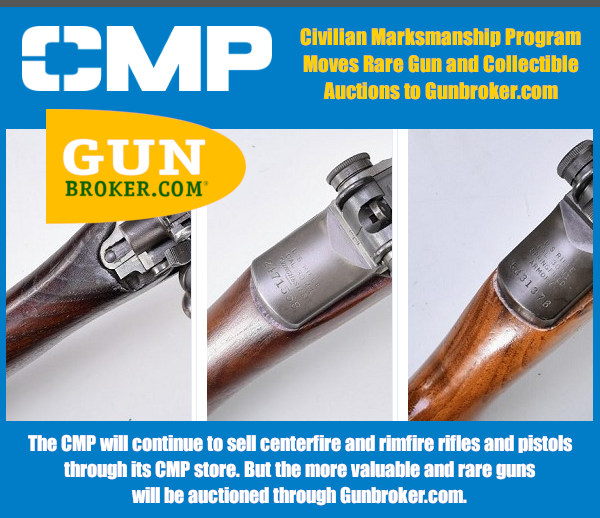
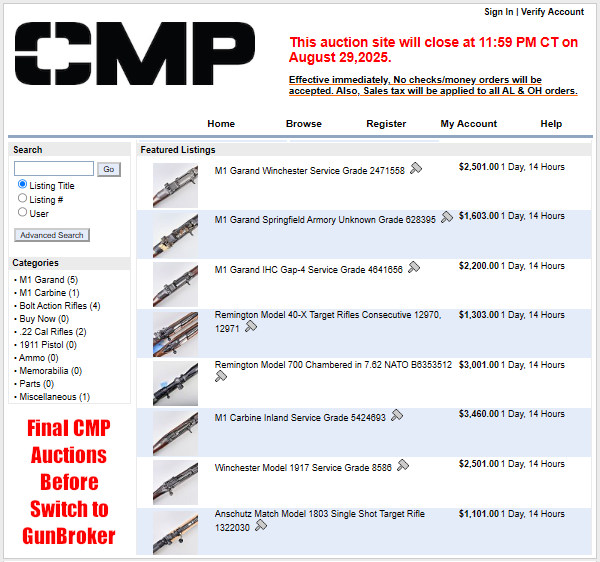
For decades the Civilian Marksmanship Program (CMP) sold firearms, barrels, and other valuable collectible products through its own CMP online auctions. This system worked well, allowing Americans to purchase M1 Garands, M1903 Rifles, 1911 pistols and more via the CMP auction site. But that’s all changing now. The CMP is moving its auction program to GunBroker.com. CLICK HERE for CMP Gunbroker INFO page. The final listings on the current CMP Auction site will end on Friday, August 29, 2025 at 11:59 PM Central Time.
But note, firearms and other products will continue to be sold in the CMP Store. It will be the select or more rare guns that will go up for auction. The CMP states that “Our partnership with GunBroker aims to enhance the quality of our auction services while giving more U.S. citizens the chance to own a treasured piece of our nation’s history.” The CMP store will continue to sell “non-select” M1 Garands, M1917 Enfields, M1911/A1 Pistols, as well as ammunition, gear, and shooting equipment. Visit CMP Online Store.
CMP Auctions on GunBroker
Beginning in September 2025, all CMP Auction and “Buy Now” items will be listed, displayed, and sold through GunBroker.com, one of the most widely-used online marketplaces for firearms and related items. CLICK HERE for more INFO on CMP Gunbroker Auction Programs.
Q. What type of CMP items can we expect to see auctioned on GunBroker?
Memorabilia and Collectibles
Rifles in very low quantities
Other items for which the auction program is used to determine market value.
CMP states this change should make auctions more accessible: “This transition will allow for improved accessibility, a more user-friendly bidding experience, and enhanced customer support, all while maintaining the same level of quality items you’ve come to expect from our auction site.”
CMP Auction Frequently Asked Questions (FAQs)
Here are some common questions about the CMP Auction transition, with answers from the CMP.
Q. How do I register to participate in auctions from the CMP?
Q: Will additional fees be added to auction items?
A: Since CMP is a non-profit, no extra fees will be charged on the GunBroker platform.
Q. Whom should I contact if I have questions about the item being auctioned?
A. Email khayden@thecmp.org or auction@thecmp.org. CMP hours of operation are 7:00 AM – 3:30 PM (CST) Mon-Fri. There is no one available to answer your questions on weekends.
Q: How will GunBroker ensure CMP membership and purchasing requirements are met?
Final CMP-Hosted Auctions Conclude August 29, 2025 at 11:59 PM CT
Learn More About CMP Auctions on Gunbroker
CMP’s current auction website includes a link to the new CMP Page on GunBroker.com. Current and featured listings will also be visible on the CMP site, with direct links to the GunBroker auction.
If you have questions, contact the CMP Auction Team at auction@thecmp.org or 256-835-8455 ext. 418. Inquiries relating to GunBroker account creation are handled through the GunBroker Help Center.
Our friend Gavin Gear has just released an excellent video showing how to make a threaded Modified Case for use with the Hornady Lock-N-Load Overall Length Gauge. You can watch Gavin make a Modified Case start to finish in the video below:
Video Shows How to Drill and Tap Modified Case
Gavin has some clever tricks. First he uses a sizing die to hold the cartridge case during the threading process. Second he uses two drill bits in sequence — a smaller bit to ream out the primer pocket, and then a larger “M” bit to increase the hole diameter before threading the brass. Finally he leaves the threading tap IN the brass, locks the tailstock, and then “gently pulls on the quill” to remove the brass from the die held in his lathe (See 5:46 timemark).
Get the Correct 5/16″-36 RH Tap
Unfortunately, Hornady has selected an uncommon thread type for OAL Gauges. You probably won’t be able to buy the correct 5/16″ – 36 RH HSS Tap at your local hardware store. However you CAN order this special tap from Amazon for $9.99.
Modified Case Q & A — TECH TIPS
Why do I need a Modified Case?
Every serious reloader should have a Modified Case for each cartridge type they shoot. The reason is that this allows you to get very precise measurements of the length-to-lands in your chamber. When used with the Hornady OAL Gauge, with some practice, you should be able to get repeatable length-to-lands measurements within about 0.0015″. We generally do 4-5 measurements with the OAL Gauge and usually 3 or 4 will be “on the money”. NOTE: We recommend a gentle, easy pressure on the plastic pusher rod. Don’t push too hard or you will jam the bullet hard into the lands, which produces inconsistent results.
Can’t I Just Buy a Modified Case?
Hornady makes a variety of Modified Cases sold on Amazon and through retailers such as Midsouth. While Hornady makes modified cases for many standard cartridges, if you shoot a wildcat such as the 6mm Dasher or .284 Shehane, you’ll need to create a custom modified case. And even if you shoot a standard cartridge such as the .308 Win, you can get more consistent measurements with a custom Modified Case.
If you do decide to make your own modified case, you’ll want to start with a case that’s been fired in your rifle. That way you get the best fit to YOUR chamber. Also, you won’t need to expand the neck to provide bullet clearance. Then you need to drill out the primer pocket and tap the base of the case to match the threads on the Hornady OAL Gauge tool. Make at least two modified cases, as you’ll probably misplace one at some point.
MORE INFORMATION: Want to learn more? We published a much longer story in which Erik Cortina explains in greater detail how to made the Modified Case. That article illustrates the 5/16″ – 36 RH HSS Tap required and shows how to set up the lathe to drill and tap your case. If you are serious about making your own Modified Cases, you should Read the Full Article.
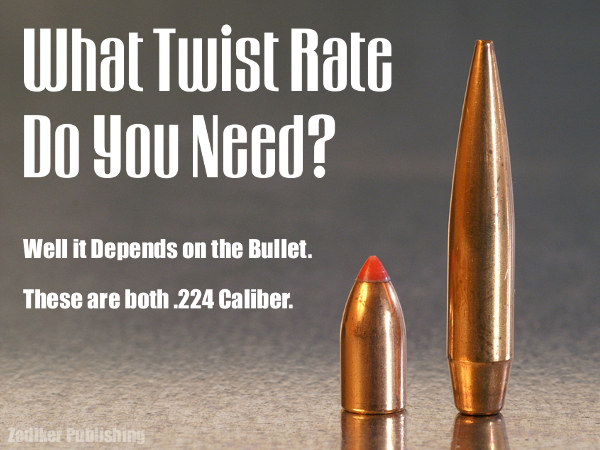
Here’s an extreme range of .224-Caliber bullets: 35gr varmint bullet and 90gr match bullet. Of course, along with bullet length/design, you need to consider MV when choosing twist rate.
Even with the same caliber (and same bullet weight), different bullet types may require different rates of spin to stabilize properly. The bullet’s initial spin rate (RPM) is a function of the bullet’s muzzle velocity and the spin imparted by the rifling in the barrel. You want to ensure your bullet is stable throughout flight. It is better to have too much spin than too little, according to many ballistics experts, including Bryan Litz of Applied Ballistics. The late Glen Zediker put together some basic tips concerning barrel twist rates and bullet stability. These come from Glen’s book, Top Grade Ammo.
Choosing the Right Twist Rate
I’d always rather have a twist too fast than not fast enough. Generally… I recommend erring toward the faster side of a barrel twist decision. 1:8″ twist is becoming a “new standard” for .224 caliber, replacing 1:9″ in the process. The reason is that new bullets tend to be bigger rather than smaller. Don’t let a too-slow twist limit your capacity to [achieve] better long-range performance.
Base your next barrel twist rate decision on the longest, heaviest bullets you choose to use, and at the same time realize that the rate you choose will in turn limit your bullet choices. If the longest, heaviest bullet you’ll shoot (ever) is a 55-grain .224, then there’s honestly no reason not to use a 1:12″. Likewise true for .308-caliber: unless you’re going over 200-grain bullet weight, a 1:10″ will perform perfectly well.
Bullet Length is More Critical than Weight
Bullet length, not weight, [primarily] determines how much rotation is necessary for stability. Twist rate suggestions, though, are most usually given with respect to bullet weight, but that’s more of a generality for convenience’s sake, I think. The reason is that with the introduction of higher-ballistic-coefficient bullet designs, which are longer than conventional forms, it is easily possible to have two same-weight bullets that won’t both stabilize from the same twist rate.
Evidence of Instability
The tell-tale for an unstable (wobbling or tumbling) bullet is an oblong hole in the target paper, a “keyhole,” and that means the bullet contacted the target at some attitude other than nose-first.
Increasing Barrel Length Can Deliver More Velocity, But That May Still Not Provide Enough Stability if the Twist Rate Is Too Slow
Bullet speed and barrel length have an influence on bullet stability, and a higher muzzle velocity through a longer tube will bring on more effect from the twist, but it’s a little too edgy if a particular bullet stabilizes only when running maximum velocity.
My failed 90-grain .224 experiment is a good example of that: I could get them asleep in a 1:7″ twist, 25-inch barrel, which was chambered in .22 PPC, but could not get them stabilized in a 20-inch 1:7″ .223 Rem. The answer always is to get a twist that’s correct.
These tips were adapted from Glen’s popular 2016 book, Top-Grade Ammo. That work, now getting harder to find, has numerous helpful articles on technical topics. Berger Bullets also has a FREE online Twist Rate Stability Calculator, developed by Applied Ballistics.
Labor Day 2025 (September 1st) is just 5 days away. Soon we’ll be enjoying a major 3-day holiday weekend. We know many of our readers will be out on the road visiting friends or enjoying end-of-summer getaways. How do you do your reloading chores while traveling on holiday? Here’s a solution from Forum member Dave Gray (U.S. Army Retired).
Dave is a self-declared “full-time RVer” who spends most of his time on the road. Behind his Ram 3500 pickup, Dave tows a huge 41-foot Heartland Cyclone toy hauler featuring a 12X8 foot garage in the rear. In the rear garage area, which holds a compact Smart Car, Dave has set up a removable reloading bench complete with RCBS Rockchucker single stage press and Dillon progressive press.
Reloading Bench Mounts to RV Wall with Brackets
Dave explains: “I used a 2″X6″X5′ board for the bench. It’s perfect for my needs, and is easy to disassemble. I made it this small so that I can park my Smart Car in the garage during travel to my destinations. The bench, attached to the wall frames, is very solid. The presses’ centers are 3″ and 6.5″ from the brackets. [There are] four bolts on the wall into aluminum wall frame and 3 bolts in the bench. If I ever have to replace the current board, I’ll do so with oak or birch or hickory. When I’m not reloading, I remove the presses and store them in a protected space. I can easily attach other equipment to the bench by using C-Clamps.” Dave’s “rolling reloading room” looks very well thought-out. We commend Dave for his inventiveness.
How to Fill Shooting Sandbags Most Effectively
For both front and rear Edgewood bags, start by looking for the black nylon/cordura flap. This flap will have white stiches running along both sides. Note that the flap is actually two pieces of nylon/cordura which are sewn together. These two pieces must be separated at the end where there are no stitches in order to insert a funnel or other filling device.
Hold the bag so that the flap is pointed straight up and fill half way. Using a blunted rod and alternating between filling and packing, begin packing the sand firmly into the bag until the shape is uniform and you are satisfied with the firmness. Slam the base of the bag firmly on the bench several times to compact and evenly seat the sand. Then, check to see if more sand needs to be added. Repeat this process for the ears if you are filling a rear bag. Note that as the sand continues to condense during use, the bag may occasionally require additional sand until it reaches maximum capacity. NOTE: This tip is from Creedmoor Sports, which carries Edgewood Shooting Bags.
Edgewood offers an innovative rear Twisted Gater bag with an unusual asymmetrical footprint. This provides arm/hand support for the shooter while still providing superb rear support for your bench rifles.
SANDBAG Fill Options — Yes Weight Matters
For most shooting applications, “heavy is good” when it comes to sandbags. The more your sandbag weighs, the better it will resist movement or mis-alignment that can throw off a shot. In order to increase the weight of their rear bags, serious shooters have turned to exotic sand formulations that offer greater density (hence higher weight by volume) than plain silica sand (aka “play sand”).
In this article, Jason Baney reviews three popular alternatives to play sand for rear sandbags. He tested each variety to determine its density, i.e. how much volume it would displace per pound. Then he calculated how much each type of sand would weigh in various sizes of rear sandbags: standard, large, and ultra-large (Bigfoot). Check our Rapid Reference Chart to see how much weight you can add to your sandbag by switching to heavy sand.
Is heavy sand worth the added expense? For serious shooters, the answer is yes. More mass equals more stability, and a more stable bag will help you shoot tighter groups. By switching from conventional sand to Zircon or Chromite, you can DOUBLE the weight of sand in your rear bag.
Shown above are the SEB Bigfoot Bags. Note that the bags sit perfectly flat — there is no bulge on the bottom even though the bags are “packed to the brim with sand”.
Heavy Sand — Weighing the Benefits by Jason Baney
Many serious Benchrest shooters fill their sand bags with “heavy sand”. This practice may seem “overkill” to most shooters, but its benefits are realized quickly when shooting from a bench. Heavy sand is more dense than normal silica “play sand” and therefore makes the sandbag heavier and more stable. How much heavier is the heaviest sand? Check the chart below and you’ll see that Zircon sand weighs essentially TWICE as much as ordinary play sand. More weight equals more inertia opposing bag movement, plus more gravity-induced “stiction” on the bottom of the bag. In other words, using heavy sand helps your rear bag stay planted on the bench during a string of fire. When you shoot a hard-recoiling gun, the difference between a bag filled with play sand vs. Zircon is very noticeable. The Zircon-filled bag stays put. The play sand-filled bag may not.
Rapid Reference Chart
Comparative Sand Weights by Sandbag Size
SandBag Type
Play Sand
Riverbed Sand
Chromite
Zircon
Standard 5″x6″
5.1 lbs.
7.9 lbs.
9.9 lbs.
10.1 lbs.
Large 6″x8″
6.8 lbs.
10.5 lbs.
13.2 lbs.
13.4 lbs.
BigFoot 6″x13″
10.2 lbs.
15.8 lbs.
19.7 lbs.
20.1 lbs.
Weight Increase Compared to Play Sand
Zincon +98%
Chromite +94%
Riverbed Sand +55%
The Benefits of Heavier Sand
Heavy Sand helps your sandbag resist the tendency to shift or change alignment (relative to the stock) during recoil. This ability to maintain sandbag alignment is vital when shooting competitive Benchrest, either short-range or long-range. Having to fight a “migrating” rear bag during a group at 1000 yards will not do anything to help your accuracy. In non-competitive use, heavy sand can still benefit shooters. Friction from the stock on the rear bag, or bumping the bag on recoil with either a body part or pistol grip can move a lighter bag out of place and necessitate realigning the bag to get on target.
Of course there are some shooting situations where you don’t need (or don’t want) maximum sandbag weight. During a “walk-around” varmint session you may prefer a lighter bag. Beanbags that I carry around the groundhog fields stay filled with plastic beads, making the bag handier to tote. But, any rear bag used on a bench will be as heavy as I can make it while still using “sand” as filler.
Heavy Sand, Lead Shot, and Competition Rules
Some will say, “Well if you want a heavier sandbag, why not just add lead shot?” That is a great idea, but as far as I know, it is also illegal in every form of Benchrest competition. The material in sandbags must actually be “sand”, and only sand. It’s tempting to filter in a mix of shot and sand to increase weight, but that would also violate the rules.
Heavy Sand — Available Types and Properties
Heavy sand comes in several different varieties. In this article we tested three types: Zircon, Chromite, and commercial Riverbed sand (Exo-Terra brand “Reptile Sand”). All these are heavier alternatives to normal silica “play sand.” There are other types of Heavy Sand not tested here, such as Garnet Sand, which is between Chromite and Zircon in weight.
Sources: ProtektorModel.com sells black “Heavy Sand”, basically chromite. Large quantities of Zircon and Chromite are available from IFS Industries, and other industrial suppliers.
Exo-Terra Riverbed sand (amber). Available at pet stores.
Silica “Play Sand” (tan or light gray). Available at Home/Garden stores.
Zircon — Heavy-Weight Champion
To my knowledge, “Dupont Zircon M” is the heaviest “sand” that a normal human can acquire. It is also the most expensive. Zircon is a very light tan/brown color and is very similar in appearance to normal sandbox “play sand”. Zircon is normally rated as having the greatest density among heavy sands and it has the smallest particle size, though some Chromite sand density values overlap the Zircon numbers.
1.00 pound of Zircon displaces 149cc vs. 295cc for Play Sand. So, that means Zircon is 98% heavier than an equal volume of Play Sand.
CONSUMER TIP: Real ZIRCON sand is TAN in color, not black or dark gray. Some “heavy sand” vendors promise Zircon but deliver a dark gray sand that is something else entirely!
Chromite — Almost as Heavy as Zircon, and 30% Cheaper
Chromite sand is nearly the same density as Zircon but it costs quite a bit less. Chromite typically sells for about 25-30% less than Zircon (comparing bulk prices of both types of sand). Chromite sand is black in color. So when you buy “heavy sand,” make sure you are getting what you pay for.
1.00 pound of Chromite displaces 152cc vs. 295cc for Play Sand. So, that means Chromite is 94% heavier than an equal volume of Play Sand.
Riverbed Sand — Weighs Less but Costs More than Chromite
Riverbed sand, is about 30% less dense than Zircon or Chromite, but is about 150% more dense than silica sand. Depending upon where you buy this sand, and the quantity, you will most likely pay more for this sand than you would Zircon or Chromite. Riverbed sand is a conglomerate of several different sizes and colors and appears red and black. Unless you are unable to get Zircon or Chromite, I would not bother with the riverbed sand.
1.00 pound of Riverbed Sand displaces 190cc vs. 295cc for Play Sand. So, that means Riverbed Sand is 55% heavier than an equal volume of Play Sand.
Density/Volume Testing and Weight Comparisons
All four sand varieties mentioned above were tested for volumetric density by weight. Each type of sand was weighed out to 1.00 lbs. on a commercial postal scale. Each 1.00 lb sample of sand was then poured loosely into a 600ml beaker and shaken minimally to level the top surface. This served to determine the volume that the sand occupied.
1.00 pound of sand displaced the following volumes:
Zircon: 149 cc
Chromite: 152 cc
Riverbed sand: 190 cc
Play Sand: 295 cc
How do the density-volume numbers translate to the real world? Here is an estimate of how much each sand would weigh in various sizes of rear bag:
Standard Bunny Ear Bag
5″ by 6″ footprint or about 1500cc
Zircon: 10.1 lbs.
Chromite: 9.9 lbs.
Riverbed Sand: 7.9 lbs.
Play Sand: 5.1 lbs.
Protektor Doctor Bag
6″ by 8″ footprint or about 2000cc
Zircon: 13.4 lbs.
Chromite: 13.2 lbs.
Riverbed Sand: 10.5 lbs.
Play Sand: 6.8 lbs.
Seb BigFoot Rear Loaf Bag
6″ by 13″ footprint or about 3000cc
Zircon: 20.1 lbs.
Chromite: 19.7 lbs.
Riverbed Sand: 15.8 lbs.
Play Sand: 10.2 lbs.
Conclusions and Recommendations
What’s the best choice? For most users, we recommend Chromite. Chromite delivers nearly the same bag weight as Zircon but is more economical to buy. But for those who demand the maximum weight in their sandbag (without consideration of cost), Zircon is the top choice because it is sold at a finer grade (higher density) than Chromite. However, Chromite will save you money, and deliver very nearly the same amount of weight by volume. When purchased in bulk, Chromite is typically 25-30% LESS expensive than Zircon.
I would not suggest using the Riverbed sand unless you really need to fill a sandbag immediately and can’t wait to locate a source for either Zircon or Chromite. Keep in mind that Sinclair Int’l and other major mail-order vendors do sell heavy sand (though Zircon and Chromite may be much less expensive when purchased in larger quantities from local industrial sources.) The price of the Riverbed sand will vary quite a bit depending on the pet store and quantity bought. The Riverbed sand I tested, Exo-Terra Reptile sand (photo right), was fairly expensive as purchased at a pet store.
Bottom Line: When it comes time to fill your new rear bag, you may want to save a few dollars and go with cheaper Chromite sand, but if you want to gain every bit of weight possible, step up to the heavier Zircon.
Lenzi Rear bags work very well and are popular with top competitors. This are sold through PMA Tool.


















 Increasing Barrel Length Can Deliver More Velocity, But That May Still Not Provide Enough Stability if the Twist Rate Is Too Slow
 Labor Day 2025 (September 1st) is just 5 days away. Soon we’ll be enjoying a major 3-day holiday weekend. We know many of our readers will be out on the road visiting friends or enjoying end-of-summer getaways. How do you do your reloading chores while traveling on holiday? Here’s a solution from Forum member Dave Gray (U.S. Army Retired).
 Reloading Bench Mounts to RV Wall with Brackets

 How to Fill Shooting Sandbags Most Effectively
 For most shooting applications, “heavy is good” when it comes to sandbags. The more your sandbag weighs, the better it will resist movement or mis-alignment that can throw off a shot. In order to increase the weight of their rear bags, serious shooters have turned to exotic sand formulations that offer greater density (hence higher weight by volume) than plain silica sand (aka “play sand”).
 Many serious Benchrest shooters fill their sand bags with “heavy sand”. This practice may seem “overkill” to most shooters, but its benefits are realized quickly when shooting from a bench. Heavy sand is more dense than normal silica “play sand” and therefore makes the sandbag heavier and more stable. How much heavier is the heaviest sand? Check the chart below and you’ll see that Zircon sand weighs essentially TWICE as much as ordinary play sand. More weight equals more inertia opposing bag movement, plus more gravity-induced “stiction” on the bottom of the bag. In other words, using heavy sand helps your rear bag stay planted on the bench during a string of fire. When you shoot a hard-recoiling gun, the difference between a bag filled with play sand vs. Zircon is very noticeable. The Zircon-filled bag stays put. The play sand-filled bag may not.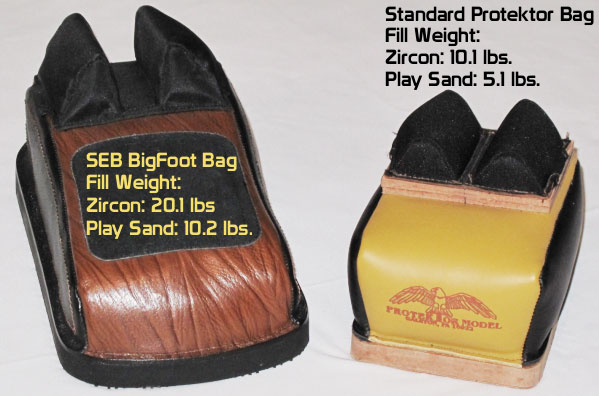
 Dupont Zircon M (pale tan): 165-175 lb/cu.ft; avg. particle size 0.01″.
 Prince Minerals Chrome CAST 7850 (Chromite) (black): 172 lb/cu.ft; avg. particle size 0.02″.

 Zircon — Heavy-Weight Champion
 Chromite — Almost as Heavy as Zircon, and 30% Cheaper
 Riverbed Sand — Weighs Less but Costs More than Chromite


 I would not suggest using the Riverbed sand unless you really need to fill a sandbag immediately and can’t wait to locate a source for either Zircon or Chromite. Keep in mind that


