Brownells’ Do-It-Yourself (DIY) video series provides logical, step-by-step installation help for triggers, stocks, and springs. Nine separate videos cover Brownells various DIY Kits. Not sure if you’re up to the project? Just watch each video to see what’s involved. The nine DIY kits are:
This video shows Remington 700 after-market trigger installation:
In the Do-It-Yourself videos, Brownells’ Gun Techs proceed step-by-step, showing you exactly how to install the parts on your gun. Each kit also comes with complete, illustrated instructions you can take to the bench. To learn more, click the links above, or CLICK HERE to visit Brownells’ DIY Kit online page.
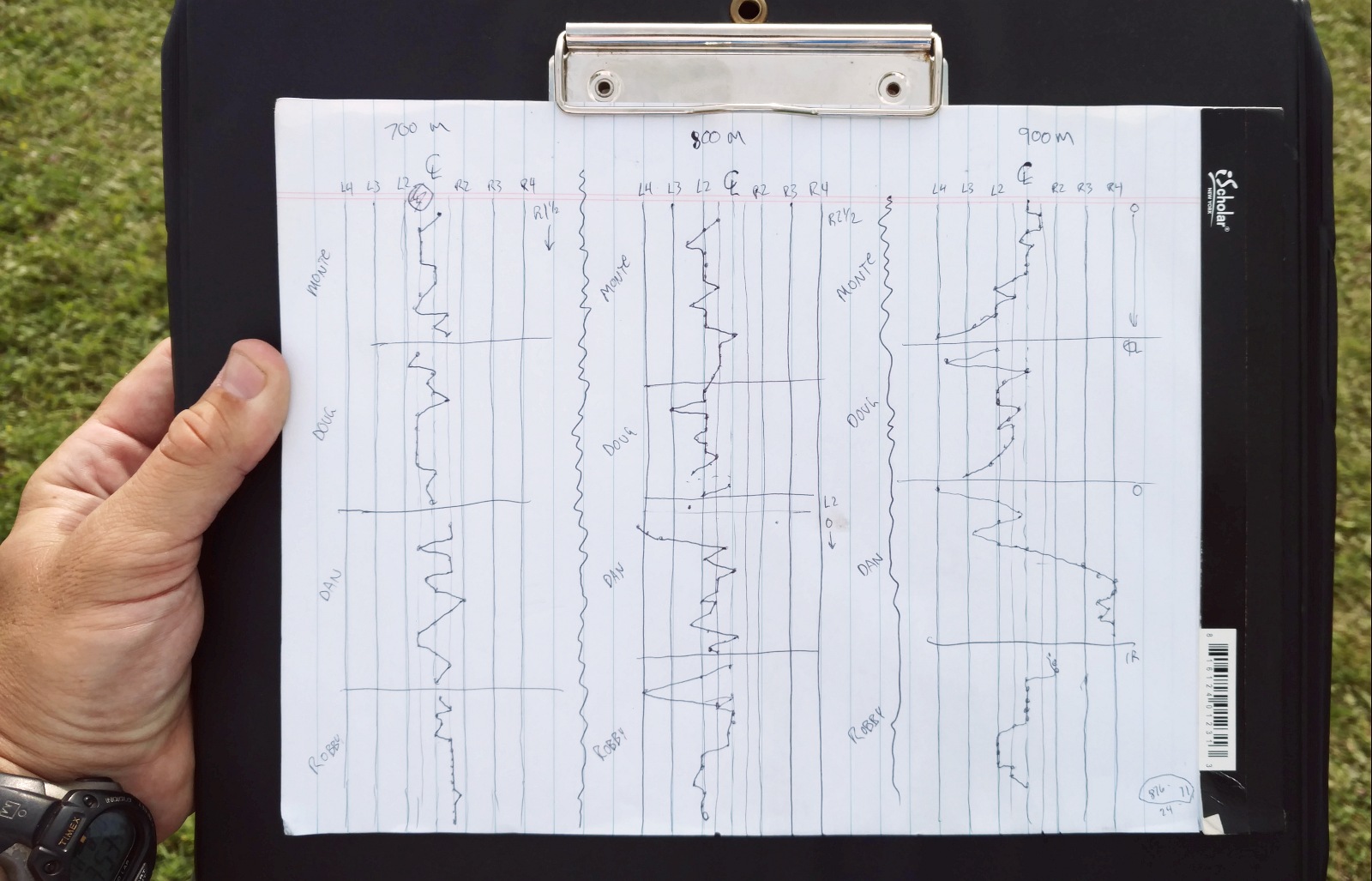
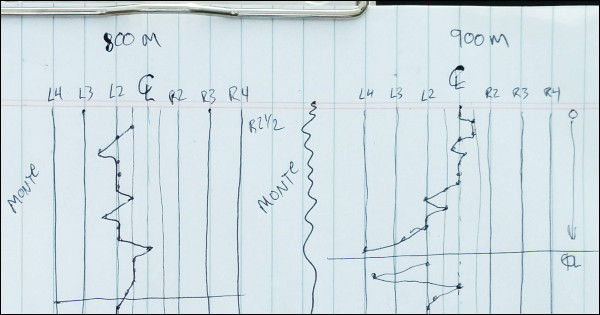
CLICK HERE to see full-screen version of Wind Plot.
Team shooting is very different than individual competition. Typically a team coach makes the wind calls for the shooters. In some cases (where the rules allow), the wind coach even dials elevation and windage changes for the active shooter. For the wind coach to do his job effectively, he must follow the changes in the wind and determine what the correct wind call should have been for each shot. (In other words — what was the “right call”)
Bryan Litz, founder of Applied Ballistics and Past USA F-TR National Champion, served as wind coach for the winning 4-man F-TR Team at the 2017 Canadian F-Class Championships, which preceded the F-Class World Championships also held in Canada. Here Bryan explains how he has used a Wind Plot to make better wind calls, helping his team-mates maximize their scores.
Wind Plot Methodology by Bryan Litz
The wind plot I use is a running history of what the correct wind call was for every shot fired. The more you shoot, the more history you have in a condition, and I find that very useful information. This kind of plot IS NOT showing where the bullet hit, and is NOT showing what you held. It’s showing what you should have held to center each shot. IMO, this is the most valuable information to have when guessing where to hold next for each shot. Here are some key points:
1. I always look for blocks of stable conditions to shoot in and wait out the rest.
2. If the wind plot shows drastic changes, either I’m not picking the right time to shoot or it’s just a really unstable wind condition.
3. When you see many shots using the same hold (e.g. Robby’s 700m and 900m strings on plot), it can indicate very fast shooting and fast pit service.
Q. What are the numbers and Markings on this Wind Plot?
Litz: The wind plot represents the rings on the target. Left 2 for example, is the 5 line on the international target, while Left 2 is the 10 line on the USA target. F-Class shooters and coaches talk about wind holds in relation to these rings. A Left 2 hold isn’t left 2 MOA or 2 MILS, it’s the second ring from center. The vertical lines on the plot represent the rings going out from center, 4 or 5 in each direction. A left or right 5 hold is edge of black on the int’l target.
Q: What Does this Specific Plot Reveal?
Litz: Looking at the plot, from left to right is 700m, 800m, and 900m that we shot progressively through the day. Top to bottom shows each shooter in sequence (shooters names are shown by their blocks). To the right I note what was on the gun for that shooter, and note when it changes. Often times we run the same wind on the gun for several shooters but if it changes, I note what the new windage is and continue on. For example if we’re settled into a condition where we’re shooting Vs with a right 3 hold, I might adjust the scope 1 MOA right because a right 3 hold is equal to 1 MOA. So we can move the scope and start shooting with a center hold.
Q. Are you Plotting Where the Bullet Hits?
Litz: Not exactly. This kind of plot IS NOT specifically showing where the bullet hit, and IS NOT showing what the shooter held. It’s showing what the shooter should have held to center each shot. IMO, this is the most valuable information to have when guessing where to hold next for each shot.
On each shot, the shooter or coach takes a guess about where to hold, and fires the shot. If the bullet hits the center, you plot the point right where you held because it was the correct hold. However, if you miss the call, you plot what hold was required to put that shot in the center. For example if you shoot a right 3 and hit where you held, the correct call would have been “center”. In this way, you’re building a history of what you should have done, which may or may not be what you actually did. This shows you the trends, and brackets which can be used to make future decisions.
Q: Is this Type of Wind Plot Something New?
Litz: I didn’t invent this method, it’s been around a long time. Vertical can be plotted the same way. In team matches, we have a plotter who is advising on elevation trends and suggesting corrections. But, as wind coach, my job is the horizontal so I only keep the wind plot. I have learned lots of strategies from my coaches Emil Praslick and Steve Hardin.
There are many ways to plot and many standard work sheets for this. They’re all tools and the key is to find something that works for you in different situations. I don’t keep a plot when I am personally behind the trigger string firing because I lose more points when I take the time to do it vs. just shooting fast. When pair firing or coaching, I can keep the wind plot without compromising the shooting.
Here Team Australia used plots and communication gear linking coaches. This helped the Aussies win the 2013 F-Open Team World Championship held at Raton, NM.
Know Your Goal — Keep It Simple
Know your goal of plotting. The simplest plot is where you write the shot number where it hit on a target face. This kind of plotting is useful for evaluating shooter performance because it shows how big the group is (in particular the vertical dispersion). However keeping a plot like this does little to help you figure out the wind. It just shows you what shots you messed up on. It does nothing to help you find the center. [Editor: That’s a whole different matter with many variables.] The wind plot I use is a running history of what the correct wind call was for every shot fired. The more you shoot, the more history you have in a condition, and I find that very useful information.
We first ran this story a few years back. We’re republishing it today as a reminder to our readers that safety should be their paramount concern at the range. Avoid distractions and always check your barrel for obstructions before you chamber a round or pull the trigger. A moment of inattention can result in a catastrophic kaboom.
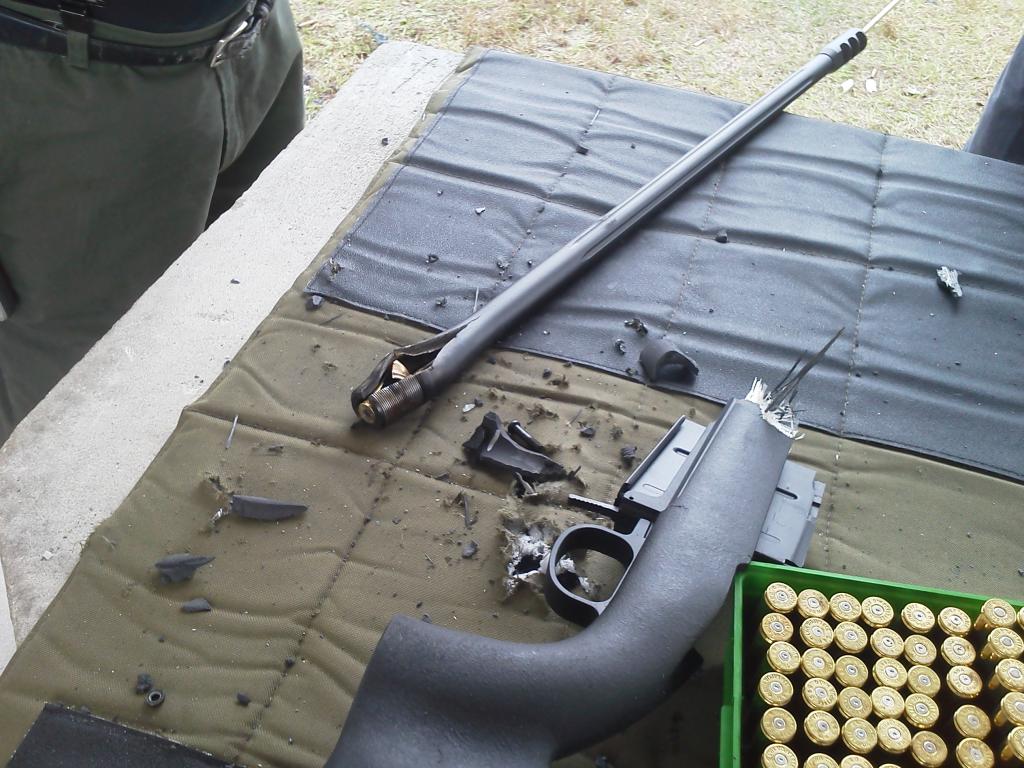
Discharging a .338 Lapua Magnum round with a cleaning rod in the barrel — that’s a recipe for disaster. What happens when a fired .338 caliber bullet and a cleaning rod try to occupy the same place at the same time? Well you get a catastrophic kaboom, with metal pieces flying all over the place, and a shooter very lucky to escape without serious injury. This incident occurred recently in Manatee, Florida, as reported by Sniper’s Hide member Queequeg. We thank SnipersHide.com for granting permission to publish these revealing images in the Daily Bulletin. CLICK HERE for more Kaboom info from the ‘Hide.
This story should serve as a chilling reminder to follow proper safety practices whenever you are at the range. Always check to make sure there is no obstruction in the bore BEFORE loading a live round.
.338 Lapua Magnum + Cleaning Rod + Inattention = Kaboom!
Kaboom at Manatee!
Sniper’s Hide member Queequeg recently published shocking photos of a catastrophic kaboom involving a .338 Lapua Magnum (Savage action). The action was blown off the rifle, shrapnel went through the roof, and the barrel split at the tenon before taking an excursion downrange. The action did crack in the front but the lugs remained engaged so the bolt did not slam to the rear (luckily for the shooter).
Here’s the report: “This happened [January 20, 2014] at the Manatee Gun and Archery Club. Al, Ren and myself were there with a couple other folks. Ren was at bench 12, I was at 13. The fellow at 11 was running a Savage .338 Lapua. He had a very bad day! He damn sure could have killed himself and quite likely Ren as well.”
Queeqeg added: “After the boom, I heard Ren ask ‘Are you alright’ and then turned to look in time to see the fellow reacting in total shock — literally stunned. Ren and I went over to him and could not see any major injuries. Ren was uninjured as well but had a lot of fiberglass splinters on him. The barrel nut is what I presume punched the two holes in the roof. The shooter is a regular there[.] He had been having a problem with sticky cases though he said he was certain the loads were mild. That’s why he was content to knock the sticky ones out with the rod. He simply forgot to remove the rod after knocking out the last stuck case. You can see what happened next.”
To learn more about this incident, go to the original Snipers Hide Forum Thread. There you’ll find more details and four pages of related discussions.
The Important Lesson Here
What did the .338 LM shooter do wrong here? You will say — “Well that’s obvious, he left a cleaning rod in the barrel and then shot a round.” Yes, that was a potentially fatal error. But that was his second mistake — one that occurred only because he made a more fundamental judgment error first.
The FIRST mistake was not acknowledging the problem with his ammo. Had he heeded the warning signs, he would still have a rifle (and an unsoiled pair of trousers). When he first observed that he was having problems with extracting cases, a warning light should have gone off in his head. Presuming his extractor was not broken (and that the chamber was cut properly) he should have been able to extract his brass if he was running safe loads. The lesson here we all need to learn is that if you observe a serious ammo-related issue, it is time to stop shooting. Don’t try to invent work-arounds just to extend your range session, when there are clear signs that something is wrong, very wrong.
The 2022 NRA Annual Meetings & Exhibits will be held May 26-29, 2022, at the George R. Brown Convention Center in Houston, Texas. Starting Thursday evening the 26th, the NRA Annual Meetings will include numerous special events over the four days preceding Memorial Day (Monday May 30th). The NRA will have a powerhouse lineup of political speakers, country music artists, plus workshops and seminars. Below major events are listed. Along with these events, the Exhibit Hall will showcase over 14 acres of the latest guns and gear from shooting industry companies. Over 540 exhibitors.
Major Scheduled Events at 2022 NRA Annual Meetings
NRA-ILA Leadership Forum
May 27, 2022 | General Assembly Hall, George R. Brown Convention Center I
Confirmed Speakers will include: Wayne LaPierre (NRA Exec. VP), Jason Ouimet (NRA-ILA Exec. Director), Texas Governor Greg Abbott, U.S. Senator John Cornyn, U.S. Senator Ted Cruz, Congressman Dan Crenshaw, Kristi Noem, South Dakota Governor, Mark Robinson, North Carolina Lt. Governor.
The U.S. Army Marksmanship Unit regularly publishes “how-to” articles on the USAMU Facebook page. A while back, the USAMU’s reloading gurus looked at the subject of case lubrication. Tasked with loading thousands of rounds of ammo for team members, the USAMU’s reloading staff has developed efficient procedures for lubricating large quantities of cases. This article reveals the USAMU’s clever “big-batch” lube methods. For other helpful hand-loading tips, visit the USAMU Facebook page.
Rapid, High-Volume Case Lubrication
Today’s topic covers methods for quickly applying spray lube to cartridge cases prior to sizing. A typical order for this shop may be 25,000 rounds, so [speeding up] the lubrication process can be a real time-saver. While your ammunition lots probably aren’t this large, the efficient methods discussed here may help save a considerable amount of time over your handloading career. Our case lubrication rates range from 1500-1600 cases per hour, to 2400-2500 cases per hour, depending on caliber.
This shop uses virgin brass, whereas most home handloaders use fired brass, which necessitates some small changes at times. These will be discussed as they arise. Begin with fired brass that has been tumbled clean.
Ensure as much tumbling media as possible is removed from the brass, as when it gets into a size die, it can dent cases significantly. This is a good time to round out dents in the case mouths using a tapered tool to prevent damage from the decapping stem.
First, dump the clean cases into a large box or reloading bin. Shake the bin back and forth so that many cases are oriented with the mouths up. Next, pick up as many cases as is convenient with the mouths “up”, from natural clusters of correctly-oriented cases. With 7.62mm-size cases, this is usually 3-4, and with 5.56mm cases, this can be up to 8-10. Place the cases into the rack slots, mouth-up. Doing this in groups rather than singly saves considerable time. Once these clusters have been depleted, it will be time to re-shake the bin to orient more cases “up.”.
This photo shows a case lubrication rack made by a USAMU staffer.
Naturally, adjust the spacing to best fit the calibers you reload. We have found this size … convenient for handling through the various phases of case lubrication/transfer to progressive case feeders for processing. Note that the 1/2-inch angle does not cover much of the critical case area at the base, just forward of the extractor groove, where most re-sizing force will be exerted. As the USAMU uses virgin brass, less lubrication is required for our brass than would be needed for Full Length (FL) sizing of previously-fired brass.
NOTE: The amount applied using our rack is easily enough for our purpose. If using fired brass, be sure to adequately lube this base area to avoid having cases stick in the full-length sizing die.
Using a spray lube, coat the cases adequately, but not excessively, from all sides. Be sure to get some lube into the case mouths/necks, in order to reduce expander ball drag and case stretching/headspace changes. The spray lube this shop uses does not harm primers or powder, and does not require tumbling to remove after lubing.*
Take a close look at the photo above. The USAMU shop uses a common kitchen turntable, which allows the rack to be rotated easily. We place this in a custom-made box which prevents over-spray on to floors and walls.
Angled Box Method for Smaller Cases to be Neck-Sized
A refinement of the above method which especially speeds processing of 5.56x45mm cases is as follows. A small cardboard box which holds about 100 cases is fitted with an angled “floor” secured by tape. With the smaller 5.56mm cases, usually about 8-10 cases per handful can be picked up, already correctly-oriented, and placed into the box together. This prevents having to place them into the rack slots, saving time.
HOWEVER, note that this does not allow nearly as much lube access to the case bodies as does the rack. For our purposes — neck-sizing and setting neck tension on new brass, this works well. If using this procedure with fired brass, take steps to ensure adequate lube to prevent stuck cases.
As always, we hope this will help our fellow handloaders. Good luck, and good shooting!
*A two-part test performed here involved spraying primed cases heavily, while getting more lube into the case mouth/body than even a careless handloader would likely apply. The second part of the test involved literally spraying considerable quantities of the lube directly into the cases, drenching the primers. After a several-day wait to allow the lube to penetrate the primers, they were then fired in a test barrel. All fired normally; no unusual reports were noted. This bolstered confidence that normal amounts of the lube would not adversely affect our ammunition, and we have been pleased with the results over several years.
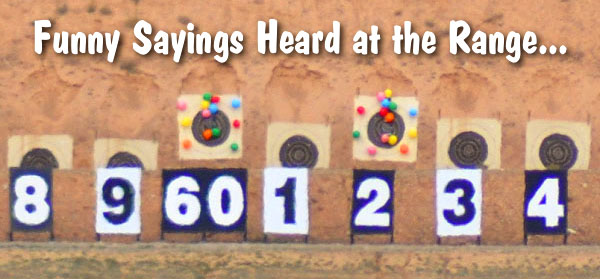
Shooting can be a frustrating sport at times, prompting shooters to say some funny things in the heat of the moment. Here’s a collection of humorous range ripostes, supplied by Shooters’ Forum members (who are listed after each quote). Enjoy. (CLICK HERE for full Forum Funny Saying Thread).
“I paid to use all of the target and I’m getting value for money on all of the real estate!” (Macropod)
“At 65 years of age, 1000-yard benchrest is better than sex, because a relay lasts 10 minutes!” (The Viper)
“How did I do?” “Well the gun went off and nobody got hurt, we can build on that….” (Mr. Majestic)
“Treat that trigger likes it’s your first date, not like you’ve been married to it for 20 years.” (Jet)
“It’s a good thing broad sides of barns aren’t at many shooting ranges.” (Rocky F.)
Target photo by Forum member RyanJay11.
“It was an 0.2″ group! Well, err, except for that flyer….” (Dsandfort)
“It’s not the arrow, it’s the Indian.” (Rocky F.)
“I can’t understand it. That load worked good in my other barrel”. (Hogpatrol)
“You bakin a biscuit?” Said to me as I was sitting at the bench ready to shoot with a cartridge in the chamber of a hot gun, taking longer than necessary. (Ebb)
“Shooting groups is easy. Just put the last three between the first two.” (Uthink)
“There is no Alibi for Stupid” (Seen at Berger SWN — Erik Cortina)
Shooter 1: “Hey you cross-fired on my target!”
Shooter 2: “Well you cross-fired on mine first!”
Shooter 1: “Yeah but you could have at least shot an X like I did on yours.” (At Raton — Rocky F.)
“I had a bughole going and my second shot dropped straight down!” (JDMock)
“The nut came loose on the end of my stock.” (TXDan)
“That’s a pretty eight.” (REastman quoting James Crofts)
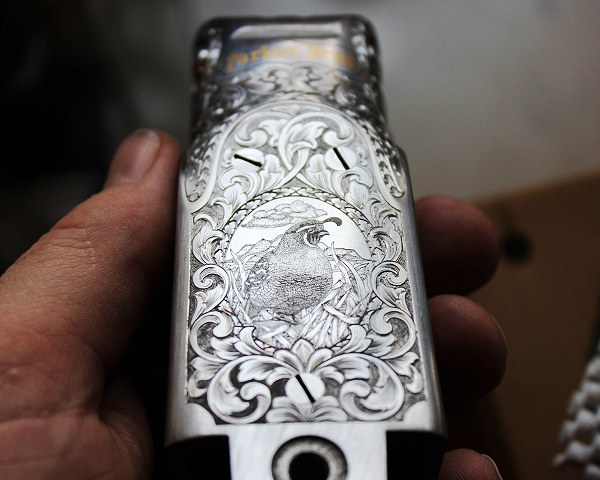
Impressive engraving by Jesse Kaufmann. Note how the scope rings have been engraved to perfectly match the engraving pattern on the Remington 547 action.
Who says fine craftsmanship is dead? There’s a modern day engraving wizard up in South Dakota, Jesse Kaufmann, who produces some of the most handsome engraving we’ve seen. Jesse, who operates Black Hills Gunstocks and Engraving LLC, is a true master at metal engraving and he also does superb stock checkering. Here are some examples of Jesse’s engraving work:
This 14-minute video showcases dozens of Jesse Kaufmann’s Engraving examples:
About Jesse Kaufmann, Master Engraver
Jesse Kaufmann was a professional stockmaker for Dakota Arms for over a decade. In 2009, he was inducted in the American Custom Gunmakers Guild as a checkering specialist. In January 2017, Jesse was awarded his Master Engraver certification by the Firearms Engravers Guild of America. With his broad skill set, Jesse is able to offer his clients a unique and complete package of stock work, finish, checkering, and engraving for a custom package that is all completed under one roof by his own hands.
Jesse Kaufmann’s work has been featured in American Rifleman, American Hunter, FEGA’s The Engraver, Sports Afield, Waidmannsheil Journal of German Gun Collectors Assn., Gun Digest 71st Edition, Modern Custom Guns Volume 2, Dangerous Game Rifles 2d. Edition. For more info, visit BlackHillsgunstocksandengraving.com, email blackhillsgunstocks [at] gmail.com, or call Jesse at (605) 499-9090 after 5:00 pm. SEE Gallery of Work.
Need a new barrel for your Rem-actioned hunting or tactical rifle? Here’s a great DIY option for riflemen. McRee’s Precision offers complete, no-gunsmithing re-barreling kits for Remington and Rem-clone actions. These feature a high-quality, pre-chambered “PRE-FIT” stainless barrel from Criterion, a Savage-style barrel nut, a recoil lug, and a special barrel-nut wrench. Most of the Pre-Fit barrels are 24″ long and threaded at the muzzle. CLICK Here for all Pre-Fit barrel specs.
With this system you can easily re-barrel your favorite Remington rifle yourself in less than an hour. You don’t need to pay gunsmithing fees, or wait weeks (or months) for a busy smith to do the job. And the price is under $500.00. Kits are currently available for these chamberings: 6.5 Creedmoor, 6mm Creedmoor, .243 Win, .308 Win, .308 Winchester Magnum. (call for other cartridge options on special order). You can buy with confidence — McRee’s Precision offers a Half-MOA Accuracy Guarantee with its pre-fitted barrel kits: “Our barrels are made to specific standards that [ensure] sub-1/2 MOA of accuracy”.
The stainless steel Barrel Nut is set up for 1 1/16 x 16 barrel threads, while the stainless steel recoil lug has a 1/8 inch removable locator pin and is set up for 1.0625 dia barrel threads.
McRee’s Precision sells Rem-action Pre-Fit barrel packages complete with chambered barrel, barrel nut, recoil lug, and wrench. Choose from three chamberings: 6.5mm Creedmoor, .308 Win, and .300 Win Mag each priced at $499.47. These Pre-Fit barrel kits come ready-to-install. All you need to do is remove your current barrel, place the recoil lug, spin on the new tube, follow the instructions for setting head-space with standard go/no-go gauges, then torque the barrel nut against the lug. NOTE: You may require a barrel vise and action wrench to remove the original barrel. Chambering-specific headspace gauges required. Minor inletting changes may be needed forward of the action.
The folks at McRee’s Precision say their Pre-Fit system offers many advantages: “Remington Pre-Fitted Barrel Kits have become popular over the years. If Savage can do it, why not for our Remingtons? Our [Criterion-supplied] barrels are spec’d to the McRee standard of performance. There are several places to get the tools required to remove your factory barrel correctly. Once you have your barrel removed all you have to do is follow the normal Savage procedure to install your new barrel. We recommend that you contact your local gunsmith for the install. Feel free to call us with any questions.”
Product Tip from Ed LongRange. We welcome readers’ submissions.
At the request of our readers, we provide select “Deals of the Week”. Every Sunday afternoon or Monday morning we offer our Best Bargain selections. Here are some of the best deals on firearms, hardware, reloading components, optics, and shooting accessories. Be aware that sale prices are subject to change, and once clearance inventory is sold, it’s gone for good. You snooze you lose.
1. Bruno Shooters Supply — Good Selection of Powders IN STOCK
⏺ Many Hodgdon, VihtaVuori, Alliant, Accurate, IMR & Winch Powders
As of 4/24/2022 we found these popular powders (and many others) at Bruno Shooters Supply: Accurate LT30, Hodgdon Titegroup, Hodgdon CFE223, Hodgdon Superformance, IMR 4198, VV N120, VV N135, VV N530, VV 3N35, Alliant Reloder 10-X, Accurate 2230, Accurate 5744. But that is just a partial list. Sorry no Varget, H4350, Reloder 16, or VV N133 — but there are many other good propellants. Head over to Bruno’s and see what’s in stock. FYI, we also recommend checking with Powder Valley and Midsouth, as they received some significant powder shipments recently.
2. EuroOptic — Christensen Arms Sale
⏺ BIG Savings — get $300-$500 off normal price for MPR and hunting rifles
EuroOptic is running a remarkable sale on Christensen Arms Rifles. When you add one of these rifles to your shopping cart, BINGO you’ll get HUGE savings over normal prices. For example, a $2399.99 Christensen Arms Modern Precision Rifle (MPR) is $1899.99 in the shopping cart — that’s a FIVE HUNDRED dollar savings! And the price on the Ridgeline hunting rifle is $1599.99 in the cart, FOUR HUNDRED bucks less than the regular $1999.99 price. Plus if you purchase a Christensen Arms MPR on or before 4/30/22 you qualify for a $300.00 Christensen Arms GIFT CARD.
3. Midsouth — Redding T7 Turret Press with Primer Arm, $359.99
⏺ Good deal on quality Turret Press and add Creedmoor Upgrade
Are you looking to upgrade from a single stage but don’t need a full progressive press? Consider a turret press such as the Redding T7. The Redding T-7 Turret Press features a 7-station turret head that is easily turned to switch from one die to another. Cast iron construction and compound linkage handle allow for reloading magnum cartridges with ease. The TZ can also be easily upgraded with a $19.95 Creedmoor Redding T7 Turret Press Upgrade Kit. By reducing play/slop, this kit can improve loaded case concentricity and bullet seating consistency. The Upgrade Kit includes all the shims, rings, and pads needed to improve T7 tolerances.
4. Natchez — Major Ammo Sale with Significant Savings
⏺ Up to 32% discounts on rifle, pistol, and shotgun ammunition
Supplies of quality factory ammunition are growing, but prices are still high at most vendors. If you’re looking for good deals on ammo check out the Natchez April Ammunition Sale. You’ll find rimfire ammo, pistol ammo, rifle ammo, and shotgun ammo on sale, all at some of the lowest prices we’ve seen this year. For example, the Federal FX2 12ga shotshells are discounted 32%!
5. Amazon — CHDN Quick-Release Bipod, $28.95
⏺ Nice rail-mounted bipod is sturdy and easy to deploy and retract
Here’ss a great alternative to a spring-loaded Harris-type bipod. The CHDN Tactical Quick Release Rifle Bipod features a quick-release clamp that fits Picatinny rails. Made of hardened steel and aluminum, non-rust black anodized finish, the rifle bipod is duty and light weight. With the leg release button, the central height of the bipod can be adjusted from 7.5 to 9 inches. One of our Editors, who has this bipod, confirms it is a very functional unit for under $30.00.
6. Palmetto State Armory — Norma TAC-22 Ammo, $4.50/box
⏺ Excellent rimfire ammo at a GREAT price — .22 LR Deal of the Year
Do you shoot NRL22 or want to plink with much better ammo than bulk box loads? We found a truly great deal on Norma TAC22 .22 LR ammo at Palmetto State Armory. On sale at just $4.50 per 50-round box (just $0.09/rd), this TAC-22 ammo is a total steal. Norma TAC-22 is good quality ammo that has shown excellent accuracy in tests. You’ll have to pay twice as much (or more) to get more accurate rimfire ammo.
⏺ Good value LRF for hunters, varminters and tactical shooters
Whether hunting or shooting PRS, knowing the precise distance to your target is critical to a first shot hit. If you’re looking for an effective yet very affordable Laser Rangefinder (LRF), check out the Vortex Impact 1000 Rangefinder The Impact 1000 features 6-power magnification, convenient angle compensation, and easy-to-use controls. This LRF can range targets from 5 yards out to 1000 yards. At under $200, it’s a great value.
8. Amazon — PRS-Style Shooting Bag, $48.99
⏺ Very effective, versatile bag for PRS and NRL matches
Shooting a PRS or NRL22 match requires stabilizing your rifle on all kinds of barricades. This means using a portable support bag. If you’re just getting into the sport and want a cost-effective bag, check out the versatile S2Delta PRS Large Shooting Bag. Featuring a crescent shape that fits everything from T-Traps to ladders, this is a great bag to help you enjoy tactical shooting competitions.
9. Amazon — Birchwood Casey Spinner Targets
⏺ Rimfire reactive targets are fun to shoot — multiple options
Reactive targets are fun because you get instant gratification for a hit. For rimfire rounds and handgun cartridges we like Birchwood Casey reactive spinner targets. There are many affordably-priced target types including singles, doubles, triples, and quads. And for a bit more money, Birchwood Casey even offers shot-resettable Quad Gallery Targets (hit the top plate to reset the bottom four). These are offered in multiple configurations for rimfire guns and centerfire pistols. NOTE: These BC reactive targets are NOT for centerfire rifles — you’ll need heavier AR500 steal for that.
10. Amazon — Bronze Bore Brush Ten-Pack, $14.99
⏺ Get ten bronze brushes, you choice of caliber, for just $1.50 each
Cleaning rifles properly often requires a brush but they do wear out. And buying one brush at a time isn’t cost effective. If you need fresh brushes consider this 10-Pack of bronze brushes. You get ten 8/32-threaded brushes in your choice of caliber. Choose .22, .243, .25, .270, .30, .35, or .375 Calibers.
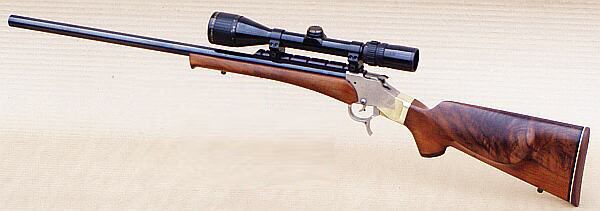
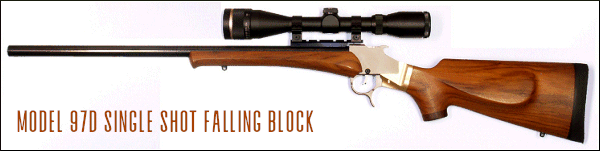
While a 16.5-pound benchrest gun is wonderfully stable on the bench, it’s not what you want in a field rifle. There is much to be said for a slim, light-weight, and easy-handling firearm when it comes to a walking varmint adventure. Eben Brown, who runs E. Arthur Brown Company, has created just such a rifle — the Model 97D Falling Block. When chambered for the 6PPC cartridge it delivered quarter-MOA accuracy in a splendidly portable package that tips the scales at just over six pounds without scope. The Model 97D is fairly unique in its lightweight and compact format — that makes it a great field-carry varmint rig. [Editor’s Note: This is an older article and we use some more recent photos of other model 97D Rifles to better illustrate the design and layout.]
Catalog photo of EABCO Model 97D Falling Block rifle.
Excellent Accuracy Made Easy for Sport Shooters
by Eben Brown, E. Arthur Brown Company
You don’t have to be a benchrest competitor to enjoy shooting one of the most accurate centerfire cartridges in the world, the 6mm PPC. With no complicated brass forming or finicky reloading processes, you can be shooting near half-inch groups right from the start and hone your skills to near quarter-inch groups by your second outing–at least that’s how it worked for me, and I’m NOT a good bench rest shooter! Developed by Louis Palmisano and Ferris Pindell, the 6PPC has won more bench rest accuracy competitions than any other cartridge. Easily made from Lapua .220 Russian brass, the 6mm PPC has a small primer and uniquely small flash hole that is credited for much of its inherent accuracy. The “short, fat” shape and nearly straight body contribute to efficient, consistent powder burning and stable chamber performance (it grips the chamber well during ignition).
The Brown Model 97D — A Slim, Accurate 6-Pound Rifle
The 97D was developed from the EABCO “BF” falling block silhouette pistols that have won world championships and set 500-meter distance records. In operation, the 97D falling block slides perpendicularly and closes the breech with absolutely zero camming leverage. This makes it a perfect test-bed to measure the chamber performance needed for hand-loading most other single-shot rifles accurately. At the reloading bench, I worked up a load with the now fully shaped 6mm PPC brass. I full-length sized the brass, trimmed, and primed each case the same as I would with any other cartridge, and began loading. With the resultant load, I easily shot a 5-shot 1/4″ group, a personal best for me. See target photo at right.
Making 6mm PPC Cartridges
Full-length size, prime, charge with powder, and seat a bullet… sounds like what you do with any other cartridge, doesn’t it? In fact, the only difference with 6mm PPC is that it has to be fired once (fire-formed) to expand to its final shape and size. But even fire-forming shots produce exceptional accuracy. I shot several 3/4″ groups while fire-forming at 100 yards, with my best group at nearly half-inch–so the time spent fire-forming was wonderful! In the photo, the parent .220 Russian case is on the left, while the fire-formed 6PPC case is on the right.
The EABCO 6mm PPC Chamber – 6PPC without Neck-turning!
We dimensioned our 6mm PPC chamber reamer to cut a chamber that fits Lapua 220 Russian brass closely without neck-turning. Naturally we recommend you use the Lapua brass for best results.
[Editor’s Note: We asked Eben if he had tried a 6BR chambering in a model 97D. He explained that, because of the extractor design, the falling block action works better with a smaller rim diameter: “The larger .308 rim width creates some issues. This design works best with cartridges no wider than the 30/30 case, or the 7.62×39 case, from which the 22 Russian case was derived. Cases with .308-sized rims develop more bolt thrust and work best with a different type of extractor than we use in the 97D. I love the 6BR, but I recommend the 6PPC for our 97D.”]
6mm PPC Reloading Data for Model 97D
The following loads were worked up in a Model 97D Rifle with 24″ barrel chambered for 6mm PPC with the chamber neck reamed to .275″ to fit Lapua brass without neck-turning. Lapua 220 Russian brass was full-length sized and fire-formed to 6mm PPC using 65gr V-Max bullets, CCI BR4 primers, and 24.5gr of VV N135 powder. Eben cautions: Load at Your Own Risk — Always start 10% low and work up
The following optimum loads were worked up with Vihtavuori N135, 58gr and 65gr V-Max bullets, and CCI BR4 primers. Please Note: There really is no “standard” for 6mm PPC. It can be finicky. But once you find what works best for you, the cartridge performs superbly. The accuracy will astound you.
Model 97D Specifications
OAL (with 24″ Barrel): 38″
Approx. Weight without Scope: 6-6.5 lbs.
Barrel: 17-26″ Chromoly or Stainless
Stock: Walnut w/Hardwood Grip Cap
Trigger: Tuned 16-24 ounces
This video shows the Loading Technique for Model 97D Rifle
Powder Selection — Choosing the Right Propellant
I’ve found that my maximum single-shot loads reach the same level of performance as bolt gun loads when I use one level slower burning powder type and proper chamber preparation. For example, when the VihtaVuori loading guide shows a maximum with VV N133, my best single shot load ends up being with the slower burning VV N135. Here’s the simplest way to proceed: Use a starting load from the loading guide and increase the powder charge until you detect some resistance to block movement with your thumb. Next, charge a case with that same amount of powder, tap it to settle, and look to see if the case is full to the base of the neck. If it’s not full, step up to the next slower-rated powder and repeat the load development process. There’s a powder burn rate chart for all brands of powder in the front of the current VihtaVuori Loading Guide. When you have the maximum load that will fill the case and still allow the 97D single-shot to open and eject freely after firing, you’re ready to shoot some groups!
Loading for Best Chamber Performance
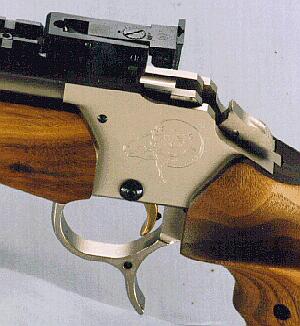
In the model 97D rifle you can check chamber performance easily. After firing a shot, see if you can press the block downward with only your thumb on the top of the block. If it moves freely, you’ve got good chamber performance.
I use three pressure indicators when developing loads on the Model 97D. First I check the block with my thumb. Then I check to see if the cartridge sticks at all when ejecting. And finally, I check the primer for the excessive flattening that would indicate too much pressure. Generally, the hottest load that still allows the gun to open and eject freely ends up being my most accurate shooting load.
Chamber Preparation
Best chamber performance happens when a cartridge grips the chamber and does not drive backward significantly. When you want something to grip (rather than slip), you want to make sure there is no lubricant on the gripping surfaces. Case forming lube and gun oil are the two lubricants you want to remove. Clean your 6mm PPC cases after sizing (I wipe mine with a paper towel and Windex). Clean your chamber with a chamber sized jag and patch wetted with acetone. (Note: protect your chamber with a thin coat of Clenzoil when you’re not out shooting.)
Conclusions of a Single-Shot Sport Shooter
I love the 6mm PPC! It was easy to hand-load for the cartridge and it was easy to get excellent results. The group shot on this page was with the 65gr bullet and a rifling twist of 1:10. I usually recommend a 1:12 twist and the 58gr bullet because customers have reported superb accuracy (better groups than I can shoot). But the 5-shot ¼” group I shot with this set-up is my personal best ever–so naturally I’m thrilled!
While it’s hard to beat the 6PPC’s accuracy in a Model 97D rifle, my company currently offers the rifle in a variety of chamberings including 17 Hornet, 219 Donaldson Wasp, and 6mm BRM. The 97D Standard features a blued 24″ chrome-moly barrel, French Gray receiver, anodized buttstock transition, 2-ring scope mount and swivel studs.– Eben Brown
About the production Model 97D Rifles: “The 97D is a small frame single shot rifle that’s suitable for big game as well as small game and varmint hunting. It originally evolved from our World Champion long range silhouette pistol action and incorporates the same accurate gun making processes. The 97D action itself is inherently accurate and simple. Onto this we fit an EABCO Accuracy Barrel, precision turned and threaded between centers. Each chamber is individually reamed on-center and individually head spaced. We feel the crown is so critical to accuracy that we leave it until after the gun is finished. Our 11 degree target crowns are cut last and left bright — our trademark finishing touch.”













 About Jesse Kaufmann, Master Engraver


 The Brown Model 97D — A Slim, Accurate 6-Pound Rifle
 Making 6mm PPC Cartridges
 The EABCO 6mm PPC Chamber
 The following optimum loads were worked up with Vihtavuori N135, 58gr and 65gr V-Max bullets, and CCI BR4 primers. Please Note: There really is no “standard” for 6mm PPC. It can be finicky. But once you find what works best for you, the cartridge performs superbly. The accuracy will astound you.
 Loading for Best Chamber Performance