Here is great news for score benchrest shooters. For years 100/200 yard score competition has been dominated by the 30 BR cartridge, which offers outstanding accuracy and consistency with .30-caliber bullets. But creating a .30 BR cartridge took time and effort forming the brass from a parent typically using Lapua 6mm BR Norma brass or Peterson 7mm BR brass.
Now that has changed. Alpha Munitions now offers excellent, ready-to-shoot 30 BR brass. No separate fire-forming or hydro-forming is required. This Alpha 30 BR brass has shown excellent accuracy both with a no-turn neck and as turned for a tighter chamber. Case life is excellent as Alpha brass is strong with good longevity. This impressive new 30 BR brass is now available exclusively through Bruno Shooters Supply. It is IN STOCK now and priced at $159.99 for 100 pieces.
Ace benchrester and gunsmith Speedy Gonzales has praised this new Alpha 30 BR brass: “Well fellow score shooters, the days of expanding 6mm or 7mm brass up to make 30 BR brass are just about over. UPS just dropped off the test samples for me to test, and should be in full production soon. I will post a full video after testing and give you all the full report. 30 BR brass by Alpha will be sold exclusively through Bruno Shooters Supply and has an order list up and running[.]”
This was one of our 25 Most Popular Articles in past years. We’re repeating it for those of you who may have missed it the first time around. These diagrams were created by the South Texas Shooting Marksmanship Training Center (STMTC).
There was an excellent article about Mirage created for the South Texas Marksmanship Training Center (STMTC). This article explains what causes mirage and how mirage can move the perceived aiming point on your target. Most importantly, the article explains, in considerable detail, how you can “read” mirage to discern wind speeds and wind directions.
Mirage Is Your Friend
While hot days with lots of mirage can be frustrating, mirage can reveal how the wind is flowing (and changing). If you learn how to recognize and read mirage patterns, you can use that information to shoot higher scores. That’s why many leading long-range shooters tell us: “Mirage is your friend.” As the STMTC article explained: “A mirage condition is not a handicap, since it offers a very accurate method of perceiving small wind changes[.]”
Mirage Illustrated with Diagrams
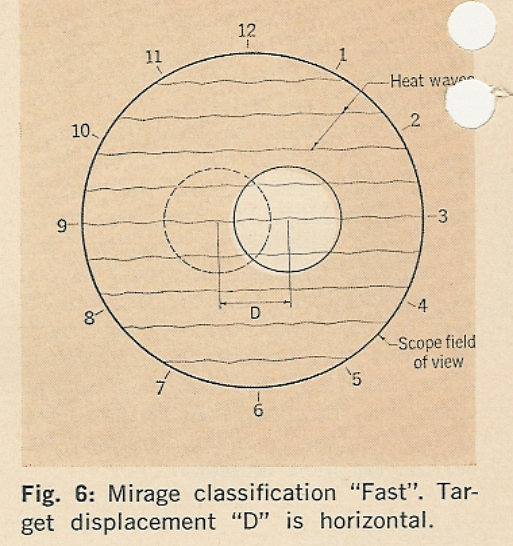
With simple but effective graphic illustrations, this is one of the best explanations of mirage (and mirage reading) we have found on the internet. This is a “must-read” for any serious competitive shooter. Here is a brief sample from the article, along with an illustration. NOTE: the full article is six times longer and has 8 diagrams.
The term “mirage” as used by the shooter does not refer to a true mirage, but to heat waves and the refraction of light as it is bent passing through air layers of different density. Light which passes obliquely from one wind medium to another it undergoes an abrupt change in direction, whenever its velocity in the second medium is different from the velocity in the first wind medium; the shooter will see a “mirage”.
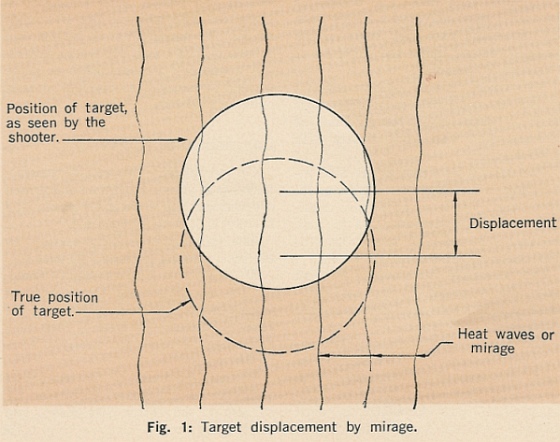
The density of air, and therefore its refraction, varies with its temperature. A condition of cool air overlaying warm air next to the ground is the cause of heat waves or “mirage”. The warm air, having a lower index of refraction, is mixed with the cooler air above by convection, irregularly bending the light transmitting the target image to the shooter’s eye. Figure 1 shows (greatly exaggerated) the vertical displacement of the target image by heat waves.
Heat waves are easily seen with the unaided eye on a hot, bright day and can be seen with spotting scope on all but the coldest days. To observe heat waves, the scope should be focused on a point about midway to the target. This will cause the target to appear slightly out of focus, but since the high power rifle shooter generally does not try to spot bullet holes, the lack in target clarity is more than compensated by clarity of the heat waves.
Story tip from Boyd Allen. We welcome reader submissions.
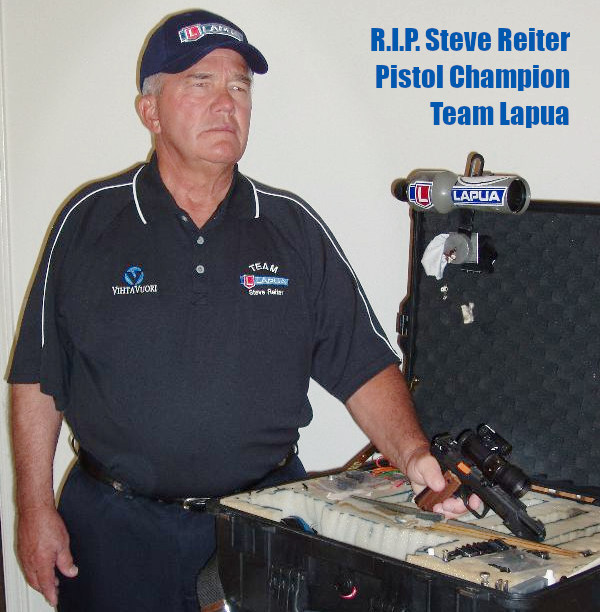
Capstone Precision Group and Team Lapua USA announce with deep sadness the passing of Steve Reiter, one of the most accomplished competitive pistol shooters in history and a foundational member of Team Lapua in the United States. Steve passed away on May 18, 2026. In the slow-fire pistol shooting disciplines, Steve is probably the greatest American shooter ever.
Reiter was among the original members of Team Lapua USA when the program was established in 2009, helping to define the standard for excellence, sportsmanship, and brand representation that continues today. Throughout his career, he served not only as a world-class competitor, but also as a dedicated ambassador for the shooting sports.
Steve Reiter’s record in high-level competition is extraordinary:
34 National Championship titles, including five National Championships at Camp Perry
63 National Records, including a historic .22 Aggregate score of 899, the highest ever recorded
40+ Regional Championships
First-ever Quadruple Distinguished Marksman under the CMP
Triple Distinguished Marksman under the CMP
Two-time President’s 100 Champion in Pistol
Two-time National Trophy Individual Match Champion in Pistol
10-time Winner of the National Match High Senior Pistol Trophy
Five-time Winner of Citizens’ Military Pistol Trophy
Canada International Service Pistol Champion
Two-time Free Pistol National Champion
Seven-time Interservice Champion
Standard Pistol National Champion
Member of the 1980 U.S. Olympic Team (Free Pistol)
Reiter continued to compete at an elite level well into his later years, achieving many Senior titles. Following his retirement from active competition, Reiter remained an integral part of Team Lapua as an Emeritus Member, continuing to mentor shooters and support the sport he loved.
Steve Reiter Senior Championships:
2017 NRA National Pistol Championships — 1st Place, Super Senior
2013 NRA National Pistol Championship — Grand Senior Champion
2014 Mid-Winter Championship — 1st Place
2014 Indoor National Sectional Championship — 3rd Place and new Senior National Record
“Steve Reiter was more than a champion—he was one of the foundational figures of Team Lapua in the United States,” said Adam Braverman, Vice President of Sales & Marketing for Capstone Precision Group. “His achievements speak for themselves, but what truly set Steve apart was the way he carried himself and the impact he had on others. He represented our brand with integrity, passion, and a genuine love for the shooting sports. Steve helped shape what Team Lapua stands for today, and his legacy will continue to inspire our team and the broader shooting community for years to come.”
In 2022, the Civilian Marksmanship Program (CMP) honored Reiter by establishing the Reiter Cup National Champion Trophy. This award is presented to the winner of the Match Pistol 2700 Any Sights National Championship, which recognizes the highest combined scores from the .22, .45 ACP, and Centerfire 900 Aggregate matches held during the annual National Matches at Camp Perry.
Beyond his competitive accomplishments, Reiter was widely respected for his humility, sportsmanship, and commitment to growing the shooting sports community. His influence extended far beyond the firing line, impacting countless shooters, teammates, and fans across generations. Capstone Precision Group and Team Lapua extend their deepest condolences to Steve’s family, friends, and the entire shooting sports community.
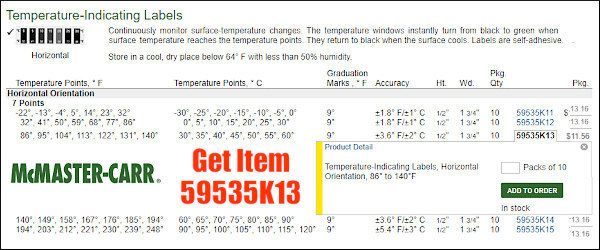
The official start of summer (6/21/2026) is just one month away, and temperatures are starting to heat up. We are already seeing unseasonably hot conditions in some areas of the country. You never want your barrels to get too hot, which can happen more quickly in summertime. Accuracy suffers when barrels over-heat, and excessive heat is not good for barrel life. So how do you monitor your barrel’s temperature? You can check if the barrel is “warm to the touch” — but that method is not particularly precise. There is a better way — using temperature-sensitive strips. McMaster.com (an industrial supply house) offers stick-on temp strips with values from 86° F to 140° F. A pack of ten (10) of these horizontal strips (item 59535K13) costs $11.56. That’s a mere $1.16 per barrel for strips — cheap insurance for your precious barrels. For best barrel life, you should try to keep your barrels under 120 degrees F.
NOTE: On the McMaster.com website, you’ll need to scroll down to the multi-use “Temperature Indicating Labels”. Then click on the horizontal label and select item 59535K13, as shown below.
Forum member Nomad47 says: “I have temperature strips (bought at McMaster-Carr) on all my barrels. I try not to shoot when the barrel gets to 122 degrees or higher[.]” Here are photos of the McMaster-Carr temp strips on Nomad47’s customized Savage.
Creedmoor Sports now offers handy Temp Strips, with 3-packs for $12.95. These have colored temp range markers so you can quickly see if your barrel is getting too hot. Creedmoor Sports notes: “The temperature range of 30-160° spaced in 10° increments fit most … shooting situations. The 1″-wide 6″-long LCD strip will provide many years of service. In general, we recommend that if a barrel begins to reach 140°, it is too hot and continuing to shoot at these temperatures accelerates barrel wear These barrel temperature strips use a 3M® adhesive and will stick to blued, parkerized and stainless barrels.”
Bad things can happen if your barrel gets too hot. First, with some barrels, the point of impact (POI) will shift or “walk” as the barrel heats up excessively. Second, even if the POI doesn’t change, the groups can open up dramatically when the barrel gets too hot. Third, if the barrel is very hot, the chamber will transfer heat to your loaded cartridge, which can lead to pressure issues. Finally, there’s considerable evidence that hot barrels wear out faster. This is a very real concern, particularly for varmint shooters who may shoot hundreds of rounds in a day. For this reason, many varminters switch among various guns, never letting a particular barrel get too hot.
Neconos.com offers BAR-L Temp Strips that visually display heat readings from 86 to 140 degrees. Think of these strips as compact, unbreakable thermometers that monitor barrel heating.
Put a strip on the side of the barrel and the barrel’s temp will be indicated by a stripe that changes from black to green. There is also a “general purpose” strip that reads to 196 degrees (see bottom row). The Benchrest model strip (86°F to 140°F) is in the middle. These Bar-L temp strips cost $12.70 each, or $25.00 for a 3-pack.
NOTE: These strips can be permanently fixed to the barrel with the heavy-duty clear plastic tape strip provided with the BAR-L Temp strip.
Here’s something all shooters need — a smartphone App that calculates bullet-hole group sizes from your own photos. The Ballistic-X App is simple to use. Take a photo of your target, set some values (such as bullet diameter and distance to target), then use the touchscreen to place circles around each hole. The App will calculate group size (in MOA or Mils), distance to point of aim, and provide all the info in an overlay. Then click “save” to record your group for posterity!
This App works well, is relatively easy to set-up, and costs just $7.99. It is available for both Android devices and iOS (Apple) devices. There are other ways to measure group sizes from target images, such as the excellent On-Target program, which we have used for years. However On-Target requires a software installation on a Windows platform desktop or laptop. Ballistic-X is a simple, easy-to-install App with versions for both Android and iOS (Apple) Mobile devices.
The Ballistic-X App has a relatively easy-to-use interface. Of course you can choose either MOA or Milrad group values, and Inch or Metric dimensions. There are various labeling options that provide useful info for Load Development. There is even an ATZ (Adjustment To Zero) feature for adjusting your turrets.
How to Use Ballistic-X App
1. Select Photo Source — Choose Camera to take new photo or get image from Photo Library.
2. Set Reference Values — Select Bullet Diameter and enter Distance to Target.
3. Establish Scale on Image — Mark two points on target photo to set scale. For example, if the target has a 1″-square grid lines, mark two points on grid for 1″ distance.
4. Mark Point Of Aim — Put the central X on the aim point.
5. Designate Shot Locations — Place the green circles around each shot.
6. Finalize Data Display — Position Overlay, select size/color options, and export file.
Android Options — Range Buddy FREE App
Along with Ballistic-X, there is another Mobile App, Range Buddy, that also measures shot groups. Range Buddy is currently offered for Android devices only. It is FREE, but has adverts. Range Buddy isn’t bad, but users complained about the program crashing, and there are compatibility issues with newer phones. We recommend you pay $7.99 and stick with Ballistic-X.
Here’s a cool video from the University of Mississippi Womens’ Shooting Team a decade ago. The gals from Ole Miss challenge their marksmanship skills with a variety of tiny targets — grapes, pencil erasers, and playing cards on edge. The results are filmed with ultra-high-speed cameras so you can watch the moment of impact. This is a fun, feel-good video. Enjoy.
These young ladies were training for competition at the Ole Miss Invitational Tournament in Oxford, Mississsippi. For more information, visit OldMissSports.com.
To understand the heart and mind of a champion, watch this video profiling Jessie Harrison. This talented lady is arguably the best female action pistol shooter in history. No other woman has amassed as many championships or set so many speed-shooting records. Over the past two decades Jessie Harrison (who has also competed with with married names Jessie Duff and Jessie Abbate) has earned dozens of major titles including twenty-two U.S. Practical Shooting Association (USPSA) Ladies Championships. Jessie won her 22nd USPSA title at the 2021 USPSA Race Gun Nationals in Alabama.
Jessie is one of the hardest-working athletes in the shooting game. Jessie is America’s “leading lady” — perhaps the winningest female pistol shooter in the game today. The drive and dedication that has made Jessie a success are revealed in this video from Weatherby.
Jessie Harrison’s Will to Win
Jessie explains how hard work brings titles: “To prepare for a championship, I’m on the range constantly.
My office is the gun range — that’s where I do my work.
I travel the country pullin’ the trigger, makin’ brass, smelling gunsmoke. I have to make sure that I’m in control because… there is no other person on the line with me, helping pull the trigger.
I have to pay attention to my foot placements, my set-ups, my positions, gettin’ the gun clean out of the holster, my reloads. I can’t think about it when I’m shooting. I can’t think about these small things. I have to focus on the sights and pulling the trigger. It’s just me and the gun.
[When] I step out on to the range, I simply have to be perfect — I have to be the best… I won’t settle for anything less.”
First-Ever Female Grand Master
Jessie Duff is the first woman in history to earn the title of USPSA Grand Master (GM), the highest rating conferred by the U.S. Practical Shooting Association (USPSA). To earn this prestigious ranking, Duff had to maintain an average above 95% in shooting classification courses, something never before achieved by a lady shooter. Jessie finished 2013 with a 95.39% average.
We’ve been fans of the Howa Mini Action rifles since they were introduced a decade ago. With actions that are nearly an inch shorter than typical “short actions”, these Mini Action rigs work great as a compact “truck gun” or carry-around varminter. Current chamberings are: 22 ARC, .223 Rem, 6MM ARC, 6.5 Grendel, 7.62x39mm, 350 Legend. These feature a 20″ barrel with a 16.5″ option for the 350 Legend.
6.5 Guy Ed Mobley Tests the 7.62×39 Howa Mini Action Rifle
The Howa Mini Action rifles come with the excellent HACT 2-stage trigger and a 5-round or 10-round, synthetic detachable box mag (depending on caliber). The Mini Action’s bolt is 13% shorter than on regular short actions, providing a shorter, faster bolt throw. Weight is also reduced. This makes for a nice, compact (and very shootable) package.
6.5 Guys Test Howa Mini Actions in 6.5 Grendel and 7.62×39
The 6.5 Guys recently secured a pair of Howa Mini Actions, one chambered in 6.5 Grendel and the other in 7.62×39 Russian: “After trying out the Howa Mini Action rifles at SHOT Show 2017, we got a couple of loaners in 6.5 Grendel and 7.62×39 courtesy of Legacy Sports. These rifles are known for their smooth cycling and lightweight actions, as well as some unique chamberings for bolt rifles (6.5 Grendel, 7.62×39). Long story short, we really enjoyed them.” In fact Steve liked his 6.5 Grendel enough that he plans to purchase the gun. Get the full scoop in this VIDEO REVIEW:
The folks at Legacy Sports also conducted extensive accuracy tests of commercial ammunition in 6.5 Grendel and 7.62×39. The most accurate 6.5 Grendel ammo, with a stunning 0.29″ group, was Alexander Arms with Lapua 123gr Scenar; second best (0.56″ group) was Hornady with 123gr A-Max bullet. The most accurate 7.62×39 ammo was Hornady 123gr SST with a 0.62″ group in the 20″ Heavy Barrel version. View Howa’s Test Reports with these links:
At the request of our readers, we provide select “Deals of the Week”. Every Sunday afternoon or Monday morning we offer our Best Bargain selections. Here are some of the best deals on firearms, hardware, reloading components, optics, and shooting accessories. Be aware that sale prices are subject to change, and once clearance inventory is sold, it’s gone for good. You snooze you lose.
NOTE: All listed products are for sale to persons 18 years of age or older. No products are intended for use by minors.
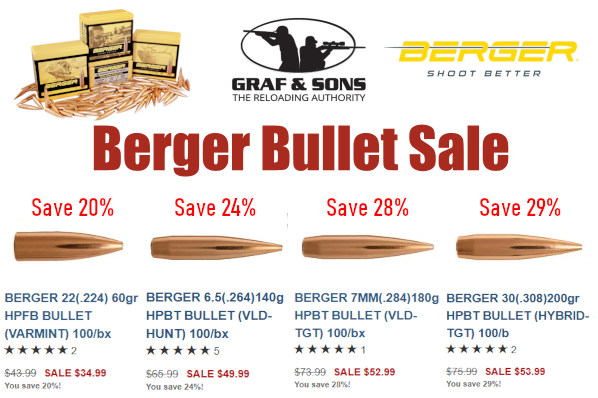
Graf & Sons — Berger Bullet Sale
⏺️ » Good 20-29% savings on Berger match and hunting bullets, many calibers
When it comes to competition components, Berger Bullets produces some of the best bullets you can buy. And Berger offers a wide selection of calibers, bullet weights, and bullet profiles (standard, VLD, hybrid). With savings up to 29%, now is the time to stock up for this year’s matches and take advantage of these big Berger bullet discounts at Grafs.com.
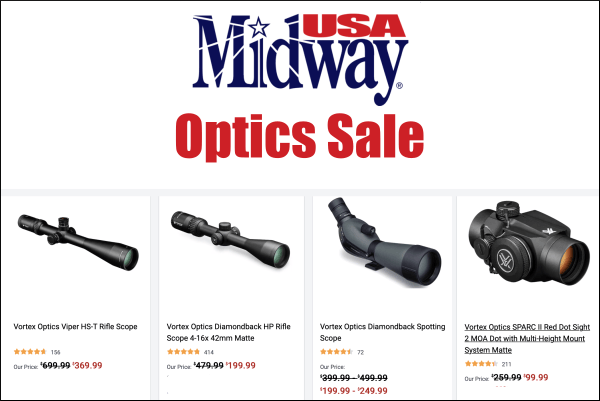
MidwayUSA — Major Discounts on All Types of Optics
⏺️ » Big Optics Sale with major savings, plus FREE Shipping offers
If you’re looking to grab a new scope or other type of optic, check out the optics sale at MidwayUSA. You’ll find riflescopes, spotting scopes, binoculars, thermal monoculars, rangefinders and Red Dots at crazy low prices. For example the Burris 5-20x50mm Eliminator rangefinder scope has been discounted $800, a huge 40% savings. Plus many orders over $100 will qualify for FREE Shipping this week.
As an Amazon affiliate, this site can earn revenues through sales commissions.
When a rifle isn’t shooting up to it’s potential, we need to ask: “Is it the gun or the shooter?” Having multiple shooters test the same rifle in the same conditions with the same load can be very revealing…
When developing a load for a new rifle, one can easily get consumed by all the potential variables — charge weight, seating depth, neck tension, primer options, neck lube, and so on. When you’re fully focused on loading variables, and the results on the target are disappointing, you may quickly assume you need to change your load. But we learned that sometimes the load is just fine — the problem is the trigger puller, or the set-up on the bench.
Here’s an example. A while back we tested two new Savage F-Class rifles, both chambered in 6mmBR. Initial results were promising, but not great — one gun’s owner was getting round groups with shots distributed at 10 o’clock, 2 o’clock, 5 o’clock, 8 o’clock, and none were touching. We could have concluded that the load was no good. But then another shooter sat down behind the rifle and put the next two shots, identical load, through the same hole. Shooter #2 eventually produced a 6-shot group that was a vertical line, with 2 shots in each hole but at three different points of impact. OK, now we can conclude the load needs to be tuned to get rid of the vertical. Right? Wrong. Shooter #3 sat down behind the gun and produced a group that strung horizontally but had almost no vertical.
Hmmm… what gives?
Shooting Styles Created Vertical or Horizontal Dispersion
What was the problem? Well, each of the three shooters had a different way of holding the gun and adjusting the rear bag. Shooter #1, the gun’s owner, used a wrap-around hold with hand and cheek pressure, and he was squeezing the bag. All that contact was moving the shot up, down, left and right. The wrap-around hold produced erratic results.
Shooter #2 was using no cheek pressure, and very slight thumb pressure behind the tang, but he was experimenting with different amounts of bag “squeeze”. His hold eliminated the side push, but variances in squeeze technique and down pressure caused the vertical string. When he kept things constant, the gun put successive shots through the same hole.
Shooter #3 was using heavy cheek pressure. This settled the gun down vertically, but it also side-loaded the rifle. The result was almost no vertical, but this shooting style produced too much horizontal.
A “Second Opinion” Is Always Useful
Conclusion? Before you spend all day fiddling with a load, you might want to adjust your shooting style and see if that affects the group size and shape on the target. Additionally, it is nearly always useful to have another experienced shooter try your rifle. In our test session, each time we changed “drivers”, the way the shots grouped on the target changed significantly. We went from a big round group, to vertical string, to horizontal string.
Interestingly, all three shooters were able to diagnose problems in their shooting styles, and then refine their gun-handling. As a result, in a second session, we all shot that gun better, and the average group size dropped from 0.5-0.6 inches into the threes — with NO changes to the load.
That’s right, we cut group size in half, and we didn’t alter the load one bit. Switching shooters demonstrated that the load was good and the gun was good. The skill of the trigger-puller(s) proved to be the limiting factor in terms of group size.


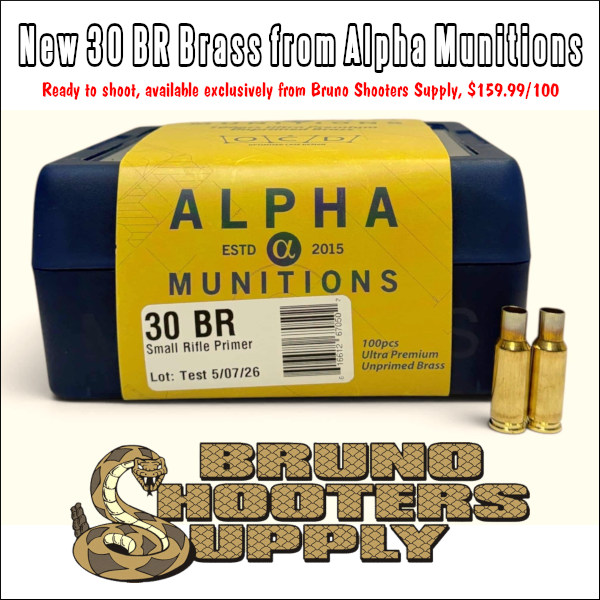
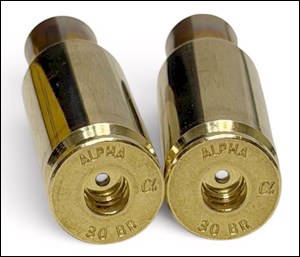 Now that has changed. Alpha Munitions now offers excellent, ready-to-shoot 30 BR brass. No separate fire-forming or hydro-forming is required. This Alpha 30 BR brass has shown excellent accuracy both with a no-turn neck and as turned for a tighter chamber. Case life is excellent as Alpha brass is strong with good longevity. This impressive new 30 BR brass is now available exclusively through Bruno Shooters Supply. It is IN STOCK now and priced at $159.99 for 100 pieces.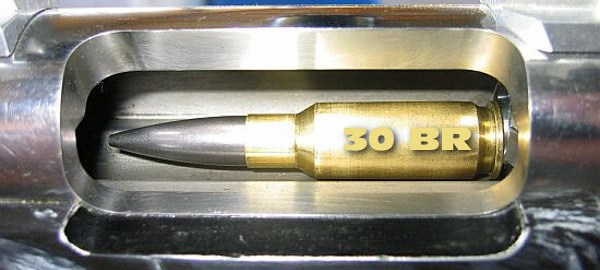



 Beyond his competitive accomplishments, Reiter was widely respected for his humility, sportsmanship, and commitment to growing the shooting sports community. His influence extended far beyond the firing line, impacting countless shooters, teammates, and fans across generations. Capstone Precision Group and Team Lapua extend their deepest condolences to Steve’s family, friends, and the entire shooting sports community.



 Jessie Harrison’s Will to Win