Be prepared to have your mind blown by Max Michel. This guy is FAST. In this video he puts 18 shots on three targets with two (2) reloads, in a total of 4.79 seconds. That’s right, drawing from holster, he sends 18 rounds in under five seconds, with two mag changes in the process. That works out to a rate of fire of 225 rounds per minute. Consider this — Max shoots faster than a 19th-century Gatling Gun (which had a rate of fire of roughly 200 rounds per minute). And Max is accurate as well as speedy — 16 of Max’s 18 shots were in the targets’ A-Zones, with the other two just barely outside.
Click Speaker Icon to hear sound (audio) — it’s even more impressive with sound!
At age 39, Max Michel is a legend within the world of competitive shooting. A four-time World Speed Shooting Champion, six-time USPSA National Champion, and three-time US National Steel Champion, Max is a dominant force in pistol shooting sports. Born and raised in New Orleans, Louisiana, Max began shooting when he was just five years old. In 1999 Max joined the USAMU’s Action Pistol Team and served in the U.S. Army for 10 years as an Army shooter and trainer. Today, Max is recognized worldwide as a top-tier athlete and instructor.
Back in 2015, the firearms collection of famed gun writer Elmer Keith went to auction. The Keith Estate auction drew interest from around the globe, and bidding was strong. When the dust settled, and all the individual lots were totaled, Keith’s remarkable collection sold to various bidders for $1,905,458!
High-priced highlights from the auction are shown below. NOTE: You can see more than 60 other Elmer Keith firearms, along with a list of final auction prices. The Guns & Ammo website has a detailed, illustrated report on the Elmer Keith auction with dozens of high-quality photos.
Elmer Keith was an American rancher, firearms enthusiast, and author. Keith was instrumental in the development of the first magnum revolver cartridge, the .357 Magnum, as well as the later .44 Magnum and .41 Magnum cartridges, credited by Roy G. Jinks as “the father of big bore handgunning.” These videos recount Keith’s personal history and his influence on the design of modern Magnum cartridges.
Lot 1038: Colonel Jim Corbett’s .450/.400 “Tiger Rifle” (Sold for $264,500.00)
Dangerous Game Rifles in Collection
The legendary “Corbett Tiger Rifle”, a Jeffery boxlock .450/400 was used by famed hunter Edward James “Jim” Corbett. This rifle was featured in Corbett’s book Man-Eaters of Kumaon. Two of the man-eating tigers Corbett hunted were believed to have killed over 800 humans in the Kumaon Hills of India.
Lot 1005: Colt SAA No. 5 .44 Special “The Last Word in Sixguns” (Sold for $80,500.00)
This famous revolver started as a Colt SAA, but then was heavily modified. The top strap of the frame was welded up into a flat-top target configuration, with an adjustable rear sight added. The hammer was modified with a Bisley-type target spur. The unique grip of the Number Five was created by marrying a modified Bisley backstrap to a Single Action Army trigger guard. His most famous pistol, Keith called this handgun “The last word in fine six-guns”.
This video showcases this rare Colt SAA revolver, as viewed at the auction:
Lot 1060: Pachmayar Custom Model 70 .375 H&H (Sold for $22,425.00)
This may be one of the most beautiful model 70 Winchesters ever created. Listed as “Pachmayar Custom M70 .375 H&H with Full Coverage Engraving and Exhibition Wood” this rifle sold for $22,425.00 at the Elmer Keith Estate Collection auction. Look at the figure in that wood! The detailed engraving on the action and barrel is fantastic, as is the checkering on the grip.
Lot 1041: Westley Richards Droplock .476 NE (Sold for $69,000.00)
Used by Elmer Keith on safari in Tanzania, this was Keith’s preferred Elephant Rifle.
Lot 1020: Smith & Wesson Triple Lock Target Revolvers. (Sold for $39,100.00)
This rare set belonged to Gerrit Forbes and Ed McGivern before being acquired by Elmer Keith.
Photos courtesy of James D. Julia Auctioneers, Fairfield, Maine.
When Annealing Made Perfect (AMP), a New Zealand-based company, first unveiled its original induction annealing machine at SHOT Show 2015, it was big news in the reloading world. This was a real breakthrough — an induction annealer running on electricity that was fully programmable. No more flames to fuss with. The advent of the AMP annealer was a true “game-changer” for the shooting enthusiasts who reloaded their ammo.
The AMP system is based on smart science and modern technology. Right from the start, AMP invested in advanced lab equipment (such as gear for Micro-Vickers hardness testing). AMP also worked with independent outside metallurgical laboratories. And AMP invited shooters from around the world to send in sample cartridge cases. AMP accumulated a huge archive of cartridges from .17 Hornet to an array of .50 BMG wildcats and everything in-between. AMP’s archive includes multiple brands and even different lot numbers of the same cartridge. AMP now offers the most highly developed and precise consumer annealing system on the planet. That is because of the amazing amount of R&D behind the product, plus the use of advanced technologies.
Annealing Under the Microscope — Informative Articles
Alex and Matt Findlay have produced a series of articles called “Annealing Under the Microscope”. The first of these was released in July 2017. Part 1 was a general explanation of annealing, and busted a number of myths. It examined the repeatability of annealing over multiple reloads, and conducted a series of tensile bullet pull tests.
Annealing Different Brands of Brass
Part 2 of Annealing Under the Microscope covered an important topic — annealing for different brands of brass. This article examines the reasons why different brands of the same cartridge can require different annealing settings. The article also reveals that lot to lot variations of the same brand of brass can make a big difference.
AZTEC Annealing System — AMP Annealers become Smart Machines
In late 2017, Alex and Matt started the development of their revolutionary AZTEC system, which in effect transformed AMP annealers into SMART annealers. It meant that individual customers could analyse their own cases with laboratory grade accuracy without the need to send samples to the AMP lab for calibration.
Part 3 of Annealing Under the Microscope was released in July 2018 after nearly 12 months of R&D on AZTEC. It focused on how to best utilize this new self-calibration capability. It also highlighted the difference between several “premium” brands of brass compared to cheaper alternatives.
Benefits of Precision Annealing — Accuracy and Repeatability
Part 4 of the series was released in September 2019. It focused on the true benefits of accurate annealing, and the arguments for annealing every reload. The study identified sizing accuracy and repeatability as the key factor. This article also revealed the first prototype of AMP’s new auto bullet seater with seating pressure data capture.
Proof on the Target — Down-Range Benefits of Annealing
In Part 5 of the series, AMP’s experts focus on the real world, down-range benefits of annealing, turned out to be a much more complex process than AMP initially planned. Accordingly, Part 5 was conducted in three stages, with three detailed write-ups.
The Part 5, Stage 1 paper examined sizing accuracy of annealed vs un-annealed cases, taking two sets of three identical Peterson Cartridge .308 Winchester cases through twenty (20) reloading cycles. For every cycle, cases were measured both fire-formed and as re-sized. With each cycle the cases were measured for case length, shoulder bump, neck OD, and head OD.
Field Testing in Tennessee — Proof on Target
The Part 5, Stage 2 article covered detailed ballistic testing using multiple rifles, cartridges, and shooters at the Strategic Edge range in Tennessee.
The Tennessee testing sessions accumulated a wealth of data on velocity spreads and group sizes right out to 1,000 yards. The evidence showed a clear advantage for annealed brass, both for average group size and average Extreme Spread for the groups shot with AMP-annealed cases.
Underground Testing with Lou Murdica
Lastly, AMP’s Part 5, Stage 3 paper featured testing by Lou Murdica at an underground range in California. We have previously shown a video of Lou shooting one case, then reloading it and shooting the same case into the same hole at 100 yards.
This time he repeated the feat, shooting one un-annealed case twenty times into the one hole. Then Lou produced another even smaller 20-shot group, shot with a case which he annealed before every shot.
Enjoy These Technical Articles from AMP Annealing
Collectively AMP’s “Annealing Under the Microscope” series represents a remarkable body of outstanding work. Whether you anneal your cartridge brass now, or just want to learn more about the benefits of annealing, we recommend you take a look at this series of informative articles.
We support Hunters for the Hungry, a program that feeds needy families in the USA. Hunters for the Hungry (HFH) is a nationwide program that gives back to communities by supplying meals throughout the country. The NRA works closely with state agencies that supervise meat donations. Since the program’s inception, Hunters for the Hungry has brought millions of pounds of game meat to homeless shelters, soup kitchens, and food banks across the United States. This program has been in place for 27 years. In recent years, HFH affiliates donated 2.1 million pounds of meat on average, supplying over 10 million meals.
Hunt and Help Others
Many American hunters are able to harvest more than they can eat or share with friends and family. Through Hunters for the Hungry you can help share your bounty with those in need. All donated game must be field dressed and legally harvested. Note that each state has different rules and regulations for donations, please check with your local drop off location prior to donating.
Big Horn Armory Gives 5% of Sales Proceeds to Wyoming Hunters for the Hungry Program
To help support H4H efforts, Big Horn Armory has partnered with the Wyoming Wildlife Federation (WWF) for a special Pay it Forward H4H program. From November 1st through 30th, 2021, five percent (5%) of all net proceeds from sales made from the Big Horn Armory website will be donated to the WWF’s H4H program. This donation will help offset the costs of processing donated game meat, which will be distributed to local food banks, pantries, and other food services within Wyoming.
“Last year we were able to donate $3,000 that was used to process meals for donation to food-insecure families within Wyoming, and this year our goal is higher. We are excited to work with the WWF’s Hunters for the Hungry Program again to help ensure that even more Wyoming residents will get healthy meals,” commented Greg Buchel, president of Big Horn Armory.
Winter is coming soon. For many Americans that means indoor training if they want to maintain their shooting skills. Even if you can shoot outdoors all year long in your location, it makes sense for position shooters to work on their rifle holds. The Mantis systems help with that. These advanced smart devices record and plot the movement of your firearm as you aim and then break the shot. There are systems for both dry-fire and live-fire training, starting at $99.99. Considering the cost of bullets these days, and the difficulty of finding primers, it makes sense to increase your dry-fire training.
Mantis X2 for Dry-Fire, $99.99
Built for dry-fire use only, the Mantis X2 ($99.99) provides real-time, shot-by-shot feedback for both pistol and rifle users. You can track multiple training sessions with data-driven insights, and monitor your progress. This unit has earned high user reviews such as: “As a new gun owner the Mantis X is a game changer for me. I have not been able to get to the range during the lockdowns and being able to practice at home [is great].” And another: “Easy to install[.] The App is free and easy to use.”
The Mantis X2 is a good value. The manufacturer states: “There is nothing at this price point that will give you this level of feedback for dry fire.” There are actually four Mantis models: X2 ($99.99), X3 ($169.99), X7 Shotgun ($199.99) and X10 Elite ($249.99). The X3 adds live fire functionality. MORE INFO HERE.
Mantis X10 Elite– Advanced Training System
The advanced Mantis X10 Elite ($249.99) is 50% lighter and 40% smaller than the original Mantis, with three times the battery life and four times the data transfer rate. This new quick-detach X10 system offers all X2 and X3 functions PLUS recoil analysis and software support for all shooting sports (pistol, rifle, shotgun, archery). Collecting thousands of data points per second, the X10 works with dry fire, live fire, airsoft/CO2, and simulated firearm systems.
Mantis Blackbeard Trigger Reset System for AR-Platform Rifles
If you compete with an AR-platform rifle, you can definitely benefit from the Mantis Blackbeard system, a drop-in Bolt Carrier + Magazine replacement that works with your existing trigger. Using electromechanical wizardry, the $199.00 Blackbeard quickly resets the hammer between each shot, so you can stay in position through multiple practice shots. Installation takes less than a minute — remove the bolt carrier group, drop in the red upper unit, place the red Mantis magazine and you’re good to go. All Blackbeards now support both direct impingement and piston-driven ARs. Guys we know say that a few sessions with this system delivered marked improvement in their service rifle scores.
Mantis X3 for Live-Fire or Dry-Fire, Rifle and Pistol
The Mantis X3 collects thousands of data points per second and analyzes your shooting in real-time. For both pistols and rifles, the X3 works with dry fire and live fire. It will also work with airsoft/CO2/compressed air, and simulated firearm systems. Priced at $169.99, the Mantis X3 mounts to standard universal accessory rails. (No Picatinny rail? Creedmoor Sports sells adapters). The X3 is part of the second generation of Mantis Shooting Performance Systems.
In the face of growing online censorship across many popular social media sites (such as YouTube), Brownells has launched a new online resource to help customers build their own AR-15 rifles at home. Hosted at Brownells.com/HowToBuild, the new web page features step-by-step, interactive videos. Featuring Brownells Gun Tech Caleb Savant, the videos show the AR-15 build process with easy-to-follow directions and expert advice. There are currently four AR Build videos: Introduction, How to Build Your Lower, How to Build Your Upper, and Troubleshooting Guide. See all videos at: Brownells.com/HowToBuild.
Each of the videos have an easy search button on the upper left-hand corner, allowing viewers to navigate to specific parts of the video. This will help viewers access key parts of each video and find the information they need. For example, the Lower Video has specific sections on trigger and buttstock installation. There is also a video on how to properly test fire and troubleshoot an AR-15 once it’s built.
In addition to the instructional videos, Brownells’ AR Builder Site also provides links to all the parts, tools, and accessories required to build an AR-15 rifle. There are specific links to uppers, lowers, triggers, grips, buttstocks, bolt carrier groups, handguards, barrels, gas blocks, muzzle brakes and more.
“Several social media platforms have banned videos and other content showing how to build firearms,” said Brownells V.P. of Marketing Ryan Repp. “Because of Brownells’ long-time support of the Second Amendment and individual freedom, it made sense for us to create a professionally-produced video and resource center to assist rifle builders of all skill levels make the rifle of their dreams in the comfort of their own home or workshop.”
Colt has issued a Recall for certain Colt AR-type rifles made in 2021. Here is the official Recall Notice:
COLT’S Manufacturing LLC (“Colt”) has recently discovered a potential safety issue with certain Modern Sporting Rifles (“MSRs”). Colt is voluntarily initiating a recall to protect the safety of its customers because, under certain conditions, it is possible that some of these MSRs may discharge a second round when the trigger is released when there is a live round in the chamber.
Colt is committed to the highest standards of quality and customer satisfaction. In keeping with that commitment, during routine quality testing, Colt discovered that hammers that do not meet Colt’s specifications were installed in certain MSRs that were manufactured beginning on March 5, 2021. The issue will be corrected by replacing the hammers in affected MSRs.
The recall only covers a portion of MSRs manufactured beginning on March 5, 2021, and includes the following models: AR15A4, CR6700A4, CR6920, CR6920-EPR, CR6920MPS-B, CR6921, CR6921-EPR, CR6933, CR6933-EPR, CR6960, LE6920-EPR, LE6920MPS-B, LE6920-OEM1, LE6920-OEM2, LE6920-R, LE6933-EPR, SP633784, LE6920SOCOM.
Chart lists all the serial numbers for those models that may potentially be subject to the recall:
To prevent the possibility of death or serious personal injury, Colt advises anyone who has purchased a Colt MSR since March 5, 2021 to stop using it immediately and visit ColtRepairMSR.com or call Customer Service at 1-800-971-3216 to see if your specific MSR is affected. Please note: Not all MSRs within the serial number range in the above chart are subject to this recall and this website offers easy, step-by-step instructions to determine if a particular MSR is affected.
Customer service agents will assist anyone who needs additional help. Our expert craftsmen are ready to upgrade all affected MSRs at our West Hartford, CT headquarters.
4140, 4150, 316, 17-4, 6061, 7075-T6 — What is the significance of these numbers? No, they’re not winning lottery numbers. These are all designations for metals commonly used in firearm and barrel construction. 4140 and 4150 are carbon steels, with 4150 often used in mil-spec AR15 barrels. 316 and 17-4 are grades of stainless steel. 316 is “marine grade” stainless, while 17-4 has 17% chromium and 4% nickel. 17-4 is a harder steel used in barrels and receivers. 6061 and 7075-T6 are aluminum alloys. 6061 is “aircraft grade” aluminum, often used for rings and trigger guards, while 7075-T6 is a much stronger, heat-treated aluminum commonly used in AR15 uppers.
You can learn about all these metals (and more) in the online archives of RifleShooter magazine.
Written by Patrick Sweeney, RifleShooter’s Guide to Gun Metal summarizes the primary types of steel and aluminum used in gun and barrel construction. Sweeney explains the nomenclature used to define metal types, and he outlines the salient properties of various steel and aluminum alloys. This is a useful resource for anyone selecting components or building rifles. We recommend you print out the page, or at least bookmark it.
Metals by the Number
The number system for steel classification came from the auto industry. Sweeney explains: “The Society of Automotive Engineers uses a simple designating system, the four numbers you see bandied about in gun articles. Numbers such as 1060, 4140 or 5150 all designate how much of what [elements are] in them. The first number is what class—carbon, nickel, chromium, and so forth. The next three numbers [list other elements in the alloy]. 4140, also known as ordnance steel, was one of the early high-alloy steels. It has about 1 percent chromium, 0.25 percent molybdenum, 0.4 percent carbon, 1 percent manganese, around 0.2 percent silicon and no more than 0.035 percent phosphorus and no more than 0.04 percent sulphur. That leaves most of it, 94.25 percent, iron.”
Aluminum Alloys
Numbers are also used to differentiate different types of aluminum alloys. Sweeny writes: “Aluminum is used in firearms in two alloys: 7075 and 6061. 6061 is commonly referred to as ‘aircraft aluminum’ and has trace amounts of silicon, copper, manganese, molybdenum and zinc. 7075 is a much stronger alloy and has markedly larger amounts of copper, manganese, chromium and zinc.” 7075 Aluminum has significantly better corrosion resistance, and that’s why it is used for AR receivers. The “T6″ you often see appended to 7075 refers to a heat-treating process.
Aluminum (or “Aluminium” in the UK) is a chemical element in the boron group with symbol Al and atomic number 13. It is a silvery-white, soft, nonmagnetic, ductile metal. Aluminum is the third most abundant element, and the most abundant metal, in the Earth’s crust. (Wikipedia)
To learn more about the metals used in your firearms’ barrels, rings, receivers, and internal parts, read Sweeney’s article in RifleShooterMag.com. Taking the time to read the article from start to finish will expand your knowledge of metal properties and how metals are chosen by manufacturers and gunsmiths. CLICK to Read Guide to Gun Metal.
Story Tip by EdLongrange. We welcome reader submissions. Aluminum Alloy chart courtesy AluminiumDesign.net.
Enjoy the Shooting Sports USA Archives
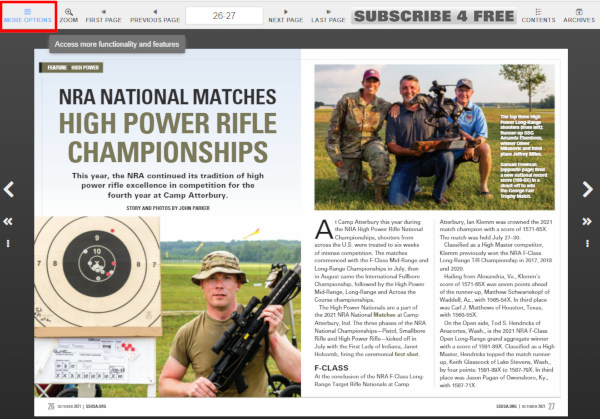
With winter coming, many Americans will soon be spending more time indoors at home. For some folks that means long sessions in front of the boob tube. Here’s a better idea — there’s a vast resource of great gun-related content available online for FREE. Check out the Shooting Sports USA Articles Archive. SSUSA maintains a vast digital library with hundreds of articles going back to June 2009.
It’s easy to find back issues of Shooting Sports USA magazine. Here’s how: First, navigate to the SSUSA Online Issue. Then click on the “ARCHIVES” icon in the upper right area (indicated with red arrow). When you click on “ARCHIVES”, a window will open with a selection of Shooting Sports USA magazine covers/dates in a vertical column. The most recent issue (November 2021) will appear at the top. You can then scroll down — use the vertical scroll bar to go from November 2021 (the latest issue) all the way back to June 2009. Click any issue cover to read.
How to Find and Save Articles
To search back issues, select “MORE OPTIONS” from the toolbar (top left). Then click the “SEARCH” button. When that opens, select either “Search Archives” for ALL back issues or “Search Only this Issue”. When you’ve made your choice, enter your search term(s). For example, you can search for “Camp Perry” or “Palma” or “F-Class Championship”. You can also save any archived issue as a PDF for viewing offline. Just click “SAVE” to download the article you’re currently viewing/reading.
Read Sample Articles
Here are a couple of our favorite SSUSA feature stories from recent years. There are hundreds of other informative articles worth reading.
Yes, the type of targets you use can make a difference during load development and training — helping you align your crosshairs, estimate group size visually, and also record load data/gun type. Here we provide selection of FREE printable precision and training targets. This selection includes popular load development targets AccurateShooter created as well as other useful grid targets. You can download ALL these targets as PDF files and then print them out on 8.5×11″ heavy paper.
AccurateShooter.com offers a cool page with over 50 FREE downloadable targets. You’ll find all types or FREE targets — sight-in targets, varmint targets, rimfire targets, bullseye targets, tactical targets, load development targets and more. CLICK HERE for all our free targets, including our LOAD DEV target.
We created the above target a decade ago. Since then it has been used by tens of thousands of shooters. It has proven very popular as a load development target, since all your load data fits neatly in the boxes under each target. In fact this target is being employed by both rifle-makers and barrel-makers (including Criterion) to test their products. The target was designed for aiming efficiency. The diamonds have 1/2″ sides and you can align your cross-hairs on the horizontal and vertical lines. It is a clean design that is easy to see even at 200 yards with a 20X scope. When we test, we usually crank in a little elevation, setting the point-of-impact higher, so that our shots fall in the gray circles. That way you leave the squares intact for precise aiming.
Versatile Targets with Multiple Aiming Points
We use the two targets below for load development and precision practice. For the left target, use the corners of the diamonds to align your cross-hairs precisely. The circle dot target (on the right) can also be used for informal rimfire competition at 50 yards. Right-Click Each Target to Download Printable PDFs.
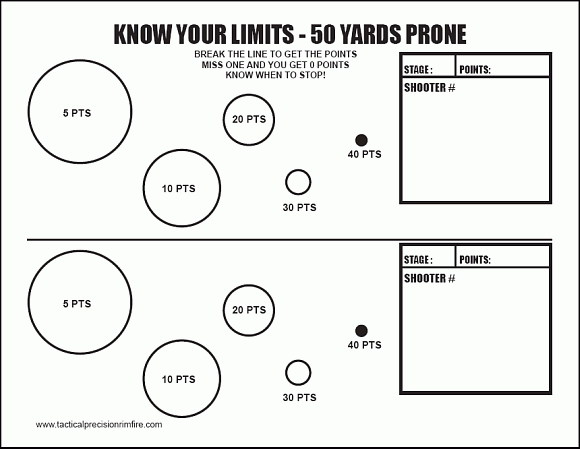
Know-Your-Limits Target for Rimfire Training & Fun Matches
Here’s a rimfire training target with “big to small” target circles. Start with the largest circles, then move to the smaller ones in sequence. This systematic drill provides increasing challenge shot-by-shot. Novices often are quite surprised to see their accuracy improve as they move from bigger to smaller aiming points. That provides positive feedback — always a good thing.
Right Click and “Save as” to download printable PDF versions of target.
RED Center Pistol Target
Here’s a NRA-type target for pistol shooting. The bright red center helps when shooting indoors because well-placed bullet holes are much more visible. This target includes data entry boxes to record gun type, score, and load data. This is one of many good free targets available at Targets4free.com.