At the request of our readers, we provide select “Deals of the Week”. Every Sunday afternoon or Monday morning we offer our Best Bargain selections. Here are some of the best deals on firearms, hardware, reloading components, optics, and shooting accessories. Be aware that sale prices are subject to change, and once clearance inventory is sold, it’s gone for good. You snooze you lose.
⏺ Versatile, affordable — great for ARs and sighting-in hunting rifles
Here’s a versatile, affordable tripod-style shooting rest. The Caldwell Precision Adjustable Turret Rest offers quick horizontal and vertical adjustment making it great for target shooting as well as varminting from a bench. Amazon user ‘Jet Mech 1′ reports “…it’s REALLY solid! Solid steel legs and everything is heavy duty. It’s really compact. Easily fits in the smallest car trunk. It holds your firearm very securely. The tilt and pan is super smooth and precise. This is the perfect platform for an AR-style rifle but works equally well for just about anything.” This is a great deal — the same unit is $114.99 on Amazon
2. Bruno Shooters Supply — McMillan Stocks now $100 OFF
⏺ Great savings on quality McMillan Fiberglass stocks
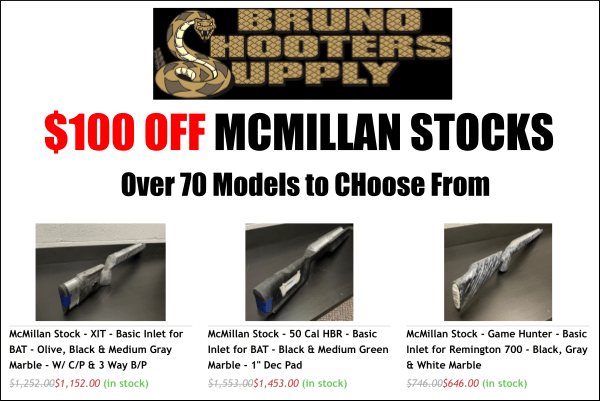
McMillan stocks are world-renowned for hunting, tactical, and competition applications. We found a rare deal on McMillan stocks over at Bruno’s. Find one that works for your needs and save $100 instantly. Bruno’s has 60+ McMillan stocks available now for $100 off. There are many stock varieties — benchrest, hunting, tactical, F-Class.
3. Precision Reloading — Starline .223 Rem Brass, $31.20/100
⏺ Excellent deal on quality .223 Rem brass
If you need some new .223 Remington brass consider grabbing some American-made Starline .223 Rem brass. This quality brass is good for hunting, varminting, and competition in bolt guns and ARs. If loaded to 5.56 pressures keep in mind you need to use firearms labeled for use with 5.56mm.
4. KYGUNCO — Savage Mark II FV-SR .22 LR Rifle, $259.99
⏺ Inexpensive rimfire rig for NRL22 or plinking
With NRL22 and other fun disciplines, .22 LR rimfire shooting is more popular than ever. A good, low-cost .22 LR rifle option is the Savage Mark II FV-SR. The Mark II FV-SR offers a 16.5″ fluted heavy barrel, factory scope rail, 5-round mag, and user-adjustable AccuTrigger. This Savage Mark II FV-SR is also available complete with a Vortex 3-9x40mm scope and rings for $369.99 at KYGUNCO.
⏺ Well-made, durable case that will fit long match rifles
This is an outstanding, rugged, well-padded fabric rifle case at a very good price. We can definitely recommend this Bulldog 54″ Black Long Range Rifle Cases. It features heavy-duty zippers, side storage bags, and plenty of space for your scope. With a 54″ OAL, this case will hold a Palma or F-Class match rifle with a long barrel. It’s pretty rare that we go to a match and don’t see some of these big Bulldog cases — they are popular.
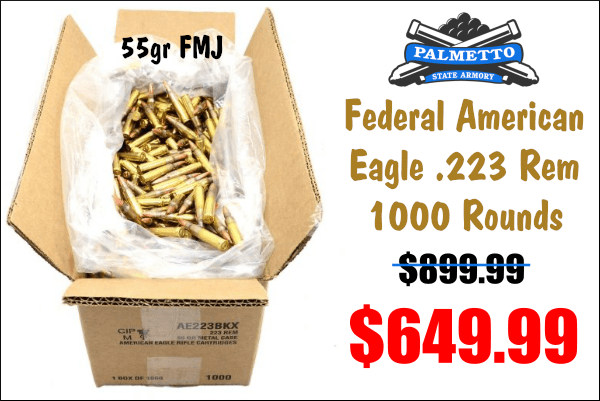
You can never have enough plinking ammo for your .223 Rem rifles. With this deal, get 1000 rds of American Eagle .223 Rem ammo for $649.99 — just 65 cents per round. American Eagle rifle ammunition offers consistent, accurate performance at a price that’s perfect for high-volume shooting. This ammo has quality bullets, reloadable brass cases, and dependable Federal primers.
7. Natchez — CCI Blazer .40 S&W Ammo, $19.95
⏺ Very competitive price on quality .40 S&W ammo
Do you need .40 S&W ammo but don’t want to pay a high price? We found a great deal on CCI Blazer .40 S&W aluminum case ammunition for under $20 a box (50 rounds). This .40 S&W Blazer ammo features high-quality Speer bullets. NOTE: The aluminum cases are NON-reloadable. If you prefer reloadable, brass-cased ammo, Brownells has CCI Blazer Brass 165gr .40 S&W ammo on sale at $26.99 for 50 rounds.
⏺ Parts and bushing kit helps turret presses run smoothly
If you have a Lyman, RCBS, or Redding turret press, we recommend you get one of these Creedmoor Turret Press Upgrade Kits. These kits, which reduce wear and improve “feel”, install on the press with simple hand tools. The kit includes Self-Adhesive Teflon pads that reduce friction between the Turret Head and the Press Body, Brass Shim that allows the bushing to ride on a smooth surface, and spring and ball that improve the press lock-up, giving a firmer lock and reducing play in the press head. There is a specific kit for three turret press types: Lyman, RCBS, and Redding T-7.
9. Amazon — S2Delta Tactical Squeeze Bag, $26.99
⏺ Versatile Support Bag is popular with shooters
For hunters and tactical shooters, a versatile Squeezebag provides rear support when shooting from bipod, or can be used in the front as a fore-arm rest on a support. The S2Delta Tactical Rear Squeeze Bag is a nice design that can do multiple tasks, and has a useful carry strap. This Squeezebag has a removable internal case that’s easy to fill with various types of media (sand, plastic pellets, etc.). Grab one in coyote tan, camo, or OD green for just $26.99 on Amazon.
10. Amazon — MTM Universal Loading Tray, $5.99
⏺ Good, versatile loading tray at significantly reduced price
Handloaders need versatile, high-quality loading trays. These two-sided MTM trays can handle just about any cartridge you reload. Priced at just $5.99, the MTM Universal Ammo Loading Tray holds 50 cartridge cases. These two-sided trays will fit all common handgun cartridges and almost all rifle cartridges .17 through .458 Winchester, including the “fat” WSM, WSSM, and Ultra Mags. These trays are also sold by Midsouth for $7.51.
Do you own a Ruger 10/22? Here’s a new product you may want to acquire. Luth-AR’s new Modular Chassis Assembly (MCA) offers adjustability and features that can transform a 10/22 into a much more effective rifle for rimfire gun games. Priced at just $189.95, the new MCA-22 modular chassis is great for NRL22 competition, Tactical 22 matches, Steel Challenge, Practical Rimfire Challenge matches, as well as casual plinking.
The new MCA-22 Rimfire Chassis is compatible with the original Ruger 10/22 barreled action as well as 10/22 clone actions such as the PRP Rubicon.
A well-known seller of AR parts and accessories, Luth-AR now offers the MCA-22 Modular Chassis Assembly for 10/22-style rimfire barreled actions. The MCA-22 was developed by Roth Performance in conjunction with Luth-AR.
The MCA-22 Rimfire Chassis provides improved ergonomics and adjustability along with M-LOK mounting options. This can make your 10/22 more effective for rimfire competition shooting and general recreation use. The Ruger 10/22 (or similar) receiver, trigger group, and barrel can be easily installed in the MCA-22 chassis, which accepts standard or bull barrels with the use of an insert.
MCA™-22 features:
— Easy to install, light weight chassis and cost effective.
— Constructed with high-strength glass filled nylon, 6061 aluminum and steel.
— Designed for comfort and ergonomic control for wide range of body types.
— Ambidextrous goose-neck style pistol grip with palm swell.
— Aggressive grip panel and front grip strap texturing.
— Click-adjustable cheek piece.
Wall of Guns — Are You Feeling Lucky?
The 2022 NRA Annual Meetings and Exhibits is just a few days away. The big event runs May 26-29, 2022 in Houston, Texas at the George R. Brown Convention Center. One popular feature of NRA Annual Meetings is the Wall of Guns — a large, wood-framed display with 40+ firearms that will be awarded to lucky ticket purchasers. There will be firearms from gun-makers SIG Sauer, Henry Repeating Arms, Taurus, Diamondback Firearms, and Kel-Tec. Other guns come from online gun seller Gallery of Guns.
Stop by the NRA Foundation’s popular Wall of Guns where a $20 ticket gives you the chance to win a prize from the wall featuring over 40 firearms. All proceeds benefit The NRA Foundation and the future of shooting sports. The NRA Foundation’s Wall of Guns runs the full duration of the NRA Annual Meetings and Exhibits, starting Thursday evening the 26th of May.
Drawings take place after 100 tickets are sold. Winners choose one firearm from the “Pick One” side or two firearms from the “Pick Two” side. Along with single $20 ticket sales, there are other options which increase your change to win.
$20 for 1 Ticket
$100 for 5 Tickets, 1 GX4 Reload Ticket
$200 for 10 Tickets, 3 GX4 Reload Tickets
$500 for 5 Tickets, Kel-tec P17 OR Henry AR-7, T-Shirt, 8 GX4 Reload Tickets
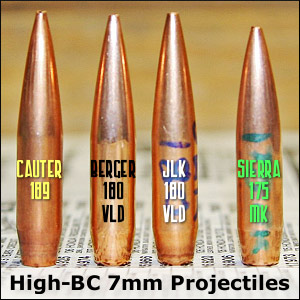
7mm (.284) remains the caliber to beat in F-Class Open Division (though some shooters have had success with .30-Cal short magnums.) With a standard .284 Winchester, or better yet, a .284 Improved, you can drive the high-BC Berger 180gr and 184gr bullets to competitive velocities.
The straight .284 Win is an excellent cartridge, quite capable of winning F-class matches. However, in most barrels, it can’t push the 180s at 2900-2950 fps velocity levels*. A lot of barrels will top out at about 2850 fps. That’s where the .284 Shehane comes into play.
The .284 Shehane is a slightly modified wildcat that retains the same 35° shoulder as the parent case. However, by blowing the sidewalls out 0.010″, the .284 Shehane picks up about 3.3 grains of extra case capacity. That enhancement makes a BIG difference. The extra boiler room is enough to drive the 180s at 2900-2950 fps with 30-32″ barrels using H4831sc, Vihtavuori N560, or Alliant Reloder 16. (That’s with a reasonably fast barrel. Some barrels are faster than others.)
Norm Harrold Won 2018 F-Class Open Division Nationals with .284 Shehane Rifle
Norm Harrold (above) won the 2018 USA F-Class Nationals shooting a .284 Shehane. Norm’s F-Open rig features a McMillan Kestros ZR stock and Bartlein barrel chambered for the .284 Shehane, which has a bit more case capacity than a standard .284 Winchester. Norm loaded Berger 184gr 7mm bullets in Lapua brass. Norm revealed his load in an Erik Cortina YouTube Video.
F-Class shooter Erik Cortina notes that the .284 Shehane has a velocity edge over the straight .284 Win because it holds more powder: “The Shehane has more capacity than the .284 Winchester. Ryan is using 54.0 grains simply as a fire-forming load. Typical load for a Shehane is around 57.0 grains of Hodgdon H4831 SC.” By blowing the sidewalls out 0.010″, the .284 Shehane picks up about 3.3 grains of extra case capacity. That enhancement makes a BIG difference. The extra boiler room is enough to drive the 180s at 2900-2950 fps with H4831sc, with long barrels.
Forum member Jim Hardy has shot the .284 with great success. He tells us: “In my humble opinion, the .284 Shehane is the best balanced long-range round there is — bar none. Here is why:
You have to shoot a 30 Cal Magnum with a 240gr bullet to equal the performance of most 7mm chamberings with the 180 Berger VLD. With the .284 Shehane, you have a .308 bolt face, medium action, and Lapua brass. You use less powder than the 7 mags, and have great accuracy and ballistics even while fire-forming. The .284 Shehane shoots inside the 6.5 AND the straight .284, the .300 WSM, and the .300 Win Mag with less recoil. What is not to love about the 284 Shehane? It is a no-brainer for long range — F-Class or Prone or 1000-yard Benchrest.”
Amazing Accuracy When Fire-Forming .284 Shehane
If you look at that 5-round group you might think it was shot with a 6 PPC or maybe a 6mmBR. But no, this was done with heavy 180gr Berger Hybrid bullets and the .284 Shehane. In fact, this impressive sub-quarter MOA group was shot while fire-forming with a very well-worn barrel! Gun builder Ryan Pierce of Piercision Rifles explains: “Here’s a 5-shot 0.191″ group at 100 yards with my .284 Shehane fireforming loads. This barrel has 2200 rounds through it. It had 2000 as a straight .284 Win and then I set it back to .284 Shehane to form brass with. [The load was] 180 Hybrids with 54.0 grains of H4831 SC.”
Scotland’s Grant Taylor. who used the .284 Shehane to finish third at the 2009 F-Class Worlds in England says the .284 Shehane is “very accurate with superb vertical spreads at 1000 yards. [This] caliber… has awesome accuracy. I’m getting 2930-2950 fps with spreads in the 3-5 fps range. I use Hodgdon H4831sc powder, CCI BR2 primers, and pointed 180gr Bergers.”
.284 Shehane Showcase — Two Special F-Open Rifles
Jason Cohen’s “We the People” patriotic .284 Shehane F-Class rifle. This rig scored second place in its very first match, a 3×20 at 1000 yards in Wyoming.
Here’s another handsome .284 Shehane F-Open rifle. Owner Jason Cohen explained why he chose the .284 Shehane chambering: “The .284 Shehane has a proven record of accomplishments and that is why I have chosen it. I use Lapua brass (6.5-284 necked-up), CCI BR-2 primers, Hodgdon H4350 powder, and Berger 184gr bullets. All these components have been a successful combination that has worked flawlessly[.]”
The barrel is a Blake Machine 1:8″-twist finished at 32 inches. It was fitted to my action by Dale Woolum of Woolum Accuracy. Dale also threaded the barrel for a Woolum Accuracy tuner. This has proven to be a valuable tool in my load development.
The rifle began its life as a Will McClosky Cerus stock. This was sent that to Bryan Blake at Blake Machine. Jason noticed that Bryan had been adding aluminum rails to the front of Cerus stocks to lower the center of gravity and improve tracking. Jason asked Bryan to fit the stock with forearm rails, shown in the photo below. Bryan did all the stock work and fitted the action, rails, and RAD recoil pad.
The .284 Shehane — Accurate and Forgiving Wildcat
Jason explains why he selected the .284 Shehane chambering: “The .284 Shehane is amazing, very forgiving and not temperamental. Straight .284 or Shehane — you cannot go wrong. I run a 184gr Berger at about 2850 FPS and get great brass life in my other rifles. I usually start to consider tossing the brass around 15 firings. Primer pockets start to get a little looser and the brass seems to need more sizing than the newer brass with less firings.”
.284 Shehane Load Development
Load development for me starts with each new barrel. I screw on the new barrel, fire 25 rounds of whatever I have left over and then clean it. I push out to 600 yards and do a ladder test in round-robin format. I start 0.6 grains lower than my last charge that worked. I work up from that reduced charge weight in increments of 0.3 grains. The paper tells the rest of the story. Once I get something that works well at 600 yards I go back in work around that by 0.1 grains. After that I play a little with seating depth and look for a change. I will occasionally mess with the tuner and tighten things up if possible.
.284 Shehane Raffle Prize Rifle for Team USA
This stunning .284 Shehane rifle was constructed as a raffle prize to benefit Team USA members preparing for the F-Class World Championship. This eye-catching F-Open rifle was crafted by Blake Barrel and Rifle in Arizona. This prize rifle features all top-of-the-line components: Borden BRMXD Action, Cerus multi-laminate stock with forearm extension, R.A.D. recoil reduction system (hydraulic-damped buttpad), Bix ‘N Andy trigger, and Nightforce Competition scope. The stainless Blake barrel is chambered for the .284 Shehane wildcat, and sports an F-Class Products tuner on the end.
.284 Shehane Also Shines in 1K Benchrest Competition
The .284 Shehane has won in Benchrest as well as F-Class competition. In 2013, Henry Pasquet won the IBS 1000-Yard Nationals shooting a .284 Shehane. Henry’s Championship-winning rig is shown below. Note the 5″-wide fore-end which is not legal for F-Class. Henry also runs a combo tuner/muzzle-brake.
*Some exceptional barrels chambered in straight .284 Win can reach 2900 fps with the 180s. Ryan Pierce has a 32″ Brux barrel that is delivering 2900 fps with the straight .284. However, Ryan acknowledges that his velocities are not typical: “A lot of .284 Win barrels top out at around 2850 fps with the 180s”.
This popular video, viewed nearly 1.9 million times on YouTube, provides a clear explanation of Minute of Angle (MOA) and how that angular measurement is used. Among novice shooters, there is much confusion over this term. In this NSSF Video, Ryan Cleckner, a former Sniper Instructor for the 1st Ranger Battalion, defines the term, “Minute of Angle” (MOA) and explains how you can adjust for windage and elevation using 1/4 or 1/8 MOA clicks on your scope. This allows you to sight-in precisely and compensate for bullet drop at various distances.
For starters, Ryan explains that, when talking about angular degrees, a “minute” is simply 1/60th. So a “Minute of Angle” is simply 1/60th of one degree of a central angle, measured either up and down (for elevation) or side to side (for windage). At 100 yards, 1 MOA equals 1.047″ on the target. This is often rounded to one inch for simplicity. Say, for example, you click up 1 MOA. That is roughly 1 inch at 100 yards, or roughly 4 inches at 400 yards, since the target area measured by 1 MOA increases in linear fashion with the distance.
More Minute of Angle (MOA) Explanatory Videos
This Gunwerks video explains that Minute of Angle subtends approximately 1″ for each 100 yards (well, 1.047″ to be exact). That means a Minute of Angle increases in actual measured size the greater the distance of the target from the shooter.
This lengthy (24-minute) video defines Minute of Angle, and uses multiple diagrams to illustrate how MOA angular measurements works. The video also how MOA-based click values translate to point-of-impact changes at various distances.
Every shooter should have a good rimfire rifle, both for fun shooting and for training. The .22 LR is very affordable to shoot, and the more potent .17 HMR and .22 WMR rounds also are great for small varmints out to 200 yards or so. Among the rimfire rifle makers, the Czech manufacturer CZ (Česká Zbrojovka) has been a world leader for many decades. In today’s Video round-up we feature a variety of CZ rimfire rifles including the the all-new CZ 457, the versatile CZ 455 VPT, and the classic CZ 452. We also include one semi-auto, the CZ 512 in .22 Winchester Magnum Rimfire (WMR).
CZ 455 Varmint Precision Trainer in Manners Stock
Rimfire cross-training allows PRS competitors to build their skill sets without breaking the bank (or burning out barrels). One great .22 LR option for cross-training is offered by CZ, the Czech arms-maker. The TFBTV video below spotlights the CZ 455 Varmint Precision Trainer (VPT), a smooth-running .22 LR bolt action. This factory rifle was designed specifically as a training tool for precision long-range competition. It boasts a Manners composite stock and 20.5 or 24-inch heavy barrel. The 0.866″-diameter tube is threaded and suppressor-ready. The model 455 VPT is mag-fed and comes with a crisp trigger that adjusts to two pounds. Street price is around $860. That’s pricey for a rimfire — but you’re getting a premium Manners stock that would cost $534 by itself.
Field Testing the CZ 455 Varmint Precision Trainer
New Generation CZ 457 with Upgrades
The CZ 457 may be the most modular precision rimfire on the market. You can swap barrels and magazines easily. The interchangeable barrel feature is by far the best feature of the CZ 457. Want to shoot .22 WMR for varmint hunts then transition to a .22 LR for precision shooting? No problem — five minutes and four screws are all you need. The CZ 457 is also an excellent value — it’s WAY better than a 10/22 but a fraction of the cost of high-end custom rimfire rigs. In the second video below, the CZ 457 goes head to head
In this video, Josh of Pursuit of Accuracy drives nails at 100 yards with his CZ 457:
And here Josh comparison-tests his Lilja-barreled CZ 457 head-to-head with the much more expensive Vudoo V22. The results may surprise you.
CZ 457 MTR Varmint — Product Showcase and Review
We really like the relatively new CZ 457 Varmint MTR .22 LR rifle. Along with other CZ 457 models, the MTR (“Match Target Rifle) Varmint features a completely new action that runs very smoothly with shorter bolt throw. The new 457s also have an American-style, push-to-fire safety. The new-generation actions have been trimmed back nearly one-inch in length, and slab-sided to reduce the footprint and weight of the actions. CZ ditched the 90º bolt rotation of the past in favor of 60º rotation. This change provides more room between bolt handle and scope for easier cycling of rounds. It also allows for the use of scopes with larger ocular bell diameters and lower ring heights.
The well-designed MTR stock has good ergonomics and nice stippling on the grip and fore-end. We were pleased to note that, with the 457 series, CZ is once again offering steel magazines that are interchangeable with older 452/455 magazines.
Here our friends at Area 419 offer a side-by-side comparison between a $2300+ rifle with Vudoo V-22 action in Manners stock and the $752.00 CZ 457. On a bang-for-the-buck basis, the CZ wins hands down. However, the Vudoo V-22 does offer centerfire-style action cycle, which helps with training. It also can run Rem 700-compatible triggers.
CZ 452 — Classic Bolt-Action Rimfire Rifle
The CZ 452 is an affordable classic. It is ultra-reliable, easy to clean and maintain, and you’ll find very good examples on the used market for under $400. This is an excellent first rifle for a young family member. In this video, The TFB TV team tests a CZ 452-2E fitted with a suppressor. As the 452 series is being replaced, if you want to buy a new 2019 CZ 452, you’ll need to spend big bucks on the Grand Finale model: “Produced in limited quantity, the 452 Grand Finale (MSRP $1189.00) is a last hurrah to the venerable CZ 452. Built using the last 452 actions ever produced, on the original manual barrelling equipment and at the Brno workshop, the Grand Finale [features] hand-engraved scroll-work on the action, barrel, bottom metal and scope rings. The upgraded American walnut is trimmed with an ebony fore-end and grip cap.”
Semi-Auto CZ — Model 512 American in .22 Magnum Rimfire
The folks at Varminter.com are avid varmint hunters, who test varmint rigs in the real world, seeing how they perform in the varmint fields. Varminter.com was quite impressed with the CZ Model 512 American semi-auto .22 WMR (Winchester Magnum Rimfire) rifle. The testers found the Model 512 to be accurate, extremely reliable, and fun to shoot. Watch the video to field tests conducted in California. This self-loading rifle performed ultra-effective on California ground squirrels. Erik Mayer, Varminter.com’s publisher says: “The 22 Magnum (.22 WMR) is beginning to see a resurgence of sorts, as the rimfire ammunition becomes more readily available. Because of this, rifles like the CZ Model 512 have also begun to see a rise in interest again”. CLICK HERE for FULL REPORT with accuracy findings for multiple ammo types.
One of our Forum members asked: “Are there any good books on pistol marksmanship? I’m looking for a book that covers techniques and concepts….” Here are six recommended titles that can make you a better pistol shooter. These books run the gamut from basic handgun training to Olympic-level bullseye shooting.
Good Guidebooks for Pistol Shooters
There are actually many good books which can help both novice and experienced pistol shooters improve their skills and accuracy. For new pistol shooters, we recommend the NRA Guide to the Basics of Pistol Shooting. This full-color publication is the designated student “textbook” for the NRA Basic Pistol Shooting Course.
Serious competitive pistol shooters should definitely read Pistol Shooters Treasury a compilation of articles from World and National Champions published by Gil Hebard. You could work your way through the ranks with that book alone even though it is very small. It is an excellent resource.
If you’re interested in bullseye shooting, you should get the USAMU’s The Advanced Pistol Marksmanship Manual. This USAMU pistol marksmanship guide has been a trusted resource since the 1960s. Action Shooters should read Practical Shooting: Beyond Fundamentals by Brian Enos, and Practical Pistol by Ben Stoeger. Brian Enos is a well-known pistol competitor with many titles. Ben Stoeger is a two-time U.S. Practical Pistol shooting champion. Last but not least, Julie Golob’s popular SHOOT book covers pistol marksmanship, along with 3-Gun competition. Julie holds multiple national pistol shooting titles.
Jessie Harrison is one of the greatest female pistol shooters on the planet. In the video below, Jessie offers smart tips on purchasing a handgun, and getting started in competition. Jessie covers caliber choice, handgun fit/ergonomics, concealability, holster options, and other key factors.
by Sierra Bullets Ballistic Technician Paul Box
One thing that plays a major role in building an accuracy load is neck tension [one of the factors that controls the “grip” on a bullet]. I think a lot of reloaders pretty much take this for granted and don’t give that enough thought.
So, how much neck tension is enough?
Through the years and shooting both a wide variety of calibers and burn rates of powder, I’ve had the best accuracy overall with .002″ of neck tension. Naturally you will run into a rifle now and then that will do its best with something different like .001″ or even .003″, but .002″ has worked very well for me. So how do we control the neck tension? Let’s take a look at that.
First of all, if you’re running a standard sizing die with an expander ball, just pull your decapping rod assembly out of your die and measure the expander ball. What I prefer [for starters] is to have an expander ball that is .003″ smaller than bullet diameter. So for example in a .224 caliber, run an expander ball of .221″. If you want to take the expander ball down in diameter, just chuck up your decapping rod assembly in a drill and turn it down with some emery cloth. When you have the diameter you need, polish it with three ought or four ought steel wool. This will give it a mirror finish and less drag coming through your case neck after sizing.
Tips for Dies With Interchangeable Neck Bushings
If you’re using a bushing die, I measure across the neck of eight or ten loaded rounds, then take an average on these and go .003″ under that measurement. There are other methods to determine bushing size, but this system has worked well for me.
Proper Annealing Can Deliver More Uniform Neck Tension
Another thing I want to mention is annealing. When brass is the correct softness, it will take a “set” coming out of the sizing die far better than brass that has become too hard. When brass has been work hardened to a point, it will be more springy when it comes out of a sizing die and neck tension will vary. Have you ever noticed how some bullets seated harder than others? That is why.
Paying closer attention to neck tension will give you both better accuracy and more consistent groups.
Ready to learn more about marksmanship? This summer, the CMP will offer a wide selection of training programs at the National Matches at Camp Perry. CMP training courses serve all levels of shooters, with personalized instruction for all. During this year’s National Matches, there will be an array of educational courses taught by experts, including USAMU team personnel and coaches. Courses span from junior to advanced, delivering a little something for everyone.
Participants in CMP National Matches clinics receive one-on-one instruction. Here is a quick guide (ranked from Advanced to Beginner) for scheduled learning events at the 2022 Camp Perry National Matches, which run July 12 through August 13, 2022.
ADVANCED – Team CMP Advanced Highpower Clinic:
Led by members of CMP Gold (CMP’s own competitive Highpower squad), the Advanced Highpower Clinic offers more complex instruction in service rifle competition techniques using classroom and range discussion. Though the class traditionally utilizes only dry-fire training on the range, in 2021, a 600-yard live-fire portion was added. This course is only open to those who have attended the Advanced Small Arms Firing School at least once and have an “Expert” classification with the CMP or National Rifle Association.
The Advanced High Power Clinic, led by Team CMP members including Bob Gil (above), provides advanced training on wind reading, mental management and more.
INTERMEDIATE/ADVANCED – Junior Smallbore and Air Rifle Camp:
The camp is open to intermediate and advanced junior athletes who shoot both three-position smallbore and standing or international air rifle. Instruction is held on CMP’s outdoor Petrarca Range and within the Gary Anderson CMP Competition Center indoor air range, both located on the grounds of Camp Perry. Participants must be between the ages of 12 to 20 and currently involved in three-position smallbore competition matches and international air rifle. Camp will cover safety and a reinforced understanding of the fundamentals, among several other points of interest. Those juniors hoping to move their marksmanship careers on to college are encouraged to sign up for this valuable course.
INTERMEDIATE – U.S. Marine Corps Junior Highpower Clinic:
The three-day clinic gives focus to more advanced training outside of fundamentals, including weather conditions, how to read wind, equipment use, shooting positions and rulebook standards. Juniors in the clinic spend one day in the classroom, followed by two days of live-fire on the range at 200, 300 and 600 yards. Those young athletes who would like to attend this clinic must first attend the Rifle Small Arms Firing School.
BEGINNER – Small Arms Firing Schools (SAFS):
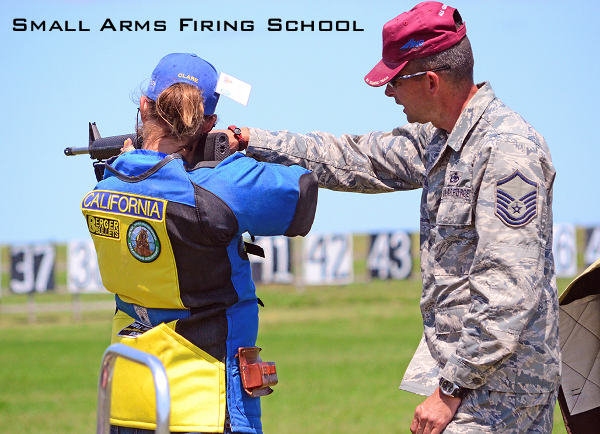
One of the most popular events of the National Matches, the SAFS course is a combination of classroom education and hands-on instruction on fundamentals, competition basics and safety. Training is led by members of military marksmanship teams as well as certified CMP instructors. At the conclusion of the course, students fire real competitions on the range, with instructors nearby. Equipment is provided by the CMP, with participants only needing a willingness to learn in order to attend. Currently, the CMP offers Small Arms Firing Schools for Pistol (M9), Smallbore Rifle, .22 caliber Rimfire Sporter Rifle and Highpower Rifle (M16) during the National Matches as well as an Advanced SAFS course for further training.
BEGINNER — As-Issued Military Rifle Clinics:
Any CMP Games competitors who have not previously fired in one of these matches are required to attend a clinic before they fire. All other competitors in these matches are encouraged to attend as well. These free one-hour clinics will cover the Garand-Springfield-Vintage Matches with instruction and demonstrations. Topics include match rules, shooting positions and techniques, scoring and pit pulling procedures and how to fire the courses of fire. The clinic is open to all competitors. More experienced juniors may attend the USMC clinic, taught by current marksmanship professionals.
BEGINNER — M1 Maintenance Clinic:
CMP Armorers will present this two-hour clinic on disassembly, assembly and maintenance of the M1 Garand Rifle. Special attention will be given to accurizing steps that can be taken with the rifle while maintaining its legality for CMP-sanctioned As-Issued Military Rifle Matches. Topics such as head space, barrel installation, component purpose/function, general rifle assembly, rifle/component maintenance and various other techniques will be covered during the course.
Fans of PRS/NRL competition should watch Shooting USA today March 16, 2022. This action-packed episode features the 2021 Armageddon Gear (AG) Cup Invitational, a major PRS event with $75,000 in cash prize awards. The show airs today, Wednesday 5/18/22 at 9:00 PM Eastern/Pacific (8:00 PM Central) on the Outdoor Channel. You can also stream the show anytime on Vimeo for $0.99.
$75,000 in cash prizes makes the AG Cup the biggest cash money match in Precision Rifle Competition. It’s an elimination format shot over three days of challenging stages of fire at K & M Precision’s ranges in West Tennessee. In this episode, match organizer Tom Fuller joins John Scoutten to narrate the action and the award of the cash in extended coverage of the match. The 2020 AG Cup showcased an all-star line-up of tactical talent with the nation’s top PRS/NRL marksmen invited to the three-day match in TN.
Highlights of 2020 Armageddon Gear Cup Tactical Match:
Armageddon Gear Founder Tom Fuller competes in PRS and supervised the latest AG Cup.
SHOOTING USA TV Air Times
View Shooting USA on the Outdoor Channel Wednesdays 9:00 PM (Eastern and Pacific) + 8:00 PM Central.
NOTE: If you miss today’s 5/18/22 broadcast, you can still view the show on Vimeo for a small 99-cent fee, or just $1.99 per month unlimited. LINK HERE: Shooting USA on Vimeo.
Shooting USA is available On Demand via Vimeo.com. Watch a single episode for $0.99, or get a full-month subscription for $1.99 and watch as many shows as you like with limited commercial interruptions.






 7mm (.284) remains the caliber to beat in F-Class Open Division (though some shooters have had success with .30-Cal short magnums.) With a standard .284 Winchester, or better yet, a .284 Improved, you can drive the high-BC Berger 180gr and 184gr bullets to competitive velocities.


 Rimfire cross-training allows PRS competitors to build their skill sets without breaking the bank (or burning out barrels). One great .22 LR option for cross-training is offered by CZ, the Czech arms-maker. The TFBTV video below spotlights the


 Good Guidebooks for Pistol Shooters