OK this is no novice. But even champion pistol shooter Jessie Harrison, Captain of Team Taurus, had to start with the basics. Jessie says that safety should always be your number one priority.
At AccurateShooter.com, our primary focus is precision target shooting with rifles. But it’s definitely fun to shoot pistols too, and we bet most of our regular readers own handguns. Here are six tips for shooting safely and accurately with handguns. These pointers will help you advance your skills and have more fun with your pistols and revolvers.
1. Make Sure Safety Is Number One
Whether you own one gun or one hundred, gun safety must always be your main priority. In this video, Smith & Wesson Team Captain Julie Golob covers the basics of gun safety.
2. Start with a .22 LR Handgun
We strongly recommend that new pistol shooters start off with a .22 LR rimfire handgun. The .22 LR cartridge is accurate but has very low recoil, less “bark” than a centerfire, and very little smoke and muzzle flash. New shooters won’t have to fight muzzle flip, and won’t develop a flinch from the sharp recoil and muzzle blast common to larger calibers. With the .22 LR, the trainee can focus on sight alignment, breathing, and trigger pull. When he or she has mastered those skills, move on to a .38 Special or 9mm Luger (9x19mm).
What gun to use? We recommend the 10-shot Smith & Wesson Model 617. Tthis is ideal for initial training, shooting single action, slow-fire. You want to focus on sight picture and holding steady. Shown above is the 4″-barrel Model 617 which balances well. There is also a 6″-barrel version. It has a longer sight radius, but is a little nose-heavy. Both are great choices. They are extremely accurate and they boast a very clean, precise trigger.
If you prefer a semi-auto .22 LR pistol, we recommend the Browning Buck Mark series. Buck Marks are very accurate and very reliable. This rimfire pistol is available in a variety of models starting at under $350.00. Like the S&W Model 617, a good Buck Mark will serve you for a lifetime.
3. Use Quality Targets with Multiple Aim Points
It’s common for new pistoleros to start shooting at cans or clay birds at a public range. That can be fun, but it’s better to start with proper targets, placed at eye level, at 7-10 yards. We like to use targets with large, brightly colored circles. Focus on putting 5 shots in a circle. We recommend targets that have multiple bullseyes or aiming points — that way you don’t have to constantly change your target. There are also special paper targets that can help you diagnose common shooting problems, such as anticipating recoil. EZ2C makes very good targets with bright, red-orange aim points. You can also use the bright orange Birchwood Casey stick-on Target Dots (right). These come in a variety of diameters. We like the 2″ dot at 10 yards.
4. Shoot Outdoors If You Can
We recommend that new pistol shooters begin their training at an outdoor range. There are many reasons. First, the light is better outdoors. Indoor ranges can be dark with lots of shadows, making it harder to see your target. Second, sound dissipates better outdoors. The sound of gunfire echoes and bounces off walls indoors. Third, an outdoor range is a more comfortable environment, particularly if you can get out on a weekday morning. Indoor ranges, at least in urban areas, tend to be crowded. Many also have poor ventilation. If you can make it to an outdoor range, you’ll be happy. Many outdoor ranges also have some steel pistol targets, which offer a fun alternative to paper. When shooting steel however, we recommend polymer encased or lead bullets to avoid ricochets.
Too many new pistol shooters try to move right to rapid fire drills. It’s better to start slow, practicing the basics, under the guidance of a good mentor. If you belong to a club, ask if there are certified instructors who will help out. This Editor learned pistol shooting from a seasoned bullseye shooter, who got me started with a .22 LR revolver and very close targets. Over the course of a few range sessions we progressed to farther targets and faster pace. But the fundamentals were never forgotten. When starting your pistol training, it’s wise to view some instructional videos. Top Shot Champion Chris Cheng hosts an excellent Handgun 101 Series produced by the NSSF. We’ve linked one of these Handgun 101 videos for Tip #6.
6. SLOW DOWN — This Is Not a Race
When you learned to ride a bicycle, you started slow — maybe even with training wheels. The same principle applies to pistol shooting. When you get started with handguns, we recommend you shoot slowly and deliberately. Start with the handgun unloaded — just work on your sight alignment and breathing. With snap caps in place, try some dry-firing drills. Then progress to live fire. But be deliberate and slow. With the target at 20 feet, see if you can get three successive shot-holes to touch. Believe it or not, many common pistols are capable of this kind of accuracy (but you won’t see many shooters at indoor ranges who pursue that kind of precision). Once you master your form and accuracy, then you can work on your speed.
The Gun Digest 2022, 76th Edition, can be pre-ordered now for $34.99 (paperback). Set for release on 8/17/2021, this 592-page resource covers rifles, shotguns, handguns, muzzleloaders, airguns, optics and more. We like the print edition, but there is also a PDF eBook version for $32.99 at Gundigeststore.com. You can read the PDF version on your tablet or computer. Both paperback and PDF versions provide hundreds of photos plus new product roundups, in-depth product tests, and scores of articles and stories.
The Gun Digest 2022 Annual is also available on Amazon.com. The paperback print edition is $31.87 at Amazon while the electronic Kindle version is $23.16 at Amazon.
Gun Digest 2022 Editor-in-Chief Phil Massaro has assembled a large team of respected industry authors for the new book, including Craig Boddington, Joe Coogan, Ron Spomer, Patrick Sweeney, Jim Supica, Thomas Gomez, Tom Turpin, Wayne van Zwoll, Bob Campbell and many more.
Gun Digest 2022 covers hunting, personal defense, target shooting, gunsmithing, and collecting. Historical articles look at the role played by firearms in our country. There are Updated Ballistics Tables, and the catalog section shows off the newest offerings in rifles, handguns, shotguns, muzzleloaders and air rifles.
Reports from the Field cover the newest firearms and accessories. A Testfire section brings readers up to date on product performance. And the annual photo essay spotlights the finest custom and engraved guns.
Other Good Books from Gun Digest Media
Gun Digest Media produces numerous other quality books for rifle, pistol, and shotgun owners. Here are four volumes we recommend. These are offered in both paperback and eBook versions:
RCBS has introduced an advanced successor to the ChargeMaster Lite electronic powder scale/dispenser. RCBS calls the new machine the ChargeMaster LINK. This boasts multiple refinements, most notably the ability to control the scale via BlueTooth using an APP on your mobile device. RCBS claims the unit “consistently delivers +/- 0.1-grain accuracy, from 0 to 350 grains[.]” It will be able to run from an external battery, or various voltage AC sources using a CE Approved 4-Country Universal Power Supply.
The ChargeMaster LINK will hold up to 2000 grains of powder, and dispense up to 350 grains per charge. MSRP is $349.95, and we expect “street price” to be around $299.00. RCBS plans to start shipping the end of this month (August 2021).
Our friend Gavin Gear of UltimateReloader.com has done an early “reveal” of the new ChargeMaster LINK. Watch the video below for Gavin’s explanation of this machine’s capabilities and features.
Watch Video to see new RCBS ChargeMaster LINK Features
Gavin plans to do a full-length product review but so far he has been impressed with the ChargeMaster LINK: “This new powder dispenser builds on the RCBS ChargeMaster Lite, adding Bluetooth connectivity, and it works with a free APP that will be available from RCBS.”
ChargeMaster LINK Features
The new RCBS ChargeMaster LINK employs the load cell and electronics of the ChargeMaster Lite. However the newer Link model “advances the powder measuring process with built-in Bluetooth that pairs with updated RCBS APP for a customized, streamlined powder-dispensing.”
Bluetooth Compatible with FREE APP
+/- 0.1 Grain Dispensing Accuracy
2000 Grain Powder Capacity
Quick Warm-Up Period
Ability to run on external battery pack
CE Approved 4-Country Universal Power Supply
16 Segment LCD Touchscreen Display
Overcharge Warning via Flashing screen
Ability to disable audible beeps
User-serviceable infinite lifeshaft seals
Sealed Platen to keep powder out
Optimal dispense tub angle for speed and accuracy
This week, Shooting USA TV spotlights the 2020 GAP Grind, the largest and most popular PRS Pro-Am Tactical match. The 2020 GAP Grind/Bushnell Pro/Am took place last October at the K&M Precision Shooting Complex in Finger, Tennessee. The 3-day event, the biggest PRS match of the year, included professional and “amateur” classes with both individual and team competition. Competitors ranged from top professionals to those shooting their first-ever tactical match.
SHOW TIMES: This Shooting USA Episode airs Wednesday, August 4, 2021 at 9:00 PM Eastern and Pacific; 8:00 PM Central. If you miss the regular broadcast, you can stream the show at any time on Vimeo for $0.99 per episode.
The GAP Grind is held at the impressive K&M Shooting Complex in Tennessee:
Lots of Action, with 20+ Stages
The GAP Grind is a challenging, “high tempo” match with minimal down-time between stages. Over the course of 20+ stages, competitors will fire 200+ shots at a variety of steel, paper, moving, and reactive targets out to 1,200 yards. Targets vary in size/difficulty based on the shooter’s position, distance, and time allotted. Most stages include “stressors” — i.e. time limits or required movement(s).
The GAP Grind typically attracts over 300 competitors — half experienced shooters and the other half newcomers to the sport. The key to growing the shooting sports is attracting new shooters. The best way to bring in “new blood” seems to be the Pro-Am type format. At the GAP Grind, experienced shooters share their knowledge and guide the new shooters through the competition.
Great video shows K&M Complex — overhead and action shots — Click II pause to halt:
GAP Grind Hardware
You’ll find the latest and greatest PRS hardware at the GAP Grind. Notable in 2019 was the fact that many top competitors “stepped down” from the 6.5/6mm Creedmoor to the smaller, more efficient 6mm Dasher, 6BRA and other 6mm cartridges. The Dasher offers excellent accuracy with less recoil than the 6.5 Creedmoor. Also, many top shooters are now running Kahles optics. Photo by Shelley Giddings.
BONUS: NRA Membership Discount for Shooting USA Viewers
Shooting USA offers discounts on NRA Memberships. You can save $10 on an annual membership, $15 on a 3-year membership, $25 on a 5-year membership, or $500 on a Life Membership. CLICK HERE for more information on the NRA website.
He who dies with the most toys wins — right? Well Sinclair has another interesting gadget you can add to your reloading bench. The Sinclair Case Neck Sorting Tool lets you quickly sort brass by neck-wall thickness. For those who shoot “no-turn” brass, this can improve neck-tension consistency. Large variances in neck-wall thickness can cause inconsistent neck “grip” on the bullet. Generally, we’ve found that more consistent neck tension will lower ES and (usually) improve accuracy. We know some guys who shoot no-turn 6mmBR brass in competition with considerable success — but their secret is pre-sorting their brass by neck-wall thickness. Cases that are out-of-spec are set aside for sighters (or are later skim-turned).
Watch Case Neck Sorting Tool Operation in Video
How the Case Neck Sorting Tool Works
Here’s how the Sinclair tool works. Cases are rotated under an indicator tip while they are supported on a case-neck pilot and a support pin through the flash hole. The unit has a nice, wide base and low profile so it is stable in use. The tool works for .22 through .45 caliber cases and can be used on .17- and .20-caliber cases with the optional carbide alignment rod. The MIC-4 pin fits both .060 (PPC size) and .080 (standard size) flash holes. Sinclair’s Case Neck Sorting Tool can be ordered with or without a dial indicator. The basic unit without dial indicator (item 749-006-612WB) is priced at $59.99. You can also buy the tool complete with dial indicator (item 749-007-129WB) for $89.99. IMPORTANT: This sorting tool requires caliber-specific Case Neck Pilots which must be ordered separately.
Editor’s Comment: The purpose of this Sinclair tool is rapid, high-quantity sorting of cartridge brass to ascertain significant case-neck-wall thickness variations. Consider this a rapid culling/sorting tool. If you are turning your necks, you will still need a quality ball micrometer tool to measure neck-wall thickness (to .0005) before and after neck-turning operations.
At the request of our readers, we provide select “Deals of the Week”. Every Sunday afternoon or Monday morning we offer our Best Bargain selections. Here are some of the best deals on firearms, hardware, reloading components, optics, and shooting accessories. Be aware that sale prices are subject to change, and once clearance inventory is sold, it’s gone for good. You snooze you lose.
1. Creedmoor Sports — American Practice Bullets, Save 20-30%
⏺ Save money on big brand bullets so you can practice more often
Creedmoor Sports is offering 500-ct bulk packs of factory second bullets. You can snatch up these American Bullet Company Practice Bullets in .22, 6mm, and .308 calibers at exceptionally low prices. These are factory ‘seconds’ from a very well-known manufacturer (think green) that are bulk-packed and ready to load. Get a box of 500 bullets at huge savings over regular prices. NOTE: There may be minor cosmetic issues with the bullets, or weight variances. In today’s world of component shortages, this is a great way to save money, and/or do more live fire practice with a lower cost per shot.
2. Sportsman’s WHSE — Savage 110 Elite Precision, $1749.99
⏺ Competitive PRS Production Class Rig with MDT Chassis
Excellent Video Review of Savage 110 Elite Precision in 6mm Creedmoor
PRS Production Class has a $2500 limit. With this Savage 110 Elite Precision you get a very competitive 6mm Creedmoor rifle, with a top-quality chassis, for $1749.99. That’s hundreds less than similar quality boutique-brand PRS Production rigs. Put the money saved into optics. The Savage Arms 110 Elite Precision boasts a Modular Driven Technologies (MDT) Adjustable Core Competition (ACC) Chassis, a full-length forearm ARCA rail, titanium nitride-coated “blueprinted” action, and effective muzzle brake. This Guns & Ammo video showcases the Elite Precision’s notable features.
⏺ Turn-key solution for 6mm Dasher Shooters with great dies
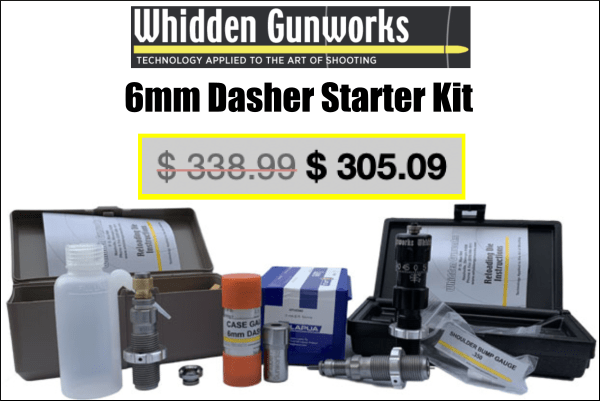
The 6mm Dasher is very popular in PRS and Mid-range Benchrest. And a 6mm Dasher just won the F-Open Mid-Range Nationals convincingly. If you’re ready to build a Dasher, consider the 6mm Dasher Starter Kit from Whidden Gunworks. The kit includes your choice of standard dies, 100 pieces of Lapua 6mmBR brass, 6mm Dasher Hydraulic Form Die, and a 6mm Dasher Case Gauge. This is everything you need to get up and running with this match-winning wildcat cartridge.
4. Creedmoor Sports — Sierra Bullets PLUS FREE Ammo Box
⏺ Good Deal on Sierra bullets plus handy Ammo Box
Sierra makes some of the highest-quality bullets on the market. Right now Creedmoor Sports has most popular Sierra Bullets in stock and ready to ship in many calibers. Most of the popular MatchKing bullet types have the meplats “tipped” at the factory for consistent BC and improved long-range performance. NOTE: If you purchase at least $150 in Sierra bullets you’ll get a FREE high-quality Plano Ammo Box.
5. KYGUNCO — Taurus G2c 9mm Pistol, $205.99
⏺ Great Deal on Reliable 12rd 9mm Carry Pistol
The Taurus G2c is a good little compact carry gun at a VERY attractive price — a third what you might pay for a 9mm Glock 19 these days. KYGUNCO has the black-on-black 9mm Taurus G2c for just $205.99 (cash price). That’s the best deal we’ve seen on a major brand 9mm pistol in a long time. At 6.25″ OAL, and weighing just 21.2 oz. unloaded, this affordable 9mm handgun is a true compact. Despite its small size, the G2c boasts a 12-round magazine. We like the fact it has a left-side manual safety (unlike the Glock).
6. Amazon — RCBS Rock Chucker Supreme, $188.99
⏺ Strong, versatile full-size press with lifetime warranty
With the shortages of good factory ammo, more shooters are hand-loading than ever before. That means that good reloading presses have been hard to find at reasonable prices. But here’s a good deal on a great press. Right now Amazon has the legendary RCBS Rock Chucker Supreme for under $190.00. This strong, capable press and allows you to do myriad reloading tasks: decapping, neck-sizing, FL-sizing, crimping, and even swaging bullets. RCBS offers a rock-solid lifetime warranty.
7. Amazon — Caldwell The Rock BR Rest, $140.79
⏺ Good basic rest for Varmint work and sighting-in rifles
Right now the green-framed Caldwell Rests are deeply discounted on Amazon. If you’re looking for something you could use in competition as well as varminting, check out the Caldwell Rock BR at $140.79. The Rock BR model is stable and works well for varmint shooting. If you want something lighter and more basic, the Rock Deluxe at $75.19 is an excellent value. Or if you prefer a compact, lightweight front rest for basic rifle and pistol work, consider a Rock Jr. at $35.54.
8. Natchez — CCI Blazer 9mm Ammunition, $19.99
⏺ Very reliable 9mm practice ammo at a good price
Finding quality 9mm Luger ammo at a decent price has been difficult lately. But here’s a good deal at Natchez. Quality, aluminum-case CCI Blazer 9mm 115gr ammo is now just $19.99 per 50-count box. That’s HALF the cost of 9mm pistol ammo at some other vendors. NOTE: Having aluminum cases, this ammo is NOT reloadable. But, in our experience it is reliable and accurate.
9. Amazon — KUBEI USB Rechargeable Digital Scale, $24.99
⏺ Compact scale with USB-rechargeable battery at great price
Everyone can use an inexpensive, compact scale for loading at the range or sorting bullets or maybe even primers. One very affordable option KUBEI USB Rechargeable Digital Scale. Unlike most other inexpensive digital scales, this comes with a large dust cover with a “window” for your powder pan. Notably, this scale can be conveniently recharged with a standard USB cable — no batteries to replace ever! We have heard positive reports from Forum members about this $24.99 portable scale, which offers 9 types of weight units, calibration weight, and fold-down protective lid.
10. Amazon — Tactical Hard Case, Customizable Foam, $89.99
⏺ Solid, strong wheeled case for ARs, or hunting rifles
Whether driving or flying, you need a good, strong case to protect your firearms. This affordable TSA-approved HQ ISSUE Tactical Rifle Hard Case has room for an AR, handguns, and accessories or a couple hunting rifles (with moderate-length barrels). NOTE: This case has rollers — something you don’t typically find on cases at this price point. The included pluckable foam interior can be easily customized to fit your rifle. External dimensions are: 43″ x 16″ x 7″.
11. Amazon — LEE Perfect Powder Measure, $22.95
⏺ Low-cost unit will work for basic powder-dispensing duties
Sometimes you just need a simple but effective way to throw powder charges without a big investment. For basic powder-throwing tasks the LEE Perfect Powder Measure can do the job. With a simple adjustment you can throw anywhere from 2 grains to over 70 grains. This is fine for most pistol charges. For more accurate rifle handloads, you can throw the charge within a grain and then trickle up to the final load weight using using a scale and separate trickler.
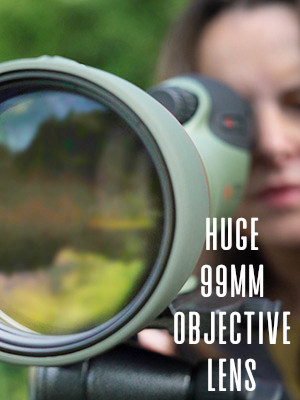
Bigger is normally better — when it comes to light transmission and field of view. Kowa has introduced an all-new, high-end spotting scope, the TSN-99 Prominar, which has a huge 99mm front objective lens. This 99mm spotting scope features a pure Fluorite XD (eXtra-low Dispersion) lens for maximum light transmission, with superior edge-to-edge sharpness, and minimal chromatic aberration.
The TSN-99’s primary TE-11WZ II eyepiece provides a 30-70X range of magnification and there is also a 40X extreme-wide-angle eyepiece. That would be very effective for wind-reading. Existing accessories for Kowa’s 88/77 series are compatible with the new TSN-99 series spotters.
Who needs a spotter this big? We expect this will be popular with wind coaches and shooters involved in the ELR game. And guys who started with a 60mm, then graduated to an 80mm or 88mm, may decide to step up to this big new optic. It will certainly offer better low-light performance. That 99mm objective equals 3.898 inches.
With a 100% magnesium alloy structure, this big spotter is lighter than you might expect. The angled model weighs 3.99 lbs. (1810 grams) while the straight version weighs 4.04 lbs. (1835 grams). With the magnesium body, Kowa claims the TSN-99 series is “one of the most compact and lightweight in its class … making it more portable than many other models.” The objective lens boasts a protective Kowa KR coating which actively repels dirt, moisture and dust.
Avaliable accessories include: TE-11WZ II 30-70X wide zoom eyepiece, TE-80XW 40X extreme-wide-angle eyepiece, TSN-EX16 1.6x extender, plus Digiscoping adapters.
The TSN-99 PROMINAR spotting scopes will be available for pre-order starting August 2, 2021, with product distribution beginning on September 9, 2021.* Click HERE for product information.
For our European readers, the Kowa Website lists the prices for TSN-99A Angled OR TSN-99S Straight spotters as follows: €3,899.00 with 30-70X eyepiece, or €3,199.00 body only. (I.e. same price for either straight or angled, VAT included).
Kowa’s 88mm TSN-880 Prominar spotters have finished at the top of many spotting scope comparison tests, so we expect the new 99mm TSN-99 to raise the bar even higher. Kowa explains: “The TSN-99 Prominar Series is the evolution of over six decades of Japanese optical design and technology. It utilizes the very best from our optical heritage and benefits from features, technology, and engineering developed by generations of Kowa optical experts.”
Kowa states that the TSN-99 Prominar Spotter was created to deliver “the brightest and widest view of nature[.] We created TSN-99 PROMINAR series because we wanted to deliver one of the most immersive and detailed views of the natural world.”
This short 1.5-minute video shows the TSN-99 used in the field:
This 7.5-minute video provides details of the TSN-99’s design, lens properties, and controls:
TE-80XW Extreme-Wide-Angle 40X EyePiece: 37M at 1000M
Along with a 30-70X zoom eyepiece, Kowa offers the Kowa TE-80XW eyepiece for the TSN-99 spotter series. The TE-80XW offers an 80-degree view, one of the widest field of views ever offered with similar magnification. This provides a view of 37 meters (40.5 yards) width at 1000m distance. That would allow you to see a very long line of targets or wide spread of wind flags with 40X magnification.
The TE-80XW incorporates a field-flattener lens maintaining flat resolution throughout the entire 80-degree field of view. The Kowa TE-80XW is 100% waterproof, sealed against the elements, and protected against dirt, moisture and dust by Kowa’s unique KR coating.
*The September 9, 2021 date was in Kowa’s official press release. However, Kowa’s global website states: “The new TSN-99 PROMINAR spotting scope series… will be available to purchase from Kowa authorised dealers from the 1st October 2021 [sic].” Thanks to EdLongRange for finding TSN-99 Series current pricing.
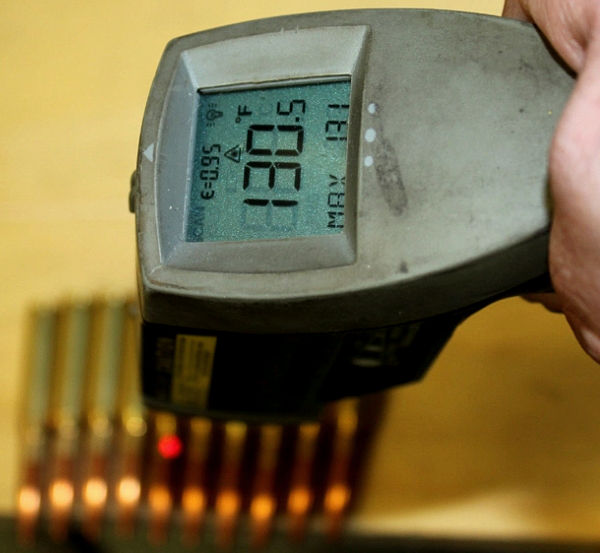
In this .308 Win test, 70° F ammo shot 96 FPS slower than ammo heated to 130.5° F. And the 130.5° ammunition was 145 fps faster than ammo taken right out of the freezer (at 25.5° F). That’s a huge difference…
Today is the first day of August. That means most parts of the country will soon be encountering peak summer heat. Some ranges in the Western states have already recorded temperatures well over 100 degrees F during matches. When dealing with extreme summer heat, you should make a serious effort to keep your ammo at reasonable temperatures. When possible, keep ammo in a cooler in the shade.
Never leave boxes of ammo out in the hot sun. Even with powders advertised as “temp stable” you can see significant velocity increases when ambient temps reach 90 degrees and above. This article explains how temperature extremes (both hot and cold) can alter bullet velocities. The velocity differences between very cold ammo and very hot ammo can be very large, as this article explains.
EDITOR’s NOTE: The Sierra tester does not reveal the brand of powder tested here. Some powders are much more temp sensitive than others. Accordingly, you cannot extrapolate test results from one propellant to another. Nonetheless, it is interesting to see the actual recorded velocity shift with ammo temperature variations in a .308 Win.
Written by Sierra Chief Ballistician Tommy Todd This story originally appeared in theSierra Bullets Blog
A few weeks ago I was attending the Missouri State F-Class Match. This was a two-day event during the summer and temperatures were hot one day and hotter the next. I shot next to a gentleman who was relatively new to the sport. He was shooting a basically factory rifle and was enjoying himself with the exception that his scores were not as good as he hoped they would be and he was experiencing pressure issues with his ammunition. I noticed that he was having to force the bolt open on a couple of rounds. During a break, I visited with him and offered a couple of suggestions which helped his situation somewhat and he was able to finish the match without major issues.
He was shooting factory ammunition, which is normally loaded to upper levels of allowable pressures. While this ammunition showed no problems during “normal” testing, it was definitely showing issues during a 20-round string of fire in the temperatures we were competing in. My first suggestion was that he keep his ammunition out of the direct sun and shade it as much as possible. My second suggestion was to not close the bolt on a cartridge until he was ready to fire. He had his ammo in the direct sunlight and was chambering a round while waiting on the target to be pulled and scored which can take from a few seconds to almost a minute sometimes.
This time frame allowed the bullet and powder to absorb chamber [heat] and build pressure/velocity above normal conditions. Making my recommended changes lowered the pressures enough for the rifle and cartridge to function normally.
Testing Effects of Ammunition Temperature on Velocity and POI
After thinking about this situation, I decided to perform a test in the Sierra Bullets underground range to see what temperature changes will do to a rifle/cartridge combination. I acquired thirty consecutive .30 caliber 175 grain MatchKing bullets #2275 right off one of our bullet assembly presses and loaded them into .308 Winchester ammunition. I utilized an unnamed powder manufacturer’s product that is appropriate for the .308 Winchester cartridge. This load is not at the maximum for this cartridge, but it gives consistent velocities and accuracy for testing.
I took ten of the cartridges and placed them in a freezer to condition.
I set ten of them on my loading bench, and since it was cool and cloudy the day I performed this test I utilized a floodlight and stand to simulate ammunition being heated in the sun.
I kept track of the temperatures of the three ammunition samples with a non-contact laser thermometer.
The rifle was fired at room temperature (70 degrees) with all three sets of ammunition. I fired this test at 200 yards out of a return-to-battery machine rest. The aiming point was a leveled line drawn on a sheet of paper. I fired one group with the scope aimed at the line and then moved the aiming point across the paper from left to right for the subsequent groups.
NOTE that the velocity increased as the temperature of the ammunition did.
The ammunition from the freezer shot at 2451 fps.
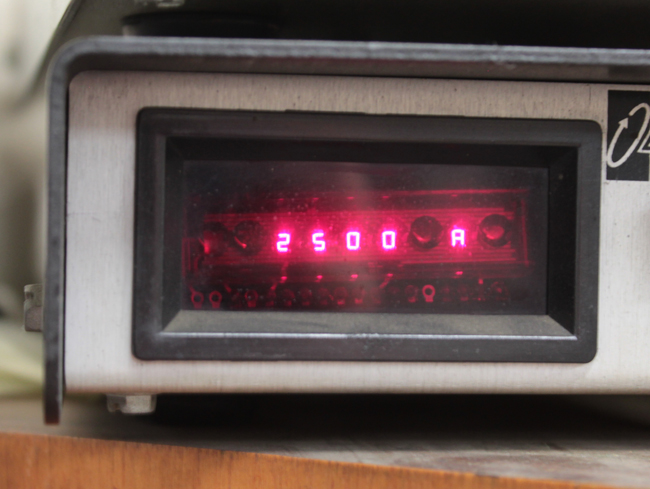
The room temperature ammunition shot at 2500 fps.
The heated ammunition shot at 2596 fps.
The tune window of the particular rifle is fairly wide as is shown by the accuracy of the three pressure/velocity levels and good accuracy was achieved across the board. However, notice the point of impact shift with the third group? There is enough shift at 200 yards to cause a miss if you were shooting a target or animal at longer ranges. While the pressure and velocities changed this load was far enough from maximum that perceived over pressure issues such as flattened primer, ejector marks on the case head, or sticky extraction did not appear. If you load to maximum and then subject your ammunition to this test your results will probably be magnified in comparison.
This test showed that pressures, velocities, and point-of-impact can be affected by temperatures of your ammunition at the time of firing. It’s really not a bad idea to test in the conditions that you plan on utilizing the ammo/firearm in if at all possible. It wouldn’t be a bad idea to also test to see what condition changes do to your particular gun and ammunition combination so that you can make allowances as needed. Any personal testing along these lines should be done with caution as some powder and cartridge combination could become unsafe with relatively small changes in conditions.
Keith Glasscock is one of America’s greatest F-Class shooters, as well as a highly respected wind coach. A High Master, Keith finished second overall at the 2021 NRA F-Class Long Range Championship in F-Open division. He also finished second at the 2020 Nationals, tied with F-Open winner Pat Scully on points, but with fewer Xs. And he took second also at the 2019 Nationals. His consistency is unrivaled, which means he definitely knows the secrets of long range wind calling and loading ultra-accurate ammo.
Keith has a popular YouTube Channel with new content every week. On Keith’s Winning in the Wind channel, Keith offers 60+ informative videos on a wide range of topics including wind reading, reloading, component selection, load development, and training. For today’s Video Showcase, we offer four of our favorite Keith Glasscock videos. Each video has important points that can benefit any competitive rifle shooter, whether you shoot in local 100-yard fun matches or compete at the National Level in F-Class, LR Benchrest, Palma, or High Power.
How to Find (and Fine-Tune) Seating Depth
This is Keith’s most popular video. Keith definitely knows how to maximize accuracy by finding the optimal seating depth for each particular barrel. He is achieving groups in the high Ones for three shots. That would be good for a short-range benchrest cartridge, but Keith is achieving that with a .284 Winchester which has much more recoil. If you shoot F-TR or F-Open or even PRS, you should watch this video.
How to Lower your ES/SD and Reduce Vertical at Long Range
This is Keith’s first video in a series on how to improve long range groups, precision, and accuracy by reducing velocity Extreme Spread (ES) and Standard Deviation (SD). To achieve the lowest ES you need to look at multiple processes, including precision powder weighing, careful seating, brass annealing, and primer selection. Another factor is bullet selection. Not all bullets of the same nominal caliber and weight class have exactly the same bullet diameter or shape. Sometimes you can get better accuracy AND lower ES by trying a different brand of bullet. We have found bullet diameters, of the same stated caliber, can vary by up to .0008″ (eight ten-thousandths). Some barrels like the fatter bullets, while other barrels may favor the skinny bullets.
How to Find Bullet-to-Rifling Touch Point
Before you even start to load for a new rifle you need to know the point at which the bullet in a loaded round will first touch the rifling. (This will be a base to ogive measurement on your round). Beyond that point you are “in the lands”. If you load shorter than that base-to-ogive length you are “jumping” your bullets. Some cartridge/bullet combos typically shoot best in the lands, while with other bullets and cartridges, jumping is the way to go. Additionally, with some disciplines it is wise to jump your bullets since you may have to unload a chambered round while on the firing line. In this video Keith shows a number of methods to determine “length to lands” with repeatable precision.
Field Test and Review of SEB Mini-X Coaxial Front Rest
While gear reviews are not the primary focus of Keith’s YouTube Channel, Keith does talk about products he likes and uses. In this video. Keith reviews the SEB Mini-X, the newest coaxial tripod rest from SEB Rests. The Mini-X offers fast, precise windage and elevation adjustment with the joystick control. The unit is much easier to pack and transport than a large, heavy front rest such as a SEB NEO or Farley. The latest Mini-X also has upgraded foot controls that make it easier to level the rest on uneven ground. For more info, see our SEB Mini-X Report.
Tomorrow is the first day of August, and that means it’s time to get ready for National Shooting Sports Month (NSSM). To help grow the ranks of shooters, the National Shooting Sports Foundation (NSSF) asks you to bring a new shooter to the range in August. That’s a good mission — adding to the ranks of shooters is the best way to preserve our Second Amendment rights.
This coast-to-coast celebration spotlights the fun and enjoyment of target shooting. Newcomers can take their first shots, and experienced shooters can invite someone new to the range or help an erstwhile shooter rediscover the fun of target shooting. This month-long event involves all the shooting sports — rifle, pistol, and shotgun.
Find Shooting Sports Events Near You
The NSSF’s ShootingSportsMonth.org website offers a comprehensive, searchable database. This lets you search by state, to find ranges, events, and sales promotions near you. Visit the NSSF online database of NSSM shooting events to find matches, clinics, training sessions, special sales — and much more.
Great FREE Targets for Fun at the Range
To promote National Shooting Sports Month, the NSSF has created a dozen FREE Downloadable Targets. There are regular bullseyes, as well as Darts, Golf, and more. We really like the Billiards target and kids love the Water Balloons target. You can download all 12 targets for free, and then print them out, ideally with a color printer. Have at it!


 It’s common for new pistoleros to start shooting at cans or clay birds at a public range. That can be fun, but it’s better to start with proper targets, placed at eye level, at 7-10 yards. We like to use targets with large, brightly colored circles. Focus on putting 5 shots in a circle. We recommend targets that have multiple bullseyes or aiming points — that way you don’t have to constantly change your target. There are also special paper targets that can help you diagnose common shooting problems, such as anticipating recoil. EZ2C makes very good targets with bright, red-orange aim points. You can also use the bright orange Birchwood Casey stick-on Target Dots (right). These come in a variety of diameters. We like the 2″ dot at 10 yards.


 He who dies with the most toys wins — right? Well Sinclair has another interesting gadget you can add to your reloading bench. The Sinclair




 Bigger is normally better — when it comes to light transmission and field of view. Kowa has introduced an all-new, high-end spotting scope, the


 Today is the first day of August. That means most parts of the country will soon be encountering peak summer heat. Some ranges in the Western states have already recorded temperatures well over 100 degrees F during matches. When dealing with extreme summer heat, you should make a serious effort to keep your ammo at reasonable temperatures. When possible, keep ammo in a cooler in the shade.