AR owners know that their black rifles require regular cleaning and maintenance. And this modular platform allows many options for stocks, fore-arms, and optics mounting. That ability to customize is one of the AR’s major attractions, but customization requires solid understanding of the AR’s design and components.
GET FREE 40-Page AR-15 Book Sample
Note, if you are interested in the book, there is a substantial 40+ page FREE sample available on the Amazon site. You can see the entirety of the first two chapters from the Kindle digital version. CLICK HERE to visit Amazon.com and then click on the button labeled “Read Sample” below the cover image.
AR Set-Up and Maintenance
If you need to disassemble and maintain your AR rifle, swap barrels or handguards, add optics, or customize the stock, Gun Digest’s AR-15 Setup, Maintenance and Repair book tells you what you need to know. From field-stripping to barrel mounting and trigger installations, the book covers a wide range of topics. The book provides step-by-step instructions for set-up and maintenance, with hundreds of detailed photos. The book also includes AR gunsmithing chapters with reviews of recommended tools.
Author Patrick Sweeney is a certified master gunsmith and armorer instructor for police departments. Sweeney has also authored the notable 4-volume Gunsmithing the AR-15 series (Vol. 1, Vol. 2, Vol. 3, and Vol. 4) and 20+ other titles for Gun Digest Books.
Whether you want to learn about disassembling your AR for regular maintenance, field-stripping, swapping out parts, adding optics or customizing a stock, AR-15 Setup, Maintenance and Repair guides you through everything you need to know to keep your AR-platform rifle running well. There are also tips on how to improve accuracy, and maintain your bolt carrier group properly.
Authored by Patrick Sweeney
Published by Gun Digest Books
ISBN-13: 978-1951115470
320 pages, softcover, 8 ¼ x 10 7/8 inches
Editor’s NOTE: The key to keeping an AR running reliably is proper lubrication (in the RIGHT places), and regular cleaning of the bolt carrier and bolt, including ejector recess and extractor recess. The majority of non-functioning ARs we’ve seen had gunk, lube, carbon, and brass shavings in those recesses.
Other AR Books by Patrick Sweeney
Bonus Video — AR15 Maintenance with Jerry Miculek
In this helpful video, legendary shooting Jerry Miculek explains how he cleans and maintains his AR-platform rifles. Miculek shoots ARs in three-gun competitions.
It’s now the month of May, so summer shooting season is right around the corner for the whole nation. Before you head to the range for the first time, we recommend you do some basic tasks with your firearms. Here’s some good advice on readying your rifles for the 2026 shooting season.
by Ron Dague, Sinclair International I give my rifles a pre-season check before the shooting season starts. This starts with a general inspection starting with the butt-plate or recoil pad and making sure that all the screws and adjustable parts (on an adjustable butt-plate) move freely up or down and side to side. If you got caught in rain some of these screws and adjustable parts may not move when needed. I disassemble parts as needed and put rust preventative or a light oil and/or grease on threads and sliding parts. On rifles with recoil pads and fixed butt-plates, make sure the screws are tight and that holes in the stock aren’t stripped out. Also make sure there are no cracks in the stock and around the butt-plate. And if the recoil pad is glued-on, just make sure it hasn’t come loose.
Next I take the action out of the stock and check for cracks and wear marks. I look at the bedding to make sure that oils and cleaning solvents have not damaged the bedding. While the action is out of the stock, I look for any surface rust or dirt/dust in the recoil lug area and magazine well. Clean as needed and repair or re-bed if needed.
Trigger Assembly and Action With the barreled action out of the stock, it is a good time to spray out the trigger with cleaner. I use Ronson oil or lighter fluid. [Editor’s Note: Some trigger-makers advise against using any kind of lubricant, grease or oil — so plain lighter fluid is preferred.] After the trigger is cleaned you may want to check the trigger pull weight. If you don’t feel comfortable doing this, take it to a gun smith and have it checked. It is worth every penny to not have a trigger issue and/or a safety malfunction. I also take the bolt apart and clean the firing pin spring and bolt housing with Gun Scrubber or automotive brake cleaner. Then lube the firing pin-spring and firing pin with light oil. I use Kel Lube and/or Butch’s gun oil. Put a small dab of gun grease on the [bolt locking lugs] and cocking ramp.
I will also spray the outside of the action and barrel and give that a light coating of oil for rust prevention. I clean the action with Sinclair’s action cleaning tool. Don’t forget to clean the bore. Even though you didn’t fire the rifle, this makes sure nothing obstructs your barrel.
Checking Metal Fixtures and Fasteners Next I look at the trigger guard and hinged floor plate and make sure it works as designed. Make sure there are no cracks in the trigger guard from an accidental drop. Check guard screws and /or action screws for tightness and tighten to proper spec. There are torque specs for this, but on wood stocks the wood can crush and this should be checked throughout the year as weather change can affect this. My entire collection of rifles are bedded and I just tighten them just snug with screw driver or Allen wrench. The rimfire rifles have a spec of 55 to 74 inch/lbs and I think would carry over to center fire as well. I would caution you about torque wrenches as you need a good quality wrench, and read the directions on how to use it. You can over torque if not careful. Check the swivel studs and bipod to make sure there tight as well. You may want to take scope off and check the base screws and check the rings.
Test Fire the Rifle After Maintenance
After all cleaning and is done and everything is reassembled, take a few rounds out to the range and test fire to make sure everything works as it should. Don’t forget to run 3-5 rounds through the magazine at least two times for function. I look at this as preventive maintenance on the rifle. If you give it a look over you shouldn’t have any trouble during the rifle matches or hunting trip.
Ron Dague
Certified Reloading Instructor
Certified Range Safety Officer
Email: rond [at] sinclairintl.com
Phone: 800-717-8211
This Article Originally Appeared in Sinclair International’s The Reloading Press.
Civilian Marksmanship Program (CMP) Provides $10 Million Challenge Grant for WSSC
The Board of Directors of the Civilian Marksmanship Program (CMP) has approved a $10 million challenge grant for development of the new Wyoming State Shooting Complex (WSSC) in Cody, Wyoming. This marks a major milestone in the CMP’s strategic “Western Expansion”, establishing a permanent footprint to serve marksmanship enthusiasts west of the Mississippi River.
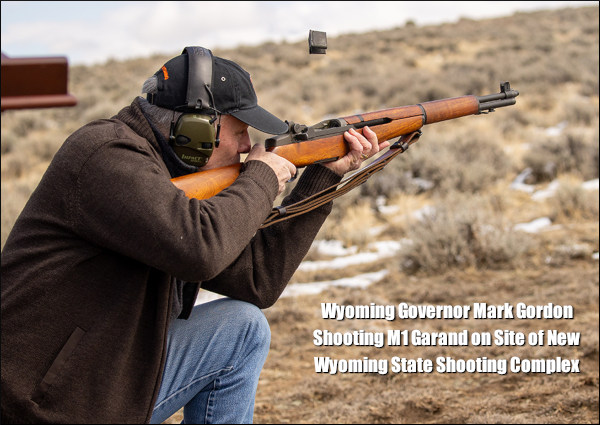
The new WSSC is now under development on 2,000 acres of state-contributed land located just seven miles south of downtown Cody. Positioned near Yellowstone National Park, the complex will become a premiere shooting sports destination, with purpose-built venues for elite competitors, recreational shooters, and youth programs.
The $10 million grant is structured as a matching initiative for three years. Under the agreement, the CMP will match new private and industry WSSC donations dollar-for-dollar, up to $10 million total.
Construction Is Underway with State Governmental Approval
The WSSC project has earned full support from the Wyoming Legislature and Governor, and it is governed by a Joint Powers Board representing city and county leadership. Construction is already underway, with core infrastructure and internal roads currently being established.
“Cody, Wyoming, is a great choice for Western expansion,” CMP Board Member and Wyoming resident Ed Newell noted following a site visit. The [WSSC] offers a unique opportunity for a high-impact partnership consistent with CMP’s mission to promote youth programs, marksmanship and firearms safety.
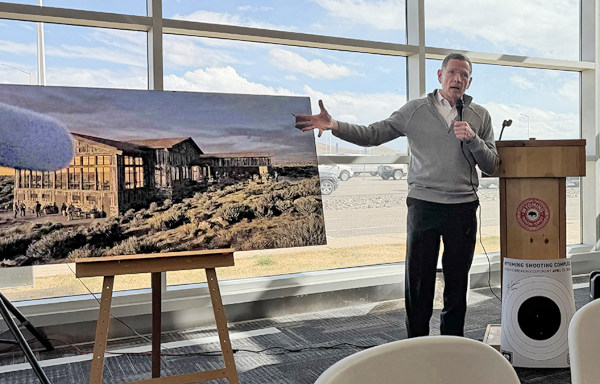
Above, U.S. Senator Barrasso shows the WSSC event center, which will include a retail area, classroom, kitchen, and a multi-purpose conference hall that can also be used for indoor archery and air gun.
The WSSC is designed to be a world-class destination for shooting sports. Its mission is to inspire youth participation, promote responsible firearm use, and serve as a catalyst for economic growth and outdoor recreation in the State of Wyoming and our nation.
Beyond the financial contribution, the CMP partnership includes key collaborative elements:
Expert Range Design: The CMP will provide technical input on range design to ensure the facility can host the organization’s signature matches and national-level competitions.
On-Site CMP Store: There’s a plan for the WSSC clubhouse to feature a CMP Store which would provide visitors with access to historic American firearms.
Nearby Buffalo Bill Museum: The WSSC’s proximity to the Buffalo Bill Center of the West, which houses over 7,000 firearms, will create a unique “view it, learn it, then buy it” experience for the more than one million tourists who visit the area annually.
Photo courtesy NRA MuseumClick Photo to View Larger Image
With today’s polymer-framed Glocks and Kel-Tecs, aesthetics have been sacrificed on the altar of functionality. Not so in the early 20th century — in that period, the best firearm designers created guns that looked as good as they worked. One example is the classic Colt Woodsman. This design came from the legendary John Moses Browning and was later refined by Colt before the pistol’s introduction in 1915. The Colt Woodsman’s frame design evolved over time in three distinct series: Series One 1915–1947, Series Two 1947–1955, and Series Three 1955–1977. Shown above is a stunning Carbonia-blued and engraved Third Series model with ivory grips.
Engraved Colt Woodsman from NRA Museum
In the NRA Museum’s Robert E. Petersen Gallery are many fine engraved arms. This Colt Woodsman .22 pistol is one of the Third Series guns that were made until 1977. Heavy barrels in either 4.5 or 6 inch lengths were offered in this variation. The Museum’s staff says: “We think the poised golden rattlesnake near the serial number is the [best] embellishment without putting down in any way the ivory grip panels or gold outline inlays.”
You can see this lovely Colt and countless other fine firearms at the NRA Museum in Fairfax, Virginia. The Museum is open every day from 9:30 am to 5:00 pm, and admission is free.
The Colt Woodsman was made in many variations, with different barrel lengths and contours and finishes. Here is a Colt Woodsman Third Series Match Target with 6″ Blued frame and slab barrel. Photo from Sam Lisker’s ColtAutos.com.
Here is a Colt Woodsman First Series Match Target with 6.5″ undercut slab match barrel and basic blued finish. Photo from Heritage Auctions.
Here is a Colt Woodsman Bullseye Match Target Pistol (6.5″ barrel) with blued finish and early factory “elephant ear” stocks with Colt medallions. This was owned by Philip Judd, an avid marksman who was 1952 Camp Perry Champion in the 500-yard .30-06 rifle competition. Photo from Sam Lisker’s ColtAutos.com.
With rising crime rates in the USA, many Americans are taking a much more serious look at armed self-defense. We understand why citizens in large cities are more concerned than ever with the need to protect themselves, their families, and their homes and businesses.
Shotgun vs. Handgun — which is better for home defense? That question inspires strong opinions on both sides. We think the best answer may be “both”. There are some situations where a pistol is most handy, while there are other situations where the power (and lethality) of the shotgun clearly wins out. Some would argue that the shotgun offers an “intimidation” factor that may better resolve a threat without a shot being fired.
The NSSF, in cooperation with Thunder Ranch Training Center, has created an interesting video that examines the Shotgun vs. Handgun debate. As the Cheaper Than Dirt Blog notes: “The primary argument against the shotgun is a longer length leading to less maneuverability. On the other hand, the pistol offers better maneuverability, but lacks the stopping power of a shotgun”. Moreover, the pistol may be less accurate, according to some critics. This NSSF video looks at the question from a logical standpoint — making some surprising points.
As you can see in this still frame (above) from the video, the shooting stance of the pistol shooter (Clint) is NOT much more compact than that of the two shotgunners (compare actual muzzle positions). So a shotgun may actually be more handy inside a home than some people realize. Clint concludes that the gun selection debate “is all very easily solved by only one question: ‘If someone was going to run across a bedroom at you and they had a big knife, would you rather shoot him one time with a pistol or one time with a shotgun?’ When you answer the question you figure out why this [shotgun length] doesn’t really bother us. We simply take these [shotguns] and use them in a slightly different manner…”
In this video, Thunder Ranch Director Clint Smith explains why the overall length of a shotgun, as held in firing position against the shoulder, is not really that much greater than the “shooting stance length” of a handgun held in a proper firing position (with arms extended). Accordingly gun length/size should not be the deciding factor when choosing a firearm for home defense.
Whatever Weapon You Choose — Train with It
Fundamentally, you should use the firearm that is 100% reliable, and with which you have trained regularly. Mastery of a defensive firearm — whether shotgun or handgun — needs to be second-nature. You should be able to operate all the controls (safety, pump, decocker, slide, bolt handle etc.) by “instinct” based on hours of training. Likewise you should know how to operate the light/laser if your defensive firearm is so equipped. Importantly, you should be able to reload in darkness, and clear malfunctions without panicking.
The RCBS Lock-Out Die can also be used with some Dillon and Hornady progressive presses.
If you load pistol or rifle ammo with a progressive press, we strongly recommend you get a Lock-Out Die from RCBS. This unique reloading die will prevent your progressive press from advancing if the dispensed powder charge is more or less than about 0.3 grains too high or too low. The Lock-Out Die really works. Your Editor uses it on his RCBS 2000 progressive press. I can affirm that a Lock-Out Die has “saved my bacon” a half-dozen times over the years when there was an over-charge (which could cause a Kaboom) or a low charge (which could cause a squib load).
The Lock-Out Die works by using a central die detection rod that sets its vertical position based on the height of the powder column in the case. Through an ingenious design, if the powder column height is too low or too high, the rod locks in place as you start to pull the press handle. This halts the press before the ram can lift and the cartridge plate can advance. Unlike a beeping alarm system (which can be ignored or defeated), the Lock-Out Die physically stops the movement of the press ram and prevents a bullet being seated in the “problem” case.
It takes a bit of tweaking to get the Lock-Out Die detection rod setting just right, but once it is correctly positioned, the Lock-Out Die works smoothly in the background. The Lock-Out Die won’t interfere with the loading process unless it detects a high or low charge — and then it positively stops the progressive loading cycle.
While crafted for use in RCBS progressive presses, the RCBS Lock-Out Die can also be used on a Dillon XL Progressive (see video below) or Hornady Lock-N-Load progressive — though it does take up one station which could otherwise be used for a final crimp die (after the seating die). The RCBS 2000 has one more station than a Dillon 550/650, so it’s an ideal platform for using the Lock-Out Die.
Learn More at UltimateReloader.com
On the UltimateReloader.com website, run by our friend Gavin Gear, you’ll find an excellent two-part series on the function and set-up of the RCBS Lock-Out Die. Part One explains how the Lock-Out Die functions, using cut-away illustrations. Part Two shows how to install and adjust the Lock-Out Die on various progressive presses. The Ultimate Reloader video at the top of this article shows setup of the RCBS Lock-Out Die on the Dillon XL-650 progressive press, while the Reloading Bench video below shows the Lock-Out Die on a Hornady LnL progressive.
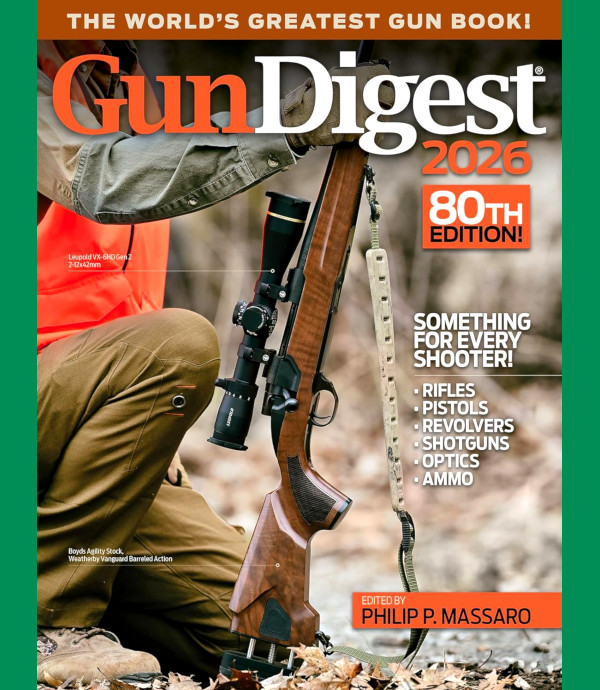
This 608-page resource covers rifles, shotguns, handguns, muzzleloaders, airguns, optics and more. We like the print edition, but there is also a Kindle eBook version for just $23.99 on Amazon. Both paperback and Kindle versions provide hundreds of photos plus new product roundups, in-depth product tests, and scores of articles and stories.
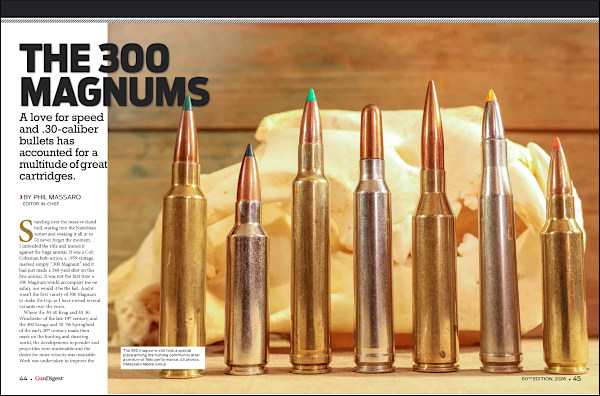
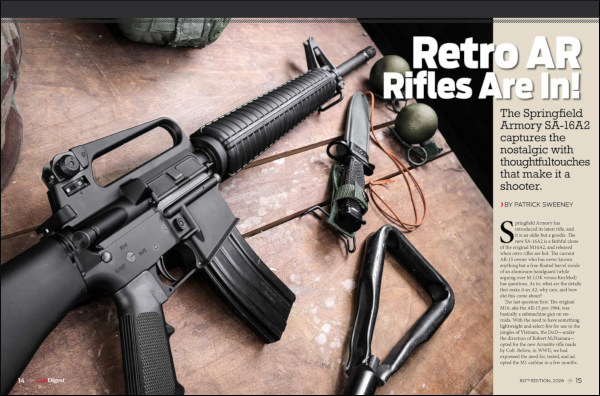
There are dozens of photo-illustrated feature articles. Among the notable stories are a guide to .300 caliber magnum cartridges, a feature on “Retro” AR rifles, evolution of the Ruger American Rifle, CZ 75 (Past/Present/Future), new Drone Killer guns, and multiple field tests on centerfire and rimfire rifles.
Gun Digest 2026 Editor-in-Chief Phil Massaro has assembled a team of respected industry authors for the 2026 book, including Craig Boddington, Bob Campbell, Joe Coogan, Mike Dickerson, Bill Gabbard, Nick Hahn, Ron Spomer, Patrick Sweeney, Col. Townsend Wehlen, Wayne van Zwoll, and many more.
Gun Digest 2026 (80th Ed.) covers hunting, personal defense, target shooting, gunsmithing, and collecting. There are Updated Ballistics Tables, and the catalog section shows off the newest offerings in rifles, handguns, shotguns, muzzleloaders and air rifles. The new 80th Edition has a vast collection of gun histories, in-depth reviews, and new product roundups. In addition to this, the Gun Digest 2026 book includes gun and optics field tests in the Testfire section, plus a guide to buying optics and ammunition. Reports from the Field (see below) cover the newest firearms and accessories.
A very large segment of the books catalogs hundreds of firearms currently offered for sale — rifles (centerfire/rimfire/black powder), pistols, shotguns, and airguns. There are also Ballistics Tables for centerfire rifle cartridges, pistol cartrdiges, and rimfire cartridges. Here is a summary of feature articles in this 608-page book:
Gun Digest 2026 Annual Feature Articles
Retro AR Rifles Are In! — BY PATRICK SWEENEY
A Custom Revolver Experience — BY SHANE JAHN
My Parkwest Arms SD-10 Dream Rifle — BY RON SPOMER
The 300 Magnums — BY PHIL MASSARO
The Evolution of the Ruger American Rifle — BY MIKE DICKERSON
Custom & Engraved Guns — BY THE AMERICAN CUSTOM GUNMAKER’S GUILD
All About the 7mm Backcountry — BY WILL BRANTLEY
Ruark’s Rifles—Part I — BY JOE COOGAN
The Guns of Famous Sports Figures — BY ALAN CLEMONS
Nagant Model 1895 Revolver — BY GEORGE LAYMAN
Big Nan — BY PHIL SHOEMAKER
Thompson/Center Arms: A Legacy Revitalized — BY BRAD FENSON
Drone Killers — BY L.P. BREZNY
The O’Connor Letters — BY LARRY L. WEISHUHN
CZ 75—Past, Present, Future — BY ALEXANDER CASTIGLIONE
Tracking Guns — BY RANDY FLANNERY
Stack-Barrel 28—The Ultimate Shotgun — BY TERRY WIELAND
Tailor-Made — BY ANDREA BOGARD
The Non-Dangerous Double Rifle — BY CRAIG BODDINGTON
A Holster a Day — BY TRENT MARSH
Colonel Colt’s Roster of Rogues — BY WAYNE VAN ZWOLL
Suppressor Primer — BY FRANK MELLONI
My Single-Shot Rifles — BY COL. TOWNSEND WHELEN
One Is Never Enough — BY RICK HACKER
From Mice to Moose: Freedom Arms Revolvers — BY DICK WILLIAMS
TESTFIRE
Mossberg International Silver Reserve Eventide HS12 Shotgun — BY PHIL MASSARO
Smith & Wesson’s All-Around Lever-Action — BY BOB CAMPBELL
The Leupold VX-6HD Gen 2 — BY PHIL MASSARO
Springfield Armory Hellcat Pro Comp — BY ROBERT SADOWSKI
ONE GOOD GUN
The Heart of a 99 — BY KRISTIN ALBERTS
The Browning “3 Shot” Sweet Sixteen — BY NICK HAHN
The Legendary 7mm Mauser Still Works — BY JIM HOUSE
The 370 Sako Magnum — BY STEVE GASH
Other Good Books from Gun Digest Media
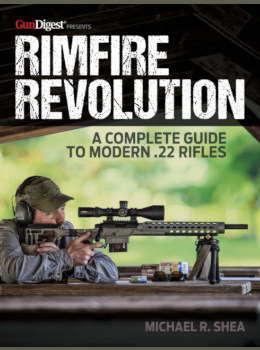
Gun Digest Media produces numerous other quality books for rifle, pistol, and shotgun owners. Here are four books we recommend. These are offered in both paperback and eBook versions:
Do you use bushings to size your case-necks? Are you assuming that your bushings are actually round on the inside, with a hole that’s centered-up properly? Well you may be in for an unpleasant surprise, based on what our friend Jim de Kort recently discovered. Jim was concerned about the run-out on his brass. His cases went into his bushing-equipped FL die pretty straight, but came out of the die with up to .004″ run-out. “What gives?”, Jim wondered. “Could the problem be the bushings themselves?”
To answer that question, Jim decided to examine his bushings. Using an Accuracy One Wheel-drive concentricity gauge, Jim checked out some of his neck bushings. What he discovered may surprise you…
Neck Bushing Flaws Revealed
Trust no one… — Jim de Kort
Jim writes: “I measured the concentricity of my 6BR rounds today. I noticed they went into the neck-bushing equipped full-length sizing die with less than .001″ deviation but came out with .003-.004″. The culprit, it appears, was the bushing itself. Without it the cases stayed within .0005″ to .001″ deviation, so something was happening with the bushing.
One bushing had .00025″ deviation on the outside, yet almost .003″ on the inside, so it is crooked. But even when using a bushing that is within .001″ I still get .003″ runout after sizing. I repeated the same procedure for my 6×47 and got the same results. When using the bushing, concentricity suffers a lot.”
Before we bash the bushing-makers, we must acknowledge that many different things can contribute to excessive run-out and/or mis-alignment of case-necks. We don’t have all the answers here, and Jim would be the first to say that some mysteries remain. Still, these are interesting results that give all precision hand-loaders something to think about.
Jim Borden of Borden Accuracy also offers this tip: “Check the trueness of the face of the die cap. That has more to do with trueness than the bushing. Also check perpendicularity of hole in bushing to top surface. When I was making dies, the cap was made by threading and facing the threaded tenon in same setup.”
Editor’s Comment: Many people have great results with neck-bushing dies, but Jim isn’t the only fellow who has seen some very odd results. I personally employ honed, non-bushing dies for many of my chamberings. These non-bushing dies (with the necks honed for .002-.003″ neck tension) produce extremely straight ammo, with run-out consistently under .0015″.
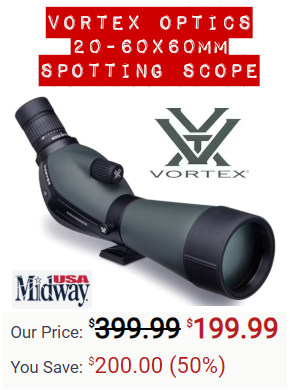
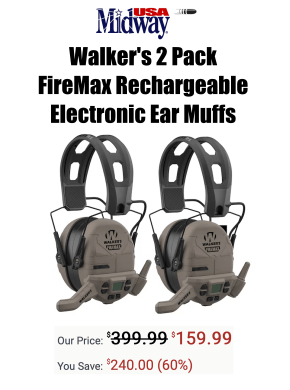
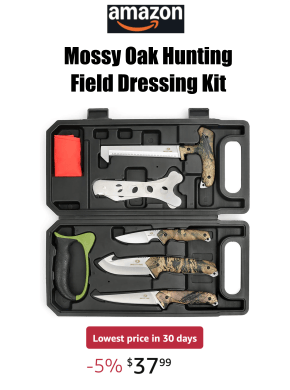
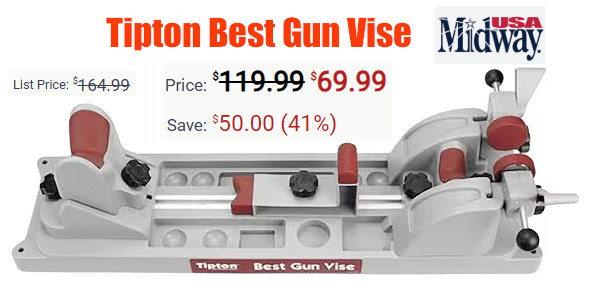
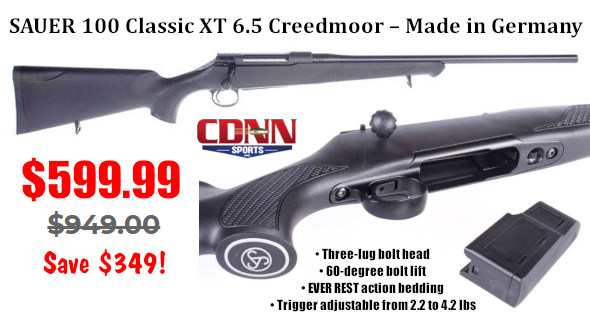
At the request of our readers, we provide select “Deals of the Week”. Every Sunday afternoon or Monday morning we offer our Best Bargain selections. Here are some of the best deals on firearms, hardware, reloading components, optics, and shooting accessories. Be aware that sale prices are subject to change, and once clearance inventory is sold, it’s gone for good. You snooze you lose.
NOTE: All listed products are for sale to persons 18 years of age or older. No products are intended for use by minors.
Creedmoor Sports — Big Savings on Optics, Tools, Bags, & More
⏺️ » Major discounts on hundreds of top-tier products
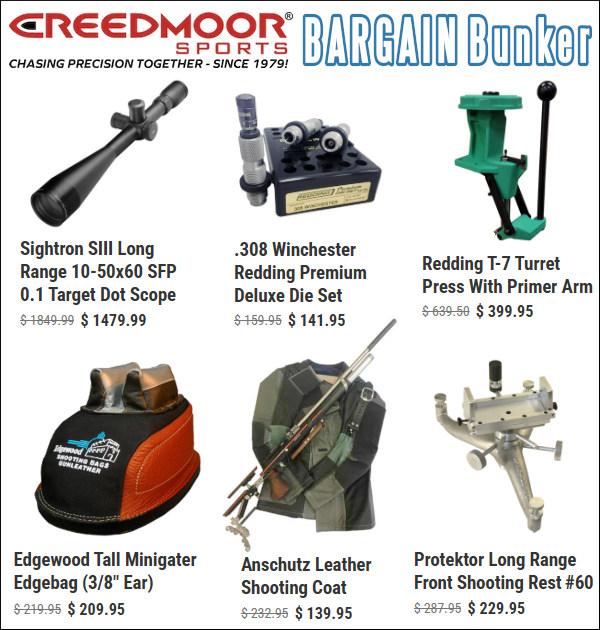
Lookin’ for a great deal? Currently there are over 500 discounted items in the Creedmoor Sports Sale section with 90+ in the Bargain Bunker (with major price cuts). You’ll find some great savings on Sightron Scopes, Wilson and Redding presses, Edgewood Bags, Protektor Front Rests, Wilson and Redding Dies, Berger Bullets, Starline Brass and much more.
Palmetto SA — AR Complete Rifles, Uppers, Lowers on Sale
⏺️ » Spectacular deals on AR Black Rifles, AR Pistols, and AR components
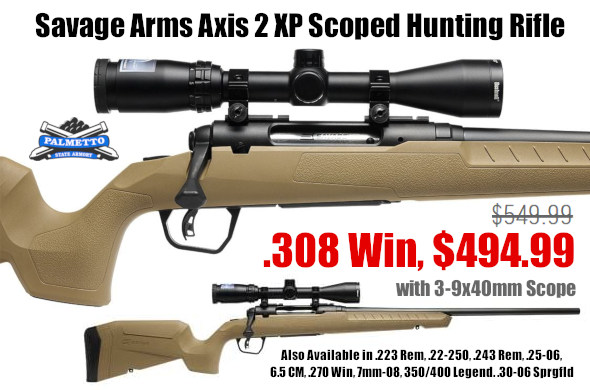
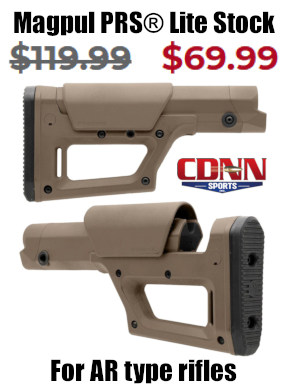
This week at Palmetto State Armory you’ll find exceptional deals on AR rifles, AR uppers, AR lowers, AR pistols, and the full range of AR components (such as bolt assemblies, sights, triggers, magazines etc.). If you are looking to add a quality 16″ bbl AR to your collection, you’ll find some great bargains. We like the 16″ barrel PSA EPT model. Complete with adjustable buttstock, M-LOK fore-end, and MBUS sights, it’s just $569.99 with FREE shipping.
As an Amazon affiliate, this site can earn revenues through sales commissions.
Our Friend (and int’l champion) Brandon Green reminded us on Facebook about a program to support the United States National Rifle Team (USNRT) youth squad, the Young Eagles.
Brandon posted: “I just wanted to share an opportunity for you guys to help our Young Eagles rifle team in preparation for the 2028 World Long Range Championships. This team is comprised of shooters under the age of 25 and will compete for the U25 championship in Bisley, England. They will be traveling over in 2027 for the Imperial meeting and again in 2028 for the Imperial and the Worlds. Anything you guys can do will be truly appreciated and the MidwayUSA Foundation will match donations!”
CLICK HERE to go to the webpage set up for donations to the USNRT Young Eagles program. You can also donate to the Young Eagles team using the QR Code Shown below. NOTE: Today through April 30, 2026, the MidwayUSA Foundation will match (dollar for dollar) all private donations for the Young Eagles.
About the USNRT Young Eagles
The USNRT (United States National Rifle Team) Young Eagles is a junior shooting program for athletes aged 25 and under, focusing on fullbore and long-range rifle disciplines. This elite team competes internationally, developing young talent in under-19, under-21, and under-25 categories. The team enjoyed notable success at the 2024 World Championships in South Africa.
Key Aspects of the USNRT Young Eagles Program:
Purpose: To represent the USA in international, high-level, fullbore, and long-range rifle competitions.
Disciplines: Participants compete in matches involving, or similar to, the Palma match format, shooting at ranges from 300 to 1000 yards.
Structure: As part of the USNRT, the Young Eagles program serves as a development pathway for younger shooters to gain international experience.
Competition Levels: The program includes under-25, under-21, and sometimes under-19 divisions.
Achievements: The Young Eagles have achieved great results, with podium finishes at the 2024 World Long Range Championships in South Africa, and 2nd place in the Under-25 World Team Championship.


 AR Set-Up and Maintenance

 I give my rifles a pre-season check before the shooting season starts. This starts with a general inspection starting with the butt-plate or recoil pad and making sure that all the screws and adjustable parts (on an adjustable butt-plate) move freely up or down and side to side. If you got caught in rain some of these screws and adjustable parts may not move when needed. I disassemble parts as needed and put rust preventative or a light oil and/or grease on threads and sliding parts. On rifles with recoil pads and fixed butt-plates, make sure the screws are tight and that holes in the stock aren’t stripped out. Also make sure there are no cracks in the stock and around the butt-plate. And if the recoil pad is glued-on, just make sure it hasn’t come loose.
 With the barreled action out of the stock, it is a good time to spray out the trigger with cleaner. I use Ronson oil or lighter fluid. [Editor’s Note: Some trigger-makers advise against using any kind of lubricant, grease or oil — so plain lighter fluid is preferred.] After the trigger is cleaned you may want to check the trigger pull weight. If you don’t feel comfortable doing this, take it to a gun smith and have it checked. It is worth every penny to not have a trigger issue and/or a safety malfunction. I also take the bolt apart and clean the firing pin spring and bolt housing with Gun Scrubber or automotive brake cleaner. Then lube the firing pin-spring and firing pin with light oil. I use Kel Lube and/or Butch’s gun oil. Put a small dab of gun grease on the [bolt locking lugs] and cocking ramp.
 Next I look at the trigger guard and hinged floor plate and make sure it works as designed. Make sure there are no cracks in the trigger guard from an accidental drop. Check guard screws and /or action screws for tightness and tighten to proper spec. There are torque specs for this, but on wood stocks the wood can crush and this should be checked throughout the year as weather change can affect this. My entire collection of rifles are bedded and I just tighten them just snug with screw driver or Allen wrench. The rimfire rifles have a spec of 55 to 74 inch/lbs and I think would carry over to center fire as well. I would caution you about torque wrenches as you need a good quality wrench, and read the directions on how to use it. You can over torque if not careful. Check the swivel studs and bipod to make sure there tight as well. You may want to take scope off and check the base screws and check the rings.



 Engraved Colt Woodsman from NRA Museum


 If you load pistol or rifle ammo with a progressive press, we strongly recommend you get a Lock-Out Die from RCBS. This unique reloading die will prevent your progressive press from advancing if the dispensed powder charge is more or less than about 0.3 grains too high or too low. The Lock-Out Die really works. Your Editor uses it on his RCBS 2000 progressive press. I can affirm that a Lock-Out Die has “saved my bacon” a half-dozen times over the years when there was an over-charge (which could cause a Kaboom) or a low charge (which could cause a squib load).