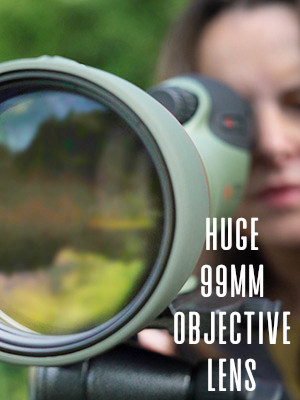
Bigger is normally better — when it comes to light transmission and field of view. Kowa has introduced an all-new, high-end spotting scope, the TSN-99 Prominar, which has a huge 99mm front objective lens. This 99mm spotting scope features a pure Fluorite XD (eXtra-low Dispersion) lens for maximum light transmission, with superior edge-to-edge sharpness, and minimal chromatic aberration.
The TSN-99’s primary TE-11WZ II eyepiece provides a 30-70X range of magnification and there is also a 40X extreme-wide-angle eyepiece. That would be very effective for wind-reading. Existing accessories for Kowa’s 88/77 series are compatible with the new TSN-99 series spotters.
Who needs a spotter this big? We expect this will be popular with wind coaches and shooters involved in the ELR game. And guys who started with a 60mm, then graduated to an 80mm or 88mm, may decide to step up to this big new optic. It will certainly offer better low-light performance. That 99mm objective equals 3.898 inches.
With a 100% magnesium alloy structure, this big spotter is lighter than you might expect. The angled model weighs 3.99 lbs. (1810 grams) while the straight version weighs 4.04 lbs. (1835 grams). With the magnesium body, Kowa claims the TSN-99 series is “one of the most compact and lightweight in its class … making it more portable than many other models.” The objective lens boasts a protective Kowa KR coating which actively repels dirt, moisture and dust.
Avaliable accessories include: TE-11WZ II 30-70X wide zoom eyepiece, TE-80XW 40X extreme-wide-angle eyepiece, TSN-EX16 1.6x extender, plus Digiscoping adapters.
The TSN-99 PROMINAR spotting scopes will be available for pre-order starting August 2, 2021, with product distribution beginning on September 9, 2021.* Click HERE for product information.
For our European readers, the Kowa Website lists the prices for TSN-99A Angled OR TSN-99S Straight spotters as follows: €3,899.00 with 30-70X eyepiece, or €3,199.00 body only. (I.e. same price for either straight or angled, VAT included).
Kowa’s 88mm TSN-880 Prominar spotters have finished at the top of many spotting scope comparison tests, so we expect the new 99mm TSN-99 to raise the bar even higher. Kowa explains: “The TSN-99 Prominar Series is the evolution of over six decades of Japanese optical design and technology. It utilizes the very best from our optical heritage and benefits from features, technology, and engineering developed by generations of Kowa optical experts.”
Kowa states that the TSN-99 Prominar Spotter was created to deliver “the brightest and widest view of nature[.] We created TSN-99 PROMINAR series because we wanted to deliver one of the most immersive and detailed views of the natural world.”
This short 1.5-minute video shows the TSN-99 used in the field:
This 7.5-minute video provides details of the TSN-99’s design, lens properties, and controls:
TE-80XW Extreme-Wide-Angle 40X EyePiece: 37M at 1000M
Along with a 30-70X zoom eyepiece, Kowa offers the Kowa TE-80XW eyepiece for the TSN-99 spotter series. The TE-80XW offers an 80-degree view, one of the widest field of views ever offered with similar magnification. This provides a view of 37 meters (40.5 yards) width at 1000m distance. That would allow you to see a very long line of targets or wide spread of wind flags with 40X magnification.
The TE-80XW incorporates a field-flattener lens maintaining flat resolution throughout the entire 80-degree field of view. The Kowa TE-80XW is 100% waterproof, sealed against the elements, and protected against dirt, moisture and dust by Kowa’s unique KR coating.
*The September 9, 2021 date was in Kowa’s official press release. However, Kowa’s global website states: “The new TSN-99 PROMINAR spotting scope series… will be available to purchase from Kowa authorised dealers from the 1st October 2021 [sic].” Thanks to EdLongRange for finding TSN-99 Series current pricing.
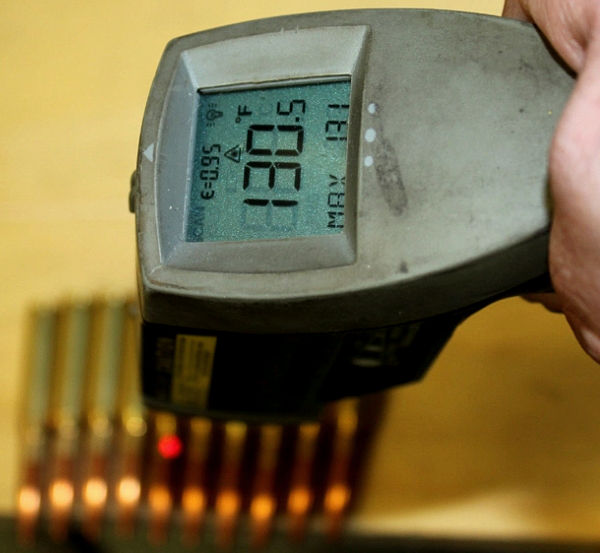
In this .308 Win test, 70° F ammo shot 96 FPS slower than ammo heated to 130.5° F. And the 130.5° ammunition was 145 fps faster than ammo taken right out of the freezer (at 25.5° F). That’s a huge difference…
Today is the first day of August. That means most parts of the country will soon be encountering peak summer heat. Some ranges in the Western states have already recorded temperatures well over 100 degrees F during matches. When dealing with extreme summer heat, you should make a serious effort to keep your ammo at reasonable temperatures. When possible, keep ammo in a cooler in the shade.
Never leave boxes of ammo out in the hot sun. Even with powders advertised as “temp stable” you can see significant velocity increases when ambient temps reach 90 degrees and above. This article explains how temperature extremes (both hot and cold) can alter bullet velocities. The velocity differences between very cold ammo and very hot ammo can be very large, as this article explains.
EDITOR’s NOTE: The Sierra tester does not reveal the brand of powder tested here. Some powders are much more temp sensitive than others. Accordingly, you cannot extrapolate test results from one propellant to another. Nonetheless, it is interesting to see the actual recorded velocity shift with ammo temperature variations in a .308 Win.
Written by Sierra Chief Ballistician Tommy Todd This story originally appeared in theSierra Bullets Blog
A few weeks ago I was attending the Missouri State F-Class Match. This was a two-day event during the summer and temperatures were hot one day and hotter the next. I shot next to a gentleman who was relatively new to the sport. He was shooting a basically factory rifle and was enjoying himself with the exception that his scores were not as good as he hoped they would be and he was experiencing pressure issues with his ammunition. I noticed that he was having to force the bolt open on a couple of rounds. During a break, I visited with him and offered a couple of suggestions which helped his situation somewhat and he was able to finish the match without major issues.
He was shooting factory ammunition, which is normally loaded to upper levels of allowable pressures. While this ammunition showed no problems during “normal” testing, it was definitely showing issues during a 20-round string of fire in the temperatures we were competing in. My first suggestion was that he keep his ammunition out of the direct sun and shade it as much as possible. My second suggestion was to not close the bolt on a cartridge until he was ready to fire. He had his ammo in the direct sunlight and was chambering a round while waiting on the target to be pulled and scored which can take from a few seconds to almost a minute sometimes.
This time frame allowed the bullet and powder to absorb chamber [heat] and build pressure/velocity above normal conditions. Making my recommended changes lowered the pressures enough for the rifle and cartridge to function normally.
Testing Effects of Ammunition Temperature on Velocity and POI
After thinking about this situation, I decided to perform a test in the Sierra Bullets underground range to see what temperature changes will do to a rifle/cartridge combination. I acquired thirty consecutive .30 caliber 175 grain MatchKing bullets #2275 right off one of our bullet assembly presses and loaded them into .308 Winchester ammunition. I utilized an unnamed powder manufacturer’s product that is appropriate for the .308 Winchester cartridge. This load is not at the maximum for this cartridge, but it gives consistent velocities and accuracy for testing.
I took ten of the cartridges and placed them in a freezer to condition.
I set ten of them on my loading bench, and since it was cool and cloudy the day I performed this test I utilized a floodlight and stand to simulate ammunition being heated in the sun.
I kept track of the temperatures of the three ammunition samples with a non-contact laser thermometer.
The rifle was fired at room temperature (70 degrees) with all three sets of ammunition. I fired this test at 200 yards out of a return-to-battery machine rest. The aiming point was a leveled line drawn on a sheet of paper. I fired one group with the scope aimed at the line and then moved the aiming point across the paper from left to right for the subsequent groups.
NOTE that the velocity increased as the temperature of the ammunition did.
The ammunition from the freezer shot at 2451 fps.
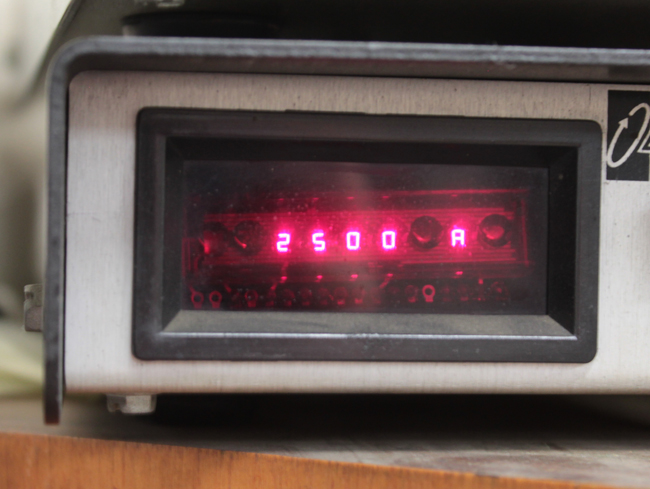
The room temperature ammunition shot at 2500 fps.
The heated ammunition shot at 2596 fps.
The tune window of the particular rifle is fairly wide as is shown by the accuracy of the three pressure/velocity levels and good accuracy was achieved across the board. However, notice the point of impact shift with the third group? There is enough shift at 200 yards to cause a miss if you were shooting a target or animal at longer ranges. While the pressure and velocities changed this load was far enough from maximum that perceived over pressure issues such as flattened primer, ejector marks on the case head, or sticky extraction did not appear. If you load to maximum and then subject your ammunition to this test your results will probably be magnified in comparison.
This test showed that pressures, velocities, and point-of-impact can be affected by temperatures of your ammunition at the time of firing. It’s really not a bad idea to test in the conditions that you plan on utilizing the ammo/firearm in if at all possible. It wouldn’t be a bad idea to also test to see what condition changes do to your particular gun and ammunition combination so that you can make allowances as needed. Any personal testing along these lines should be done with caution as some powder and cartridge combination could become unsafe with relatively small changes in conditions.
Keith Glasscock is one of America’s greatest F-Class shooters, as well as a highly respected wind coach. A High Master, Keith finished second overall at the 2021 NRA F-Class Long Range Championship in F-Open division. He also finished second at the 2020 Nationals, tied with F-Open winner Pat Scully on points, but with fewer Xs. And he took second also at the 2019 Nationals. His consistency is unrivaled, which means he definitely knows the secrets of long range wind calling and loading ultra-accurate ammo.
Keith has a popular YouTube Channel with new content every week. On Keith’s Winning in the Wind channel, Keith offers 60+ informative videos on a wide range of topics including wind reading, reloading, component selection, load development, and training. For today’s Video Showcase, we offer four of our favorite Keith Glasscock videos. Each video has important points that can benefit any competitive rifle shooter, whether you shoot in local 100-yard fun matches or compete at the National Level in F-Class, LR Benchrest, Palma, or High Power.
How to Find (and Fine-Tune) Seating Depth
This is Keith’s most popular video. Keith definitely knows how to maximize accuracy by finding the optimal seating depth for each particular barrel. He is achieving groups in the high Ones for three shots. That would be good for a short-range benchrest cartridge, but Keith is achieving that with a .284 Winchester which has much more recoil. If you shoot F-TR or F-Open or even PRS, you should watch this video.
How to Lower your ES/SD and Reduce Vertical at Long Range
This is Keith’s first video in a series on how to improve long range groups, precision, and accuracy by reducing velocity Extreme Spread (ES) and Standard Deviation (SD). To achieve the lowest ES you need to look at multiple processes, including precision powder weighing, careful seating, brass annealing, and primer selection. Another factor is bullet selection. Not all bullets of the same nominal caliber and weight class have exactly the same bullet diameter or shape. Sometimes you can get better accuracy AND lower ES by trying a different brand of bullet. We have found bullet diameters, of the same stated caliber, can vary by up to .0008″ (eight ten-thousandths). Some barrels like the fatter bullets, while other barrels may favor the skinny bullets.
How to Find Bullet-to-Rifling Touch Point
Before you even start to load for a new rifle you need to know the point at which the bullet in a loaded round will first touch the rifling. (This will be a base to ogive measurement on your round). Beyond that point you are “in the lands”. If you load shorter than that base-to-ogive length you are “jumping” your bullets. Some cartridge/bullet combos typically shoot best in the lands, while with other bullets and cartridges, jumping is the way to go. Additionally, with some disciplines it is wise to jump your bullets since you may have to unload a chambered round while on the firing line. In this video Keith shows a number of methods to determine “length to lands” with repeatable precision.
Field Test and Review of SEB Mini-X Coaxial Front Rest
While gear reviews are not the primary focus of Keith’s YouTube Channel, Keith does talk about products he likes and uses. In this video. Keith reviews the SEB Mini-X, the newest coaxial tripod rest from SEB Rests. The Mini-X offers fast, precise windage and elevation adjustment with the joystick control. The unit is much easier to pack and transport than a large, heavy front rest such as a SEB NEO or Farley. The latest Mini-X also has upgraded foot controls that make it easier to level the rest on uneven ground. For more info, see our SEB Mini-X Report.
Tomorrow is the first day of August, and that means it’s time to get ready for National Shooting Sports Month (NSSM). To help grow the ranks of shooters, the National Shooting Sports Foundation (NSSF) asks you to bring a new shooter to the range in August. That’s a good mission — adding to the ranks of shooters is the best way to preserve our Second Amendment rights.
This coast-to-coast celebration spotlights the fun and enjoyment of target shooting. Newcomers can take their first shots, and experienced shooters can invite someone new to the range or help an erstwhile shooter rediscover the fun of target shooting. This month-long event involves all the shooting sports — rifle, pistol, and shotgun.
Find Shooting Sports Events Near You
The NSSF’s ShootingSportsMonth.org website offers a comprehensive, searchable database. This lets you search by state, to find ranges, events, and sales promotions near you. Visit the NSSF online database of NSSM shooting events to find matches, clinics, training sessions, special sales — and much more.
Great FREE Targets for Fun at the Range
To promote National Shooting Sports Month, the NSSF has created a dozen FREE Downloadable Targets. There are regular bullseyes, as well as Darts, Golf, and more. We really like the Billiards target and kids love the Water Balloons target. You can download all 12 targets for free, and then print them out, ideally with a color printer. Have at it!
The final individual match results have been tallied and there are two new NRA Long Range F-Class National Champions: Ian Klemm in F-TR and Tod Hendricks in F-Open. Congrats to both of these men for their outstanding performances. Ian, a multi-time Champion, has really dominated the F-TR field in recent years. This is now his FOURTH F-TR National Championship, having previously won in 2020, 2018, and 2017. That is dominance! And Tod has long been a top competitor, including past F-Open team (Grand Agg) and individual (Mid-Range) wins at the Berger SW Nationals.
Finishing second in F-Open was Forum member Keith Glasscock, host of the popular Winning in the Wind YouTube Channel. Second in F-TR was Matt Schwartzkopf, a great guy who also supervises the Berger SW Nationals at Ben Avery. Matt is a double amputee below the knee, but he has never let that issue hold him back in competition.
Comments from F-Open Winner Tod Hendricks
Tod told us: “The heat and humidity were very challenging, but everyone had to deal with that. I struggled a bit on the first two relays on Day One, actually shooting an 8 due to a mental mistake on relay one. Both those relays were cleanable and I dropped 6 points. Being able to refocus myself and only drop 3 points in the last six relays is something that I will forever use as a mental tool. I’ve been close to winning a few big matches. I never felt like I choked at the end, but after a while you start to question yourself a little. Of course, this win got that monkey off my back.
I’d like to thank my sponsors Lapua, Brux barrels, Borden Accuracy, and Kahles, as well as my teammates on Team LBB — they were pulling for me and I felt it. Shout out to X-Ring Rifle Stocks — the owner Jason and I developed a new F-Open stock a couple years ago. He’s a very smart and hard working guy who took the time to listen to a few unconventional ideas.”
Matt Schwartzkopf (center, dark blue shirt) with Michelle Gallagher at 2021 F-Class Nationals. Photo by Forum member Turbulent Turtle.
Here is one of Keith Glasscock’s fine videos from his Winning in the Wind YouTube Channel:
Keith, who finished second overall in F-Open, offered these insights about the F-Class LR Nationals: “The key to performing well in Atterbury revolved around keeping yourself healthy in the heat and humidity. It is difficult to make good decisions when overheated or dehydrated. Winds were only marginally readable, but changes were not ‘sharp’ in nature. With so many excellent competitors at the event, the chances of getting target service in less than 7 seconds was better than even. For the record, the draw of these events is the opportunity to spend time with my F-Class family doing the thing we love.”
The NRA F-Class Team Championship was held July 29, 2021. Congrats to the winning squads, Team Indiana (F-Open) and Team USA Blue (F-TR). Conditions were fairly difficult with plenty of rapid wind switches to challenge the wind callers. It was great to see a large number of teams on the firing line, both in F-TR and F-Open.
Second place was very close in both divisions. F-TR was decided on X-count. In F-0pen, Team Kelly McMillan finished second by just one point, but with a huge edge in X-count. Team Kelly McMillan had 83 Xs compared to 66 Xs for Team Indiana. Tim Vaught and Norm Harrold both drilled 23 Xs while Doug Skogman had 20 Xs. Kelly, who sadly passed away recently, would have been proud of this team. His team’s outstanding performance honored his memory.
In F-TR division, Team USA Blue’s Luke Ramsey shot brilliantly to score 396-21X to lead his team. Ian Klemm, currently in first place in the individual F-TR competition, also shot great to tally 392-16X.
Ray Gross joined six good friends to squad up as Team Creedmoor, which finished a very close second in the F-TR division. The top two squads had the same 1559 Aggregate point total with Team USA Blue earning Gold with 57Xs vs. 44Xs for Team Creedmoor.
Ray was proud of his team’s performance: “After a 3-year hiatus, we got the band back together to finish Silver (by Xs) at the U.S. F-Class Long Range Nationals. It was a fairly tough day, living off the flags, with a lot of quick switches. I’ll coach you guys anytime!”
Team Creedmoor team-mates (L to R): Daniel Pohlabel, Paul Phillips, Ray Gross, Brad Sauve, John Droelle, and Jeff Rorer.
In the video below, Shiraz Balolia takes you through the essentials of fire-forming brass with his custom-made, water-cooled benchrest railgun. Shiraz is a current Team member (and former Team Captain) of the U.S. F-Class Open Rifle Team. Shiraz has competed on the National and World level for more than two decades, and has won multiple major International championships in 1000-yard shooting. In this video he will walk you through fire-forming cartridges in .284 Shiraz, a wildcat based on the .284 Winchester.
Fire-forming properly is a pre-requisite for accuracy in a match rifle. Done right, fire-forming can improve cartridge consistency shot to shot. Creating a fire-forming fixture like this, or even a more basic design, can save you time and potential frustration on the range, Shiraz explains. The key is getting the initial case expansion to match your competition chamber quickly but without generating excessive heat. Follow along as Shiraz takes you through the methodology of fire-forming both in his work shop and on the range.
Here Shiraz Balolia takes you through the essentials of fire-forming brass with his custom-made, water-cooled benchrest railgun.
Along with running the successful Grizzly Industrial enterprise, Shiraz is a top competitor and member of the U.S. F-Open team. He has competed in three world championships. In recent years he captured three straight Canadian National F-Class Championships (READ 3-Peat STORY). So, this guy knows his stuff.
Shiraz shows fellow shooters how to fire-form cases efficiently without burning precious match barrel life. In the video above he uses a custom-designed railgun that employs water cooling for the barrel. This is done with hoses running from a sink, so that cool water is constantly flowing through the barrel jacket.
Shiraz says the fired cartridge are actually cool to the touch because the water-jacketed barrel keeps everything at a moderate temperature. (See video at 8:00)
Paul Phillips is now best known as an Extreme Long Range (ELR) ace shooting large caliber “boomers”. He was the King of Two Miles in 2019. But Paul has also competed in F-Class and other disciplines. This week he is at Camp Atterbury, Indiana, participating in the NRA F-Class National Championships in F-TR division. He is currently in fourth place, with the final invidual competition to take place this Friday, July 30, 2021 (today 7/29/21 is Team Competition). SEE Current F-TR Standings.
Paul has good skills with a camera as well as a rifle. On his Facebook Page, Paul recently posted images from the F-Class Nationals. He observed: “My First National Match string since 2018. Feels like a .22 rimfire compared to the big bruisers. Lots of fun.”
Mid-Range Team Match at 600 Yards
This photo from the Mid-Range Team Match by Forum member “Turbulent Turtle”.
Paul Phillips also shot the 600-yard Team Match on July 26, 2021. Shown below are score-cards for Paul Phillips and his team-mate Jeff Rorer. Both shot “clean” (not dropping a point), in this particular event, Team Match 6311. Paul’s 200-13X was the second highest score among all competitors on the line, but he didn’t want to take full credit: “I’m just a trigger-puller. Dan Pohlabel was making the wind calls.”
Paul wanted to credit his sponsors: Creedmoor Sports, Manson Precision Reamers, Nightforce Optics, Berger Bullets, Lapua, Vihtavuori, CROSSTAC, Kestrel Ballistics, Labradar, Longshot Cameras, Applied Ballistics LLC, Bullet Central, Bix’n Andy, and Ryan Pierce.
With barrels, one wonders “Can a little more length provide a meaningful velocity gain?” To answer that question, Rifleshooter.com performed an interesting test, cutting a .308 Win barrel from 28″ all the way down to 16.5″. The cuts were made in one-inch intervals with a rotary saw. At each cut length, velocity was measured with a Magnetospeed chronograph. To make the test even more interesting, four different types of .308 Win factory ammunition were chronographed at each barrel length.
This is a very useful test is you’re thinking about building a .308 Win hunting rifle, or perhaps thinking of going shorter for your F-TR rifle to save weight.
Test Barrel Lost 22.7 FPS Per Inch (.308 Win Chambering)
How much velocity do you think was lost, on average, for each 1″ reduction in barrel length? The answer may surprise you. With a barrel reduction from 28″ to 16.5″, the average speed loss of the four types of .308 ammo was 261 fps total. That works out to an average loss of 22.7 fps per inch. This chart shows velocity changes for all four ammo varieties:
Summary of Findings:
The average velocity loss per inch, for all four ammo types combined, was 22.7 FPS. By ammo type, the average FPS loss per inch was: 24.6 (Win 147 FMJ), 22.8 (IMI 150 FMJ), 20.9 (Fed GMM 168gr), and 22.5 (Win 180PP).
Interestingly, these numbers jive pretty well with estimates found in reloading manuals. The testers observed: “The Berger Reloading manual says for the 308 Winchester, ‘muzzle velocity will increase (or decrease) by approximately 20 fps per inch from a standard 24″ barrel’.”
How the Test Was Done
The testers described their procedure as follows: “Ballistic data was gathered using a Magnetospeed barrel mounted ballistic chronograph. At each barrel length, the rifle was fired from a front rest with rear bags, with five rounds of each type of ammunition. Average velocity and standard deviation were logged for each round. Since we would be gathering data on 52 different barrel length and ammunition combinations and would not be crowning the barrel after each cut, we decided to eliminate gathering data on group sizes. Once data was gathered for each cartridge at a given barrel length, the rifle was cleared and the bolt was removed. The barrel was cut off using a cold saw. The test protocol was repeated for the next length. Temperature was 47° F.”
CLICK HERE to Read the Rifleshooter.com Test. This includes detailed charts with inch-by-inch velocity numbers, multiple line charts, and complete data sets for each type of ammo. Rifleshooter.com also offers ballistics graphs showing trajectories with different barrel lengths. All in all, this was a very thorough test by the folks at RifleShooter.com.
Much Different Results with 6mmBR and a Longer Barrel
The results from Rifleshooter.com’s .308 barrel cut-down test are quite different than the results we recorded some years ago with a barrel chambered for the 6mmBR cartridge. When we cut our 6mmBR barrel down from 33″ to 28″, we only lost about 8 FPS per inch. Obviously this is a different cartridge type, but also our 6mmBR barrel end length was 5″ longer than Rifleshooter.com’s .308 Win start length. Velocity loss can be more extreme with shorter barrel lengths (and bigger cartridges). Powder burn rates can also make a difference.
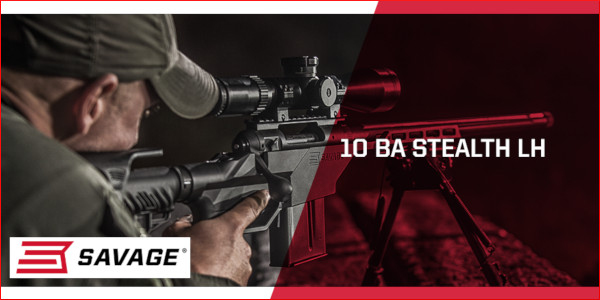
On the 6.5 Creedmoor Facebook page we found an eye-catching Savage Model 10 BA Stealth. Rifle owner Derek P. has done some important upgrades, starting with a wicked, spiral-fluted McGowen barrel with red-painted flutes. The red theme was carried over to the chassis which combines fire-engine red with matte black in the middle. The scope rings and even the magazine were painted red to match as well. The whole effect is very striking, as you can see.
The barrel is a 29-inch 1:8″-twist McGowen. The optic is a 4.5-27x56mm Vortex Razor HD GenII with sunshade. That supper-stable rear sandbag is a Protektor DR Bag, one of our favorites. The front sandbag is also a Protektor. The front Rest is the new Protektor Aluminum Rest with Mariners Wheel. Look carefully and you’ll see a flat 2.5″-wide block on the underside of the forearm. That improves stability and tracking.
What we really like is the upgraded rear buttstock section. This is NOT standard by any means. Rifle owner Derek has fitted an aftermarket XLR Tactical Lite Buttstock that sits properly in that Protektor DR rear bag. This unit combines an adjustable buttpad with a nice cheek-rest (with upgraded pad from Tactical Works). And, very importantly, the XLR can be fitted with a “tactical bag rider” or you can easily make your own bag rider.
As the Savage 10 BA Stealth Comes from the Factory
This video shows a box-stock Savage 10BA Stealth. Note how different the stock buttstock/cheekpiece assembly is compared to Derek’s Red Hot Savage.


 Bigger is normally better — when it comes to light transmission and field of view. Kowa has introduced an all-new, high-end spotting scope, the TSN-99 Prominar, which has a huge 99mm front objective lens. This 99mm spotting scope features a pure Fluorite XD (eXtra-low Dispersion) lens for maximum light transmission, with superior edge-to-edge sharpness, and minimal chromatic aberration.


 Today is the first day of August. That means most parts of the country will soon be encountering peak summer heat. Some ranges in the Western states have already recorded temperatures well over 100 degrees F during matches. When dealing with extreme summer heat, you should make a serious effort to keep your ammo at reasonable temperatures. When possible, keep ammo in a cooler in the shade.




 The NRA F-Class Team Championship was held July 29, 2021. Congrats to the winning squads, Team Indiana (F-Open) and Team USA Blue (F-TR). Conditions were fairly difficult with plenty of rapid wind switches to challenge the wind callers. It was great to see a large number of teams on the firing line, both in F-TR and F-Open.


 Paul Phillips is now best known as an Extreme Long Range (ELR) ace shooting large caliber “boomers”. He was the