Here’s a great Do-It-Yourself project for tactical shooters. Ed and Steve of the 65Guys.com have created a versatile wooden barricade designed for easy transport. The goal with this design was to create a stable barricade that offers a variety of shooting positions, but can also fit in the bed of a pick-up or the back of an SUV. The 69″ tall barricade is hinged in the middle, so it’s just 27″ wide. To deploy the Barricade you simply fold it open and then nest the lower wings in ground-level stands.
We call this the BYOB Project — Build Your Own Barricade. Anyone with basic wood-working skills should find the Barricade prettyeasy to make. The only tricky part is cutting the side Dado joints for the left and right lower wings. But when you’ve got it completed, you have a low-cost unit that is versatile and sturdy yet easy to pack in a truck and carry out on the range. In the video below the 6.5 Guys showcase their Gen 2 barricade and explain how to build one just like it.
Looking at the 6.5 Guys Modular Barricade
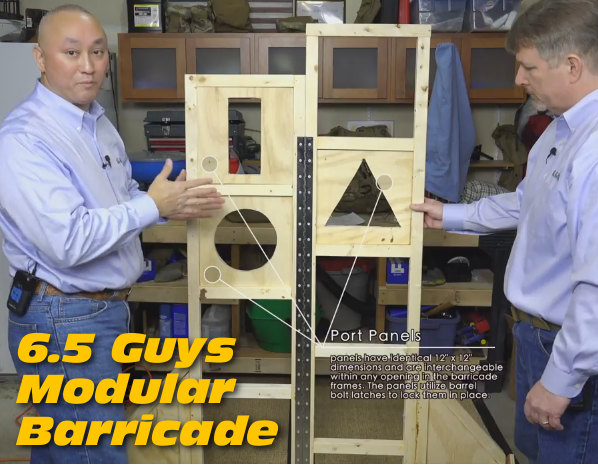
The Modular Barricade was drawn up by Steve in PowerPoint and then dimensions added. Once the entire plan was created, Steve cut components to size and then used ordinary wood screws and wood glue to assemble the barricade frame. This was done to ensure maximum rigidity due to the light weight construction using 2″ x 2″ frame members. A long piano hinge was used to allow the Barricade to fold in half, while still having high torsional rigidity. Each of the Barricade openings are 12″ x 12″ square. This consistent ‘window’ spacing allows interchangeable panels with different cut-out shapes to be placed at varies heights/locations in the Barricade.
Modular Barricade Key Features
— Lightweight construction using low-cost 2×2 wood beams.
— Collapsible frame with center hinges for easy transport and deployment.
— Multiple Support levels at 6″ vertical intervals (6″ variance R to L).
— Modular port design allows ports to be changed and moved as desired.
6.5 Guys’ Modular Barricade — Construction Tips
The Modular Barricade can be constructed over a weekend with the proper materials and basic shop tools such as a power saw and electric screwdriver. Steve used a router for the side panel dado joints but a table saw could also be used for that task. Steve’s only real issue with the build involved the port panels — getting them to fit right. The 2″ x 2″ frame wood wasn’t always straight; even a small variation in the wood could cause a port panel to be too tight or too loose. Steve had to do a lot of extra sanding and planing to get the port panels to fit just right.
Where and How to Use the Barricade for Training
Because the 6.5 Guys’ Modular Barricade is so easy to move, you can simply pack it up and deploy it at your local range for practice. (Do ensure club/range rules allow shooting from barricades.) While the Barricade is designed to sit on the natural ground, the base stands can also be placed on concrete if your range does not allow deployment forward of the normal firing line. While you can use the Barricade for training on your own, Ed and Steve say novice shooters can benefit from a formal clinic.
The popular gun supplies vendor KYGUNCO is running a big 12 Deals of Christmas Sale, with special bargains every day. Today is Day Seven of the promotion, and already there have been some very attractive bargains, with super deals on guns, optics, knives, ammo, game cameras and more. Check the site daily to see the best deals. Here are seven items that caught our attention:
“Shooting Chrony” is a product name. “Shooting Chrony” should not describe (post-mortem) what you have been doing to your chronograph. Sooner or later all of us may make a mistake, and ventilate our chronograph. With luck, the bullet just “wings” your chronograph, and the damage is minor. But if you hit the unit smack dab in the middle, you may have to retire your chrono for good.
A while back, Forum member Jeff M. (aka “JRM850″) experienced a “low blow” that put his Shooting Chrony out of commission. With tongue firmly in cheek, Jeff started a Forum thread entitled Chronograph Not Picking Up Shots in Bright Sunlight Anymore. Looking at the photo at top, the problem is obvious — he ventilated his Chrono.
This was Jeff’s first chrono kill in 23 years of use, so we shouldn’t be too critical. Jeff explained: “I didn’t realize a friend was shifting from a 300-yard target to 100 yards.” The agent of destruction was a low-traveling 58gr V-Max running at 3415 fps. What happened? Well, when one is shooting at 300 yards, the trajectory will be higher than at 100 yards. We should say, however, that this may have been a low shot, or the 100-yard aiming point may have been placed lower to the ground (closer to the bottom of the target frame), as compared to the 300-yard aiming point.
Other Forum members offered some sarcastic responses:
Try it on an overcast day – it might work again.
It looks like the V-Max performed just about as advertised.
Aww…a little duct tape and some Super Glue and you’re good to go.
Double Check Your Aim Point and Trajectory BEFORE You Shoot
The lesson learned here is that you should never change targets (or aim points) without checking your bullet’s flight over the chronograph. We like to align the barrel so the bullet exits a good 6-8 inches above the electronics (check your manual for recommended shot height). In addition, we always boresight the barrel so we can see the actual target through the bore. Then, with gun UNLOADED, bolt removed and action clear, we look back down the barrel so we can see daylight through the bore, with the gun set on solid rests. If you look through the middle of the “V” formed by the sky screen supports and you can’t see light shining through the barrel’s bore, you probably have a set-up problem and you should re-align the rifle.
Use a Test Backer to Confirm Your Bullet Trajectory
You can put tape on the support rods about 6″ up from the unit. This helps you judge the correct vertical height when setting up your rifle on the bags. Another trick is to hang a sheet of paper from the rear skyscreen and then use a laser boresighter to shine a dot on the paper (with the gun planted steady front and rear). This should give you a good idea (within an inch or so) of the bullet’s actual flight path through the “V” over the light sensors. Of course, when using a laser, never look directly at the laser! Instead shine the laser away from you and see where it appears on the paper.
After you have used the laser boresighter to get the rifle centered up in the chrono’s “sweet spot”, confirm with a test shot or two (see photo). Even when using an in-chamber laser boresighter, it is not uncommon for the bullet’s actual point of impact to be different than the laser’s dot location.
MIL-system scopes are popular with tactical shooters. One advantage of MIL scopes is that the mil-dot divisions in the reticle can be used to estimate range to a target. If you know the actual size of a target, you can calculate the distance to the target relatively easily with a mil-based ranging reticle. Watch this helpful NRA video to see how this is done:
Milliradian Definition and Yardage Ranging Formula
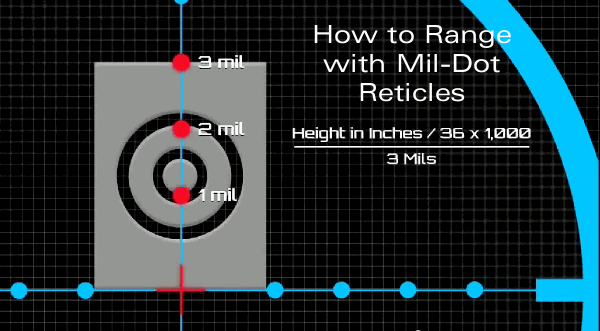
“MIL” or “Milrad” is short-hand for Milliradian, a unit of angular measurement. The subtension of 1 mil equals 3.6 inches at 100 yards or 36 inches at 1,000 yards. (In metric units, 1 mil equals 10 centimeters at 100 meters or 1 meter at 1,000 meters.) Knowing this subtension and knowing the size of the target (or a reference object near the target) allows the distance to the target to be estimated with considerable accuracy. The formula used to calculate range (in yards) based on MIL measurement is:
Height of Target in inches (divided by 36) x 1000, divided by the number of mils.
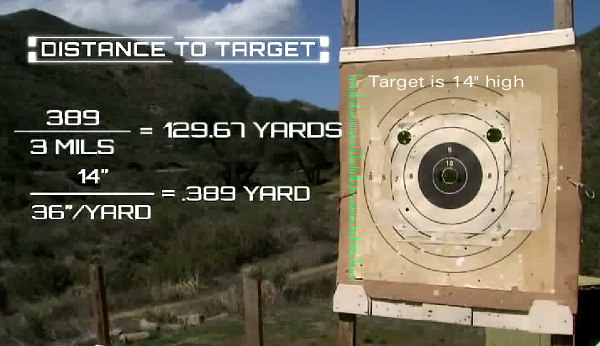
For example, if a 14″ tall target spans 3 mils from top to bottom, the distance is 129.67 yards calculated as follows: 14/36 x 1000 = 389, then divided by 3 = 129.67. You can also use a different conversion to find distance in meters.
Can You Estimate Range with an MOA-Marked Reticle? Yes You Can…
Reader Josh offers this handy advice: “It worth noting that the ability to measure range is not unique to mil-based systems. A MIL is just another unit for measuring angles, and any angular measurement will work. Considering that just about everybody knows that 1 MOA is about an inch per hundred yards, similar formulae can be developed for ranging with MOA marks. The advantage with mils is the precise relationship between units — the MOA-inch measurement is imprecise (being off by 0.047″) — so in principle MILs are a better unit”.
This report comes from the American Suppressor Association (ASA).
The Bureau of Alcohol, Tobacco, Firearms and Explosives (ATF) has announced the imminent launch of a new electronic system for NFA transfers. Known as the eForms system, this overdue modernization will allow consumers to submit both ATF Forms 1 and 4 electronically, hopefully resulting in a significant decrease in transfer times when compared to traditional paper Forms. This should speed up acquisition of firearm suppressors, since these require a Form 4.
According to ATF, the transition to the new system will occur sometime after December 15th, but before Christmas. The new eForms system will handle all existing NFA transfer forms, including the ATF Form 4, which is used for transfers of suppressors.
What is the NFA?
The National Firearms Act of 1934 (NFA) requires the Federal registration of fully-automatic firearms, of short-barreled rifles and shotguns, of rifles over .50 caliber, and of firearms sound suppressors (termed “silencers” under the NFA).
Do NOT Withdraw an Existing Form 4 Submission
If you recently submitted an NFA application, keep it in the queue. The ASA cannot stress this enough. Withdrawing your Form 4 and re-submitting electronically will take longer than allowing your Form 4 to make its way through the approval process. Withdrawing and re-submitting electronically will add months to your overall application process.
That’s because ATF isn’t going to dig through the tens of thousands of forms being processed to find your application. They’re going to wait until your Form 4 reaches an NFA examiner’s desk – the exact point at which it would normally be approved – to process your withdrawal. Instead of approving it though, they will acknowledge your withdrawal and release your serial number. You will not be able to re-submit an eForm 4 with the same serial number until ATF acknowledges your withdrawal and puts it back into your dealers’ inventory.
While traditional paper-based applications will remain a viable option, ASA recommends that suppressor buyers submit new NFA applications electronically. That’s because, if the new eForms system works as promised, it will increase efficiencies by reducing form submission and payment processing times, eliminating weeks of delays in data processing, and all but eradicating data entry errors.
The ASA plans to provide updated information about eForms as soon the ATF officially launches the new program for submitting ATF Forms 1 and 4 electronically. In the meantime, stay tuned by following the American Suppressor Association on Instagram, Facebook, and YouTube.
Once the transition to the new eForms system begins, ATF estimates that the transition will take between two to four days to complete, at which point the new eForms system will go live. ATF has indicated that it will notify the industry 24 to 48 hours prior to the transition, and the ASA will post information as soon as it receives this notifice.
“December 7, 1941, a date which will live in infamy…”
Today, 80 years later, it remains important to remember what took place at Pearl Harbor, and to honor those soldiers, sailors, marines (and civilians) who lost their lives in the surprise attack. The tragic memory of Pearl Harbor reminds us that our nation should never be lulled into complacency. The world remains a dangerous place. The nation must remain alert to all dangers, and be prepared to respond to all threats, both known and unknown. As Wendell Phillips said famously: “Eternal vigilance is the price of liberty.”
The Shooting Wire noted: “Today, as we live in another period of uncertainty … we owe our lives and success as a nation to the more than 16 million Americans who left their homes and traveled over the world to protect freedom.” According to U.S. Department of Veterans Affairs, only about 240,000 of the 16 million Americans who served in World War II are alive in 2021. Today, it’s appropriate to remember them and the sacrifices they made for us.
This Editor’s father and uncle both fought in WWII, father in the Army, uncle in the U.S. Navy. A Lieutenant in the Corps of Engineers, my father took part in three landings — North Africa, Sicily, and the south of France. I still have his invasion armband — a treasured memento. Sadly, we lost my uncle in 2019, when he died at age 100. While in the Pacific, he served at the Tulagi Navy Base, where he knew Lt. (JG) John F. Kennedy. Of Kennedy, my uncle told me: “Jack? He was a good kid… and he loved his country.”
Thoughts on Pearl Harbor, by Dennis Santiago
When I think of December 7th, I remember it is the day my elders began the most difficult four years of their lives. I have seen in their eyes the fear, anger and resolve that come from experiencing what it was like to survive in territory occupied by the Empire of the Rising Sun. My mother had never heard of Pearl Harbor. For her, World War II began on the same day seeing the Japanese bomb a U.S. naval installation called Cubi Point, at the entrance to Manila Bay in the Philippine Islands.
My maternal grandfather never spoke of what horrors he had seen on the Bataan Death March or his years in the prison camps. When I look at my father, I think of my other grandfather’s memories of his son — my father — hanging off the side of a Japanese patrol boat in Subic Bay with an Arisaka pointed at him, forced to give up the catch needed to feed his family….
Time has passed but the poignancy has not faded. Each December 7th, I’m thankful my elders survived because I would not be here to muse about it, had they not. The echoes of their ordeal drive me deeply to make sure that such a thing will never happen again. Whether called the Greater East Asia Co-Prosperity Sphere or some other name made up by the contemporaries of my day, the evil that lurks underneath those who believe their ideas justify the horrors they impose must always be confronted and defeated.
These three videos show how the classic Model 1911 pistol works. This pistol requires the hammer to be cocked in order to fire. Watch the video to see the operation of the trigger, hammer, firing pin, and slide. After the round is fired the slide retracts and the cartridge ejects. Then, a new round rises in the magazine and chambers as the slide moves forward back into battery. With the hammer cocked when the slide came back, the m1911 is ready for the next shot.
Striker-Fired Glock Pistol — Modern Design
For comparison with the Model 1911 shown above, this video shows the Glock 19 (Gen 4) pistol with 3D animation. This modern, polymer-framed, striker-fired pistol has constant trigger pull for all shots. Some folks call this a DAO (double-action-only) trigger but that’s not really correct. Unlike the Model 1911, on a Glock there is no external safety on the frame or slide. The trigger “shoe” (the part that contacts finger) includes a central blade. This prevents the gun from firing unless the trigger is depresses normally. Glock calls this the “safe action”.
At the request of our readers, we provide select “Deals of the Week”. Every Sunday afternoon or Monday morning we offer our Best Bargain selections. Here are some of the best deals on firearms, hardware, reloading components, optics, and shooting accessories. Be aware that sale prices are subject to change, and once clearance inventory is sold, it’s gone for good. You snooze you lose.
1. Graf & Sons — Major Year-End Sightron Optics Sale
⏺ High quality scopes at 25% savings — Forum members praise Sightrons
Sightron scopes offer excellent performance for the price, and are used by successful competitors in many shooting disciplines. With a wide range of scope styles and power ranges you can find a Signtrong to fit your purpose — whether hunting, varminting, or competition. For a limited time, you can pick up a fine Sightron scope at major savings, during the Sightron sale at Graf’s. Through the end of the year, nearly all the Sightron scopes are 25% off, with a few discounted over 30%! Sightron spotting scopes and binoculars are also discounted up to 25%.
⏺ Awesome Deal — Save $100 now on full RCBS Reloading Package
If you are just getting started in hand-loading, the RCBS Rebel Master Reloading Kit offers everything you need to load pistol or rifle ammunition. This Rebel Master Kit includes: Rebel Single Stage Reloading Press, Uniflow-III Powder Measure, 1500 grain digital pocket scale, hand priming tool, Speer #15 manual, powder funnel, fold-up hex key set, accessory handle 2 with case neck brushes, primer pocket brushes, deburring tool, case loading block and case slick spray lube. Don’t hesitate — this week Midsouth has slashed the price of this kit by a full $100.00 — a 20% savings.
3. Midsouth — Lee APP Press & Lee Automatic Case Primer Sale
⏺ Lee APP Press and ACP perform specialized tasks superbly at low cost
The Lee APP and the Lee ACP both offer outstanding functionality for the price. The Lee APP (Automatic Processing Press) can efficiently handles many reloading tasks, including sizing and bullet seating. It’s a good choice for pistol calibers in particular. The Lee Automatic Case Primer (ACP) machine can decap and prime just about any pistol or rifle caliber on the market with ease. Both tool can speed up repetitive tasks dramatically, with a very modest investment. The Lee APP is on sale now at Midsouth for just $79.49 while the Lee ACP is $74.99 on sale.
4. Sportsman’s — Savage Axis XP Scope Combo, $314.99
⏺ Great deal on reliable hunting rifles complete with scopes
Right now at Sportsman’s Warehouse you can get quality hunting rifles complete with a 4-20x40mm scope for just $329.99 — a great deal. These Savage Axis XP rifles come in a wide range of popular chamberings including .223 Rem, .243 Win, 6.5 Creedmoor, .270 Win, .308 Win, and .30-06 SPRG. The Savage Axis XP Scope Combo rifles feature a black synthetic stock and carbon steel, sporter-contour, button-rifled barrel. Each rifle includes a mounted and bore-sighted Bushnell 4-12x40mm scope.
⏺ Smart new Die System simplifies loading multiple cartridge types
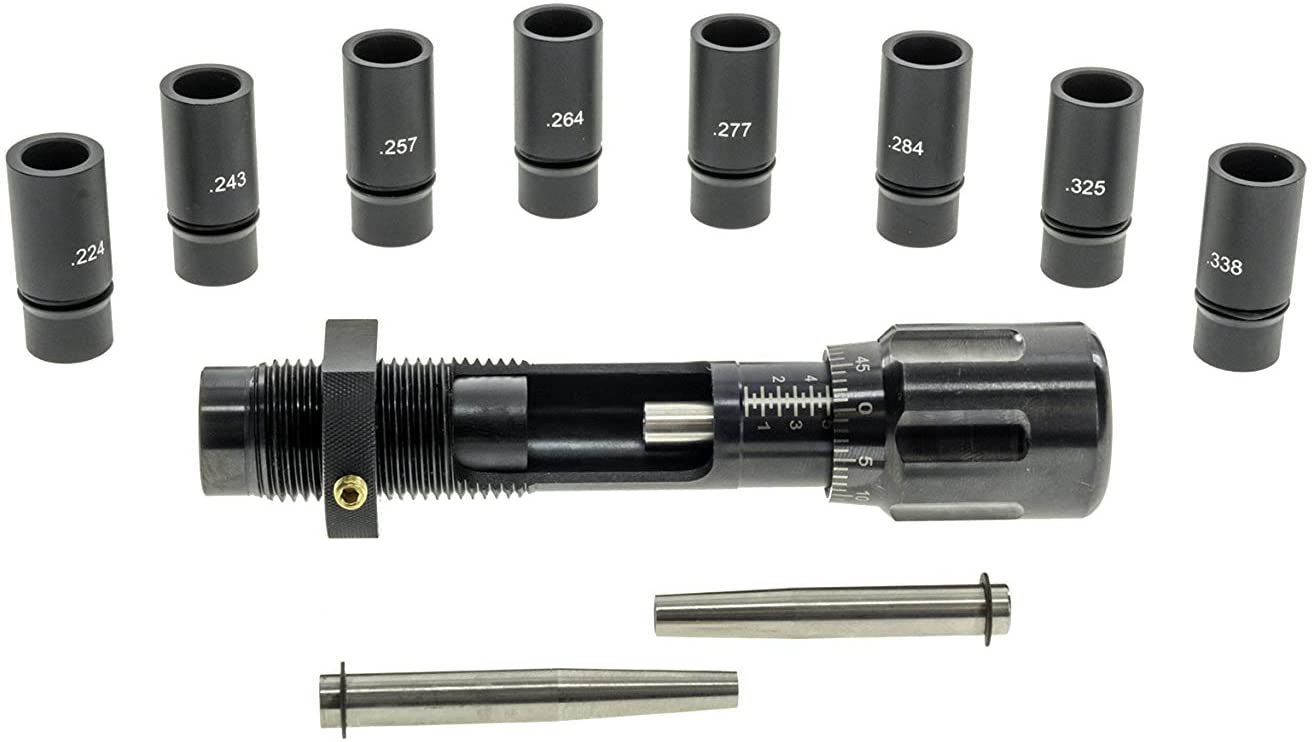
Are you tired of buying another expensive seating die every time you try a new cartridge type? With the unique Frankford Arsenal Universal Bullet Seating Die you can have one die that loads multiple cartridge types. This clever bullet seating system includes 3 different stems and 9 sleeves allowing you to seat .224 to .338-caliber bullets with this one multi-caliber tool. Forum members using this system have praised it. NOTE: the universal seating die comes with the .308-caliber sleeve pre-installed. The other 8 sleeves are provided in the box.
6. Amazon — Frankford Arsenal Folding Reloading Stand, $144.75
⏺ Very handy folding bench can handle multiple tasks
Not everybody has a dedicated reloading room. For those with limited space here is a good option. The Frankford Arsenal Platinum Series Reloading Stand can handle a press and a powder measure at the same time. This highly adaptable bench also features collapsible shelves that create more space and tuck away for easy storage. When folded, this reloading stand can fit in a closet or a RV storage compartment.
⏺ Good quality brass available while premium brands out of stock
Here’s good deal for those who shoot the ultra-popular 6.5 Creedmoor chambering. Quality Nosler 6.5 Creedmoor brass is on sale now at $94.99 for 100 cases. That’s a pretty good deal when you consider that many other good brands of 6.5 Creedmoor brass are out of stock nearly everywhere. This Nosler brass will work well for hunters and PRS/NRL shooters.
8. Amazon — Digi-Sense Temperature Strips 10pk, $22.36
⏺ Extend barrel life by monitoring temps with stick-on strips
Knowing how hot your barrel is getting is critical to maintaining a healthy barrel and getting the most out of your gun. Monitoring barrel heat is important when doing load development, when shooting in competition, and when varminting. We recommend placing adhesive temp-monitor strips on your valuable barrels. These Digi-Sense Reversible 7-Point Horizontal 86-140F temperature stickers have worked well for our staffers. Simply apply the strip on the barrel close to your action and you can quickly see your barrel temp.
9. 5.11 Tactical — Range Master Backpack Set 33L, $94.49
⏺ Quality specialized backpacks and cases for shooters on sale
Here’s a good way to haul your gear to the range. The 33L 5.11 Tactical Range Master Backpack Set holds handguns, spotting scopes, ammo, wind meters, and other gear. This 5.11 Backpack Set comes complete with companion pistol case and two smaller zip-top carriers, providing multiple ways to organize your pistols, ammo, mags, holster, and other gear. The large case will hold the included Single Pistol Case, and included small and medium Range Master pouches. The large case features external MOLLE web strips.
10. Amazon — Allnice Digital Calipers, $19.99
⏺ Effective digital read-out calipers at bargain price
Every handloader needs a set of calipers for multiple reloading/measurement tasks. In fact we recommend you have at least two sets of calipers, one being an inexpensive unit that you can take to the range. These $19.99 Allnice Digital Calipers fill the bill. These calipers feature stainless steel construction and a large digital readout. User reviews have been quite positive, with 88% four- or five-star ratings.
This week, starting on Tuesday evening, a snowstorm is predicted to hit the upper Midwest and Northeast, with snow from West Virginia to Maine. (SEE Weather Report) But if you want to go shooting this week, don’t let a little snowfall stand in your way. Heck, just grab your snow shovel and head to the range. That’s how Forum Member Nick (aka “ChevyTruck 83″) coped with winter’s fury back in 2012 (See Forum Thread). Never underestimate the resourcefulness of a dedicated AccurateShooter Forum member.
Weather.com reports: “Snow showers could sweep through the upper Midwest on Tuesday and then the Ohio Valley and Central Appalachians on Tuesday night. Bands of light snow could spread through parts of the mid-Atlantic and Northeast on Wednesday. This might include parts of the Interstate 95 corridor from northern Virginia into New England.”
We admire the fortitude of Forum Member Nick who, a few seasons back, braved wintry weather to enjoy a day at the range in his native Pennsylvania. A little snow on the ground couldn’t stop this intrepid shooter, who brought snow shovel and arctic gear to his range session. Folks, here’s a true “hardcore” fan of shooting! Despite the “relentless snow”, Nick reports that “at least it wasn’t windy”. Nick shot a variety of long guns, including his .22 LR rimfires, a .223 Rem, and a .308. Not daunted by the cold, Rick said it was fun to “play like a kid once in a while.” That’s the spirit!
Nick reports: “There was no wind to speak of — just relentless snow. I’ll tell you what — it’s awesome to get out and play like a kid once in a while.”
Nick’s foray into the winter wonderland really puts things in perspective for “fair-weather” shooters. After viewing Nick’s Forum thread about his snowy range session, fellow Forum member DennisH observed: “I will never complain about our super hot sugar cane fields in south Louisiana ever again! We can hold matches 12 months a year. I have NEVER had, owned, or used a snow shovel.”
Probably 95% of all civilian rifle shooting is done from the bench — if you include fun shooting, load development, sight-in sessions, practice days, youth training, as well as actual benchrest and club competitions. If you shoot with iron sights, or a low-power optic, you’ll definitely need a spotting scope to see your shots on target. And if you’re shooting long-range, that spotting scope will help you see mirage, as well as hits on far targets.
It’s not always easy to place a spotting scope near your bench. There are short benchtop tripods, but they take up precious bench-top space and can interfere with your non-favored arm placement/functions. Or you can deploy a complete separate tall tripod, next to the bench, but, frankly, that’s inconvenient, and with some bench structures it’s difficult to get the scope close enough to the shooter’s eye.
Here is a smart solution from Creedmoor Sports — a specialized, clamp-on Spotting Scope Support that mounts directly to the side of your bench. This will work with heavy, thick range benchtops as well as thinner-top portable shooting benches.
Creedmoor Spotting Scope Bench Mount
This mounting system clamps to the bench, allowing your spotting scope to be suspended near your face, with nothing below it to get bumped. If your buddy wants to look through the scope, simply spin the horizontal boom piece away from the bench. This system adjusts up and down and left and right. Set the scope head in any configuration you prefer. The $219.95 kit has everything you need, including all clamps AND the blue adjustable scope head. Select either 3/4″ rod diameter or 1″ rod diameter. (Bigger is better for heavier spotting scopes).
Creedmoor Bench Mount Spotting Scope Stand Features:
1″ or 3/4″ aluminum rods for vertical and horizontal support (18″ in length)
Anti-pivot pins to keep the mount from twisting on the edge of the bench
Includes high-grade Blue anodized adjustable scope head
Durable anti-slip rubber on the clamp
Micro-adjustment clamping stopper




 The popular gun supplies vendor KYGUNCO is running a big







 We admire the fortitude of Forum Member Nick who, a few seasons back, braved wintry weather to enjoy a day at the range in his native Pennsylvania. A little snow on the ground couldn’t stop this intrepid shooter, who brought snow shovel and arctic gear to his range session. Folks, here’s a true “hardcore” fan of shooting! Despite the “relentless snow”, Nick reports that “at least it wasn’t windy”. Nick shot a variety of long guns, including his .22 LR rimfires, a .223 Rem, and a .308. Not daunted by the cold, Rick said it was fun to “play like a kid once in a while.” That’s the spirit!