SSG Greg Markowski of the USAMU at Camp Perry, Ohio.
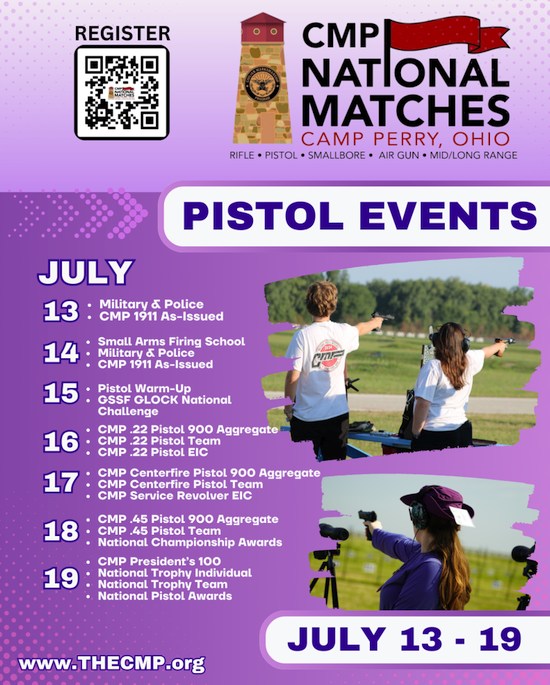
On July 13, 2025, pistol competition commenced at the National Matches at Camp Perry. Many of the best pistol shooters in the country have been on the firing lines, including members of the U.S. Army Marksmanship Unit Service Pistol team. After the last pistol match on Saturday, July 19th, trophies and awards will be presented to the top shooters.
Below is a schedule for the 2025 Pistol Competitions at Camp Perry. For more information about the National Trophy Pistol & Games Matches, visit the CMP’s Pistol Match INFO Page.
This video shows .45 ACP centerfire pistol competitors at Camp Perry
Loading Precision Centerfire Pistol Ammunition
If you want to compete in top competitions like the CMP matches at Camp Perry, you’ll need good ammo. The following USAMU article provides rock-solid reloading advice, explaining how to load accurate, reliable handgun ammo.
The U.S. Army Marksmanship Unit (USAMU) fields pistol teams as well as rifle and shotgun competition squads. Consequently the USAMU’s Reloading Shop loads tens of thousands of pistol rounds every year. In this article, the USAMU’s handgun experts talk about reloading for handguns — with smart tips on how to achieve superior accuracy with 100% reliability. This article, which offers important insights on COAL, primers, crimps and more.
Precision Pistol Reloading — Recommended Methods
Optimize the Taper Crimp
One often-overlooked aspect of handloading highly-accurate pistol ammunition is the amount of crimp and its effect on accuracy. Different amounts of taper crimp are used with various handloads to obtain best accuracy. The amount is based on bullet weight, powder burn rate and charge, plus other factors. It is not unusual for our Shop to vary a load’s crimp in degrees of 0.001″ and re-test for finest accuracy.
Use Consistent Brass
Brass is also important to pistol accuracy. While accurate ammunition can be loaded using brass of mixed parentage, that is not conducive to finest results, particularly at 50 yards. It is important for the serious competitor/handloader to use brass of the same headstamp and ideally one lot number, to maximize uniformity. Given the volumes of ammunition consumed by active pistol competitors, using inexpensive, mixed surplus brass for practice, particularly at the “short line” (25 yards), is understandable. However, for the “long line” (50 yards), purchasing and segregating a lot of high-quality brass to be used strictly for slow-fire is a wise idea.
Importance of Uniform COAL
Uniformity of the Case Overall Length (COAL) as it comes from the factory is also important to achieving utmost accuracy. More uniform case lengths (best measured after sizing) contribute to greater consistency of crimp, neck tension, ignition/burn of powder charge, and so on. Cartridge case-length consistency varies from lot to lot, as well as by maker. Some manufacturers are more consistent in this dimension than others. [Editor’s note: It is easy to trim pistol brass to uniform length. Doing this will make your taper crimps much more consistent.]
Primers and Powders — Comparison Test for Accuracy
Pay attention to primer brands, powder types and charges. Evaluating accuracy with a Ransom or other machine rest at 50 yards can quickly reveal the effect of changes made to handload recipes.
Bullet Selection — FMJ vs. JHP
Bullets are another vital issue. First, there is the question of FMJ vs. JHP. A friend of this writer spent decades making and accuracy-testing rifle and pistol bullets during QC for a major bullet manufacturer. In his experience, making highly-accurate FMJ bullets is much more difficult than making highly-accurate JHPs, in large part due to the way the jackets are formed. Small die changes could affect accuracy of FMJ lots dramatically.
The CMP now allows “safe, jacketed ammunition” in Excellence-in-Competition (EIC) Service Pistol matches, although wadcutter ammunition is prohibited. Thus, the option to use very accurate JHP designs simplifies the life of CMP Service Pistol shooters in pursuit of the prestigious Distinguished Pistol Shot badge.
Hopefully, these tips will be helpful to any pistol shooters interested in accurate handloads, not just “Bullseye” shooters. Small tweaks to one’s normal routine can pay big dividends in improved accuracy and make practice and competition more rewarding. Stay safe, and good shooting!
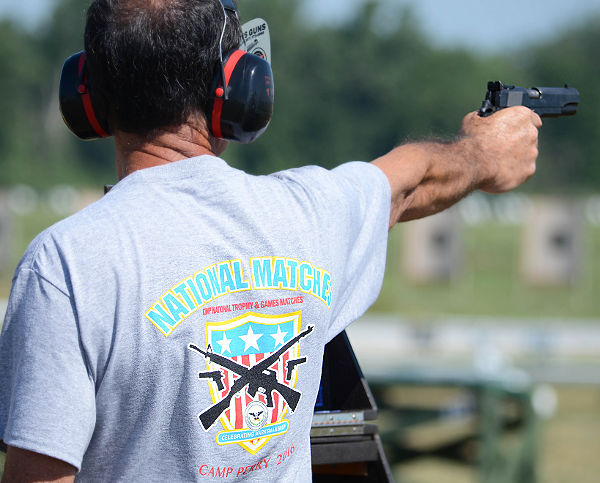
TOP IMAGE: SSG Greg Markowski, a shooter/instructor with the U.S. Army Marksmanship Unit and native of Poland, fires his pistol during the 2018 Civilian Marksmanship Program’s National Pistol Matches at Camp Perry, Ohio July 13, 2018. At that event, Markowski claimed the General Mellon Trophy, General Patton Trophy and the General Custer Trophy. U.S. Army photo by Maj. Michelle Lunato/released by Defense Visual Information Distribution Service.
Erich Mietenkorte Wins 2025 Canadian Rifle Silhouette National High Power Championship.
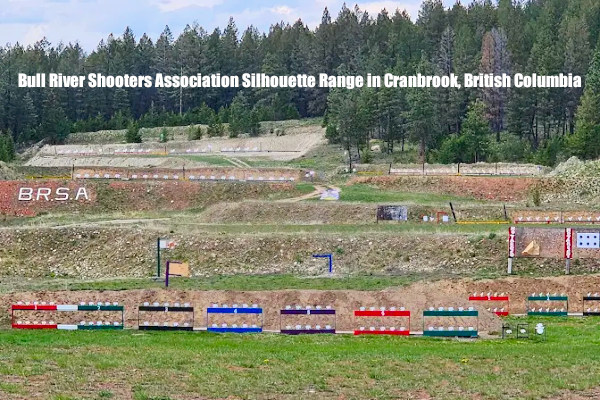
Team Lapua’s Erich Mietenkorte took top honors at the 2025 Canadian High Power Rifle Silhouette National Championships, winning the 240-shot High Power Aggregate with an impressive combined score of 195/240. Held at the Bull River Shooters Association range in Cranbrook, British Columbia, from June 29 to July 5, the national championship featured both Smallbore and High Power rifle disciplines, with competitors engaging steel silhouette targets from the standing offhand position at distances of 200, 300, 385, and 500 meters.
Mietenkorte competed in both High Power categories — Standard Rifle and Hunting Rifle — scoring 99/120 with his 6.5×47 Lapua in the Standard division, and 96/120 with his 6mm BR in the Hunting Rifle division. Mietenkorte’s combined performance earned him first place overall in the High Power aggregate and national titles in both rifle categories.
“Success in this discipline requires absolute confidence in your equipment. When it comes to consistency, reliability, and performance,?Lapua cases and bullets,?Vihtavuori powders, and?Berger bullets?are unmatched,” commented Mietenkorte. “I used Lapua 108gr and 139gr Scenar bullets in my 6.5×47, and Berger 95gr and 115gr bullets in my 6BR, all handloaded with Vihtavuori N140 powder. These components gave me the precision and consistency needed[.]”
What’s next? Mietenkorte will be competing at the U.S. NRA Rifle Silhouette National Championships at the NRA Whittington Center in Raton, NM, July 20-26, 2025.
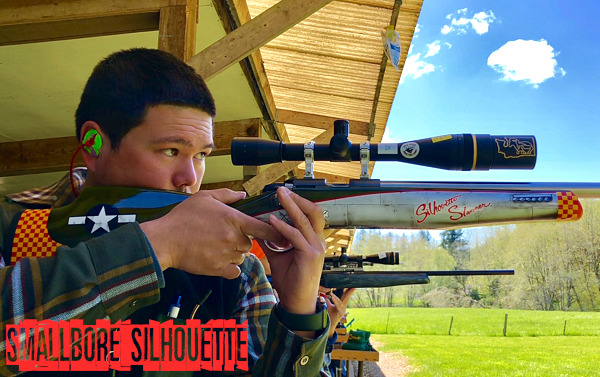
In addition to his success in the Canadian High Power competition, Mietenkorte finished 4th overall in the Smallbore Standard Rifle category. In the video below Eric demonstrates Smallbore Silhouette marksmanship skills.
Silhouette Champion Shares His Skills
In the video below, silhouette champion Eric Mietenkorte explains proper hold: “Consistency is key! Form a solid stance that is repeatable and allows you to have a natural point of aim. If you don’t come down on target adjust your feet, don’t rotate your body with your torso muscles.”
Erich explains his aiming method: “Pick a spot on the target and shoot for that. Try not to hesitate, if you’re on target, take the shot. It’s easy to get locked up by trying to make a great shot better. Make sure to follow through, keep that trigger pulled back. Don’t forget to have fun!”
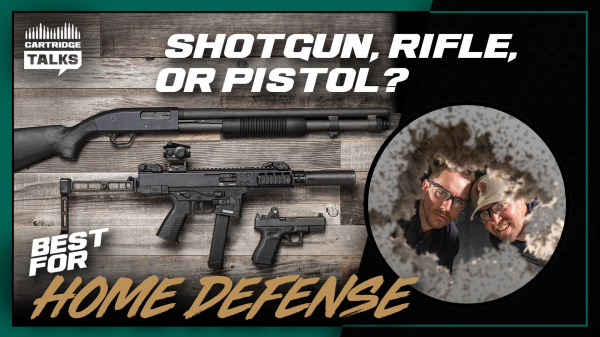
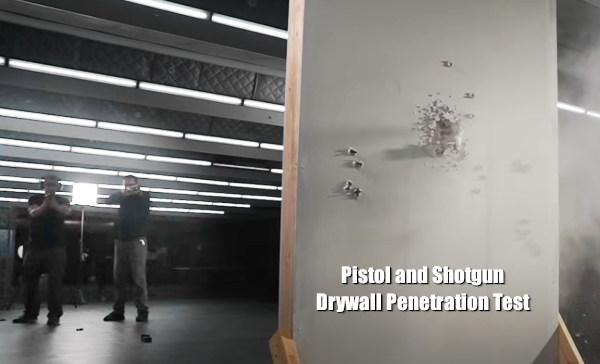
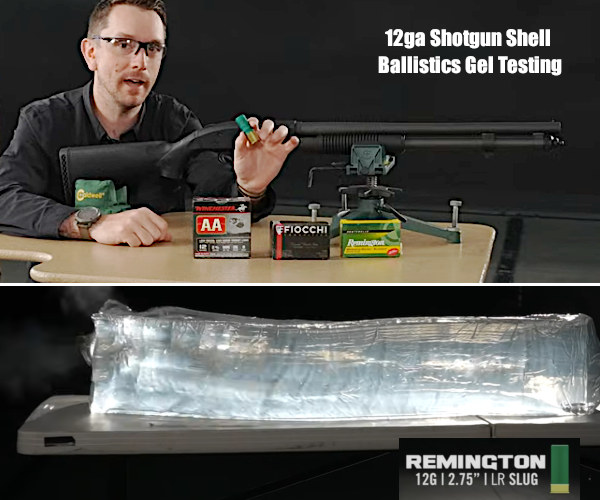
Mark and Ryan, co-hosts of the Vortex Nation Podcast, have released an informative video about gun choice for home defense. Mark and Ryan examine the performance of pistols, rifles, and shotguns in home defense scenarios. The podcast looks at the practical side of ballistics, comparing the pros and cons of these three gun types. The hosts assess the effectiveness (and penetration power) of these weapon types via field tests with cardboard silhouette targets, ballistics gel, and drywall. The eye-opening tests show how pistols, rifles, and shotguns perform in terms of accuracy, penetration power, and likely lethality.
At an indoor range, the Vortex team tests these three gun types (rifle, pistol, and shotgun) used for protection of home and family. They run a simulated home defense scenario, aerate some dry wall for science, and hit the ballistics gel to give you the real-world testing and fun you expect with plenty of surprises along the way. Click HERE for video.
Vortex invites viewers to share their thoughts in the YouTube comments section. You can access other interesting Cartridge Talks episodes by subscribing to the Vortex Nation YouTube Channel. To see more from Vortex visit VortexOptics.com or follow Vortex on Instagram and/or Facebook.
The CMP’s hugely popular Rimfire Sporter event runs Sunday, July 20, 2025 at Camp Perry, Ohio. Prior to the Sunday match, on Saturday, July 19th, the CMP will host the Rimfire Check-In and a CMP Rimfire Clinic.
New Range Location Will Have E-Targets
Unlike past years, the 2025 National Rimfire Sporter match will be held on Camp Perry’s Petrarca Range — equipped with CMP eTargets. This should please the hundreds of Rimfire Sporter competitors. The Petrarca range features more conveniences, such as a covered firing line and adjacent parking. Moreover, the eTargets should improve the experience for competitors. Brian Williams, CMP Highpower Manager, explained: “The matches should run faster, without the need to hang targets and do the scoring.”
E-Targets for Rimfire Sporter Match This Year
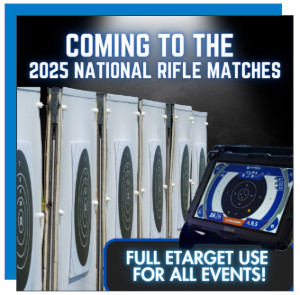
For the first time, this summer the CMP will utilize the electronic targets of Petrarca Range for the National Rimfire Sporter Match. Featuring Kongsberg Target System (KTS) technology, the system includes monitors at each firing point.
The eTargets will permit the Rimfire Sporter Match to run more smoothly and efficiently. Competitors won’t have to walk down-range between relays to change targets, and scores will be tracked and recorded instantly. Monitors placed alongside each competitor will instantly show shot placements during the match, while suspended displays above the firing line will allow spectators to follow along with each shot in real time.
Popular Match for Junior and Adult Competitors
The National Rimfire Sporter Match, one of the most well-attended events of the annual National Matches, is open to both adults and juniors of all experience levels. Using .22 caliber rifles at 25 and 50 yards, participants in the match traditionally chose from three separate classes: Open Sight (O), Telescope Sight (T) and Tactical Unlimited (TU). Due to high demand, the CMP has added an “M-class” for 2025 to give competitors the option to use U.S. military rimfire training rifles during competition. Competitors may enter in Single or Double Entry options and then select the rifle class(es) in which they will fire.
Firing is done at 25 and 50 yards in prone, sitting, and standing positions, in slow and rapid-fire modes. For each Class, awards are offered to High Juniors, High Seniors, and High Women as well as Overall Winners.
If there is a single CMP event at Camp Perry every summer that offers the highest level of shooter satisfaction, the most diverse group of competitors, and the lowest cost of entry, that would have to be the annual Rimfire Sporter Match. Shooters range in age from young juniors to seniors in their 70s and 80s. And persons with disabilities can compete as well, with Adaptive Shooting Programs for physically-challenged competitors.
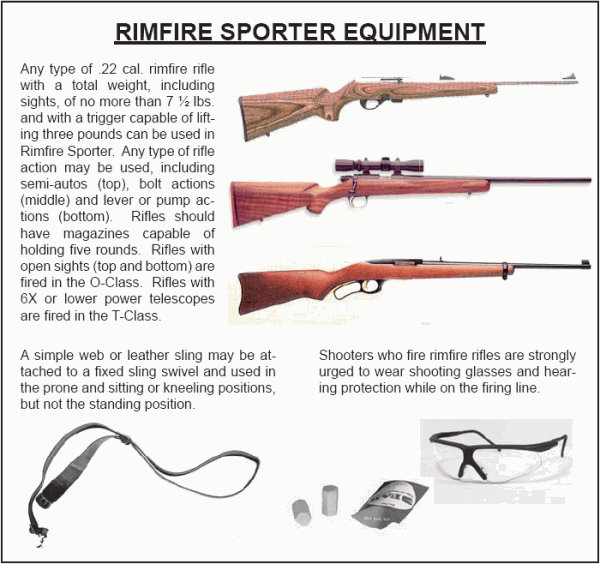
Each year, the Rimfire Sporter Match attracts hundreds of shooters to Camp Perry. National Rimfire Sporter competitors can use affordable sporter rifles with either scopes or iron sights. All you need are a .22 LR rifle, a simple sling, and ammo. Rifles may be manually operated or semi-automatic, in four classes: the standard “O Class” for open-sighted rifles, “T-Class” for telescope-sighted rifles, the “TU Class” for Tactical and unlimited rifles, and the new “M-Class” for Military Rimfire Training Rifles.
Rimfire Sporter Course of Fire
Competitors will complete slow fire prone, rapid fire prone, slow fire sitting or kneeling, rapid fire sitting or kneeling, slow fire standing, and rapid fire standing shot sequences. To learn more about the National Rimfire Sporter Match, CLICK HERE.
Learn more about the National Rimfire Sporter Match at TheCMP.org website.
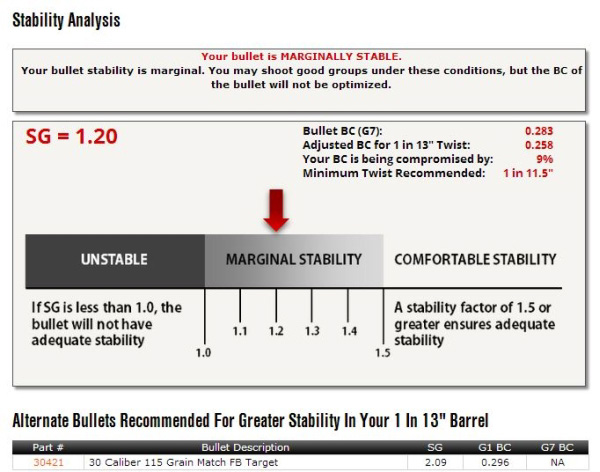
Berger Twist-Rate Stability Calculator On the Berger Bullets website you’ll find a handy Twist-Rate Stability Calculator that predicts your gyroscopic stability factor (SG) based on mulitiple variables: velocity, bullet length, bullet weight, barrel twist rate, ambient temperature, and altitude. This cool tool tells you if your chosen bullet will really stabilize in your barrel.
How to Use Berger’s Twist Rate Calculator
Using the Twist Rate Calculator is simple. Just enter the bullet DIAMETER (e.g. .264), bullet WEIGHT (in grains), and bullet overall LENGTH (in inches). On its website, Berger conveniently provides this info for all its bullet types. For other brands, we suggest you weigh three examples of your chosen bullet, and also measure the length on three samples. Then use the average weight and length of the three. To calculate bullet stability, simply enter your bullet data (along with observed Muzzle Velocity, outside Temperature, and Altitude) and click “Calculate SG”. Try different twist rate numbers (and recalculate) until you get an SG value of 1.4 (or higher).
Gyroscopic Stability (SG) and Twist Rate
Berger’s Twist Rate Calculator provides a predicted stability value called “SG” (for “Gyroscopic Stability”). This indicates the Gyroscopic Stability applied to the bullet by spin. This number is derived from the basic equation: SG = (rigidity of the spinning mass)/(overturning aerodynamic torque).
If you have an SG under 1.0, your bullet is predicted not to stabilize. If you have between 1.0 and 1.1 SG, your bullet may or may not stabilize. If you have an SG greater than 1.1, your bullet should stabilize under optimal conditions, but stabilization might not be adequate when temperature, altitude, or other variables are less-than-optimal. That’s why Berger normally recommends at least 1.5 SG to get out of the “Marginal Stability” zone.
In his book Applied Ballistics For Long-Range Shooting (3rd Ed.), Bryan Litz (Berger Ballistician) recommends at least a 1.4 SG rating when selecting a barrel twist for a particular bullet. This gives you a safety margin for shooting under various conditions, such as higher or lower altitudes or temperatures.
Story idea from EdLongrange. We welcome reader submissions.
Want to see a bullet hit a target in ultra-slow motion? Watch this video to witness some amazing things — such as a bullet jacket peeling back like a banana-skin (at time-mark 7:30). A while back, Germany’s Werner Mehl produced this remarkable 10-minute video for the NSSF SHOT Show. This video has has been watched over 15.6 million times, making it one of the most popular shooting-related videos in history. Employing cameras recording at up to 1,000,000 (one million) frames per second, Mehl’s bullet flight video has been called “astounding” and “mesmerizing”. If you haven’t seen it yet, sit back and enjoy!
Watch This Video! It’s Really Something Special…
This remarkable 1 million Frame Per Second video by Werner has over 15,600,000 YouTube Views with 77,000+ likes. It is one of the best high-speed bullet impact videos ever created.
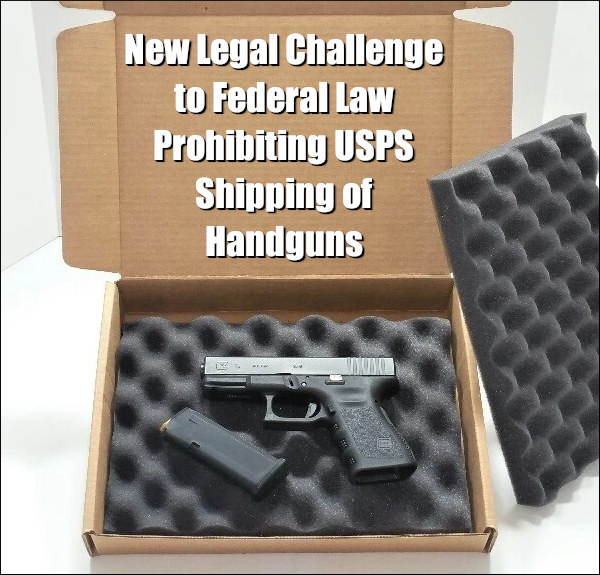
Gun Owners of America (GOA) and Gun Owners Foundation (GOF), together with Pennsylvania resident Bonita Shreve, have filed a lawsuit against the United States Postal Service (USPS), seeking to overturn the Prohibition-era federal ban on the mailing of handguns. The Complaint alleges that this ban is “inconsistent with Founding-era historical tradition” of firearm regulation.
Since 1927, federal law has denied ordinary Americans the right to utilize the mails to ship handguns. Yet all the while, the USPS handles handgun shipments on behalf of businesses and government officials every single day. This ban is as arbitrary and discriminatory as it is violative of the Second Amendment — and its criminal penalties are steep.
Erich Pratt, Senior Vice President of Gun Owners of America, stated: “This complaint demonstrates that the federal government’s Prohibition-era ban on mailing handguns violates the Second Amendment. GOA is proud to stand with its members and supporters to ensure that their constitutional rights are protected, and we are committed to ending all anti-gun ‘rules for me, but not for thee’, in any form they may take.”
Sam Paredes, speaking for the Gun Owners Foundation, added: “This law was passed in a different time. Our complaint makes clear that every day this ban remains in effect, it infringes on the rights of law-abiding Americans who are fully entitled to exercise all of their Second Amendment freedoms. In America, using the Postal Service to mail handguns to other law-abiding individuals should not be a felony.”
Smart Option for Shipping Handguns Currently
Until Federal policy changes, persons without FFLs cannot use USPS to ship handguns — doing that can get you arrested! But there IS an efficient, cost-effective way to ship handguns — ship via UPS (United Parcel Service) using ShipMyGun.com labels.
If you want to ship handguns, as a private party (non-FFL), there are now very limited options. You cannot use the U.S. Postal Service, and, since September 2021, you cannot use FEDEX. Yes, that’s right, FEDEX no longer allows non-FFLs to ship handguns.
So UPS is currently the only choice for handguns (for non-FFLs). But this can be very expensive because of rules requiring overnight shipping. There IS an alternative that can save you significant money. By ordering your shipping labels from ShipMyGun.com, you could save $50 or more on UPS handgun shipping. It is quick and easy.
ShipMyGun.com has a large FFL database, so you can verify the recipient’s address and FFL status. The ShipMyGun.com website has a simple to use label-printing process. All handgun shipments are fulfilled via next day air. Long guns are shipped quickly via ground and typically arrive within 3-5 business days. (NOTE: For rifles and shotguns it is still possible to use U.S. Postal Service following USPS rules.)
Do you know someone who recently purchased his/her first handgun and is getting started in the shooting sports? Or do you need to brush up your own pistol skills? Then check out a new FREE video training series from the SIG Sauer Academy: Shooter’s Edge — Learning to Shoot.
Here is the Second Video from the Shooter’ Edge series, covering Basic Rules of Firearms Safety:
This video series features foundational handgun classes at the SIG Sauer Academy in New Hampshire. The ten-episode series takes viewers into the classroom and onto the range as the instructors walk through the fundamentals of handgun safety, shooting techniques, practice and training exercises, along with instruction in equipment options and handgun selection. The series was shot on location during several of the Academy’s introductory classes.
Click Below to Access Full Video Series on SigSauer.com:
The Shooter’ Edge Series includes the following episodes: Learn to Shoot at SIG Sauer Academy; Basic Rules of Safety; Types of Handguns and Ammunition; Foundational Shooting Techniques; How to Practice and Train Effectively; Choosing the Right Gun; Equipment and Its Purpose; Holsters — Presentation and Recovery; Magazines — Loading and Unloading; and What Happens After Learning to Shoot.
Adam Scepaniak, of The Guns and Gear Store, has written an interesting story about Prairie Dog Hunting in North Dakota. If a P-Dog safari is on your “bucket list”, you’ll want to read the full story in the Sierra Bullets Blog. Adam provides many tips that can help you plan a successful prairie dog adventure.
Prairie Dog Hunting in North Dakota with Sierra Bullets
It’s that time of year where lots of men and women point their vehicles westward and try to push the limits of their rifles on prairie dogs. [A few seasons back] I was a part of this group of people… while in northwestern North Dakota. CLICK HERE to Read Full Story.
Little Missouri National Grassland
Once my hunting party arrived at the Little Missouri National Grassland in North Dakota we immediately began scouting for prime prairie dog towns. There is a certain amount of strategy involved in choosing a prairie dog town … for several reasons. For one, you should try to always stay “above” the prairie dogs.
Small objects like rocks, cactuses, and prairie vegetation can easily obstruct your view if you’re shooting prone on a level plane. We encountered this in the first small prairie dog town we stopped and shot at. The prairie dog town was very visible while walking and standing, but once we laid down with our rifles on bipods the two-foot prairie grass became a severe obstruction. We shortly moved on because the small town became quick-studies to our shooting.
The second prairie dog town we hunted was at the base of a small ridge with a dried, cattle creek at the bottom. This area offered better shooting opportunities because we were above most of the prairie dog holes, and if we were not above them, a deep ravine separated us from the prairie dogs removing any obstructions from our rifle scopes which was our previous problem. This area had its own disadvantage though because of some other wildlife present. There were approximately fifty head of cattle in our close vicinity grazing, which was to no surprise because many ranchers utilize the National Grassland for grazing. We had to wait for the cattle to leave our area as to not have an incidental hit due to a rare ricochet. As the sun passed over the horizon we decided to return to this spot the next morning, but would change our shooting position to increase our advantage.
This Location Offered a Nice Overlook.
Zoomed Image Shows Individual Prairie Dog Mounds.
My previous varminting best was a 275-yard shot near Mobridge, South Dakota on a separate prairie dog hunting trip. With more experience and better reloading, Here in North Dakota I was able to make a solid hit on a prairie dog just over 400 yards which made me ecstatic! For a central Minnesota, shotgun-raised guy, I was pretty happy that my bullet selection and hand-loading ability produced a 125-yard improvement.
Once we cleaned and cased our rifles for the journey home we had shot a little over 200 rounds of my Sierra® reloads. This was a lot less than previous prairie dog trips I have been a part of, but our hit percentage was substantially higher as well. Traveling into a new area meant a lot more scouting and experimentation for us as a group. In future trips or hunts of your own, it can be very beneficial to schedule an extra day just for scouting[.]
Little Missouri National Grassland is a National Grassland located in western North Dakota. At 1,033,271 acres, it is the largest grassland in the country. Within its borders is Theodore Roosevelt National Park. The Little Missouri National Grasslands was once a part of the Custer National Forest, but is now a part of the Dakota Prairie Grasslands, a National Forest unit consisting entirely of National Grasslands. A predominant feature of the grassland is colorful and beautiful badlands, a rugged terrain extensively eroded by wind and water. It is a mixed grass prairie, meaning it has both long and short grass.
The boundaries of the grasslands on certain maps can be misleading. Within the boundaries of the national grassland are significant portions of state-owned and privately-owned land, much of it leased by cattle ranchers for grazing.
The grassland is administered by the Forest Service as part of the Dakota Prairie Grasslands from offices in Bismarck, ND. There are ranger district offices in Dickinson and Watford City.
Starline Brass offers a series of videos with helpful reloading tips. Focused primarily on pistol cartridges, these short videos can help anyone get started with metallic cartridge reloading. If you load pistol rounds on a progressive, this video series is particularly helpful. The on-camera host is Hunter Pilant, son of Carroll Pilant of Sierra Bullets.
Preventing Double Charges
Tip: Use a bulky powder that fills your case more than half way with a correct charge. This will overfill the case if it is double-charged, making it very difficult to seat a bullet.
Tumble New Brass Before Loading the First Time
Tip: Tumble new pistol cartridge brass in used media for 30 minutes before loading for the first time. This will add enough graphite (carbon residue) to smooth case entry into dies. You can also lube the case mouths with graphite, or use spray lube.
Powder Through Expander — How to Eliminate Hang-ups
Tip: When loading pistol brass with a progressive press, sometime the powder-through expander is hard to remove, especially with short cases. There are two fixes — first, try deburring the inside of the case mouth on your cases. Second, the radius of the powder through expander plug can be modified to smooth entry and exit (see photo). Starline will do this modification for free.




 Use Consistent Brass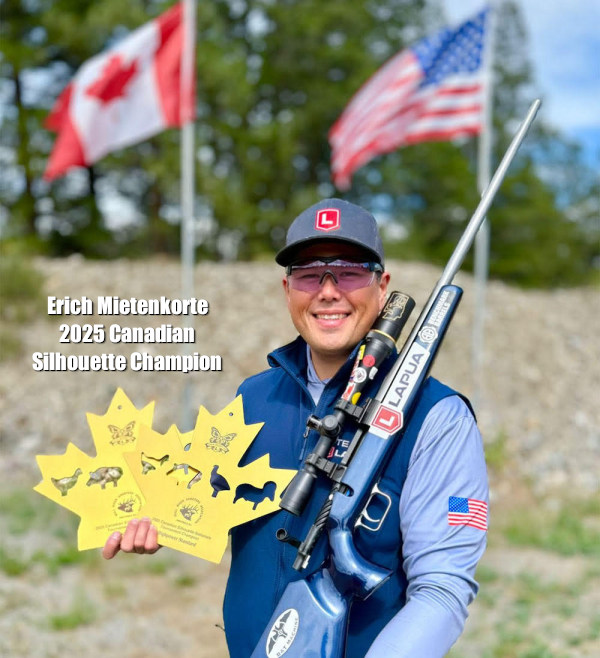


 E-Targets for Rimfire Sporter Match This Year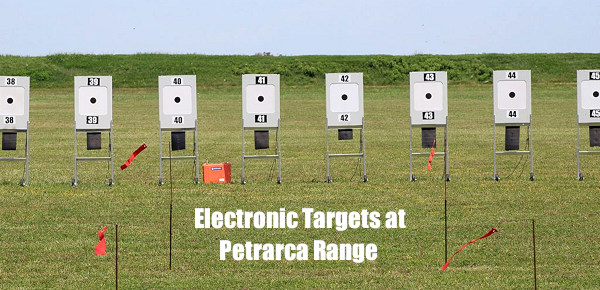






 ShipMyGun.com has a large FFL database, so you can verify the recipient’s address and FFL status. The ShipMyGun.com website has a simple to use label-printing process. All handgun shipments are fulfilled via next day air. Long guns are shipped quickly via ground and typically arrive within 3-5 business days. (NOTE: For rifles and shotguns it is still possible to use U.S. Postal Service following USPS rules.)


 Little Missouri National Grassland