You’ve probably heard of cut-rifling, but did you know this process was invented in Germany nearly 500 years ago? Read on to learn more about how a cut-rifled barrel is made…
The cut-rifling process, used by leading barrel-makers such as Bartlein, Blake, Brux, Krieger, and Obermeyer, can yield a very high-quality barrel with a long useful life. Cut-rifled barrels have been at the top in short- and long-range benchrest competition in recent years, and cut-rifled barrels have long been popular with F-Class and High Power shooters.
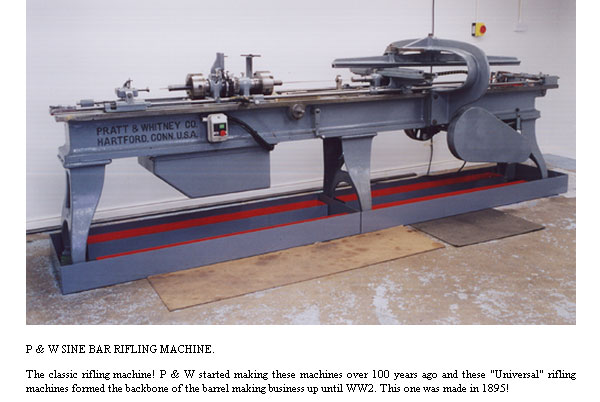
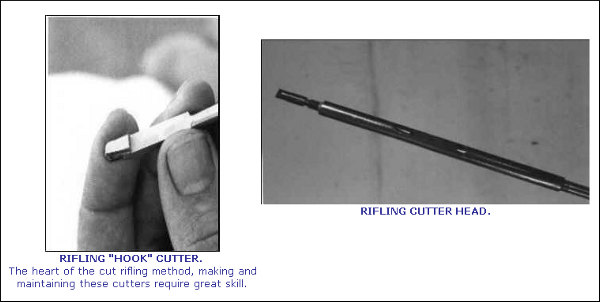
You may be surprised to learn that cut-rifling is probably the oldest method of rifling a barrel. Invented in Nuremberg around 1520, the cut-rifling technique creates spiral grooves in the barrel by removing steel using some form of cutter. In its traditional form, cut rifling may be described as a single-point cutting system using a “hook” cutter. The cutter rests in the cutter box, a hardened steel cylinder made so it will just fit the reamed barrel blank and which also contains the cutter raising mechanism.
Above is a computer animation of an older style, sine-bar cut-rifling machine. Some machine features have been simplified for the purposes of illustration, but the basic operation is correctly shown. No, the cut-rifling machines at Krieger don’t use a hand-crank, but the mechanical process shown in this video is very similar to the way cut-rifling is done with more modern machines.
Read About Cut-Rifling Process at FirearmsID.com
To learn more about the barrel-making process, and cut-rifling in particular, visit FirearmsID.com. There you’ll find a “must-read” article by Dr. Geoffrey Kolbe: The Making of a Rifled Barrel. This article describes in detail how barrels are crafted, using both cut-rifling and button-rifling methods. Kolbe (past owner of Border Barrels) covers all the important processes: steel selection, hole drilling, hole reaming, and rifling (by various means). You’ll find a very extensive discussion of how rifling machines work. Here’s a short sample:
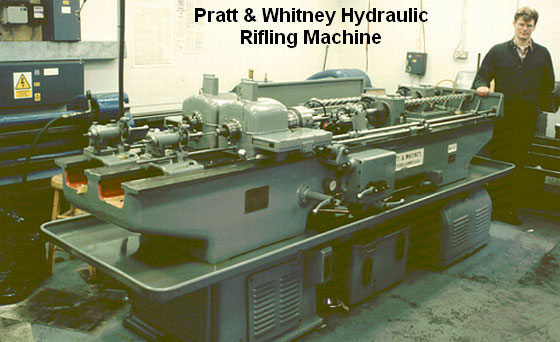
“At the start of World War Two, Pratt & Whitney developed a new, ‘B’ series of hydraulically-powered rifling machines, which were in fact two machines on the same bed. They weighed in at three tons and required the concrete floors now generally seen in workshops by this time. About two thousand were built to satisfy the new demand for rifle barrels, but many were broken up after the war or sold to emerging third world countries building up their own arms industry.
Very few of these hydraulic machines subsequently became available on the surplus market and now it is these machines which are sought after and used by barrel makers like John Krieger and ‘Boots’ Obermeyer. In fact, there are probably less of the ‘B’ series hydraulic riflers around today than of the older ‘Sine Bar’ universal riflers.
The techniques of cut rifling have not stood still since the end of the war though. Largely due to the efforts of Boots Obermeyer the design, manufacture and maintenance of the hook cutter and the cutter box have been refined and developed so that barrels of superb accuracy have come from his shop. Cut rifled barrel makers like John Krieger (Krieger Barrels), Mark Chanlyn (Rocky Mountain Rifle Works) and Cliff Labounty (Labounty Precision Reboring)… learned much of their art from Boots Obermeyer, as did I.” — Geoffrey Kolbe
Video find by Boyd Allen. Archive photos from Border Barrels. In June 2013, Birmingham Gunmakers Ltd. acquired Border Barrels. Dr. Geoffrey Kolbe has set up a new company called BBT Ltd. which produces chamber reamers and other gunsmithing tools and gauges. (Thanks to L. Holland for the Kolbe update).
With winter here, many gun enthusiasts are switching to indoor ranges. There are important safety and behavior rules you need to follow when shooting indoors. Sometimes bad range etiquette is simply annoying. Other times poor gun-handling practices can be downright dangerous. The NRA Blog has published a useful article about range safety and “range etiquette”. While these tips were formulated with indoor ranges in mind, most of the points apply equally well to outdoor ranges. You may want to print out this article to provide to novice shooters at your local range or club.
8 Tips for Gun Range Etiquette
Story by Kyle Jillson for NRABlog
Here are eight tips on range etiquette to keep yourself and others safe while enjoying your day [at the range]. Special thanks to NRA Headquarters Range General Manager Michael Johns who assisted with this article.
1. Follow the Three Fundamental Rules for Safe Gun Handling
ALWAYS keep the gun pointed in a safe direction.
ALWAYS keep your finger off the trigger until ready to shoot.
ALWAYS keep the gun unloaded until ready to use.
This Video Covers Basic Gun Range Safety Rules and Etiquette
2. Bring Safety Gear (Eye and Ear Protection)
Eye and Ear protection are MANDATORY for proper safety and health, no matter if “required” by range rules or not. It is the shooter’s responsibility to ensure proper protection is secured and used prior to entering/using any range. Hearing loss can be instantaneous and permanent in some cases. Eyesight can be ruined in an instant with a catastrophic firearm failure.
3. Carry a Gun Bag or Case
Common courtesy and general good behavior dictates that you bring all firearms to a range unloaded and cased and/or covered. No range staff appreciates a stranger walking into a range with a “naked” firearm whose loaded/unloaded condition is not known. You can buy a long gun sock or pistol case for less than $10.
4. Know Your Range’s Rules
Review and understand any and all “range specific” rules/requirements/expectations set forth by your range. What’s the range’s maximum rate of fire? Are you allowed to collect your brass? Are you required to take a test before you can shoot? Don’t be afraid to ask the staff questions or tell them it’s your first time. They’re there to help.
5. Follow ALL Range Officer instructions
ROs are the first and final authority on any range and their decisions are generally final. Arguing/debating with a Range Officer is both in poor taste and may just get you thrown out depending on circumstances.
6. Don’t Bother Others or Touch Their Guns
Respect other shooters’ privacy unless a safety issue arises. Do NOT engage other shooters to correct a perceived safety violation unless absolutely necessary – inform the RO instead. Shooters have the right and responsibility to call for a cease fire should a SERIOUS safety event occur. Handling/touching another shooter’s firearm without their permission is a major breech of protocol. Offering unsolicited “training” or other instructional suggestions to other shooters is also impolite.
7. Know What To Do During a Cease Fire
IMMEDIATELY set down your firearm, pointed downrange, and STEP AWAY from the shooting booth (or bench). The Range Officer(s) on duty will give instructions from that point and/or secure all firearms prior to going downrange if needed. ROs do not want shooters trying to “secure/unload” their firearms in a cease fire situation, possibly in a stressful event; they want the shooters separated from their guns instantly so that they can then control the situation as they see fit.
8. Clean Up After Yourself
Remember to take down your old targets, police your shooting booth, throw away your trash, and return any equipment/chairs, etc. Other people use the range too; no one wants to walk up to a dirty lane.
This NSSF Video Covers Basic Gun Range Safety Rules:
BAD RANGE BEHAVIOR — Five Things NOT to Do at the Range
Here are the five worst behaviors we’ve seen at indoor ranges. These behaviors are both dangerous and inconsiderate. Any one of these behaviors can get you permanently banned from an indoor range.
1. Sweeping other individuals after loading a weapon behind the firing line is very bad. All your weapons should be empty until you reach your shooting station.
2. Turning the handgun sideways while trying to clear a malfunction or insert/remove a magazine. This will point the muzzle at a fellow shooter. Or, after shooting a gun, the shooter fails to clear the weapon and then places the gun somewhere near the shooting station with the muzzle in an unsafe position.
3. Reacting unpredictably when firing a high recoil handgun. We’ve seen people take a second shot by accident with the muzzle way off target.
4. Not obeying range commands — in particular continuing to shoot during called cease-fires.
5. Poorly aimed shooting that hits target frames or carriers, causing ricochets.
Double-Up on Hearing Protection When Shooting Indoors
When shooting pistols indoors we recommend quality muffs with earplugs underneath, offering double protection. When inside an enclosed range, with other shooters blasting away right next to you, you really need effective hearing protection. But you also need to hear range commands and be able to communicate with your fellow shooters. That’s why we recommend electronic muffs with plugs underneath.
For pistol shooting indoors, we like the latest Howard Leight Impact Pro Muffs. These offer an impressive 30 dB Noise Reduction Rating (NRR). In addition, these muffs are pretty comfortable and offer Headphone Functionality so you can connect to your smartphone, MP3 player, or other audio device. These muffs are a good value. They are currently offered for $62.55 on Amazon.com.
Let’s face it, AR-15s run dirty. With the direct gas impingement system, combustion by-products blow back into the upper receiver through the bolt carrier. And there many small parts to worry about — gas rings for example. We have seen AR failures also from bits of brass combined with lube and carbon getting in the ejector spring recess. So, to keep your ARs running well, you need to do a lot of maintenance, employing the right tools. You also need some specialized tools to assemble an AR-15 properly — that’s important for guys building their own lowers and uppers.
That is where the new Wheeler Engineering Delta Series Ultra Armorers Kit comes in — this kit provides pretty much all the tools you need to keep an AR15 running well. As you’d expect you get an AR combo took, Torque wrench, Strap Wrench and Delta Ring Tool. In addition, there are special clamps/mounts that make it easier to assemble uppers and lowers, such as an Armorers Vise, Vise Block Clamp, and Armorer’s Bench Block. And then there are key maintenance items such as AR Bore Guide, and Bolt Carrier Brush. Supplied in a large, well-constructed carry case, the Ultra Armorer’s Kit $218.69 at MidwayUSA, contains ALL the following:
AR Armorer’s Vise
AR-15 Combo Tool
Torque Wrench
AR-15 Armorer’s Bench Block
AR-15 Roll Pin Install Tool Kit
Upper Vise Block Clamp with Gas Tube Alignment Tool
Pivot Pin & Roll Pin Installation Tool
AR Front Sight Tool
Delta Ring Tool
Strap Wrench
AR-15 Bore Guide
AR-15 Adjustable Receiver Link
Bore Brush, .22 Cal.
Bolt Carrier Brush
Chamber Brush
Magazine/Upper Receiver Brush
Nylon Brush Handle
Double-ended General Cleaning Brush
Cleaning Pick Set
PLUS: Maintenance Mat with AR-15 Exploded View Parts Diagram and Custom Carrying Case
AR-15 Armorer’s Essentials Kit
If you don’t need all the tools and components from the Ultra Kit, Wheeler Engineering also offers a smaller “essentials” Kit at less than half the price. The Wheeler Delta Series AR-15 Armorer’s Essentials Kit allows assembly of most basic AR components.
This is more a builder’s kit than a maintenance package. This Armorer’s Essential Kit, $89.09 at MidwayUSA, includes the following tools and specialty products, all contained in a nice, fitted carry case:
Upper vise block clamp with gas tube alignment tool
Pivot pin and roll pin installation tool
AR-15 adjustable receiver link
AR-15 Armorer’s Wrench
Mag well vise block
Torque wrench
Build Your Own AR-15 Videos
Here are three videos that provide helpful guidance on constructing a modern AR-15 lower and upper. The first video explains all the components you’ll need. The second and third videos show the step-by-step process of building an AR Upper and Lower.
There will be no SHOT Show this year. So, to learn about new gun industry products, we must rely on the print media, internet, and a few gun-centric cable TV shows (such as Shooting USA). Thankfully, Shooting Industry magazine remains alive and well. And SI just released its first of three new-for-2021 product features. Part One of the three-part 2021 New Product Showcase is found in Shooting Industry’s just-released December issue. This features new-for-2021 products from 50+ companies. CLICK HERE to see all new featured products.
Here are six standout products from the 2021 New Product Showcase:
Springfield Armory Waypoint Rifles
Springfield’s new Waypoint rifles feature steel or carbon-wrapped barrels, TriggerTech triggers, and carbon-fiber, hand-painted camo stocks with five QD mounts for versatile carry plus M-Lok slots. The actions are impressive too — with precision machining, enlarged ejection port, and integral recoil lug. These Waypoint rifles rival full-custom hunting rigs, yet are reasonably affordable. Starting price is $1699.00 with stainless barrel, while the deluxe model with carbon-wrapped barrel and adjustable cheekpiece is still under $2,400.00. All Model 2020 Waypoint rifles feature strong, light-weight, carbon-fiber-reinforced stocks with hand-painted camouflage finishes. You could easily pay $700-$800 just for an equivalent camo-painted stock from McMillan or Manners Composite Stocks.
New Lapua Brass: .284 Win, 6.5 PRC, .300 PRC, and .300 WinMag
Lapua will offer four new types of ultra-premium cartridge brass in 2021. The four new Lapua cases are: 6.5 PRC, .284 Winchester, .300 Winchester Magnum, and .300 PRC. The .284 Win cartridge still dominates the F-Open game, so this is good news for F-Class shooters. Lapua is excited about the PRC offerings: “The new Lapua 6.5 and .300 PRC cartridge cases provide competitive shooters, hunters, and accuracy enthusiasts a premium selection for precision hand loads, an option that’s been missing from the market since the PRC’s inception.” The venerable .300 Winchester Magnum remains a top choice for hunting.
Daniel Defense Delta 5 Pro Chassis Rifle
PRS/NRL shooters should check out the new DELTA 5 PRO from Daniel Defense. This features a stainless action with 3-lug bolt and hammer-forged barrels. The aluminum chassis stock is fully adjustable and features a thumbrest that works for both left- and right-hand shooters. This Delta 5 Pro comes standard with an Area 419 HELLFIRE muzzlebrake. The rifle is available in .308 (20″ Heavy Palma barrel), 6.5 Creedmoor (24″ Heavy Palma barrel or 26″ varmint barrel) and 6mm Creedmoor (26″ varmint barrel).
J.P. Sauer & Sohn — UltraLight Synchro XTC Hunting Rifle
For 2021, J.P. Sauer enhances the S404 series with the Synchro XTC, a carbon fiber, bolt-action rifle in camouflage green. Weighing 6.1 pounds, this lightweight S404-series rifle features a hand-laid, carbon-fiber, thumbhole stock with adjustable comb. The hammer-forged barrel is fluted for balance and weight reduction. The adjustable trigger offers four pull weights from 1.2 to 2.7 pounds. Adjusting the pull weight is easy using settings marked above the trigger. Like all J.P. Sauer S404-series rifles, the new Synchro XTC allows easy changing of bolt heads and barrels for quick caliber conversions. If you want something even lighter, the S101 Highland XTC carbon-fiber rifle weighs just 5.5 pounds for short action version. This features a hand-laid, carbon-fiber stock with fluted barrel. The manufacturer guarantees sub-MOA accuracy at 100 yards.
Lee Precision Primer Pocket Swager (Large and Small)
Lee’s new Ram Swage primer pocket swager will remove primer pocket crimps on both large- and small-primer brass. This new tool features spring-assisted case extraction. The all-steel case guide ensures cases will be positively centered on the push rod. The Lee Swager works on all single-stage presses with 7/8″-14 threads in the press frame that can accept universal shell holders. The unique design, which does not use a conventional shellholder, allows users to swage any small or large primer pocket without swapping to a different size shellholder.
Rite in the Rain All-Weather MRAD Target
Not that winter is here, there will be some cold, wet days at the range. No worries with Rite in the Rain Target Products with rain-proof cardstock. New for 2021 is an All-Weather 100M Sniper Target. Perfect for PRS shooters with Mil-Rad scopes, this target boasts a 1 cm grid with each box representing 1/10 milliradian at 100 meters. The bullseye and scoring rings represent an MR-1 target presented at 500 meters. Below the target grid are fields for recording load information and Range conditions. The target also has 1, 2, and 3 MOA rings so you quickly judge accuracy at long range.
More Women Become Gun Owners — Important Trend
More women than ever are becoming gun-owners. So far in 2020, women represented over 40% of first-time gun buyers, a notable statistic. To analyze this trends, leaders from The Well Armed Woman, A Girl & A Gun, and Shoot Like A Girl sat down with Shooting Industry Magazine to share their insights. They discussed how 2020’s events compelled new groups of women to not only purchase their first firearm, but to join the broader firearms community. READ Story HERE
Do you have a concealed carry permit, or do you plan to carry a concealed handgun in the future? Then you can benefit from Beretta’s FREE 15-page e-book, Ten Essential Tips for CCW Holders. This eBook, in handy PDF format, helps gun owners select an appropriate handgun (and holster), understand legal obligations and responsibilities, and train effectively with the firearm. This short eBook offers many useful tips to consider, in particular for gun owners who are contemplating the pros and cons of everyday carry for themselves.
As the Beretta CCW booklet says, “Carrying a concealed handgun requires a certain amount of confidence. You need to be confident in your knowledge of laws and regulations. You have to have confidence in your accuracy, and you need to trust that you can carry a gun effectively, securely and comfortably. If a gun is a burden for you to carry, you probably won’t.”
Surprising Facts About Actual Defensive Handgun Use
You may be surprised to learn when and how handguns are actually used for self-defense. Most defensive uses are at very short range and the incident only lasts a matter of seconds. You need to be prepared, and train to be proficient drawing and aiming your weapon. And remember, shooting is a last resort, when a safe retreat is not available.
55% of gunfights take place in 0-5 feet.
20% of gunfights take place in 5-10 feet.
20% of gunfights take place in 10-21 feet.
95% of gunfights take place in 0-21 feet. (Source: FBI)
The average man can cover 21 feet of ground in 1.5 seconds.
The average gunfight is over in 3-5 seconds.
3 to 4 shots are usually fired.
Most gunfights take place in low-light conditions.
On average, one shot in four strikes someone.
Here are two (2) sample pages from Beretta’s CCW eBook.
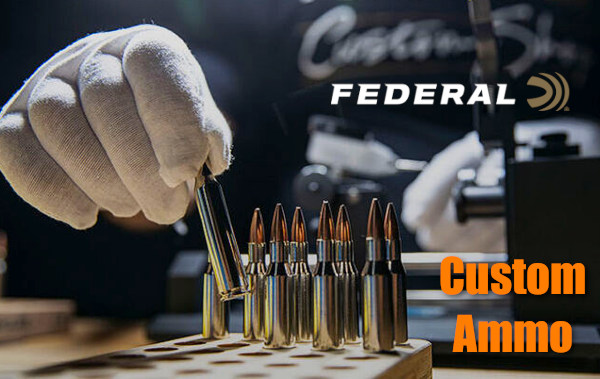
Don’t have time to hand-load your own ammo, or don’t have all the equipment and dies needed? There’s a new option — something that’s actually quite revolutionary in the ammo industry. Federal is now offering custom-loaded ammunition. You choose the cartridge type and bullet type and Federal technicians put the ammo together. Think about it — this could be an interesting option for hunters who only need a few rounds a year, or if you want to try out a bullet/cartridge combo for the first time.
“Each round is painstakingly handloaded to order by our team of expert engineers in our state-of-the-art reloading workshop. Veteran craftsmen combine the best components with extra quality checks at every stage for the most consistent velocity, accuracy, and overall performance. Loads are then hand-checked for final inspection and cleaned before being custom-packed in durable, personalized packaging.”
26 Centerfire Rifle Cartridge Types + Many Bullet Options
Currently, you can choose from 26 rifle cartridge types and a wide selection of quality bullets from Barnes, Berger, Sierra, Nosler, Federal, Hornady, Swift, and more. NOTE: Federal Custom Shop ammo will be sold direct-to-consumer only. Along with rifle ammo, Federal will offer custom TSS Shotshells.
Bullet Types Offered: BARNES TIPPED TSX, BERGER HYBRID HUNTER, HORNADY ELD-X, NOSLER ACCUBOND (and Accubond LR), NOSLER PARTITION, SIERRA MATCHKING, SWIFT A-FRAME, WOODLEIGH HYDRO SOLID; and Federal TERMINAL ASCENT, TROPHY BOND BEAR CLAW, TROPHY BONDED SLEDGEHAMMER, TROPHY COPPER.
Please note: Federal Custom Shop ammunition is built to order — not pulled out of inventory in a warehouse. As such, please allow more time for processing and delivery. Typically, your Custom Shop order will take two weeks to build, plus standard delivery time. The Custom Shop handloading center is located at Federal’s main factory in Anoka, Minnesota. For more information, including how to order, what specific load options are available, and shipping details, visit: FederalPremium.com/custom-shop.html.
“If it’s not in Federal’s vast catalog as factory-loaded ammo, we may have it listed on our website as a load we will custom hand-load for you,” notes Federal Ammunition President Jason Vanderbrink. “For example, Barnes 120-grain Tipped TSX in 6.5-284 Norma and 28-gauge TSS turkey loads aren’t products we list in our catalog, but you can certainly order them through our Custom Shop.”
Many shooters are familiar with ballistics tables, weather programs, and even wind meters for smart devices, but few may know about a very handy Leveling Tool that comes factory-installed on Apple iPhones. The leveling function is a little-known option in Apple’s Compass App. It works well for a multitude of tasks.
There are a numerous reasons that a leveling tool should be in every rifleman’s range bag. From leveling optics during mounting to figuring out how much extra compensation is going to be required for a tricky angled shot, knowing just how far off things are from plumb can go a long way towards realizing success in the field.
This writer has used the leveling app on his iPhone to level a rifle on a rest while at the range. It definitely worked for “field expedient” leveling duties. That’s especially important for long-range applications. Just one degree of cant (tilt) can move your point of impact 7 inches at 1000 yards.
Of course, the iPhone level doesn’t use an actual bubble to find angles. Rather, it relies on the device’s sophisticated accelerometer to do so, and with a great degree of accuracy. Navigating to the level is done by first selecting the Compass App (Utilities folder), at which point the device will need to be calibrated by rotating it a full 360 degrees. Once the compass is fully calibrated, simply make swipe LEFT gesture to bring up the level — it will start operating immediately. Swipe right to return to compass. NOTE: On some newer iPhones the Level feature is part of the Measure App, so to access it you go to Utilities > Measure, and it’s listed at the bottom.
From there, use is intuitive and easy, like most iPhone Apps. Switching from horizontal plane to vertical is done by simply changing the physical axis of the phone. How do you know when you’ve got things just right — well the entire lower half of the screen turns green when everything is perfectly level. You’ll also see a zero° read-out, like this:
Bottom Line: If you already own an iPhone, you should definitely give this App a try. The price is right (free), and for a wide variety of tasks the iPhone Level App is actually pretty handy.
For Android Phone Users — FREE Leveling Apps
Don’t have an iPhone? No worries — there are a multitude of Bubble Level Apps available for Android OS phones. We found over 40 leveling Apps. Most are free, others cost a few dollars. Most of these Apps work in multiple orientations. Choose the App that offers the display views you find most convenient or pleasing to the eye. You may want to try two or three before you settle on a favorite.
Thomas Haugland, a Shooters’ Forum member from Norway, is a long-range target shooter and hunter. He has created an interesting video showing how to gauge wind velocities by watching trees, grass, and other natural vegetation. The video commentary is in English, but the units of wind speed (and distance) are metric. Haugland explains: “This is not a full tutorial, but rather a short heads-up to make you draw the lines between the dots yourself”. Here are some conversions that will help when watching the video:
.5 m/s = 1.1 mph | 1 m/s = 2.2 mph | 2 m/s = 4.5 mph
3 m/s = 6.7 mph | 4 m/s = 8.9 mph | 5 m/s =11.2 mph
How to Gauge Wind Speed and Hold Off Using Reticles
This field video shows how to observe natural indicators — trees and vegetation — to estimate wind velocity. Then it shows how to calculate hold-offs using the reticle hash-marks. Thomas shoots a fast-cycling Blaser R93 rifle with Norma 6XC ammunition.
Bryan Blake, a very clever machinist and gunsmith, has created an ultra-precise and speedy neck-turning machine. Bryan, who runs Blake Machine, Blake Barrel, and F-Class Products has created a system that uses twin precision cutter tips to turn case necks inside and out quickly and efficiently, with superior precision. This advanced IDOD Neck Turning Machine holds cases securely in a precision-machined spindle attached to an electric motor. Twin blades move precisely during the cutting process, milling the necks inside and out. The turned necks come out perfect every time, with the shoulders trimmed exactly (with doughnut removed) as well. If you turn hundreds of cases during a shooting season, you may want to consider getting an IDOD from F-Class Products. Bryan was able to turn 30 cases in just 6 minutes. And there is an even more advanced version, called the AUTODOD, shown in the last video below.
Our friend Erik Cortina recently visited Bryan Blake in Phoenix. Erik saw the IDOD in action and was impressed. Erik notes: “For a very long time, we have been turning brass the exact same way. Use a mandrel as a pilot and have a cutter with a specified gap go around the perimeter and turn the necks to specified thickness. The IDOD uses a technique called ‘pinch turning’ to turn the ID and the OD (IDOD) at the same time.” You can watch how it works in Erik’s video below (action starts at 7:55 time-mark):
The secret to the efficiency of the Blake IDOD is a vibration-free motor, high-mass case-holder, precision OD/ID-adjustable cutter, along with an advanced tracking system that moves the cutter heads towards the case neck (and back again) with absolute, 100% repeatable precision. Watch the video from 8:30 to 10:10 to see Bryan explain how to adjust the system for a perfect result.
This shows how to set up the IDOD Neck-turning machine for a particular cartridge type:
This video shows a close-up of a neck being with perfect neck-wall consistency:
This latest video from Blake Machine shows the new AUTODOD machine with power controls. This speeds up and simplifies neck-turning process.
SAF, NRA File Appeal Brief in Federal Challenge of WA Gun Control Measure
Attorneys representing the Second Amendment Foundation, National Rifle Association, two Washington state gun retailers and three private citizens have filed an appeal brief with the U.S. Ninth Circuit Court of Appeals in their challenge of gun control Initiative 1639 (I-1639), a measure adopted two years ago in the Evergreen State. This appeal in the case of Mitchell vs. Atkins seeks to overturn I-1639’s ban on semi-auto rifle ownership for Washington citizens 18-20 years of age.
The lawsuit challenges the measure on the grounds that it violates the commerce clause by banning sales of rifles to non-residents, and that it unconstitutionally impairs the rights guaranteed by the First, Second and Fourteenth Amendments, and Article I Section 24 of the Washington State constitution by preventing the sale to otherwise qualified adults under age 21 of certain rifles.
The 45-page brief asserts that I-1639: “infringes the rights protected by the Second Amendment and enjoyed by law-abiding adults of all ages. The interstate sales ban violates the Interstate Commerce Clause”. A district court judge in Tacoma dismissed the case in August, and plaintiffs promptly filed notice of appeal with the Ninth U.S. Circuit Court in San Francisco.
The initiative prohibits young adults ages 18-20 from purchasing and owning so-called “semiautomatic assault rifles” — defined as literally ANY self-loading rifle, regardless of caliber. Tens of millions of semi-automatic rifles are in use today by law-abiding citizens of all ages for hunting, competition, predator and varmint control, recreational shooting and personal/home protection.
“We’re asking the Ninth Circuit to reverse a ruling by the lower federal district court, and remand this case back for further action”, said SAF founder/Executive V.P. Alan M. Gottlieb. “The constitutional rights of law-abiding citizens should never be subject to a popular vote, and we are hopeful the Appeals court agrees.”
Plaintiffs are represented by Seattle attorney Joel B. Ard and Spokane attorney David K. DeWolf. The case is known as Mitchell v. Atkins.
The Second Amendment Foundation (www.saf.org) is the nation’s oldest and largest tax-exempt education, research, publishing and legal action group focusing on the Constitutional right and heritage to privately own and possess firearms. Founded in 1974, The Foundation has grown to more than 650,000 members and supporters and conducts many programs designed to better inform the public about the consequences of gun control.






 Many shooters are familiar with ballistics tables, weather programs, and even